

For Whom Does Mindfulness-Based Stress Reduction Work? Moderating Effects of Personality
Open accessThe DOI matches its Crossref record; 45 of the 47 references it cites were found in a registry or an index.
Abstract
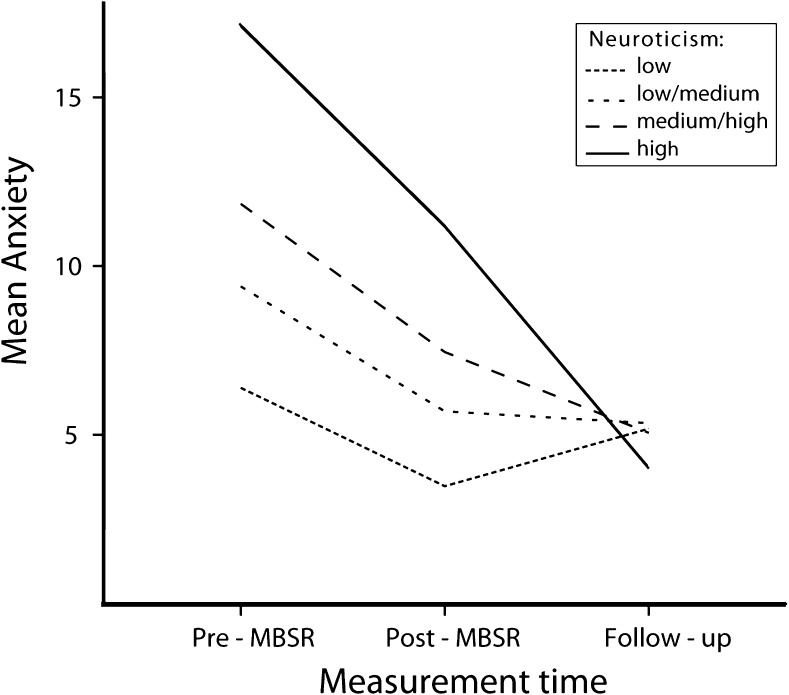
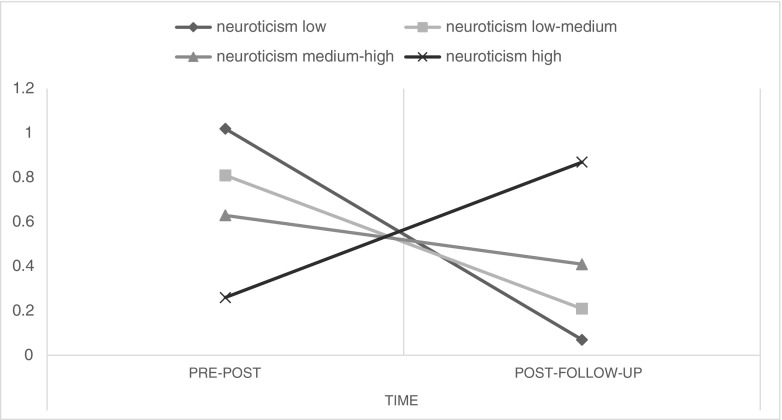
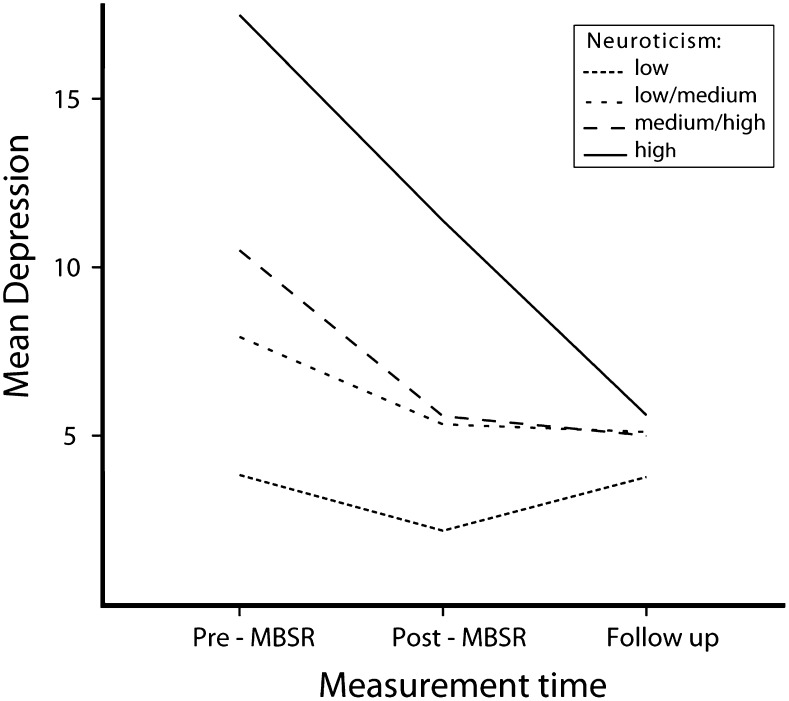
The aim of the present study was to examine potentially moderating effects of personality characteristics regarding changes in anxious and depressed mood associated with Mindfulness-Based Stress Reduction (MBSR), controlling for socio-demographic factors. Meditation-naïve participants from the general population self-presenting with psychological stress complaints ( n = 167 participants, 70% women, mean age 45.8 ± 9.3 years) were assessed in a longitudinal investigation of change in mood before and after the intervention and at a 3-month follow-up. Participants initially scoring high on neuroticism showed stronger decreases in both anxious and depressed mood (both p < 0.001). However, when controlled for baseline mood, only the time by neuroticism interaction effect on anxiety remained significant ( p = 0.001), reflecting a smaller decrease in anxiety between pre- and post-intervention but a larger decrease in anxiety between post-intervention and follow-up in those with higher baseline neuroticism scores. Most personality factors did not show moderating effects, when controlled for baseline mood. Only neuroticism showed to be associated with delayed benefit. Results are discussed in the context of findings from similar research using more traditional cognitive-behavioral interventions.
Overview
The claims and statistics of this paper haven’t been checked yet.
Free: it reads the open-access text and checks the first 5 claims that cite a source we can check. Create a free account to check every claim.
Integrity signals
Registry
Cites
Statistics
Figures
Verification
Claims the paper makes
The claims and statistics of this paper haven’t been checked yet.
Free: it reads the open-access text and checks the first 5 claims that cite a source we can check. Create a free account to check every claim.
Claims other papers make about this one
Each is checked against this paper’s own text: does it say what the citing paper says it does?
The source backs part of the claim, not all of it — or backs it for a different population, condition or comparison.
In the citing paper
“In contrast, two studies found that individuals with greater pre-treatment neuroticism experienced a greater reduction in distress (de Vibe et al., 2015) and anxiety (Nyklíček & Irrmischer, 2017) after an MBSR course, independent of pre-treatment mood in one case (Nyklíček & Irrmischer, 2017).”
From Who Benefits Most from a Brief Mindfulness Intervention to Reduce Anxiety During Stereotactic Breast Biopsy: the Moderating Effect of Trait Mindfulness, Spiritual Well-being, and Distress Tolerance (2021) · cites this paper as Nyklíček & Irrmischer, 2017
Experimental — accuracy not yet measured
Self-check
Percentages, sums and reported differences re-computed from the paper’s own numbers.
The self-check needs the paper’s full text.
Citations
Cites
The benefits of being present: Mindfulness and its role in psychological well-being
Brown, K. W., & Ryan, R. M. (2003) · Journal of Personality and Social Psychology · doi:10.1037/0022-3514.84.4.822 · Cited by 13,448
Using Self-Report Assessment Methods to Explore Facets of Mindfulness
Baer, R. A., Smith, G. T., Hopkins, J., Krietemeyer, J., & Toney, L. (2006) · Assessment · doi:10.1177/1073191105283504 · Cited by 7,511 · cited 9×
“This attitude, consisting of a set of learnable skills, is often defined as being attentive to phenomena occurring in the present moment in a nonjudgmental or accepting way (Baer et al. 2006; Brown and Ryan 2003; Kabat-Zinn 1990).”
BackgroundInfluential(2008) · Medical Entomology and Zoology · Cited by 7,477
Shapiro, S. L., Carlson, L. E., Astin, J. A., & Freedman, B. (2006) · Journal of Clinical Psychology · doi:10.1002/jclp.20237 · Cited by 4,002 · cited 1×
“In general, CBT shows weaker benefit regarding anxious and depressed mood for those high in neuroticism, perhaps making changemore difficult for those having amore stable propensity to negative affect (Quilty et al. 2008; Spek et al. 2008; Taylor andMclean 1993;Wolitzky-Taylor et al. 2012).”
BackgroundThe effect of mindfulness based therapy on anxiety and depression: A meta analytic review
Hofmann, S. G., Sawyer, A. T., Witt, A. A., & Oh, D. (2010) · Journal of Consulting and Clinical Psychology · doi:10.1037/a0018555 · Cited by 3,846 · cited 3×
“First, consistent with previous studies as summarized in recent reviews and meta-analyses (Fjorback et al. 2011; Hofmann et al. 2010; Khoury et al. 2013), overall decreasing anxious and depressed mood have been found in the present study.”
BackgroundResultClinical Psychology: Science and Practice
(2021) · Clinical Psychology Science and Practice · doi:10.1111/(issn)1468-2850 · Cited by 3,672
Psychological flexibility as a fundamental aspect of health
Kashdan, T. B., & Rottenberg, J. (2010) · Clinical Psychology Review · doi:10.1016/j.cpr.2010.03.001 · Cited by 3,054 · cited 7×
“Perhaps the central mindfulnessaspectof (self)acceptance incombinationwithasafe andacceptinggroupformatof theinterventionlargelyfocusingon introspective and interoceptive processes may be well fitting the more introverted participants, which may have balanced out the expected potential benefit of extraversion associat…”
BackgroundInfluentialEffects of mindfulness on psychological health: A review of empirical studies
Keng, S.-L., Smoski, M. J., & Robins, C. J. (2011) · Clinical Psychology Review · doi:10.1016/j.cpr.2011.04.006 · Cited by 2,687 · cited 1×
“Recent systematic reviews (Chiesa and Serretti 2010; Fjorback et al. 2011; Keng et al. 2011) and meta-analyses (Hofmann et al. 2010; Khoury et al. 2013) on the effectiveness of MBSR regarding psychological outcomes have concluded that MBSR and its variant Mindfulness-Based Cognitive Therapy (MBCT)…”
BackgroundMcCrae, R. R., & Costa, P. T. (2010) · Medical Entomology and Zoology · Cited by 2,345
Assessment of Mindfulness by Self-Report: The Kentucky Inventory of Mindfulness Skills
Baer, R. A., Smith, G. T., & Allen, K. B. (2004) · Assessment · doi:10.1177/1073191104268029 · Cited by 2,298
Mindfulness-based therapy: a comprehensive meta-analysis
Khoury, B., Lecomte, T., Fortin, G., Masse, M., Therien, P., Bouchard, V., Chapleau, M.-A., Paquin, K., & Hofmann, S. G. (2013) · Clinical Psychology Review · doi:10.1016/j.cpr.2013.05.005 · Cited by 2,003
Effectiveness of a meditation-based stress reduction program in the treatment of anxiety disorders
(1992) · American Journal of Psychiatry · doi:10.1176/ajp.149.7.936 · Cited by 1,941
Trapnell, P. D., & Campbell, J. D. (1999) · Journal of Personality and Social Psychology · doi:10.1037/0022-3514.76.2.284 · Cited by 1,646 · cited 1×
“…well-being but also with mindfulness skills (Baer et al. 2004; Baer et al. 2006; Brown and Ryan 2003) and (other) putative mechanisms, such as emotion regulation skills (Kokkonen and Pulkkinen 2001), rumination (Trapnell and Campbell 1999), and cognitive flexibility (Kashdan and Rottenberg 2010).”
BackgroundMindful emotion regulation: an integrative review
Chambers, R., Gullone, E., & Allen, N. B. (2009) · Clinical Psychology Review · doi:10.1016/j.cpr.2009.06.005 · Cited by 1,360
Mindfulness-Based Cognitive Therapy for Depression
Segal, Z. (2023) · PsycTHERAPY Dataset · doi:10.1037/v00751-001 · Cited by 1,029
Bohlmeijer, E., ten Klooster, P. M., Fledderus, M., Veehof, M., & Baer, R. (2011) · Assessment · doi:10.1177/1073191111408231 · Cited by 990 · cited 1×
“Opennesshasbeenassociatedwithseveralmindfulnessskills, especially observing and describing (Bohlmeijer et al. 2011; Hollis-Walker and Colosimo 2011), although associations are often not very strong and not always found (Latzman and Masuda 2013).”
BackgroundFjorback, L. O., Arendt, M., Ørnbøl, E., Fink, P., & Walach, H. (2011) · Acta Psychiatrica Scandinavica · doi:10.1111/j.1600-0447.2011.01704.x · Cited by 803 · cited 2×
“First, consistent with previous studies as summarized in recent reviews and meta-analyses (Fjorback et al. 2011; Hofmann et al. 2010; Khoury et al. 2013), overall decreasing anxious and depressed mood have been found in the present study.”
BackgroundResultHayes, A. M., & Feldman, G. (2004) · Clinical Psychology: Science and Practice · doi:10.1093/clipsy.bph080 · Cited by 759 · cited 3×
“In addition, neuroticism is known tobepositivelyassociatedwitha tendency to ruminate (Costa and McCrae1992) andwith avoidantbehavior (Lommenet al. 2010), both being mechanisms exacerbating negative mood and both being counteracted by mindfulness (Hayes and Feldman 2004).”
BackgroundA systematic review of neurobiological and clinical features of mindfulness meditations
Chiesa, A., & Serretti, A. (2010) · Psychological Medicine · doi:10.1017/s0033291709991747 · Cited by 749
Understanding the Impact of Convergent Validity on Research Results
Carlson, K. D., & Herdman, A. O. (2012) · Organizational Research Methods · doi:10.1177/1094428110392383 · Cited by 642
Mindfulness, Big Five personality, and affect: A meta-analysis
Giluk, T. L. (2009) · Personality and Individual Differences · doi:10.1016/j.paid.2009.06.026 · Cited by 593 · cited 3×
“Extraversion has been showing rather weak and inconsistent associations with mindfulness (Giluk 2009; Hanley 2016), although it is sometimes reported to be associated with several mindfulness facets (Hollis-Walker and Colosimo 2011).”
BackgroundInfluentialHollis-Walker, L., & Colosimo, K. (2011) · Personality and Individual Differences · doi:10.1016/j.paid.2010.09.033 · Cited by 498 · cited 3×
“Extraversion has been showing rather weak and inconsistent associations with mindfulness (Giluk 2009; Hanley 2016), although it is sometimes reported to be associated with several mindfulness facets (Hollis-Walker and Colosimo 2011).”
Backgroundvan der Velden, A. M., Kuyken, W., Wattar, U., Crane, C., Pallesen, K. J., Dahlgaard, J., Fjorback, L. O., & Piet, J. (2015) · Clinical Psychology Review · doi:10.1016/j.cpr.2015.02.001 · Cited by 455
Shapiro, S. L., Brown, K. W., Thoresen, C., & Plante, T. G. (2011) · Journal of Clinical Psychology · doi:10.1002/jclp.20761 · Cited by 440 · cited 1×
“In a small randomized trial comparing MBSR with a waitlist control group, it was shown that pre-treatment mindfulness was positively associated with increases in psychological well-being (Shapiro et al. 2011).”
BackgroundMyths about longitudinal research.
Rogosa, D. (1988) · Cited by 436
Self-focused attention and mechanisms of change in mindfulness-based treatment
Baer, R. A. (2009) · Cognitive Behaviour Therapy · doi:10.1080/16506070902980703 · Cited by 187 · cited 1×
“…(Baer et al. 2006), decentering/cognitive defusion leading to cognitive and behavioral flexibility (Hayes and Feldman 2004; Shapiro et al. 2006), enhancement of emotion regulation skills (Chambers et al. 2009; Nyklíček 2011), and decrease of rumination and worry (Baer 2009; Segal et al. 2002).”
BackgroundWolitzky-Taylor, K. B., Arch, J. J., Rosenfield, D., & Craske, M. G. (2012) · Journal of Consulting and Clinical Psychology · doi:10.1037/a0029418 · Cited by 185
Dimensional personality traits and treatment outcome in patients with major depressive disorder
Quilty, L. C., De Fruyt, F., Rolland, J.-P., Kennedy, S. H., Rouillon, P. F., & Bagby, R. M. (2008) · Journal of Affective Disorders · doi:10.1016/j.jad.2007.10.022 · Cited by 177
van Son, J., Nyklíček, I., Pop, V. J., Blonk, M. C., Erdtsieck, R. J., Spooren, P. F., Toorians, A. W., & Pouwer, F. (2013) · Diabetes Care · doi:10.2337/dc12-1477 · Cited by 169 · cited 1×
“…difference between the studies is that in contrast to research not finding an effect of extraversion, the MBCT study in diabetes did not use the words mindfulness or meditation during recruitment of participants, instead referring to learning attention regulation skills (van Son et al. 2013).”
ResultSelf-citationNeuroticism and avoidance of ambiguous stimuli: Better safe than sorry?
Lommen, M. J. J., Engelhard, I. M., & van den Hout, M. A. (2010) · Personality and Individual Differences · doi:10.1016/j.paid.2010.08.012 · Cited by 168
Does Personality Moderate the Effects of Mindfulness Training for Medical and Psychology Students?
de Vibe, M., Solhaug, I., Tyssen, R., Friborg, O., Rosenvinge, J. H., Sørlie, T., Halland, E., & Bjørndal, A. (2015) · Mindfulness · doi:10.1007/s12671-013-0258-y · Cited by 144 · cited 3×
“These findings are in line with the previous study conducted in students (de Vibe et al. 2015).”
BackgroundResultvan den Hurk, P. A. M., Wingens, T., Giommi, F., Barendregt, H. P., Speckens, A. E. M., & van Schie, H. T. (2011) · Mindfulness · doi:10.1007/s12671-011-0060-7 · Cited by 135 · cited 1×
“…to be associated with a generally less adaptive personality trait profile, mindfulness as a trait is associated with adaptive scores on personality traits, i.e., especially lower scores on neuroticism and higher on conscientiousness (Baer et al. 2004; Brown and Ryan 2003; Van den Hurk et al. 2011).”
BackgroundPredictors of outcome of group and internet-based cognitive behavior therapy
Spek, V., Nyklíček, I., Cuijpers, P., & Pop, V. (2008) · Journal of Affective Disorders · doi:10.1016/j.jad.2007.05.001 · Cited by 134 · cited 1×
“In general, CBT shows weaker benefit regarding anxious and depressed mood for those high in neuroticism, perhaps making changemore difficult for those having amore stable propensity to negative affect (Quilty et al. 2008; Spek et al. 2008; Taylor andMclean 1993;Wolitzky-Taylor et al. 2012).”
BackgroundExamination of the paths between personality, current mood, its evaluation, and emotion regulation
Kokkonen, M., & Pulkkinen, L. (2001) · European Journal of Personality · doi:10.1002/per.397 · Cited by 110
Examining mindfulness and psychological inflexibility within the framework of Big Five personality
Latzman, R. D., & Masuda, A. (2013) · Personality and Individual Differences · doi:10.1016/j.paid.2013.02.019 · Cited by 104 · cited 2×
“Hollis-Walker and Colosimo 2011), although associations are often not very strong and not always found (Latzman and Masuda 2013).”
BackgroundArch, J. J., & Ayers, C. R. (2013) · Behaviour Research and Therapy · doi:10.1016/j.brat.2013.04.004 · Cited by 94 · cited 2×
“…in one recent direct comparison study between CBT and MBSR for anxiety disorders, MBSR outperformed CBT in those patients with comorbid moderate to severe depressive symptoms (Arch and Ayers 2013), which are known to be strongly associated with the traits of negative affectivity and neuroticism.”
BackgroundMindfulness, Emotion Regulation, and Well-Being
Nyklíček, I. (2010) · Springer eBooks · doi:10.1007/978-1-4419-6953-8_7 · Cited by 81
Self-citationMethodological Issues in Aging Research
Schaie, K. W., & Caskie, I. L. (2005) · Handbook of Research Methods in Developmental Science · doi:10.1002/9780470756676.ch2 · Cited by 81
Mindfulness-oriented meditation improves self-related character scales in healthy individuals
Campanella, F., Crescentini, C., Urgesi, C., & Fabbro, F. (2014) · Comprehensive Psychiatry · doi:10.1016/j.comppsych.2014.03.009 · Cited by 76
Nyklíček, I., van Beugen, S., & Denollet, J. (2013) · Journal of Behavioral Medicine · doi:10.1007/s10865-012-9431-3 · Cited by 70
Self-citationHanley, A. W. (2016) · Personality and Individual Differences · doi:10.1016/j.paid.2015.11.054 · Cited by 58 · cited 5×
“Extraversion has been showing rather weak and inconsistent associations with mindfulness (Giluk 2009; Hanley 2016), although it is sometimes reported to be associated with several mindfulness facets (Hollis-Walker and Colosimo 2011).”
BackgroundInfluentialOutcome profiles in the treatment of unipolar depression
Taylor, S. J., & McLean, P. D. (1993) · Behaviour Research and Therapy · doi:10.1016/0005-7967(93)90032-p · Cited by 43
Mindfulness as a moderator in expressive writing
Poon, A., & Danoff‐Burg, S. (2011) · Journal of Clinical Psychology · doi:10.1002/jclp.20810 · Cited by 39
Haenen, S., Nyklíček, I., van Son, J., Pop, V., & Pouwer, F. (2016) · Journal of Psychosomatic Research · doi:10.1016/j.jpsychores.2016.04.006 · Cited by 38 · cited 1×
“…0.87 at baseline), and correlations with related and unrelated constructs showed convergent and discriminant validity (Wald and Mellenbergh 1990), and the subscales have been found to be sensitive to change over the course of a mindfulness-based psychological intervention (Haenen et al. 2016).”
BackgroundInfluentialSelf-citationNyklíček, I., van Son, J., Pop, V. J., Denollet, J., & Pouwer, F. (2016) · Journal of Psychosomatic Research · doi:10.1016/j.jpsychores.2016.10.009 · Cited by 28
Self-citation
Research works printed but not linked: 1
- Wald FDM Mellenbergh GJ De verkorte versie van de Nederlandse vertaling van de Profile of Mood States (POMS) [the shortened version of the Dutch translation of the Profile of Mood States (POMS)] Nederlands Tijdschrift voor de Psychologie 1990 45 86 90
Cited by
Mak, W. W., Tong, A. C., Yip, S. Y., Lui, W. W., Chio, F. H., Chan, A. T., & Wong, C. C. (2018) · JMIR Mental Health · doi:10.2196/mental.8597 · Cited by 123
“Previous studies showed that people scoring high on neuroticism tend to show greater decrease in anxiety and depressive symptoms 3 months after mindfulness-based stress reduction program, whereas introverts were less likely to drop out from mindfulness-based training [43,44].”
Galante, J., Friedrich, C., Collaboration of Mindfulness Trials (CoMinT), Aeamla-Or, N., Arts-de Jong, M., Barrett, B., Bögels, S. M., Buitelaar, J. K., Checovich, M. M., Christopher, M. S., et al. (2023) · Nature Mental Health · doi:10.1038/s44220-023-00081-5 · Cited by 113
“While some studies support this suggestion 44 , age was not a significant effect modifier in the clinical MBCT IPD meta-analysis nor in other studies 34,45 .”
Tang, R., & Braver, T. S. (2020) · Frontiers in Psychology · doi:10.3389/fpsyg.2020.00818 · Cited by 91
“The General Health Questionnaire Subjective well-being – Subjective Well-being Scale Student stress – Perceived Medical School Stress Nyklíček and Irrmischer, 2017 Longitudinal MBSR 167 Neuroticism – Revised NEO Personality Inventory Anxiety – Profile of Mood States Krick and Felfe, 2019 RCT Mindfulness intervention/…”
BackgroundMethodInfluentialRosenkranz, M. A., Dunne, J. D., & Davidson, R. J. (2019) · Current Opinion in Psychology · doi:10.1016/j.copsyc.2018.12.022 · Cited by 81
A balanced view of mindfulness at work
Choi, E., Gruman, J. A., & Leonard, C. (2021) · Organizational Psychology Review · doi:10.1177/20413866211036930 · Cited by 90
“Similar results were obtained by Nykĺıček and Irrmischer (2017) who found that neuroticism moderated changes in anxiety levels among participants who took part in mindfulness-based stress reduction training.”
Result
Metadata
- Authors
- Nyklíček, I., & Irrmischer, M.
- Affiliations
- Tilburg University (NL)
- Vrije Universiteit Amsterdam (NL)
- Corresponding author
- Nyklíček, Ivan
- Venue
- Mindfulness
- Published
- 2017-02-15
- Volume
- 8
- Issue
- 4
- Pages
- 1106-1116
- ISSN
- 1868-8527 (ISSN-L)
- 1868-8535
- PMC
- PMC5506177
- OpenAlex
- W2588148143
- Cited by
- 81
- References
- 47
- Citations by year
- 2026: 5 · 2025: 10 · 2024: 10 · 2023: 15 · 2022: 13 · 2021: 10 · 2020: 7 · 2019: 6 · 2018: 3 · 2017: 1
- FWCI
- 5.77
- Type
- journal article
- Language
- en
- Open access
- hybrid
- doi.org
- Locations
- Mindfulness (publishedVersion, cc-by)
- PubMed Central (publishedVersion, cc-by)
- Research portal (Tilburg University) (publishedVersion, other-oa)
- PubMed (publishedVersion)
- VU Research Portal (publishedVersion, other-oa)
- Data Archiving and Networked Services (DANS) (submittedVersion, other-oa)
- Funders
- Tilburg University
- Topics
- Social Sciences › Psychology › Clinical Psychology › Mindfulness and Compassion Interventions
- Social Sciences › Psychology › Clinical Psychology › Personality Disorders and Psychopathology
- Social Sciences › Psychology › Social Psychology › Psychological Well-being and Life Satisfaction
- Keywords
- mindfulness-based stress reduction, mindfulness meditation, neuroticism, personality moderators, anxious mood, depressive mood, psychological stress, delayed treatment effect
About these checks
Registry, retraction, Cites and statistics results are computed, not judged, with one exception: a printed reference that no index lists is read once by a model before it counts as a citation error. Claims are extracted by a model and kept only when their quote appears verbatim in the text; each cited source is then checked, with a model’s help, for whether it says what the claim relies on. Those verdicts can be wrong — read the claim’s quote and the cited source before relying on one.
Statistics and arithmetic are recomputed, not judged.
Confidence bands are shown only for fields calibrated on our annotated test set. None is calibrated yet, so no band is shown.
What counts as a claim ›How we measure confidence ›How we check this ›
Are you an author, or do you see a problem with this page? Request a review
Data sources
Bibliographic data: Semantic Scholar, OpenAlex, Crossref.
Contains information from the Semantic Scholar Academic Graph Datasets, made available under the ODC Attribution License (ODC-BY 1.0).
Semantic Scholar’s data is described in: Kinney, R., et al. (2023). The Semantic Scholar Open Data Platform. arXiv:2301.10140.
