

Barriers to Mindfulness: a Path Analytic Model Exploring the Role of Rumination and Worry in Predicting Psychological and Physical Engagement in an Online Mindfulness-Based Intervention
Open accessThe DOI matches its Crossref record; 65 of the 65 references it cites were found in a registry or an index.
Abstract
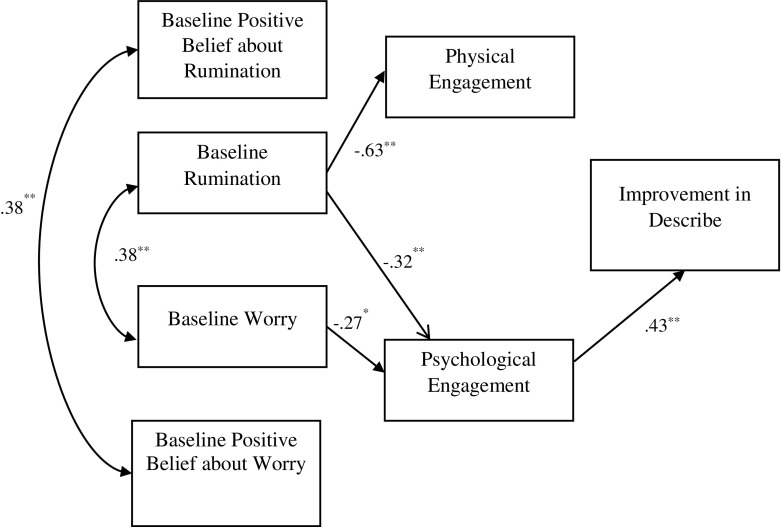
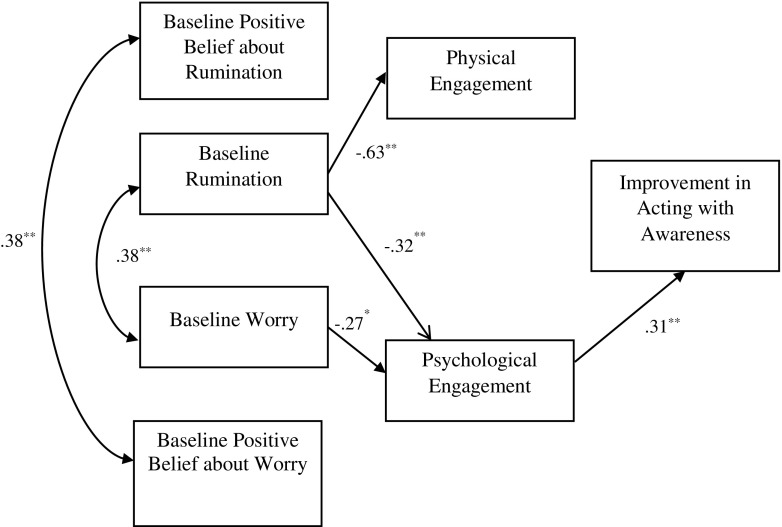
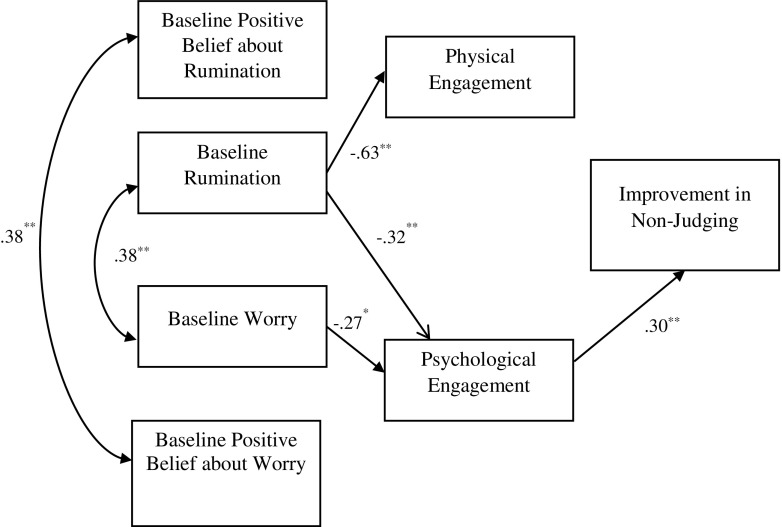
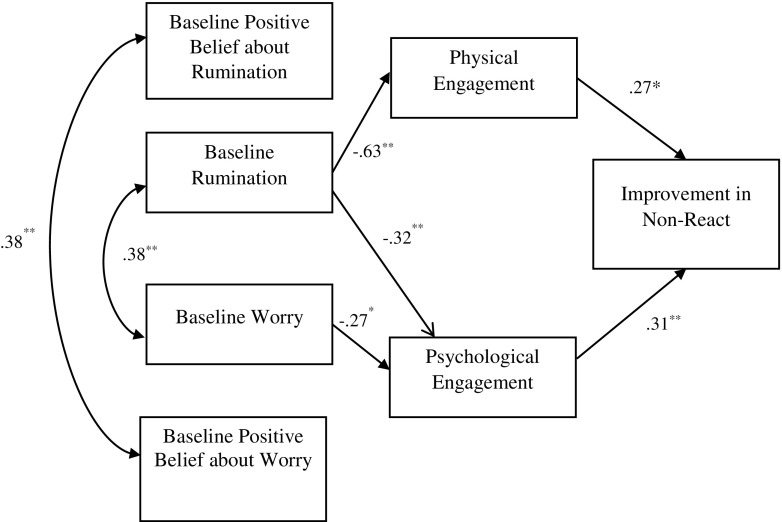
Little is known about the factors associated with engagement in mindfulness-based interventions (MBIs). Moreover, engagement in MBIs is usually defined in terms of class attendance ('physical engagement') only. However, in the psychotherapy literature, there is increasing emphasis on measuring participants' involvement with interventions ('psychological engagement'). This study tests a model that rumination and worry act as barriers to physical and psychological engagement in MBIs and that this in turn impedes learning mindfulness. One hundred and twenty-four participants were given access to a 2-week online mindfulness-based self-help (MBSH) intervention. Self-report measures of mindfulness, rumination, worry, positive beliefs about rumination, positive beliefs about worry and physical and psychological engagement were administered. A path analysis was used to test the linear relationships between the variables. Physical and psychological engagement were identified as two distinct constructs. Findings were that rumination and worry both predicted psychological disengagement in MBSH. Psychological engagement predicted change in the describe, act with awareness, non-judge and non-react facets of mindfulness while physical engagement only predicted changes in the non-react facet of mindfulness. Thus, rumination and worry may increase risk of psychological disengagement from MBSH which may in turn hinder cultivating mindfulness. Future suggestions for practice are discussed.
Overview
The claims and statistics of this paper haven’t been checked yet.
Free: it reads the open-access text and checks the first 5 claims that cite a source we can check. Create a free account to check every claim.
Integrity signals
Registry
Cites
Statistics
Figures
Verification
Claims the paper makes
The claims and statistics of this paper haven’t been checked yet.
Free: it reads the open-access text and checks the first 5 claims that cite a source we can check. Create a free account to check every claim.
Claims other papers make about this one
Each is checked against this paper’s own text: does it say what the citing paper says it does?
The source backs part of the claim, not all of it — or backs it for a different population, condition or comparison.
In the citing paper
“Finally, although this review synthesized evidence from diverse study types, it is worth bearing in mind that engagement with MBIs is usually defined in terms of intervention use (ie, physical engagement [77]).”
From Experiences of Using Digital Mindfulness-Based Interventions: Rapid Scoping Review and Thematic Synthesis (2023) · cites this paper as [77]
Experimental — accuracy not yet measuredThe cited source says what the claim attributes to it.
In the citing paper
“Participation in MBIs requires both physical and psychological engagement.63”
From Feasibility, Acceptability, and Efficacy of Mindfulness Training in People With Upper Motor Neuron Disorders: A Systematic Review (2022) · cites this paper as [63]
The cited source says what the claim attributes to it.
In the citing paper
“This is an important area for further research given evidence that psychological rather than physical disengagement from self-help MBIs has a greater impact on cultivating mindfulness [77].”
From Experiences of Using Digital Mindfulness-Based Interventions: Rapid Scoping Review and Thematic Synthesis (2023) · cites this paper as [77]
Self-check
Percentages, sums and reported differences re-computed from the paper’s own numbers.
The self-check needs the paper’s full text.
Citations
Cites
(1998) · Cited by 36,049
Mindfulness-based interventions in context: Past, present, and future
Kabat-Zinn, J. (2003) · Clinical Psychology: Science and Practice · doi:10.1093/clipsy.bpg016 · Cited by 8,615 · cited 3×
“Mindfulness is a process of purposefully cultivating nonjudgemental attention to experiences in the present moment (Kabat-Zinn 2003).”
Mindfulness-based interventions in context: Past, present, and future.
Kabat-Zinn, J. (2003) · Clinical Psychology: Science and Practice · doi:10.1093/clipsy/bpg016 · Cited by 8,612
Nolen-Hoeksema, S., Wisco, B. E., & Lyubomirsky, S. (2008) · Perspectives on Psychological Science · doi:10.1111/j.1745-6924.2008.00088.x · Cited by 5,172 · cited 2×
“Rumination is typically seen as past or present focused, whereas worry is typically seen as future focused (Nolen-Hoeksema et al. 2008).”
Development and validation of the Penn State Worry Questionnaire
Meyer, T. J., Miller, M. L., Metzger, R. L., & Borkovec, T. D. (1990) · Behaviour Research and Therapy · doi:10.1016/0005-7967(90)90135-6 · Cited by 5,099 · cited 11×
“Rumination and worry are closely related processes.”
InfluentialStructural Equation Modeling With AMOS: Basic Concepts, Applications, and Programming, Third Edition
Byrne, B. M. (2016) · doi:10.4324/9781315757421 · Cited by 4,653
Mindfulness training as a clinical intervention: a conceptual and empirical review
Baer, R. A. (2003) · Clinical Psychology: Science and Practice · doi:10.1093/clipsy.bpg015 · Cited by 4,577 · cited 2×
“Among the several interventions that have utilised this principle, mindfulness-based stress reduct ion (MBSR) and mindfulness-based cognitive therapy (MBCT) are two prominent psychological group-based interventions including primarily mindfulness practice and group discussion of principles (Baer 2003).”
Mindfulness training as a clinical intervention: A conceptual and empirical review.
Baer, R. A. (2003) · Clinical Psychology: Science and Practice · doi:10.1093/clipsy/bpg015 · Cited by 4,576
Kabat-Zinn, J. (1982) · General Hospital Psychiatry · doi:10.1016/0163-8343(82)90026-3 · Cited by 4,255 · cited 1×
“This ‘detached observation’ (Kabat-Zinn 1982, p. 34) of a constantly changing field is difficult to attain (Chambers et al. 2009) as the mind has a strong habitual tendency to wander to the content of thoughts.”
The effect of mindfulness based therapy on anxiety and depression: A meta analytic review
Hofmann, S. G., Sawyer, A. T., Witt, A. A., & Oh, D. (2010) · Journal of Consulting and Clinical Psychology · doi:10.1037/a0018555 · Cited by 3,846 · cited 1×
“Rumination and worry mediate depression and anxiety (Muris et al. 2005), and there is substantial evidence suggesting that MBIs are effective in the treatment of depression and anxiety (Hofmann et al. 2010) with effects mediated by reductions in rumination and worry (Gu et al. 2015).”
Research works printed but not linked: 2
- Arbuckle JL AMOS (version 7.0) [computer software] 2006 Chicago SPSS
- Byrne BM Structured equation modeling with AMOS. Basic concepts, applications, and programming 2010 2 New York Taylor and Francis
Cited by
The future of mindfulness training is digital, and the future is now
Mrazek, A. J., Mrazek, M. D., Cherolini, C. M., Cloughesy, J. N., Cynman, D. J., Gougis, L. J., Landry, A. P., Reese, J. V., & Schooler, J. W. (2019) · Current Opinion in Psychology · doi:10.1016/j.copsyc.2018.11.012 · Cited by 201
Taylor, H., Strauss, C., & Cavanagh, K. (2021) · Clinical Psychology Review · doi:10.1016/j.cpr.2021.102078 · Cited by 102
Self-citationWeigelt, O., Gierer, P., & Syrek, C. J. (2019) · International Journal of Environmental Research and Public Health · doi:10.3390/ijerph16162987 · Cited by 92
Winter, N., Russell, L., Ugalde, A., WHITE, V. M., & Livingston, P. M. (2022) · Journal of Medical Internet Research · doi:10.2196/30026 · Cited by 99
“In mindfulness programs, engagement involves regular meditation and daily awareness exercises coupled with intention motivation and commitment to practice [23].”
BackgroundResultInfluentialEvaluating Short Versions of the Five Facet Mindfulness Questionnaire Using Rasch Analysis
Medvedev, O. N., Titkova, E. A., Siegert, R. J., Hwang, Y.-S., & Krägeloh, C. U. (2018) · Mindfulness · doi:10.1007/s12671-017-0881-0 · Cited by 71
Mindfulness promotes a more balanced time perspective: Correlational and intervention-based evidence
Rönnlund, M., Koudriavtseva, A., Germundsjö, L., Eriksson, T., Åström, E., & Carelli, M. G. (2019) · Mindfulness · doi:10.1007/s12671-019-01113-x · Cited by 54
Green, J., Huberty, J., Puzia, M., & Stecher, C. D. (2021) · JMIR Mental Health · doi:10.2196/28479 · Cited by 56
“This is aligned with other research demonstrating that anxiety and worry can be detrimental to habitual participation in health-promoting behaviors, both in general [48] and in the context of COVID-19 [49,50].”
Osborne, E. L., Ainsworth, B., Hooper, N., & Atkinson, M. J. (2023) · Journal of Medical Internet Research · doi:10.2196/44220 · Cited by 37
“All of this [...] suggests that “one-size-fits-all” online interventions might be less engaging and less effective than those tailored to individual preferences.”
Osborne, E. L., Ainsworth, B., Hooper, N., & Atkinson, M. J. (2022) · doi:10.2196/preprints.44220 · Cited by 37
A natural meditation setting improves compliance with mindfulness training
Lymeus, F., Lindberg, P., & Hartig, T. (2019) · Journal of Environmental Psychology · doi:10.1016/j.jenvp.2019.05.008 · Cited by 36
Krägeloh, C. U., Medvedev, O. N., Taylor, T., Wrapson, W., Rix, G., Sumich, A., Wang, G. Y., Csako, R., Anstiss, D., Ranta, J. T., et al. (2019) · Mindfulness · doi:10.1007/s12671-018-1024-y · Cited by 33
Farrall, A., Taylor, J., Ainsworth, B., & Alexander, J. (2023) · CHI Conference on Human Factors in Computing Systems · doi:10.1145/3544548.3581188 · Cited by 42
“This improved state highlights reductions in fatigue, distractions, or ruminations across all study phases [9].”
BackgroundОсин, Е. Н., & Turilina, I. I. (2021) · Applied Psychology Health and Well-Being · doi:10.1111/aphw.12293 · Cited by 39
Kerr, D. C., Ornelas, I. J., Lilly, M. M., Calhoun, R., & Meischke, H. (2019) · Journal of Medical Internet Research · doi:10.2196/13449 · Cited by 25
“Studies have indicated that a paradoxical relationship may exist, in which the psychological symptoms that MBIs intend to ameliorate may make it more difficult for participants first engaging in mindfulness practice to attain present-centered awareness [23-26].”
Halamová, J., Kanovský, M., Jurková, V., & Kupeli, N. (2018) · Studia Psychologica · doi:10.21909/sp.2018.04.766 · Cited by 30
Esketamine combined with a mindfulness-based intervention for individuals with alcohol problems
Gent, E. M., Bryan, J., Cleary, M. A., Clarke, T. I., Holmwood, H. D., Nassereddine, R. O., Salway, C., Depla, S., Statton, S., Krecké, J., et al. (2024) · Journal of Psychopharmacology · doi:10.1177/02698811241254834 · Cited by 27
“Engagement in mindfulness was measured using an adapted scale created by Banerjee et al. (2018).”
MethodFinlay‐jones, A. L., Boyes, M. E., Perry, Y., Sirois, F. M., Lee, R. K., & Rees, C. S. (2020) · BMC Public Health · doi:10.1186/s12889-020-8226-7 · Cited by 29
Kasson, E. M., Vázquez, M. M., Doroshenko, C., Fitzsimmons‐Craft, E. E., Wilfley, D. E., Taylor, C. B., & Cavazos‐Rehg, P. A. (2021) · International Journal of Environmental Research and Public Health · doi:10.3390/ijerph18157979 · Cited by 22
“All participants reported some symptoms of depression in the Discovery Group, with a few noting that low mood or lack of motivation for activities could impact their use of the app [20,61,62].”
BackgroundLymeus, F., Ahrling, M., Apelman, J., Florin, C. D. M., Nilsson, C., Vincenti, J., Zetterberg, A., Lindberg, P., & Hartig, T. (2020) · Frontiers in Psychology · doi:10.3389/fpsyg.2020.01560 · Cited by 27
“…issue of acceptability is a major concern with people who enter into training with attention regulation difficulties; they seem to be particularly unlikely to complete the courses and the recommended amounts of homework exercise (Crane and Williams, 2010; Lymeus et al., 2017; Banerjee et al., 2018).”
Hsieh, C.-C., Lin, Z.-Z., Ho, C.-C., Yu, C.-J., Chen, H.-J., Chen, Y.-W., & Hsiao, F.-H. (2021) · Mindfulness · doi:10.1007/s12671-021-01642-4 · Cited by 19
“A later disengagement in mindfulness intervention was predicted for individuals with baseline levels of worry and rumination (Banerjee et al., 2018).”
BackgroundLeite, N. J. C., Raimundo, A. M. D. M., Mendes, R., & Marmeleira, J. (2022) · International Journal of Environmental Research and Public Health · doi:10.3390/ijerph19073986 · Cited by 25
“Concordant results demonstrated that generalised worries are associated with poorer participation in healthpromoting behaviours [45].”
ResultCovington, L., Banerjee, M., Pereira, A., & Price, M. (2022) · Journal of Palliative Care · doi:10.1177/08258597221100330 · Cited by 21
Self-citationRobe, A., & Dobrean, A. (2022) · European Child & Adolescent Psychiatry · doi:10.1007/s00787-022-02005-7 · Cited by 26
“Previous studies have shown that poor engagement could limit the intervention’s effectiveness [39].”
BackgroundThe case for mindfulness interventions for traumatic stress in high violence, low resource settings
Pillay, K., & Eagle, G. T. (2019) · Current Psychology · doi:10.1007/s12144-019-00177-1 · Cited by 22
Hutchinson, J. K., Jones, F., & Griffith, G. (2021) · Mindfulness · doi:10.1007/s12671-021-01596-7 · Cited by 15
Weng, X., Luk, T. T., Lau, O. S., Suen, Y. N., Lee, J. J., Li, W. H. C., Kwok, J. Y. Y., Lam, T. H., & Wang, M. P. (2020) · Addictive Behaviors · doi:10.1016/j.addbeh.2020.106677 · Cited by 16
Wu, J., Hamilton, J. L., Fresco, D. M., Alloy, L. B., & Stange, J. P. (2021) · Behaviour Research and Therapy · doi:10.1016/j.brat.2021.104017 · Cited by 16
PE augmented mindfulness: A neurocognitive framework for research and future healthcare
Sars, D. (2022) · Frontiers in Human Neuroscience · doi:10.3389/fnhum.2022.899988 · Cited by 13
Social Cognitions and Mental Health as Predictors of Adolescents’ Mindfulness Practice
Beattie, M. M., Konttinen, H. M., Volanen, S., Knittle, K. P., & Hankonen, N. E. (2020) · Mindfulness · doi:10.1007/s12671-020-01331-8 · Cited by 11
“…quantitative studies have found that various mental health problems are associated with meditation program attrition or perceived barriers to meditation (Banerjee et al. 2018; Crane andWilliams 2010; Delmonte 1980, 1984, 1988; Whitford and Warren 2019; Williams et al. 2012; Williams et al. 1976).”
BackgroundBawa, F. L. M., Mercer, S. W., Sutton, J. W., & Bond, C. M. (2023) · Health Expectations · doi:10.1111/hex.13745 · Cited by 11
“applied this specifically to mindfulness‐based interventions, suggesting that engagement involves physical engagement (session attendance and between‐session mindfulness practice), psychological engagement (consisting of motivation to participate in the programme, the belief that practicing mindfulness will be benefic…”
BackgroundKorupolu, R., Malik, A., Ratcliff, C., Robinson-Whelen, S., & Taylor, H. B. (2022) · Archives of Physical Medicine and Rehabilitation · doi:10.1016/j.apmr.2022.05.020 · Cited by 8
The impact of neurological disability and sensory loss on mindfulness practice
Finlay, K. A., Hearn, J. H., & Chater, A. (2022) · Disability and Rehabilitation · doi:10.1080/09638288.2021.1887946 · Cited by 8
“Despite the evidence suggesting beneficial outcomes of mindfulness, people with sensory loss often experience barriers to practising mindfulness, which may be both psychological and physiological [4,8].”
BackgroundThomas, E. M., Freeman, T. P., Poplutz, P., Howden, K., Hindocha, C., Bloomfield, M., & Kamboj, S. K. (2021) · Journal of Psychopharmacology · doi:10.1177/0269881121991835 · Cited by 10
“Indeed, the specific focus of MBIs on self-regulation of attention represents a potential barrier in patients for whom attentional and motivational difficulties are an inherent symptom of their disorder (Barnhofer et al, 2009; Eysenck et al, 2007).”
BackgroundRiedl, E. M., Müller, A., Perzl, J., & Thomas, J. (2023) · Occupational Health Science · doi:10.1007/s41542-022-00141-9 · Cited by 11
“Indeed, there is evidence from between-subject research that worry and rumination predict psychological disengagement from mindfulness interventions, reflected in a lower motivation and intent to practice, lower commitment and lower beliefs in its effectiveness in helping to deal with stressful situations (Banerjee et…”
BackgroundMudiyanselage, C. A. K. R. A., Ewens, B. A., Smyth, A. M., Dickson, J. M., & Ang, S. G. M. (2024) · Mindfulness · doi:10.1007/s12671-024-02365-y · Cited by 9
Mindful Metacognition: Attention, Beliefs, and Skills in the Acceptance of Experiences
Wunder, Z. I., & Jones, L. L. (2023) · Mindfulness · doi:10.1007/s12671-023-02254-w · Cited by 11
“Experiential avoidance and RNT contribute to low-dispositional mindfulness (Cribb et al., 2006; Hawley et al., 2014; Parmentier et al., 2019; Thompson et al., 2021) and RNT can inhibit mindfulness cultivation (Banerjee et al., 2017, 2018; Kaplan et al., 2018; Llera & Newman, 2014).”
Godara, M., & Singer, T. (2024) · Journal of Clinical Medicine · doi:10.3390/jcm13113295 · Cited by 5
“Some of these mechanisms include use of emotion regulation and coping strategies [45–47], mindfulness skills [48,49], psychological flexibility [50], emotional cognitive control [51,52], and worry [53,54].”
BackgroundLymeus, F. (2022) · Frontiers in Psychology · doi:10.3389/fpsyg.2022.715411 · Cited by 6
“However, the null results for CMT did not align with expectations based on previous studies (Crane and Williams, 2010; Lymeus et al., 2017; Banerjee et al., 2018): Associations between initial cognitive functioning, compliance, and outcomes may be more pronounced in longer and more demanding conventional mindfulness c…”
BackgroundResultBeing Mindful about Workaholism: Associations Between Dimensions of Workaholism and Mindfulness
Howard, G. J., Smith, R. W., Haynes, N. J., & Clark, M. A. (2022) · Occupational Health Science · doi:10.1007/s41542-022-00113-z · Cited by 10
“Their findings suggest that individuals who ruminate are psychologically disengaged from mindfulness interventions even though they may be physically present (Banerjee et al., 2018).”
BackgroundInfluentialMcDonald, H., Valmaggia, L., Antonova, E., & Chadwick, P. (2024) · Frontiers in Psychology · doi:10.3389/fpsyg.2024.1380077 · Cited by 5
Stańko-Kaczmarek, M., Jankowski, T., Bartel, R., Stankowska, M., Andrzejewska, M., Rybakowski, F., Kaczmarek, L. D., & RYBAKOWSKI, J. K. (2025) · Journal of Happiness Studies · doi:10.1007/s10902-025-00932-1 · Cited by 4
“These findings are essential because repetitive thinking increases the risk of psychological disengagement from mindfulness-based interventions (Banerjee et al., 2018).”
Lymeus, F. (2022) · Landscape and Urban Planning · doi:10.1016/j.landurbplan.2022.104403 · Cited by 6
Does Virtual Reality Training Increase Mindfulness in Aboriginal Out-of-Home Care Children?
Rowland, G., Hindman, E., Jomeen, J., & Hassmén, P. (2024) · Mindfulness · doi:10.1007/s12671-024-02373-y · Cited by 4
Sackett, C. R., Jenkins, A. M., & Gambrel, L. E. (2023) · Counseling Outcome Research and Evaluation · doi:10.1080/21501378.2023.2206952 · Cited by 5
The Relation between Work Involvement and the Quality of Nursing Care among Staff Nurses
Mahmoud, M., Ahmed, E., & Hasanin, A. G. (2023) · Sohag Journal of Nursing Science · doi:10.21608/sjns.2023.215832.1014 · Cited by 3
Girgenti, S. G., Dallasta, I., Lawrence, E., Merbach, D., Simon, J. Z., Llinas, R. H., Gould, N. F., & Marsh, E. B. (2025) · Frontiers in Neurology · doi:10.3389/fneur.2025.1534480 · Cited by 5
“While prior studies classified engagement as physical attendance of the class, other studies have seen better results with more nuanced definitions, including homework completion and psychological engagement with the material (44).”
dethoor, M., Vialatte, F., martinelli, M., peri, P., Lançon, C., & Trousselard, M. (2022) · OBM Integrative and Complementary Medicine · doi:10.21926/obm.icm.2204058 · Cited by 4
Green, J., Huberty, J., Puzia, M., & Stecher, C. D. (2020) · Research Square · doi:10.21203/rs.3.rs-53798/v1 · Cited by 4
“This is aligned with other research demonstrating that anxiety and worry can be detrimental to habitual participation in health-promoting behaviors, both in general[46] and in the context of COVID-19 One cross-sectional survey conducted in Belgium during their COVID-19 lockdown reported increases in physical activity…”
BackgroundResultMoran, M. J., Thompson, T., Harmon, M., Rzonca, A. J., Lucas‐Thompson, R. G., DeJonkheere, M., Guetterman, T. C., & Shomaker, L. B. (2026) · Current Psychology · doi:10.1007/s12144-026-09542-3 · Cited by 2
The Use of Mindfulness in the Metaverse: A Scoping Review
Seymour, L. M., Seymour, S., Sharpe, B. T., Nandy, M., Lodh, S., & Banerjee, M. (2025) · Mindfulness · doi:10.1007/s12671-025-02608-6 · Cited by 3
“Furthermore, as most existing research focuses on specific population groups, there remains a significant gap in exploring the impact of MBIs on the broader population.”
InfluentialSelf-citationEmotion regulation and the experience of racial microaggressions.
Sawyer, B. A. (2019) · ThinkIR: The University of Louisville's Institutional Repository (University of Louisville) · doi:10.18297/etd/3189 · Cited by 3
Spiritual boredom is associated with over- and underchallenge, lack of value, and reduced motivation
Goetz, T., Fries, J., Stempfer, L., Kraiger, L., Stoll, S. E. M., Baumgartner, L., Diamant, Y. L., Porics, C., Sonntag, B., Würglauer, S., et al. (2025) · Communications Psychology · doi:10.1038/s44271-025-00216-7 · Cited by 2
“These studies indicate that such negative emotions can act as barriers to spiritual practice and as predictors of attrition 55 – 58 .”
Mathersul, D. C., Byrne, J., Lau, J. J. Y., Schütze, R., Learmonth, Y. C., Fujiyama, H., Naragon‐Gainey, K., McEvoy, P. M., & Bayley, P. J. (2025) · Advances in Integrative Medicine · doi:10.1016/j.aimed.2025.100484 · Cited by 2
Bavi, S., Salar, A. R., Talayeri, A., & Bahmaei, H. (2025) · Journal of Contemporary Psychotherapy · doi:10.1007/s10879-025-09676-8 · Cited by 1
Chan, D. C. C., Luk, L. H. F., You, L. L. L., Zhang, D., Ngai, W. B., & Wong, S. Y. S. (2025) · Cogent Psychology · doi:10.1080/23311908.2025.2510737 · Cited by 2
“Mindfulness-based programmes with fewer sessions might be more feasible in a busy environment (Banerjee et al., 2018). studies have shown that salutary effects were already observed in participants who attended only brief online mindfulness programmes (Forbes et al., 2018; Kemper, 2017) and lKM or…”
Eguchi, M., Yoshinaga, N., & Kunikata, H. (2025) · Journal of Psychosocial Nursing and Mental Health Services · doi:10.3928/02793695-20251104-02 · Cited by 1
McDonald, M. A., Berryhill, M. E., Lansing, A. H., & Lancaster, C. L. (2026) · Mindfulness · doi:10.1007/s12671-026-02774-1 · Cited by 1
Scholl, J., Winkens, L. H. H., & Veling, H. (2026) · JMIR Formative Research · doi:10.2196/79141 · Cited by 1
“Many individuals hold—whether conscious or not—positive metacognitive beliefs about worry, such as “worrying helps me cope” or “worrying keeps me prepared” [67,68], which leads them to engage with intrusive thoughts rather than letting them pass [69].”
Beylin, N. R., & Zawadzki, M. J. (2026) · Frontiers in Psychology · doi:10.3389/fpsyg.2026.1801095 · Cited by 1
“For instance, prior work has found that elevated persevera-tive cognitions can inhibit engagement with mindfulness practices (Banerjee et al., 2018).”
Liang, W.-M., Griškova-Bulanova, I., Xiao, J., Zhao, Q., Hou, M.-Y., Ren, F.-F., Zhu, Y., Truskauskaitė‐Kunevičienė, I., Xiao, Y.-H., & Rukšėnas, O. (2026) · Frontiers in Psychology · doi:10.3389/fpsyg.2026.1854234 · Cited by 1
“Worry is a core feature of anxiety; a study has found that individuals who tend to worry may experience difficulty engaging in mindfulness practice (Banerjee et al., 2018).”
Funkhouser, C. J., Katz, A. C., Meissel, E. E. E., Stevens, E. S., Weinberg, A., Nabb, C. B., & Shankman, S. A. (2022) · Affective Science · doi:10.1007/s42761-022-00121-w · Cited by 1
Moran, M. J., Miller, R. L., Rzonca, A. J., Krause, J. T., Adams, M. S., Rigsby, B. A., Prince, M. A., & Lucas‐Thompson, R. G. (2023) · Counselling and Psychotherapy Research · doi:10.1002/capr.12724 · Cited by 3
A Model for Employee Engagement
Turner, P. A. (2019) · Springer eBooks · doi:10.1007/978-3-030-36387-1_4
Impact of Naturalistic and Urban Environment on Mindfulness Practice in Reducing Rumination
Lee, N., Chatzisarantis, N. L. D., & McMahon, A. (2021) · Advanced Research in Psychology · doi:10.46412/001c.21398
Mubarak, A. S., Alzahrani, A. M., Alamri, R. D., Asiri, A. A., Alzahrani, S. A., Alwadai, F. Y., Saeedi, A. A., & Alzahrani, K. T. (2022) · Medical Science · doi:10.54905/disssi/v26i124/ms211e2325
Monteiro, B., Galhardo, A. B., Cunha, M. I. V. A., & Pinto‐Gouveia, J. (2022) · Mindfulness · doi:10.1007/s12671-022-01953-0 · Cited by 1
Rubio, A. D. R. M., Núñez, M. N., Hernández, V. F. F., & Salazar, C. M. L. (2023) · LATAM Revista Latinoamericana de Ciencias Sociales y Humanidades · doi:10.56712/latam.v4i1.444 · Cited by 11
Patangia, B., Sarkar, S., & Antony, J. M. (2024) · Advances in psychology, mental health, and behavioral studies (APMHBS) book series · doi:10.4018/979-8-3693-2651-0.ch010
A Qualitative Evaluation of a Mindfulness-Based Intervention for Complex Trauma Survivors
Dussault, É., Fernet, M., Boucher, N., Boileau, M.-J., & Godbout, N. (2025) · Mindfulness · doi:10.1007/s12671-025-02599-4 · Cited by 1
Cullen, D., Cavanagh, K., & Strauss, C. (2025) · PLoS ONE · doi:10.1371/journal.pone.0331196
“However, negative perception was not reserved for medical professionals, as stated by a social worker, “I don’t see enough of that in the work that I do, those sort of people, the psychologists that I work with are very sort of risk focussed” (Interviewee 27).”
InfluentialSelf-citationFarrall, A., Sharma, A., Ainsworth, B., Jacobsen, P. C., & Alexander, J. (2026) · CHI Conference on Human Factors in Computing Systems · doi:10.1145/3772318.3790933 · Cited by 3
Gentes, E. L., & Bonchonsky, J. (2026) · Cognitive Therapy and Research · doi:10.1007/s10608-026-10743-0
O’Brien, V., & Rickert, N. P. (2026) · Journal of Affective Disorders · doi:10.1016/j.jad.2026.122062
Amorim, A. B., Ashton-James, C. E., Barnet-Hepples, T., Rebbeck, T. J., Refshauge, K. M., Pappas, E., & Costa, N. (2026) · Disability and Rehabilitation · doi:10.1080/09638288.2026.2721575
Mesghina, A., & Richland, L. E. (2026) · Mindfulness · doi:10.1007/s12671-026-02995-4
Metadata
- Authors
- Banerjee, M., Cavanagh, K., & Strauss, C.
- Affiliations
- University of Sussex (GB)
- Corresponding author
- Strauss, Clara
- Venue
- Mindfulness
- Published
- 2017-11-06
- Volume
- 9
- Issue
- 3
- Pages
- 980-992
- ISSN
- 1868-8527 (ISSN-L)
- 1868-8535
- PMC
- PMC5968050
- OpenAlex
- W2767186300
- Semantic Scholar
- 365cdd239fe661b1e2a180b05b4e6f248e58ff7e
- Cited by
- 75
- References
- 63
- Citations by year
- 2026: 10 · 2025: 10 · 2024: 6 · 2023: 10 · 2022: 13 · 2021: 10 · 2020: 5 · 2019: 7 · 2018: 4
- FWCI
- 5.43
- Type
- journal article
- Language
- en
- Open access
- hybrid
- doi.org
- Locations
- Mindfulness (publishedVersion, cc-by)
- Europe PMC (PubMed Central) (publishedVersion, cc-by)
- PubMed Central (publishedVersion, cc-by)
- PubMed (publishedVersion)
- ChiPrints (University of Chichester) (acceptedVersion)
- Funders
- University of Sussex
- Topics
- Social Sciences › Psychology › Clinical Psychology › Mindfulness and Compassion Interventions
- Social Sciences › Psychology › Applied Psychology › Digital Mental Health Interventions
- Social Sciences › Psychology › Experimental and Cognitive Psychology › Anxiety, Depression, Psychometrics, Treatment, Cognitive Processes
- Keywords
- mindfulness-based interventions, rumination, worry, psychological engagement, physical engagement, online self-help intervention, barriers to engagement, mindfulness facets, psychological disengagement
About these checks
Registry, retraction, Cites and statistics results are computed, not judged, with one exception: a printed reference that no index lists is read once by a model before it counts as a citation error. Claims are extracted by a model and kept only when their quote appears verbatim in the text; each cited source is then checked, with a model’s help, for whether it says what the claim relies on. Those verdicts can be wrong — read the claim’s quote and the cited source before relying on one.
Statistics and arithmetic are recomputed, not judged.
Confidence bands are shown only for fields calibrated on our annotated test set. None is calibrated yet, so no band is shown.
What counts as a claim ›How we measure confidence ›How we check this ›
Are you an author, or do you see a problem with this page? Request a review
Data sources
Bibliographic data: Semantic Scholar, OpenAlex, Crossref.
Contains information from the Semantic Scholar Academic Graph Datasets, made available under the ODC Attribution License (ODC-BY 1.0).
Semantic Scholar’s data is described in: Kinney, R., et al. (2023). The Semantic Scholar Open Data Platform. arXiv:2301.10140.
