

Self-compassion and Psychological Distress in Adolescents—a Meta-analysis
Open accessThe DOI matches its Crossref record; 98 of the 98 references it cites were found in a registry or an index.
Abstract
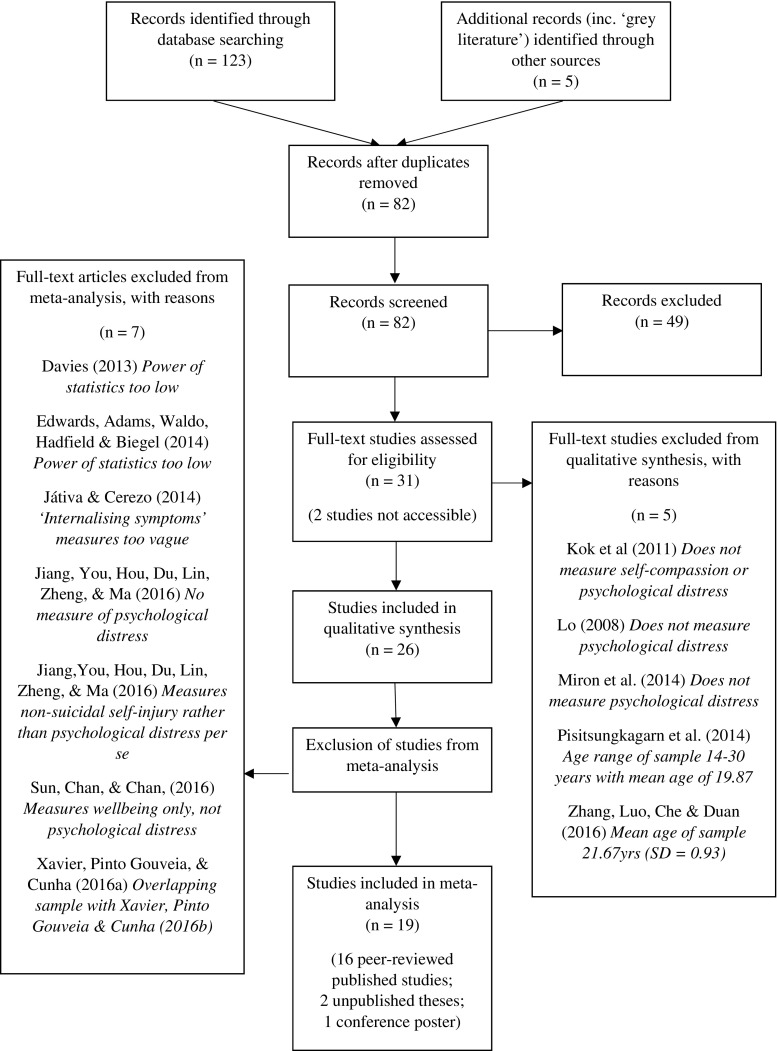
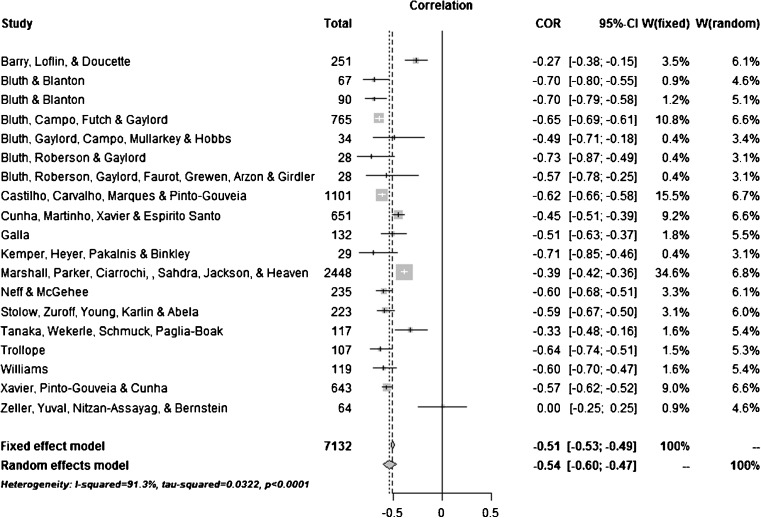
Research indicates that self-compassion is relevant to adolescents’ psychological well-being, and may inform the development of mental health and well-being interventions for youth. This meta-analysis synthesises the existing literature to estimate the magnitude of effect for the association between self-compassion and psychological distress in adolescents. Our search identified 19 relevant studies of adolescents (10–19 years; N = 7049) for inclusion. A large effect size was found for an inverse relationship between self-compassion and psychological distress indexed by anxiety, depression, and stress ( r = − 0.55; 95% CI − 0.61 to − 0.47). The identified studies were highly heterogeneous, however sensitivity analyses indicated that correction for publication bias did not significantly alter the pattern of results. These findings replicate those in adult samples, suggesting that lack of self-compassion may play a significant role in causing and/or maintaining emotional difficulties in adolescents. We conclude that self-compassion may be an important factor to target in psychological distress and well-being interventions for youth.
Overview
The claims and statistics of this paper haven’t been checked yet.
Free: it reads the open-access text and checks the first 5 claims that cite a source we can check. Create a free account to check every claim.
Integrity signals
Registry
Cites
Statistics
Figures
Verification
Claims the paper makes
The claims and statistics of this paper haven’t been checked yet.
Free: it reads the open-access text and checks the first 5 claims that cite a source we can check. Create a free account to check every claim.
Claims other papers make about this one
Each is checked against this paper’s own text: does it say what the citing paper says it does?
The cited source says what the claim attributes to it.
In the citing paper
“and adolescents ( r = -0.55; Marsh et al. 2018)”
From Effectiveness of Self-Compassion Related Therapies: a Systematic Review and Meta-analysis (2019) · cites this paper as Marsh et al. 2018
Self-check
Percentages, sums and reported differences re-computed from the paper’s own numbers.
The self-check needs the paper’s full text.
Citations
Cites
Preferred Reporting Items for Systematic Reviews and Meta-Analyses: the PRISMA statement
Moher, D., Liberati, A., Tetzlaff, J., Altman, D. G., & for the PRISMA Group (2009) · BMJ · doi:10.1136/bmj.b2535 · Cited by 83,823
Preferred Reporting Items for Systematic Reviews and Meta-Analyses: The PRISMA Statement
Moher, D., Liberati, A., Tetzlaff, J., Altman, D. G., & The PRISMA Group (2009) · PLoS Medicine · doi:10.1371/journal.pmed.1000097 · Cited by 64,042 · cited 2×
“A systematic review was performed using PRISMA criteria (Moher et al. 2009).”
BackgroundMethodMeasuring inconsistency in meta-analyses
Higgins, J. P. T., Thompson, S. G., Deeks, J. J., & Altman, D. G. (2003) · BMJ · doi:10.1136/bmj.327.7414.557 · Cited by 63,139 · cited 1×
“Higgins et al. (2003) suggested that I2 values of 0, 25, 50, and 75% indicate zero, low, moderate, and high heterogeneity, respectively.”
BackgroundThe CES-D Scale: A Self-Report Depression Scale for Research in the General Population
Radloff, L. S. (1977) · Applied Psychological Measurement · doi:10.1177/014662167700100306 · Cited by 53,267
Preferred reporting items for systematic reviews and meta-analyses: the PRISMA Statement.
(2009) · PubMed Central · Cited by 44,859
Meta-analysis in clinical trials
DerSimonian, R., & Laird, N. (1986) · Controlled Clinical Trials · doi:10.1016/0197-2456(86)90046-2 · Cited by 39,552 · cited 2×
“2001), using DerSimonian Laird (DerSimonian and Laird 1986) estimators for between-study variance.”
MethodA Global Measure of Perceived Stress
Cohen, S., Kamarck, T., & Mermelstein, R. (1983) · Journal of Health and Social Behavior · doi:10.2307/2136404 · Cited by 32,807
Development and validation of brief measures of positive and negative affect: The PANAS scales.
Watson, D., Clark, L. A., & Tellegen, A. (1988) · Journal of Personality and Social Psychology · doi:10.1037/0022-3514.54.6.1063 · Cited by 32,433
(1970) · Cited by 24,983
Conducting Meta-Analyses in R with the metafor Package
Viechtbauer, W. (2010) · Journal of Statistical Software · doi:10.18637/jss.v036.i03 · Cited by 20,464 · cited 2×
“Analyses were conducted in RStudio (RStudio Version 3.2.2) using the ‘metafor’ (Viechtbauer 2010) and ‘meta’ packages (Schwarzer 2007).”
MethodInfluential
Research works printed but not linked: 7
- Beck, A. T., & Steer, R. A. (1987). Manual for the revised Beck depression inventory. San Antonio: Psychological Corporation.
- Conway, D. G. (2007). The role of internal resources in academic achievement: exploring the meaning of self-compassion in the adaptive functioning of low-income college students (Unpublished doctoral dissertation, University of Pittsburgh, USA).
- Davies, G. (2013). An investigation into the effectiveness of mindfulness-based cognitive therapy with adolescents (Unpublished doctoral dissertation: Canterbury Christ Church University, United Kingdom).
- Lachar, D., & Gruber, C. P. (1995). Personality inventory for youth (PIY) manual: technical guide. Los Angeles: Western Psychological Services.
- Schwarzer, G. (2007). Meta: an R package for meta-analysis. R news, 7(3), 40–45.
- Trollope, M. (2009). Stressful life-events and adolescent depression: the possible roles of self-criticism and self-compassion (Unpublished doctoral dissertation, University of East Anglia, United Kingdom).
- Xavier, A., Cunha, M., & Pinto Gouveia, J. (2015). Deliberate self-harm in adolescence: the impact of childhood experiences, negative affect and fears of compassion. Revista de Psicopatología y Psicología Clínica, 20(1), 41–49.
Cited by
Self-compassion: Theory, method, research, and intervention
Neff, K. D. (2023) · Annual Review of Psychology · doi:10.1146/annurev-psych-032420-031047 · Cited by 931
“…populations have found moderate to large effect sizes indicating an inverse association between selfcompassion and negative mental states such as depression, anxiety, stress, and suicidal ideation (Ferrari et al. 2019,Hughes et al. 2021,MacBeth &Gumley 2012,Marsh et al. 2018, Suh & Jeong 2021).”
BackgroundEffectiveness of Self-Compassion Related Therapies: a Systematic Review and Meta-analysis
Wilson, A. C., Mackintosh, K., Power, K., & Chan, S. W. Y. (2019) · Mindfulness · doi:10.1007/s12671-018-1037-6 · Cited by 301
Self-citationTurk, F., & Waller, G. (2020) · Clinical Psychology Review · doi:10.1016/j.cpr.2020.101856 · Cited by 248
Self-Compassion and Current Close Interpersonal Relationships: a Scoping Literature Review
Lathren, C. R., Rao, S. S., Park, J., & Bluth, K. (2021) · Mindfulness · doi:10.1007/s12671-020-01566-5 · Cited by 186
Development and Validation of the Self-Compassion Scale for Youth
Neff, K. D., Bluth, K., Tóth-Király, I., Davidson, O., Knox, M. C., Williamson, Z., & Costigan, A. (2021) · Journal of Personality Assessment · doi:10.1080/00223891.2020.1729774 · Cited by 175
“For example, a meta-analysis found a strong negative association with depression, anxiety and stress (Marsh et al., 2018) among adolescents.”
BackgroundResult
Metadata
- Authors
- Marsh, I. C., Chan, S. W. Y., & MacBeth, A.
- Affiliations
- University of Edinburgh (GB)
- Corresponding author
- MacBeth, Angus
- Venue
- Mindfulness
- Published
- 2017-11-25
- Volume
- 9
- Issue
- 4
- Pages
- 1011-1027
- ISSN
- 1868-8527 (ISSN-L)
- 1868-8535
- PMC
- PMC6061226
- OpenAlex
- W2769880865
- Cited by
- 465
- References
- 97
- Citations by year
- 2026: 58 · 2025: 72 · 2024: 71 · 2023: 73 · 2022: 76 · 2021: 55 · 2020: 41 · 2019: 12 · 2018: 6
- FWCI
- 2.46
- Type
- journal article
- Language
- en
- Open access
- hybrid
- doi.org
- Locations
- Mindfulness (publishedVersion, cc-by)
- Europe PMC (PubMed Central) (publishedVersion, cc-by)
- PubMed Central (publishedVersion, cc-by)
- PubMed (publishedVersion)
- Edinburgh Research Explorer (University of Edinburgh) (submittedVersion, cc-by)
- Funders
- University of Edinburgh
- Topics
- Social Sciences › Psychology › Clinical Psychology › Mindfulness and Compassion Interventions
- Social Sciences › Psychology › Social Psychology › Psychological Well-being and Life Satisfaction
- Social Sciences › Psychology › Developmental and Educational Psychology › Student Stress and Coping
- Keywords
- self-compassion, psychological distress, adolescents, anxiety, depression, stress, youth mental health, well-being interventions, emotional problems
About these checks
Registry, retraction, Cites and statistics results are computed, not judged, with one exception: a printed reference that no index lists is read once by a model before it counts as a citation error. Claims are extracted by a model and kept only when their quote appears verbatim in the text; each cited source is then checked, with a model’s help, for whether it says what the claim relies on. Those verdicts can be wrong — read the claim’s quote and the cited source before relying on one.
Statistics and arithmetic are recomputed, not judged.
Confidence bands are shown only for fields calibrated on our annotated test set. None is calibrated yet, so no band is shown.
What counts as a claim ›How we measure confidence ›How we check this ›
Are you an author, or do you see a problem with this page? Request a review
How to cite
Cite CoChat for the checks on this page, and the paper for its own findings.
- This page
- CoChat. (2026). Citation check: Self-compassion and Psychological Distress in Adolescents—a Meta-analysis. https://app.cochat.ai/papers/10.1007/s12671-017-0850-7
- The paper
- Marsh, I. C., Chan, S. W. Y., & MacBeth, A. (2018). Self-compassion and Psychological Distress in Adolescents—a Meta-analysis. Mindfulness. https://doi.org/10.1007/s12671-017-0850-7
Data sources
Bibliographic data: Semantic Scholar, OpenAlex, Crossref.
Contains information from the Semantic Scholar Academic Graph Datasets, made available under the ODC Attribution License (ODC-BY 1.0).
Semantic Scholar’s data is described in: Kinney, R., et al. (2023). The Semantic Scholar Open Data Platform. arXiv:2301.10140.
