

Self-compassion and Psychological Distress in Adolescents—a Meta-analysis
Open accessThe DOI matches its Crossref record; 98 of the 98 references it cites were found in a registry or an index.
Abstract
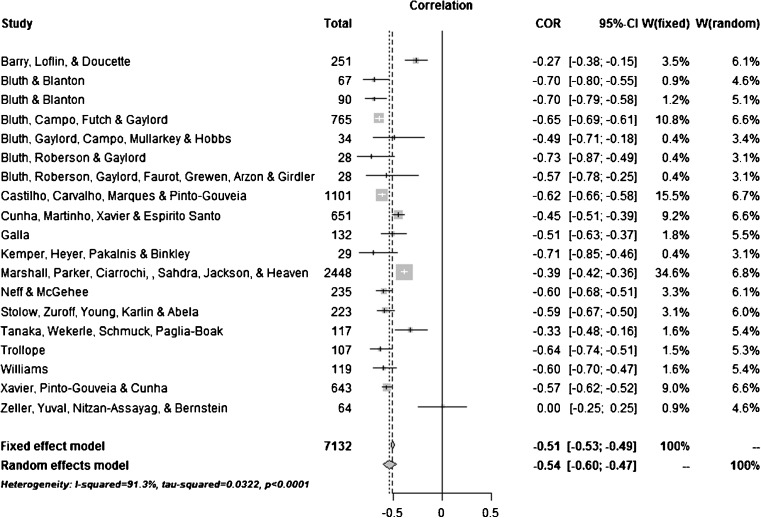
Research indicates that self-compassion is relevant to adolescents’ psychological well-being, and may inform the development of mental health and well-being interventions for youth. This meta-analysis synthesises the existing literature to estimate the magnitude of effect for the association between self-compassion and psychological distress in adolescents. Our search identified 19 relevant studies of adolescents (10–19 years; N = 7049) for inclusion. A large effect size was found for an inverse relationship between self-compassion and psychological distress indexed by anxiety, depression, and stress ( r = − 0.55; 95% CI − 0.61 to − 0.47). The identified studies were highly heterogeneous, however sensitivity analyses indicated that correction for publication bias did not significantly alter the pattern of results. These findings replicate those in adult samples, suggesting that lack of self-compassion may play a significant role in causing and/or maintaining emotional difficulties in adolescents. We conclude that self-compassion may be an important factor to target in psychological distress and well-being interventions for youth.
Overview
The claims and statistics of this paper haven’t been checked yet.
Free: it reads the open-access text and checks the first 5 claims that cite a source we can check. Create a free account to check every claim.
Integrity signals
Registry
Cites
Statistics
Figures
Verification
Claims the paper makes
The claims and statistics of this paper haven’t been checked yet.
Free: it reads the open-access text and checks the first 5 claims that cite a source we can check. Create a free account to check every claim.
Claims other papers make about this one
Each is checked against this paper’s own text: does it say what the citing paper says it does?
The cited source says what the claim attributes to it.
In the citing paper
“and adolescents ( r = -0.55; Marsh et al. 2018)”
From Effectiveness of Self-Compassion Related Therapies: a Systematic Review and Meta-analysis (2019) · cites this paper as Marsh et al. 2018
Self-check
Percentages, sums and reported differences re-computed from the paper’s own numbers.
The self-check needs the paper’s full text.
Citations
Cites
Preferred Reporting Items for Systematic Reviews and Meta-Analyses: the PRISMA statement
Moher, D., Liberati, A., Tetzlaff, J., Altman, D. G., & for the PRISMA Group (2009) · BMJ · doi:10.1136/bmj.b2535 · Cited by 83,823
Preferred Reporting Items for Systematic Reviews and Meta-Analyses: The PRISMA Statement
Moher, D., Liberati, A., Tetzlaff, J., Altman, D. G., & The PRISMA Group (2009) · PLoS Medicine · doi:10.1371/journal.pmed.1000097 · Cited by 64,042 · cited 2×
“A systematic review was performed using PRISMA criteria (Moher et al. 2009).”
BackgroundMethodMeasuring inconsistency in meta-analyses
Higgins, J. P. T., Thompson, S. G., Deeks, J. J., & Altman, D. G. (2003) · BMJ · doi:10.1136/bmj.327.7414.557 · Cited by 63,139 · cited 1×
“Higgins et al. (2003) suggested that I2 values of 0, 25, 50, and 75% indicate zero, low, moderate, and high heterogeneity, respectively.”
BackgroundThe CES-D Scale: A Self-Report Depression Scale for Research in the General Population
Radloff, L. S. (1977) · Applied Psychological Measurement · doi:10.1177/014662167700100306 · Cited by 53,267
Preferred reporting items for systematic reviews and meta-analyses: the PRISMA Statement.
(2009) · PubMed Central · Cited by 44,859
Meta-analysis in clinical trials
DerSimonian, R., & Laird, N. (1986) · Controlled Clinical Trials · doi:10.1016/0197-2456(86)90046-2 · Cited by 39,552 · cited 2×
“2001), using DerSimonian Laird (DerSimonian and Laird 1986) estimators for between-study variance.”
MethodA Global Measure of Perceived Stress
Cohen, S., Kamarck, T., & Mermelstein, R. (1983) · Journal of Health and Social Behavior · doi:10.2307/2136404 · Cited by 32,807
Development and validation of brief measures of positive and negative affect: The PANAS scales.
Watson, D., Clark, L. A., & Tellegen, A. (1988) · Journal of Personality and Social Psychology · doi:10.1037/0022-3514.54.6.1063 · Cited by 32,433
(1970) · Cited by 24,983
Conducting Meta-Analyses in R with the metafor Package
Viechtbauer, W. (2010) · Journal of Statistical Software · doi:10.18637/jss.v036.i03 · Cited by 20,464 · cited 2×
“Analyses were conducted in RStudio (RStudio Version 3.2.2) using the ‘metafor’ (Viechtbauer 2010) and ‘meta’ packages (Schwarzer 2007).”
MethodInfluentialDuval, S., & Tweedie, R. (2000) · Biometrics · doi:10.1111/j.0006-341x.2000.00455.x · Cited by 14,099 · cited 1×
“In addition to visual analysis of funnel plots, trim-and-fill analysis (Duval and Tweedie 2000) was conducted in order to account for the effect of publication bias on the overall effect sizes of this meta-analysis.”
MethodCohen, J. (1992) · Psychological Bulletin · doi:10.1037//0033-2909.112.1.155 · Cited by 8,771
The Development and Validation of a Scale to Measure Self-Compassion
NEFF, K. D. (2003) · Self and Identity · doi:10.1080/15298860309027 · Cited by 6,436 · cited 8×
“Due to the inclusion criteria, all studies in the final sample used the SCS (Neff 2003b), SCS-A (Cunha et al. 2015), or SCS-short-form (SCS-SF, Raes et al. 2011), and at least one valid measure of psychological distress (anxiety, depression, stress; see Table 2).”
BackgroundMethodInfluential(1988) · NFER-Nelson eBooks · Cited by 5,560
Self-Compassion: An Alternative Conceptualization of a Healthy Attitude Toward Oneself
NEFF, K. (2003) · Self and Identity · doi:10.1080/15298860309032 · Cited by 5,440 · cited 8×
“Due to the inclusion criteria, all studies in the final sample used the SCS (Neff 2003b), SCS-A (Cunha et al. 2015), or SCS-short-form (SCS-SF, Raes et al. 2011), and at least one valid measure of psychological distress (anxiety, depression, stress; see Table 2).”
BackgroundMethodInfluentialThe adolescent brain and age-related behavioral manifestations
Spear, L. P. (2000) · Neuroscience & Biobehavioral Reviews · doi:10.1016/s0149-7634(00)00014-2 · Cited by 5,433 · cited 1×
“Furthermore, it has been hypothesised that the substantial increase in depression during adolescence is related to a range of physical and psychosocial changes (Spear 2000).”
BackgroundFunnel plots for detecting bias in meta-analysis
Sterne, J. A. C., & Egger, M. (2001) · Journal of Clinical Epidemiology · doi:10.1016/s0895-4356(01)00377-8 · Cited by 3,779 · cited 1×
“However, it should be noted that a symmetrical distribution with such a small sample size would be unlikely (Sterne and Egger 2001).”
BackgroundMental health of young people: A global public-health challenge
Patel, V., Flisher, A. J., Hetrick, S., & McGorry, P. (2007) · The Lancet · doi:10.1016/s0140-6736(07)60368-7 · Cited by 3,126 · cited 6×
“It is estimated that 15–30% of disability-adjusted life years are lost to early mental health problems (Kieling et al. 2011), and thus present a significant burden to the global economy (Patel et al. 2007).”
BackgroundInfluentialConstruction and factorial validation of a short form of the Self-Compassion Scale
Raes, F., Pommier, E., Neff, K. D., & Van Gucht, D. (2011) · Clinical Psychology & Psychotherapy · doi:10.1002/cpp.702 · Cited by 2,997 · cited 3×
“The SCS-SF has been shown to have near-perfect correlation with the full SCS scale in a sample of English-speaking undergraduate students (Raes et al. 2011).”
MethodResultChild and adolescent mental health worldwide: evidence for action
Kieling, C., Baker-Henningham, H., Belfer, M., Conti, G., Ertem, I., Omigbodun, O., Rohde, L. A., Srinath, S., Ulkuer, N., & Rahman, A. (2011) · The Lancet · doi:10.1016/s0140-6736(11)60827-1 · Cited by 2,449 · cited 3×
“Likewise, if there is an aspiration to increase the breadth of self-compassion as a tool for building resilience (Kieling et al. 2011), it is necessary that research be conducted using samples from both high and low/middle income countries.”
BackgroundThapar, A., Collishaw, S., Pine, D. S., & Thapar, A. K. (2012) · The Lancet · doi:10.1016/s0140-6736(11)60871-4 · Cited by 2,365
Deeks, J. J., Altman, D. G., & Bradburn, M. J. (2001) · Systematic Reviews in Health Care · doi:10.1002/9780470693926.ch15 · Cited by 2,163 · cited 1×
“As fixed-effects meta-analytic modeling would inflate the Type 1 error rate, random effects analyses were conducted, using the inverse variance method (Deeks et al. 2001), using DerSimonian Laird (DerSimonian and Laird 1986) estimators for between-study variance.”
Method(1995) · International Journal of Methods in Psychiatric Research · Cited by 1,847
Exploring compassion: A meta-analysis of the association between self-compassion and psychopathology
MacBeth, A., & Gumley, A. (2012) · Clinical Psychology Review · doi:10.1016/j.cpr.2012.06.003 · Cited by 1,838 · cited 6×
“However, both Neff and Gilbert’s models propose that self-compassion is a relational state characterized by kindness and empathy, and are complementary frameworks for understanding the concept of compassion towards the self and others (MacBeth and Gumley 2012).”
BackgroundResultInfluentialSelf-citationBeesdo, K., Knappe, S., & Pine, D. S. (2009) · Psychiatric Clinics of North America · doi:10.1016/j.psc.2009.06.002 · Cited by 1,703 · cited 2×
“Female adolescents have been reported to be two to three times more likely to experience anxiety (Beesdo et al. 2009).”
BackgroundFeldman, G., Hayes, A., Kumar, S., Greeson, J., & Laurenceau, J.-P. (2007) · Journal of Psychopathology and Behavioral Assessment · doi:10.1007/s10862-006-9035-8 · Cited by 1,630
The origins and nature of compassion focused therapy
Gilbert, P. (2014) · British Journal of Clinical Psychology · doi:10.1111/bjc.12043 · Cited by 1,593 · cited 1×
“The Gilbert model is constructed on the premise that the Bcompassion system^ is separate to the Bcritical system^ (Gilbert 2014), suggesting that these constructs should be measured independently, in contrast to Neff’s (2003b) dimensional conceptualization.”
Elkind, D. (1967) · Child Development · doi:10.2307/1127100 · Cited by 1,551 · cited 2×
“It may be that the development of certain cognitive abilities typical of the mid-to-late adolescent period (such as the Bimaginary audience^; Elkind 1967) paired with greater cultural judgement of females (certainly within Western societies; Grant 2013), results in adolescent females’ increased vulnerability to the de…”
BackgroundInternational Journal of Methods in Psychiatric Research
(2006) · International Journal of Methods in Psychiatric Research · doi:10.1002/(issn)1557-0657 · Cited by 1,492
Gender differences in depression
Nolen-Hoeksema, S. (2001) · Current Directions in Psychological Science · doi:10.1111/1467-8721.00142 · Cited by 1,474 · cited 1×
“Females are more vulnerable to stress (Parker and Brotchie 2010), which may be related to the increased prevalence of anxiety and depression observed in this group.”
BackgroundIntroducing compassion-focused therapy
Gilbert, P. (2009) · Advances in Psychiatric Treatment · doi:10.1192/apt.bp.107.005264 · Cited by 1,435 · cited 2×
“Another model of (self) compassion has been developed by Gilbert (2009).”
BackgroundThe Relationship Between Self‐Compassion and Well‐Being: A Meta‐Analysis
Zessin, U., Dickhäuser, O., & Garbade, S. (2015) · Applied Psychology: Health and Well-Being · doi:10.1111/aphw.12051 · Cited by 1,237 · cited 1×
“Self-compassion and psychopathology have also been shown to be significantly negatively correlated, with a large effect size, in adult clinical and non-clinical populations (MacBeth and Gumley 2012; Zessin and Garbade 2015).”
BackgroundSelf‐Compassion Versus Global Self‐Esteem: Two Different Ways of Relating to Oneself
Neff, K. D., & Vonk, R. (2009) · Journal of Personality · doi:10.1111/j.1467-6494.2008.00537.x · Cited by 1,234 · cited 2×
“It may be that the development of certain cognitive abilities typical of the mid-to-late adolescent period (such as the Bimaginary audience^; Elkind 1967) paired with greater cultural judgement of females (certainly within Western societies; Grant 2013), results in adolescent females’ increased vulnerability to the de…”
BackgroundSelf-compassion and Psychological Resilience Among Adolescents and Young Adults
Neff, K. D., & McGehee, P. (2010) · Self and Identity · doi:10.1080/15298860902979307 · Cited by 1,232 · cited 4×
“…12- to 18-year-olds, and indicate that the dimensional model of self-compassion can optimise understanding of adolescents’ experience of self-compassion (Cunha et al. 2015), although it should be noted that this study was conducted in a Portuguese sample (Cunha et al. 2015; Neff and McGehee 2010).”
BackgroundInfluentialNeff, K. D., Rude, S. S., & Kirkpatrick, K. L. (2007) · Journal of Research in Personality · doi:10.1016/j.jrp.2006.08.002 · Cited by 1,224 · cited 2×
“In adult samples, self-compassion has been shown to account for a significant degree of variance in psychological well-being, and is predictive of lower symptom severity in anxiety and depression, as well as higher quality of life (Neff et al. 2007; Van Dam et al. 2011).”
BackgroundChildren’s Depression Inventory
Kovács, M. (1978) · PsycTESTS Dataset · doi:10.1037/t00788-000 · Cited by 1,151
Comorbidity of anxiety and depression in children and adolescents: 20 years after
Cummings, C. M., Caporino, N. E., & Kendall, P. C. (2014) · Psychological Bulletin · doi:10.1037/a0034733 · Cited by 1,028 · cited 2×
“The most common mental health issues experienced in adolescence are stress, anxiety, and depression (Cummings et al. 2014).”
BackgroundApplied Psychology: Health and Well-Being
(2010) · Applied Psychology Health and Well-Being · doi:10.1111/(issn)1758-0854 · Cited by 890
Self-Compassion: Conceptualizations, Correlates, & Interventions
Barnard, L. K., & Curry, J. F. (2011) · Review of General Psychology · doi:10.1037/a0025754 · Cited by 835 · cited 1×
“The research evidence thus far indicates the potential validity of self-compassion as a point of intervention in psychological well-being for the adolescent population, as in adult samples (Barnard and Curry 2011).”
BackgroundThe Self-Compassion Scale is a Valid and Theoretically Coherent Measure of Self-Compassion
Neff, K. D. (2016) · Mindfulness · doi:10.1007/s12671-015-0479-3 · Cited by 805 · cited 4×
“If researchers are content to define mindfulness as a subcomponent of self-compassion, as in Neff’s dimensional model, it seems reasonable to suggest that the current drive towards reporting SCS subscale outcomes in research (Neff 2016) is an appropriate way of better understanding the differential roles of mindfulnes…”
BackgroundResultInfluentialGender differences in depression
Parker, G., & Brotchie, H. (2010) · International Review of Psychiatry · doi:10.3109/09540261.2010.492391 · Cited by 756
Development and validation of the Inventory of Depression and Anxiety Symptoms (IDAS).
Watson, D., O'Hara, M. W., Simms, L. J., Kotov, R., Chmielewski, M., McDade-Montez, E. A., Gamez, W., & Stuart, S. (2007) · Psychological Assessment · doi:10.1037/1040-3590.19.3.253 · Cited by 740
Greco, L. A., Baer, R. A., & Smith, G. T. (2011) · Psychological Assessment · doi:10.1037/a0022819 · Cited by 685
Grossman, P. (2011) · Psychological Assessment · doi:10.1037/a0022713 · Cited by 666 · cited 1×
“It should be noted that the recommendation to measure self-compassion and Bglobal^ mindfulness separately is inextricably linked with the documented difficulties with conceptualizing and measuring mindfulness in a valid and reliable manner in Western science (Grossman 2011).”
Exploring self compassion and empathy in the context of mindfulness-based stress reduction (MBSR)
Birnie, K., Speca, M., & Carlson, L. E. (2010) · Stress and Health · doi:10.1002/smi.1305 · Cited by 600 · cited 2×
“2014) roles in reducing psychological distress symptoms and elevating well-being in youth; findings which echo those in adult samples (Baer et al. 2012; Birnie et al. 2010; Hollis-Walker and Colosimo 2011; Van Dam et al. 2011).”
BackgroundProfiles of adolescent stress: The development of the adolescent stress questionnaire (ASQ)
Byrne, D. G., Davenport, S. C., & Mazanov, J. (2007) · Journal of Adolescence · doi:10.1016/j.adolescence.2006.04.004 · Cited by 596 · cited 3×
“These normative developmental changes may contribute to some mental health issues, such as elevated stress levels (Byrne et al. 2007).”
BackgroundVan Dam, N. T., Sheppard, S. C., Forsyth, J. P., & Earleywine, M. (2011) · Journal of Anxiety Disorders · doi:10.1016/j.janxdis.2010.08.011 · Cited by 592
Self-Compassion: What It Is, What It Does, and How It Relates to Mindfulness
Neff, K. D., & Dahm, K. A. (2015) · Handbook of Mindfulness and Self-Regulation · doi:10.1007/978-1-4939-2263-5_10 · Cited by 574
Hollis-Walker, L., & Colosimo, K. (2011) · Personality and Individual Differences · doi:10.1016/j.paid.2010.09.033 · Cited by 498 · cited 2×
“2014) roles in reducing psychological distress symptoms and elevating well-being in youth; findings which echo those in adult samples (Baer et al. 2012; Birnie et al. 2010; Hollis-Walker and Colosimo 2011; Van Dam et al. 2011).”
BackgroundMeta-Analysis of Gender Differences in Self-Compassion
Yarnell, L. M., Stafford, R. E., Neff, K. D., Reilly, E. D., Knox, M. C., & Mullarkey, M. (2015) · Self and Identity · doi:10.1080/15298868.2015.1029966 · Cited by 493 · cited 2×
“However, findings in adult populations indicate that this putative effect of gender lessens over time (Yarnell et al. 2015), highlighting a need for further investigating regarding the interaction of age and gender in the experience of self-compassion.”
BackgroundResultBaer, R. A., Lykins, E. L. B., & Peters, J. R. (2012) · The Journal of Positive Psychology · doi:10.1080/17439760.2012.674548 · Cited by 389 · cited 2×
“2014) roles in reducing psychological distress symptoms and elevating well-being in youth; findings which echo those in adult samples (Baer et al. 2012; Birnie et al. 2010; Hollis-Walker and Colosimo 2011; Van Dam et al. 2011).”
BackgroundClass and compassion: Socioeconomic factors predict responses to suffering.
Stellar, J. E., Manzo, V. M., Kraus, M. W., & Keltner, D. (2012) · Emotion · doi:10.1037/a0026508 · Cited by 380 · cited 1×
“Whilst the research base examining the impact of SES on the experience of self-compassion is limited, early indications suggest that it is a pertinent factor which may explain some of the heterogeneity in the results of this meta-analysis (Stellar et al. 2012; Yarnell et al. 2015).”
ResultPreventing Alzheimer's disease and cognitive decline.
Williams, J. W., Plassman, B., Burke, J., Holsinger, T., & Benjamin, S. (2010) · Evidence report/technology assessment · doi:10.1037/e554772010-001 · Cited by 362 · cited 2×
“The risk of bias within the studies included for metaanalysis was appraised using a bespoke quality assessment tool adapted from Williams et al. (2010).”
MethodSacks, D., Canadian Paediatric Society, & Adolescent Health Committee (2003) · Paediatrics & Child Health · doi:10.1093/pch/8.9.577 · Cited by 308 · cited 1×
“These age parameters were chosen to provide a sample which reflects the World Health Organisation’s definition of Badolescence^ (Sacks 2003), taking into account the chronological ages usually associated with developmental (pubertal and social) changes of adolescence.”
MethodTanaka, M., Wekerle, C., Schmuck, M. L., & Paglia-Boak, A. (2011) · Child Abuse & Neglect · doi:10.1016/j.chiabu.2011.07.003 · Cited by 279 · cited 3×
“Low self-compassion has been shown to be predictive of elevated depressive symptoms (Trollope 2009; Williams 2013), elevated psychological distress, problem alcohol use, and serious suicide attempts (Tanaka et al. 2011).”
BackgroundMindfulness and Self-Compassion: Exploring Pathways to Adolescent Emotional Well-Being
Bluth, K., & Blanton, P. W. (2014) · Journal of Child and Family Studies · doi:10.1007/s10826-013-9830-2 · Cited by 270 · cited 5×
“Existing research has reported that self-compassion and mindfulness may have different (Bluth et al. 2016a; Galla 2016) and complementary (Bluth and Blanton 2014; Edwards et al. 2014) roles in reducing psychological distress symptoms and elevating well-being in youth; findings which echo those in…”
BackgroundInfluentialPreventing Alzheimer's disease and cognitive decline.
(2010) · PubMed Central · Cited by 259
Bluth, K., Campo, R. A., Futch, W. S., & Gaylord, S. A. (2017) · Journal of Youth and Adolescence · doi:10.1007/s10964-016-0567-2 · Cited by 258 · cited 3×
“90 ✗ ✗ ✓ Bluth et al. (2017) Age and gender differences in the associations of self-compassion and emotional well-being in a large adolescent sample.”
BackgroundBluth, K., Gaylord, S. A., Campo, R. A., Mullarkey, M. C., & Hobbs, L. (2016) · Mindfulness · doi:10.1007/s12671-015-0476-6 · Cited by 253
Bluth, K., & Blanton, P. W. (2015) · The Journal of Positive Psychology · doi:10.1080/17439760.2014.936967 · Cited by 245 · cited 6×
“Age has also been shown to interact with gender, with older female adolescents (above 14 years) reporting lower levels of self-compassion than younger females and male adolescents (Bluth and Blanton 2015; Bluth et al. 2017; Muris et al. 2016).”
BackgroundInfluentialWei, C., Sun, X., Liu, J., Zhou, C., & Xue, G. (2017) · Frontiers in Psychology · doi:10.3389/fpsyg.2016.02066 · Cited by 234
Bluth, K., & Eisenlohr‐Moul, T. A. (2017) · Journal of Adolescence · doi:10.1016/j.adolescence.2017.04.001 · Cited by 233 · cited 2×
“Bluth and Eisenlohr-Moul (2017) found that participants’ level of perceived stress reduced to a significant degree postintervention and at follow-up.”
BackgroundThe Effect of Self-Compassion on the Development of Depression Symptoms in a Non-clinical Sample
Raes, F. (2011) · Mindfulness · doi:10.1007/s12671-011-0040-y · Cited by 224 · cited 1×
“Raes (2011) reported that, in a non-clinical sample of adults, higher self-compassion predicted greater reduction in depressive symptoms, or smaller increases in depressive symptoms, at 5-month follow-up.”
BackgroundSelf-Compassion and Psychological Well-being
Neff, K., & Germer, C. (2017) · Oxford Handbooks Online · doi:10.1093/oxfordhb/9780190464684.013.27 · Cited by 215 · cited 1×
“The concept of self-compassion is rooted in Buddhist philosophy (where self-compassion is considered to be identical to compassion towards others, merely turned inward to the self (Neff 2004).”
BackgroundBarry, C. T., Loflin, D. C., & Doucette, H. (2015) · Personality and Individual Differences · doi:10.1016/j.paid.2014.12.036 · Cited by 205 · cited 7×
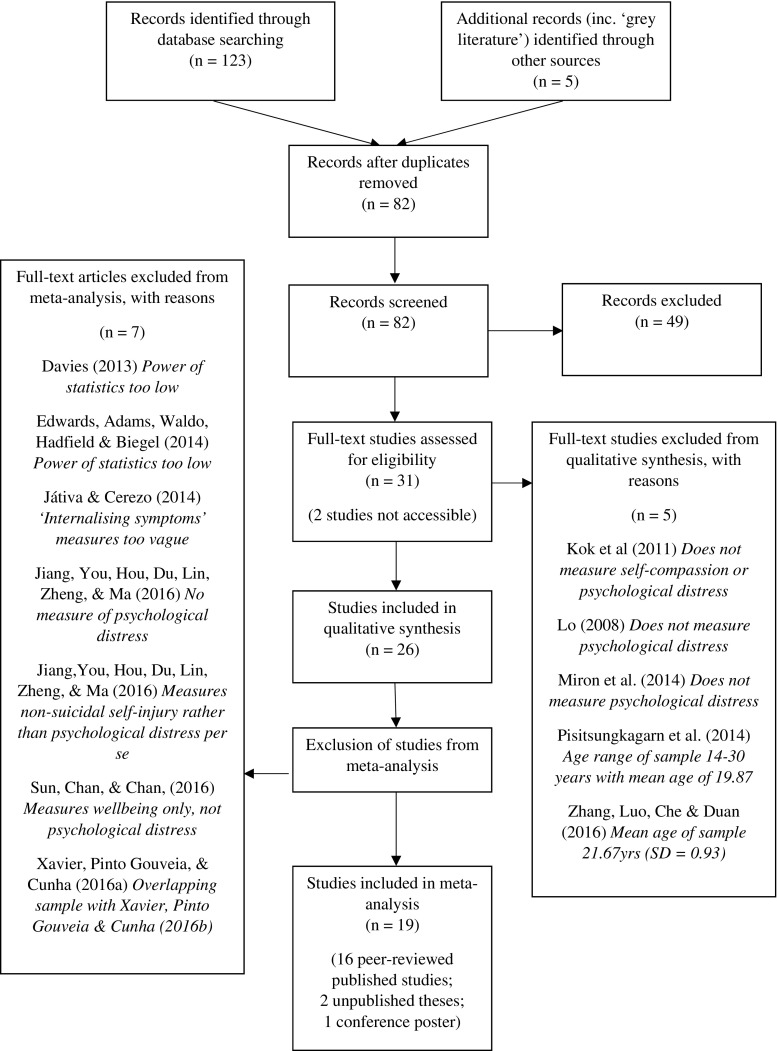
“Eight studies reported effect sizes for the relationship between self-compassion and multiple psychological distress outcomes (Barry et al. 2015; Bluth et al. 2017; Cunha et al. 2013; Galla 2016; Kemper et al. 2015; Neff and McGehee 2010; Tanaka et al. 2011).”
BackgroundMethodInfluentialMarshall, S. L., Parker, P. D., Ciarrochi, J., Sahdra, B., Jackson, C. J., & Heaven, P. C. L. (2015) · Personality and Individual Differences · doi:10.1016/j.paid.2014.09.013 · Cited by 194 · cited 3×
“29 ✓ ✓ ✓ Marshall et al., 2015 Self-compassion protects against the negative effects of low self-esteem: a longitudinal study in a large adolescent sample.”
BackgroundInfluentialMuris, P., & Meesters, C. (2014) · Clinical Child and Family Psychology Review · doi:10.1007/s10567-013-0137-z · Cited by 188 · cited 1×
“Muris and Meesters (2014) have highlighted the potential utility of selfcompassion interventions as a method of buffering against the formation of negative self-conscious emotional and cognitive styles (which are linked to development of anxiety and depression) in youth.”
BackgroundDoes Self-Compassion Protect Adolescents from Stress?
Bluth, K., Roberson, P. N. E., Gaylord, S. A., Faurot, K. R., Grewen, K. M., Arzon, S., & Girdler, S. S. (2016) · Journal of Child and Family Studies · doi:10.1007/s10826-015-0307-3 · Cited by 186 · cited 8×
“Similarly, a small-scale pilot of a 6-week mindful selfcompassion programme for non-clinical adolescents (Bluth et al. 2016a) has found that those who completed the programme reported increased levels of self-compassion and life satisfaction, as well as significantly lower levels of depression than…”
BackgroundInfluentialZeller, M., Yuval, K., Nitzan-Assayag, Y., & Bernstein, A. (2015) · Journal of Abnormal Child Psychology · doi:10.1007/s10802-014-9937-y · Cited by 185 · cited 5×
“In a naturalistic longitudinal study, Zeller et al. (2015) found that a higher level of selfcompassion at baseline was predictive of lower levels of psychopathology (depression, post-traumatic stress, panic, and suicidality) following a traumatic event in a sample of adolescents.”
BackgroundMethodInfluentialMuris, P., Meesters, C., Pierik, A., & de Kock, B. (2016) · Journal of Child and Family Studies · doi:10.1007/s10826-015-0235-2 · Cited by 168 · cited 2×
“In adolescent samples, some researchers have identified an interaction effect of gender and age on self-compassion, with older female adolescents having lower levels of self-compassion than younger females or males of any age (Bluth and Blanton 2015; Bluth et al. 2016a; Muris et al. 2016).”
BackgroundSun, X., Chan, D. W., & Chan, L.-K. (2016) · Personality and Individual Differences · doi:10.1016/j.paid.2016.06.011 · Cited by 168 · cited 1×
“Several studies have shown that female adolescents have lower levels of self-compassion than their male counterparts (Bluth and Blanton 2014; Castilho et al. 2017; Sun et al. 2016).”
BackgroundNieminen, P., Lehtiniemi, H., Vähäkangas, K., Huusko, A., & Rautio, A. (2022) · Epidemiology, Biostatistics, and Public Health · doi:10.2427/8854 · Cited by 167
Shame, self-criticism, and self-compassion in adolescence
Gilbert, P., & Irons, C. (2008) · Adolescent Emotional Development and the Emergence of Depressive Disorders · doi:10.1017/cbo9780511551963.011 · Cited by 165 · cited 4×
“…engage in mentalisation and form rewarding relationships with others—adolescence is a time of significant biopsychosocial change, and as such adolescents’ sympathetic nervous systems are highly ‘primed’ for activation, thus elevating risk for development of psychopathology (Gilbert and Irons 2009).”
BackgroundInfluentialXavier, A., Pinto‐Gouveia, J., & Cunha, M. I. V. A. (2016) · Child & Youth Care Forum · doi:10.1007/s10566-016-9346-1 · Cited by 164 · cited 6×
“The relationship between depressive symptoms and non-suicidal self-injury (NSSI; Xavier et al. 2016b) and peer victimisation and NSSI (Jiang et al. 2016) has been shown to be buffered by selfcompassion, as has the relationship between chronic academic stress and negative affect (Zhang et al. 2016).”
BackgroundInfluentialJátiva, R., & Cerezo, M. Á. (2014) · Child Abuse & Neglect · doi:10.1016/j.chiabu.2014.04.005 · Cited by 153 · cited 1×
“Játiva and Cerezo (2014) found that self-compassion acts as a buffer between negative life experiences (such as victimisation) and poor psychological outcomes in disadvantaged youths.”
BackgroundKrieger, T., Berger, T., & Holtforth, M. G. (2016) · Journal of Affective Disorders · doi:10.1016/j.jad.2016.05.032 · Cited by 149 · cited 1×
“…selfcompassion and psychological distress outcomes—although some researchers have demonstrated that low self-compassion predicts depression in later life: Krieger et al. (2016) report that in adults with depression, low self-compassion predicts elevated symptoms of depression 6 months later.”
BackgroundPreventing Alzheimer’s Disease and Cognitive Decline
April, & Natcher, W. H. (2010) · Cited by 148
Galla, B. M. (2016) · Journal of Adolescence · doi:10.1016/j.adolescence.2016.03.016 · Cited by 145 · cited 7×
“Eight studies reported effect sizes for the relationship between self-compassion and multiple psychological distress outcomes (Barry et al. 2015; Bluth et al. 2017; Cunha et al. 2013; Galla 2016; Kemper et al. 2015; Neff and McGehee 2010; Tanaka et al. 2011).”
BackgroundInfluentialHankin, B. L. (2015) · Current Opinion in Psychology · doi:10.1016/j.copsyc.2015.01.003 · Cited by 142 · cited 1×
“The lifetime prevalence of depression in 13- to 18-yearolds has been reported as 11% (Hankin 2015).”
BackgroundUnderstanding self-compassion in adolescents: validation study of the Self-Compassion scale
Cunha, M., Xavier, A., & Castilho, P. (2016) · Personality and Individual Differences · doi:10.1016/j.paid.2015.09.023 · Cited by 126 · cited 8×
“Due to the inclusion criteria, all studies in the final sample used the SCS (Neff 2003b), SCS-A (Cunha et al. 2015), or SCS-short-form (SCS-SF, Raes et al. 2011), and at least one valid measure of psychological distress (anxiety, depression, stress; see Table 2).”
BackgroundMethodInfluentialAdolescent Emotional Development and the Emergence of Depressive Disorders
Burke, M. G. (2009) · JAMA · doi:10.1001/jama.2009.1766 · Cited by 124
Edwards, M., Adams, E. M., Waldo, M., Hadfield, O. D., & Biegel, G. M. (2014) · The Journal for Specialists in Group Work · doi:10.1080/01933922.2014.891683 · Cited by 122 · cited 2×
“2016a; Galla 2016) and complementary (Bluth and Blanton 2014; Edwards et al. 2014) roles in reducing psychological distress symptoms and elevating well-being in youth; findings which echo those in adult samples (Baer et al.”
BackgroundJiang, Y., You, J., Hou, Y., Du, C., Lin, M., Zheng, X., & Ma, C. (2016) · Journal of Adolescence · doi:10.1016/j.adolescence.2016.09.005 · Cited by 120 · cited 2×
“2016b) and peer victimisation and NSSI (Jiang et al. 2016) has been shown to be buffered by selfcompassion, as has the relationship between chronic academic stress and negative affect (Zhang et al.”
BackgroundBluth, K., Roberson, P. N. E., & Gaylord, S. A. (2015) · EXPLORE · doi:10.1016/j.explore.2015.04.005 · Cited by 106 · cited 1×
“34 ✓ ✗ ✓ Bluth et al. (2015) A pilot study of a mindfulness intervention for adolescents and the potential role of self-compassion in reducing stress.”
BackgroundThe Protective Role of Self-Compassion on Risk Factors for Non-suicidal Self-Injury in Adolescence
Xavier, A., Pinto‐Gouveia, J., & Cunha, M. I. V. A. (2016) · School Mental Health · doi:10.1007/s12310-016-9197-9 · Cited by 105 · cited 6×
“The relationship between depressive symptoms and non-suicidal self-injury (NSSI; Xavier et al. 2016b) and peer victimisation and NSSI (Jiang et al. 2016) has been shown to be buffered by selfcompassion, as has the relationship between chronic academic stress and negative affect (Zhang et al. 2016).”
BackgroundInfluentialAdolescent Emotional Development and the Emergence of Depressive Disorders
(2008) · doi:10.1017/cbo9780511551963 · Cited by 89 · cited 2×
“…engage in mentalisation and form rewarding relationships with others—adolescence is a time of significant biopsychosocial change, and as such adolescents’ sympathetic nervous systems are highly ‘primed’ for activation, thus elevating risk for development of psychopathology (Gilbert and Irons 2009).”
Background"Sinking Into the Ground": The Development and Consequences of Shame in Adolescence
Reimer, M. S. (1996) · Developmental Review · doi:10.1006/drev.1996.0015 · Cited by 85 · cited 1×
“( 20 15 ) L on gi tu di na l N o (0 ) N /A N /A Y es (2 ) Y es (2 ) Y es (2 ) N /A Pa rt ia lly (1 ) C an ’t te ll/ no (0 ) C an ’t te ll (0 ) Y es (2 ) 9 56 % H ig h to symptoms of psychopathology (Reimer 1996).”
Castilho, P., Carvalho, S. A., Marques, S., & Pinto‐Gouveia, J. (2016) · Journal of Child and Family Studies · doi:10.1007/s10826-016-0613-4 · Cited by 80 · cited 7×
“Two studies reported separate effect sizes for the relationship between selfcompassion and anxiety (Xavier et al. 2016b) and depression (Castilho et al. 2017).”
BackgroundInfluentialKohn, P. M., & Milrose, J. A. (1993) · Journal of Youth and Adolescence · doi:10.1007/bf01537903 · Cited by 72
Zhang, Y., Luo, X., Che, X., & Duan, W. (2016) · Frontiers in Psychology · doi:10.3389/fpsyg.2016.01802 · Cited by 70 · cited 2×
“2016) has been shown to be buffered by selfcompassion, as has the relationship between chronic academic stress and negative affect (Zhang et al. 2016).”
BackgroundAcquiring Complex Focus-Marking: Finnish 4- to 5-Year-Olds Use Prosody and Word Order in Interaction
Arnhold, A., Chen, A., & Järvikivi, J. (2016) · Frontiers in Psychology · doi:10.3389/fpsyg.2016.01886 · Cited by 66
Xavier, A., Cunha, M. I. V. A., & Pinto‐Gouveia, J. (2015) · Revista de Psicopatología y Psicología Clínica · doi:10.5944/rppc.vol.1.num.1.2015.14407 · Cited by 48 · cited 1×
“…is a critical period characterised by vulnerability to psychological distress, and is therefore an important time for promotion of psychological well-being and early mental health intervention, in order to safeguard against the development of mental health issues (Xavier et al. 2015).”
BackgroundStolow, D., Zuroff, D. C., Young, J. F., Karlin, R. A., & Abela, J. R. Z. (2016) · Journal of Social and Clinical Psychology · doi:10.1521/jscp.2016.35.1.1 · Cited by 47 · cited 1×
“235 ✓ ✓ ✗ Stolow et al. (2016) A prospective examination of self-compassion as a predictor of depressive symptoms in children and adolescents.”
BackgroundGrant, D. M. (2013) · Springer eBooks · doi:10.1007/978-1-4614-6633-8_32 · Cited by 41 · cited 3×
“…period (such as the Bimaginary audience^; Elkind 1967) paired with greater cultural judgement of females (certainly within Western societies; Grant 2013), results in adolescent females’ increased vulnerability to the development anxiety, depression, and stress (Grant 2013), and the…”
BackgroundWhat Factors Contribute to Headache-Related Disability in Teens?
Kemper, K. J., Heyer, G., Pakalnis, A., & Binkley, P. F. (2016) · Pediatric Neurology · doi:10.1016/j.pediatrneurol.2015.10.024 · Cited by 40 · cited 3×
“132 ✗ ✓ ✓ Kemper et al. (2015) What factors contribute to headache-related disability in teens?”
BackgroundBeardslee, W., & Richmond, J. B. (2008) · American Academy of Pediatrics Textbook of Pediatric Care · doi:10.1542/9781581106411-6-section_1_chapter02 · Cited by 31 · cited 6×
“It is estimated that 15–30% of disability-adjusted life years are lost to early mental health problems (Kieling et al. 2011), and thus present a significant burden to the global economy (Patel et al. 2007).”
BackgroundInfluentialCunha, M., Martinho, M. I., Xavier, A., & Santo, H. E. (2013) · European psychiatry · doi:10.1016/s0924-9338(13)76444-7 · Cited by 24 · cited 2×
“1101 ✗ ✓ ✗ Cunha et al. (2013) Early memories of positive emotions and its relationships to attachment styles, self-compassion and psychopathology in adolescence.”
BackgroundWilliams, J. L. (2013) · ERA: Education and Research Archive (University of Alberta) · doi:10.7939/r3ph20 · Cited by 7 · cited 6×
“117 ✗ ✓ ✓ Trollope (2009) Stressful life-events and adolescent depression: the possible roles of self-criticism and self-compassion 107 ✗ ✓ ✗ Williams (2013) Examining the moderating effects of adolescent self-compassion on the relationship between social rank and depression.”
BackgroundInfluential
Research works printed but not linked: 7
- Beck, A. T., & Steer, R. A. (1987). Manual for the revised Beck depression inventory. San Antonio: Psychological Corporation.
- Conway, D. G. (2007). The role of internal resources in academic achievement: exploring the meaning of self-compassion in the adaptive functioning of low-income college students (Unpublished doctoral dissertation, University of Pittsburgh, USA).
- Davies, G. (2013). An investigation into the effectiveness of mindfulness-based cognitive therapy with adolescents (Unpublished doctoral dissertation: Canterbury Christ Church University, United Kingdom).
- Lachar, D., & Gruber, C. P. (1995). Personality inventory for youth (PIY) manual: technical guide. Los Angeles: Western Psychological Services.
- Schwarzer, G. (2007). Meta: an R package for meta-analysis. R news, 7(3), 40–45.
- Trollope, M. (2009). Stressful life-events and adolescent depression: the possible roles of self-criticism and self-compassion (Unpublished doctoral dissertation, University of East Anglia, United Kingdom).
- Xavier, A., Cunha, M., & Pinto Gouveia, J. (2015). Deliberate self-harm in adolescence: the impact of childhood experiences, negative affect and fears of compassion. Revista de Psicopatología y Psicología Clínica, 20(1), 41–49.
Cited by
Self-compassion: Theory, method, research, and intervention
Neff, K. D. (2023) · Annual Review of Psychology · doi:10.1146/annurev-psych-032420-031047 · Cited by 931
“…populations have found moderate to large effect sizes indicating an inverse association between selfcompassion and negative mental states such as depression, anxiety, stress, and suicidal ideation (Ferrari et al. 2019,Hughes et al. 2021,MacBeth &Gumley 2012,Marsh et al. 2018, Suh & Jeong 2021).”
BackgroundEffectiveness of Self-Compassion Related Therapies: a Systematic Review and Meta-analysis
Wilson, A. C., Mackintosh, K., Power, K., & Chan, S. W. Y. (2019) · Mindfulness · doi:10.1007/s12671-018-1037-6 · Cited by 301
Self-citationTurk, F., & Waller, G. (2020) · Clinical Psychology Review · doi:10.1016/j.cpr.2020.101856 · Cited by 248
Self-Compassion and Current Close Interpersonal Relationships: a Scoping Literature Review
Lathren, C. R., Rao, S. S., Park, J., & Bluth, K. (2021) · Mindfulness · doi:10.1007/s12671-020-01566-5 · Cited by 186
Development and Validation of the Self-Compassion Scale for Youth
Neff, K. D., Bluth, K., Tóth-Király, I., Davidson, O., Knox, M. C., Williamson, Z., & Costigan, A. (2021) · Journal of Personality Assessment · doi:10.1080/00223891.2020.1729774 · Cited by 175
“For example, a meta-analysis found a strong negative association with depression, anxiety and stress (Marsh et al., 2018) among adolescents.”
BackgroundResult
Metadata
- Authors
- Marsh, I. C., Chan, S. W. Y., & MacBeth, A.
- Affiliations
- University of Edinburgh (GB)
- Corresponding author
- MacBeth, Angus
- Venue
- Mindfulness
- Published
- 2017-11-25
- Volume
- 9
- Issue
- 4
- Pages
- 1011-1027
- ISSN
- 1868-8527 (ISSN-L)
- 1868-8535
- PMC
- PMC6061226
- OpenAlex
- W2769880865
- Cited by
- 465
- References
- 97
- Citations by year
- 2026: 58 · 2025: 72 · 2024: 71 · 2023: 73 · 2022: 76 · 2021: 55 · 2020: 41 · 2019: 12 · 2018: 6
- FWCI
- 2.46
- Type
- journal article
- Language
- en
- Open access
- hybrid
- doi.org
- Locations
- Mindfulness (publishedVersion, cc-by)
- Europe PMC (PubMed Central) (publishedVersion, cc-by)
- PubMed Central (publishedVersion, cc-by)
- PubMed (publishedVersion)
- Edinburgh Research Explorer (University of Edinburgh) (submittedVersion, cc-by)
- Funders
- University of Edinburgh
- Topics
- Social Sciences › Psychology › Clinical Psychology › Mindfulness and Compassion Interventions
- Social Sciences › Psychology › Social Psychology › Psychological Well-being and Life Satisfaction
- Social Sciences › Psychology › Developmental and Educational Psychology › Student Stress and Coping
- Keywords
- self-compassion, psychological distress, adolescents, anxiety, depression, stress, youth mental health, well-being interventions, emotional problems
About these checks
Registry, retraction, Cites and statistics results are computed, not judged, with one exception: a printed reference that no index lists is read once by a model before it counts as a citation error. Claims are extracted by a model and kept only when their quote appears verbatim in the text; each cited source is then checked, with a model’s help, for whether it says what the claim relies on. Those verdicts can be wrong — read the claim’s quote and the cited source before relying on one.
Statistics and arithmetic are recomputed, not judged.
Confidence bands are shown only for fields calibrated on our annotated test set. None is calibrated yet, so no band is shown.
What counts as a claim ›How we measure confidence ›How we check this ›
Are you an author, or do you see a problem with this page? Request a review
Data sources
Bibliographic data: Semantic Scholar, OpenAlex, Crossref.
Contains information from the Semantic Scholar Academic Graph Datasets, made available under the ODC Attribution License (ODC-BY 1.0).
Semantic Scholar’s data is described in: Kinney, R., et al. (2023). The Semantic Scholar Open Data Platform. arXiv:2301.10140.
