

The DOI matches its Crossref record; 48 of the 48 references it cites were found in a registry or an index.
The Effects of an Online Mindfulness Intervention on Perceived Stress, Depression and Anxiety in a Non-clinical Sample: A Randomised Waitlist Control Trial
Open accessAbstract
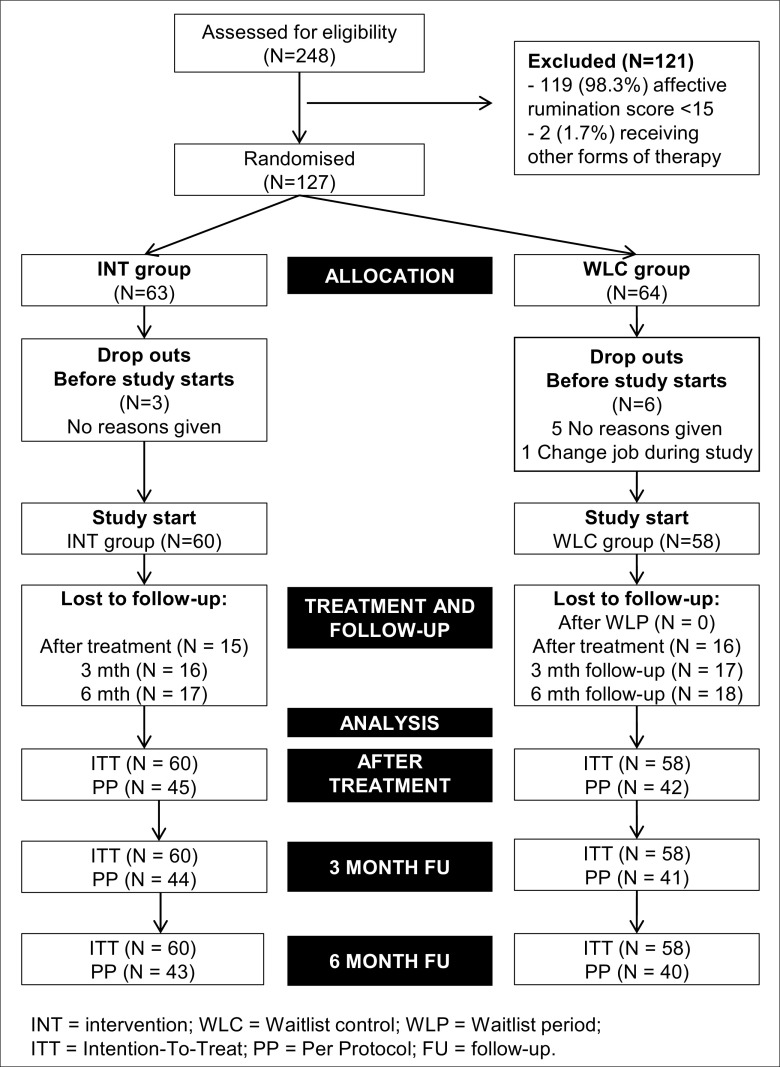
Mindfulness interventions have been shown to be effective for health and wellbeing, and delivering mindfulness programmes online may increase accessibility and reduce waiting times and associated costs; however, research assessing the effectiveness of online interventions is lacking. We sought to: (1) assess the effects of an online mindfulness intervention on perceived stress, depression and anxiety; (2) assess different facets of mindfulness (i.e. acting with awareness, describing, non-judging and non-reacting) as mechanisms of change and (3) assess whether the effect of the intervention was maintained over time. The sample was comprised of 118 adults (female, n = 95) drawn from the general population. Using a randomised waitlist control design, participants were randomised to either an intervention (INT) or waitlist control (WLC) group. Participants completed the online intervention, with the WLC group starting after a 6-week waitlist period. Participants completed measures of depression (PHQ-9), anxiety (GAD-7) and perceived stress (PSS-10) at baseline, post-treatment, 3- and 6-month follow-up. Participants who completed the mindfulness intervention ( n = 60) reported significantly lower levels of perceived stress ( d = − 1.25 [− 1.64, − 0.85]), anxiety ( d = − 1.09 [− 1.47, − 0.98]) and depression ( d = − 1.06 [− 1.44, − 0.67]), when compared with waitlist control participants ( n = 58), and these effects were maintained at follow-up. The effect of the intervention was primarily explained by increased levels of non-judging. This study provides support for online mindfulness interventions and furthers our understanding with regards to how mindfulness interventions exert their positive effects.
Overview
The claims and statistics of this paper haven’t been checked yet.
Run the check — free, no account needed. It reads the open-access text and checks the sources it cites.
Integrity signals
Registry
Cites
Statistics
Figures
Verification
Claims the paper makes
The claims and statistics of this paper haven’t been checked yet.
Run the check — free, no account needed. It reads the open-access text and checks the sources it cites.
Claims other papers make about this one
Each is checked against this paper’s own text: does it say what the citing paper says it does?
The source backs part of the claim, not all of it — or backs it for a different population, condition or comparison.
In the citing paper
“A study by Querstrert et al. [27] revealed that even a four-week training might be sufficient.”
From The Effectiveness of a Four-Week Online Mindfulness Training Course on Individual Mindfulness Skills and Personal Perception of Stress in Company Employees Working from Home (2022) · cites this paper as [27]
Experimental — accuracy not yet measuredThe source backs part of the claim, not all of it — or backs it for a different population, condition or comparison.
In the citing paper
“In previous studies, it has also been found that these effects can last up to several months after the end of the program (Khoury et al., 2015; Querstret et al., 2018).”
From Mindfulness-Based Stress Reduction Increases Mental Wellbeing and Emotion Regulation During the First Wave of the COVID-19 Pandemic: A Synchronous Online Intervention Study (2021) · cites this paper as Querstret et al., 2018
Experimental — accuracy not yet measured
Self-check
Percentages, sums and reported differences re-computed from the paper’s own numbers.
The self-check needs the paper’s full text.
Citations
Cites
Statistical Power Analysis for the Behavioral Sciences
Muller, K. E., & Cohen, J. (1989) · Technometrics · doi:10.2307/1270020 · Cited by 99,603
The PHQ-9: Validity of a brief depression severity measure
Kroenke, K., Spitzer, R. L., & Williams, J. B. W. (2001) · Journal of General Internal Medicine · doi:10.1046/j.1525-1497.2001.016009606.x · Cited by 44,910
Statistical power analyses using G∗Power 3.1: tests for correlation and regression analyses
Faul, F., Erdfelder, E., Buchner, A., & Lang, A.-G. (2009) · Behavior Research Methods · doi:10.3758/brm.41.4.1149 · Cited by 37,615
Statistical Power Analysis for the Behavioral Sciences (2nd ed.).
Lachenbruch, P. A., & Cohen, J. (1989) · Journal of the American Statistical Association · doi:10.2307/2290095 · Cited by 37,421
A Global Measure of Perceived Stress
Cohen, S., Kamarck, T., & Mermelstein, R. (1983) · Journal of Health and Social Behavior · doi:10.2307/2136404 · Cited by 32,807
A Brief Measure for Assessing Generalized Anxiety Disorder: The GAD-7
Spitzer, R. L., Kroenke, K., Williams, J. B. W., & Löwe, B. (2006) · Archives of Internal Medicine · doi:10.1001/archinte.166.10.1092 · Cited by 31,765
Using Self-Report Assessment Methods to Explore Facets of Mindfulness
Baer, R. A., Smith, G. T., Hopkins, J., Krietemeyer, J., & Toney, L. (2006) · Assessment · doi:10.1177/1073191105283504 · Cited by 7,511 · cited 1×
“Previous research has shown that the OBS facet is only predictive for participants with previous experience of meditation (Baer et al. 2006), and the participants in the current study were required to be naive to meditation; therefore, this facet was not utilised.”
Result(2008) · Medical Entomology and Zoology · Cited by 7,477
Introduction to mediation, moderation, and conditional process analysis :
Hayes, A. F., & names (2015) · Cited by 7,004
Required sample size to detect the mediated effect
Fritz, M. S., & MacKinnon, D. P. (2007) · Psychological Science · doi:10.1111/j.1467-9280.2007.01882.x · Cited by 4,810
Kabat-Zinn, J. (1982) · General Hospital Psychiatry · doi:10.1016/0163-8343(82)90026-3 · Cited by 4,255
(1988) · Cited by 4,111
Shapiro, S. L., Carlson, L. E., Astin, J. A., & Freedman, B. (2006) · Journal of Clinical Psychology · doi:10.1002/jclp.20237 · Cited by 4,002
Mindfulness-based stress reduction and health benefits
Grossman, P., Niemann, L., Schmidt, S., & Walach, H. (2004) · Journal of Psychosomatic Research · doi:10.1016/s0022-3999(03)00573-7 · Cited by 3,958
(2001) · Cited by 3,666
Mindfulness: Theoretical Foundations and Evidence for its Salutary Effects
Brown, K. W., Ryan, R. M., & Creswell, J. D. (2007) · Psychological Inquiry · doi:10.1080/10478400701598298 · Cited by 3,654
Prevention of relapse/recurrence in major depression by mindfulness-based cognitive therapy.
Teasdale, J. D., Segal, Z. V., Williams, J. M. G., Ridgeway, V. A., Soulsby, J. M., & Lau, M. A. (2000) · Journal of Consulting and Clinical Psychology · doi:10.1037/0022-006x.68.4.615 · Cited by 3,236
Applied Multivariate Research: Design and Interpretation
Meyers, L. S., Gamst, G. C., & GUARINO, A. J. (2017) · Sage eBooks · doi:10.4135/9781071802687 · Cited by 2,883
McLean, C. P., Asnaani, A., Litz, B. T., & Hofmann, S. G. (2011) · Journal of Psychiatric Research · doi:10.1016/j.jpsychires.2011.03.006 · Cited by 2,519
Mediators and Mechanisms of Change in Psychotherapy Research
Kazdin, A. E. (2007) · Annual Review of Clinical Psychology · doi:10.1146/annurev.clinpsy.3.022806.091432 · Cited by 2,504 · cited 1×
“For example, Kazdin (2007) recommends that both mediators and outcomes are measured several points throughout treatment to establish whether the mediator changes prior to any change in the outcome variable(s).”
BackgroundThe social psychology of health
(1989) · Choice Reviews Online · doi:10.5860/choice.26-5686 · Cited by 1,797
Mindfulness-based stress reduction and health benefits: A meta-analysis
Grossman, P., Niemann, L., Schmidt, S., & Walach, H. (2003) · Focus on Alternative and Complementary Therapies · doi:10.1111/j.2042-7166.2003.tb04008.x · Cited by 1,394 · cited 1×
“…for the efficacy of mindfulness courses—be that Mindfulness Based Stress Reduction (MBSR; Kabat Zinn 1982) or Mindfulness Based Cognitive Therapy (MBCT; Segal et al. 2002)—for a range of chronic health problems such as depression, chronic pain and anxiety disorders (Grossman et al. 2004).”
BackgroundBootstrapping: A Nonparametric Approach to Statistical Inference.
Aa, Mooney, C. Z., & Duval, R. D. (1994) · Journal of the American Statistical Association · doi:10.2307/2290969 · Cited by 1,365
Mindfulness-Based Cognitive Therapy for Depression: A New Approach to Preventing Relapse
Morgan, D. (2003) · Psychotherapy Research · doi:10.1080/713869628 · Cited by 1,307
Shapiro, S. L., Brown, K. W., & Biegel, G. M. (2007) · Training and Education in Professional Psychology · doi:10.1037/1931-3918.1.2.105 · Cited by 1,134 · cited 1×
“For example, Shapiro et al. (2007), employing a randomised waitlist control design, assessed the impact of an MBSR intervention, found a medium between-groups effect size (d = − 0.70), and in another randomised waitlist control trial, the authors reported a large between-group effect size for an…”
MethodInfluentialBohlmeijer, E., ten Klooster, P. M., Fledderus, M., Veehof, M., & Baer, R. (2011) · Assessment · doi:10.1177/1073191111408231 · Cited by 990 · cited 1×
“Mindfulness The Five Facet Mindfulness Questionnaire Short form (FFMQ-SF; Bohlmeijer et al. 2011) has 24-items that measure five facets of mindfulness: observing (OBS; 4 items, e.g.”
BackgroundPremature discontinuation in adult psychotherapy: A meta-analysis
Swift, J. K., & Greenberg, R. P. (2012) · Journal of Consulting and Clinical Psychology · doi:10.1037/a0028226 · Cited by 978 · cited 1×
“1) was comparable to other studies (for review, see Swift and Greenberg 2012).”
ResultSpijkerman, M. P. J., Pots, W. T. M., & Bohlmeijer, E. T. (2016) · Clinical Psychology Review · doi:10.1016/j.cpr.2016.03.009 · Cited by 975 · cited 2×
“…meta-analysis focussing exclusively on studies assessing online mindfulness-based interventions (n = 15; predominantly MBSR), reported small but beneficial effects on depression (g = 0.29), and anxiety (g = 0.22), and moderate effects for the reduction of stress (g = 0.51; Spijkerman et al. 2016).”
BackgroundResultInfluentialMooney, C., & Duval, R. (1993) · doi:10.4135/9781412983532 · Cited by 893
Reenvisioning Clinical Science: Unifying the Discipline to Improve the Public Health
Onken, L. S., Carroll, K. M., Shoham, V., Cuthbert, B. N., & Riddle, M. (2014) · Clinical Psychological Science · doi:10.1177/2167702613497932 · Cited by 872 · cited 2×
“Similarly, in the National Institutes Health Stage Model (Onken et al. 2014), a sixstage progressive model is proposed in the development of behavioural therapies.”
A stage model of behavioral therapies research: getting started and moving on from stage I.
Rounsaville, B. J., Carroll, K. M., & Onken, L. S. (2001) · Clinical Psychology: Science and Practice · doi:10.1093/clipsy.8.2.133 · Cited by 846
Glomb, T. M., Duffy, M. K., Bono, J. E., & Yang, T. (2011) · Research in Personnel and Human Resources Management · doi:10.1108/s0742-7301(2011)0000030005 · Cited by 809
Nyklíček, I., & Kuijpers, K. F. (2008) · Annals of Behavioral Medicine · doi:10.1007/s12160-008-9030-2 · Cited by 532
An empirical study of the mechanisms of mindfulness in a mindfulness-based stress reduction program.
Carmody, J., Baer, R. A., L. B. Lykins, E., & Olendzki, N. (2009) · Journal of Clinical Psychology · doi:10.1002/jclp.20579 · Cited by 526
Vøllestad, J., Sivertsen, B., & Nielsen, G. H. (2011) · Behaviour Research and Therapy · doi:10.1016/j.brat.2011.01.007 · Cited by 361
Finucane, A., & Mercer, S. W. (2006) · BMC Psychiatry · doi:10.1186/1471-244x-6-14 · Cited by 308 · cited 1×
“Furthermore, accessibility could be improved for a large number of people who may benefit but who may not be able to physically attend a face-to-face course (Finucane and Mercer 2006).”
BackgroundThe prevalence, clinical relevance, and public health significance of subthreshold depressions
Judd, L. L., Schettler, P. J., & Akiskal, H. S. (2002) · Psychiatric Clinics of North America · doi:10.1016/s0193-953x(02)00026-6 · Cited by 307
Lakens, D., & Evers, E. R. K. (2014) · Perspectives on Psychological Science · doi:10.1177/1745691614528520 · Cited by 266
van Aalderen, J. R., Donders, A. R. T., Giommi, F., Spinhoven, P., Barendregt, H. P., & Speckens, A. E. M. (2012) · Psychological Medicine · doi:10.1017/s0033291711002054 · Cited by 262
A qualitative study of mindfulness‐based cognitive therapy for depression
Mason, O., & Hargreaves, I. (2001) · British Journal of Medical Psychology · doi:10.1348/000711201160911 · Cited by 242 · cited 1×
“Indeed, this position is supported by qualitative studies suggesting that participants find the group context largely very helpful (e.g. Allen et al. 2009; Mason and Hargreaves 2001).”
BackgroundApplied multivariate research: Design and interpretation, 2nd ed.
Meyers, L. S., Gamst, G. C., & GUARINO, A. J. (2013) · Cited by 171
A randomized controlled pilot study of a brief web-based mindfulness training
Glück, T. M., & Maercker, A. (2011) · BMC Psychiatry · doi:10.1186/1471-244x-11-175 · Cited by 168
Querstret, D., Cropley, M., & Fife‐Schaw, C. (2016) · Journal of Occupational Health Psychology · doi:10.1037/ocp0000028 · Cited by 164
Allen, M., Bromley, A., Kuyken, W., & Sonnenberg, S. J. (2009) · Behavioural and Cognitive Psychotherapy · doi:10.1017/s135246580999004x · Cited by 160 · cited 1×
“Indeed, this position is supported by qualitative studies suggesting that participants find the group context largely very helpful (e.g. Allen et al. 2009; Mason and Hargreaves 2001).”
BackgroundMissing outcomes in randomized trials: addressing the dilemma.
Altman, D. G. (2009) · PubMed Central · Cited by 149
Krusche, A., Cyhlarova, E., King, S., & Williams, J. M. G. (2012) · BMJ Open · doi:10.1136/bmjopen-2011-000803 · Cited by 121 · cited 8×
“The effect sizes in this study rival those of studies which have employed a group-based face-to-face format for mindfulnessbased intervention delivery (e.g. see Nyklicek and Kuijpers 2008), and they align with the findings from Krusche et al. (2012) in their pre-post study design.”
BackgroundResultInfluentialChanges in facets of mindfulness and posttraumatic stress disorder treatment outcome
Boden, M. T., Bernstein, A., Walser, R. D., Bui, L., Alvarez, J., & Bonn-Miller, M. O. (2012) · Psychiatry Research · doi:10.1016/j.psychres.2012.07.011 · Cited by 78 · cited 1×
“From the clinical literature, Boden et al. (2012) found that the impact of their intervention on post-treatment posttraumatic stress disorder severity was mediated by acting with awareness; whereas, the impact on posttreatment depression severity was mediated by non-judging.”
BackgroundIntroduction to the special series on psychological reports
Groth‐Marnat, G. (2005) · Journal of Clinical Psychology · doi:10.1002/jclp.20195 · Cited by 10
Research works printed but not linked: 1
- IBM Corp. (2012). IBM SPSS statistics for Windows, Version 21.0. Armonk: IBM Corp.
Cited by
Sorted by citations
Carpenter, J. K., Conroy, K., Gomez, A. F., Curren, L. C., & Hofmann, S. G. (2019) · Clinical Psychology Review · doi:10.1016/j.cpr.2019.101785 · Cited by 342
The future of mindfulness training is digital, and the future is now
Mrazek, A. J., Mrazek, M. D., Cherolini, C. M., Cloughesy, J. N., Cynman, D. J., Gougis, L. J., Landry, A. P., Reese, J. V., & Schooler, J. W. (2019) · Current Opinion in Psychology · doi:10.1016/j.copsyc.2018.11.012 · Cited by 201
Sommers-Spijkerman, M., Austin, J., Bohlmeijer, E., & Pots, W. (2021) · JMIR Mental Health · doi:10.2196/28168 · Cited by 179
“dThree outliers were removed: Kladnitski et al [34] (study 4); Querstret et al [35,36]; Yang et al [37].”
BackgroundMethodInfluentialFauzi, M. F., Anuar, T. S., Teh, L. K., Lim, W. F., James, R. J., Ahmad, R., Mohamed, M. B., Bakar, S. H. A., Yusof, F. Z. M., & Salleh, M. Z. (2021) · International Journal of Environmental Research and Public Health · doi:10.3390/ijerph18063269 · Cited by 167
Domhardt, M., Steubl, L., Boettcher, J., Buntrock, C., Karyotaki, E., Ebert, D. D., Cuijpers, P., & Baumeister, H. (2021) · Clinical Psychology Review · doi:10.1016/j.cpr.2020.101953 · Cited by 106
Metadata
- Authors
- Querstret, D., Cropley, M., & Fife-Schaw, C.
- Affiliations
- University of Surrey (GB)
- Corresponding author
- Querstret, Dawn
- Venue
- Mindfulness
- Published
- 2018-05-02
- Volume
- 9
- Issue
- 6
- Pages
- 1825-1836
- ISSN
- 1868-8527 (ISSN-L)
- 1868-8535
- PMC
- PMC6244637
- OpenAlex
- W2802354969
- Cited by
- 103
- References
- 48
- Citations by year
- 2026: 9 · 2025: 17 · 2024: 18 · 2023: 16 · 2022: 16 · 2021: 10 · 2020: 11 · 2019: 4 · 2018: 2
- FWCI
- 7.93
- Type
- journal article
- Language
- en
- Open access
- hybrid
- doi.org
- Licence
- Locations
- Mindfulness (publishedVersion, cc-by)
- Europe PMC (PubMed Central) (publishedVersion, other-oa)
- PubMed Central (publishedVersion, cc-by)
- PubMed (publishedVersion)
- Surrey Research Insight Open Access (The University of Surrey) (submittedVersion)
- Funders
- University of Surrey
- Topics
- Social Sciences › Psychology › Clinical Psychology › Mindfulness and Compassion Interventions
- Social Sciences › Psychology › Applied Psychology › Digital Mental Health Interventions
- Social Sciences › Psychology › Social Psychology › Psychological Well-being and Life Satisfaction
- Keywords
- online mindfulness intervention, perceived stress, depression, anxiety, non-judgment, mechanisms of change, non-clinical adults, maintenance of intervention effects, waitlist control
About these checks
Registry, retraction, Cites and statistics results are computed, not judged, with one exception: a printed reference that no index lists is read once by a model before it counts as a citation error. Claims are extracted by a model and kept only when their quote appears verbatim in the text; each cited source is then checked, with a model’s help, for whether it says what the claim relies on. Those verdicts can be wrong — read the claim’s quote and the cited source before relying on one.
Statistics and arithmetic are recomputed, not judged.
Confidence bands are shown only for fields calibrated on our annotated test set. None is calibrated yet, so no band is shown.
What counts as a claim ›How we measure confidence ›How we check this ›
Are you an author, or do you see a problem with this page? Request a review
