

Consequences of mandated usage of innovations in organizations: developing an innovation decision model of symbolic and forced adoption
Open accessThe DOI matches its Crossref record; 140 of the 144 references it cites were found in a registry or an index.
Abstract
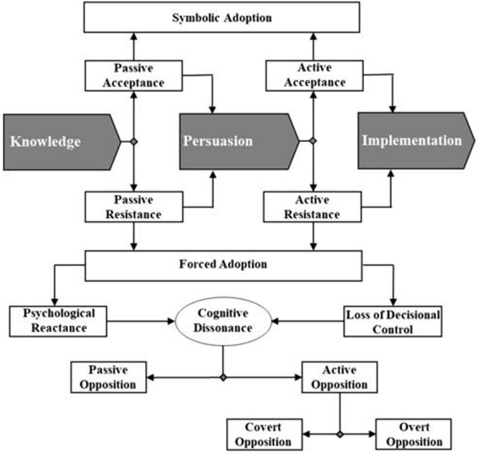
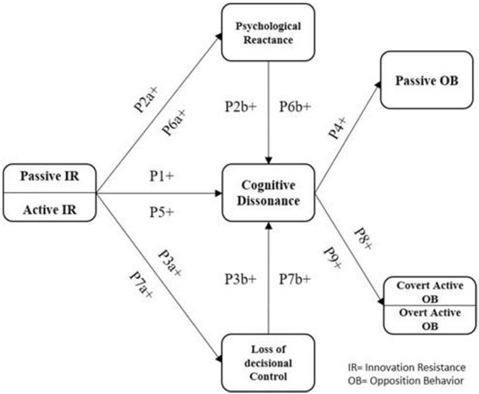
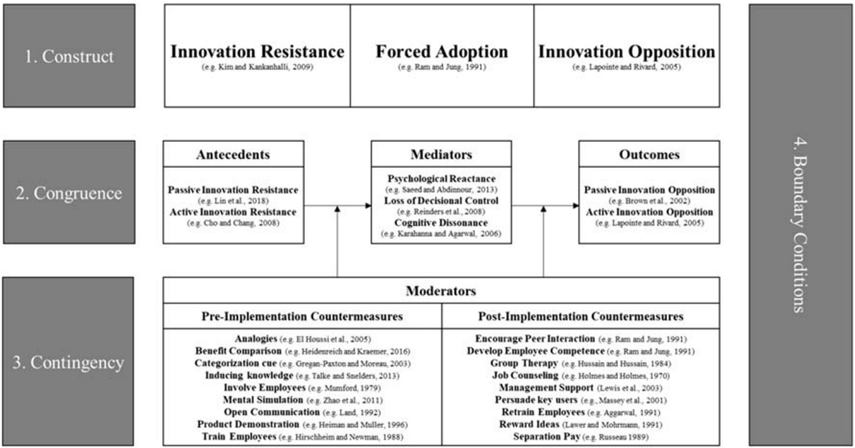
In organizations, mandated adoption contexts are the rule rather than the exception. Individuals, who are denied the choice between adopting and rejecting an innovation, are more likely to engage in opposition behavior, particularly if the innovation conflicts with their held beliefs. Interestingly, neither the construct of forced adoption nor its consequences have received much research attention. To address this gap, we conduct a systematic literature review and provide theoretical rationales for the emergence of innovation resistance and opposition behaviors in organizations. We then develop an innovation decision model of individual adoption behavior that localizes negative outcomes of the secondary adoption process along the different process stages, providing insights into their emergence and potential consequences for the organization. Furthermore, we identify important avenues for future research and show how our innovation decision model can be used to advance theory development on forced adoption.
Overview
The claims and statistics of this paper haven’t been checked yet.
Free: it reads the open-access text and checks the first 5 claims that cite a source we can check. Create a free account to check every claim.
Integrity signals
Registry
Cites
Statistics
Figures
Verification
Claims the paper makes
The claims and statistics of this paper haven’t been checked yet.
Free: it reads the open-access text and checks the first 5 claims that cite a source we can check. Create a free account to check every claim.
Claims other papers make about this one
Each is checked against this paper’s own text: does it say what the citing paper says it does?
The source backs part of the claim, not all of it — or backs it for a different population, condition or comparison.
In the citing paper
“This is relevant as the bias might have different effects on the level of the primary adoption process on a group level and on the secondary adoption process on an individual level (Heidenreich and Talke 2020) and might also call for different countermeasures.”
From How to measure the status quo bias? A review of current literature (2023) · cites this paper as Heidenreich and Talke 2020
Experimental — accuracy not yet measured
Self-check
Percentages, sums and reported differences re-computed from the paper’s own numbers.
The self-check needs the paper’s full text.
Citations
Cites
Rogers, E. M., Singhal, A., & Quinlan, M. M. (2019) · An Integrated Approach to Communication Theory and Research · doi:10.4324/9780203710753-35 · Cited by 37,322
The "what" and "why" of goal pursuits: Human needs and the self-determination of behavior
Deci, E. L., & Ryan, R. M. (2000) · Psychological Inquiry · doi:10.1207/s15327965pli1104_01 · Cited by 34,210
User Acceptance of Computer Technology: A Comparison of Two Theoretical Models
Davis, F. D., Bagozzi, R. P., & Warshaw, P. R. (1989) · Management Science · doi:10.1287/mnsc.35.8.982 · Cited by 25,709
A Theory of Cognitive Dissonance
Festinger, L. (1957) · doi:10.1515/9781503620766 · Cited by 24,241
A Theoretical Extension of the Technology Acceptance Model: Four Longitudinal Field Studies
Venkatesh, V., & Davis, F. D. (2000) · Management Science · doi:10.1287/mnsc.46.2.186.11926 · Cited by 23,066
Advances In Experimental Social Psychology
(2022) · Advances in Experimental Social Psychology · doi:10.1016/s0065-2601(22)x0002-6 · Cited by 22,259
A Theory of Cognitive Dissonance
(2017) · Macat Library eBooks · doi:10.4324/9781912282432 · Cited by 18,122 · cited 1×
“Social psychological research uses cognitive dissonance theory (Aronson 1969; Festinger 1957) to describe such unpleasant states of dissonance that occur whenever an individual simultaneously holds two cognitions that are psychologically inconsistent.”
BackgroundValente, T. W. (2003) · Genetics in Medicine · doi:10.1097/01.gim.0000061743.67794.c4 · Cited by 13,723
(2025) · doi:10.53555/acr.v2i2 · Cited by 13,264
Perceived Behavioral Control, Self‐Efficacy, Locus of Control, and the Theory of Planned Behavior 1
Ajzen, I. (2002) · Journal of Applied Social Psychology · doi:10.1111/j.1559-1816.2002.tb00236.x · Cited by 7,629 · cited 1×
“Previous studies show that colleagues’ opinions have a salient social influence (Lewis et al. 2003), such that employees have the tendency to conform to their colleagues’ opinions (Ajzen 2002; Lewis et al. 2003) due to their need for social companionship (Kim and Kankanhalli 2009).”
Result
Research works printed but not linked: 5
- Dubin, R. (1978). Theory building. New York: Free Press.
- Karahanna, E., & Agarwal, R. (2006). When the spirit is willing: Symbolic adoption and technology exploration. Athens: University of Georgia.
- Kimberling, E. (2014). 2014 ERP report. Denver: Panorama Consulting Solutions.
- Klonglan, G. E., & Coward, E. W. (1970). The concept of symbolic adoption: A suggested interpretation. Rural Sociology, 35(1), 77-83.
- Mumford, E. (1979). Human values and the introduction of technological change. Manchester Business School Review, 3(2), 13-17.
Cited by
Brem, A., Viardot, E., & Nylund, P. A. (2021) · Technological Forecasting and Social Change · doi:10.1016/j.techfore.2020.120451 · Cited by 389
Klein, S. P., Spieth, P., & Heidenreich, S. (2021) · Journal of Product Innovation Management · doi:10.1111/jpim.12563 · Cited by 190
Self-citationThe role of institutional and self in the formation of trust in artificial intelligence technologies
Wong, L.-W., Tan, G. W.-H., Ooi, K.-B., & Dwivedi, Y. (2024) · Internet Research · doi:10.1108/intr-07-2021-0446 · Cited by 105
How to measure the status quo bias? A review of current literature
Godefroid, M.-E., Plattfaut, R., & Niehaves, B. (2023) · Management Review Quarterly · doi:10.1007/s11301-022-00283-8 · Cited by 101
“This is relevant as the bias might have different effects on the level of the primary adoption process on a group level and on the secondary adoption pro‑ cess on an individual level (Heidenreich and Talke 2020) and might also call for different countermeasures.”
BackgroundBouguerra, A., Hughes, M., Rodgers, P., Stokes, P. J., & Tatoğlu, E. (2023) · Journal of Product Innovation Management · doi:10.1111/jpim.12692 · Cited by 89
Lino, A. F., de Aquino, A. C. B., & Neves, F. R. (2021) · Financial Accountability and Management · doi:10.1111/faam.12313 · Cited by 66
Artificial Intelligence and Groups: Effects of Attitudes and Discretion on Collaboration
Bezrukova, K., Griffith, T. L., Spell, C., Rice, V., & Yang, H. E. (2023) · Group & Organization Management · doi:10.1177/10596011231160574 · Cited by 51
“Unlike negative attitudes toward AI that may re fl ect an emotional bond with human interaction (Lichtenthaler, 2020), teams with positive attitudes toward AI are internally motivated (Heidenreich & Talke, 2020) as they would want to adopt the innovation voluntarily.”
InfluentialThe role of brand in overcoming consumer resistance to autonomous vehicles
Casidy, R., Claudy, M., Heidenreich, S., & Camurdan, E. (2021) · Psychology and Marketing · doi:10.1002/mar.21496 · Cited by 51
Self-citationShahreki, J., & Lee, J. Y. (2024) · Cross Cultural & Strategic Management · doi:10.1108/ccsm-09-2022-0144 · Cited by 32
Resilient manufacturing: case studies in Thai automotive industries during the COVID-19 pandemic
Kaeo-Tad, N., Jeenanunta, C., Chumnumporn, K., Nitisahakul, T., & Sanprasert, V. (2021) · Engineering Management in Production and Services · doi:10.2478/emj-2021-0024 · Cited by 32
“Some technologies already existed before the pandemic, but it became the factor that led to forced adoption aiming to survive (Heidenreich & Talke, 2020; Giones et al., 2020).”
BackgroundAjmal, M. M., Khan, M., Shad, M. K., Alkatheeri, H. B., & Jabeen, F. (2021) · The International Journal of Logistics Management · doi:10.1108/ijlm-04-2021-0220 · Cited by 27
Is New Always Better? How Business Model Innovation Affects Consumers’ Adoption Behavior
Futterer, F., Heidenreich, S., & Spieth, P. (2022) · IEEE transactions on engineering management · doi:10.1109/tem.2020.3014403 · Cited by 13
“domain refers to different types of innovation resistance [20], [43], [94], hat bear significant potential to explain why certain innovations can or cannot unfold their full potential.”
BackgroundSelf-citationSchaarschmidt, M., Walsh, G., Dose, D. B., & Christ‐Brendemühl, S. (2021) · European Management Journal · doi:10.1016/j.emj.2021.10.010 · Cited by 18
Liu, X., Wang, F., & Hoo, W. C. (2022) · Frontiers in Psychology · doi:10.3389/fpsyg.2022.923094 · Cited by 12
“In addition, this outcome is also similar to Joachim et al. (2018) also examine the impact of social enterprises’ behavior toward innovation adoption, and the traditional nature of social enterprises are unwilling to adopt the innovation because they have lack of sources to adopt innovation in the business processes.”
BackgroundOoi, E. C. W., Isa, Z. M., Manaf, M. R. A., Fuad, A. S. A., Ahmad, A., Mustapa, M. N., & Marzuki, N. M. (2024) · Scientific Reports · doi:10.1038/s41598-024-60439-2 · Cited by 13
“Users may hold an unfavourable opinion and not want to adopt the innovation 16,18 .”
BackgroundDesign thinking traits and cognitive passive resistance: mediating effect of linear thinking
Ospina, J. M. G., & Sánchez, D. E. G. (2022) · Management Research Review · doi:10.1108/mrr-11-2021-0803 · Cited by 14
Müller, M. M., Böhm, K. L., & Renz, E. (2023) · Managerial and Decision Economics · doi:10.1002/mde.3901 · Cited by 13
The antecedents of m-banking usage under capital controls in Greece – a mixed methods approach
Patsiotis, A. G., Krasonikolakis, I. G., & Lyu, J. (2022) · International Journal of Bank Marketing · doi:10.1108/ijbm-01-2022-0001 · Cited by 11
Spieth, P., Röth, T., Clauß, T., Urhahn, C., & Killen, C. P. (2021) · IEEE Transactions on Engineering Management · doi:10.1109/tem.2021.3102517 · Cited by 10
“tiveness variety [13], [49], [95], [98].”
BackgroundThe dark side of innovation in local authorities: influential typologies and impacted modalities
Boutchich, D. E. K., & Gallouj, N. (2022) · International Journal of Innovation Science · doi:10.1108/ijis-08-2021-0159 · Cited by 8
I am too young for this! A moderated-mediation model of metaverse commerce resistance
Ooi, K., Hew, J.-J., Aw, E. C., Cham, T., Lin, C., & Tan, G. W. (2025) · Journal of Retailing and Consumer Services · doi:10.1016/j.jretconser.2025.104224 · Cited by 10
Choi, I. (2025) · International Review of Administrative Sciences · doi:10.1177/00208523241301956 · Cited by 10
“This perception could result in stress, fatigue, or other negative psychological attitudes associated with demonstrating IWB (Brown and Osborne, 2013; Heidenreich and Talke, 2020), ultimately leading to turnover intention.”
Elgazouly, M., AbdelAziz, G. S., & Fathy, D. (2022) · The Academic Journal of Contemporary Commerical Research · doi:10.21608/ajccr.2022.277219 · Cited by 8
“Heidenreich & Talke (2020) argues this innovation resistance must be understood to facilitate new technology adoption among consumers.”
BackgroundChange Triggers in Early Innovation Stages: How Technology Pilots Enable Routine Reflection
ter Huurne, R., Scholtenhuis, L. O., & Dorée, A. G. (2022) · Journal of Construction Engineering and Management · doi:10.1061/(asce)co.1943-7862.0002307 · Cited by 4
“…is considered to be rather disruptive, enforcing organizational change (Lines and Reddy Vardireddy 2017), provoking opposing behavior (Heidenreich and Talke 2020), and potentially triggering implementation failures (Klaus and Blanton 2010), this study postulated that the possibility…”
BackgroundStrategies for Mitigating Flood Risks in Western Region, Kenya
Nasambu, O. B., & Mugalavai, E. M. (2023) · African Journal of Empirical Research · doi:10.51867/ajernet.4.2.108 · Cited by 6
“An innovation’s consequences may create uncertainty: Consequences are the changes that occur in an individual or a social system as a result of the adoption or rejection of an innovation (S. Heidenreich & Talke, 2020).”
BackgroundCan Regulatory Efforts Motivate Innovation? The Case of Ventilator Innovations During COVID
Stanislow, K., Rothenberg, S. L., Leo, E. M., & Esterman, M. (2021) · IEEE Engineering Management Review · doi:10.1109/emr.2021.3127452 · Cited by 4
Schwehn, L. H., Heußler, T., & Backhaus, C. (2026) · Transport Policy · doi:10.1016/j.tranpol.2026.104110 · Cited by 3
Revolutionising autonomous vehicles: inspiring consumers in the age of Industry 4.0 technologies
McLeay, F., Olya, H., Lichy, J., & Pandit, A. (2025) · Journal of Marketing Management · doi:10.1080/0267257x.2025.2541840 · Cited by 4
“…innovations requires consumers to accept significant changes, which invariably creates uncertainty and risk (Garcia et al., 2007) and can arouse strong negative reactions (Heidenreich & Talke, 2020) resulting in market failure and detrimental consequences for the firm (Heidenreich & Kraemer, 2015).”
Multi-Criteria Evaluation of Mobile Fitness Applications During COVID-19 Pandemic Based on AHP
Ercan, C. (2023) · Pamukkale Journal of Sport Sciences · doi:10.54141/psbd.1182006 · Cited by 3
Ramírez-Portilla, A., Pérez, D. M. V., Massri, I. A., & Kinney, Á. E. O. M. (2023) · Ciencia Nicolaita · doi:10.35830/cn.vi88.680 · Cited by 2
Schaarschmidt, M., Heidenreich, S., & Bertram, M. (2025) · Journal of Management Information Systems · doi:10.1080/07421222.2025.2561389 · Cited by 2
“PIR is defined as a general predisposition to resist innovations that evolves even before any active evaluation of a specific new product or service occurs [24].”
Self-citationMediatised live sport as leisure experience: exploring the adoption of media technologies
Kim, S., Karg, A., Breitbarth, T., & Raw, K. (2026) · Leisure Studies · doi:10.1080/02614367.2026.2656256 · Cited by 2
Does innovation drive customer relationship management performance? The case of Qatar
Ramdani, B., Bouchakour, R., & Abdellatif, M. (2026) · Humanities and Social Sciences Communications · doi:10.1057/s41599-026-07240-w · Cited by 2
“Policies intended for SMEs could focus on these orientations to help overcome resistance to innovation (Heidenreich and Talke, 2020).”
Lee, J.-M., & Kim, S. (2026) · Journal of theoretical and applied electronic commerce research · doi:10.3390/jtaer21040126 · Cited by 4
Yuliana, Y. (2022) · Journal of Indonesian Economy and Business · doi:10.22146/jieb.v37i3.2746 · Cited by 2
Adoption, diffusion, and innovation of IoT in Indonesian concrete manufacturing industry
Fauzia, N., Mani, L., Novelia, D., & Kalonica, D. (2025) · Multidisciplinary Science Journal · doi:10.31893/multiscience.2026203 · Cited by 2
Converting case conferences to peer learning: Opportunities and barriers
Kadom, N., Sivathapandi, T., Murcia, D. J., Moreno, C., & Balthazar, P. (2025) · Current Problems in Diagnostic Radiology · doi:10.1067/j.cpradiol.2025.01.004 · Cited by 1
Drohnen in der Intralogistik: Chancen und Barrieren
Spurk, A., Grosse, E. H., Schnellbächer, B., & Glock, C. H. (2022) · Zeitschrift für wirtschaftlichen Fabrikbetrieb · doi:10.1515/zwf-2022-1100 · Cited by 1
Adopción Forzada de Tecnología en Personas Mayores. Una revisión Exploratoria de la Literatura
Diez, M. F. C., Barrueto, C. M., & Pavez, I. (2024) · Research on Ageing and Social Policy · doi:10.17583/rasp.12902 · Cited by 1
Customer Satisfaction as a Key Driver of M-Tix Usage Intention: An Analytical Study
Stefania, F. (2024) · Economics Business Accounting & Society Review · doi:10.55980/ebasr.v3i1.98 · Cited by 1
“Employee resistance to organizational innovation is the biggest challenge that can lead to implementation failure and even threaten business continuity (Heidenreich & Talke, 2020).”
BackgroundImpact of the Emergency Use Authorization on Ventilator Innovation
Stanislow, K. (2020) · RIT Scholar Works (Rochester Institute of Technology)
Service Robots in the Wild: The Impact of the Robotic-Human Intrusion Challenge on FLE Well-Being
Phillips, C. (2024) · Queensland University of Technology · doi:10.5204/thesis.eprints.251864
Global Breakdowns and Transformations in the World of Sports After Covid‐19
Ercan, Ö. (2024) · Advances in experimental medicine and biology · doi:10.1007/978-3-031-61939-7_25
Introducing a Computerized Care‐Pathways System for Older Adults in Home‐Care Settings
Dubuc, N., N’Bouké, A., Corbin, C., & Delli-Colli, N. (2025) · Health & Social Care in the Community · doi:10.1155/hsc/5535495
“A large part can be explained by the consequences of forced adoption [128] and the cognitive dissonance theory [132] applied to technology adoption [133].”
InfluentialChoi, I. (2025) · Revue Internationale des Sciences Administratives · doi:10.3917/risa.912.0351
Essays in Behavioral Economics
Böhm, K. L. (2023) · DuEPublico (University of Duisburg-Essen) · doi:10.17185/duepublico/78458
Lessa, W. P. (2024) · LA Referencia (Red Federada de Repositorios Institucionales de Publicaciones Científicas)
saha (2025) · Journal of Informatics Education and Research · doi:10.52783/jier.v5i4.4364
Louart, S. (2024) · theses.fr (ABES) · doi:10.70675/57eccaa5z4d60z4628zb6e3z12d8aff48752
Soliman, M., Sankar, J. G., Darwish, D. A. M., Nousir, A., & Ali, R. A. (2026) · Ingénierie des systèmes d information · doi:10.18280/isi.310316
Soeiro, T. D. M., Wanderley, C. D. A., Cullen, J., & Tsamenyi, M. (2026) · Accounting Forum · doi:10.1080/01559982.2026.2655530
Understanding customers' Reactance towards Neo Bank
Garg, N., & Sahu, G. P. (2026) · ReMark - Revista Brasileira de Marketing · doi:10.5585/2026.26128
Compreendendo a reatância dos clientes em relação aos neobancos
Garg, N., & Sahu, G. P. (2026) · ReMark - Revista Brasileira de Marketing · doi:10.5585/2026.31221
Ajayi, D., Kelsey, K., Galindo, S., Monaghan, P., & Rodriguez‐Saona, C. (2026) · Journal of Agricultural Science · doi:10.5539/jas.v18n8p11
“…and subjective norms are, the greater their perceived control, leading to increases in their intention to perform the behavior; in this case, the adoption of SPMPs. Technologies that are congruent with growers’ attitude and belief systems are more likely to be adopted (Heidenreich & Talke, 2020).”
Makwinya, N. M. (2026) · Cogent Education · doi:10.1080/2331186x.2026.2713814
Pınaroğlu, B., AYYILDIZ, S., & Türker, N. (2026) · Journal of Hospitality & Tourism Education · doi:10.1080/10963758.2026.2756294
Metadata
- Authors
- Heidenreich, S., & Talke, K.
- Affiliations
- Saarland University (DE)
- Technische Universität Berlin (DE)
- Corresponding author
- Heidenreich, Sven
- ORCID
- Heidenreich, Sven
- Venue
- AMS Review
- Published
- 2020-04-07
- Volume
- 10
- Issue
- 3-4
- Pages
- 279-298
- ISSN
- 1869-814X (ISSN-L)
- 1869-8182
- OpenAlex
- W3015571773
- Cited by
- 46
- References
- 144
- Citations by year
- 2026: 7 · 2025: 8 · 2024: 5 · 2023: 7 · 2022: 9 · 2021: 8 · 2020: 2
- FWCI
- 4.14
- Type
- journal article
- Language
- en
- Open access
- hybrid
- doi.org
- Licence
- cc-by
- creativecommons.org/licenses/by/4.0 (tdm)
- creativecommons.org/licenses/by/4.0 (vor)
- Locations
- AMS Review (publishedVersion, cc-by)
- RePEc: Research Papers in Economics (submittedVersion)
- Econstor (Econstor) (submittedVersion, cc-by)
- Publications of the UdS (Saarland University) (cc-by)
- Funders
- Universität des Saarlandes
- Topics
- Social Sciences › Decision Sciences › Management Science and Operations Research › Innovation Diffusion and Forecasting
- Social Sciences › Decision Sciences › Information Systems and Management › Technology Adoption and User Behaviour
- Social Sciences › Business, Management and Accounting › Organizational Behavior and Human Resource Management › Management and Organizational Studies
- Keywords
- forced adoption, symbolic adoption, innovation adoption, resistance to innovation, organizational innovation, belief conflict
About these checks
Registry, retraction, Cites and statistics results are computed, not judged, with one exception: a printed reference that no index lists is read once by a model before it counts as a citation error. Claims are extracted by a model and kept only when their quote appears verbatim in the text; each cited source is then checked, with a model’s help, for whether it says what the claim relies on. Those verdicts can be wrong — read the claim’s quote and the cited source before relying on one.
Statistics and arithmetic are recomputed, not judged.
Confidence bands are shown only for fields calibrated on our annotated test set. None is calibrated yet, so no band is shown.
What counts as a claim ›How we measure confidence ›How we check this ›
Are you an author, or do you see a problem with this page? Request a review
Data sources
Bibliographic data: Semantic Scholar, OpenAlex, Crossref.
Contains information from the Semantic Scholar Academic Graph Datasets, made available under the ODC Attribution License (ODC-BY 1.0).
Semantic Scholar’s data is described in: Kinney, R., et al. (2023). The Semantic Scholar Open Data Platform. arXiv:2301.10140.
