

Consequences of mandated usage of innovations in organizations: developing an innovation decision model of symbolic and forced adoption
Open accessThe DOI matches its Crossref record; 140 of the 144 references it cites were found in a registry or an index.
Abstract
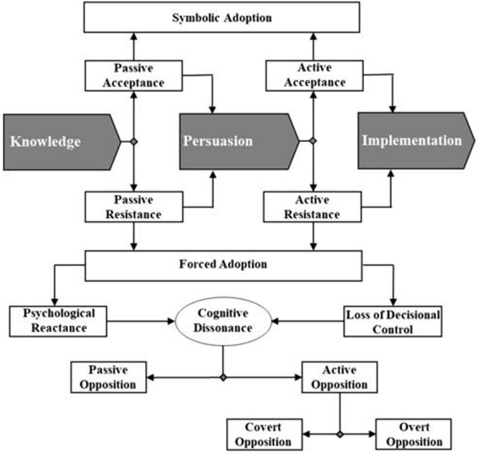
In organizations, mandated adoption contexts are the rule rather than the exception. Individuals, who are denied the choice between adopting and rejecting an innovation, are more likely to engage in opposition behavior, particularly if the innovation conflicts with their held beliefs. Interestingly, neither the construct of forced adoption nor its consequences have received much research attention. To address this gap, we conduct a systematic literature review and provide theoretical rationales for the emergence of innovation resistance and opposition behaviors in organizations. We then develop an innovation decision model of individual adoption behavior that localizes negative outcomes of the secondary adoption process along the different process stages, providing insights into their emergence and potential consequences for the organization. Furthermore, we identify important avenues for future research and show how our innovation decision model can be used to advance theory development on forced adoption.
Overview
The claims and statistics of this paper haven’t been checked yet.
Free: it reads the open-access text and checks the first 5 claims that cite a source we can check. Create a free account to check every claim.
Integrity signals
Registry
Cites
Statistics
Figures
Verification
Claims the paper makes
The claims and statistics of this paper haven’t been checked yet.
Free: it reads the open-access text and checks the first 5 claims that cite a source we can check. Create a free account to check every claim.
Claims other papers make about this one
Each is checked against this paper’s own text: does it say what the citing paper says it does?
The source backs part of the claim, not all of it — or backs it for a different population, condition or comparison.
In the citing paper
“This is relevant as the bias might have different effects on the level of the primary adoption process on a group level and on the secondary adoption process on an individual level (Heidenreich and Talke 2020) and might also call for different countermeasures.”
From How to measure the status quo bias? A review of current literature (2023) · cites this paper as Heidenreich and Talke 2020
Experimental — accuracy not yet measured
Self-check
Percentages, sums and reported differences re-computed from the paper’s own numbers.
The self-check needs the paper’s full text.
Citations
Cites
Rogers, E. M., Singhal, A., & Quinlan, M. M. (2019) · An Integrated Approach to Communication Theory and Research · doi:10.4324/9780203710753-35 · Cited by 37,322
The "what" and "why" of goal pursuits: Human needs and the self-determination of behavior
Deci, E. L., & Ryan, R. M. (2000) · Psychological Inquiry · doi:10.1207/s15327965pli1104_01 · Cited by 34,210
User Acceptance of Computer Technology: A Comparison of Two Theoretical Models
Davis, F. D., Bagozzi, R. P., & Warshaw, P. R. (1989) · Management Science · doi:10.1287/mnsc.35.8.982 · Cited by 25,709
A Theory of Cognitive Dissonance
Festinger, L. (1957) · doi:10.1515/9781503620766 · Cited by 24,241
A Theoretical Extension of the Technology Acceptance Model: Four Longitudinal Field Studies
Venkatesh, V., & Davis, F. D. (2000) · Management Science · doi:10.1287/mnsc.46.2.186.11926 · Cited by 23,066
Advances In Experimental Social Psychology
(2022) · Advances in Experimental Social Psychology · doi:10.1016/s0065-2601(22)x0002-6 · Cited by 22,259
A Theory of Cognitive Dissonance
(2017) · Macat Library eBooks · doi:10.4324/9781912282432 · Cited by 18,122 · cited 1×
“Social psychological research uses cognitive dissonance theory (Aronson 1969; Festinger 1957) to describe such unpleasant states of dissonance that occur whenever an individual simultaneously holds two cognitions that are psychologically inconsistent.”
BackgroundValente, T. W. (2003) · Genetics in Medicine · doi:10.1097/01.gim.0000061743.67794.c4 · Cited by 13,723
(2025) · doi:10.53555/acr.v2i2 · Cited by 13,264
Perceived Behavioral Control, Self‐Efficacy, Locus of Control, and the Theory of Planned Behavior 1
Ajzen, I. (2002) · Journal of Applied Social Psychology · doi:10.1111/j.1559-1816.2002.tb00236.x · Cited by 7,629 · cited 1×
“Previous studies show that colleagues’ opinions have a salient social influence (Lewis et al. 2003), such that employees have the tendency to conform to their colleagues’ opinions (Ajzen 2002; Lewis et al. 2003) due to their need for social companionship (Kim and Kankanhalli 2009).”
ResultLearned helplessness in humans: Critique and reformulation.
Abramson, L. Y., Seligman, M. E., & Teasdale, J. D. (1978) · Journal of Abnormal Psychology · doi:10.1037//0021-843x.87.1.49 · Cited by 7,121
Prediction of goal-directed behavior: Attitudes, intentions, and perceived behavioral control
Ajzen, I., & Madden, T. J. (1986) · Journal of Experimental Social Psychology · doi:10.1016/0022-1031(86)90045-4 · Cited by 5,718
A Theory of Psychological Reactance
Torrance, E. P., & Brehm, J. W. (1968) · The American Journal of Psychology · doi:10.2307/1420824 · Cited by 4,759 · cited 1×
“A similar line of thought is brought forward by psychological reactance theory (Brehm 1966).”
BackgroundGriffeth, R. W., Hom, P. W., & Gaertner, S. (2000) · Journal of Management · doi:10.1177/014920630002600305 · Cited by 4,001
Innovation characteristics and innovation adoption-implementation: A meta-analysis of findings
Tornatzky, L. G., & Klein, K. J. (1982) · IEEE Transactions on Engineering Management · doi:10.1109/tem.1982.6447463 · Cited by 3,280
Information Technology Implementation Research: A Technological Diffusion Approach
Cooper, R. B., & Zmud, R. W. (1990) · Management Science · doi:10.1287/mnsc.36.2.123 · Cited by 2,765
Power, politics, and MIS implementation
Markus, M. L. (1983) · Communications of the ACM · doi:10.1145/358141.358148 · Cited by 2,224 · cited 1×
“These forms of adverse behavioral responses by organization members are labeled opposition to innovation (Hirschheim and Newman 1988; Markus 1983).”
BackgroundThe Challenge of Innovation Implementation
Klein, K. J., & Sorra, J. S. (1996) · The Academy of Management Review · doi:10.2307/259164 · Cited by 2,113
Dynamic Capabilities: A Review of Past Research and an Agenda for the Future
Barreto, I. (2010) · Journal of Management · doi:10.1177/0149206309350776 · Cited by 1,948 · cited 1×
“…the set of laws of relationship among constructs or variables, (c) the boundaries within which the laws of relationship are expected to operate, and (d) the contingency hypotheses within which the integrity of the system is maintained but in a markedly different condition” (Barreto 2010 p. 264).”
BackgroundFoss, N. J., & Saebi, T. (2017) · Journal of Management · doi:10.1177/0149206316675927 · Cited by 1,907
A Process Model of Internal Corporate Venturing in the Diversified Major Firm
Burgelman, R. A. (1983) · Administrative Science Quarterly · doi:10.2307/2392619 · Cited by 1,878 · cited 1×
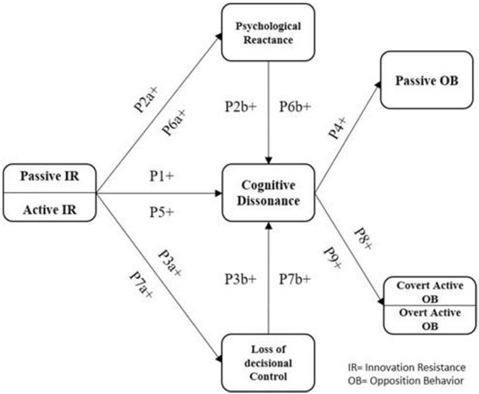
“The theoretical rationales on negative outcomes derived from our innovation decision model are then summarized in solid propositions about the relationships between these core constructs, and converted into a conceptual process model of forced adoption (Burgelman 1983;; Keats and Bracker 1988).”
MethodPiderit, S. K. (2000) · The Academy of Management Review · doi:10.5465/amr.2000.3707722 · Cited by 1,873 · cited 1×
“As a consequence, a systematic overview of different types of employee reactions is missing, and concepts of employee resistance and opposition remain ambiguous in terms of their definitions, antecedents and consequences, just like the concept of forced adoption itself (Piderit 2000).”
BackgroundJasperson, '. (., Carter, P. E., & Zmud, R. W. (2005) · MIS Quarterly · doi:10.2307/25148694 · Cited by 1,729
The relationship between job satisfaction and health: a meta-analysis
Faragher, E. B., Cass, M., & Cooper, C. L. (2005) · Occupational and Environmental Medicine · doi:10.1136/oem.2002.006734 · Cited by 1,658
Resistance to change: Developing an individual differences measure.
Oreg, S. (2003) · Journal of Applied Psychology · doi:10.1037/0021-9010.88.4.680 · Cited by 1,517 · cited 3×
“It evolves from individuals’ inclination to resist change (Oreg 2003) and their satisfaction with the status quo (Heidenreich and Handrich 2015) in the moment of awareness, which separately or in combination induces a generic disposition to resist innovations (Heidenreich and Kraemer 2016;…”
BackgroundOrlikowski, W. J. (1993) · MIS Quarterly · doi:10.2307/249774 · Cited by 1,512 · cited 2×
“Future studies may draw on published reviews of potential boundary conditions (Orlikowski 1993; Pardo del Val and Martínez Fuentes 2003) and test whether the assumed relationships in each process stage might vary in their magnitude under different boundary conditions.”
BackgroundA Multilevel Model of Resistance to Information Technology Implementation1
Lapointe, L., & Rivard, S. (2005) · MIS Quarterly · doi:10.2307/25148692 · Cited by 1,323
Cognitive change, strategic action, and organizational renewal
Barr, P. S., Stimpert, J. L., & Huff, A. S. (1992) · Strategic Management Journal · doi:10.1002/smj.4250131004 · Cited by 1,290
Frambach, R. T., & Schillewaert, N. (2002) · Journal of Business Research · doi:10.1016/s0148-2963(00)00152-1 · Cited by 1,270
Consumer resistance to innovations: the marketing problem and its solutions
Ram, S., & Sheth, J. N. (1989) · Journal of Consumer Marketing · doi:10.1108/eum0000000002542 · Cited by 1,221
Investigating User Resistance to Information Systems Implementation: A Status Quo Bias Perspective1
Kim, H.-W., & Kankanhalli, A. (2009) · MIS Quarterly · doi:10.2307/20650309 · Cited by 1,135
Lewis, W., Agarwal, R., & Sambamurthy, V. (2003) · MIS Quarterly · doi:10.2307/30036552 · Cited by 1,080
Habitual routines in task-performing groups
Gersick, C. J. G., & Hackman, J. R. (1990) · Organizational Behavior and Human Decision Processes · doi:10.1016/0749-5978(90)90047-d · Cited by 1,048
Jasperson, J., Carter, P. E., & Zmud, R. W. (2005) · MIS Quarterly · doi:10.5555/2017264.2017272 · Cited by 1,034
The Theory of Cognitive Dissonance: A Current Perspective
Aronson, E. (1969) · Advances in experimental social psychology · doi:10.1016/s0065-2601(08)60075-1 · Cited by 950 · cited 1×
“Social psychological research uses cognitive dissonance theory (Aronson 1969; Festinger 1957) to describe such unpleasant states of dissonance that occur whenever an individual simultaneously holds two cognitions that are psychologically inconsistent.”
BackgroundA motivational model of microcomputer usage
Igbaria, M., Parasuraman, S., & Baroudi, J. J. (1996) · Journal of Management Information Systems · doi:10.1080/07421222.1996.11518115 · Cited by 915
ORGANIZATIONAL ASSIMILATION OF INNOVATIONS: A MULTILEVEL CONTEXTUAL ANALYSIS.
Meyer, A. D., & Goes, J. B. (1988) · Academy of Management Journal · doi:10.2307/256344 · Cited by 840 · cited 1×
“The findings of Meyer and Goes (1988) show that innovationspecific factors like perceived complexity play an important role in the early stages of the adoption process, whereas relative advantage (value barrier) is more important in later stages (Frambach and Schillewaert 2002; Labay and Kinnear…”
BackgroundManagerial Influence in the Implementation of New Technology
Leonard-Barton, D., & Deschamps, I. (1988) · Management Science · doi:10.1287/mnsc.34.10.1252 · Cited by 812
Jones, R. A., Jimmieson, N. L., & Griffiths, A. (2005) · Journal of Management Studies · doi:10.1111/j.1467-6486.2005.00500.x · Cited by 756
Do I really have to? User acceptance of mandated technology
Brown, S. A., Massey, A. P., Montoya-weiss, M. M., & Burkman, J. R. (2002) · European Journal of Information Systems · doi:10.1057/palgrave.ejis.3000438 · Cited by 737
The Defense Style Questionnaire
ANDREWS, G., SINGH, M., & BOND, M. (1993) · The Journal of Nervous and Mental Disease · doi:10.1097/00005053-199304000-00006 · Cited by 711
Laukkanen, T. (2016) · Journal of Business Research · doi:10.1016/j.jbusres.2016.01.013 · Cited by 687 · cited 1×
“This might be the case if an innovation is perceived as overly complex or as lacking superior performance over existing alternatives (Laukkanen 2016; Laukkanen et al. 2008).”
BackgroundIm, S., Bayus, B. L., & Mason, C. H. (2003) · Journal of the Academy of Marketing Science · doi:10.1177/0092070302238602 · Cited by 654
Gallivan, M. J. (2001) · ACM SIGMIS Database: the DATABASE for Advances in Information Systems · doi:10.1145/506724.506729 · Cited by 652 · cited 8×
“To better understand the consequences of forced adoption and the transformational mechanisms described above, prior research has called for the development of an innovation decision model for the secondary adoption process (Gallivan 2001).”
BackgroundMethodInfluentialConsumer Behavior and Psychological Reactance
Clee, M. A., & Wicklund, R. A. (1980) · Journal of Consumer Research · doi:10.1086/208782 · Cited by 649
Consumer resistance to innovation—a behavioral reasoning perspective
Claudy, M. C., Garcia, R., & O’Driscoll, A. (2015) · Journal of the Academy of Marketing Science · doi:10.1007/s11747-014-0399-0 · Cited by 619
Arts, J. W. C., Frambach, R. T., & Bijmolt, T. H. A. (2011) · International Journal of Research in Marketing · doi:10.1016/j.ijresmar.2010.11.002 · Cited by 567
Employees' attitudes toward organizational change: A literature review
Choi, M. (2011) · Human Resource Management · doi:10.1002/hrm.20434 · Cited by 520 · cited 1×
“Furthermore, we also included “change” as an additional context-specific search term using the “OR” condition to cover the broad research stream on organizational resistance to change induced by innovations (Choi 2011; Pardo del Val andMartínez Fuentes 2003).”
MethodResistance to change: a literature review and empirical study
Pardo del Val, M., & Martínez Fuentes, C. (2003) · Management Decision · doi:10.1108/00251740310457597 · Cited by 513
Chen, G., Ployhart, R. E., Thomas, H. C., Anderson, N., & Bliese, P. D. (2011) · Academy of Management Journal · doi:10.5465/amj.2011.59215089 · Cited by 509
Exploring the Consumer Decision Process in the Adoption of Solar Energy Systems
Labay, D. G., & Kinnear, T. C. (1981) · Journal of Consumer Research · doi:10.1086/208865 · Cited by 434
Herold, D. M., Fedor, D. B., & Caldwell, S. D. (2007) · Journal of Applied Psychology · doi:10.1037/0021-9010.92.4.942 · Cited by 432
The Role of Leaders in Internal Marketing
Wieseke, J., Ahearne, M., Lam, S. K., & van Dick, R. (2009) · Journal of Marketing · doi:10.1509/jmkg.73.2.123 · Cited by 380
Rafiq, M., & Ahmed, P. K. (1993) · Journal of Marketing Management · doi:10.1080/0267257x.1993.9964234 · Cited by 378
Talke, K., & Heidenreich, S. (2014) · Journal of Product Innovation Management · doi:10.1111/jpim.12130 · Cited by 373
Self-citationResistance to organisational change: the role of defence mechanisms
Bovey, W. H., & Hede, A. (2001) · Journal of Managerial Psychology · doi:10.1108/eum0000000006166 · Cited by 371
Rumelt, R. P. (1995) · Resource-Based and Evolutionary Theories of the Firm · doi:10.1007/978-1-4615-2201-0_5 · Cited by 353 · cited 3×
“In this respect, prior research highlights that managerial interventions (Rumelt, 1995) and expectations evoked during the primary adoption process by the decision makers (Davis et al.”
BackgroundResultInfluentialInformation Systems and User Resistance: Theory and Practice
Hirschheim, R. (1988) · The Computer Journal · doi:10.1093/comjnl/31.5.398 · Cited by 336
Consequences of Forcing Consumers to Use Technology-Based Self-Service
Reinders, M. J., Dabholkar, P. A., & Frambach, R. T. (2008) · Journal of Service Research · doi:10.1177/1094670508324297 · Cited by 319
Cultures that support product-innovation processes
Jassawalla, A. R., & Sashittal, H. C. (2002) · Academy of Management Perspectives · doi:10.5465/ame.2002.8540307 · Cited by 313
The three faces of corporate renewal: Institution, revolution, and evolution
Mezias, S. J., & Glynn, M. A. (1993) · Strategic Management Journal · doi:10.1002/smj.4250140202 · Cited by 295
Heidenreich, S., & Handrich, M. (2015) · Journal of Product Innovation Management · doi:10.1111/jpim.12161 · Cited by 292
Self-citationConsumer resistance to internet banking: postponers, opponents and rejectors
Laukkanen, P., Sinkkonen, S., & Laukkanen, T. (2008) · International Journal of Bank Marketing · doi:10.1108/02652320810902451 · Cited by 280
Consumer innovativeness and its correlates: A propositional inventory for future research
Bartels, J., & Reinders, M. J. (2011) · Journal of Business Research · doi:10.1016/j.jbusres.2010.05.002 · Cited by 279
Internal marketing—The missing half of the marketing programme
Piercy, N., & Morgan, N. (1991) · Long Range Planning · doi:10.1016/0024-6301(91)90083-z · Cited by 274
Passive resistance misuse: overt support and covert recalcitrance in IS implementation
Marakas, G., & Hornik, S. (1996) · European Journal of Information Systems · doi:10.1057/ejis.1996.26 · Cited by 263
Internal marketing: a review and some interdisciplinary research challenges
Varey, R. J. (1995) · International Journal of Service Industry Management · doi:10.1108/09564239510078849 · Cited by 257 · cited 4×
“Hence, companies need to understand how forced adoption triggers innovation resistance and opposition behavior to effectively set up their internal marketing to reduce the probability of failure within implementation processes (Ram and Jung 1991; Varey 1995).”
BackgroundInfluentialJournal of Managerial Psychology
(1992) · Journal of Managerial Psychology · doi:10.1108/eb004440 · Cited by 257
Joachim, V., Spieth, P., & Heidenreich, S. (2018) · Industrial Marketing Management · doi:10.1016/j.indmarman.2017.12.011 · Cited by 255
Self-citationJohnson, D. S., Bardhi, F., & Dunn, D. T. (2008) · Psychology & Marketing · doi:10.1002/mar.20218 · Cited by 246
Innovations—Doomed to Fail? Investigating Strategies to Overcome Passive Innovation Resistance
Heidenreich, S., & Kraemer, T. (2016) · Journal of Product Innovation Management · doi:10.1111/jpim.12273 · Cited by 244
Self-citationCommunication and Innovation Implementation
Fidler, L. A., & Johnson, J. D. (1984) · The Academy of Management Review · doi:10.2307/258492 · Cited by 220
WHY INNOVATIONS FAIL — THE CASE OF PASSIVE AND ACTIVE INNOVATION RESISTANCE
HEIDENREICH, S., & SPIETH, P. (2013) · International Journal of Innovation Management · doi:10.1142/s1363919613500217 · Cited by 199
Self-citationWork Motivation: The Incorporation of Self-Concept-Based Processes
Leonard, N. H., Beauvais, L. L., & Scholl, R. W. (1999) · Human Relations · doi:10.1177/001872679905200801 · Cited by 195 · cited 1×
“The literature has discussed a wide range of adaptive strategies (Leonard et al. 1999).”
BackgroundToward a Theory of Small Firm Performance: A Conceptual Model
Keats, B. W., & Bracker, J. S. (1988) · American Journal of Small Business · doi:10.1177/104225878801200403 · Cited by 194
Factors affecting late adoption of digital innovations
Jahanmir, S. F., & Cavadas, J. (2018) · Journal of Business Research · doi:10.1016/j.jbusres.2018.01.058 · Cited by 177
Why Do People Reject Technologies: A Review of User Resistance Theories
Laumer, S., & Eckhardt, A. (2011) · Integrated series on information systems/Integrated series in information systems · doi:10.1007/978-1-4419-6108-2_4 · Cited by 175 · cited 8×
“Such behaviors may encompass publicly expressing concerns or mobilizing like-minded colleagues to cancel or reverse the implementation of an innovation (Kim and Kankanhalli 2009) or even more destructive forms, like infighting, threats, boss-napping, strikes, collective boycotts or sabotage (Lapointe and Rivard 2005;…”
BackgroundInfluentialAn Exploratory Study of the Innovation Evaluation Process
Olshavsky, R. W., & Spreng, R. A. (1996) · Journal of Product Innovation Management · doi:10.1016/s0737-6782(96)00037-9 · Cited by 175 · cited 2×
“Similar to the study of Olshavsky and Spreng (1996) on consumer decision-making processes, future organizational studies might utilize qualitative approaches, such as analyzing cases in which employees are confronted with several work-related innovations.”
BackgroundResultConsumer Resistance to, and Acceptance Of, Innovations
Bagozzi, R. P., & Lee, H. C. (1999) · ACR North American Advances · Cited by 172
Zhao, M., Hoeffler, S., & Zauberman, G. S. (2011) · Journal of Marketing Research · doi:10.1509/jmkr.48.5.827 · Cited by 169
Share of Heart: What is it and How can it be Measured?
Day, E. (1989) · Journal of Consumer Marketing · doi:10.1108/eum0000000002534 · Cited by 168
Age, resistance to change, and job performance
Kunze, F., Boehm, S., & Bruch, H. (2013) · Journal of Managerial Psychology · doi:10.1108/jmp-06-2013-0194 · Cited by 163
The Use of Visual Mental Imagery in New Product Design
Dahl, D. W., Chattopadhyay, A., & Gorn, G. J. (1999) · Journal of Marketing Research · doi:10.2307/3151912 · Cited by 162
Understanding technology acceptance in a mandatory environment: A literature review
Hwang, Y., Al-Arabiat, M., & Shin, D. (2016) · Information Development · doi:10.1177/0266666915593621 · Cited by 158
Consumer Behavior: Basic Findings and Management Implications
Zaltman, G., & Wallendorf, M. (1979) · Medical Entomology and Zoology · Cited by 152
Implementing Structured Software Methodologies: A Case of Innovation in Process Technology
Leonard-Barton, D. (1987) · Interfaces · doi:10.1287/inte.17.3.6 · Cited by 150 · cited 1×
“…review further indicates that only 10 of the 36 articles exclusively focus on the forced adoption of innovations (e.g., Cho and Chang 2008; Ram and Jung 1991), whi le the res t d i scuss fo rced adopt ion on ly in passing (e.g., Leonard-Barton 1987; Marakas and Hornig 1996; Rawstorne et al. 2000).”
BackgroundPunishment, Justice, and Compliance in Mandatory IT Settings
Xue, Y., Liang, H., & Wu, L. (2011) · Information Systems Research · doi:10.1287/isre.1090.0266 · Cited by 141
User resistance determinants and the psychological contract in enterprise system implementations
Klaus, T., & Blanton, J. E. (2010) · European Journal of Information Systems · doi:10.1057/ejis.2010.39 · Cited by 139
Schalk, R., Campbell, J. W., & Freese, C. (1998) · Leadership & Organization Development Journal · doi:10.1108/01437739810210202 · Cited by 136
Heidenreich, S., & Kraemer, T. (2015) · Journal of Economic Psychology · doi:10.1016/j.joep.2015.09.003 · Cited by 133
Self-citationThe impact of forced use on customer adoption of self-service technologies
Liu, S. (2012) · Computers in Human Behavior · doi:10.1016/j.chb.2012.02.002 · Cited by 131 · cited 4×
“As a consequence, insights into the psychological processes triggered by forced adoption are scarce (Liu 2012).”
BackgroundInfluentialMahmud, I., Ramayah, T., & Kurnia, S. (2017) · Information Systems · doi:10.1016/j.is.2017.05.005 · Cited by 131
Rawstorne, P., Jayasuriya, R., & Caputi, P. (2000) · Journal of the Association for Information Systems · doi:10.5555/359640.359721 · Cited by 123
Consumer Behavior: Basic Findings and Management Implications
Scott, C. A., Zaltman, G., Wallendorf, M., Wallendorf, M., & Zaltman, G. (1980) · Journal of Marketing Research · doi:10.2307/3151134 · Cited by 119
Short-term intrusions into the life style routine
Holmes, T. S., & Holmes, T. H. (1970) · Journal of Psychosomatic Research · doi:10.1016/0022-3999(70)90022-x · Cited by 117 · cited 1×
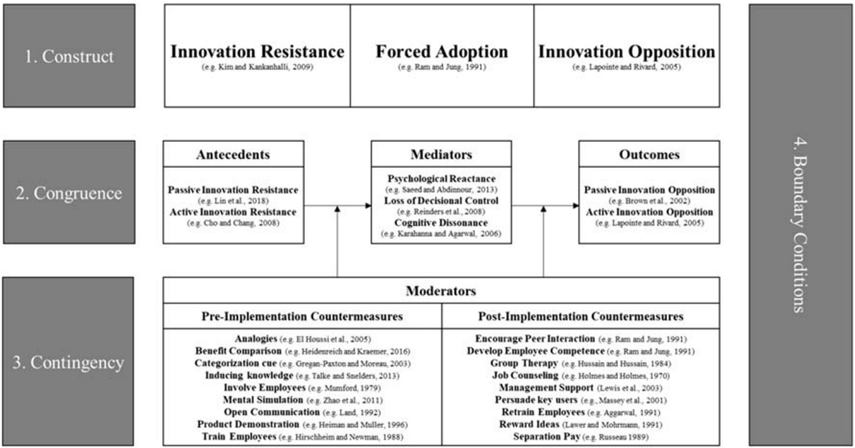
“With respect to postimplementation countermeasures, future research might test the effectiveness of peer interaction (Ram and Jung 1991), group therapy (Hussain and Hussain 1984) and job counseling (Holmes and Holmes 1970) as alternative routes to reduce cognitive dissonance.”
BackgroundHabit slips: when consumers unintentionally resist new products
Labrecque, J. S., Wood, W., Neal, D. T., & Harrington, N. (2016) · Journal of the Academy of Marketing Science · doi:10.1007/s11747-016-0482-9 · Cited by 115
“Forced” Adoption of Innovations in Organizations: Consequences and Implications
Ram, S., & Jung, H. (1991) · Journal of Product Innovation Management · doi:10.1016/0737-6782(91)90005-j · Cited by 113
Using Demonstration to Increase New Product Acceptance: Controlling Demonstration Time
Heiman, A., & Muller, E. (1996) · Journal of Marketing Research · doi:10.1177/002224379603300404 · Cited by 109
Perera, S., McKinnon, J., & Harrison, G. L. (2003) · Management Accounting Research · doi:10.1016/s1044-5005(03)00023-4 · Cited by 107
Implementing innovations within organizations: a systematic review and research agenda
Kim, J. S., & Chung, G. H. (2017) · Innovation · doi:10.1080/14479338.2017.1335943 · Cited by 107
Satisfied and unwilling: Exploring cognitive and situational resistance to innovations
Heidenreich, S., Kraemer, T., & Handrich, M. (2016) · Journal of Business Research · doi:10.1016/j.jbusres.2016.01.014 · Cited by 105
Self-citationCho, S. D., & Chang, D. R. (2008) · Industrial Marketing Management · doi:10.1016/j.indmarman.2008.04.004 · Cited by 103
Evidence of the impacts of public e-procurement: The Portuguese experience
Costa, A. A., Arantes, A., & Tavares, L. V. (2013) · Journal of Purchasing and Supply Management · doi:10.1016/j.pursup.2013.07.004 · Cited by 99
The Long-Term Influence of Service Employee Attrition on Customer Outcomes and Profits
Subramony, M. V., & Holtom, B. C. (2012) · Journal of Service Research · doi:10.1177/1094670512452792 · Cited by 96
RESISTANCE TO ORGANIZATIONAL CHANGE: THE ROLE OF DEFENSE MECHANISMS
Bovey, W. H. (2001) · Cited by 89
Johansson, C., Åström, S., Kauffeldt, A., Helldin, L., & Carlström, E. (2013) · Health Policy · doi:10.1016/j.healthpol.2013.07.014 · Cited by 88
Cross Cultural Differences in Managers’ Support for Home-Based Telework: A Theoretical Elaboration
Peters, P., & den Dulk, L. (2003) · International Journal of Cross Cultural Management · doi:10.1177/1470595803003003005 · Cited by 87
Hurdle the cross-functional barriers to strategic change
(1995) · Long Range Planning · doi:10.1016/0024-6301(95)94270-9 · Cited by 86 · cited 1×
“In addition, the communication measures within internal marketing applied by the authority decision unit might have similar effects since they strongly determine the employees’ expectations and perception of the innovation (Hutt et al. 1995).”
BackgroundPerceived Control and Consumer Attribution for the Service Encounter
Hui, M. K., & Toffoli, R. (2002) · Journal of Applied Social Psychology · doi:10.1111/j.1559-1816.2002.tb00261.x · Cited by 84
Saeed, K. A., & Abdinnour, S. (2013) · Information Systems Journal · doi:10.1111/j.1365-2575.2011.00389.x · Cited by 84
Conceptual Issues in the Study of Innovation Adoption Behavior
Nabih, M. I., Bloem, J. G., & Poiesz, T. B. C. (1997) · Research portal (Tilburg University) · Cited by 84
Restrictive Control and Information Pathologies in Organizations
Schöll, W. (1999) · Journal of Social Issues · doi:10.1111/0022-4537.00107 · Cited by 83 · cited 3×
“However, when individuals are constrained and feel unable to control their own decisions, negative reactions are very likely to occur (Ajzen and Madden 1986; Scholl 1996, 1999).”
BackgroundMANAGERIAL FACTORS INFLUENCING SUCCESS OF NEW PRODUCT DEVELOPMENT
SEDIGHADELI, S., & KACHOUIE, R. (2013) · International Journal of Innovation Management · doi:10.1142/s1363919613500229 · Cited by 79
Kishore, A., & McLean, E. R. (2007) · IEEE Transactions on Engineering Management · doi:10.1109/tem.2007.906849 · Cited by 76
Al‐Sayed, M., & Dugdale, D. (2015) · The British Accounting Review · doi:10.1016/j.bar.2015.03.004 · Cited by 68
User resistance in ERP implementations: A literature review
Haddara, M., & Moen, H. (2017) · Procedia Computer Science · doi:10.1016/j.procs.2017.11.111 · Cited by 67 · cited 2×
“Since reducing innovation failure due to forced adoption is often deemed as a research priority (Cho and Chang 2008; Haddara and Moen 2017), we focus on moderators that might buffer negative consequences of mandated usage.”
BackgroundFactors influencing e-government adoption in India: a qualitative approach
Kumar, R., Sachan, A., Mukherjee, A., & Kumar, R. A. (2018) · Digital Policy Regulation and Governance · doi:10.1108/dprg-02-2018-0007 · Cited by 65
Getting Your House in Order with Internal Marketing
Winter, J. P. (1985) · Health Marketing Quarterly · doi:10.1300/j026v03n01_09 · Cited by 59 · cited 1×
“However, using internal marketing to educate, motivate and align employees towards institutional objectives during innovation implementation (Winter 1985), requires better knowledge onwhen and howmandated usage transforms into forced adoption with opposition behavior as the detrimental consequence.”
BackgroundLin, T., Huang, S., & Chiang, S.-C. (2018) · Journal of the Association for Information Systems · doi:10.17705/1jais.00493 · Cited by 57
Reaping the benefits of innovative IT: the long and winding road
Massey, A. P., Montoya‐Weiss, M. M., & Brown, S. A. (2001) · IEEE Transactions on Engineering Management · doi:10.1109/17.946534 · Cited by 52
Leapfrogging bei technologischen Innovationen
Pohl, A. (1996) · Gabler Verlag eBooks · doi:10.1007/978-3-322-99229-1 · Cited by 50 · cited 1×
“In addition to initial engagement with the innovation, employees continuously process information, which was either actively searched for or provided by other organization members (Pohl 1996) or internal marketing (Piercy and Morgan 1991).”
BackgroundRevisiting Technology Resistance: Current Insights and Future Directions
Samhan, B. (2018) · AJIS. Australasian journal of information systems/AJIS. Australian journal of information systems/Australian journal of information systems · doi:10.3127/ajis.v22i0.1655 · Cited by 45 · cited 4×
“2011), to insist on keeping their status quo (Kim and Kankanhalli 2009; Kim and Chung 2017), or both in combination (Lin et al. 2018; Samhan 2018).”
BackgroundInfluentialInformation in Launch Messages: Stimulating the Adoption of New High‐Tech Consumer Products
Talke, K., & Snelders, D. (2013) · Journal of Product Innovation Management · doi:10.1111/jpim.12017 · Cited by 44
Self-citationTatsuse, T., & Sekine, M. (2013) · Industrial Health · doi:10.2486/indhealth.2012-0058 · Cited by 43
Robert De Board (1978) · Medical Entomology and Zoology · Cited by 35
Lehmann, D. R., & Parker, J. R. (2017) · AMS Review · doi:10.1007/s13162-017-0093-8 · Cited by 35 · cited 1×
“This can also happen to products or services that were previously adopted but that didn’t turn out to be useful, are no longer wanted or needed (Lehmann and Parker 2017).”
BackgroundHaddara, M., & Hetlevik, T. (2016) · Procedia Computer Science · doi:10.1016/j.procs.2016.09.189 · Cited by 30
Deighton, J. (2005) · Journal of Consumer Research · doi:10.1086/430647 · Cited by 26
Houssi, A. A. E., Morel, K. P. N., & Hultink, E. J. (2005) · Figshare · Cited by 26
Tsatsou, P. (2012) · The Information Society · doi:10.1080/01972243.2012.670190 · Cited by 22 · cited 1×
“…resistance generated and thus the probability that a mandated usage transforms into forced adoption might principally be much higher in countries like Greece with high uncertainty avoidance (Tsatsou 2012) compared to countries like Denmark with low uncertainty avoidance (Peters and Den Dulk 2003).”
BackgroundHwang, Y., Chung, J.-Y., Shin, D., & Lee, Y. (2017) · Behaviour and Information Technology · doi:10.1080/0144929x.2017.1306751 · Cited by 22
Physician Reactions to Healthcare IT: An Activity-Theoretic Analysis
Bhattacherjee, A., Davis, C. J., & Hikmet, N. (2013) · Hawaii International Conference on System Sciences (HICSS) · doi:10.1109/hicss.2013.448 · Cited by 21
Effective Teamwork— A Theoretical Model and a Test in the Field
Schöll, W. (2018) · Psychology Press eBooks · doi:10.4324/9781315789293-6 · Cited by 14 · cited 2×
“However, when individuals are constrained and feel unable to control their own decisions, negative reactions are very likely to occur (Ajzen and Madden 1986; Scholl 1996, 1999).”
BackgroundPreference For Control and Its Effect on the Evaluation of Consumption Experiences
Botti, S., McGill, A. L., & Iyengar, S. S. (2003) · ACR North American Advances · Cited by 12
The Psychoanalysis of Organizations
Robert De Board (2014) · Routledge eBooks · doi:10.4324/9781315752662 · Cited by 12
Cultural Differences and Technology Acceptance: A Comparative Study
Uğur, N. G. (2017) · Journal of Media Critiques · doi:10.17349/jmc117310 · Cited by 11 · cited 1×
“Similarly, differences in social and national culture were also shown to influence individual working in companies and their responses to innovations (Jassawalla and Sashittal 2002; Uğur 2017).”
BackgroundInformation Resource Management
(2018) · Libraries Unlimited eBooks · doi:10.5040/9798216011316.0106 · Cited by 11
Irawan, S., Foster, S., & Tanner, K. (2018) · AJIS. Australasian journal of information systems/AJIS. Australian journal of information systems/Australian journal of information systems · doi:10.3127/ajis.v22i0.1828 · Cited by 8 · cited 2×
“However, except for a few rare exceptions, studies shedding light on the secondary adoption process are still lacking (Gallivan 2001; Irawan et al. 2018).”
BackgroundControl Theory and Decision Making in Organisations A Reconnaissance
Mallen, G. L. (1970) · Measurement and Control · doi:10.1177/002029407000300307 · Cited by 3 · cited 1×
“According to decisional control theory (Mallen 1970), the extent of choice on means and goals that a person has in a situation is significantly reducedwhen individuals are no longer able to make decisions for themselves (Hui and Toffoli 2002; Botti et al. 2003).”
BackgroundREVIEW PAPER: CRITICAL FACTORS OF USER RESISTANCE IN POST-ERP IMPLEMENTATION WITHIN AN ORGANIZATION.
Raisian, K., & Yahaya, J. B. (2014) · Cited by 2
Research works printed but not linked: 5
- Dubin, R. (1978). Theory building. New York: Free Press.
- Karahanna, E., & Agarwal, R. (2006). When the spirit is willing: Symbolic adoption and technology exploration. Athens: University of Georgia.
- Kimberling, E. (2014). 2014 ERP report. Denver: Panorama Consulting Solutions.
- Klonglan, G. E., & Coward, E. W. (1970). The concept of symbolic adoption: A suggested interpretation. Rural Sociology, 35(1), 77-83.
- Mumford, E. (1979). Human values and the introduction of technological change. Manchester Business School Review, 3(2), 13-17.
Cited by
Brem, A., Viardot, E., & Nylund, P. A. (2021) · Technological Forecasting and Social Change · doi:10.1016/j.techfore.2020.120451 · Cited by 389
Klein, S. P., Spieth, P., & Heidenreich, S. (2021) · Journal of Product Innovation Management · doi:10.1111/jpim.12563 · Cited by 190
Self-citationThe role of institutional and self in the formation of trust in artificial intelligence technologies
Wong, L.-W., Tan, G. W.-H., Ooi, K.-B., & Dwivedi, Y. (2024) · Internet Research · doi:10.1108/intr-07-2021-0446 · Cited by 105
How to measure the status quo bias? A review of current literature
Godefroid, M.-E., Plattfaut, R., & Niehaves, B. (2023) · Management Review Quarterly · doi:10.1007/s11301-022-00283-8 · Cited by 101
“This is relevant as the bias might have different effects on the level of the primary adoption process on a group level and on the secondary adoption pro‑ cess on an individual level (Heidenreich and Talke 2020) and might also call for different countermeasures.”
BackgroundBouguerra, A., Hughes, M., Rodgers, P., Stokes, P. J., & Tatoğlu, E. (2023) · Journal of Product Innovation Management · doi:10.1111/jpim.12692 · Cited by 89
Metadata
- Authors
- Heidenreich, S., & Talke, K.
- Affiliations
- Saarland University (DE)
- Technische Universität Berlin (DE)
- Corresponding author
- Heidenreich, Sven
- ORCID
- Heidenreich, Sven
- Venue
- AMS Review
- Published
- 2020-04-07
- Volume
- 10
- Issue
- 3-4
- Pages
- 279-298
- ISSN
- 1869-814X (ISSN-L)
- 1869-8182
- OpenAlex
- W3015571773
- Cited by
- 46
- References
- 144
- Citations by year
- 2026: 7 · 2025: 8 · 2024: 5 · 2023: 7 · 2022: 9 · 2021: 8 · 2020: 2
- FWCI
- 4.14
- Type
- journal article
- Language
- en
- Open access
- hybrid
- doi.org
- Licence
- cc-by
- creativecommons.org/licenses/by/4.0 (tdm)
- creativecommons.org/licenses/by/4.0 (vor)
- Locations
- AMS Review (publishedVersion, cc-by)
- RePEc: Research Papers in Economics (submittedVersion)
- Econstor (Econstor) (submittedVersion, cc-by)
- Publications of the UdS (Saarland University) (cc-by)
- Funders
- Universität des Saarlandes
- Topics
- Social Sciences › Decision Sciences › Management Science and Operations Research › Innovation Diffusion and Forecasting
- Social Sciences › Decision Sciences › Information Systems and Management › Technology Adoption and User Behaviour
- Social Sciences › Business, Management and Accounting › Organizational Behavior and Human Resource Management › Management and Organizational Studies
- Keywords
- forced adoption, symbolic adoption, innovation adoption, resistance to innovation, organizational innovation, belief conflict
About these checks
Registry, retraction, Cites and statistics results are computed, not judged, with one exception: a printed reference that no index lists is read once by a model before it counts as a citation error. Claims are extracted by a model and kept only when their quote appears verbatim in the text; each cited source is then checked, with a model’s help, for whether it says what the claim relies on. Those verdicts can be wrong — read the claim’s quote and the cited source before relying on one.
Statistics and arithmetic are recomputed, not judged.
Confidence bands are shown only for fields calibrated on our annotated test set. None is calibrated yet, so no band is shown.
What counts as a claim ›How we measure confidence ›How we check this ›
Are you an author, or do you see a problem with this page? Request a review
Data sources
Bibliographic data: Semantic Scholar, OpenAlex, Crossref.
Contains information from the Semantic Scholar Academic Graph Datasets, made available under the ODC Attribution License (ODC-BY 1.0).
Semantic Scholar’s data is described in: Kinney, R., et al. (2023). The Semantic Scholar Open Data Platform. arXiv:2301.10140.
