

On Equilibrium Properties of the Replicator–Mutator Equation in Deterministic and Random Games
Open accessThe DOI matches its Crossref record; 35 of the 36 references it cites were found in a registry or an index.
Abstract
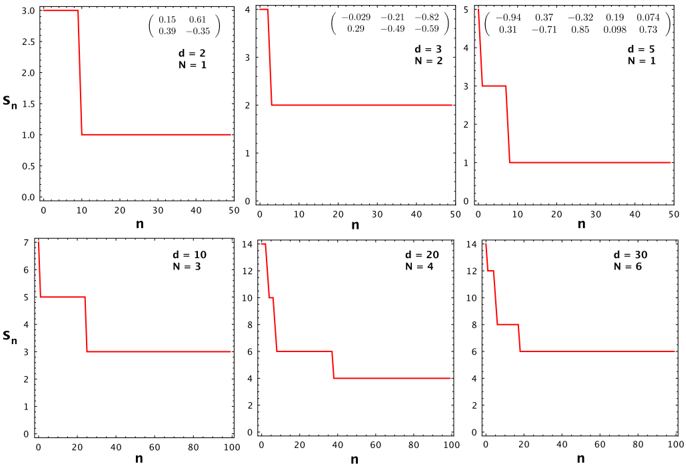
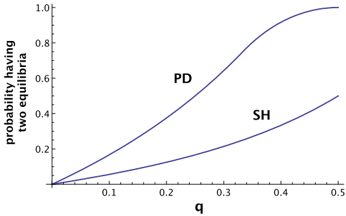
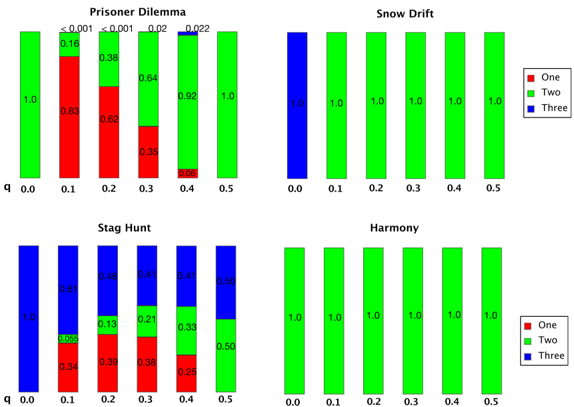
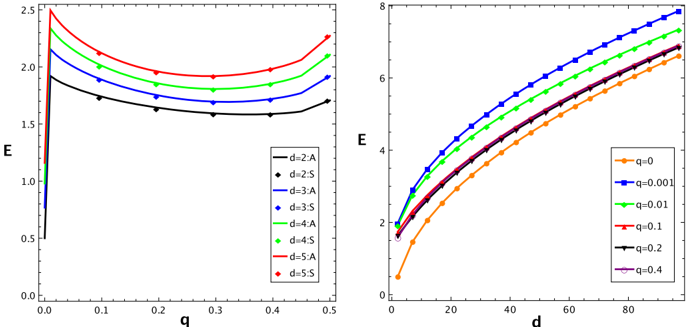
In this paper, we study the number of equilibria of the replicator–mutator dynamics for both deterministic and random multi-player two-strategy evolutionary games. For deterministic games, using Descartes’ rule of signs, we provide a formula to compute the number of equilibria in multi-player games via the number of change of signs in the coefficients of a polynomial. For two-player social dilemmas (namely the Prisoner’s Dilemma, Snow Drift, Stag Hunt and Harmony), we characterize (stable) equilibrium points and analytically calculate the probability of having a certain number of equilibria when the payoff entries are uniformly distributed. For multi-player random games whose pay-offs are independently distributed according to a normal distribution, by employing techniques from random polynomial theory, we compute the expected or average number of internal equilibria. In addition, we perform extensive simulations by sampling and averaging over a large number of possible payoff matrices to compare with and illustrate analytical results. Numerical simulations also suggest several interesting behaviours of the average number of equilibria when the number of players is sufficiently large or when the mutation is sufficiently small. In general, we observe that introducing mutation results in a larger average number of internal equilibria than when mutation is absent, implying that mutation leads to larger behavioural diversity in dynamical systems. Interestingly, this number is largest when mutation is rare rather than when it is frequent.
Overview
The claims and statistics of this paper haven’t been checked yet.
Free: it reads the open-access text and checks the first 5 claims that cite a source we can check. Create a free account to check every claim.
Integrity signals
Registry
Cites
Statistics
Figures
Verification
Claims the paper makes
The claims and statistics of this paper haven’t been checked yet.
Free: it reads the open-access text and checks the first 5 claims that cite a source we can check. Create a free account to check every claim.
Claims other papers make about this one
Each is checked against this paper’s own text: does it say what the citing paper says it does?
The cited source says what the claim attributes to it.
In the citing paper
“Some have addressed this via the replicator-mutator equation [31][32][33], although this still involves switching from one strategy to another within a predefined set, so the strategy space is constrained and chosen from the outset.”
From Maynard Smith revisited: A multi-agent reinforcement learning approach to the coevolution of signalling behaviour (2025) · cites this paper as [32]
Self-check
Percentages, sums and reported differences re-computed from the paper’s own numbers.
The self-check needs the paper’s full text.
Citations
Cites
Statistical physics of human cooperation
Perc, M., Jordan, J. J., Rand, D. G., Wang, Z., Boccaletti, S., & Szolnoki, A. (2017) · Physics Reports · doi:10.1016/j.physrep.2017.05.004 · Cited by 1,590
Volunteering as Red Queen Mechanism for Cooperation in Public Goods Games
Hauert, C., De Monte, S., Hofbauer, J., & Sigmund, K. (2002) · Science · doi:10.1126/science.1070582 · Cited by 1,114
Evolutionary dynamics of social dilemmas in structured heterogeneous populations
Santos, F. C., Pacheco, J. M., & Lenaerts, T. (2006) · Proceedings of the National Academy of Sciences · doi:10.1073/pnas.0508201103 · Cited by 1,011
Solving Systems of Polynomial Equations
Sturmfels, B. (2002) · CBMS Regional Conference Series in Mathematics · doi:10.1090/cbms/097 · Cited by 792
Universal scaling for the dilemma strength in evolutionary games
Wang, Z., Kokubo, S., Jusup, M., & Tanimoto, J. (2015) · Physics of Life Reviews · doi:10.1016/j.plrev.2015.04.033 · Cited by 586
Evolution of Universal Grammar
Nowak, M. A., Komarova, N. L., & Niyogi, P. (2001) · Science · doi:10.1126/science.291.5501.114 · Cited by 453
Evolutionary cycles of cooperation and defection
Imhof, L. A., Fudenberg, D., & Nowak, M. A. (2005) · Proceedings of the National Academy of Sciences · doi:10.1073/pnas.0502589102 · Cited by 381
How many zeros of a random polynomial are real?
Edelman, A., & Kostlan, E. (1995) · Bulletin of the American Mathematical Society · doi:10.1090/s0273-0979-1995-00571-9 · Cited by 381
Generalized Models Reveal Stabilizing Factors in Food Webs
Gross, T., Rudolf, L., Levin, S. A., & Dieckmann, U. (2009) · Science · doi:10.1126/science.1173536 · Cited by 306
Evolutionary games in the multiverse
Gokhale, C. S., & Traulsen, A. (2010) · Proceedings of the National Academy of Sciences · doi:10.1073/pnas.0912214107 · Cited by 279
Multiple Scales and the Maintenance of Biodiversity
Levin, S. A. (2000) · Ecosystems · doi:10.1007/s100210000044 · Cited by 260
Evolutionary dynamics with aggregate shocks
Fudenberg, D., & Harris, C. (1992) · Journal of Economic Theory · doi:10.1016/0022-0531(92)90044-i · Cited by 244
The role of diversity in the evolution of cooperation
Santos, F. C., Pinheiro, F. L., Lenaerts, T., & Pacheco, J. M. (2012) · Journal of Theoretical Biology · doi:10.1016/j.jtbi.2011.09.003 · Cited by 197
Complex dynamics in learning complicated games
Galla, T., & Farmer, J. (2011) · Proceedings of the National Academy of Sciences of the United States of America · doi:10.1073/pnas.1109672110 · Cited by 185
The Evolutionary Dynamics of Grammar Acquisition
Komarova, N. L., Niyogi, P., & Nowak, M. A. (2001) · Journal of Theoretical Biology · doi:10.1006/jtbi.2000.2240 · Cited by 184
A new bound for Pólya's Theorem with applications to polynomials positive on polyhedra
Powers, V., & Reznick, B. (2001) · Journal of Pure and Applied Algebra · doi:10.1016/s0022-4049(00)00155-9 · Cited by 179
Broom, M., Cannings, C., & Vickers, G. T. (1997) · Bulletin of Mathematical Biology · doi:10.1007/bf02460000 · Cited by 156
Evolutionary Multiplayer Games
Gokhale, C. S., & Traulsen, A. (2014) · Dynamic Games and Applications · doi:10.1007/s13235-014-0106-2 · Cited by 119
Broom, M. (1997) · Bulletin of Mathematical Biology · doi:10.1016/s0092-8240(97)00041-4 · Cited by 113 · cited 2×
“Equilibrium properties of the replicator dynamics, particularly the probability of observing the maximal number of equilibrium points, the attainability and stability of the patterns of evolutionarily stable strategies have been studied intensively in the literature [2,3,12,13,17].”
BackgroundStable Polymorphisms in a Selection Model with Mutation
Hadeler, K. P. (1981) · SIAM Journal on Applied Mathematics · doi:10.1137/0141001 · Cited by 112
Mutation in autocatalytic reaction networks
Stadler, P. F., & Schuster, P. M. (1992) · Journal of Mathematical Biology · doi:10.1007/bf00948894 · Cited by 92
Replicator-mutator equation, universality property and population dynamics of learning
Komarova, N. L. (2004) · Journal of Theoretical Biology · doi:10.1016/j.jtbi.2004.05.004 · Cited by 82
Evolution of commitment and level of participation in public goods games
Han, T. A., Pereira, L. M., & Lenaerts, T. (2017) · Autonomous Agents and Multi-Agent Systems · doi:10.1007/s10458-016-9338-4 · Cited by 82
Self-citationGains from switching and evolutionary stability in multi-player matrix games
Peña, J., Lehmann, L., & Nöldeke, G. (2014) · Journal of Theoretical Biology · doi:10.1016/j.jtbi.2013.12.016 · Cited by 81
On equilibrium properties of evolutionary multi-player games with random payoff matrices
Han, T. A., Traulsen, A., & Gokhale, C. S. (2012) · Theoretical Population Biology · doi:10.1016/j.tpb.2012.02.004 · Cited by 67
Self-citationEvolutionary dynamics of collective action in spatially structured populations
Peña, J., Nöldeke, G., & Lehmann, L. (2015) · Journal of Theoretical Biology · doi:10.1016/j.jtbi.2015.06.039 · Cited by 65
GROUP-SIZE DIVERSITY IN PUBLIC GOODS GAMES
Peña, J. (2011) · Evolution · doi:10.1111/j.1558-5646.2011.01504.x · Cited by 62
Evolutionary dynamics of behavior in social networks
Olfati‐Saber, R. (2007) · IEEE Conference on Decision and Control (CDC) · doi:10.1109/cdc.2007.4435009 · Cited by 57
Hopf Bifurcations and Limit Cycles in Evolutionary Network Dynamics
Pais, D., Caicedo-Núñez, C. H., & Leonard, N. E. (2012) · SIAM Journal on Applied Dynamical Systems · doi:10.1137/120878537 · Cited by 55
Duong, M. H., & Han, T. A. (2016) · Journal of Mathematical Biology · doi:10.1007/s00285-016-1010-8 · Cited by 34
Self-citationEavesdropping and language dynamics
Komarova, N. L., & Levin, S. A. (2010) · Journal of Theoretical Biology · doi:10.1016/j.jtbi.2010.01.010 · Cited by 25
On the Expected Number of Equilibria in a Multi-player Multi-strategy Evolutionary Game
Duong, M. H., & Han, T. A. (2015) · Dynamic Games and Applications · doi:10.1007/s13235-015-0148-0 · Cited by 25
Self-citationBounds on the number of ESSs of a matrix game
Broom, M. (2000) · Mathematical Biosciences · doi:10.1016/s0025-5564(00)00036-5 · Cited by 15
On the distribution of the number of internal equilibria in random evolutionary games
Duong, M. H., Tran, H. M., & Han, T. A. (2018) · Journal of Mathematical Biology · doi:10.1007/s00285-018-1276-0 · Cited by 15
Self-citationDuong, M. H., Tran, H. M., & Han, T. A. (2018) · Dynamic Games and Applications · doi:10.1007/s13235-018-0276-4 · Cited by 15
Self-citationDescartes' rule of signs is exact!
Avendano, M. E. (2010) · Journal of Algebra · doi:10.1016/j.jalgebra.2010.08.014 · Cited by 10
Cited by
Han, T. A., Perret, C., & Powers, S. T. (2021) · Cognitive Systems Research · doi:10.1016/j.cogsys.2021.02.003 · Cited by 98
Self-citationComplex evolutionary dynamics due to punishment and free space in ecological multigames
Chowdhury, S. N., Kundu, S., Perc, M., & Ghosh, D. (2021) · Proceedings of the Royal Society A Mathematical Physical and Engineering Sciences · doi:10.1098/rspa.2021.0397 · Cited by 73
Cost-efficient interventions for promoting fairness in the ultimatum game
Cimpeanu, T., Perret, C., & Han, T. A. (2021) · Knowledge-Based Systems · doi:10.1016/j.knosys.2021.107545 · Cited by 61
Self-citationPleasing Enhances Indirect Reciprocity-Based Cooperation Under Private Assessment
Krellner, M., & Han, T. A. (2021) · Artificial Life · doi:10.1162/artl_a_00344 · Cited by 38
“Non-rare mutations also204 play an important role in enabling cooperation in the context of social dilemmas (Garćıa and Traulsen,205 2012; Duong and Han, 2020; Antal et al., 2009).”
BackgroundSelf-citationInvolution game with spatio-temporal heterogeneity of social resources
Wang, C., & Szolnoki, A. (2022) · Applied Mathematics and Computation · doi:10.1016/j.amc.2022.127307 · Cited by 31
“The simplest dilemma situations can be studied by pairwise interactions, such as the prisoner’s dilemma (PD), snowdrift (SD) and stag-hunt (SH) games [6, 7, 8].”
Background
Metadata
- Authors
- Duong, M. H., & Han, T. A.
- Affiliations
- University of Birmingham (GB)
- Teesside University (GB)
- Corresponding author
- Duong, Manh Hong
- Venue
- Dynamic Games and Applications
- Published
- 2019-11-27
- Volume
- 10
- Issue
- 3
- Pages
- 641-663
- ISSN
- 2153-0785 (ISSN-L)
- 2153-0793
- OpenAlex
- W2979697513
- Cited by
- 7
- References
- 35
- Citations by year
- 2026: 1 · 2024: 1 · 2023: 1 · 2022: 1 · 2021: 2 · 2020: 1
- FWCI
- 2.01
- Type
- journal article
- Language
- en
- Open access
- hybrid
- doi.org
- Licence
- cc-by
- creativecommons.org/licenses/by/4.0 (tdm)
- creativecommons.org/licenses/by/4.0 (vor)
- Locations
- Dynamic Games and Applications (publishedVersion, cc-by)
- Teesside University Research Portal (Teesside University) (publishedVersion, cc-by-nc-nd)
- arXiv (Cornell University) (submittedVersion)
- RePEc: Research Papers in Economics (submittedVersion)
- University of Birmingham Research Portal (University of Birmingham) (submittedVersion, cc-by)
- arXiv (Cornell University)
- Funders
- Future of Life Institute (RFP2-154)
- Topics
- Social Sciences › Sociology and Political Science › Evolutionary Game Theory and Cooperation
- Social Sciences › Decision Sciences › Management Science and Operations Research › Game Theory and Applications
- Life Sciences › Biochemistry, Genetics and Molecular Biology › Genetics › Evolution and Genetic Dynamics
- Keywords
- number of equilibria, evolutionary game theory, multiplayer games, two-strategy games, Descartes' rule of signs, social dilemmas, prisoner's dilemma, snowdrift game, stag hunt, genetic mutations, random payoffs, behavioral diversity
About these checks
Registry, retraction, Cites and statistics results are computed, not judged, with one exception: a printed reference that no index lists is read once by a model before it counts as a citation error. Claims are extracted by a model and kept only when their quote appears verbatim in the text; each cited source is then checked, with a model’s help, for whether it says what the claim relies on. Those verdicts can be wrong — read the claim’s quote and the cited source before relying on one.
Statistics and arithmetic are recomputed, not judged.
Confidence bands are shown only for fields calibrated on our annotated test set. None is calibrated yet, so no band is shown.
What counts as a claim ›How we measure confidence ›How we check this ›
Are you an author, or do you see a problem with this page? Request a review
Data sources
Bibliographic data: Semantic Scholar, OpenAlex, Crossref.
Contains information from the Semantic Scholar Academic Graph Datasets, made available under the ODC Attribution License (ODC-BY 1.0).
Semantic Scholar’s data is described in: Kinney, R., et al. (2023). The Semantic Scholar Open Data Platform. arXiv:2301.10140.
