

Misogynoir: challenges in detecting intersectional hate
Open accessThe DOI matches its Crossref record; 47 of the 51 references it cites were found in a registry or an index, and 3 are not checked yet; 7 of the 24 sources its claims cite were checked for support.
Abstract
Evaluates the performance of automated hate speech detection tools (HateSonar and Google's Perspective API) on detecting misogynoir in tweets, finding that current tools are ineffective due to a lack of sensitivity to context.
Verified 2026-11-22 · 3 references not checked yet
Overview
CoChat Summary
## TL;DR
This paper evaluates two hate-speech detection tools, HateSonar and Google’s Perspective API, on Twitter data about misogynoir and finds that both systems are ineffective at detecting this intersectional hate. The main issue is lack of context sensitivity: the tools often flag explicit references to racism, sexism, or profanity, but miss subtler forms such as White Centring and Defensiveness.
## Key findings
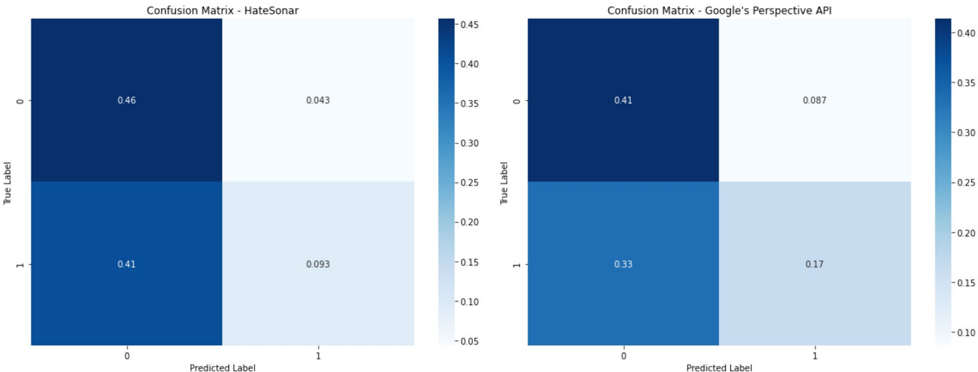
- On the balanced dataset of 300 tweets (150 misogynoir, 150 allyship), Perspective API outperformed HateSonar, but still performed poorly for misogynoir detection: precision 0.66, recall 0.33, F1 0.44, accuracy 0.58; only 17% of misogynoir tweets were correctly classified by Perspective API and 9.3% by HateSonar.
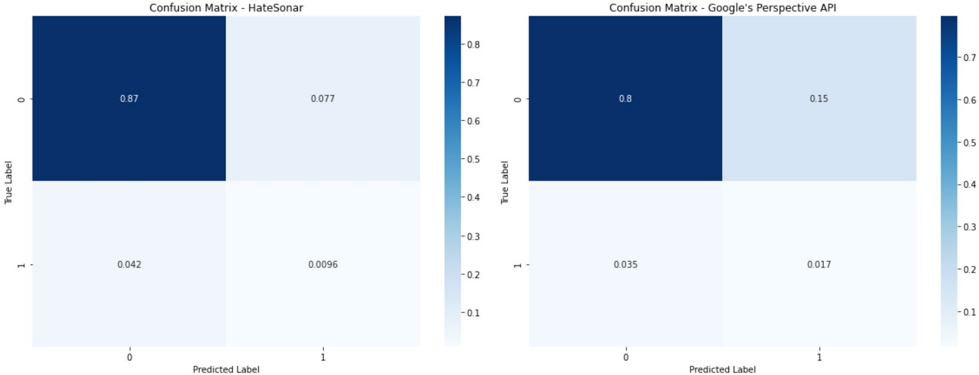
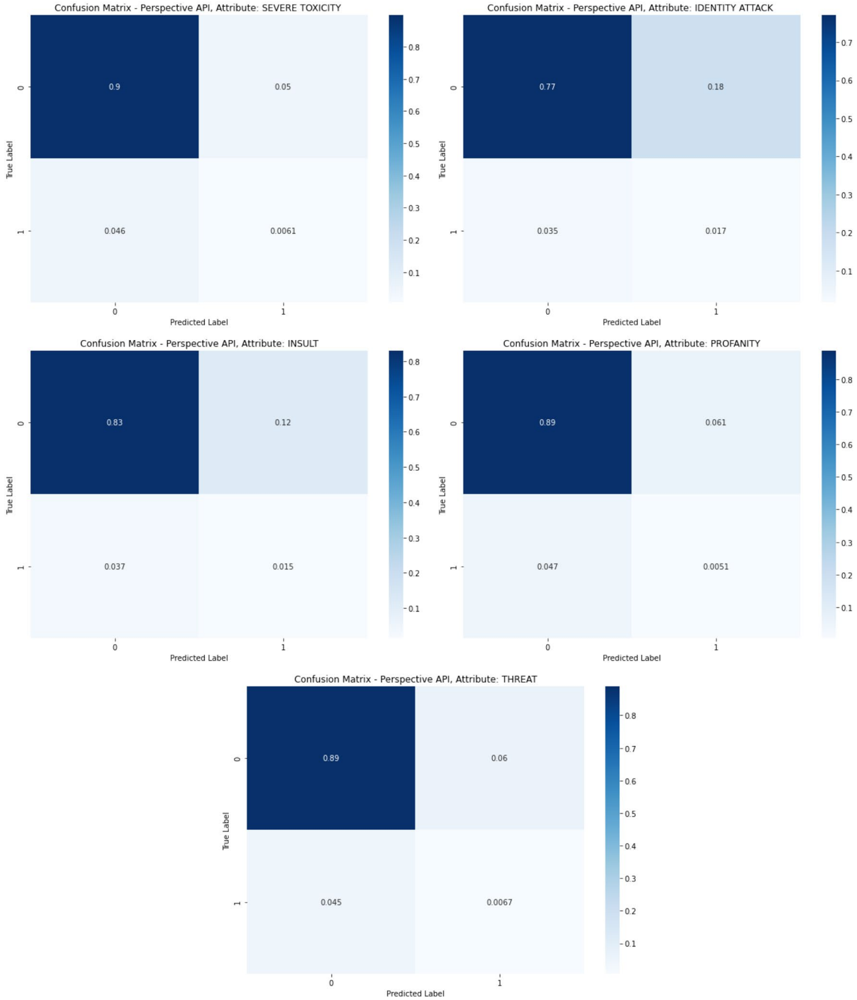
- On the imbalanced dataset of 3,138 tweets (162 misogynoir, 2,976 allyship), Perspective API again outperformed HateSonar, with precision 0.10, recall 0.33, F1 0.15 for misogynoir; only 0.96% of misogynoir tweets were correctly classified by Perspective API and 1.7% by HateSonar.
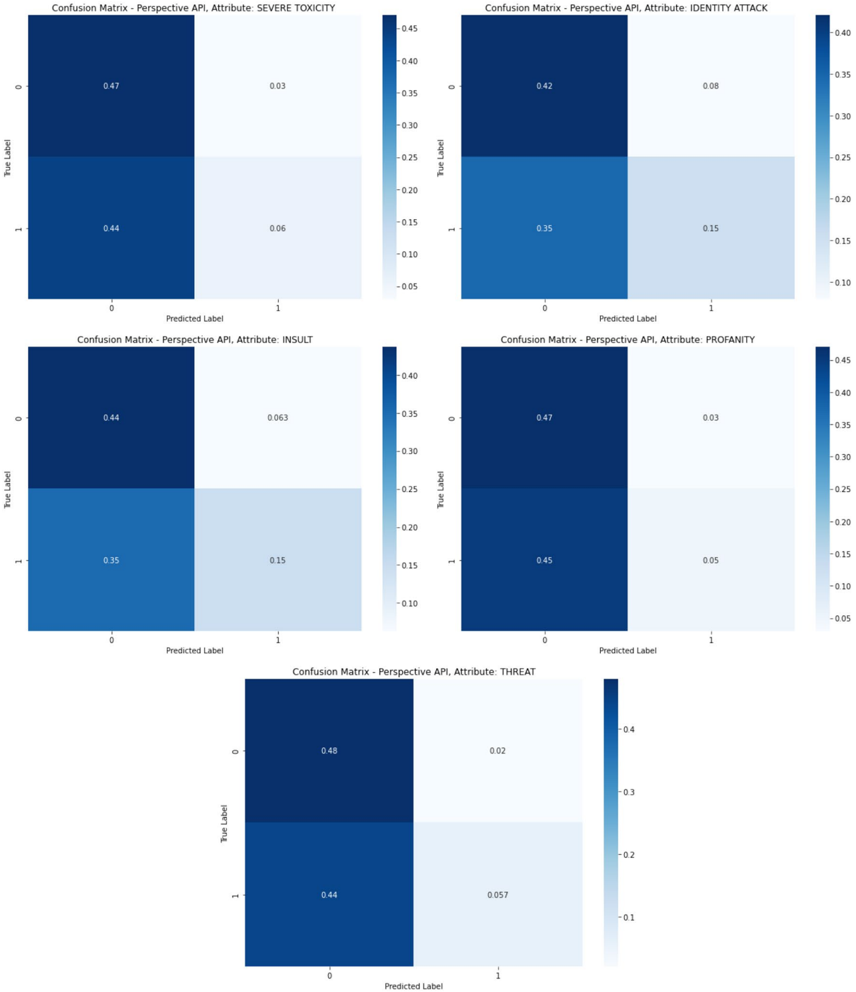
- For the Perspective API’s sub-attributes on the balanced dataset, the strongest were Identity attack and Insult, with balanced-dataset scores of precision/recall/F1/accuracy = 0.66/0.31/0.42/0.57 and 0.70/0.29/0.41/0.58, respectively.
- The paper reports that Racial gaslighting and Tone policing were easier to detect than White centring and Defensiveness, because the former have more lexical clues; on the imbalanced dataset, the table reports correct classifications for misogynoir types such as Racial gaslighting: 27/53 (57%) and Tone policing: 9/22 (41%), versus White centring: 3/16 (19%) and Defensiveness: 3/9 (33%) by Perspective API.
## Methods
- The study built on a prior Twitter collection about four Black women in tech and assembled a new annotated dataset; the paper states a combined dataset of 4,532 tweets for the study, with an analysis dataset of 3,138 tweets after filtering out unclear cases.
- Tweets were manually annotated by three authors into Misogynoir (M), Allyship (A), or Unclear (U), with allyship further divided into subtypes such as Sharing experiences (E), Thanks (T), and Generic support (GR); annotation agreement improved from Fleiss’ kappa 0.66 to 0.89 after discussion and refinement.
- The authors evaluated HateSonar and Google’s Perspective API on a balanced sample of 300 tweets and on the full imbalanced dataset, using precision, recall, F1, and accuracy, and inspected confusion matrices plus false positives/negatives qualitatively.
## Limitations
- The paper states that the classifiers’ labels do not match the dataset labels: HateSonar outputs hate speech / offensive language / neither, so the authors had to treat hate speech and offensive language as potential misogynoir, which they say “might not be an accurate representation” of misogynoir.
- The text makes evident that the study is limited by context loss in Twitter data: deleted tweets, suspended accounts, missing threads, and URL-only posts made annotation difficult; this is stated in the paper.
- The paper also makes evident that the dataset is narrowly grounded in one prior case study context (public responses to four Black women in tech), which may limit generalization; this is implied by the dataset construction and the paper’s own discussion of context-specific language.
Model-written summary. Check it against the paper before relying on it.
Integrity signals
Registry
Cites
Statistics
Figures
Verification
Claims the paper makes
6 Valid · 2 Not valid · 13 Not checked · 57 Own results and interpretations
Every source the paper cites for this claim was checked and supports it.
In the paper
“Detecting hate speech is a challenging endeavour as there are several definitional conflicts and variances.”
What the sources say
- Supportedcites MacAvaney et al. 2019 matched to “Hate speech detection: Challenges and solutions” (2019) source
The Introduction explicitly calls hate speech detection challenging because definitions disagree and says those variances create difficulties. The “Defining hate speech” section likewise says there is no universally accepted definition. (LLM, conf=0.94)
plainstates a cause- Asserted: passes — The authors put it forward as true.
- Checkable: passes — It can be checked against evidence.
- Load-bearing: passes — The paper’s conclusions depend on it.
- Based: passes — The paper gives a reason why it holds.
- Supported
Every source the paper cites for this claim was checked and supports it.
In the paper
“According to(MacAvaney etal. 2019), these opposing definitions complicate the assessment of hate speech systems, resulting in datasets derived from disparate sources and capturing disparate information.”
What the sources say
- Supportedcites MacAvaney et al. 2019 matched to “Hate speech detection: Challenges and solutions” (2019) source
The Introduction states that competing definitions challenge the evaluation of hate speech detection systems. It also says existing datasets differ in their definitions, sources, and the information they capture, directly supporting the paraphrase. (LLM, conf=0.95)
plainstates a cause- Asserted: passes — The authors put it forward as true.
- Checkable: passes — It can be checked against evidence.
- Load-bearing: unclear — It is unclear whether the paper’s conclusions depend on it.
- Based: passes — The paper gives a reason why it holds.
- Supported
The cited sources support only part of this claim — read each source’s verdict below.
In the paper
“For example, the dataset used to train HateSonar was built using a Hatebase 13 hate speech vocabulary, including commonly used terms and phrases on the internet, which is likely to create non-representative training data with other nuances of hate uncounted for.”
What the sources say
- Partly supportedcites [13] ElSherief M, Kulkarni V, Nguyen D, Wang WY, Belding E (2018) Hate lingo: A target-based linguistic analysis of hate speech in social media. In: Proceedings of the international AAAI conference on web and social media Vol. 12 sourceExperimental — accuracy not yet measured
The Data and Methods section (page unavailable) says the authors used Hatebase terms to build a keyphrase-based Twitter dataset and notes that filters based on specific hate terms can miss evasive spellings. It does not identify this as HateSonar’s training dataset or establish that HateSonar’s training data is non-representative. (LLM, conf=0.82)
hedgedstates a possible cause- Asserted: passes — The authors put it forward as true.
- Checkable: passes — It can be checked against evidence.
- Load-bearing: passes — The paper’s conclusions depend on it.
- Based: passes — The paper gives a reason why it holds.
- Partly supported
Every source the paper cites for this claim was checked and supports it.
In the paper
“In addition, online abusers have also adapted, learning to replace racist words with other more benign terms and phrases to avoid detection(Magu etal. 2017).”
What the sources say
- Supportedcites Magu et al. 2017 matched to “Detecting the Hate Code on Social Media” (2017) source
The Introduction says users adopt seemingly innocuous code words for targeted communities to evade hate-speech detection. The Abstract likewise describes substituting benign words for references to communities in hateful posts. (LLM, conf=0.94)
plainstates a cause- Asserted: passes — The authors put it forward as true.
- Checkable: passes — It can be checked against evidence.
- Load-bearing: unclear — It is unclear whether the paper’s conclusions depend on it.
- Based: passes — The paper gives a reason why it holds.
- Supported
A result the paper reports from its own data — it cites no other source for it, so there is none to check. The quote shows it is in the paper.
In the paper
“Our qualitative examination of false positives and false negatives revealed that these systems were classifying many instances of tweets containing references to racism, sexism, and profane or aggressive language as hate speech”
plainstates a cause- Asserted: passes — The authors put it forward as true.
- Checkable: passes — It can be checked against evidence.
- Load-bearing: passes — The paper’s conclusions depend on it.
- Based: passes — The paper gives a reason why it holds.
40 more claims
Create a free account to see all 78 claims and every source verdict.
- Probably not a substantial claim. 17
- It may state two separate claims as one. 21
Self-check
Percentages, sums and reported differences re-computed from the paper’s own numbers.
Each contradiction between two passages listed here was confirmed by an independent check.
Rated minor: it would not touch a result — a value no result rests on, a p-value that stays on the same side of the significance level, or a conflict that is clerical, resolved elsewhere in the paper, or outside its own findings.
In the paper
§ 4.1 Dataset
“The newly annotated dataset (See Sect.4.2 for annotation process) was then joined with the analysis dataset of 2519 tweets from the(Kwarteng etal. 2021) article making a total of 4532 tweets for this study.”
§ 1 Introduction
“- A newly manually annotated dataset of 2014 Twitter posts combined with our previously annotated dataset from(Kwarteng etal. 2021) of 2519 Twitter posts capturing public responses of misogynoir online (both supportive and non-supportive messages)”
Citations
Cites
Fereday, J., & Muir-Cochrane, E. (2006) · International Journal of Qualitative Methods · doi:10.1177/160940690600500107 · Cited by 11,829 · cited 2×
“Hybrid approaches of this kind have been shown to improve rigour in exploratory studies (Fereday and Muir-Cochrane 2006).”
Checklists for improving rigour in qualitative research: a case of the tail wagging the dog?
Barbour, R. S. (2001) · BMJ · doi:10.1136/bmj.322.7294.1115 · Cited by 2,613 · cited 1×
“It is to identify the points of disagreement and to go deeper into why they exist to offer insights for refining the coding guidelines (Barbour 2001).”
Automated Hate Speech Detection and the Problem of Offensive Language
Davidson, T., Warmsley, D., Macy, M., & Weber, I. (2017) · Proceedings of the International AAAI Conference on Web and Social Media · doi:10.1609/icwsm.v11i1.14955 · Cited by 2,610 · cited 3×
“While HateSonar and Perspective API are effective at recognising tweets containing anti-black racism, hostile, sexist and swear slurs, which may constitute misogynoir, it is less effective at detecting nuanced types of misogynoir and hate speech in general, as observed by (Davidson et al. 2017; Nobata et al. 2016).”
BackgroundMethodHateful Symbols or Hateful People? Predictive Features for Hate Speech Detection on Twitter
Waseem, Z., & Hovy, D. (2016) · Proceedings of the NAACL Student Research Workshop · doi:10.18653/v1/n16-2013 · Cited by 1,655 · cited 2×
“Some of the datasets accessible or used to train detection algorithms, for instance (Davidson et al. 2017; Waseem and Hovy 2016; Gomez et al. 2019), are sampled using an ad hoc collection of phrases or crowdsourced dictionaries of hateful expressions .”
MethodIntersectionality as Critical Social Theory
Collins, P. H. (2019) · doi:10.1215/9781478007098 · Cited by 1,639
A Survey on Hate Speech Detection using Natural Language Processing
Schmidt, A., & Wiegand, M. (2017) · Proceedings of the Fifth International Workshop on Natural Language Processing for Social Media · doi:10.18653/v1/w17-1101 · Cited by 1,395 · cited 1×
“As a lot of online communication is text-based, there is a long history of linguistic computational approaches to analysing online abuse and hateful speech (Schmidt and Wiegand 2017).”
BackgroundA Survey on Automatic Detection of Hate Speech in Text
Fortuna, P., & Nunes, S. (2019) · ACM Computing Surveys · doi:10.1145/3232676 · Cited by 1,241 · cited 1×
“2019; Fortuna and Nunes 2018) that have looked into tackling and proposing subtle hate detection suggest the consideration of making all subtle forms of discrimination, even jokes, as hate speech since they negatively affect some people psychological even though they are considered…”
Abusive Language Detection in Online User Content
Nobata, C., Tetreault, J., Thomas, A., Mehdad, Y., & Chang, Y. (2016) · Proceedings of the 25th International Conference on World Wide Web · doi:10.1145/2872427.2883062 · Cited by 1,122 · cited 1×
“While HateSonar and Perspective API are effective at recognising tweets containing anti-black racism, hostile, sexist and swear slurs, which may constitute misogynoir, it is less effective at detecting nuanced types of misogynoir and hate speech in general, as observed by (Davidson et al. 2017; Nobata et al. 2016).”
BackgroundHateXplain: A Benchmark Dataset for Explainable Hate Speech Detection
Mathew, B., Saha, P., Yimam, S. M., Biemann, C., Goyal, P., & Mukherjee, A. (2020) · AAAI Conference on Artificial Intelligence · doi:10.48550/arxiv.2012.10289 · Cited by 949
The Risk of Racial Bias in Hate Speech Detection
Sap, M., Card, D., Gabriel, S., Choi, Y., & Smith, N. A. (2019) · Proceedings of the 57th Annual Meeting of the Association for Computational Linguistics · doi:10.18653/v1/p19-1163 · Cited by 817
On misogynoir: citation, erasure, and plagiarism
Bailey, M. (2018) · Feminist Media Studies · doi:10.1080/14680777.2018.1447395 · Cited by 659 · cited 4×
“The term was further developed by Trudy (aka @ thetrudz) (Trudy 2014)1 and the Crunk Feminist Collective2 to include social or institutional environments (Trudy 2014; Bailey and Trudy 2018).”
BackgroundInfluentialAre You a Racist or Am I Seeing Things? Annotator Influence on Hate Speech Detection on Twitter
Waseem, Z. (2016) · Proceedings of the First Workshop on NLP and Computational Social Science · doi:10.18653/v1/w16-5618 · Cited by 569 · cited 1×
“2017; Waseem and Hovy 2016; Gomez et al.”
Hate speech detection: Challenges and solutions
MacAvaney, S., Yao, H.-R., Yang, E., Russell, K., Goharian, N., & Frieder, O. (2019) · PLOS ONE · doi:10.1371/journal.pone.0221152 · Cited by 566 · cited 2×
“However, subtleties in language continue to pose a barrier to automatic hate speech detection (MacAvaney et al. 2019; Rodríguez-Sánchez et al. 2020) which could be a potential Fig.”
HateXplain: A Benchmark Dataset for Explainable Hate Speech Detection
Mathew, B., Saha, P., Yimam, S. M., Biemann, C., Goyal, P., & Mukherjee, A. (2021) · Proceedings of the AAAI Conference on Artificial Intelligence · doi:10.1609/aaai.v35i17.17745 · Cited by 513
Girlhood Interrupted: The Erasure of Black Girlss Childhood
Epstein, R., Blake, J., & Gonzzlez, T. (2017) · SSRN Electronic Journal · doi:10.2139/ssrn.3000695 · Cited by 449
Racial Bias in Hate Speech and Abusive Language Detection Datasets
Davidson, T., Bhattacharya, D., & Weber, I. (2019) · Proceedings of the Third Workshop on Abusive Language Online · doi:10.18653/v1/w19-3504 · Cited by 414 · cited 1×
“including studies by (ElSherief et al. 2018; Davidson et al. 2019; Cao et al. 2020), HateSonar has been used in a number of hate speech detection research studies to evaluate and compare other datasets and classifiers in studies by (Kim et al.”
Reducing Gender Bias in Abusive Language Detection
Park, J. H., Shin, J., & Fung, P. (2018) · Proceedings of the 2018 Conference on Empirical Methods in Natural Language Processing · doi:10.18653/v1/d18-1302 · Cited by 323
The Troubled Success of Black Women in STEM
McGee, E. O., & Bentley, L. (2017) · Cognition and Instruction · doi:10.1080/07370008.2017.1355211 · Cited by 310 · cited 2×
“A person who is a token may be expected to fulfil colleagues’ desires to feel inclusive or to be all-knowing about issues of diversity and conform (or not) to various stereotypes (McGee and Bentley 2017).”
BackgroundHate Lingo: A Target-Based Linguistic Analysis of Hate Speech in Social Media
ElSherief, M., Kulkarni, V., Nguyen, D., Yang Wang, W., & Belding, E. (2018) · Proceedings of the International AAAI Conference on Web and Social Media · doi:10.1609/icwsm.v12i1.15041 · Cited by 294 · cited 1×
“including studies by (ElSherief et al. 2018; Davidson et al. 2019; Cao et al. 2020), HateSonar has been used in a number of hate speech detection research studies to evaluate and compare other datasets and classifiers in studies by (Kim et al.”
MethodSo You Want to Talk About Race
Oluo, I. (2018) · Cited by 287
Exploring Misogyny across the Manosphere in Reddit
Farrell, T., Fernandez, M., Novotny, J., & Alani, H. (2019) · Proceedings of the 10th ACM Conference on Web Science · doi:10.1145/3292522.3326045 · Cited by 265 · cited 1×
“Previous work has tried to capture nuances through delineating certain types of abuse from others using lexicons (Farrell et al. 2019), or providing a set of layered rules for how words interact with each other (Gorrell et al.”
Self-citationAutomated Hate Speech Detection and the Problem of Offensive Language
Davidson, T., Warmsley, D., Macy, M. W., & Weber, I. G. (2017) · arXiv (Cornell University) · doi:10.48550/arxiv.1703.04009 · Cited by 263
A Study on the Relationships of Classifier Performance Metrics
Seliya, N., Khoshgoftaar, T. M., & Van Hulse, J. (2009) · 2009 21st IEEE International Conference on Tools with Artificial Intelligence · doi:10.1109/ictai.2009.25 · Cited by 224 · cited 1×
“See (Seliya et al. 2009) for further details on performance metrics.”
BackgroundThe White-Centering Logic of Diversity Ideology
Mayorga-Gallo, S. (2019) · American Behavioral Scientist · doi:10.1177/0002764219842619 · Cited by 196
“They were just making jokes”: Ethnic/racial teasing and discrimination among adolescents.
Douglass, S., Mirpuri, S., English, D., & Yip, T. (2016) · Cultural Diversity & Ethnic Minority Psychology · doi:10.1037/cdp0000041 · Cited by 160 · cited 1×
“, 2019) that have looked into tackling and proposing subtle hate detection suggest the consideration of making all subtle forms of discrimination, even jokes, as hate speech since they negatively affect some people psychological even though they are considered harmless (Douglass et al., 2016).”
BackgroundAnalyzing the Targets of Hate in Online Social Media
Silva, L., Mondal, M., Correa, D., Benevenuto, F., & Weber, I. (2021) · Proceedings of the International AAAI Conference on Web and Social Media · doi:10.1609/icwsm.v10i1.14811 · Cited by 150 · cited 1×
“This finding is consistent with past research that racism is a more pervasive form of hate speech (Silva et al. 2016).”
ResultA Web of Hate: Tackling Hateful Speech in Online Social Spaces
Saleem, H. M., Dillon, K. P., Benesch, S., & Ruths, D. (2017) · arXiv · doi:10.48550/arxiv.1709.10159 · Cited by 144
The Intersectional Experiences of Black Women in Computing
Rankin, Y. A., & Thomas, J. O. (2020) · Proceedings of the 51st ACM Technical Symposium on Computer Science Education · doi:10.1145/3328778.3366873 · Cited by 143 · cited 1×
“(2022); Rankin and Thomas (2020); Kim (2020).”
A Just and Comprehensive Strategy for Using NLP to Address Online Abuse
Jurgens, D., Hemphill, L., & Chandrasekharan, E. (2019) · Proceedings of the 57th Annual Meeting of the Association for Computational Linguistics · doi:10.18653/v1/p19-1357 · Cited by 121 · cited 1×
“Recent studies (Jurgens et al. 2019; Fortuna and Nunes 2018) that have looked into tackling and proposing subtle hate detection suggest the consideration of making all subtle forms of discrimination, even jokes, as hate speech since they negatively affect some people psychological even though they are considered harml…”
BackgroundHate Lingo: A Target-based Linguistic Analysis of Hate Speech in Social MediaPreprint
ElSherief, M., Kulkarni, V., Nguyen, D., Wang, W. Y., & Belding, E. (2018) · arXiv (Cornell University) · doi:10.48550/arxiv.1804.04257 · Cited by 116
DeepHate: Hate Speech Detection via Multi-Faceted Text Representations
Cao, R., Lee, R. K.-W., & Hoang, T.-A. (2020) · ACM Web Science Conference (WebSci) · doi:10.1145/3394231.3397890 · Cited by 115
Automatic Classification of Sexism in Social Networks: An Empirical Study on Twitter Data
Rodriguez-Sanchez, F., Carrillo-de-Albornoz, J., & Plaza, L. (2020) · IEEE Access · doi:10.1109/access.2020.3042604 · Cited by 111 · cited 2×
“However, subtleties in language continue to pose a barrier to automatic hate speech detection (MacAvaney et al., 2019; Rodŕıguez-Sánchez et al., 2020) which could be a potential reason for the poor performance of the two detection tools on misogynoir type Defensiveness and White Centring.”
BackgroundDetecting the Hate Code on Social Media
Magu, R., Joshi, K., & Luo, J. (2017) · Proceedings of the International AAAI Conference on Web and Social Media · doi:10.1609/icwsm.v11i1.14921 · Cited by 93 · cited 1×
“In addition, online abusers have also adapted, learning to replace racist words with other more benign terms and phrases to avoid detection (Magu et al. 2017).”
BackgroundTechnological Elites, the Meritocracy, and Postracial Myths in Silicon Valley
Noble, S., & Roberts, S. (2019) · Duke University Press eBooks · doi:10.2307/j.ctv125jhp5.10 · Cited by 85
Predictive Embeddings for Hate Speech Detection on Twitter
Kshirsagar, R., Cukuvac, T., McKeown, K., & McGregor, S. (2018) · Proceedings of the 2nd Workshop on Abusive Language Online (ALW2) · doi:10.18653/v1/w18-5104 · Cited by 82 · cited 1×
“Machine Learning techniques, and particularly neural networks, have also been developed to automatically identify hate (Kshirsagar et al. 2018).”
On Anger, Silence, and Epistemic Injustice
Bailey, A. (2018) · Royal Institute of Philosophy Supplement · doi:10.1017/s1358246118000565 · Cited by 81 · cited 1×
“Tone Policing is a mechanism for preserving the status-quo through suppressing expressions of anger in response to injustice (Bailey 2018).”
Background“Subverting the Jewtocracy”: Online Antisemitism Detection Using Multimodal Deep Learning
Chandra, M., Pailla, D. R., Bhatia, H., Sanchawala, A., Gupta, M., Shrivastava, M., & Kumaraguru, P. (2021) · ACM Web Science Conference (WebSci) · doi:10.1145/3447535.3462502 · Cited by 73 · cited 1×
“(Chandra et al. 2021) combined textual and visual datasets with advanced multimodal deep learning frameworks in order to investigate antisemitism detection.”
Background6 Technological Elites, the Meritocracy, and Postracial Myths in Silicon Valley
Noble, S., & Roberts, S. T. (2019) · Racism Postrace · doi:10.1215/9781478003250-008 · Cited by 67
Race and ethnicity II: White women and the possessive geographies of white supremacy
Bonds, A. (2020) · Progress in Human Geography · doi:10.1177/0309132519863479 · Cited by 66 · cited 2×
“This appears for many Black women in their interactions with White women around feminism and race (Bonds 2020).”
BackgroundMeasuring and Characterizing Hate Speech on News Websites
Zannettou, S., Elsherief, M., Belding, E., Nilizadeh, S., & Stringhini, G. (2020) · 12th ACM Conference on Web Science · doi:10.1145/3394231.3397902 · Cited by 66 · cited 2×
“2020), HateSonar has been used in a number of hate speech detection research studies to evaluate and compare other datasets and classifiers in studies by (Kim et al. 2022; Zannettou et al. 2020).”
MethodWhich politicians receive abuse? Four factors illuminated in the UK general election 2019
Gorrell, G., Bakir, M. E., Roberts, I., Greenwood, M. A., & Bontcheva, K. (2020) · EPJ Data Science · doi:10.1140/epjds/s13688-020-00236-9 · Cited by 63
Intersectional Bias in Hate Speech and Abusive Language DatasetsPreprint
Kim, J., Ortiz, C., Nam, S., Santiago, S., & Datta, V. (2020) · arXiv (Cornell University) · doi:10.48550/arxiv.2005.05921 · Cited by 60
Nuru, A. K., & Arendt, C. E. (2018) · Southern Communication Journal · doi:10.1080/1041794x.2018.1505940 · Cited by 51 · cited 1×
“The danger of Tone Policing is that it distracts from the original injustice and creates a secondary problem to “resolve” (Nuru and Arendt 2019).”
BackgroundUnderstanding and identifying the use of emotes in toxic chat on Twitch
Kim, J., Wohn, D. Y., & Cha, M. (2021) · Online Social Networks and Media · doi:10.1016/j.osnem.2021.100180 · Cited by 49 · cited 1×
“2020), HateSonar has been used in a number of hate speech detection research studies to evaluate and compare other datasets and classifiers in studies by (Kim et al. 2022; Zannettou et al. 2020).”
MethodMediated Misogynoir: Intersecting Race and Gender in Online Harassment
Madden, S., Janoske, M., Briones Winkler, R., & Edgar, A. N. (2018) · Mediating Misogyny · doi:10.1007/978-3-319-72917-6_4 · Cited by 44
Why I’m No Longer Talking to White People About Race
Jamison, D. F. (2020) · The Black Scholar · doi:10.1080/00064246.2020.1811609 · Cited by 29
Race and Religion in Online Abuse towards UK Politicians: Working PaperPreprint
Gorrell, G., Bakir, M. E., Greenwood, M., Roberts, I., & Bontcheva, K. (2019) · White Rose Research Online (University of Leeds, The University of Sheffield, University of York) · doi:10.48550/arxiv.1910.00920 · Cited by 24
Analyzing Hate Speech Data along Racial, Gender and Intersectional Axes
Maronikolakis, A., Baader, P., & Schütze, H. (2022) · Workshop on Gender Bias in Natural Language Processing (GeBNLP) · doi:10.18653/v1/2022.gebnlp-1.1 · Cited by 22
Misogynoir: public online response towards self-reported misogynoir
Kwarteng, J., Perfumi, S. C., Farrell, T., & Fernandez, M. (2021) · Proceedings of the 2021 IEEE/ACM International Conference on Advances in Social Networks Analysis and Mining · doi:10.1145/3487351.3488342 · Cited by 11 · cited 10×
“This study expands on our previous work (Kwarteng et al. 2021) that analysed the public response in Twitter towards the self-reported experiences of misogynoir of four Black women (case studies) in tech.”
InfluentialSelf-citationExploring Hate Speech Detection in Multimodal Publications
Gomez, R., Gibert, J., Gomez, L., et al. (2019) · arXiv · doi:10.48550/arxiv.1910.03814
Research works printed but not linked: 4
- Crenshaw KW (2017) On intersectionality: essential writings. The New Press
- Fitzsimons A (2022) Intersectional identities and machine learning: illuminating language biases in twitter algorithms. Hicss pp. 1-10)
- Kumar D, Mason J, Bailey M, Gage P, Consolvo KS, Bursztein E, Thomas K (n.d.) This paper is included in the Proceedings of the 17th symposium on usable privacy and security. Designing toxic content classification for a diversity of perspectives designing toxic content classification for a diversity of perspectives. Retrieved from https:// data. esrg. stanf ord. edu/ study/ toxic ity- persp ectiv es
- Silva L, Mondal M, Correa D, Benevenuto F, Weber I (2016) Analyzing the targets of hate in online social media. In: 10th international AAAI conference on web and social media - Tan YC, Celis LE (2019) Assessing social and intersectional biases in contextualized word representations. Advances in neural information processing systems pp. 13230-13241
Cited by
Fontanella, L., Chulvi, B., Ignazzi, E., Sarra, A., & Tontodimamma, A. (2024) · Humanities and Social Sciences Communications · doi:10.1057/s41599-024-02978-7 · Cited by 76
“Kwarteng et al. (2022) created a speci fi c lexicon around misogynoir.”
Humans feel too special for machines to score their morals
Purcell, Z. A., & Bonnefon, J. (2023) · PNAS Nexus · doi:10.1093/pnasnexus/pgad179 · Cited by 10
“Building on algorithms that extract personality profiles from online activity (23, 24), there are now AI tools that attempt to automatically score individual social media users on traits such as sex-ism or aggression (25–27), which can then be used to form a moral impression of these users.”
Nguyen, T. T. X., Yue, X., Mane, H., Seelman, K., Mullaputi, P. S. P., Dennard, E., Alibilli, A. S., Merchant, J. S., Criss, S., Hswen, Y., et al. (2025) · Journal of Medical Internet Research · doi:10.2196/72822 · Cited by 10
“Kwarteng et al [79] revealed that automated hate speech detection tools, such as HateSonar and Perspective API (Google LLC), solely detected 17% of all misogynistic tweets targeting Black women.”
The Role of Gender in Hate Speech Targeting Politicians: Evidence from Finnish Twitter
Meriläinen, J. (2024) · International Journal of Politics Culture and Society · doi:10.1007/s10767-024-09476-3 · Cited by 11
“Moreover, Kwarteng et al. (2022) argued that automated detection tools lack sensitivity to context.”
Content Moderation and Hate Speech on Alternative Platforms: A Case Study of BitChute
Erickson, J., & Yan, B. (2025) · Proceedings of the ACM on Human-Computer Interaction · doi:10.1145/3710950 · Cited by 8
“Perspective API has been widely used on sites ranging from mainstream such as Twitter [39], YouTube [71], and Reddit [56, 65, 74], to more alternative sites such as Clubhouse [47], 4chan [74], Dissenter [57], Telegram [30], thedonald.win and voat.co [56].”
Metadata
- Authors
- Kwarteng, J., Perfumi, S. C., Farrell, T., Third, A., & Fernandez, M.
- Affiliations
- The Open University (GB)
- Corresponding author
- Kwarteng, Joseph
- Venue
- Social Network Analysis and Mining
- Published
- 2022-11-09
- Volume
- 12
- Issue
- 1
- ISSN
- 1869-5450 (ISSN-L)
- 1869-5469
- OpenAlex
- W4308747251
- Cited by
- 30
- References
- 51
- Citations by year
- 2026: 7 · 2025: 8 · 2024: 7 · 2023: 8
- FWCI
- 1.89
- Type
- journal article
- Language
- en
- Update notices
- correction (2022-12-03)
- Open access
- hybrid
- doi.org
- Licence
- cc-by
- creativecommons.org/licenses/by/4.0 (tdm)
- creativecommons.org/licenses/by/4.0 (vor)
- Locations
- Social Network Analysis and Mining (publishedVersion, cc-by)
- Open Research Online - ORO (The Open University) (acceptedVersion)
- Topics
- Physical Sciences › Computer Science › Artificial Intelligence › Hate Speech and Cyberbullying Detection
- Physical Sciences › Computer Science › Artificial Intelligence › Ethics and Social Impacts of AI
- Physical Sciences › Computer Science › Artificial Intelligence › Sentiment Analysis and Opinion Mining
- Keywords
- misogynoir, hate speech detection, Black women, Perspective API, Twitter, context sensitivity, racism, sexism, offensive language, toxicity classification, allyship
About these checks
Registry, retraction, Cites and statistics results are computed, not judged, with one exception: a printed reference that no index lists is read once by a model before it counts as a citation error. Claims are extracted by a model and kept only when their quote appears verbatim in the text; each cited source is then checked, with a model’s help, for whether it says what the claim relies on. Those verdicts can be wrong — read the claim’s quote and the cited source before relying on one.
The claim verdicts this report counts are experimental: their accuracy is not yet measured.
A language model drew the claims from the paper on 2026-09-29, under version 3 of the claim definition (model deepseek-v4.1-flash, prompt extract-v3).
A second model labelled each claim on 2026-09-29 (model jev-1.13-20260917, definition revision gold-guideline-v0.2).
Cited sources are checked with a language model’s help (gpt-6-sol).
Statistics and arithmetic are recomputed, not judged.
Confidence bands are shown only for fields calibrated on our annotated test set. None is calibrated yet, so no band is shown.
What counts as a claim ›How we measure confidence ›How we check this ›
Are you an author, or do you see a problem with this page? Request a review
Data sources
Bibliographic data: Semantic Scholar, OpenAlex, Crossref.
Contains information from the Semantic Scholar Academic Graph Datasets, made available under the ODC Attribution License (ODC-BY 1.0).
Semantic Scholar’s data is described in: Kinney, R., et al. (2023). The Semantic Scholar Open Data Platform. arXiv:2301.10140.
