

Hydrothermal liquefaction of kraft lignin in sub-critical water: the influence of the sodium and potassium fraction
Open accessThe DOI matches its Crossref record; 29 of the 30 references it cites were found in a registry or an index, and 1 are not checked yet.
Abstract
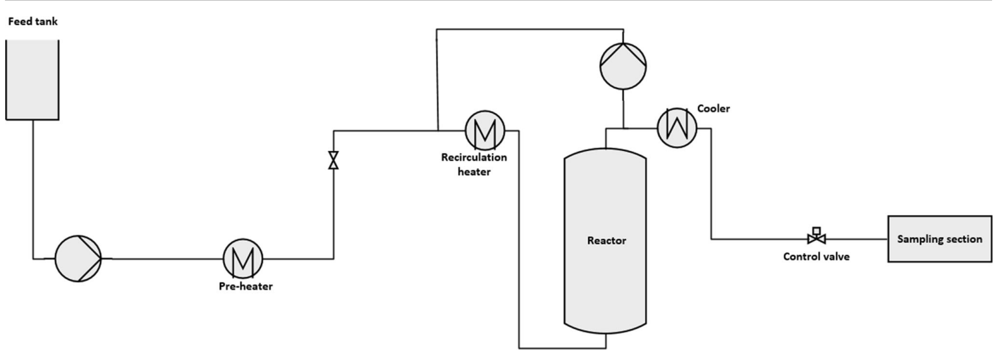
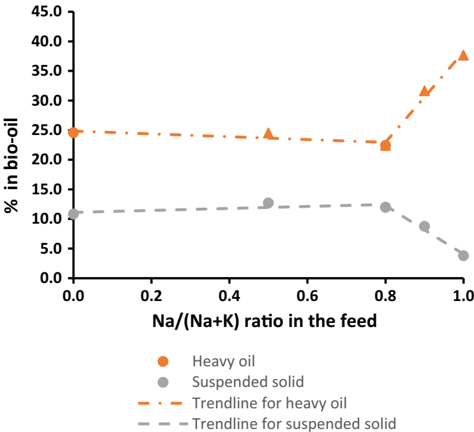
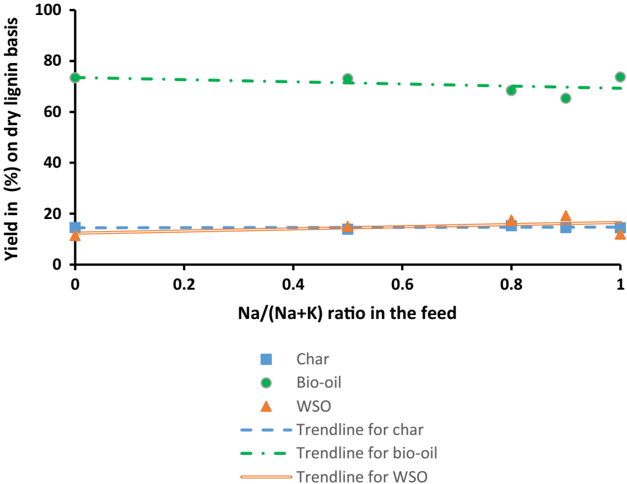
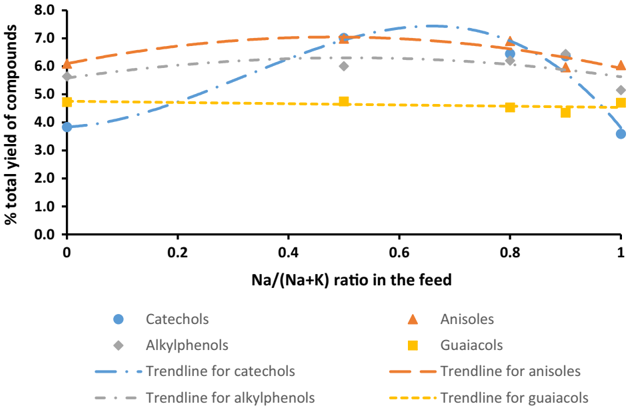
As a part of developing a hydrothermal liquefaction (HTL) process to valorise lignin, it is important to consider integration possibilities with existing infrastructures in order to obtain an overall positive economic impact. One obvious example is to integrate the HTL process with the kraft pulp mill: transport and storage costs is reduced, the temperature levels on process streams can be matched (energy integration) and the recovery/use of alkali can be made efficient. In this study, softwood kraft lignin was depolymerised using sub-critical water (623 K; 25 MPa) in a continuous, small pilot unit with a flow rate of 2 kg/h. ZrO2, K2CO3/KOH and Na2CO3/NaOH were used as catalytic system, and phenol as the capping agent. The influence of the ratio between sodium and potassium in the feed on the yield and composition of the product stream was investigated. The results showed that bio-oil, water-soluble organics (WSO) and char yields were not remarkably influenced by shifting the catalytic system from potassium to sodium. Moreover, the yields of most phenolic compounds did not change significantly when the sodium fraction was varied in the feed. The amounts of suspended solids in the bio-oil produced showed, however, a diminishing trend, (decrease from 10.8 to 3.8%) when the sodium fraction was increased in the feed, whilst the opposite trend was observed for the heavy oil, which increased from 24.6 to 37.6%.
Overview
The claims and statistics of this paper haven’t been checked yet.
Free: it reads the open-access text and checks the first 5 claims that cite a source we can check. Create a free account to check every claim.
Integrity signals
Registry
Cites
Statistics
Figures

Verification
Claims the paper makes
The claims and statistics of this paper haven’t been checked yet.
Free: it reads the open-access text and checks the first 5 claims that cite a source we can check. Create a free account to check every claim.
Claims other papers make about this one
Each is checked against this paper’s own text: does it say what the citing paper says it does?
The source backs part of the claim, not all of it — or backs it for a different population, condition or comparison.
In the citing paper
“However, the catalytic effect of KOH may have a greater influence on the SS yields, as observed in another study by Belkheiri et al. [113] where the change from sodium salts to potassium salts led to higher SS yields.”
From Sub- and Supercritical Water Liquefaction of Kraft Lignin and Black Liquor Derived Lignin (2020) · cites this paper as [113]
Experimental — accuracy not yet measuredThe source backs part of the claim, not all of it — or backs it for a different population, condition or comparison.
In the citing paper
“Similarly, the amount of light oil in the total bio-oil yield decreased from 65.6 wt.% to 58.6 wt.%.”
From Sub- and Supercritical Water Liquefaction of Kraft Lignin and Black Liquor Derived Lignin (2020) · cites this paper as [113]
Experimental — accuracy not yet measuredThe source backs part of the claim, not all of it — or backs it for a different population, condition or comparison.
In the citing paper
“The heterogeneous catalysts tested for improving the HTL of alkaline lignin were zirconia-, nickel-, ruthenium and lead-based catalysts [109,113].”
From Sub- and Supercritical Water Liquefaction of Kraft Lignin and Black Liquor Derived Lignin (2020) · cites this paper as [113]
Experimental — accuracy not yet measuredThe source backs part of the claim, not all of it — or backs it for a different population, condition or comparison.
In the citing paper
“Interestingly, the highest bio-oil yield was achieved when only Na + was used, but nearly similar bio-oil yields were achieved with the two lowest molecular ratios of Na + /(Na + + K + ) (0.0 and 0.5).”
From Sub- and Supercritical Water Liquefaction of Kraft Lignin and Black Liquor Derived Lignin (2020) · cites this paper as [113]
Experimental — accuracy not yet measuredThe source backs part of the claim, not all of it — or backs it for a different population, condition or comparison.
In the citing paper
“The yields of the WSO and char fractions did not significantly change when either sodium or potassium were used, although the yield of WSO slightly increased from ca. 12 wt.% up to 19.3 wt.% in the presence of both cations.”
From Sub- and Supercritical Water Liquefaction of Kraft Lignin and Black Liquor Derived Lignin (2020) · cites this paper as [113]
Experimental — accuracy not yet measured
7 more claims about this paper
Create a free account to see every claim other papers make about this one.
Self-check
Percentages, sums and reported differences re-computed from the paper’s own numbers.
The self-check needs the paper’s full text.
Citations
Cites
A unified correlation for estimating HHV of solid, liquid and gaseous fuels
Channiwala, S. A., & Parikh, P. P. (2002) · Fuel · doi:10.1016/s0016-2361(01)00131-4 · Cited by 2,489
Lignin depolymerisation strategies: towards valuable chemicals and fuels
Xu, C., Arancon, R. A. D., Labidi, J., & Luque, R. (2014) · Chem. Soc. Rev. · doi:10.1039/c4cs00235k · Cited by 1,031
Challenges in industrial applications of technical lignins
Vishtal, A., & Kraslawski, A. (2011) · BioResources · doi:10.15376/biores.6.3.3547-3568 · Cited by 721 · cited 1×
“The kraft process is the most common pulping process currently employed, accounting for more than 85% of the global lignin production: it amounts to approximately 63 × 10(4) tons annually [8], making this type of process of great interest as an obvious part in an integrated forest biorefinery (IFB).”
Towards quantitative catalytic lignin depolymerization
Roberts, V. M., Stein, V., Reiner, T., Lemonidou, A., Li, X., & Lercher, J. A. (2011) · Chemistry – A European Journal · doi:10.1002/chem.201002438 · Cited by 543 · cited 2×
“NaOH [14] 300 °C, 250 bar, boric acid Organosolv lignin Monomers, oligomers Oil 11.”
Converting a kraft pulp mill into an integrated forest biorefinery.
van Heiningen, A. (2006) · Cited by 502
Conversion of Lignin with Supercritical Water−Phenol Mixtures
Saisu, M., Sato, T., Watanabe, M., Adschiri, T., & Arai, K. (2003) · Energy & Fuels · doi:10.1021/ef0202844 · Cited by 330
Low-temperature catalytic hydrothermal treatment of wood biomass: analysis of liquid products
Karagöz, S., Bhaskar, T., Muto, A., Sakata, Y., Oshiki, T., & Kishimoto, T. (2005) · Chemical Engineering Journal · doi:10.1016/j.cej.2005.01.007 · Cited by 266 · cited 1×
“In these studies, potassium salts (in the form of K2CO3 or K2CO3/KOH) were used in order to promote lignin degradation: as explained earlier, the focus was on the potassium ion rather than the sodium because of its high catalytic activity [27].”
Recent Development in Chemical Depolymerization of Lignin: A Review
Wang, H., Tucker, M., & Ji, Y. (2013) · Journal of Applied Chemistry · doi:10.1155/2013/838645 · Cited by 260 · cited 2×
“Some studies have concluded more generally that using a base is important for promoting lignin degradation [13, 20].”
Organosolv lignin depolymerization with different base catalysts
Toledano, A., Serrano, L., & Labidi, J. (2012) · Journal of Chemical Technology & Biotechnology · doi:10.1002/jctb.3799 · Cited by 230 · cited 12×
“The BCD process involves the utilization of bases such as K2CO3, KOH, Na2CO3 and NaOH to promote lignin degradation.”
BackgroundInfluentialOkuda, K., Umetsu, M., Takami, S., & Adschiri, T. (2004) · Fuel Processing Technology · doi:10.1016/j.fuproc.2003.11.027 · Cited by 187 · cited 1×
“5) also showed a stable yield in this study when the Na/(Na + K) ratio was altered which, along with the fact that other studies [30, 31] consider guaiacol to be an intermediate product of lignin degradation, suggests that changing the process catalyst from potassium to sodium does not strongly affect the further conv…”
Result
Research works printed but not linked: 1
- 17. Miller JE, Evans L, Mudd JE, Brown KA (2002) Batch microreactor studies of lignin depolymerization by Bases. 1. Alcohol solvents Sandia report. Sandia National Laboratories, Albuquerque 18. Evans L, Littlewolf A, Lopez M, Miller JE (1999) Batch microreactor studies of base catalyzed ligin depolymerization in alcohol solvents. United States. https://www.osti.gov/servlets/ purl/3334. Accessed 30 December 2017
Cited by
Continuous Hydrothermal Liquefaction of Biomass: A Critical Review
Castello, D., Pedersen, T. H., & Rosendahl, L. A. (2018) · Energies · doi:10.3390/en11113165 · Cited by 343
Basar, I. A., Liu, H., Carrere, H., Trably, E., & Eskicioglu, C. (2021) · Green Chemistry · doi:10.1039/d0gc04092d · Cited by 253
Biomass to biofuels using hydrothermal liquefaction: A comprehensive review
Shahbeik, H., Kazemi Shariat Panahi, H., Dehhaghi, M., Guillemin, G. J., Fallahi, A., Hosseinzadeh-Bandbafha, H., Amiri, H., Rehan, M., Raikwar, D., Latine, H., et al. (2024) · Renewable and Sustainable Energy Reviews · doi:10.1016/j.rser.2023.113976 · Cited by 186
Nguyen, L. T., Phan, D.-P., Sarwar, A., Tran, M. H., Lee, O. K., & Lee, E. Y. (2021) · Industrial Crops and Products · doi:10.1016/j.indcrop.2020.113219 · Cited by 174
From biomass to biocrude: Innovations in hydrothermal liquefaction and upgrading
Usman, M., Cheng, S., Boonyubol, S., & Cross, J. S. (2024) · Energy Conversion and Management · doi:10.1016/j.enconman.2024.118093 · Cited by 151
Sub- and Supercritical Water Liquefaction of Kraft Lignin and Black Liquor Derived Lignin
Lappalainen, J., Baudouin, D., Hornung, U., Schuler, J., Melin, K., Bjelić, S., Vogel, F., Konttinen, J., & Joronen, T. (2020) · Energies · doi:10.3390/en13133309 · Cited by 87
“The heterogeneous catalysts tested for improving the HTL of alkaline lignin were zirconia-, nickel-, ruthenium and lead-based catalysts [109,113].”
BackgroundMethodInfluentialLignin Biorefinery: New Horizons in Catalytic Hydrodeoxygenation for the Production of Chemicals
Kumar, A., Jindal, M., Maharana, S., & Bhaskar, T. (2021) · Energy & Fuels · doi:10.1021/acs.energyfuels.1c01651 · Cited by 89
High value add bio-based low-carbon materials: Conversion processes and circular economy
AliAkbari, R., Ghasemi, M. H., Neekzad, N., Kowsari, E., Ramakrishna, S., Mehrali, M., & Marfavi, Y. (2021) · Journal of Cleaner Production · doi:10.1016/j.jclepro.2021.126101 · Cited by 82
Wu, Z. L., Zhao, X., Zhang, J., Li, X., Zhang, Y., & Wang, F. (2019) · Bioresource Technology · doi:10.1016/j.biortech.2019.01.082 · Cited by 79
Magdeldin, M., & Järvinen, M. (2020) · Applied Energy · doi:10.1016/j.apenergy.2020.114558 · Cited by 71
Ranjbar, S., & Malcata, F. X. (2023) · Molecules · doi:10.3390/molecules28248127 · Cited by 75
“As a result, lignin degradation is intensified, as prompted by enhanced diffusion and surface tension—although challenges in separation and technical aspects may temper their appeal for HTL [36].”
BackgroundYan, M., Liu, J., Yoshikawa, K., Jiang, J., Zhang, Y., Zhu, G., Liu, Y., & Hantoko, D. (2022) · Renewable Energy · doi:10.1016/j.renene.2022.01.049 · Cited by 58
Yang, J., He, Q. S., Niu, H., Dalai, A. K., Corscadden, K. W., & Zhou, N. (2020) · Fuel · doi:10.1016/j.fuel.2020.118202 · Cited by 60
Hydrothermal Liquefaction of Lignocellulosic and Protein-Containing Biomass: A Comprehensive Review
Jatoi, A. S., Shah, A. A., Ahmed, J., Rehman, S., Sultan, S. H., Shah, A. K., Raza, A., Mubarak, N. M., Hashmi, Z., Usto, M. A., et al. (2022) · Catalysts · doi:10.3390/catal12121621 · Cited by 65
Hydrothermal liquefaction of Radiata Pine with Kraft black liquor for integrated biofuel production
Ong, B. H. Y., Walmsley, T. G., Atkins, M. J., & Walmsley, M. R. W. (2018) · Journal of Cleaner Production · doi:10.1016/j.jclepro.2018.07.218 · Cited by 46
Rana, M., Taki, G., Islam, M. N., Agarwal, A., Jo, Y.-T., & Park, J.-H. (2019) · Energy & Fuels · doi:10.1021/acs.energyfuels.9b00808 · Cited by 41
Wang, H., Han, X., Zeng, Y., & Xu, C. C. (2023) · Renewable Energy · doi:10.1016/j.renene.2023.118956 · Cited by 39
Valorization of sewage sludge through catalytic sub- and supercritical water gasification
Yan, M., Hantoko, D., Kanchanatip, E., Zheng, R., Zhong, Y., & Mubeen, I. (2020) · Journal of the Energy Institute · doi:10.1016/j.joei.2020.01.004 · Cited by 39
Montesantos, N., & Maschietti, M. (2020) · Energies · doi:10.3390/en13071600 · Cited by 38
Yin, S., Shao, Y., Bao, T., & Zhu, J. (2023) · Energy & Fuels · doi:10.1021/acs.energyfuels.2c03300 · Cited by 36
Musa, U., Castro‐Díaz, M., Uguna, C. N., & Snape, C. E. (2022) · Fuel · doi:10.1016/j.fuel.2022.124784 · Cited by 32
Inorganic Salt Catalysed Hydrothermal Carbonisation (HTC) of Cellulose
Hammerton, J. M., & Ross, A. B. (2022) · Catalysts · doi:10.3390/catal12050492 · Cited by 32
Converting Biomass into Bio-Asphalt – A Review
Mahssin, Z. Y., Hassan, N. A., Yaacob, H., Puteh, M. H., Ismail, C. R., Jaya, R. P., Zainol, M. M., & Mahmud, M. Z. H. (2021) · IOP Conference Series Earth and Environmental Science · doi:10.1088/1755-1315/682/1/012066 · Cited by 33
“Kraft lignin 350 6-11 ZrO2, K2CO3 1-2 [72,73]”
Nunes, V. O., Fraga, A. D. C., Silva, R. V. S., Pontes, N. S., Pinho, A. D. R., Sousa‐Aguiar, E. F., & Azevedo, D. A. (2021) · Journal of environmental chemical engineering · doi:10.1016/j.jece.2021.106513 · Cited by 32
Forward Black Liquor Acid Precipitation: Lignin Fractionation by Ultrafiltration
Mendes, S. F., Rodrigues, J. S., de Lima, V. H., Botaro, V. R., Cardoso, V. L., & Reis, M. H. M. (2021) · Applied Biochemistry and Biotechnology · doi:10.1007/s12010-021-03580-2 · Cited by 28
Liu, M., Zeng, Y., & Luo, J. (2023) · Corrosion Science · doi:10.1016/j.corsci.2023.111148 · Cited by 27
From Pulp to Aromatic Products─Reaction Pathways of Lignin Depolymerization
Wörner, M., Barsuhn, A., Zevaco, T. A., Hornung, U., & Dahmen, N. (2024) · Energy & Fuels · doi:10.1021/acs.energyfuels.3c04509 · Cited by 27
Catalytic supercritical water gasification of black liquor along with lignocellulosic biomass
Karimi, A., Kazemi, N., Tavakoli, O., & Pirbazari, A. E. (2022) · International Journal of Hydrogen Energy · doi:10.1016/j.ijhydene.2022.03.099 · Cited by 28
Biomass carbon mining to develop nature-inspired materials for a circular economy
Bachs-Herrera, A., York, D., Stephens-Jones, T., Mabbett, I. W., Yeo, J., & Martín‐Martínez, F. J. (2023) · iScience · doi:10.1016/j.isci.2023.106549 · Cited by 30
“guaiacols, phenolic dimers, other compounds (oacetylphenol, 1,2-dimethoxybenzene, xanthene, 2-benzyl-4-methoxyphenol, retene, diethyl oxalate) Belkheiri et al.(164)”
BackgroundWörner, M., Werner, L., Hornung, U., Islongo Canabarro, N., Baudouin, D., & Dahmen, N. (2024) · Energy & Fuels · doi:10.1021/acs.energyfuels.3c04737 · Cited by 21
Dhakshinamoorthy, G. P., Gopinath, K. P., Prasanth, S. M., Harish, S., Rishikesh, M., Sivaramakrishnan, R., & Pugazhendhi, A. (2021) · Chemosphere · doi:10.1016/j.chemosphere.2021.133473 · Cited by 23
Lignin Depolymerization in the Presence of Base, Hydrogenation Catalysts, and Ethanol
Romanenko, I., Kurz, F., Baumgarten, R., Jevtovikj, I., Lindner, J.-P. B., Kundu, A., Kindler, A., & Schunk, S. A. (2022) · Catalysts · doi:10.3390/catal12020158 · Cited by 24
Liu, M., Zeng, Y., & Luo, J. (2022) · Corrosion Science · doi:10.1016/j.corsci.2022.110409 · Cited by 22
Harisankar, S., & Vinu, R. (2023) · Sustainable Energy & Fuels · doi:10.1039/d3se00308f · Cited by 20
Machine Learning Model Insights into Base-Catalyzed Hydrothermal Lignin Depolymerization
García, A. C., Cheng, S., McGlynn, S. E., & Cross, J. S. (2023) · ACS Omega · doi:10.1021/acsomega.3c04168 · Cited by 19
Sub-Supercritical Hydrothermal Liquefaction of Lignocellulose and Protein-Containing Biomass
Shah, A. A., Sharma, K., Seehar, T. H., Toor, S. S., Sandquist, J., Saanum, I., & Pedersen, T. H. (2024) · Fuels · doi:10.3390/fuels5010005 · Cited by 16
“%) with an increase in the amount of phenol in the feed [23].”
BackgroundMontesantos, N., Nielsen, R. P., & Maschietti, M. (2020) · Industrial & Engineering Chemistry Research · doi:10.1021/acs.iecr.9b06889 · Cited by 15
Catalytic hydrothermal conversion of polypropylene
Abubakar, F., Alfayez, I. A., Suleymanov, H., & McGregor, J. (2024) · Catalysis Today · doi:10.1016/j.cattod.2024.114807 · Cited by 12
Ahlbom, A., Maschietti, M., Nielsen, R. P., Lyckeskog, H. N., Hasani, M., & Theliander, H. (2021) · Energies · doi:10.3390/en14040932 · Cited by 13
Self-citationSatiada, G. B. D. A., Carpio, R. B., Guerrero, G. A., Maguyon-Detras, M. C., & Bambase, M. E. (2024) · Heliyon · doi:10.1016/j.heliyon.2024.e37520 · Cited by 13
“For example, Belkheiri et al. [44] reported that when the ratio of Na + /(Na + + K + ) increased from 0.8 to 1.0, the amount of heavy oil obtained from the HTL of Kraft lignin increased from 22.4 to 37.6 %.”
InfluentialIntegrated biorefinery concept for Indian paper and pulp industry
Sailwal, M., Banerjee, A., Bhaskar, T., & Ghosh, D. (2020) · Elsevier eBooks · doi:10.1016/b978-0-12-818228-4.00023-x · Cited by 10
Ascencio, J. J., Cruz-Santos, M. M., Ferreira, F. B., Ferraz, A. L., Yuan, J. S., & Chandel, A. K. (2026) · Chemical Engineering Journal · doi:10.1016/j.cej.2025.172434 · Cited by 5
Thermochemical methods for upgrading of lignin to aromatic chemicals
Singh, B., Rawat, S., Natte, K., & Narani, A. (2022) · Elsevier eBooks · doi:10.1016/b978-0-12-824419-7.00010-8 · Cited by 6
Švarc‐Gajić, J., Brezo-Borjan, T., Gosselink, R. J. A., Slaghek, T. M., Merkulov, D. Š., Ivetić, T. B., Bognár, S., & Stojanović, Z. S. (2022) · Processes · doi:10.3390/pr10102049 · Cited by 5
Gil, M. E., Loera‐Corral, O., Cañizares–Villanueva, R. O., Medina-Mendoza, G. G., Ortega‐López, J., & Montes-Horcasitas, M. D. C. (2025) · Heliyon · doi:10.1016/j.heliyon.2025.e43113 · Cited by 4
Assessing groundwater vulnerability in bedrock islands using the modified GALDIT method
Gong, R., Han, D., Friborg, T., & Zhang, K. (2026) · Journal of Hydrology · doi:10.1016/j.jhydrol.2026.134905 · Cited by 1
From pulp to aromatic products – Kinetic modeling of hydrothermal lignin depolymerization
Wörner, M., Campos, B. L. D. O., Hornung, U., & Dahmen, N. (2026) · Journal of environmental chemical engineering · doi:10.1016/j.jece.2026.122311 · Cited by 2
Gundupalli, M. P., Thomas, A. S. S., Gundupalli, S. P., Bhattacharyya, D., & Sriariyanun, M. (2022) · Clean Energy Production Technologies · doi:10.1007/978-981-16-4505-1_13 · Cited by 2
Liu, M., & Zeng, Y. (2024) · IEEE Lasers and Electro-Optics Society Annual Meeting (LEOS) · doi:10.5006/c2024-21224
From Pulp to Aromatic Products – Kinetic Modeling of Hydrothermal Lignin DepolymerizationPreprint
Wörner, M., Campos, B. L. D. O., Horung, U., & Dahmen, N. (2025) · SSRN Electronic Journal · doi:10.2139/ssrn.5958188
Jain, S., & Kumar, S. (2026) · Journal of Analytical and Applied Pyrolysis · doi:10.1016/j.jaap.2026.108049
Metadata
- Authors
- Belkheiri, T., Andersson, S.-I., Mattsson, C., Olausson, L., Theliander, H., & Vamling, L.
- Affiliations
- Chalmers University of Technology (SE)
- Valmet (Sweden) (SE)
- Wallenberg Wood Science Center (SE)
- Corresponding author
- Belkheiri, Tallal
- Venue
- Biomass Conversion and Biorefinery
- Published
- 2018-03-28
- Volume
- 8
- Issue
- 3
- Pages
- 585-595
- ISSN
- 2190-6815 (ISSN-L)
- 2190-6823
- OpenAlex
- W2795013788
- Cited by
- 51
- References
- 28
- Citations by year
- 2026: 4 · 2025: 2 · 2024: 7 · 2023: 8 · 2022: 10 · 2021: 9 · 2020: 7 · 2019: 2 · 2018: 2
- FWCI
- 2.00
- Type
- journal article
- Language
- en
- Open access
- hybrid
- doi.org
- Licence
- cc-by
- creativecommons.org/licenses/by/4.0 (tdm)
- Locations
- Biomass Conversion and Biorefinery (publishedVersion, cc-by)
- Chalmers Research (Chalmers University of Technology) (submittedVersion)
- Funders
- Energimyndigheten (40521-1)
- Topics
- Physical Sciences › Chemical Engineering › Process Chemistry and Technology › Lignin and Wood Chemistry
- Physical Sciences › Energy › Fuel Technology › Thermochemical Biomass Conversion Processes
- Physical Sciences › Chemical Engineering › Process Chemistry and Technology › Subcritical and Supercritical Water Processes
- Keywords
- hydrothermal liquefaction, kraft lignin, lignin valorization, zirconia catalysts, potassium hydroxide, sodium hydroxide, bio-oil, char yield, suspended solids, heavy oil, softwood kraft pulp, process integration
About these checks
Registry, retraction, Cites and statistics results are computed, not judged, with one exception: a printed reference that no index lists is read once by a model before it counts as a citation error. Claims are extracted by a model and kept only when their quote appears verbatim in the text; each cited source is then checked, with a model’s help, for whether it says what the claim relies on. Those verdicts can be wrong — read the claim’s quote and the cited source before relying on one.
Statistics and arithmetic are recomputed, not judged.
Confidence bands are shown only for fields calibrated on our annotated test set. None is calibrated yet, so no band is shown.
What counts as a claim ›How we measure confidence ›How we check this ›
Are you an author, or do you see a problem with this page? Request a review
Data sources
Bibliographic data: Semantic Scholar, OpenAlex, Crossref.
Contains information from the Semantic Scholar Academic Graph Datasets, made available under the ODC Attribution License (ODC-BY 1.0).
Semantic Scholar’s data is described in: Kinney, R., et al. (2023). The Semantic Scholar Open Data Platform. arXiv:2301.10140.
