

The impacts of environmental, social and governance (ESG) issues in achieving sustainable lithium supply in the Lithium Triangle
Open accessThe DOI matches its Crossref record; 71 of the 71 references it cites were found in a registry or an index; 11 of the 63 sources its claims cite were checked for support.
Abstract
The electrification transition will intensify the demand for lithium. The endowment in the Lithium Triangle is significant, and the expectations for the global supply are high in terms of resources and sustainability. In this paper, we investigate the impact of environmental, social and governance (ESG) challenges to the future of sustainable lithium extraction. We undertook a qualitative analysis to prioritise the risks associated with these challenges and discussed their interlinkages. We argue that a sustainable perspective for lithium extraction in the region requires continuous and informed dialogue among government, industry and community stakeholders and participatory processes that reduce the asymmetries of power and knowledge. We provide a list of urgent mitigation actions that could assist the move towards sustainability. These include the following. First is expanding our understandings of the water cycle of lithium brines in this region. This should be underpinned by baseline data and ongoing monitoring at the watershed scale, capacity building to strengthen institutions, improved regulations and data infrastructures to promote data transparency and accessibility. Second is integrating biodiversity impacts within existing mining practices and procedures (e.g. Environmental Impact Assessments — EIA). We propose the strategic implementation of the mitigation hierarchy and IFC’s Performance Standards to avoid, reduce and offset the risks of lithium extraction on ecosystem services and critically important biodiversity impacts. Third is strengthening social participatory processes that enable the local communities to become actors in decision-making and the ongoing management and monitoring of lithium projects. Fourth is establishing a framework to support a Strategic Environmental and Social Assessment (SESA) process specific to lithium with a regional approach in the Lithium Triangle.
Overview
CoChat Summary
TL;DR
This paper qualitatively assesses environmental, social and governance (ESG) challenges to sustainable lithium extraction in the Lithium Triangle (Argentina, Bolivia, Chile), using stakeholder workshops, interviews and a multicriteria scoring framework. It argues that sustainable lithium supply requires watershed-scale water understanding, biodiversity integration via the mitigation hierarchy and IFC standards, stronger participatory processes, and a regional Strategic Environmental and Social Assessment (SESA).
Key findings
- The Lithium Triangle salars hold more than 50% of global lithium resources; IEA projections cited in the paper suggest lithium demand could increase by over 40 times by 2040 compared with 2020 under a sustainable development scenario.
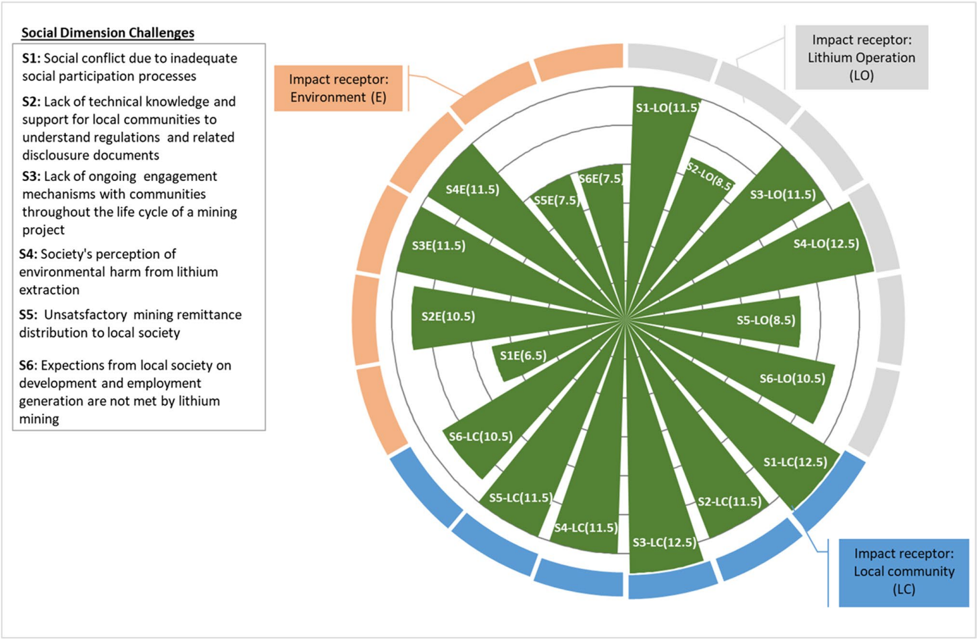
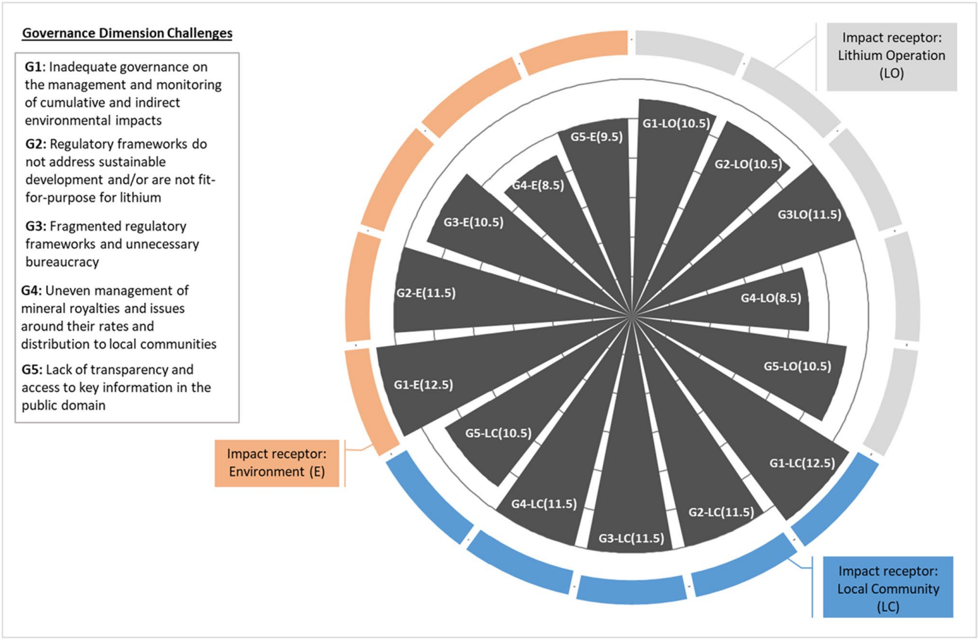
- Stakeholder engagement (81 workshop participants; nine interviews of 60–90 min) and literature review identified environmental challenges E1–E9 (water, biodiversity, mine design/processing, climate change), social challenges S1–S6, and governance challenges G1–G5.
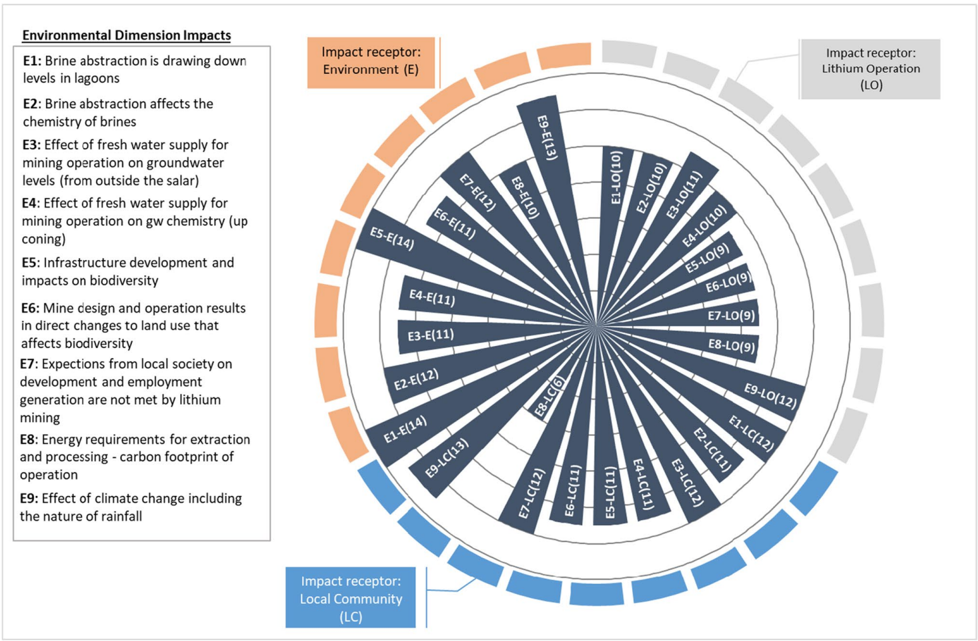
- In scoring, environmental impacts on lagoons (E1), biodiversity (E5), and climate change (E9) had the highest scores; social challenges S4 (perceived environmental harm) and S5 (mining remittance distribution) were major concerns; governance challenges scored high for local communities, especially G1 (inadequate cumulative/indirect impact management).
- Recommendations include expanding water-cycle research with baseline data and watershed monitoring, applying the mitigation hierarchy and IFC Performance Standards to biodiversity, strengthening social participation, and establishing a lithium-specific regional SESA.
Methods
- Qualitative design: field trips in 2019, semi-structured interviews and virtual workshops with stakeholders in Bolivia, Chile and Argentina (2019–2021), plus literature review of government reports, legislative frameworks, standards, best practice documents and environmental impact assessments.
- Stakeholder consultation: 81 workshop participants; nine interviews averaging 60–90 min; participation was voluntary, confidential and anonymised.
- Analysis: country-level screening scored issues 1–3 (not relevant to extremely relevant); regional multicriteria decision analysis (MCDA) scoring framework assessed severity, temporal distribution, spatial distribution, type of impact and uncertainty across receptors (lithium operation, local communities, environment), with criteria equally weighted.
Limitations
- The paper states the assessment is qualitative and based on primary and secondary data; its uncertainty criterion acknowledges major data gaps and highly uncertain assessments.
- It notes lack of consistent baseline data, models, and project-scale EIA data that do not capture cumulative or watershed-scale impacts, especially where multiple projects operate.
- Evident from the text: the MCDA scoring relies on stakeholder perceptions and qualitative judgments with equal weighting, and no quantitative validation or probability estimates are reported.
Model-written summary. Check it against the paper before relying on it.
Integrity signals
Registry
Cites
Statistics
Figures
Verification
Claims the paper makes
10 Valid · 13 Not valid · 42 Not checked · 152 Own results and interpretations
The cited sources support only part of this claim — read each source’s verdict below.
In the paper
“Whilst the connection between the nucleus and the lagoons has been studied extensively in the Salar de Atacama (e.g. (Marazuela et al. 2019; Boutt et al. 2021; McKnight, Boutt et al. 2021)”
What the sources say
- Supportedcites Marazuela et al. 2019 matched to “Hydrodynamics of salt flat basins: The Salar de Atacama example” (2019) sourceExperimental — accuracy not yet measured
Section 2.3 states that the main hydrological layers of the Salar de Atacama nucleus interact directly with lakes in the mixing zone. The Discussion also examines groundwater flows between the nucleus, mixing zone, and lakes. This paper is therefore an example of research on the connection cited in the sentence. (LLM, conf=0.91)
- Partly supportedcites Boutt et al. 2021 matched to “Imbalance in the modern hydrologic budget of topographic catchments along the western slope of the Andes (21–25°S): implications for groundwater recharge assessment” (2021) sourceExperimental — accuracy not yet measured
The Study Area section (pp. 6–7) describes springs and seeps around the halite nucleus feeding lagoons, and shallow groundwater emerging in lagoon systems near the salar margin. This supports a hydrologic connection, but the paper does not establish that the specific nucleus–lagoon connection has been studied extensively. (LLM, conf=0.79)
- Not checked — no full text of the sourcecites McKnight, Boutt et al. 2021 matched to “Impact of Hydrostratigraphic Continuity on Brine‐to‐Freshwater Interface Dynamics: Implications From a Two‐Dimensional Parametric Study in an Arid and Endorheic Basin” (2021) source
boosted- Asserted: passes — The authors put it forward as true.
- Checkable: passes — It can be checked against evidence.
- Load-bearing: unclear — It is unclear whether the paper’s conclusions depend on it.
- Based: passes — The paper gives a reason why it holds.
- Supported
The cited sources support only part of this claim — read each source’s verdict below.
In the paper
“the whole hydrological system in the region is moving from a wetter to a drier state over millennia (see for example Nunnery et al. (2018))”
What the sources say
- Partly supportedcites Nunnery et al. (2018) matched to “Lake-level variability in Salar de Coipasa, Bolivia during the past ∼40,000 yr” (2019) sourceExperimental — accuracy not yet measured
The Discussion (page unavailable) describes gradual lake drawdown after about 10,000 years ago and dry mid-Holocene conditions, supporting a long-term shift toward dryness at Salar de Coipasa. It does not support a uniform shift across the whole regional hydrological system: the same passage says Lake Titicaca rose after 4,500 years ago while Coipasa remained shallow and Uyuni was dry. (LLM, conf=0.87)
plainstates a cause- Asserted: passes — The authors put it forward as true.
- Checkable: passes — It can be checked against evidence.
- Load-bearing: unclear — It is unclear whether the paper’s conclusions depend on it.
- Based: passes — The paper gives a reason why it holds.
- Partly supported
The cited sources support only part of this claim — read each source’s verdict below.
In the paper
“The downstream supply chain (e.g. batteries, automotive) is currently demanding development of sustainable batteries and sustainable decarbonisation technologies.”
What the sources say
- Partly supportedcites Agusdinata, Liu et al. 2018 matched to “Socio-Environmental Impacts of Lithium Mineral Extraction: Towards a Research Agenda” (2018) sourceExperimental — accuracy not yet measured
The Introduction (page not available) says growing demand for electric-drive vehicles is driving demand for lithium-ion batteries, which the paper describes as instrumental to low-carbon transportation. The timeline section (page not available) also reports automakers expanding their electric-vehicle offerings. It does not say the downstream supply chain is demanding the development of *sustainable batteries* or sustainable decarbonisation technologies specifically. (LLM, conf=0.85)
- Not checked — no full text of the sourcecites Barandiarán 2019 matched to “Lithium and development imaginaries in Chile, Argentina and Bolivia” (2019) source
- Not checked — no full text of the sourcecites Bustos-Gallardo et al. 2021 matched to “Harvesting Lithium: water, brine and the industrial dynamics of production in the Salar de Atacama” (2021) source
plain- Asserted: passes — The authors put it forward as true.
- Checkable: passes — It can be checked against evidence.
- Load-bearing: unclear — It is unclear whether the paper’s conclusions depend on it.
- Based: passes — The paper gives a reason why it holds.
- Partly supported
The cited sources support only part of this claim — read each source’s verdict below.
In the paper
“But the sustainability of a product is negated if the production of raw materials is burdened by a range of significant environmental impacts, social and governance issues.”
What the sources say
- Partly supportedcites Agusdinata, Liu et al. 2018 matched to “Socio-Environmental Impacts of Lithium Mineral Extraction: Towards a Research Agenda” (2018) sourceExperimental — accuracy not yet measured
The Introduction and Concluding remarks link the sustainability of lithium-battery technologies to the socio-environmental impacts of lithium extraction and call for those impacts to be addressed. They do not state that such impacts categorically negate a product’s sustainability, or extend that conclusion to products generally. Page numbers are unavailable in our copy. (LLM, conf=0.84)
- Not checked — no full text of the sourcecites Barandiarán 2019 matched to “Lithium and development imaginaries in Chile, Argentina and Bolivia” (2019) source
- Not checked — no full text of the sourcecites Bustos-Gallardo et al. 2021 matched to “Harvesting Lithium: water, brine and the industrial dynamics of production in the Salar de Atacama” (2021) source
plainstates a cause- Asserted: passes — The authors put it forward as true.
- Checkable: passes — It can be checked against evidence.
- Load-bearing: passes — The paper’s conclusions depend on it.
- Based: passes — The paper gives a reason why it holds.
- Partly supported
A result the paper reports from its own data — it cites no other source for it, so there is none to check. The quote shows it is in the paper.
In the paper
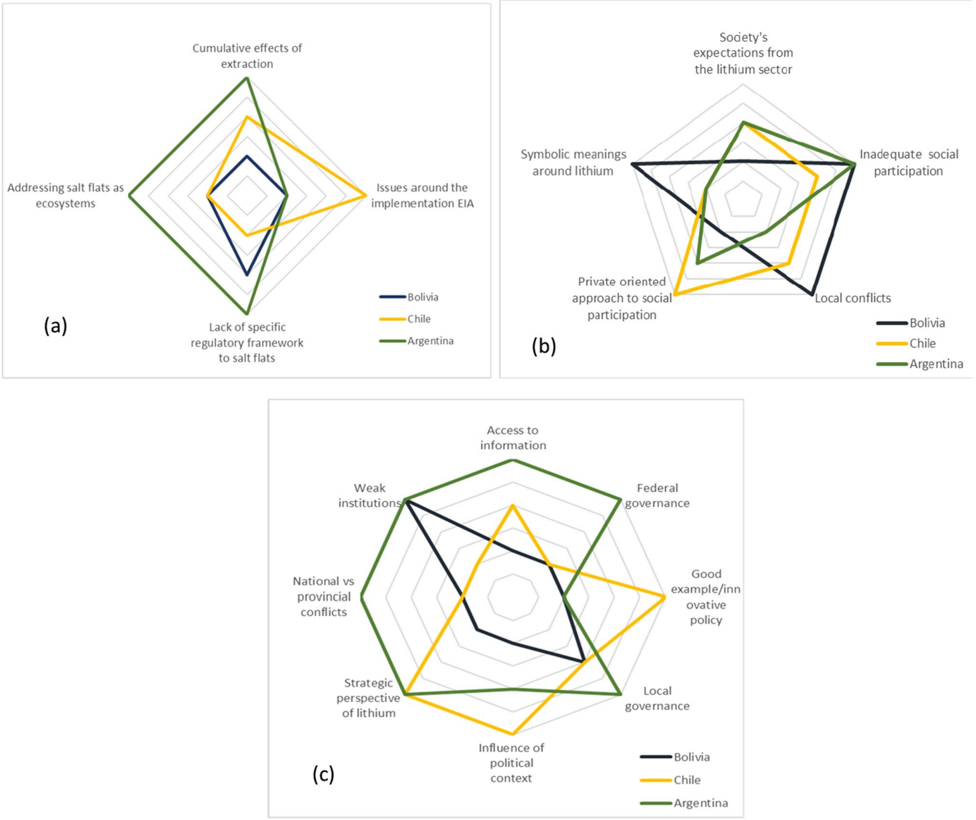
“In Argentina, the most relevant dimension encompasses governance issues (e.g. federal governance and the challenges in defining a national strategic perspective on lithium) and environmental concerns (cumulative effects of extraction and the lack of a specific regulation on lithium mining).”
plain- Asserted: passes — The authors put it forward as true.
- Checkable: passes — It can be checked against evidence.
- Load-bearing: unclear — It is unclear whether the paper’s conclusions depend on it.
- Based: passes — The paper gives a reason why it holds.
75 more claims
Create a free account to see all 217 claims and to verify the 1 reference still open.
- It may state two separate claims as one. 87
- Probably not a substantial claim. 80
- The quote only partly states this claim. 2
Self-check
Percentages, sums and reported differences re-computed from the paper’s own numbers.
Each contradiction between two passages listed here was confirmed by an independent check.
Rated minor: it would not touch a result — a value no result rests on, a p-value that stays on the same side of the significance level, or a conflict that is clerical, resolved elsewhere in the paper, or outside its own findings.
In the paper
§ Discussion of results
“the management of mineral royalties and distribution (G5-local community receptor)”
§ Governance challenges
“(G4) The management of mineral royalties and issues around their rates and distribution to local communities”
Citations
Cites
Recycling lithium-ion batteries from electric vehicles
Harper, G., Sommerville, R., Kendrick, E., Driscoll, L., Slater, P., Stolkin, R., Walton, A., Christensen, P., Heidrich, O., Lambert, S., et al. (2019) · Nature · doi:10.1038/s41586-019-1682-5 · Cited by 3,890
On the sustainability of lithium ion battery industry – A review and perspective
Yang, Y., Okonkwo, E. G., Huang, G., Xu, S., Sun, W., & He, Y. (2021) · Energy Storage Materials · doi:10.1016/j.ensm.2020.12.019 · Cited by 886
Navigating the complexity of ecological stability
Donohue, I., Hillebrand, H., Montoya, J. M., Petchey, O. L., Pimm, S. L., Fowler, M. S., Healy, K., Jackson, A. L., Lurgi, M., McClean, D., et al. (2016) · Ecology Letters · doi:10.1111/ele.12648 · Cited by 647
A comparison of The Limits to Growth with 30 years of reality
TURNER, G. (2008) · Global Environmental Change · doi:10.1016/j.gloenvcha.2008.05.001 · Cited by 556
Elliot, S. (2011) · MIS Quarterly · doi:10.2307/23043495 · Cited by 499
Limits to Growth: The 30-Year Update
(2005) · International Journal of Sustainability in Higher Education · doi:10.1108/ijshe.2005.24906cae.006 · Cited by 465
OECD Guidelines for Multinational Enterprises, 2011 Edition
OECD (2011) · OECD eBooks · doi:10.1787/9789264115415-en · Cited by 414
Variability of precipitation in the Atacama Desert: its causes and hydrological impact
Houston, J. (2006) · International Journal of Climatology · doi:10.1002/joc.1359 · Cited by 413
Climate change in Argentina: trends, projections, impacts and adaptation
Barros, V. R., Boninsegna, J. A., Camilloni, I. A., Chidiak, M., Magrín, G. O., & Rusticucci, M. (2015) · WIREs Climate Change · doi:10.1002/wcc.316 · Cited by 395
OECD Guidelines for Multinational Enterprises
(2001) · OECD eBooks · doi:10.1787/9789264196018-en · Cited by 385
Research works printed but not linked: 3
- Christmann P, Gloaguen E, Labbé J-F, Melleton J, Piantone P (2015) Chapter 1 - global lithium resources and sustainability issues. Elsevier, Lithium Process Chemistry. A. Chagnes and J. Światowska. Amsterdam, pp 1-40
- Elliot JA (1994) An introduction to sustainable development : the developing world. London Routledge
- World Commission on Environment and Development (1987) The Brundtland Report: our common future. Oxford WCED
Cited by
de Souza Barbosa, A., da Silva, M. C. B. C., da Silva, L. B., Morioka, S. N., & de Souza, V. F. (2023) · Humanities and Social Sciences Communications · doi:10.1057/s41599-023-01919-0 · Cited by 203
Krishnan, R., & Gopan, G. (2024) · Cleaner Engineering and Technology · doi:10.1016/j.clet.2024.100749 · Cited by 115
Chipangamate, N. S., & Nwaila, G. T. (2023) · Energy Geoscience · doi:10.1016/j.engeos.2023.100257 · Cited by 132
Mojid, M. R., Lee, K. J., & You, J. (2024) · Sustainable materials and technologies · doi:10.1016/j.susmat.2024.e00923 · Cited by 156
Review of life cycle assessment on lithium-ion batteries (LIBs) recycling
Domingues, A. M., & de Souza, R. G. (2024) · Next Sustainability · doi:10.1016/j.nxsust.2024.100032 · Cited by 117
Ghorbani, Y., Zhang, S. E., Bourdeau, J. E., Chipangamate, N. S., Rose, D. H., Valodia, I., & Nwaila, G. T. (2024) · Resources Policy · doi:10.1016/j.resourpol.2024.104737 · Cited by 112
Fuentealba, D., Flores-Fernández, C., Troncoso, E., & Estay, H. (2023) · Resources Policy · doi:10.1016/j.resourpol.2023.103572 · Cited by 75
Future climate impacts of sodium-ion batteries
Zhang, S., Steubing, B. R. P., Karlsson, H., Hansson, P., & Nordberg, Å. (2023) · Resources Conservation and Recycling · doi:10.1016/j.resconrec.2023.107362 · Cited by 81
Global sustainability of electric vehicles minerals: A critical review of news media
Agusdinata, D. B., & Liu, W. (2023) · The Extractive Industries and Society · doi:10.1016/j.exis.2023.101231 · Cited by 64
Halkes, R. T., Hughes, A., Wall, F., Petavratzi, E., Pell, R., & Lindsay, J. J. (2024) · Resources, Conservation and Recycling · doi:10.1016/j.resconrec.2024.107554 · Cited by 61
Self-citationLithium nexus: Energy, geopolitics, and socio-environmental impacts in Mexico's Sonora project
Vivoda, V., Bazilian, M., Khadim, A., Ralph, N., & Krame, G. (2023) · Energy Research & Social Science · doi:10.1016/j.erss.2023.103393 · Cited by 57
Chaudary, M. S. A. (2025) · Energy Research & Social Science · doi:10.1016/j.erss.2025.103952 · Cited by 74
Radebe, N., & Chipangamate, N. S. (2024) · Resources Policy · doi:10.1016/j.resourpol.2024.104887 · Cited by 82
Parker, S. S., Clifford, M. J., & Cohen, B. S. (2023) · The Science of The Total Environment · doi:10.1016/j.scitotenv.2023.168639 · Cited by 39
Domingues, A. M., de Souza, R. G., & Luiz, J. V. R. (2024) · Energy Research & Social Science · doi:10.1016/j.erss.2024.103756 · Cited by 42
Advances in integrated membrane processes for sustainable lithium extraction
Tufa, R. A., Santoro, S., Flores-Fernández, C., Zegeye, R. B., Fuentealba, D., Aquino, M., Barraza, B., Inzillo, B. M., Nasirov, S., D'Andrea, G., et al. (2025) · Desalination · doi:10.1016/j.desal.2025.118899 · Cited by 37
Aishwarya, V. M., Ekren, B. Y., Singh, T., & Singh, V. (2025) · Renewable and Sustainable Energy Reviews · doi:10.1016/j.rser.2025.115671 · Cited by 37
Recent Advances and Future Prospects of Lithium Recovery from Low-Grade Lithium Resources: A Review
Gu, J., Liang, B., Luo, X., Zhang, X., Yuan, W., Xiao, B., & Tang, X. (2024) · Inorganics · doi:10.3390/inorganics13010004 · Cited by 38
Mining, biodiversity and social conflict in the renewable energy transition
Aska, B., Sonter, L. J., zu Ermgassen, S., Franks, D. M., Mingorría, S., Iniesta-Arandia, I., Lloyd, T. J., & Torres, A. (2025) · Nature Reviews Biodiversity · doi:10.1038/s44358-025-00076-3 · Cited by 46
de Souza, R. G., Domingues, A. M., Spindlegger, A., Mair‐Bauernfeind, C., & Part, F. (2024) · Sustainable Production and Consumption · doi:10.1016/j.spc.2024.11.031 · Cited by 32
Lawley, C. J. M., Haynes, M. W., Chudasama, B., GOODENOUGH, K. M., Eerola, T., Golev, A., Zhang, S. E., Park, J., & Lèbre, É. (2024) · Earth Science Systems and Society · doi:10.3389/esss.2024.10109 · Cited by 28
Walter, M., Deniau, Y., & Vargas, V. H. (2024) · Critical Sociology · doi:10.1177/08969205241305963 · Cited by 35
Vivoda, V., & Loginova, J. (2025) · Mineral Economics · doi:10.1007/s13563-025-00517-7 · Cited by 28
Collis, G. E., Dai, Q., Loh, J. S. C., Lipson, A. L., Gaines, L. L., Zhao, Y., & Spangenberger, J. S. (2023) · Recycling · doi:10.3390/recycling8050078 · Cited by 23
Chen, Z., Awan, U., Nassani, A. A., Al‐Aiban, K. M., & Zaman, K. (2024) · Resources Policy · doi:10.1016/j.resourpol.2024.105451 · Cited by 30
Obaya, M., Murguía, D. I., & Sanchez‐Lopez, M. D. (2024) · The Extractive Industries and Society · doi:10.1016/j.exis.2024.101509 · Cited by 27
Self-citationMurguía, D. I., & Bastida, A. E. (2023) · Geological Society London Special Publications · doi:10.1144/sp526-2022-172 · Cited by 15
Al-Jawad, J., Ford, J., Petavratzi, E., & Hughes, A. (2024) · Science of The Total Environment · doi:10.1016/j.scitotenv.2023.167647 · Cited by 17
“Peri-odic flooding by surface waters helps maintain the water balance, sporadically in Atacama (Boutt et al., 2016) and more regularly in wetter salars such as Salar de Uyuni, Bolivia (Petavratzi et al., 2022a).”
Self-citationEcological restoration for China’s mines
(2024) · doi:10.1126/science.adr1001 · Cited by 13
Progress in safe nano-structured electrolytes for sodium ion batteries: A comprehensive review
Tawalbeh, M., Ali, A. M., Aljawrneh, B., & Al–Othman, A. (2024) · Nano-Structures & Nano-Objects · doi:10.1016/j.nanoso.2024.101311 · Cited by 17
Yuan, J., Liu, Z., Zhou, T., Tang, X., Yuan, J., & Yuan, W. (2023) · Sustainability · doi:10.3390/su15107962 · Cited by 18
Murguía, D. I., & Bastida, A. E. (2024) · The Extractive Industries and Society · doi:10.1016/j.exis.2024.101485 · Cited by 26
Jeong, Y., Song, J., Kim, H., Park, J., Maulana, A. Y., An, N., Yun, B., Jung, S., Park, M., & Kim, J. (2024) · Journal of Energy Storage · doi:10.1016/j.est.2024.112000 · Cited by 13
Bravo, E. S. (2022) · Mineral Economics · doi:10.1007/s13563-022-00358-8 · Cited by 21
Recyclable Organic Radical Electrodes for Metal‐Free Batteries
Thakur, R. M., Ma, T., Shamblin, G., Oka, S. S., Lalwani, S. M., Easley, A. D., & Lutkenhaus, J. L. (2024) · ChemSusChem · doi:10.1002/cssc.202400788 · Cited by 13
Geopolitics and mine waste: An overview and future research directions
Vivoda, V., Loginova, J., & Kemp, D. (2025) · Journal of Environmental Management · doi:10.1016/j.jenvman.2025.125545 · Cited by 15
Anani, A., Adewuyi, S. O., & Gonzales, C. G. (2025) · The Extractive Industries and Society · doi:10.1016/j.exis.2025.101662 · Cited by 16
Castro, A., de León, A. P., Cantera, A. L., Olofsson, V., & Reina-Rozo, J. D. (2024) · Tapuya Latin American Science Technology and Society · doi:10.1080/25729861.2024.2309046 · Cited by 12
Investment projects and the protection of indigenous peoples and territories in Colombia
Rodríguez, L. L., Lombaerde, P. A. A. D., Carrera, M. A. L., & Londono-Escudero, C. (2024) · Latin American Policy · doi:10.1111/lamp.12339 · Cited by 9
Indigenous peoples as trustees of forests: a bio-socio-cultural approach to international law
Rodríguez, L. L., Fabris, A. L., & Montag, D. (2024) · International Environmental Agreements Politics Law and Economics · doi:10.1007/s10784-024-09654-w · Cited by 17
Insufficient Lithium Supply is Likely to Slow Down the Transition to Electrified TransportPreprint
McNeil, B., Billy, R. G., Lopez, F. A., Petavratzi, E., & Müller, D. B. (2023) · SSRN Electronic Journal · doi:10.2139/ssrn.4662605 · Cited by 10
Self-citationAishwarya, V. M., Ekren, B. Y., Singh, T., & Singh, V. (2025) · Cleaner Logistics and Supply Chain · doi:10.1016/j.clscn.2025.100272 · Cited by 14
Jesus, S., Ventura, M., Assunção, R., Gueifão, S., Delgado, I. M., Rego, A., Ribeiro, M., Martins, M., Neves, O., & Coelho, I. (2024) · Food and Chemical Toxicology · doi:10.1016/j.fct.2024.114825 · Cited by 12
Okonkwo, E. (2022) · Fennia · doi:10.11143/fennia.120695 · Cited by 12
Experimental assessment of sustainable lithium extraction from geothermal reservoirs
Sajkowski, L., Turnbull, R., Blundy, J., & Rogers, K. M. (2025) · Geothermics · doi:10.1016/j.geothermics.2025.103448 · Cited by 8
Thirumurugan, A., Govindaraj, R., Dhanabalan, S. S., Sakthivel, P., Chidhambaram, N., Rednam, U., Kamaraj, S., Abarzúa, C. V., Nazer, J. C., & Morel, M. J. (2024) · Zeitschrift für Physikalische Chemie · doi:10.1515/zpch-2023-0524 · Cited by 6
Derlindati, E. J., Arengo, F., Michelutti, M. P., Romano, M. C., Sosa, H., Ortiz, E. P., Rocha, O., Jahn, A. E., Chanampa, M. M., & Barberis, I. M. (2024) · Bird Conservation International · doi:10.1017/s0959270924000273 · Cited by 9
A review on the socio-environmental impacts of lithium supply for electric aircraft
Chen-Glasser, M., & DeCaluwe, S. C. (2022) · Frontiers in Aerospace Engineering · doi:10.3389/fpace.2022.1058940 · Cited by 6
Revisiting Climate Crisis for Carbon Neutrality Through Education? A Sustainable Nudging Approach
Soubhari, T., Nanda, S. S., & Shobha, C. V. (2024) · World sustainability series · doi:10.1007/978-3-031-65972-0_14 · Cited by 6
Soamole, S. B., & Mokodompit, E. A. (2025) · Mineral Economics · doi:10.1007/s13563-025-00588-6 · Cited by 20
Fuentes, M., Negrete, M., Herrera‐León, S., & Krasławski, A. (2024) · Sustainable Development · doi:10.1002/sd.3054 · Cited by 8
Hernández-Rojas, M., Estévez, R. A., Romero, C., Pérez, S., & Labra, F. A. (2025) · Sustainability · doi:10.3390/su17188139 · Cited by 3
Environmental Justice Across the Lithium Supply Chain: A Role for Science Diplomacy in the Americas
Grossman, A., Mastrángelo, M. E., Ríos, C. D. L., & Jiménez-Córdova, M. I. (2023) · Journal of Science Policy & Governance · doi:10.38126/jspg220205 · Cited by 6
The implications of uncertainties on global lithium resources availability estimations
Zhou, D. J., Pye, S., Verrier, B., & Dodds, P. E. (2026) · iScience · doi:10.1016/j.isci.2026.114629 · Cited by 6
Reyes, C., Castillo, E., Orellana, L. F., & del Real, I. (2025) · The Extractive Industries and Society · doi:10.1016/j.exis.2025.101761 · Cited by 9
Advances in Lithium Recovery from Primary and Secondary Sources
Kim, J., Powell, A., Peng, H., & Botelho, A. B. (2025) · JOM · doi:10.1007/s11837-025-08036-0 · Cited by 3
Fierling, N., Billard, P., Fornasier, F., Bauda, P., & Blaudez, D. (2025) · The Science of The Total Environment · doi:10.1016/j.scitotenv.2025.178565 · Cited by 3
Fan, W., Ma, L., Pan, W., Zeng, X., Li, Z., Su, H., Zhang, P. F., & Zhao, Y. (2025) · Desalination · doi:10.1016/j.desal.2025.119260 · Cited by 6
Montes, T. K. (2025) · The Law and Development Review · doi:10.1515/ldr-2025-0003 · Cited by 3
Supply of critical raw materials for lithium-ion batteries: Social and environmental risks in Brazil
de Souza, R. G., Domingues, A. M., & Mancini, S. D. (2025) · The Extractive Industries and Society · doi:10.1016/j.exis.2025.101810 · Cited by 6
Saguier, M. I., Mora, S., & Godfrid, J. (2025) · Third World Quarterly · doi:10.1080/01436597.2025.2566238 · Cited by 3
Evolving Critical Metal Systems: Hype Cycles and Implications for Sustainable Innovation
Mahanty, S., Boons, F., & Harper, G. D. J. (2025) · Sustainability · doi:10.3390/su17062778 · Cited by 2
Mechanistic insights into nigerian lithium ores: implications for energy and industrial applications
Olajuyi, S. I., Adamu, H. A., Ogunmodimu, O. S. O., & Afolayan, D. O. (2025) · Frontiers in Geochemistry · doi:10.3389/fgeoc.2025.1659636 · Cited by 2
A knowledge graph approach to global nickel mining operations: Patterns and geopolitical insights
Lin, Z., Wang, P., Tang, L., Larosa, F., Zhu, Y., Ekins, P., & Chen, W. (2025) · Sustainable Production and Consumption · doi:10.1016/j.spc.2025.08.012 · Cited by 2
Al-Jawad, J. Y., Ford, J. R., Petavratzi, E., et al. (2023) · SSRN Electronic Journal · doi:10.2139/ssrn.4485239 · Cited by 1
Self-citationBeyond the Rhetoric: Integrating Justice into Transformative Innovation PolicyPreprint
Urias, E., Kok, K. P. W., & Ulug, C. (2024) · SSRN Electronic Journal · doi:10.2139/ssrn.4761995 · Cited by 2
Gilyazetdinov, R. A., Шарипов, Ф. А., Voblikova, E., Samigullina, L. Z., Kochanov, E., & Vorsina, N. (2025) · AIP conference proceedings · doi:10.1063/5.0290465 · Cited by 1
Saudi Arabia’s Lithium Ambitions: Trade, Policy, and Economic Implications
Khoj, H., Bardesi, H. J., & Yusuf, N. (2025) · The Journal of Environment & Development · doi:10.1177/10704965251393424 · Cited by 1
A dataset on metal-related production activities and their socio-environmental impacts in Canada
Pellan, M., Greffe, T., Majeau‐Bettez, G., & de Bortoli, A. (2025) · Scientific Data · doi:10.1038/s41597-025-06106-1 · Cited by 1
Vega-Muratalla, V. O., Pavão, L. V., Costa, C. B. B., Ravagnani, M. A. S. S., Lira‐Barragán, L. F., & Ponce‐Ortega, J. M. (2026) · Journal of Energy Storage · doi:10.1016/j.est.2026.123221 · Cited by 3
Popova, E. (2023) · E3S Web of Conferences · doi:10.1051/e3sconf/202345806013 · Cited by 3
Australia, Chile and Finland's energy transition minerals policy: trends and implications
Ruiz, D. C. A., Sairinen, R., Loginova, J., Kotilainen, J., Wight, N., & Hunter, T. S. (2026) · Resources Policy · doi:10.1016/j.resourpol.2026.105967
Lithium rush: The hidden costs of “green”electric vehicle production
Gentes, I., Policzer, P., & Rowlands, J. (2026) · Geoforum · doi:10.1016/j.geoforum.2026.104708
The Changing Global Geography of Lithium Extractivism: New Green Sacrifice Zones in North America
Peeva, S. (2026) · IGI Global eBooks · doi:10.4018/979-8-3373-9529-6.ch002
Arhin, P., Henrique, K. P., Ros-Tonen, M. A. F., & Leung, M. W. H. (2026) · The Extractive Industries and Society · doi:10.1016/j.exis.2026.102017 · Cited by 1
Fossil Fuel Extraction Conflicts as Climate Action
Arce, M., & Sullivan, Z. (2025) · Oxford University Press eBooks · doi:10.1093/oxfordhb/9780197762097.013.0016
Understanding resilience in critical raw material supply systems
Zhou, L. (2026) · Ore Geology Reviews · doi:10.1016/j.oregeorev.2026.107522 · Cited by 1
Montserrat, S., Niño, Y., Henriquez, Á., Zamora, J., & Estay, H. (2026) · Cleaner Engineering and Technology · doi:10.1016/j.clet.2026.101309
Challenges and Strategies in the Use of Ionic Liquids for Sodium-Ion Batteries
Dell’Era, A., Ariaudo, D., Pea, M. D., Rinaldi, A., Araneo, R., & Appetecchi, G. B. (2026) · Crystals · doi:10.3390/cryst16080500
ESG-Ն որպես կազմակերպությունների գործունեության գնահատման նոր մեթոդ
Նալբանդյան, Հ. (2026) · Սոցիալ-տնտեսական զարգացման արդի հիմնախնդիրները Հայաստանի Հանրապետությունում=The contemporary issues of socioeconomic development in the Republic of Armenia · doi:10.54503/1829-4324.2026.1-45
Fierling, N., Billard, P., Armengaud, J., Bauda, P., & Blaudez, D. (2026) · SSRN Electronic Journal · doi:10.2139/ssrn.6465490
Lithium Boom and Local Inequalities
Song, Y. (2026) · The Journal of Development Studies · doi:10.1080/00220388.2026.2689334
Hassan, W. M. W., Xu, D., Sun, H., Elahi, N., Sadat, M. A., Ahmed, M., & Hassan, Z. (2026) · Journal of the Knowledge Economy · doi:10.1007/s13132-026-03466-w
Production Concentration of Key Minerals in Belt and Road Countries: Measurement and Analysis
Li, Y., Li, J., & Shao, A. (2026) · Sustainability · doi:10.3390/su18189670
Evaluation of basic waste from the lithium industry as a main component of constructive materials
Valdez, S. K., Schwarz, A. M. O., Echazú, S. E., & Quintana, M. V. (2026) · Cleaner Waste Systems · doi:10.1016/j.clwas.2026.100491
A Carbon Accounting Concept for Lithium Processing
Mihai, D., Țîțu, A.-M., Popescu, S., & Diana, D. (2026) · Lecture notes in mechanical engineering · doi:10.1007/978-3-032-22784-3_60
Arhin, P., & Arhin, G. E. (2026) · Earth System Governance · doi:10.1016/j.esg.2026.100359
Sodium Adsorption and Mobility in a Pillared Graphene Structure
Batres, J., & González, C. (2026) · C – Journal of Carbon Research · doi:10.3390/c12040076
Advanced Battery Cooling Systems for Enhanced Efficiency and Longevity
Sharma, N., & Sharma, S. (2024) · Advances in mechatronics and mechanical engineering (AMME) book series · doi:10.4018/979-8-3693-6844-2.ch003 · Cited by 2
Wang, J., Fang, W. L., An, H., Fang, J., & Yujia, F. U. (2026) · Journal of Environmental Management · doi:10.1016/j.jenvman.2026.130742
Narrative warfare in critical minerals: Information manipulation and governance challenges
Vivoda, V., Nieboer, L., & Bisshop, R. (2025) · The Extractive Industries and Society · doi:10.1016/j.exis.2025.101798 · Cited by 9
RESEARCH ON THE IMPACT OF LITHIUM ON THE ENVIRONMENT AND OCCUPATIONAL HEALTH
Tsymbal, B., Rybalova, O., & Sula, V. (2025) · Technogenic and Ecological Safety · doi:10.52363/2522-1892.2025.1.3 · Cited by 1
González, F. D. (2026) · REVISTA DE DERECHO · doi:10.21703/issn2735-6337/2026.n48.03
Olawuyi, D. S., & Bashir, A. (2024) · Elsevier eBooks · doi:10.1016/b978-0-44-313219-3.00031-9
Metadata
- Authors
- Petavratzi, E., Sanchez-Lopez, D., Hughes, A., Stacey, J., Ford, J., & Butcher, A.
- Affiliations
- British Geological Survey (GB)
- Corresponding author
- Petavratzi, E.
- Venue
- Mineral Economics
- Published
- 2022-08-24
- Volume
- 35
- Issue
- 3-4
- Pages
- 673-699
- ISSN
- 2191-2203 (ISSN-L)
- 2191-2211
- OpenAlex
- W4292877303
- Semantic Scholar
- c88c7f0d0801b7658614b65951ed82cb0cda2cec
- Cited by
- 100
- References
- 63
- Citations by year
- 2026: 23 · 2025: 29 · 2024: 31 · 2023: 13 · 2022: 4
- FWCI
- 8.42
- Type
- journal article
- Language
- en
- Open access
- hybrid
- doi.org
- Licence
- cc-by
- creativecommons.org/licenses/by/4.0 (tdm)
- creativecommons.org/licenses/by/4.0 (vor)
- Locations
- Mineral Economics (publishedVersion, cc-by)
- NERC Open Research Archive (Natural Environment Research Council) (acceptedVersion)
- Apollo (University of Cambridge) (submittedVersion, cc-by)
- RePEc: Research Papers in Economics (submittedVersion)
- Apollo
- Funders
- Inter-American Development Bank (ATN/OC-17164-RG)
- Innovate UK (134013)
- Topics
- Physical Sciences › Environmental Science › Management, Monitoring, Policy and Law › Mining and Resource Management
- Physical Sciences › Environmental Science › Management, Monitoring, Policy and Law › Environmental and Social Impact Assessments
- Physical Sciences › Materials Science › Metals and Alloys › Extraction and Separation Processes
- Keywords
- lithium recovery, lithium triangle, ESG risk, lithium brines, water cycle, biodiversity impacts, environmental impact assessment, mitigation hierarchy, IFC Performance Standards, ecosystem services, community participation, stakeholder dialogue, data transparency, mining regulation
About these checks
Registry, retraction, Cites and statistics results are computed, not judged, with one exception: a printed reference that no index lists is read once by a model before it counts as a citation error. Claims are extracted by a model and kept only when their quote appears verbatim in the text; each cited source is then checked, with a model’s help, for whether it says what the claim relies on. Those verdicts can be wrong — read the claim’s quote and the cited source before relying on one.
The claim verdicts this report counts are experimental: their accuracy is not yet measured.
A language model drew the claims from the paper on 2026-09-28, under version 3 of the claim definition (prompt extract-v3).
A second model labelled each claim on 2026-09-28 (model jev-1.13-20260917, definition revision gold-guideline-v0.2).
Cited sources are checked with a language model’s help (gpt-6-sol).
Statistics and arithmetic are recomputed, not judged.
Confidence bands are shown only for fields calibrated on our annotated test set. None is calibrated yet, so no band is shown.
What counts as a claim ›How we measure confidence ›How we check this ›
Are you an author, or do you see a problem with this page? Request a review
Data sources
Bibliographic data: Semantic Scholar, OpenAlex, Crossref.
Contains information from the Semantic Scholar Academic Graph Datasets, made available under the ODC Attribution License (ODC-BY 1.0).
Semantic Scholar’s data is described in: Kinney, R., et al. (2023). The Semantic Scholar Open Data Platform. arXiv:2301.10140.
