

The impacts of environmental, social and governance (ESG) issues in achieving sustainable lithium supply in the Lithium Triangle
Open accessThe DOI matches its Crossref record; 71 of the 71 references it cites were found in a registry or an index; 11 of the 63 sources its claims cite were checked for support.
Abstract
The electrification transition will intensify the demand for lithium. The endowment in the Lithium Triangle is significant, and the expectations for the global supply are high in terms of resources and sustainability. In this paper, we investigate the impact of environmental, social and governance (ESG) challenges to the future of sustainable lithium extraction. We undertook a qualitative analysis to prioritise the risks associated with these challenges and discussed their interlinkages. We argue that a sustainable perspective for lithium extraction in the region requires continuous and informed dialogue among government, industry and community stakeholders and participatory processes that reduce the asymmetries of power and knowledge. We provide a list of urgent mitigation actions that could assist the move towards sustainability. These include the following. First is expanding our understandings of the water cycle of lithium brines in this region. This should be underpinned by baseline data and ongoing monitoring at the watershed scale, capacity building to strengthen institutions, improved regulations and data infrastructures to promote data transparency and accessibility. Second is integrating biodiversity impacts within existing mining practices and procedures (e.g. Environmental Impact Assessments — EIA). We propose the strategic implementation of the mitigation hierarchy and IFC’s Performance Standards to avoid, reduce and offset the risks of lithium extraction on ecosystem services and critically important biodiversity impacts. Third is strengthening social participatory processes that enable the local communities to become actors in decision-making and the ongoing management and monitoring of lithium projects. Fourth is establishing a framework to support a Strategic Environmental and Social Assessment (SESA) process specific to lithium with a regional approach in the Lithium Triangle.
Overview
CoChat Summary
TL;DR
This paper qualitatively assesses environmental, social and governance (ESG) challenges to sustainable lithium extraction in the Lithium Triangle (Argentina, Bolivia, Chile), using stakeholder workshops, interviews and a multicriteria scoring framework. It argues that sustainable lithium supply requires watershed-scale water understanding, biodiversity integration via the mitigation hierarchy and IFC standards, stronger participatory processes, and a regional Strategic Environmental and Social Assessment (SESA).
Key findings
- The Lithium Triangle salars hold more than 50% of global lithium resources; IEA projections cited in the paper suggest lithium demand could increase by over 40 times by 2040 compared with 2020 under a sustainable development scenario.
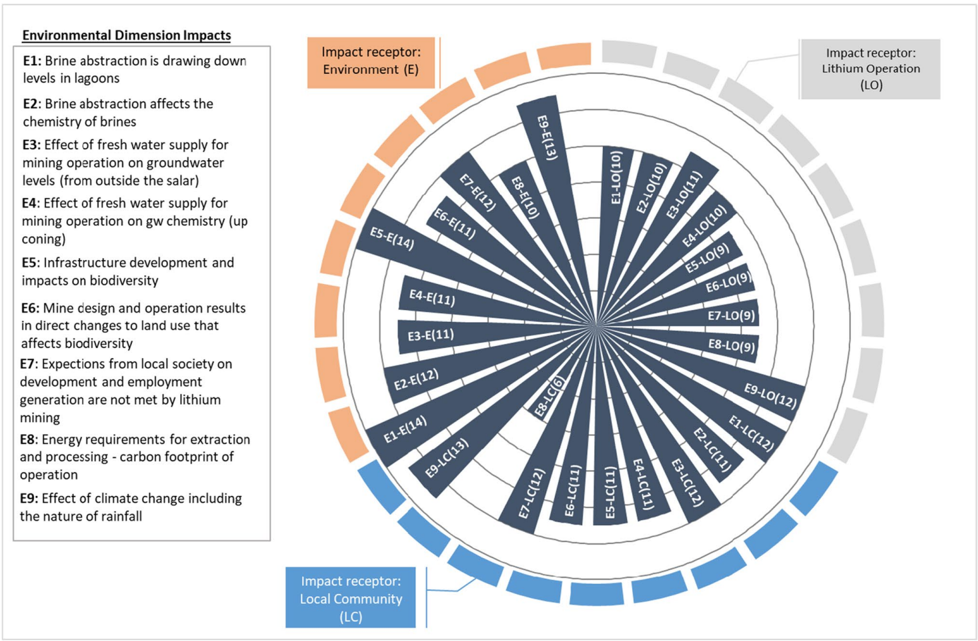
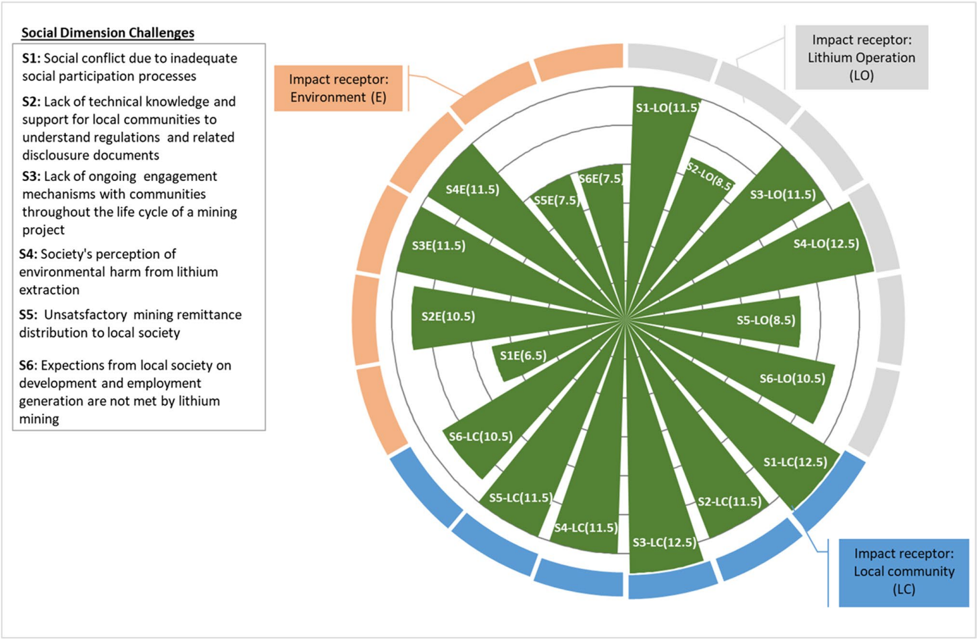
- Stakeholder engagement (81 workshop participants; nine interviews of 60–90 min) and literature review identified environmental challenges E1–E9 (water, biodiversity, mine design/processing, climate change), social challenges S1–S6, and governance challenges G1–G5.
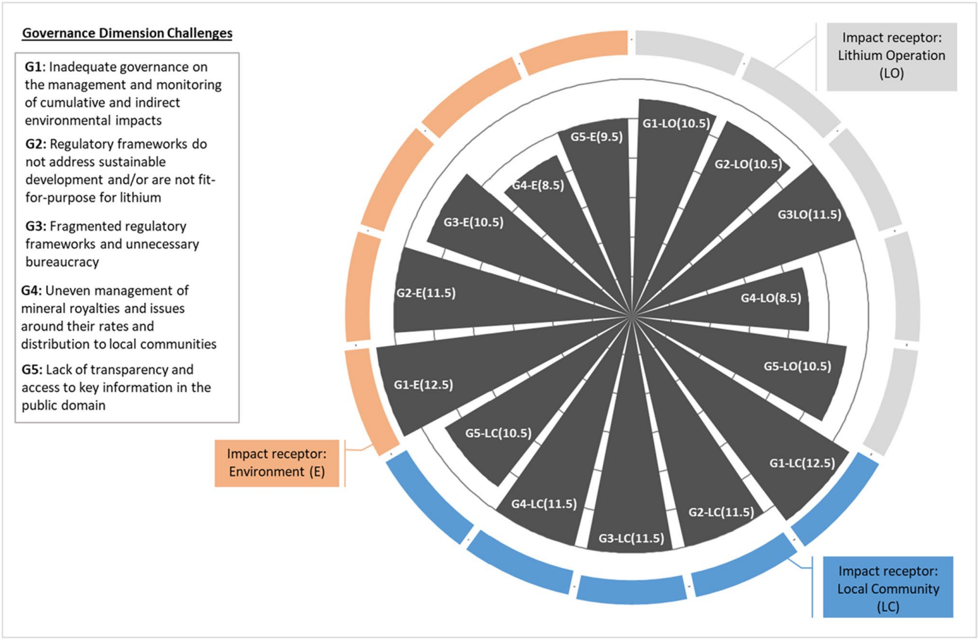
- In scoring, environmental impacts on lagoons (E1), biodiversity (E5), and climate change (E9) had the highest scores; social challenges S4 (perceived environmental harm) and S5 (mining remittance distribution) were major concerns; governance challenges scored high for local communities, especially G1 (inadequate cumulative/indirect impact management).
- Recommendations include expanding water-cycle research with baseline data and watershed monitoring, applying the mitigation hierarchy and IFC Performance Standards to biodiversity, strengthening social participation, and establishing a lithium-specific regional SESA.
Methods
- Qualitative design: field trips in 2019, semi-structured interviews and virtual workshops with stakeholders in Bolivia, Chile and Argentina (2019–2021), plus literature review of government reports, legislative frameworks, standards, best practice documents and environmental impact assessments.
- Stakeholder consultation: 81 workshop participants; nine interviews averaging 60–90 min; participation was voluntary, confidential and anonymised.
- Analysis: country-level screening scored issues 1–3 (not relevant to extremely relevant); regional multicriteria decision analysis (MCDA) scoring framework assessed severity, temporal distribution, spatial distribution, type of impact and uncertainty across receptors (lithium operation, local communities, environment), with criteria equally weighted.
Limitations
- The paper states the assessment is qualitative and based on primary and secondary data; its uncertainty criterion acknowledges major data gaps and highly uncertain assessments.
- It notes lack of consistent baseline data, models, and project-scale EIA data that do not capture cumulative or watershed-scale impacts, especially where multiple projects operate.
- Evident from the text: the MCDA scoring relies on stakeholder perceptions and qualitative judgments with equal weighting, and no quantitative validation or probability estimates are reported.
Model-written summary. Check it against the paper before relying on it.
Integrity signals
Registry
Cites
Statistics
Figures
Verification
Claims the paper makes
10 Valid · 13 Not valid · 42 Not checked · 152 Own results and interpretations
The cited sources support only part of this claim — read each source’s verdict below.
In the paper
“Whilst the connection between the nucleus and the lagoons has been studied extensively in the Salar de Atacama (e.g. (Marazuela et al. 2019; Boutt et al. 2021; McKnight, Boutt et al. 2021)”
What the sources say
- Supportedcites Marazuela et al. 2019 matched to “Hydrodynamics of salt flat basins: The Salar de Atacama example” (2019) sourceExperimental — accuracy not yet measured
Section 2.3 states that the main hydrological layers of the Salar de Atacama nucleus interact directly with lakes in the mixing zone. The Discussion also examines groundwater flows between the nucleus, mixing zone, and lakes. This paper is therefore an example of research on the connection cited in the sentence. (LLM, conf=0.91)
- Partly supportedcites Boutt et al. 2021 matched to “Imbalance in the modern hydrologic budget of topographic catchments along the western slope of the Andes (21–25°S): implications for groundwater recharge assessment” (2021) sourceExperimental — accuracy not yet measured
The Study Area section (pp. 6–7) describes springs and seeps around the halite nucleus feeding lagoons, and shallow groundwater emerging in lagoon systems near the salar margin. This supports a hydrologic connection, but the paper does not establish that the specific nucleus–lagoon connection has been studied extensively. (LLM, conf=0.79)
- Not checked — no full text of the sourcecites McKnight, Boutt et al. 2021 matched to “Impact of Hydrostratigraphic Continuity on Brine‐to‐Freshwater Interface Dynamics: Implications From a Two‐Dimensional Parametric Study in an Arid and Endorheic Basin” (2021) source
boosted- Asserted: passes — The authors put it forward as true.
- Checkable: passes — It can be checked against evidence.
- Load-bearing: unclear — It is unclear whether the paper’s conclusions depend on it.
- Based: passes — The paper gives a reason why it holds.
- Supported
The cited sources support only part of this claim — read each source’s verdict below.
In the paper
“the whole hydrological system in the region is moving from a wetter to a drier state over millennia (see for example Nunnery et al. (2018))”
What the sources say
- Partly supportedcites Nunnery et al. (2018) matched to “Lake-level variability in Salar de Coipasa, Bolivia during the past ∼40,000 yr” (2019) sourceExperimental — accuracy not yet measured
The Discussion (page unavailable) describes gradual lake drawdown after about 10,000 years ago and dry mid-Holocene conditions, supporting a long-term shift toward dryness at Salar de Coipasa. It does not support a uniform shift across the whole regional hydrological system: the same passage says Lake Titicaca rose after 4,500 years ago while Coipasa remained shallow and Uyuni was dry. (LLM, conf=0.87)
plainstates a cause- Asserted: passes — The authors put it forward as true.
- Checkable: passes — It can be checked against evidence.
- Load-bearing: unclear — It is unclear whether the paper’s conclusions depend on it.
- Based: passes — The paper gives a reason why it holds.
- Partly supported
The cited sources support only part of this claim — read each source’s verdict below.
In the paper
“The downstream supply chain (e.g. batteries, automotive) is currently demanding development of sustainable batteries and sustainable decarbonisation technologies.”
What the sources say
- Partly supportedcites Agusdinata, Liu et al. 2018 matched to “Socio-Environmental Impacts of Lithium Mineral Extraction: Towards a Research Agenda” (2018) sourceExperimental — accuracy not yet measured
The Introduction (page not available) says growing demand for electric-drive vehicles is driving demand for lithium-ion batteries, which the paper describes as instrumental to low-carbon transportation. The timeline section (page not available) also reports automakers expanding their electric-vehicle offerings. It does not say the downstream supply chain is demanding the development of *sustainable batteries* or sustainable decarbonisation technologies specifically. (LLM, conf=0.85)
- Not checked — no full text of the sourcecites Barandiarán 2019 matched to “Lithium and development imaginaries in Chile, Argentina and Bolivia” (2019) source
- Not checked — no full text of the sourcecites Bustos-Gallardo et al. 2021 matched to “Harvesting Lithium: water, brine and the industrial dynamics of production in the Salar de Atacama” (2021) source
plain- Asserted: passes — The authors put it forward as true.
- Checkable: passes — It can be checked against evidence.
- Load-bearing: unclear — It is unclear whether the paper’s conclusions depend on it.
- Based: passes — The paper gives a reason why it holds.
- Partly supported
The cited sources support only part of this claim — read each source’s verdict below.
In the paper
“But the sustainability of a product is negated if the production of raw materials is burdened by a range of significant environmental impacts, social and governance issues.”
What the sources say
- Partly supportedcites Agusdinata, Liu et al. 2018 matched to “Socio-Environmental Impacts of Lithium Mineral Extraction: Towards a Research Agenda” (2018) sourceExperimental — accuracy not yet measured
The Introduction and Concluding remarks link the sustainability of lithium-battery technologies to the socio-environmental impacts of lithium extraction and call for those impacts to be addressed. They do not state that such impacts categorically negate a product’s sustainability, or extend that conclusion to products generally. Page numbers are unavailable in our copy. (LLM, conf=0.84)
- Not checked — no full text of the sourcecites Barandiarán 2019 matched to “Lithium and development imaginaries in Chile, Argentina and Bolivia” (2019) source
- Not checked — no full text of the sourcecites Bustos-Gallardo et al. 2021 matched to “Harvesting Lithium: water, brine and the industrial dynamics of production in the Salar de Atacama” (2021) source
plainstates a cause- Asserted: passes — The authors put it forward as true.
- Checkable: passes — It can be checked against evidence.
- Load-bearing: passes — The paper’s conclusions depend on it.
- Based: passes — The paper gives a reason why it holds.
- Partly supported
A result the paper reports from its own data — it cites no other source for it, so there is none to check. The quote shows it is in the paper.
In the paper
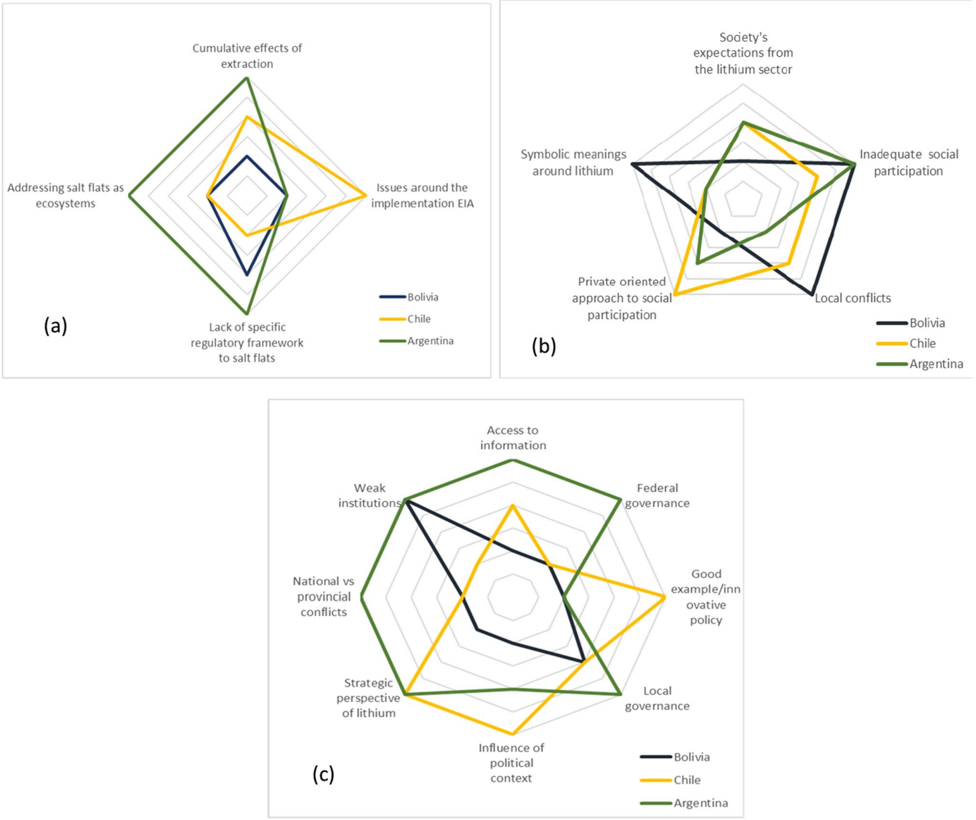
“In Argentina, the most relevant dimension encompasses governance issues (e.g. federal governance and the challenges in defining a national strategic perspective on lithium) and environmental concerns (cumulative effects of extraction and the lack of a specific regulation on lithium mining).”
plain- Asserted: passes — The authors put it forward as true.
- Checkable: passes — It can be checked against evidence.
- Load-bearing: unclear — It is unclear whether the paper’s conclusions depend on it.
- Based: passes — The paper gives a reason why it holds.
75 more claims
Create a free account to see all 217 claims and to verify the 1 reference still open.
- It may state two separate claims as one. 87
- Probably not a substantial claim. 80
- The quote only partly states this claim. 2
Self-check
Percentages, sums and reported differences re-computed from the paper’s own numbers.
Each contradiction between two passages listed here was confirmed by an independent check.
Rated minor: it would not touch a result — a value no result rests on, a p-value that stays on the same side of the significance level, or a conflict that is clerical, resolved elsewhere in the paper, or outside its own findings.
In the paper
§ Discussion of results
“the management of mineral royalties and distribution (G5-local community receptor)”
§ Governance challenges
“(G4) The management of mineral royalties and issues around their rates and distribution to local communities”
Citations
Cites
Recycling lithium-ion batteries from electric vehicles
Harper, G., Sommerville, R., Kendrick, E., Driscoll, L., Slater, P., Stolkin, R., Walton, A., Christensen, P., Heidrich, O., Lambert, S., et al. (2019) · Nature · doi:10.1038/s41586-019-1682-5 · Cited by 3,890
On the sustainability of lithium ion battery industry – A review and perspective
Yang, Y., Okonkwo, E. G., Huang, G., Xu, S., Sun, W., & He, Y. (2021) · Energy Storage Materials · doi:10.1016/j.ensm.2020.12.019 · Cited by 886
Navigating the complexity of ecological stability
Donohue, I., Hillebrand, H., Montoya, J. M., Petchey, O. L., Pimm, S. L., Fowler, M. S., Healy, K., Jackson, A. L., Lurgi, M., McClean, D., et al. (2016) · Ecology Letters · doi:10.1111/ele.12648 · Cited by 647
A comparison of The Limits to Growth with 30 years of reality
TURNER, G. (2008) · Global Environmental Change · doi:10.1016/j.gloenvcha.2008.05.001 · Cited by 556
Elliot, S. (2011) · MIS Quarterly · doi:10.2307/23043495 · Cited by 499
Limits to Growth: The 30-Year Update
(2005) · International Journal of Sustainability in Higher Education · doi:10.1108/ijshe.2005.24906cae.006 · Cited by 465
OECD Guidelines for Multinational Enterprises, 2011 Edition
OECD (2011) · OECD eBooks · doi:10.1787/9789264115415-en · Cited by 414
Variability of precipitation in the Atacama Desert: its causes and hydrological impact
Houston, J. (2006) · International Journal of Climatology · doi:10.1002/joc.1359 · Cited by 413
Climate change in Argentina: trends, projections, impacts and adaptation
Barros, V. R., Boninsegna, J. A., Camilloni, I. A., Chidiak, M., Magrín, G. O., & Rusticucci, M. (2015) · WIREs Climate Change · doi:10.1002/wcc.316 · Cited by 395
OECD Guidelines for Multinational Enterprises
(2001) · OECD eBooks · doi:10.1787/9789264196018-en · Cited by 385
Perreault, T. (2006) · Antipode · doi:10.1111/j.0066-4812.2006.00569.x · Cited by 353
Hydrogeologic processes in saline systems: playas, sabkhas, and saline lakes
Yechieli, Y., & Wood, W. W. (2002) · Earth-Science Reviews · doi:10.1016/s0012-8252(02)00067-3 · Cited by 284 · cited 1×
“Precipitation of minerals can occur resulting from concentration by evaporation, as well as temperature effects (Yechieli and Wood 2002).”
BackgroundSocio-Environmental Impacts of Lithium Mineral Extraction: Towards a Research Agenda
Agusdinata, D. B., Liu, W., Eakin, H., & Romero, H. (2018) · Environmental Research Letters · doi:10.1088/1748-9326/aae9b1 · Cited by 284
New Visions for Addressing Sustainability
McMichael, A. J., Butler, C. D., & Folke, C. (2003) · Science · doi:10.1126/science.1090001 · Cited by 265
Advancing our understanding of ecological stability
Kéfi, S., Domínguez‐García, V., Donohue, I., Fontaine, C., Thébault, E., & Dakos, V. (2019) · Ecology Letters · doi:10.1111/ele.13340 · Cited by 253
Lithium and development imaginaries in Chile, Argentina and Bolivia
Barandiarán, J. (2019) · World Development · doi:10.1016/j.worlddev.2018.09.019 · Cited by 230
Convection in groundwater below an evaporating Salt Lake: 1. Onset of instability
Wooding, R. A., Tyler, S. W., & White, I. (1997) · Water Resources Research · doi:10.1029/96wr03533 · Cited by 213
Origin of Salts and Brine Evolution of Bolivian and Chilean Salars
Risacher, F., & Fritz, B. (2009) · Aquatic Geochemistry · doi:10.1007/s10498-008-9056-x · Cited by 201
Economics of sustainability or the sustainability of economics: Different paradigms
Klaassen, G. A. J., & Opschoor, J. B. (1991) · Ecological Economics · doi:10.1016/0921-8009(91)90024-9 · Cited by 195
Interdependencies of lithium mining and communities sustainability in Salar de Atacama, Chile
Liu, W., & Agusdinata, D. B. (2020) · Journal of Cleaner Production · doi:10.1016/j.jclepro.2020.120838 · Cited by 192
Frequently asked questions about the social licence to operate
Boutilier, R. G. (2014) · Impact Assessment and Project Appraisal · doi:10.1080/14615517.2014.941141 · Cited by 183 · cited 1×
“…term social license to operate (SLO) made its appearance in the mining sector in the mid-1990s to manage social challenges by ensuring that companies and communities operate under a shared vision and maximum benefits to all involved stakeholders (Boutilier 2014; Ehrnström-Fuentes and Kröger 2017).”
BackgroundGeographies of Environmental Governance: The Nexus of Nature and Neoliberalism
Himley, M. (2008) · Geography Compass · doi:10.1111/j.1749-8198.2008.00094.x · Cited by 163
Harvesting Lithium: water, brine and the industrial dynamics of production in the Salar de Atacama
Bustos-Gallardo, B., Bridge, G., & Prieto, M. (2021) · Geoforum · doi:10.1016/j.geoforum.2021.01.001 · Cited by 160
Howarth, R. B. (1997) · Land Economics · doi:10.2307/3147246 · Cited by 146
Multi-Criteria Decision Analysis
Linkov, I., & Moberg, E. (2011) · CRC Press eBooks · doi:10.1201/b11471 · Cited by 127
Oyarzún, J., & Oyarzún, R. (2011) · Sustainable Development · doi:10.1002/sd.441 · Cited by 116 · cited 3×
“Given the aridity of the region, then future climate change is of significant concern (Oyarzún and Oyarzún 2011).”
BackgroundInfluentialYillia, P. T. (2016) · Österreichische Wasser- und Abfallwirtschaft · doi:10.1007/s00506-016-0297-4 · Cited by 103
A Comparison of the Limits to Growth with Thirty Years of RealityPreprint
Turner, G. M. (2008) · RePEc: Research Papers in Economics · doi:10.4225/08/5a6f615edf3ce · Cited by 100
Hydrodynamics of salt flat basins: The Salar de Atacama example
Marazuela, M. A., Vázquez-Suñé, E., Ayora, C., García-Gil, A., & Palma, T. (2019) · Science of the Total Environment · doi:10.1016/j.scitotenv.2018.09.190 · Cited by 96 · cited 1×
“(Marazuela et al. 2019; Boutt et al. 2021; McKnight, Boutt et al. 2021), given the dynamic nature of the system, this is not proven, particularly as the system is complex and that climatic driven changes can be extremely important.”
BackgroundThe evaluation of brine prospects and the requirement for modifications to filing standards
Houston, J., Butcher, A., Ehren, P., Evans, K., & Godfrey, L. (2011) · Economic Geology · doi:10.2113/econgeo.106.7.1225 · Cited by 95
Self-citationAssessment of social sustainability hotspots in the supply chain of lithium-ion batteries
Thies, C., Kieckhäfer, K., Spengler, T. S., & Sodhi, M. S. (2019) · Procedia CIRP · doi:10.1016/j.procir.2018.12.009 · Cited by 90
Herrera, C., Custodio, E., Chong, G., Lambán, L. J., Riquelme, R., Wilke, H., Jódar, J., Urrutia, J., Urqueta, H., Sarmiento, A., et al. (2016) · Science of The Total Environment · doi:10.1016/j.scitotenv.2015.09.060 · Cited by 89 · cited 1×
“These could be reduction in spring flows used for water supply and ecosystem support such as in the Tuyajto Basin, northern Chile (Herrera et al. 2016) as well as reduction in levels resulting in loss of access to water from shallow abstraction boreholes due to the lowering of the water table.”
BackgroundTowards more sustainable brine extraction in salt flats: Learning from the Salar de Atacama
Marazuela, M. A., Vázquez-Suñé, E., Ayora, C., & García-Gil, A. (2020) · Science of The Total Environment · doi:10.1016/j.scitotenv.2019.135605 · Cited by 82
Heredia, F., Martinez, A. L., & Surraco Urtubey, V. (2020) · Journal of Energy & Natural Resources Law · doi:10.1080/02646811.2020.1784565 · Cited by 78
Marchegiani, P., Morgera, E., & Parks, L. (2020) · The International Journal of Human Rights · doi:10.1080/13642987.2019.1677617 · Cited by 73
Sustainability and Sustainable Development
(2013) · doi:10.1007/978-3-642-28036-8_662 · Cited by 72
Hancock, L., Ralph, N., & Ali, S. H. (2018) · Journal of Cleaner Production · doi:10.1016/j.jclepro.2017.12.264 · Cited by 67
Lithium and Chile: looking back and looking forward
Maxwell, P., & Mora, M. A. (2019) · Mineral Economics · doi:10.1007/s13563-019-00181-8 · Cited by 65
Marazuela, M. A., Vázquez-Suñé, E., Custodio, E., Palma, T., García-Gil, A., & Ayora, C. (2018) · Journal of Hydrology · doi:10.1016/j.jhydrol.2018.04.010 · Cited by 62
Resourcing the future: Using foresight in resource governance
Prior, T., Daly, J., Mason, L., & Giurco, D. (2012) · Geoforum · doi:10.1016/j.geoforum.2012.07.009 · Cited by 60
Rapid Recharge of Fresh Water to the Halite-Hosted Brine Aquifer of Salar de Atacama, Chile
Boutt, D. F., Hynek, S. A., Munk, L. A., & Corenthal, L. G. (2016) · Hydrological Processes · doi:10.1002/hyp.10994 · Cited by 60
Marconi, P., Arengo, F., & Clark, A. (2022) · Wetlands Ecology and Management · doi:10.1007/s11273-022-09872-6 · Cited by 60 · cited 1×
“This could result in wetland degradation at a landscape-scale leading to significant declines of already globally threatened species and the triggering of increased threat levels to vulnerable species dependent on such salar ecosystems (Marconi et al. 2022).”
BackgroundIn the shadows of social licence to operate: Untold investment grievances in latin America
Ehrnström-Fuentes, M., & Kröger, M. (2017) · Journal of Cleaner Production · doi:10.1016/j.jclepro.2016.09.112 · Cited by 53
Lithium as a strategic resource: geopolitics, industrialization, and mining in Argentina
Dorn, F. M., & Ruiz Peyré, F. (2020) · Journal of Latin American Geography · doi:10.1353/lag.2020.0101 · Cited by 51 · cited 1×
“In the academic debate, the governance of lithium has been explored in terms of the extractive industry development implications, structural constraints and possible socioenvironmental impacts (Olivera 2017; Hancock et al. 2018; Barandiarán 2019; Fornillo 2019; López, Obaya et al. 2019; Dorn and Peyré 2020; Heredia et…”
BackgroundSustainability perspectives on lithium-ion batteries
Babbitt, C. W. (2020) · Clean Technologies and Environmental Policy · doi:10.1007/s10098-020-01890-3 · Cited by 48
Intergenerational Fairness and the Crowding Out Effects of Well‐Intended Environmental Policies
Hunt, R. A., & Fund, B. R. (2016) · Journal of Management Studies · doi:10.1111/joms.12202 · Cited by 47
Multiple Criteria Decision Making
(2022) · doi:10.1007/978-981-16-7414-3 · Cited by 46
COMUNIDADES INDÍGENAS, EMPRESAS DEL LITIO Y SUS RELACIONES EN EL SALAR DE ATACAMA
Gundermann, H., & Göbel, B. (2018) · Chungará (Arica) · doi:10.4067/s0717-73562018005001602 · Cited by 40 · cited 1×
“Lithium mining in the salar de Atacama has led to cycles of conflicts, social activism and negotiation processes, which clearly outline the interrelationship between mineral governance and social participation processes (Gundermann and Göbel 2018; Liu and Agusdinata 2020).”
BackgroundBlin, N., Hausner, M., Leray, S., Lowry, C., & Suárez, F. (2022) · Journal of Hydrology: Regional Studies · doi:10.1016/j.ejrh.2022.100996 · Cited by 38
Litio en la Argentina: Oportunidades y desafíos para el desarrollo de la cadena de valor
López, A., Obaya, M., Pascuini, P. D., & Ramos, A. (2019) · Inter-American Development Bank eBooks · doi:10.18235/0001553 · Cited by 38
La minería del litio en la Puna de Atacama: interdependencias transregionales y disputas locales
Göbel, B. (2014) · Ibero-Amerikanisches Institut (Berlin) · doi:10.18441/ibam.13.2013.49.135-149 · Cited by 38 · cited 2×
“These cases highlight the value of well-designed and implemented participatory processes and the importance of direct negotiations of mining companies with communities that can result in support for their activities (Göbel 2013; Marchegiani, Hellgren et al.”
BackgroundThe environmental impact assessment in Chile: Overview, improvements, and comparisons
Rodríguez-Luna, D., Vela, N., Alcalá, F. J., & Encina‐Montoya, F. (2020) · Environmental Impact Assessment Review · doi:10.1016/j.eiar.2020.106502 · Cited by 37
End-of-Use Management of Spent Lithium-Ion Batteries From Sustainability Perspective: A Review
Liang, C., Liu, W., Kong, S., Li, H., Deng, Y., & Ma, H. (2021) · Journal of Manufacturing Science and Engineering · doi:10.1115/1.4050925 · Cited by 32
Numerical investigation of coupled density-driven flow and hydrogeochemical processes below playas
Hamann, E., Post, V., Kohfahl, C., Prommer, H., & Simmons, C. T. (2015) · Water Resources Research · doi:10.1002/2015wr017833 · Cited by 31 · cited 1×
“A series of chemical reactions and precipitation processes take place that result in the brine chemistry evolving over time and across the nucleus (exhibiting a spatiotemporal dimension) (Hamann et al. 2015).”
BackgroundMaterials and Social Sustainability
(2013) · doi:10.1016/b978-0-08-099359-1.00007-2 · Cited by 30
Williams, C. J. (2017) · Journal of Earth Science & Climatic Change · doi:10.4172/2157-7617.1000400 · Cited by 26
Climate change impact on countrywide water balance in Bolivia
Escurra, J. J., Vazquez, V., Cestti, R., De Nys, E., & Srinivasan, R. (2014) · Regional Environmental Change · doi:10.1007/s10113-013-0534-3 · Cited by 26
Boutt, D. F., Corenthal, L. G., Moran, B. J., Munk, L., & Hynek, S. A. (2021) · Hydrogeology Journal · doi:10.1007/s10040-021-02309-z · Cited by 24
Lake-level variability in Salar de Coipasa, Bolivia during the past ∼40,000 yr
Nunnery, J. A., Fritz, S. C., Baker, P. A., & Salenbien, W. (2019) · Quaternary Research · doi:10.1017/qua.2018.108 · Cited by 24
Sustainable Governance of Strategic Minerals: Post-Neoliberalism and Lithium in Bolivia
Sanchez-Lopez, D. (2019) · Environment: Science and Policy for Sustainable Development · doi:10.1080/00139157.2019.1662659 · Cited by 23
Pragier, D. (2019) · Polis (Santiago) · doi:10.32735/s0718-6568/2019-n52-1368 · Cited by 23
McKnight, S. V., Boutt, D. F., & Munk, L. A. (2021) · Water Resources Research · doi:10.1029/2020wr028302 · Cited by 22
A Socio-technical Transition of Sustainable Lithium Industry in Latin America
Quinteros-Condoretty, A. R., Albareda, L., Barbiellini, B., & Soyer, A. (2020) · Procedia Manufacturing · doi:10.1016/j.promfg.2020.10.242 · Cited by 22
La gobernanza del litio y el cobre en los países andinos
(2020) · Cited by 2
McKnight, S., Boutt, D. F., & Munk, L. (2020) · EarthArXiv (California Digital Library) · doi:10.31223/osf.io/ea783 · Cited by 1
Convection in groundwater below an evaporating salt lake: 1. Onset of instability
Wooding, R. A. (1997) · Deleted DOIs · doi:10.1029/97wr03533
Crowding Out Effects of Well-Intended Environmental Policies
Hunt, R. (2016) · Academy of Management Proceedings · doi:10.5465/ambpp.2016.10013abstract
Research works printed but not linked: 3
- Christmann P, Gloaguen E, Labbé J-F, Melleton J, Piantone P (2015) Chapter 1 - global lithium resources and sustainability issues. Elsevier, Lithium Process Chemistry. A. Chagnes and J. Światowska. Amsterdam, pp 1-40
- Elliot JA (1994) An introduction to sustainable development : the developing world. London Routledge
- World Commission on Environment and Development (1987) The Brundtland Report: our common future. Oxford WCED
Cited by
de Souza Barbosa, A., da Silva, M. C. B. C., da Silva, L. B., Morioka, S. N., & de Souza, V. F. (2023) · Humanities and Social Sciences Communications · doi:10.1057/s41599-023-01919-0 · Cited by 203
Krishnan, R., & Gopan, G. (2024) · Cleaner Engineering and Technology · doi:10.1016/j.clet.2024.100749 · Cited by 115
Chipangamate, N. S., & Nwaila, G. T. (2023) · Energy Geoscience · doi:10.1016/j.engeos.2023.100257 · Cited by 132
Mojid, M. R., Lee, K. J., & You, J. (2024) · Sustainable materials and technologies · doi:10.1016/j.susmat.2024.e00923 · Cited by 156
Review of life cycle assessment on lithium-ion batteries (LIBs) recycling
Domingues, A. M., & de Souza, R. G. (2024) · Next Sustainability · doi:10.1016/j.nxsust.2024.100032 · Cited by 117
Metadata
- Authors
- Petavratzi, E., Sanchez-Lopez, D., Hughes, A., Stacey, J., Ford, J., & Butcher, A.
- Affiliations
- British Geological Survey (GB)
- Corresponding author
- Petavratzi, E.
- Venue
- Mineral Economics
- Published
- 2022-08-24
- Volume
- 35
- Issue
- 3-4
- Pages
- 673-699
- ISSN
- 2191-2203 (ISSN-L)
- 2191-2211
- OpenAlex
- W4292877303
- Semantic Scholar
- c88c7f0d0801b7658614b65951ed82cb0cda2cec
- Cited by
- 100
- References
- 63
- Citations by year
- 2026: 23 · 2025: 29 · 2024: 31 · 2023: 13 · 2022: 4
- FWCI
- 8.42
- Type
- journal article
- Language
- en
- Open access
- hybrid
- doi.org
- Licence
- cc-by
- creativecommons.org/licenses/by/4.0 (tdm)
- creativecommons.org/licenses/by/4.0 (vor)
- Locations
- Mineral Economics (publishedVersion, cc-by)
- NERC Open Research Archive (Natural Environment Research Council) (acceptedVersion)
- Apollo (University of Cambridge) (submittedVersion, cc-by)
- RePEc: Research Papers in Economics (submittedVersion)
- Apollo
- Funders
- Inter-American Development Bank (ATN/OC-17164-RG)
- Innovate UK (134013)
- Topics
- Physical Sciences › Environmental Science › Management, Monitoring, Policy and Law › Mining and Resource Management
- Physical Sciences › Environmental Science › Management, Monitoring, Policy and Law › Environmental and Social Impact Assessments
- Physical Sciences › Materials Science › Metals and Alloys › Extraction and Separation Processes
- Keywords
- lithium recovery, lithium triangle, ESG risk, lithium brines, water cycle, biodiversity impacts, environmental impact assessment, mitigation hierarchy, IFC Performance Standards, ecosystem services, community participation, stakeholder dialogue, data transparency, mining regulation
About these checks
Registry, retraction, Cites and statistics results are computed, not judged, with one exception: a printed reference that no index lists is read once by a model before it counts as a citation error. Claims are extracted by a model and kept only when their quote appears verbatim in the text; each cited source is then checked, with a model’s help, for whether it says what the claim relies on. Those verdicts can be wrong — read the claim’s quote and the cited source before relying on one.
The claim verdicts this report counts are experimental: their accuracy is not yet measured.
A language model drew the claims from the paper on 2026-09-28, under version 3 of the claim definition (prompt extract-v3).
A second model labelled each claim on 2026-09-28 (model jev-1.13-20260917, definition revision gold-guideline-v0.2).
Cited sources are checked with a language model’s help (gpt-6-sol).
Statistics and arithmetic are recomputed, not judged.
Confidence bands are shown only for fields calibrated on our annotated test set. None is calibrated yet, so no band is shown.
What counts as a claim ›How we measure confidence ›How we check this ›
Are you an author, or do you see a problem with this page? Request a review
Data sources
Bibliographic data: Semantic Scholar, OpenAlex, Crossref.
Contains information from the Semantic Scholar Academic Graph Datasets, made available under the ODC Attribution License (ODC-BY 1.0).
Semantic Scholar’s data is described in: Kinney, R., et al. (2023). The Semantic Scholar Open Data Platform. arXiv:2301.10140.
