

The DOI matches its Crossref record; 101 of the 101 references it cites were found in a registry or an index.
Nutrients, Clock Genes, and Chrononutrition
Open accessAbstract
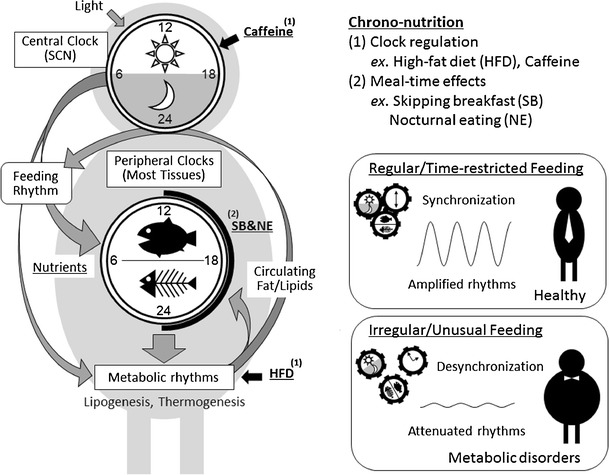
Circadian clocks that comprise clock genes exist throughout the body and control daily physiological events. The central clock that dominates activity rhythms is entrained by light/dark cycles, whereas peripheral clocks regulating local metabolic rhythms are determined by feeding/fasting cycles. Nutrients reset peripheral circadian clocks and the local clock genes control downstream metabolic processes. Metabolic states also affect the clockworks in feedback manners. Because the circadian system organizes whole energy homeostasis, including food intake, fat accumulation, and caloric expenditure, the disruption of circadian clocks leads to metabolic disorders. Recent findings show that time-restricted feeding during the active phase amplifies circadian clocks and improves metabolic disorders induced by a high-fat diet without caloric reduction, whereas unusual/irregular food intake induces various metabolic dysfunctions. Such evidence from nutrition studies that consider circadian system (chrononutrition) has rapidly accumulated. We review molecular relationships between circadian clocks and nutrition as well as recent chrononutrition findings.
Overview
The claims and statistics of this paper haven’t been checked yet.
Run the check — free, no account needed. It reads the open-access text and checks the sources it cites.
Integrity signals
Registry
Cites
Statistics
Figures
Verification
Claims the paper makes
The claims and statistics of this paper haven’t been checked yet.
Run the check — free, no account needed. It reads the open-access text and checks the sources it cites.
Claims other papers make about this one
Each is checked against this paper’s own text: does it say what the citing paper says it does?
The cited source says what the claim attributes to it.
In the citing paper
“These include poor-quality diet [232], improper meal timing and altered feeding-fasting behavior [233,234], sub-optimal exercise timing [235], disrupted sleep-wake cycles [236], shift work [237], EDC [238], and stress [239,240].”
From Polycystic Ovary Syndrome: An Evolutionary Adaptation to Lifestyle and the Environment (2022) · cites this paper as [234]
In the citing paper
“In this context, because breakfast is consumed after the longest fasting period of the day, it is usually the most important meal to modulate the phase of the liver clock [270].”
From Effects of diet, lifestyle, Chrononutrition and alternative dietary interventions on postprandial Glycemia and insulin resistance (2022) · cites this paper as [270]
Self-check
Percentages, sums and reported differences re-computed from the paper’s own numbers.
The self-check needs the paper’s full text.
Citations
Cites
Calamita, E., Schmid, M., Kunz, M., Ndebele-Murisa, M. R., Magadza, C. H. D., Nyambe, I., & Wehrli, B. (2019) · Figshare · doi:10.26181/6153922fe919c · Cited by 4,239
Obesity and Metabolic Syndrome in Circadian Clock Mutant Mice
Turek, F. W., Joshu, C., Kohsaka, A., Lin, E., Ivanova, G., McDearmon, E., Laposky, A., Losee-Olson, S., Easton, A., Jensen, D. R., et al. (2005) · Science · doi:10.1126/science.1108750 · Cited by 2,485
Damiola, F., Le Minh, N., Preitner, N., Kornmann, B., Fleury-Olela, F., & Schibler, U. (2000) · Genes & Development · doi:10.1101/gad.183500 · Cited by 2,394
Adverse metabolic and cardiovascular consequences of circadian misalignment
Scheer, F. A. J. L., Hilton, M. F., Mantzoros, C. S., & Shea, S. A. (2009) · Proceedings of the National Academy of Sciences · doi:10.1073/pnas.0808180106 · Cited by 2,351
Clock Mutants of Drosophila melanogaster
Konopka, R. J., & Benzer, S. (1971) · Proceedings of the National Academy of Sciences · doi:10.1073/pnas.68.9.2112 · Cited by 2,287
Hatori, M., Vollmers, C., Zarrinpar, A., DiTacchio, L., Bushong, E. A., Gill, S., Leblanc, M., Chaix, A., Joens, M., Fitzpatrick, J. A. J., et al. (2012) · Cell Metabolism · doi:10.1016/j.cmet.2012.04.019 · Cited by 1,986
Entrainment of the circadian clock in the liver by feeding
Stokkan, K.-A., Yamazaki, S., Tei, H., Sakaki, Y., & Menaker, M. (2001) · Science · doi:10.1126/science.291.5503.490 · Cited by 1,800
High-Fat Diet Disrupts Behavioral and Molecular Circadian Rhythms in Mice
Kohsaka, A., Laposky, A. D., Ramsey, K. M., Estrada, C., Joshu, C., Kobayashi, Y., Turek, F. W., & Bass, J. (2007) · Cell Metabolism · doi:10.1016/j.cmet.2007.09.006 · Cited by 1,528
Transcriptional architecture and chromatin landscape of the core circadian clock in mammals
Koike, N., Yoo, S.-H., Huang, H.-C., Kumar, V., Lee, C., Kim, T.-K., & Takahashi, J. S. (2012) · Science · doi:10.1126/science.1226339 · Cited by 1,464
Nakahata, Y., Kaluzova, M., Grimaldi, B., Sahar, S., Hirayama, J., Chen, D., Guarente, L. P., & Sassone-Corsi, P. (2008) · Cell · doi:10.1016/j.cell.2008.07.002 · Cited by 1,427
Cited by
Sorted by citations
de Toro‐Martín, J., Arsenault, B. J., Després, J., & Vohl, M. (2017) · Nutrients · doi:10.3390/nu9080913 · Cited by 534
The Influence of Meal Frequency and Timing on Health in Humans: The Role of Fasting
Paoli, A., Tinsley, G. M., Bianco, A., & Moro, T. (2019) · Nutrients · doi:10.3390/nu11040719 · Cited by 415
Atger, F., Gobet, C., Marquis, J., Martín, E., Wang, J., Weger, B. D., Lefebvre, G. C., Descombes, P., Naef, F., & Gachon, F. (2015) · Proceedings of the National Academy of Sciences · doi:10.1073/pnas.1515308112 · Cited by 254
New Insights Into the Circadian Rhythm and Its Related Diseases
Xie, Y., Tang, Q., Chen, G., Xie, M., Yu, S., Zhao, J., & Chen, L. (2019) · Frontiers in Physiology · doi:10.3389/fphys.2019.00682 · Cited by 250
Qasim, A., Turcotte, M., de Souza, R. J., Samaan, M. C., Champredon, D., Dushoff, J., Speakman, J. R., & Meyre, D. (2018) · Obesity Reviews · doi:10.1111/obr.12625 · Cited by 241
Metadata
- Authors
- Oike, H., Oishi, K., & Kobori, M.
- Affiliations
- National Agriculture and Food Research Organization (JP)
- Tokyo University of Science (JP)
- Corresponding author
- Oike, Hideaki
- Venue
- Current Nutrition Reports
- Published
- 2014-04-27
- Volume
- 3
- Issue
- 3
- Pages
- 204-212
- ISSN
- 2161-3311 (ISSN-L)
- PMC
- PMC4118017
- OpenAlex
- W2072829785
- Cited by
- 198
- References
- 101
- Citations by year
- 2026: 10 · 2025: 25 · 2024: 17 · 2023: 20 · 2022: 20 · 2021: 19 · 2020: 21 · 2019: 18 · 2018: 7 · 2017: 18 · 2016: 9 · 2015: 12 · 2014: 2
- FWCI
- 1.54
- Type
- journal article
- Language
- en
- Open access
- hybrid
- doi.org
- Locations
- Current Nutrition Reports (publishedVersion, cc-by)
- PubMed Central (publishedVersion, cc-by)
- PubMed (publishedVersion)
- Funders
- Japan Society for the Promotion of Science (25560066, 25702005, 25350179)
- Topics
- Life Sciences › Neuroscience › Endocrine and Autonomic Systems › Circadian rhythm and melatonin
- Health Sciences › Medicine › Physiology (medical) › Dietary Effects on Health
- Life Sciences › Biochemistry, Genetics and Molecular Biology › Genetics › Nutrition, Genetics, and Disease
- Keywords
- circadian clock, clock genes, chrononutrition, time-restricted feeding, metabolic disorders, high-fat diet, energy homeostasis, dietary intake, fat deposition, energy expenditure, circadian rhythm disruption
About these checks
Registry, retraction, Cites and statistics results are computed, not judged, with one exception: a printed reference that no index lists is read once by a model before it counts as a citation error. Claims are extracted by a model and kept only when their quote appears verbatim in the text; each cited source is then checked, with a model’s help, for whether it says what the claim relies on. Those verdicts can be wrong — read the claim’s quote and the cited source before relying on one.
Statistics and arithmetic are recomputed, not judged.
Confidence bands are shown only for fields calibrated on our annotated test set. None is calibrated yet, so no band is shown.
What counts as a claim ›How we measure confidence ›How we check this ›
Are you an author, or do you see a problem with this page? Request a review
