

The DOI matches its Crossref record; 101 of the 101 references it cites were found in a registry or an index.
Nutrients, Clock Genes, and Chrononutrition
Open accessAbstract
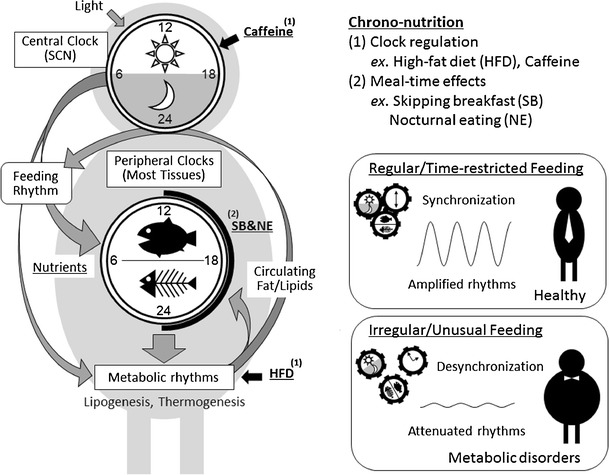
Circadian clocks that comprise clock genes exist throughout the body and control daily physiological events. The central clock that dominates activity rhythms is entrained by light/dark cycles, whereas peripheral clocks regulating local metabolic rhythms are determined by feeding/fasting cycles. Nutrients reset peripheral circadian clocks and the local clock genes control downstream metabolic processes. Metabolic states also affect the clockworks in feedback manners. Because the circadian system organizes whole energy homeostasis, including food intake, fat accumulation, and caloric expenditure, the disruption of circadian clocks leads to metabolic disorders. Recent findings show that time-restricted feeding during the active phase amplifies circadian clocks and improves metabolic disorders induced by a high-fat diet without caloric reduction, whereas unusual/irregular food intake induces various metabolic dysfunctions. Such evidence from nutrition studies that consider circadian system (chrononutrition) has rapidly accumulated. We review molecular relationships between circadian clocks and nutrition as well as recent chrononutrition findings.
Overview
The claims and statistics of this paper haven’t been checked yet.
Run the check — free, no account needed. It reads the open-access text and checks the sources it cites.
Integrity signals
Registry
Cites
Statistics
Figures
Verification
Claims the paper makes
The claims and statistics of this paper haven’t been checked yet.
Run the check — free, no account needed. It reads the open-access text and checks the sources it cites.
Claims other papers make about this one
Each is checked against this paper’s own text: does it say what the citing paper says it does?
The cited source says what the claim attributes to it.
In the citing paper
“These include poor-quality diet [232], improper meal timing and altered feeding-fasting behavior [233,234], sub-optimal exercise timing [235], disrupted sleep-wake cycles [236], shift work [237], EDC [238], and stress [239,240].”
From Polycystic Ovary Syndrome: An Evolutionary Adaptation to Lifestyle and the Environment (2022) · cites this paper as [234]
In the citing paper
“In this context, because breakfast is consumed after the longest fasting period of the day, it is usually the most important meal to modulate the phase of the liver clock [270].”
From Effects of diet, lifestyle, Chrononutrition and alternative dietary interventions on postprandial Glycemia and insulin resistance (2022) · cites this paper as [270]
Self-check
Percentages, sums and reported differences re-computed from the paper’s own numbers.
The self-check needs the paper’s full text.
Citations
Cites
Calamita, E., Schmid, M., Kunz, M., Ndebele-Murisa, M. R., Magadza, C. H. D., Nyambe, I., & Wehrli, B. (2019) · Figshare · doi:10.26181/6153922fe919c · Cited by 4,239
Obesity and Metabolic Syndrome in Circadian Clock Mutant Mice
Turek, F. W., Joshu, C., Kohsaka, A., Lin, E., Ivanova, G., McDearmon, E., Laposky, A., Losee-Olson, S., Easton, A., Jensen, D. R., et al. (2005) · Science · doi:10.1126/science.1108750 · Cited by 2,485
Damiola, F., Le Minh, N., Preitner, N., Kornmann, B., Fleury-Olela, F., & Schibler, U. (2000) · Genes & Development · doi:10.1101/gad.183500 · Cited by 2,394
Adverse metabolic and cardiovascular consequences of circadian misalignment
Scheer, F. A. J. L., Hilton, M. F., Mantzoros, C. S., & Shea, S. A. (2009) · Proceedings of the National Academy of Sciences · doi:10.1073/pnas.0808180106 · Cited by 2,351
Clock Mutants of Drosophila melanogaster
Konopka, R. J., & Benzer, S. (1971) · Proceedings of the National Academy of Sciences · doi:10.1073/pnas.68.9.2112 · Cited by 2,287
Hatori, M., Vollmers, C., Zarrinpar, A., DiTacchio, L., Bushong, E. A., Gill, S., Leblanc, M., Chaix, A., Joens, M., Fitzpatrick, J. A. J., et al. (2012) · Cell Metabolism · doi:10.1016/j.cmet.2012.04.019 · Cited by 1,986
Entrainment of the circadian clock in the liver by feeding
Stokkan, K.-A., Yamazaki, S., Tei, H., Sakaki, Y., & Menaker, M. (2001) · Science · doi:10.1126/science.291.5503.490 · Cited by 1,800
High-Fat Diet Disrupts Behavioral and Molecular Circadian Rhythms in Mice
Kohsaka, A., Laposky, A. D., Ramsey, K. M., Estrada, C., Joshu, C., Kobayashi, Y., Turek, F. W., & Bass, J. (2007) · Cell Metabolism · doi:10.1016/j.cmet.2007.09.006 · Cited by 1,528
Transcriptional architecture and chromatin landscape of the core circadian clock in mammals
Koike, N., Yoo, S.-H., Huang, H.-C., Kumar, V., Lee, C., Kim, T.-K., & Takahashi, J. S. (2012) · Science · doi:10.1126/science.1226339 · Cited by 1,464
Nakahata, Y., Kaluzova, M., Grimaldi, B., Sahar, S., Hirayama, J., Chen, D., Guarente, L. P., & Sassone-Corsi, P. (2008) · Cell · doi:10.1016/j.cell.2008.07.002 · Cited by 1,427
Cited by
Sorted by citations
de Toro‐Martín, J., Arsenault, B. J., Després, J., & Vohl, M. (2017) · Nutrients · doi:10.3390/nu9080913 · Cited by 534
The Influence of Meal Frequency and Timing on Health in Humans: The Role of Fasting
Paoli, A., Tinsley, G. M., Bianco, A., & Moro, T. (2019) · Nutrients · doi:10.3390/nu11040719 · Cited by 415
Atger, F., Gobet, C., Marquis, J., Martín, E., Wang, J., Weger, B. D., Lefebvre, G. C., Descombes, P., Naef, F., & Gachon, F. (2015) · Proceedings of the National Academy of Sciences · doi:10.1073/pnas.1515308112 · Cited by 254
New Insights Into the Circadian Rhythm and Its Related Diseases
Xie, Y., Tang, Q., Chen, G., Xie, M., Yu, S., Zhao, J., & Chen, L. (2019) · Frontiers in Physiology · doi:10.3389/fphys.2019.00682 · Cited by 250
Qasim, A., Turcotte, M., de Souza, R. J., Samaan, M. C., Champredon, D., Dushoff, J., Speakman, J. R., & Meyre, D. (2018) · Obesity Reviews · doi:10.1111/obr.12625 · Cited by 241
Adafer, R., Messaadi, W., Meddahi, M., Patey, A., Haderbache, A., Bayen, S., & Messaadi, N. (2020) · Nutrients · doi:10.3390/nu12123770 · Cited by 243
Effects of Diet on Sleep: A Narrative Review
Binks, H., Vincent, G. E., Gupta, C. C., Irwin, C. G., & Khalesi, S. (2020) · Nutrients · doi:10.3390/nu12040936 · Cited by 207
Sleep and dietary habits in the urban environment: the role of chrono-nutrition
Pot, G. K. (2017) · Proceedings of The Nutrition Society · doi:10.1017/s0029665117003974 · Cited by 212
Papakonstantinou, E., Oikonomou, C., Nychas, G., & Dimitriadis, G. D. (2022) · Nutrients · doi:10.3390/nu14040823 · Cited by 199
Chrononutrition in the management of diabetes
Henry, C. J., Kaur, B., & Quek, R. Y. C. (2020) · Nutrition & Diabetes · doi:10.1038/s41387-020-0109-6 · Cited by 174
D’Aquila, T., Hung, Y.-H., Carreiro, A. L., & Buhman, K. K. (2016) · Biochimica et Biophysica Acta (BBA) - Molecular and Cell Biology of Lipids · doi:10.1016/j.bbalip.2016.04.012 · Cited by 142
Qasrawi, S. O., Pandi-Perumal, S. R., & BaHammam, A. S. (2017) · Sleep And Breathing · doi:10.1007/s11325-017-1473-x · Cited by 132
Precision (Personalized) Nutrition: Understanding Metabolic Heterogeneity
Zeisel, S. H. (2020) · Annual Review of Food Science and Technology · doi:10.1146/annurev-food-032519-051736 · Cited by 135
Polycystic Ovary Syndrome: An Evolutionary Adaptation to Lifestyle and the Environment
parker, J., O'Brien, C., Hawrelak, J., & Gersh, F. (2021) · doi:10.20944/preprints202112.0088.v1 · Cited by 113
Polycystic Ovary Syndrome: An Evolutionary Adaptation to Lifestyle and the Environment
Parker, J., O’Brien, C., Hawrelak, J., & Gersh, F. L. (2022) · International Journal of Environmental Research and Public Health · doi:10.3390/ijerph19031336 · Cited by 114
Kunugi, H. (2023) · Psychiatry and Clinical Neurosciences · doi:10.1111/pcn.13551 · Cited by 117
Mota, M. C., Silva, C. M., Balieiro, L. C. T., Fahmy, W. M., & Crispim, C. A. (2017) · Scientific Reports · doi:10.1038/s41598-017-06723-w · Cited by 101
Quantitative Chemoproteomic Profiling with Data-Independent Acquisition-Based Mass Spectrometry
Yang, F., Jia, G., Guo, J., Liu, Y., & Wang, C. (2022) · Journal of the American Chemical Society · doi:10.1021/jacs.1c11053 · Cited by 84
Qi, G., Mi, Y., Liu, Z., Fan, R., Qiao, Q., Sun, Y., Ren, B., & Liu, X. (2017) · Journal of Functional Foods · doi:10.1016/j.jff.2017.04.031 · Cited by 81
Yasumoto, Y., Nakao, R., & Oishi, K. (2015) · PLoS ONE · doi:10.1371/journal.pone.0116476 · Cited by 79
Self-citationAbbondante, S., Eckel‐Mahan, K. L., Ceglia, N., Baldi, P., & Sassone‐Corsi, P. (2015) · Journal of Biological Chemistry · doi:10.1074/jbc.m115.681130 · Cited by 73
Circadian Clocks as Modulators of Metabolic Comorbidity in Psychiatric Disorders
Barandas, R., Landgraf, D., McCarthy, M. J., & Welsh, D. K. (2015) · Current Psychiatry Reports · doi:10.1007/s11920-015-0637-2 · Cited by 69
Fixing the broken clock in adrenal disorders: focus on glucocorticoids and chronotherapy
Minnetti, M., Hasenmajer, V., Pofi, R., Venneri, M. A., Alexandraki, K., & Isidori, A. M. (2020) · Journal of Endocrinology · doi:10.1530/joe-20-0066 · Cited by 73
Cheng, W., Ho, J. Y. S., & Chang, R. C. (2022) · Ageing Research Reviews · doi:10.1016/j.arr.2022.101620 · Cited by 71
Sleep hygiene – What do we mean? A bibliographic review
Pasquale, C. D., Kazzi, M. E., Sutherland, K., Shriane, A. E., Vincent, G. E., Cistulli, P. A., & Bin, Y. S. (2024) · Sleep Medicine Reviews · doi:10.1016/j.smrv.2024.101930 · Cited by 77
Oike, H., Sakurai, M., Ippoushi, K., & Kobori, M. (2015) · Biochemical and Biophysical Research Communications · doi:10.1016/j.bbrc.2015.08.059 · Cited by 67
Self-citationAlmeneessier, A. S., & BaHammam, A. S. (2018) · Nature and Science of Sleep · doi:10.2147/nss.s165637 · Cited by 66
Ikeda, Y., Kamagata, M., Hirao, M., Yasuda, S., Iwami, S., Sasaki, H., Tsubosaka, M., Hattori, Y., Todoh, A., Tamura, K., et al. (2018) · EBioMedicine · doi:10.1016/j.ebiom.2018.01.012 · Cited by 61
Cheng, W., Lam, K., Li, X., Kong, A. P. S., & Cheung, P. C. K. (2021) · Carbohydrate Polymers · doi:10.1016/j.carbpol.2021.118216 · Cited by 62
Dietary lipids modulate the expression of miR-107, an miRNA that regulates the circadian system
Daimiel, L., Klett‐Mingo, M., Konstantinidou, V., Micó, V., Aranda, J. F., García, B., Martı́nez-Botas, J., Dávalos, A., Fernandez-Hernando, C. F., & Ordovás, J. M. (2014) · Molecular Nutrition & Food Research · doi:10.1002/mnfr.201400616 · Cited by 58
New perspectives on chrononutrition
Crispim, C. A., & Mota, M. C. (2018) · Biological Rhythm Research · doi:10.1080/09291016.2018.1491202 · Cited by 60
Chrononutrition and Polyphenols: Roles and Diseases
Arola‐Arnal, A., Cruz‐Carrión, Á., Torres‐Fuentes, C., Ávila‐Román, J., Aragonès, G., Mulero, M., Bravo, F. I., Muguerza, B., Arola, L., & Suárez, M. (2019) · Nutrients · doi:10.3390/nu11112602 · Cited by 61
da Cunha, N. B., Teixeira, G. P., Rinaldi, A. E. M., Azeredo, C. M., & Crispim, C. A. (2023) · Clinical Nutrition · doi:10.1016/j.clnu.2023.08.005 · Cited by 60
Modulation of circadian clocks by nutrients and food factors
Oike, H. (2017) · Bioscience Biotechnology and Biochemistry · doi:10.1080/09168451.2017.1281722 · Cited by 53
Self-citationCircadian clocks, diets and aging
Chaudhari, A., Gupta, R., Makwana, K., & Kondratov, R. V. (2016) · Nutrition and Healthy Aging · doi:10.3233/nha-160006 · Cited by 53
Dyck, L. V., Vanhorebeek, I., Wilmer, A. P., Schrijvers, A., Derese, I., Mebis, L., Wouters, P. J., den Berghe, G. V., Gunst, J., & Casaer, M. P. (2020) · Critical Care · doi:10.1186/s13054-020-02987-3 · Cited by 53
A scoping review of intermittent fasting, chronobiology, and metabolism
Santos, H. O., Genário, R., Tinsley, G. M., de Carvalho, P. R., Carteri, R. B., Coelho‐Ravagnani, C. D. F., & Mota, J. F. (2021) · American Journal of Clinical Nutrition · doi:10.1093/ajcn/nqab433 · Cited by 55
Regulation of Mammalian Physiology by Interconnected Circadian and Feeding Rhythms
Atger, F., Mauvoisin, D., Weger, B. D., Gobet, C., & Gachon, F. (2017) · Frontiers in Endocrinology · doi:10.3389/fendo.2017.00042 · Cited by 46
Fader, K. A., Nault, R., Doskey, C. M., Fling, R. R., & Zacharewski, T. R. (2019) · Scientific Reports · doi:10.1038/s41598-019-42760-3 · Cited by 46
Cheng, W., Lam, K., Kong, A. P. S., & Cheung, P. C. K. (2020) · Food Research International · doi:10.1016/j.foodres.2020.109437 · Cited by 44
When should I eat: A circadian view on food intake and metabolic regulation
Chamorro, R., Jouffe, C., Oster, H., Uhlenhaut, N. H., & Meyhöfer, S. M. (2023) · Acta Physiologica · doi:10.1111/apha.13936 · Cited by 40
Samblas, M., Milagro, F. I., Gómez-Abellán, P., Martínez, J. A., & Garaulet, M. (2016) · Journal of Biological Rhythms · doi:10.1177/0748730416629247 · Cited by 37
The timing of the evening meal: how is this associated with weight status in UK children?
Coulthard, J. D., & Pot, G. K. (2016) · British Journal Of Nutrition · doi:10.1017/s0007114516000635 · Cited by 37
Song, F., Xue, Y., Dong, D., Liu, J., Fu, T., Xiao, C., Wang, H., Lin, C., Liu, P., Zhong, J., et al. (2016) · Scientific Reports · doi:10.1038/srep32871 · Cited by 35
Predominantly night-time feeding and maternal glycaemic levels during pregnancy
Loy, S. L., Cheng, T. S., Colega, M., Cheung, Y. B., Godfrey, K. M., Gluckman, P. D., Kwek, K. Y. C., Saw, S., Chong, Y. S., Padmapriya, N., et al. (2016) · British Journal Of Nutrition · doi:10.1017/s0007114516000441 · Cited by 37
Gwin, J. A., & Leidy, H. J. (2018) · Advances in Nutrition · doi:10.1093/advances/nmy047 · Cited by 37
A cross-sectional evaluation of the relationship between social jetlag and diet quality
Bodur, M., Başpınar, B., & Özçelik, A. Ö. (2021) · Chronobiology International · doi:10.1080/07420528.2021.1935990 · Cited by 37
Intermittent or continuous feeding: any difference during the first week?
Dyck, L. V., & Casaer, M. P. (2019) · Current Opinion in Critical Care · doi:10.1097/mcc.0000000000000617 · Cited by 33
Flanagan, A., Lowson, E., Arber, S., Griffin, B. A., & Skene, D. J. (2020) · Nutrients · doi:10.3390/nu12041053 · Cited by 32
Dietary lipids modulate the expression of miR‐107, a miRNA that regulates the circadian system
Daimiel, L., Klett‐Mingo, M., Konstantinidou, V., Micó, V., Aranda, J. F., García, B., Martı́nez-Botas, J., Dávalos, A., Fernandez-Hernando, C. F., & Ordovás, J. M. (2015) · Molecular Nutrition & Food Research · doi:10.1002/mnfr.201570094 · Cited by 30
Time‐restricted eating for chronodisruption‐related chronic diseases
Cheng, W., Desmet, L., & Depoortere, I. (2023) · Acta Physiologica · doi:10.1111/apha.14027 · Cited by 28
Circadian timing of eating and BMI among adults in the American Time Use Survey
O’Connor, S. G., Reedy, J., Graubard, B. I., Kant, A. K., Czajkowski, S. M., & Berrigan, D. A. (2021) · International Journal of Obesity · doi:10.1038/s41366-021-00983-3 · Cited by 27
Sáiz, N., Gómez-Boronat, M., de Pedro, N., Delgado, M. J., & Isorna, E. (2021) · Animals · doi:10.3390/ani11030669 · Cited by 25
Circadian Rhythm Disruption as a Contributor to Racial Disparities in Prostate Cancer
Dasari, S. S., Archer, M., Mohamed, N., Tewari, A. K., Figueiro, M. G., & Kyprianou, N. (2022) · Cancers · doi:10.3390/cancers14205116 · Cited by 24
Is time of eating associated with BMI and obesity? A population-based study
Crispim, C. A., Rinaldi, A. E. M., Azeredo, C. M., Skene, D. J., & Moreno, C. R. D. C. (2023) · European Journal of Nutrition · doi:10.1007/s00394-023-03282-x · Cited by 26
Tain, Y., Lee, C., & Huang, L. (2014) · International Journal of Molecular Sciences · doi:10.3390/ijms151223255 · Cited by 24
Wang, R., Xiao, M., Zhang, Y., Ho, C., Wan, X., Li, D., & Xie, Z. (2019) · Journal of Agricultural and Food Chemistry · doi:10.1021/acs.jafc.8b05057 · Cited by 24
Are periods of feeding and fasting protective during critical illness?
Puthucheary, Z., & Gunst, J. (2020) · Current Opinion in Clinical Nutrition & Metabolic Care · doi:10.1097/mco.0000000000000718 · Cited by 24
Predominantly nighttime feeding and weight outcomes in infants
Cheng, T. S., Loy, S. L., Toh, J. Y., Cheung, Y. B., Chan, J. K. Y., Godfrey, K. M., Gluckman, P. D., Saw, S., Chong, Y. S., Lee, Y. S., et al. (2016) · American Journal of Clinical Nutrition · doi:10.3945/ajcn.116.130765 · Cited by 24
Torre, S. B. D., Wild, P. P., Dorribo, V., Danuser, B., & Amati, F. (2020) · Nutrients · doi:10.3390/nu12040919 · Cited by 24
Kim, Y.-I., Kim, E., Lee, Y., & Park, J. (2025) · Physical Activity and Nutrition · doi:10.20463/pan.2025.0003 · Cited by 31
Chen, Y.-E., Loy, S. L., & Chen, L. (2023) · Nutrients · doi:10.3390/nu15030756 · Cited by 22
Ren, X., Yang, X., Jiang, H., Han, T., & Sun, C. (2021) · Journal of Diabetes · doi:10.1111/1753-0407.13185 · Cited by 24
Xie, C., Wu, X., Li, J., Fan, Z., Long, C., Liu, H., Even, P. C., Blachier, F., & Yin, Y. (2015) · PLoS ONE · doi:10.1371/journal.pone.0125640 · Cited by 20
Social dynamics modeling of chrono-nutrition
Stefano, A. D., Scatà, M., Vijayakumar, S., Angione, C., Corte, A. L., & Lió, P. (2019) · PLoS Computational Biology · doi:10.1371/journal.pcbi.1006714 · Cited by 19
Milk polar lipids: Untapped potential for pharmaceuticals and nutraceuticals
Pawar, A., Zabetakis, I., Gavankar, T., & Lordan, R. (2023) · PharmaNutrition · doi:10.1016/j.phanu.2023.100335 · Cited by 19
Chrononutrition in the context of Ramadan: Potential implications
Ali, T., & Lessan, N. (2024) · Diabetes/Metabolism Research and Reviews · doi:10.1002/dmrr.3728 · Cited by 18
Meal and snack patterns of 7–13-year-old schoolchildren in southern Brazil
Cezimbra, V. G., de Assis, M. A. A., de Oliveira, M. T., Pereira, L. J., Vieira, F. G. K., Pietro, P. F. D., Roberto, D. M. T., Geraldo, A. P. G., Soar, C., Rockenbach, G., et al. (2020) · Public Health Nutrition · doi:10.1017/s1368980020003808 · Cited by 20
Nutrigenetics, Nutrigenomics and Precision Nutrition
Meiliana, A., & Wijaya, A. (2020) · The Indonesian Biomedical Journal · doi:10.18585/inabj.v12i3.1158 · Cited by 20
Nutritional entrainment of circadian rhythms under alignment and misalignment: A mechanistic review
Chambers, L., Seidler, K., & Barrow, M. (2022) · Clinical Nutrition ESPEN · doi:10.1016/j.clnesp.2022.06.010 · Cited by 18
Lay Perceptions of Healthy Eating Styles and Their Health Impacts
Vizireanu, M., & Hruschka, D. J. (2018) · Journal of Nutrition Education and Behavior · doi:10.1016/j.jneb.2017.12.012 · Cited by 18
Arslan, S., Sahın, N., Atan, R. M., & Selçuk, K. T. (2023) · Biological Rhythm Research · doi:10.1080/09291016.2023.2206163 · Cited by 17
Nutritional support and dietary interventions for women with polycystic ovary syndrome
Papavasiliou, K., & Papakonstantinou, E. (2017) · Nutrition and Dietary Supplements · doi:10.2147/nds.s119738 · Cited by 21
Current perspective on circadian function of the kidney
Benjamin, J. I., & Pollock, D. M. (2023) · American Journal of Physiology-Renal Physiology · doi:10.1152/ajprenal.00247.2023 · Cited by 18
Carvalho, A. C., Mota, M. C., Marot, L. P., Mattar, L. A., de Sousa, J. A. G., Araújo, A. C. T., Assis, C. T. D. C., & Crispim, C. A. (2020) · Obesity Surgery · doi:10.1007/s11695-020-04873-x · Cited by 16
Smolensky, M. H., Reinberg, A., & Sackett-Lundeen, L. L. (2017) · Chronobiology International · doi:10.1080/07420528.2017.1384740 · Cited by 15
Shon, J., Han, Y., & Park, Y. J. (2022) · Nutrients · doi:10.3390/nu14030478 · Cited by 15
Comparing Methods for Measurement Error Detection in Serial 24-h Hormonal Data
van der Spoel, E., Choi, J., Roelfsema, F., le Cessie, S., van Heemst, D., & Dekkers, O. M. (2019) · Journal of Biological Rhythms · doi:10.1177/0748730419850917 · Cited by 14
Can Circadian Eating Pattern Adjustments Reduce Risk or Prevent Development of T2D?
Harris, C., & Czaja, K. (2023) · Nutrients · doi:10.3390/nu15071762 · Cited by 13
Leng, H., Thijs, T., Desmet, L., Vanotti, G., Farhadipour, M., & Depoortere, I. (2024) · Cellular and Molecular Gastroenterology and Hepatology · doi:10.1016/j.jcmgh.2024.101440 · Cited by 15
Loy, S. L., Wee, P. H., Colega, M., Cheung, Y. B., Aris, I. M., Chan, J. K. Y., Godfrey, K. M., Gluckman, P. D., Tan, K. H., Shek, L. P., et al. (2017) · Journal of Nutrition · doi:10.3945/jn.117.250639 · Cited by 13
Chrononutrition Applied to Diabetes Management: A Paradigm Shift Long Delayed
Mezitis, N. H. E., & Bhatnagar, V. (2018) · Diabetes Spectrum · doi:10.2337/ds18-0014 · Cited by 14
Do Rotating Night Shifts Change Nurses’ Nutritional Status? A Cross-Sectional Study
Ulusoy, H. G., Şanlıer, N., & Rakıcıoğlu, N. (2021) · Journal of the American Nutrition Association · doi:10.1080/07315724.2021.1947413 · Cited by 13
Lira, N. D. C. C., de Araújo, S. M., de Medeiros, A. C. Q., & de Souza, J. C. (2023) · Chronobiology International · doi:10.1080/07420528.2023.2187223 · Cited by 13
Lazado, C. C., Nayak, S., Khozin‐Goldberg, I., & Zilberg, D. (2019) · Fish & Shellfish Immunology · doi:10.1016/j.fsi.2019.04.012 · Cited by 12
Hairudin, K. F., Teng, N. I. M. F., & Juliana, N. (2022) · Current Developments in Nutrition · doi:10.1016/j.cdnut.2022.100009 · Cited by 11
Yang, R., Lei, Q., Liu, Z., Shan, X., Han, S., Tang, Y., Niu, F., Liu, H., Jiang, W., Wei, W., et al. (2024) · BMC Medicine · doi:10.1186/s12916-024-03736-x · Cited by 13
Vlahoyiannis, A., Andreou, E. P., Bargiotas, P., Aphamis, G., Sakkas, G. K., & Giannaki, C. D. (2024) · Clinical Nutrition · doi:10.1016/j.clnu.2024.02.016 · Cited by 12
Theory of Inpatient Circadian Care (TICC): A Proposal for a Middle-Range Theory
Camargo, A., Niño, C. L., Sanchez, L. V., Echeverri, S., Gutiérrez, D. P., Duque, A. F., Pianeta, O., Jaramillo-Gómez, J. A., Pilonieta, M. A., Cataño, N., et al. (2015) · The Open Nursing Journal · doi:10.2174/1874434601509010001 · Cited by 11
Preston, K. J., Rom, I., Vrakas, C. N., Landesberg, G. P., Etwebi, Z., Muraoka, S., Autieri, M. V., Eguchi, S., & Scalia, R. G. (2019) · The FASEB Journal · doi:10.1096/fj.201802637rr · Cited by 11
Time Matters: An Insight into the Relationship Between Chrononutrition and Diabetes
López-Prieto, R. S., Romo-Romo, A., Gomez-Aviles, P., Sharma, S. S., Costilla-Orozco, X., Galán-Ramírez, G. A., & Almeda‐Valdés, P. (2024) · Revista de investigaci�n Cl�nica · doi:10.24875/ric.23000271 · Cited by 11
Dilixiati, A., Koyanagi, S., Kusunose, N., Matsunaga, N., & Ohdo, S. (2017) · Journal of Pharmacological Sciences · doi:10.1016/j.jphs.2017.07.004 · Cited by 10
Modulation of cellular circadian clocks by triterpenoids
Suzuki, C., Fukumitsu, S., & Oike, H. (2020) · Phytochemistry · doi:10.1016/j.phytochem.2020.112539 · Cited by 10
Self-citationBalieiro, L. C. T., Gontijo, C. A., Marot, L. P., Teixeira, G. P., Fahmy, W. M., Maia, Y. C. D. P., & Crispim, C. A. (2021) · Nutrition · doi:10.1016/j.nut.2021.111530 · Cited by 10
Garbarino, S., Garbarino, E., & Lanteri, P. (2022) · Nutrients · doi:10.3390/nu14153113 · Cited by 11
Cros, A. P., Harding, B. N., Espinosa, A., Papantoniou, K., Pérez‐Gómez, B., Straíf, K., Ardanáz, E., Fernández‐Villa, T., Amiano, P., Gómez‐Acebo, I., et al. (2022) · Frontiers in Nutrition · doi:10.3389/fnut.2022.941477 · Cited by 11
Fukumura, T., Yoshita, K., & Tabata, M. (2015) · SANGYO EISEIGAKU ZASSHI · doi:10.1539/sangyoeisei.b15015 · Cited by 10
Age-Related Changes in Circadian Rhythm and Association with Nutrition
Akpınar, Ş., & Tek, N. A. (2023) · Current Nutrition Reports · doi:10.1007/s13668-023-00474-z · Cited by 10
Ren, X., Gao, J., Han, T., & Sun, C. (2021) · BMJ Open · doi:10.1136/bmjopen-2020-046183 · Cited by 9
Analysing the Expression of Eight Clock Genes in Five Tissues From Fasting and Fed Sows
Cardoso, T. F., Quintanilla, R., Castelló, A., Mármol‐Sánchez, E., Ballester, M., Jordana, J., & Amills, M. (2018) · Frontiers in Genetics · doi:10.3389/fgene.2018.00475 · Cited by 8
Metadata
- Authors
- Oike, H., Oishi, K., & Kobori, M.
- Affiliations
- National Agriculture and Food Research Organization (JP)
- Tokyo University of Science (JP)
- Corresponding author
- Oike, Hideaki
- Venue
- Current Nutrition Reports
- Published
- 2014-04-27
- Volume
- 3
- Issue
- 3
- Pages
- 204-212
- ISSN
- 2161-3311 (ISSN-L)
- PMC
- PMC4118017
- OpenAlex
- W2072829785
- Cited by
- 198
- References
- 101
- Citations by year
- 2026: 10 · 2025: 25 · 2024: 17 · 2023: 20 · 2022: 20 · 2021: 19 · 2020: 21 · 2019: 18 · 2018: 7 · 2017: 18 · 2016: 9 · 2015: 12 · 2014: 2
- FWCI
- 1.54
- Type
- journal article
- Language
- en
- Open access
- hybrid
- doi.org
- Locations
- Current Nutrition Reports (publishedVersion, cc-by)
- PubMed Central (publishedVersion, cc-by)
- PubMed (publishedVersion)
- Funders
- Japan Society for the Promotion of Science (25560066, 25702005, 25350179)
- Topics
- Life Sciences › Neuroscience › Endocrine and Autonomic Systems › Circadian rhythm and melatonin
- Health Sciences › Medicine › Physiology (medical) › Dietary Effects on Health
- Life Sciences › Biochemistry, Genetics and Molecular Biology › Genetics › Nutrition, Genetics, and Disease
- Keywords
- circadian clock, clock genes, chrononutrition, time-restricted feeding, metabolic disorders, high-fat diet, energy homeostasis, dietary intake, fat deposition, energy expenditure, circadian rhythm disruption
About these checks
Registry, retraction, Cites and statistics results are computed, not judged, with one exception: a printed reference that no index lists is read once by a model before it counts as a citation error. Claims are extracted by a model and kept only when their quote appears verbatim in the text; each cited source is then checked, with a model’s help, for whether it says what the claim relies on. Those verdicts can be wrong — read the claim’s quote and the cited source before relying on one.
Statistics and arithmetic are recomputed, not judged.
Confidence bands are shown only for fields calibrated on our annotated test set. None is calibrated yet, so no band is shown.
What counts as a claim ›How we measure confidence ›How we check this ›
Are you an author, or do you see a problem with this page? Request a review
