

The DOI matches its Crossref record; 101 of the 101 references it cites were found in a registry or an index.
Nutrients, Clock Genes, and Chrononutrition
Open accessAbstract
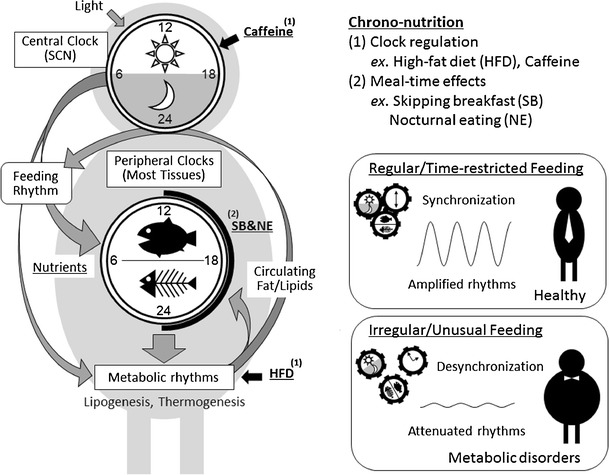
Circadian clocks that comprise clock genes exist throughout the body and control daily physiological events. The central clock that dominates activity rhythms is entrained by light/dark cycles, whereas peripheral clocks regulating local metabolic rhythms are determined by feeding/fasting cycles. Nutrients reset peripheral circadian clocks and the local clock genes control downstream metabolic processes. Metabolic states also affect the clockworks in feedback manners. Because the circadian system organizes whole energy homeostasis, including food intake, fat accumulation, and caloric expenditure, the disruption of circadian clocks leads to metabolic disorders. Recent findings show that time-restricted feeding during the active phase amplifies circadian clocks and improves metabolic disorders induced by a high-fat diet without caloric reduction, whereas unusual/irregular food intake induces various metabolic dysfunctions. Such evidence from nutrition studies that consider circadian system (chrononutrition) has rapidly accumulated. We review molecular relationships between circadian clocks and nutrition as well as recent chrononutrition findings.
Overview
The claims and statistics of this paper haven’t been checked yet.
Run the check — free, no account needed. It reads the open-access text and checks the sources it cites.
Integrity signals
Registry
Cites
Statistics
Figures
Verification
Claims the paper makes
The claims and statistics of this paper haven’t been checked yet.
Run the check — free, no account needed. It reads the open-access text and checks the sources it cites.
Claims other papers make about this one
Each is checked against this paper’s own text: does it say what the citing paper says it does?
The cited source says what the claim attributes to it.
In the citing paper
“These include poor-quality diet [232], improper meal timing and altered feeding-fasting behavior [233,234], sub-optimal exercise timing [235], disrupted sleep-wake cycles [236], shift work [237], EDC [238], and stress [239,240].”
From Polycystic Ovary Syndrome: An Evolutionary Adaptation to Lifestyle and the Environment (2022) · cites this paper as [234]
In the citing paper
“In this context, because breakfast is consumed after the longest fasting period of the day, it is usually the most important meal to modulate the phase of the liver clock [270].”
From Effects of diet, lifestyle, Chrononutrition and alternative dietary interventions on postprandial Glycemia and insulin resistance (2022) · cites this paper as [270]
Self-check
Percentages, sums and reported differences re-computed from the paper’s own numbers.
The self-check needs the paper’s full text.
Citations
Cites
Calamita, E., Schmid, M., Kunz, M., Ndebele-Murisa, M. R., Magadza, C. H. D., Nyambe, I., & Wehrli, B. (2019) · Figshare · doi:10.26181/6153922fe919c · Cited by 4,239
Obesity and Metabolic Syndrome in Circadian Clock Mutant Mice
Turek, F. W., Joshu, C., Kohsaka, A., Lin, E., Ivanova, G., McDearmon, E., Laposky, A., Losee-Olson, S., Easton, A., Jensen, D. R., et al. (2005) · Science · doi:10.1126/science.1108750 · Cited by 2,485
Damiola, F., Le Minh, N., Preitner, N., Kornmann, B., Fleury-Olela, F., & Schibler, U. (2000) · Genes & Development · doi:10.1101/gad.183500 · Cited by 2,394
Adverse metabolic and cardiovascular consequences of circadian misalignment
Scheer, F. A. J. L., Hilton, M. F., Mantzoros, C. S., & Shea, S. A. (2009) · Proceedings of the National Academy of Sciences · doi:10.1073/pnas.0808180106 · Cited by 2,351
Clock Mutants of Drosophila melanogaster
Konopka, R. J., & Benzer, S. (1971) · Proceedings of the National Academy of Sciences · doi:10.1073/pnas.68.9.2112 · Cited by 2,287
Hatori, M., Vollmers, C., Zarrinpar, A., DiTacchio, L., Bushong, E. A., Gill, S., Leblanc, M., Chaix, A., Joens, M., Fitzpatrick, J. A. J., et al. (2012) · Cell Metabolism · doi:10.1016/j.cmet.2012.04.019 · Cited by 1,986
Entrainment of the circadian clock in the liver by feeding
Stokkan, K.-A., Yamazaki, S., Tei, H., Sakaki, Y., & Menaker, M. (2001) · Science · doi:10.1126/science.291.5503.490 · Cited by 1,800
High-Fat Diet Disrupts Behavioral and Molecular Circadian Rhythms in Mice
Kohsaka, A., Laposky, A. D., Ramsey, K. M., Estrada, C., Joshu, C., Kobayashi, Y., Turek, F. W., & Bass, J. (2007) · Cell Metabolism · doi:10.1016/j.cmet.2007.09.006 · Cited by 1,528
Transcriptional architecture and chromatin landscape of the core circadian clock in mammals
Koike, N., Yoo, S.-H., Huang, H.-C., Kumar, V., Lee, C., Kim, T.-K., & Takahashi, J. S. (2012) · Science · doi:10.1126/science.1226339 · Cited by 1,464
Nakahata, Y., Kaluzova, M., Grimaldi, B., Sahar, S., Hirayama, J., Chen, D., Guarente, L. P., & Sassone-Corsi, P. (2008) · Cell · doi:10.1016/j.cell.2008.07.002 · Cited by 1,427
SIRT1 regulates circadian clock gene expression through PER2 deacetylation
Asher, G., Gatfield, D., Stratmann, M., Reinke, H., Dibner, C., Kreppel, F., Mostoslavsky, R., Alt, F. W., & Schibler, U. (2008) · Cell · doi:10.1016/j.cell.2008.06.050 · Cited by 1,376
Circadian Control of the NAD + Salvage Pathway by CLOCK-SIRT1
Nakahata, Y., Sahar, S., Astarita, G., Kaluzova, M., & Sassone-Corsi, P. (2009) · Science · doi:10.1126/science.1170803 · Cited by 1,198
Circadian Clock Feedback Cycle Through NAMPT-Mediated NAD + Biosynthesis
Ramsey, K. M., Yoshino, J., Brace, C. S., Abrassart, D., Kobayashi, Y., Marcheva, B., Hong, H.-K., Chong, J. L., Buhr, E. D., Lee, C., et al. (2009) · Science · doi:10.1126/science.1171641 · Cited by 1,126
Rudic, R. D., McNamara, P., Curtis, A.-M., Boston, R. C., Panda, S., Hogenesch, J. B., & FitzGerald, G. A. (2004) · PLoS Biology · doi:10.1371/journal.pbio.0020377 · Cited by 1,059
Regulation of clock and NPAS2 DNA binding by the redox state of NAD cofactors
Rutter, J., Reick, M., Wu, L. C., & McKnight, S. L. (2001) · Science · doi:10.1126/science.1060698 · Cited by 1,059
Regulation of circadian behaviour and metabolism by REV-ERB-α and REV-ERB-β
Cho, H., Zhao, X., Hatori, M., Yu, R. T., Barish, G. D., Lam, M. T., Chong, L.-W., DiTacchio, L., Atkins, A. R., Glass, C. K., et al. (2012) · Nature · doi:10.1038/nature11048 · Cited by 1,037
AMPK regulates the circadian clock by cryptochrome phosphorylation and degradation
Lamia, K. A., Sachdeva, U. M., DiTacchio, L., Williams, E. C., Alvarez, J. G., Egan, D. F., Vasquez, D. S., Juguilon, H., Panda, S., Shaw, R. J., et al. (2009) · Science · doi:10.1126/science.1172156 · Cited by 958
Circadian timing of food intake contributes to weight gain
Arble, D. M., Bass, J., Laposky, A. D., Vitaterna, M. H., & Turek, F. W. (2009) · Obesity · doi:10.1038/oby.2009.264 · Cited by 953
Timing to perfection: the biology of central and peripheral circadian clocks
Albrecht, U. (2012) · Neuron · doi:10.1016/j.neuron.2012.04.006 · Cited by 915
Light at night increases body mass by shifting the time of food intake
Fonken, L. K., Workman, J. L., Walton, J. C., Weil, Z. M., Morris, J. S., Haim, A., & Nelson, R. J. (2010) · Proceedings of the National Academy of Sciences · doi:10.1073/pnas.1008734107 · Cited by 796
Time of feeding and the intrinsic circadian clock drive rhythms in hepatic gene expression.
Vollmers, C., Gill, S., DiTacchio, L., Pulivarthy, S. R., Le, H. D., & Panda, S. (2009) · Proceedings of the National Academy of Sciences · doi:10.1073/pnas.0909591106 · Cited by 765
Aschoff, J. (1965) · Science · doi:10.1126/science.148.3676.1427 · Cited by 752
Molecular components of the mammalian circadian clock
Buhr, E. D., & Takahashi, J. S. (2013) · Handbook of experimental pharmacology · doi:10.1007/978-3-642-25950-0_1 · Cited by 738
Reprogramming of the Circadian Clock by Nutritional Challenge
Eckel‐Mahan, K. L., Patel, V. R., de Mateo, S., Orozco-Solís, R., Ceglia, N., Sahar, S., Dilag-Penilla, S. A., Dyar, K. A., Baldi, P., & Sassone‐Corsi, P. (2013) · Cell · doi:10.1016/j.cell.2013.11.034 · Cited by 737
Association between Eating Patterns and Obesity in a Free-living US Adult Population
Ma, Y. (2003) · American Journal of Epidemiology · doi:10.1093/aje/kwg117 · Cited by 725
Rev-erbα, a Heme Sensor That Coordinates Metabolic and Circadian Pathways
Yin, L., Wu, N., Curtin, J. C., Qatanani, M., Szwergold, N. R., Reid, R. A., Waitt, G. M., Parks, D. J., Pearce, K. H., Wisely, G. B., et al. (2007) · Science · doi:10.1126/science.1150179 · Cited by 707
A circadian rhythm orchestrated by histone deacetylase 3 controls hepatic lipid metabolism
Feng, D., Liu, T., Sun, Z., Bugge, A., Mullican, S. E., Alenghat, T., Liu, X. S., & Lazar, M. A. (2011) · Science · doi:10.1126/science.1198125 · Cited by 701
Transcriptional coactivator PGC-1α integrates the mammalian clock and energy metabolism
Liu, C., Li, S., Liu, T., Borjigin, J., & Lin, J. D. (2007) · Nature · doi:10.1038/nature05767 · Cited by 643
Timing of food intake predicts weight loss effectiveness
Garaulet, M., Gómez-Abellán, P., Alburquerque-Béjar, J. J., Lee, Y.-C., Ordovás, J. M., & Scheer, F. A. J. L. (2013) · International Journal of Obesity · doi:10.1038/ijo.2012.229 · Cited by 639
Jakubowicz, D., Barnea, M., Wainstein, J., & Froy, O. (2013) · Obesity · doi:10.1002/oby.20460 · Cited by 593
Restricted feeding entrains liver clock without participation of the suprachiasmatic nucleus
Hara, R., Wan, K., Wakamatsu, H., Aida, R., Moriya, T., Akiyama, M., & Shibata, S. (2001) · Genes to Cells · doi:10.1046/j.1365-2443.2001.00419.x · Cited by 569
Disruption of circadian clocks has ramifications for metabolism, brain, and behavior
Karatsoreos, I. N., Bhagat, S., Bloss, E. B., Morrison, J. H., & McEwen, B. S. (2011) · Proceedings of the National Academy of Sciences · doi:10.1073/pnas.1018375108 · Cited by 547
Rev-erbα and Rev-erbβ coordinately protect the circadian clock and normal metabolic functionPreprint
Bugge, A. K., Feng, D., Everett, L. J., Briggs, E. R., Mullican, S. E., Wang, F., Jager, J., & Lazar, M. A. (2012) · Genes & Development · doi:10.1101/gad.186858.112 · Cited by 514
Circadian Rhythms and Metabolic Syndrome
Maury, E., Ramsey, K. M., & Bass, J. T. (2010) · Circulation Research · doi:10.1161/circresaha.109.208355 · Cited by 509
PER2 controls lipid metabolism by direct regulation of PPARγ
Grimaldi, B., Bellet, M. M., Katada, S., Astarita, G., Hirayama, J., Amin, R. H., Granneman, J. G., Piomelli, D., Leff, T., & Sassone-Corsi, P. (2010) · Cell Metabolism · doi:10.1016/j.cmet.2010.10.005 · Cited by 489
Obesity in mice with adipocyte-specific deletion of clock component Arntl
Paschos, G. K., Ibrahim, S., Song, W.-L., Kunieda, T., Grant, G., Reyes, T. M., Bradfield, C. A., Vaughan, C. H., Eiden, M., Masoodi, M., et al. (2012) · Nature Medicine · doi:10.1038/nm.2979 · Cited by 465
Timlin, M. T., Pereira, M. A., Story, M. T., & Neumark‐Sztainer, D. (2008) · PEDIATRICS · doi:10.1542/peds.2007-1035 · Cited by 432
Timing of food intake and obesity: a novel association
Garaulet, M., & Gómez-Abellán, P. (2014) · Physiology & Behavior · doi:10.1016/j.physbeh.2014.01.001 · Cited by 362
Schmutz, I., Ripperger, J. A., Baeriswyl-Aebischer, S., & Albrecht, U. (2010) · Genes & Development · doi:10.1101/gad.564110 · Cited by 361
Timed high-fat diet resets circadian metabolism and prevents obesity
Sherman, H., Genzer, Y., Cohen, R., Chapnik, N., Madar, Z., & Froy, O. (2012) · The FASEB Journal · doi:10.1096/fj.12-208868 · Cited by 360
Shimba, S., Ogawa, T., Hitosugi, S., Ichihashi, Y., Nakadaira, Y., Kobayashi, M., Tezuka, M., Kosuge, Y., Ishige, K., Ito, Y., et al. (2011) · PLoS ONE · doi:10.1371/journal.pone.0025231 · Cited by 353
Poly(ADP-ribose) polymerase 1 participates in the phase entrainment of circadian clocks to feeding
Asher, G., Reinke, H., Altmeyer, M., Gutierrez-Arcelus, M., Hottiger, M. O., & Schibler, U. (2010) · Cell · doi:10.1016/j.cell.2010.08.016 · Cited by 340
Colles, S. L., Dixon, J. B., & O'Brien, P. E. (2007) · International Journal of Obesity · doi:10.1038/sj.ijo.0803664 · Cited by 324
Salgado-Delgado, R., Angeles-Castellanos, M., Saderi, N., Buijs, R. M., & Escobar, C. (2010) · Endocrinology · doi:10.1210/en.2009-0864 · Cited by 323
Circadian Clocks and Metabolism
Marcheva, B., Ramsey, K. M., Peek, C. B., Affinati, A., Maury, E., & Bass, J. (2013) · Handbook of Experimental Pharmacology · doi:10.1007/978-3-642-25950-0_6 · Cited by 282
Timing of energy intake during the day is associated with the risk of obesity in adults
Wang, J. B., Patterson, R. E., Ang, A., Emond, J. A., Shetty, N., & Arab, L. (2014) · Journal of Human Nutrition and Dietetics · doi:10.1111/jhn.12141 · Cited by 270
The nuclear receptor Rev-erbα controls circadian thermogenic plasticity
Gerhart‐Hines, Z., Feng, D., Emmett, M. J., Everett, L. J., Loro, E., Briggs, E. R., Bugge, A. K., Hou, C., Ferrara, C., Seale, P., et al. (2013) · Nature · doi:10.1038/nature12642 · Cited by 265
The role of mPer2 clock gene in glucocorticoid and feeding rhythms
Yang, S., Liu, A., Weidenhammer, A., Cooksey, R. C., McClain, D., Kim, M. K., Aguilera, G., Abel, E. D., & Chung, J. H. (2009) · Endocrinology · doi:10.1210/en.2008-0705 · Cited by 263
Circadian Desynchrony Promotes Metabolic Disruption in a Mouse Model of Shiftwork
Barclay, J. L., Husse, J., Bode, B., Naujokat, N., Meyer-Kovac, J., Schmid, S. M., Lehnert, H., & Oster, H. (2012) · PLoS ONE · doi:10.1371/journal.pone.0037150 · Cited by 259
Coomans, C. P., van den Berg, S. A. A., Houben, T., van Klinken, J., van den Berg, R., Pronk, A. C. M., Havekes, L. M., Romijn, J. A., van Dijk, K. W., Biermasz, N. R., et al. (2013) · The FASEB Journal · doi:10.1096/fj.12-210898 · Cited by 252
Advances in understanding the peripheral circadian clocks
Richards, J., & Gumz, M. L. (2012) · The FASEB Journal · doi:10.1096/fj.12-203554 · Cited by 247
Um, J. H., Yang, S., Yamazaki, S., Kang, H., Viollet, B., Foretz, M., & Chung, J. H. (2007) · Journal of Biological Chemistry · doi:10.1074/jbc.c700070200 · Cited by 244
The Implications of Multiple Circadian Clock Origins
Rosbash, M. (2009) · PLoS Biology · doi:10.1371/journal.pbio.1000062 · Cited by 239
A diurnal serum lipid integrates hepatic lipogenesis and peripheral fatty acid use
Liu, S., Brown, J. D., Stanya, K. J., Homan, E. A., Leidl, M., Inouye, K., Bhargava, P., Gangl, M. R., Dai, L., Hatano, B., et al. (2013) · Nature · doi:10.1038/nature12710 · Cited by 237
St-Onge, M.-P. (2013) · Journal of Clinical Sleep Medicine · doi:10.5664/jcsm.2348 · Cited by 220
Quantitative analysis of light-phase restricted feeding reveals metabolic dyssynchrony in mice
Bray, M. S., Ratcliffe, W. F., Grenett, M. H., Brewer, R. A., Gamble, K. L., & Young, M. E. (2012) · International Journal of Obesity · doi:10.1038/ijo.2012.137 · Cited by 213
Tahara, Y., & Shibata, S. (2013) · Neuroscience · doi:10.1016/j.neuroscience.2013.08.049 · Cited by 198
High-fat diet acutely affects circadian organisation and eating behavior
Pendergast, J. S., Branecky, K. L., Yang, W., Ellacott, K. L. J., Niswender, K. D., & Yamazaki, S. (2013) · European Journal of Neuroscience · doi:10.1111/ejn.12133 · Cited by 198
Circadian variation of diet-induced thermogenesis
Romon, M., Edme, J., Boulenguez, C., Lescroart, J., & Frimat, P. (1993) · The American Journal of Clinical Nutrition · doi:10.1093/ajcn/57.4.476 · Cited by 197
Breakfast Frequency and Quality May Affect Glycemia and Appetite in Adults and Children
Pereira, M. A., Erickson, E., McKee, P., Schrankler, K., Raatz, S. K., Lytle, L. A., & Pellegrini, A. D. (2010) · Journal of Nutrition · doi:10.3945/jn.109.114405 · Cited by 194
Milagro, F., Gómez-Abellán, P., Campión, J., Martinez, J., Ordovás, J. M., & Garaulet, M. (2012) · Chronobiology International · doi:10.3109/07420528.2012.719967 · Cited by 191
The REV-ERBs and RORs: Molecular Links Between Circadian Rhythms and Lipid Homeostasis
Solt, L. A., Kojetin, D. J., & Burris, T. P. (2011) · Future Medicinal Chemistry · doi:10.4155/fmc.11.9 · Cited by 177
Shift work and cardiovascular risk factors: New knowledge from the past decade
Esquirol, Y., Perret, B., Ruidavets, J. B., Marquié, J. C., Diène, E., Niezborala, M., & Ferrières, J. (2011) · Archives of cardiovascular diseases · doi:10.1016/j.acvd.2011.09.004 · Cited by 173
Disrupted fat absorption attenuates obesity induced by a high‐fat diet in Clock mutant mice
Oishi, K., Atsumi, G.-I., Sugiyama, S., Kodomari, I., Kasamatsu, M., Machida, K., & Ishida, N. (2006) · FEBS Letters · doi:10.1016/j.febslet.2005.11.063 · Cited by 166
Self-citationThe Effects of Caffeine on Sleep inDrosophilaRequire PKA Activity, But Not the Adenosine Receptor
Wu, M. N., Ho, K. S., Crocker, A. J., Yue, Z., Koh, K., & Sehgal, A. (2009) · Journal of Neuroscience · doi:10.1523/jneurosci.1653-09.2009 · Cited by 130
Tahara, Y., Otsuka, M., Fuse, Y., Hirao, A., & Shibata, S. (2011) · Journal of Biological Rhythms · doi:10.1177/0748730411405958 · Cited by 125
Yamajuku, D., Inagaki, T., Haruma, T., Okubo, S., Kataoka, Y., Kobayashi, S., Ikegami, K., Laurent, T., Kojima, T., Noutomi, K., et al. (2012) · Scientific Reports · doi:10.1038/srep00439 · Cited by 124
Oishi, K., Kasamatsu, M., & Ishida, N. (2004) · Biochemical and Biophysical Research Communications · doi:10.1016/j.bbrc.2004.03.055 · Cited by 107
Self-citationRole of clock genes in gastrointestinal motility
Hoogerwerf, W. A. (2010) · American Journal of Physiology-Gastrointestinal and Liver Physiology · doi:10.1152/ajpgi.00147.2010 · Cited by 107
Meal frequency patterns determine the phase of mouse peripheral circadian clocks
Kuroda, H., Tahara, Y., Saito, K., Ohnishi, N., Kubo, Y., Seo, Y., Otsuka, M., Fuse, Y., Ohura, Y., Hirao, A., et al. (2012) · Scientific Reports · doi:10.1038/srep00711 · Cited by 105
Association of Breakfast Skipping With Visceral Fat and Insulin Indices in Overweight Latino Youth
Alexander, K. E., Ventura, E. E., Spruijt‐Metz, D., Weigensberg, M. J., Goran, M. I., & Davis, J. N. (2009) · Obesity · doi:10.1038/oby.2009.127 · Cited by 105
A Balanced Diet Is Necessary for Proper Entrainment Signals of the Mouse Liver Clock
Hirao, A., Tahara, Y., Kimura, I., & Shibata, S. (2009) · PLoS ONE · doi:10.1371/journal.pone.0006909 · Cited by 98
Caffeine lengthens circadian rhythms in mice
Oike, H., Kobori, M., Suzuki, T., & Ishida, N. (2011) · Biochemical and Biophysical Research Communications · doi:10.1016/j.bbrc.2011.06.049 · Cited by 96
Self-citationEntrainment in calorie-restricted mice: conflicting zeitgebers and free-running conditions
Challet, É., Solberg, L. C., & Turek, F. W. (1998) · American Journal of Physiology-Regulatory, Integrative and Comparative Physiology · doi:10.1152/ajpregu.1998.274.6.r1751 · Cited by 96
Chrono-biology, Chrono-pharmacology and Chrono-nutrition
Tahara, Y., & Shibata, S. (2014) · Journal of Pharmacological Sciences · doi:10.1254/jphs.13r06cr · Cited by 94
The adjustment and manipulation of biological rhythms by light, nutrition, and abused drugs
Shibata, S., Tahara, Y., & Hirao, A. (2010) · Advanced Drug Delivery Reviews · doi:10.1016/j.addr.2010.06.003 · Cited by 91
The Time of Metabolism: NAD+, SIRT1, and the Circadian ClockPreprint
Bellet, M. M., Orozco-Solís, R., Sahar, S., Eckel‐Mahan, K. L., & Sassone‐Corsi, P. (2011) · Cold Spring Harbor Symposia on Quantitative Biology · doi:10.1101/sqb.2011.76.010520 · Cited by 90
Stern, J. H., Grant, A. S., Thomson, C. A., Tinker, L., Hale, L., Brennan, K. M., Woods, N. F., & Chen, Z. (2014) · Obesity · doi:10.1002/oby.20683 · Cited by 86
Hirao, A., Nagahama, H., Tsuboi, T., Hirao, M., Tahara, Y., & Shibata, S. (2010) · American Journal of Physiology-Gastrointestinal and Liver Physiology · doi:10.1152/ajpgi.00330.2010 · Cited by 86
Wu, T., Sun, L., ZhuGe, F., Guo, X., Zhao, Z., Tang, R., Chen, Q., Chen, L., Kato, H., & Fu, Z. (2011) · Chronobiology International · doi:10.3109/07420528.2011.622599 · Cited by 86
Fuse, Y., Hirao, A., Kuroda, H., Otsuka, M., Tahara, Y., & Shibata, S. (2012) · Journal of Circadian Rhythms · doi:10.1186/1740-3391-10-4 · Cited by 80
Altered behavioral and metabolic circadian rhythms in mice with disrupted NAD+ oscillation
Sahar, S., Nin, V., Barbosa, M. T., Chini, E. N., & Sassone-Corsi, P. (2011) · Aging · doi:10.18632/aging.100368 · Cited by 79
Oike, H., Nagai, K., Fukushima, T., Ishida, N., & Kobori, M. (2011) · PLoS ONE · doi:10.1371/journal.pone.0023709 · Cited by 72
Self-citationPPARα is a potential therapeutic target of drugs to treat circadian rhythm sleep disorders
Shirai, H., Oishi, K., Kudo, T., Shibata, S., & Ishida, N. (2007) · Biochemical and Biophysical Research Communications · doi:10.1016/j.bbrc.2007.04.002 · Cited by 70
Self-citationEarly nocturnal meal skipping alters the peripheral clock and increases lipogenesis in mice
Yoshida, C., Shikata, N., Seki, S., Koyama, N., & Noguchi, Y. (2012) · Nutrition & Metabolism · doi:10.1186/1743-7075-9-78 · Cited by 68
Resveratrol Regulates Circadian Clock Genes in Rat-1 Fibroblast Cells
Oike, H., & Kobori, M. (2008) · Bioscience Biotechnology and Biochemistry · doi:10.1271/bbb.80426 · Cited by 67
Self-citationYoshizaki, T., Tada, Y., Hida, A., Sunami, A., Yokoyama, Y., Yasuda, J., Nakai, A., Togo, F., & Kawano, Y. (2013) · European Journal of Applied Physiology · doi:10.1007/s00421-013-2702-z · Cited by 65
Circadian Periodicity in Neurospora : Alteration by Inhibitors of Cyclic AMP Phosphodiesterase
Feldman, J. F. (1975) · Science · doi:10.1126/science.173018 · Cited by 64
Thermoregulation Is Impaired in an Environment Without Circadian Time Cues
Fuller, C. A., Sulzman, F. M., & Moore‐Ede, M. C. (1978) · Science · doi:10.1126/science.414356 · Cited by 62
Food-anticipatory activity and liver per1-luc activity in diabetic transgenic rats
Davidson, A. J., Stokkan, K., Yamazaki, S., & Menaker, M. (2002) · Physiology & Behavior · doi:10.1016/s0031-9384(02)00680-7 · Cited by 59
Oishi, K., Uchida, D., Ohkura, N., Doi, R., Ishida, N., Kadota, K., & Horie, S. (2009) · Arteriosclerosis Thrombosis and Vascular Biology · doi:10.1161/atvbaha.109.190140 · Cited by 59
Self-citationBehavioral risk factors for overweight in early childhood; the ‘Be active, eat right’ study
Veldhuis, L., Vogel, I., Renders, C. M., van Rossem, L., Oenema, A., Hirasing, R. A., & Raat, H. (2012) · International Journal of Behavioral Nutrition and Physical Activity · doi:10.1186/1479-5868-9-74 · Cited by 57
High-salt diet advances molecular circadian rhythms in mouse peripheral tissues
Oike, H., Nagai, K., Fukushima, T., Ishida, N., & Kobori, M. (2010) · Biochemical and Biophysical Research Communications · doi:10.1016/j.bbrc.2010.09.072 · Cited by 49
Self-citationWu, T., Ni, Y., Kato, H., & Fu, Z. (2010) · Chronobiology International · doi:10.3109/07420520903398625 · Cited by 45
Itokawa, M., Hirao, A., Nagahama, H., Otsuka, M., Ohtsu, T., Furutani, N., Hirao, K., Hatta, T., & Shibata, S. (2013) · Nutrition Research · doi:10.1016/j.nutres.2012.12.004 · Cited by 41
Bollig, I., Mayer, K., Mayer, W., & Engelmann, W. (1978) · Planta · doi:10.1007/bf00387893 · Cited by 39
The harmala alkaloid harmine is a modulator of circadian Bmal1 transcription
Onishi, Y., Oishi, K., Kawano, Y., & Yamazaki, Y. (2011) · Bioscience Reports · doi:10.1042/bsr20110002 · Cited by 38
Self-citationSite-specific circadian expression of leptin and its receptor in human adipose tissue.
Gómez-Abellán, P., Santos, C. G., Madrid, J. A., Milagro, F. I., Campión, J., Martínez, J. A., Luján, J., Ordovás, J. M., & Garaulet, M. (2011) · PubMed · doi:10.1590/s0212-16112011000600029 · Cited by 25
Gutman, R., Barnea, M., Haviv, L., Chapnik, N., & Froy, O. (2011) · International Journal of Obesity · doi:10.1038/ijo.2011.215 · Cited by 22
Dietary Obesity Caused by a Specific Circadian Eating Pattern
Hariri, N., & Thibault, L. (2011) · Chronobiology International · doi:10.3109/07420528.2010.548614 · Cited by 21
THE EFFECTS OF CAFFEINE AND THEOPHYLLINE ON THE PHOTOTACTIC RHYTHM OFCHLAMYDOMONAS REINHARDII
Goodenough, J., & Bruce, V. G. (1980) · Biological Bulletin · doi:10.2307/1540830 · Cited by 19
Cited by
Sorted by citations
de Toro‐Martín, J., Arsenault, B. J., Després, J., & Vohl, M. (2017) · Nutrients · doi:10.3390/nu9080913 · Cited by 534
The Influence of Meal Frequency and Timing on Health in Humans: The Role of Fasting
Paoli, A., Tinsley, G. M., Bianco, A., & Moro, T. (2019) · Nutrients · doi:10.3390/nu11040719 · Cited by 415
Atger, F., Gobet, C., Marquis, J., Martín, E., Wang, J., Weger, B. D., Lefebvre, G. C., Descombes, P., Naef, F., & Gachon, F. (2015) · Proceedings of the National Academy of Sciences · doi:10.1073/pnas.1515308112 · Cited by 254
New Insights Into the Circadian Rhythm and Its Related Diseases
Xie, Y., Tang, Q., Chen, G., Xie, M., Yu, S., Zhao, J., & Chen, L. (2019) · Frontiers in Physiology · doi:10.3389/fphys.2019.00682 · Cited by 250
Qasim, A., Turcotte, M., de Souza, R. J., Samaan, M. C., Champredon, D., Dushoff, J., Speakman, J. R., & Meyre, D. (2018) · Obesity Reviews · doi:10.1111/obr.12625 · Cited by 241
Metadata
- Authors
- Oike, H., Oishi, K., & Kobori, M.
- Affiliations
- National Agriculture and Food Research Organization (JP)
- Tokyo University of Science (JP)
- Corresponding author
- Oike, Hideaki
- Venue
- Current Nutrition Reports
- Published
- 2014-04-27
- Volume
- 3
- Issue
- 3
- Pages
- 204-212
- ISSN
- 2161-3311 (ISSN-L)
- PMC
- PMC4118017
- OpenAlex
- W2072829785
- Cited by
- 198
- References
- 101
- Citations by year
- 2026: 10 · 2025: 25 · 2024: 17 · 2023: 20 · 2022: 20 · 2021: 19 · 2020: 21 · 2019: 18 · 2018: 7 · 2017: 18 · 2016: 9 · 2015: 12 · 2014: 2
- FWCI
- 1.54
- Type
- journal article
- Language
- en
- Open access
- hybrid
- doi.org
- Locations
- Current Nutrition Reports (publishedVersion, cc-by)
- PubMed Central (publishedVersion, cc-by)
- PubMed (publishedVersion)
- Funders
- Japan Society for the Promotion of Science (25560066, 25702005, 25350179)
- Topics
- Life Sciences › Neuroscience › Endocrine and Autonomic Systems › Circadian rhythm and melatonin
- Health Sciences › Medicine › Physiology (medical) › Dietary Effects on Health
- Life Sciences › Biochemistry, Genetics and Molecular Biology › Genetics › Nutrition, Genetics, and Disease
- Keywords
- circadian clock, clock genes, chrononutrition, time-restricted feeding, metabolic disorders, high-fat diet, energy homeostasis, dietary intake, fat deposition, energy expenditure, circadian rhythm disruption
About these checks
Registry, retraction, Cites and statistics results are computed, not judged, with one exception: a printed reference that no index lists is read once by a model before it counts as a citation error. Claims are extracted by a model and kept only when their quote appears verbatim in the text; each cited source is then checked, with a model’s help, for whether it says what the claim relies on. Those verdicts can be wrong — read the claim’s quote and the cited source before relying on one.
Statistics and arithmetic are recomputed, not judged.
Confidence bands are shown only for fields calibrated on our annotated test set. None is calibrated yet, so no band is shown.
What counts as a claim ›How we measure confidence ›How we check this ›
Are you an author, or do you see a problem with this page? Request a review
