

The DOI matches its Crossref record; 61 of the 62 references it cites were found in a registry or an index.
The evolution of cognitive load theory and its application to medical education
Open accessAbstract
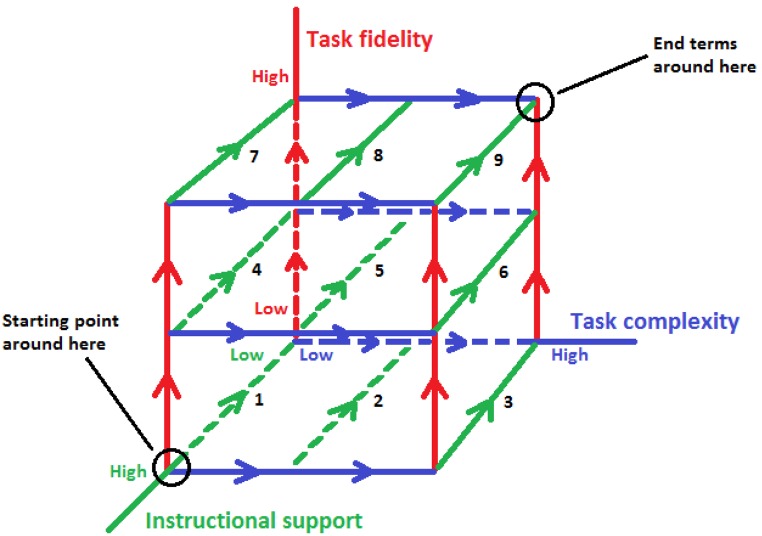
Cognitive Load Theory (CLT) has started to find more applications in medical education research. Unfortunately, misconceptions such as lower cognitive load always being beneficial to learning and the continued use of dated concepts and methods can result in improper applications of CLT principles in medical education design and research. This review outlines how CLT has evolved and presents a synthesis of current-day CLT principles in a holistic model for medical education design. This model distinguishes three dimensions: task fidelity: from literature (lowest) through simulated patients to real patients (highest); task complexity: the number of information elements; and instructional support: from worked examples (highest) through completion tasks to autonomous task performance (lowest). These three dimensions together constitute three steps to proficient learning: (I) start with high support on low-fidelity low-complexity tasks and gradually fade that support as learners become more proficient; (II) repeat I for low-fidelity but higher-complexity tasks; and (III) repeat I and II in that order at subsequent levels of fidelity. The numbers of fidelity levels and complexity levels within fidelity levels needed depend on the aims of the course, curriculum or individual learning trajectory. This paper concludes with suggestions for future research based on this model.
Overview
The claims and statistics of this paper haven’t been checked yet.
Run the check — free, no account needed. It reads the open-access text and checks the sources it cites.
Integrity signals
Registry
Cites
Statistics
Figures
Verification
Claims the paper makes
The claims and statistics of this paper haven’t been checked yet.
Run the check — free, no account needed. It reads the open-access text and checks the sources it cites.
Claims other papers make about this one
Each is checked against this paper’s own text: does it say what the citing paper says it does?
The source backs part of the claim, not all of it — or backs it for a different population, condition or comparison.
In the citing paper
“An assessment after the out-of-class instruction is an excellent way to evaluate student comprehension of a topic and facilitate the use of mastery learning techniques (22).”
From Applying learning theories and instructional design models for effective instruction (2016) · cites this paper as [22]
Experimental — accuracy not yet measured
Self-check
Percentages, sums and reported differences re-computed from the paper’s own numbers.
The self-check needs the paper’s full text.
Citations
Cites
Development of NASA-TLX (Task Load Index): Results of Empirical and Theoretical Research
(1988) · Advances in Psychology · doi:10.1016/s0166-4115(08)62386-9 · Cited by 15,003
(2011) · Cited by 14,317
Cognitive Load During Problem Solving: Effects on Learning
Sweller, J. (1988) · Cognitive Science · doi:10.1016/0364-0213(88)90023-7 · Cited by 11,048
The magical number 4 in short-term memory: A reconsideration of mental storage capacity
Cowan, N. (2001) · Behavioral and Brain Sciences · doi:10.1017/s0140525x01003922 · Cited by 6,779
Sweller, J., Ayres, P., & Kalyuga, S. (2011) · Elsevier eBooks · doi:10.1007/978-1-4419-1428-6_446 · Cited by 6,172
Cognitive Architecture and Instructional Design
Sweller, J., van Merrienboer, J. J. G., & Paas, F. G. W. C. (1998) · Educational Psychology Review · doi:10.1023/a:1022193728205 · Cited by 6,023
Cognitive load theory, learning difficulty, and instructional design
Sweller, J. (1994) · Learning and Instruction · doi:10.1016/0959-4752(94)90003-5 · Cited by 3,801 · cited 2×
“It goes without saying that the more working memory capacity is required for dealing with the way in which information is presented—a concept coined extraneous cognitive load [6]—the less working memory capacity remains for dealing with the intrinsic content of information—hereinafter referred to as intrinsic cognitiv…”
BackgroundCognitive Load Theory and the Format of Instruction
Chandler, P., & Sweller, J. (1991) · Cognition and Instruction · doi:10.1207/s1532690xci0804_2 · Cited by 2,894
Cognitive Load Measurement as a Means to Advance Cognitive Load Theory
Paas, F., Tuovinen, J. E., Tabbers, H., & Van Gerven, P. W. M. (2003) · Educational Psychologist · doi:10.1207/s15326985ep3801_8 · Cited by 2,527
Paas, F. G. W. C. (1992) · Journal of Educational Psychology · doi:10.1037/0022-0663.84.4.429 · Cited by 2,150
Cited by
Sorted by citations
Skulmowski, A., & Xu, K. M. (2022) · Educational Psychology Review · doi:10.1007/s10648-021-09624-7 · Cited by 678
Longhurst, G. J., Stone, D. M., Dulohery, K., Scully, D. M., Campbell, T. J., & Smith, C. F. (2020) · Anatomical Sciences Education · doi:10.1002/ase.1967 · Cited by 538
Applying learning theories and instructional design models for effective instruction
Khalil, M. K., & Elkhider, I. A. (2016) · Advances in Physiology Education · doi:10.1152/advan.00138.2015 · Cited by 372
Effects of augmented reality on learning and cognitive load in university physics laboratory courses
Thees, M., Kapp, S., Strzys, M. P., Beil, F., Lukowicz, P., & Kühn, J. (2020) · Computers in Human Behavior · doi:10.1016/j.chb.2020.106316 · Cited by 414
Altmeyer, K., Kapp, S., Thees, M., Malone, S., Kühn, J., & Brünken, R. (2020) · British Journal of Educational Technology · doi:10.1111/bjet.12900 · Cited by 244
Metadata
- Authors
- Leppink, J., & Van den Heuvel, A.
- Affiliations
- Maastricht University (NL)
- Corresponding author
- Leppink, Jimmie
- ORCID
- Leppink, Jimmie
- Venue
- Perspectives on Medical Education
- Publisher
- Ubiquity Press, Ltd.
- Published
- 2015-05-28
- Volume
- 4
- Issue
- 3
- Pages
- 119-127
- ISSN
- 2212-2761 (ISSN-L)
- 2212-277X
- PMC
- PMC4456454
- OpenAlex
- W1499793228
- Cited by
- 299
- References
- 62
- Citations by year
- 2026: 40 · 2025: 28 · 2024: 20 · 2023: 29 · 2022: 35 · 2021: 35 · 2020: 31 · 2019: 28 · 2018: 21 · 2017: 13 · 2016: 17 · 2015: 2
- FWCI
- 18.95
- Type
- journal article
- Language
- en
- Open access
- diamond
- doi.org
- Licence
- Locations
- Perspectives on Medical Education (publishedVersion, cc-by)
- PubMed Central (publishedVersion, cc-by)
- PubMed (publishedVersion)
- Research Publications (Maastricht University) (publishedVersion, cc-by)
- DOAJ (DOAJ: Directory of Open Access Journals) (submittedVersion)
- Research Publications (Maastricht University) (submittedVersion, other-oa)
- Topics
- Social Sciences › Education › Innovations in Medical Education
- Social Sciences › Psychology › Experimental and Cognitive Psychology › Visual and Cognitive Learning Processes
- Health Sciences › Medicine › Family Practice › Clinical Reasoning and Diagnostic Skills
- Keywords
- cognitive load theory, medical education, instructional design, task complexity, pedagogical support, worked examples, standardized patients
About these checks
Registry, retraction, Cites and statistics results are computed, not judged, with one exception: a printed reference that no index lists is read once by a model before it counts as a citation error. Claims are extracted by a model and kept only when their quote appears verbatim in the text; each cited source is then checked, with a model’s help, for whether it says what the claim relies on. Those verdicts can be wrong — read the claim’s quote and the cited source before relying on one.
Statistics and arithmetic are recomputed, not judged.
Confidence bands are shown only for fields calibrated on our annotated test set. None is calibrated yet, so no band is shown.
What counts as a claim ›How we measure confidence ›How we check this ›
Are you an author, or do you see a problem with this page? Request a review
