

The DOI matches its Crossref record; 61 of the 62 references it cites were found in a registry or an index.
The evolution of cognitive load theory and its application to medical education
Open accessAbstract
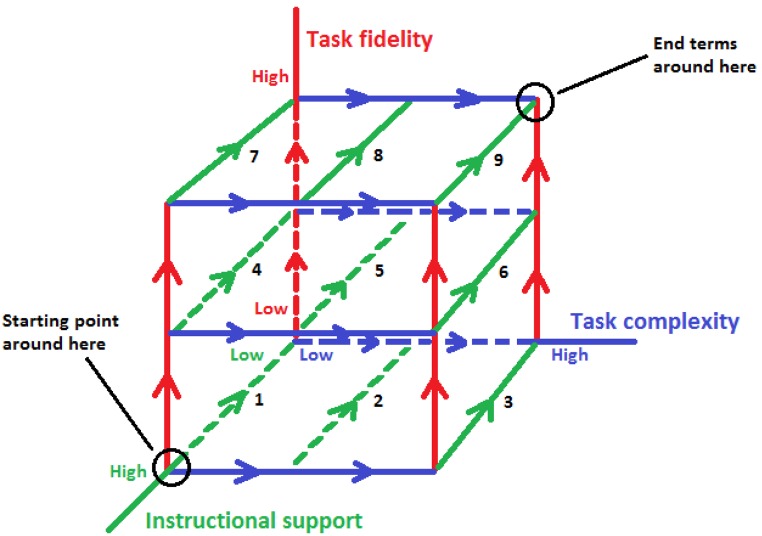
Cognitive Load Theory (CLT) has started to find more applications in medical education research. Unfortunately, misconceptions such as lower cognitive load always being beneficial to learning and the continued use of dated concepts and methods can result in improper applications of CLT principles in medical education design and research. This review outlines how CLT has evolved and presents a synthesis of current-day CLT principles in a holistic model for medical education design. This model distinguishes three dimensions: task fidelity: from literature (lowest) through simulated patients to real patients (highest); task complexity: the number of information elements; and instructional support: from worked examples (highest) through completion tasks to autonomous task performance (lowest). These three dimensions together constitute three steps to proficient learning: (I) start with high support on low-fidelity low-complexity tasks and gradually fade that support as learners become more proficient; (II) repeat I for low-fidelity but higher-complexity tasks; and (III) repeat I and II in that order at subsequent levels of fidelity. The numbers of fidelity levels and complexity levels within fidelity levels needed depend on the aims of the course, curriculum or individual learning trajectory. This paper concludes with suggestions for future research based on this model.
Overview
The claims and statistics of this paper haven’t been checked yet.
Run the check — free, no account needed. It reads the open-access text and checks the sources it cites.
Integrity signals
Registry
Cites
Statistics
Figures
Verification
Claims the paper makes
The claims and statistics of this paper haven’t been checked yet.
Run the check — free, no account needed. It reads the open-access text and checks the sources it cites.
Claims other papers make about this one
Each is checked against this paper’s own text: does it say what the citing paper says it does?
The source backs part of the claim, not all of it — or backs it for a different population, condition or comparison.
In the citing paper
“An assessment after the out-of-class instruction is an excellent way to evaluate student comprehension of a topic and facilitate the use of mastery learning techniques (22).”
From Applying learning theories and instructional design models for effective instruction (2016) · cites this paper as [22]
Experimental — accuracy not yet measured
Self-check
Percentages, sums and reported differences re-computed from the paper’s own numbers.
The self-check needs the paper’s full text.
Citations
Cites
Development of NASA-TLX (Task Load Index): Results of Empirical and Theoretical Research
(1988) · Advances in Psychology · doi:10.1016/s0166-4115(08)62386-9 · Cited by 15,003
(2011) · Cited by 14,317
Cognitive Load During Problem Solving: Effects on Learning
Sweller, J. (1988) · Cognitive Science · doi:10.1016/0364-0213(88)90023-7 · Cited by 11,048
The magical number 4 in short-term memory: A reconsideration of mental storage capacity
Cowan, N. (2001) · Behavioral and Brain Sciences · doi:10.1017/s0140525x01003922 · Cited by 6,779
Sweller, J., Ayres, P., & Kalyuga, S. (2011) · Elsevier eBooks · doi:10.1007/978-1-4419-1428-6_446 · Cited by 6,172
Cognitive Architecture and Instructional Design
Sweller, J., van Merrienboer, J. J. G., & Paas, F. G. W. C. (1998) · Educational Psychology Review · doi:10.1023/a:1022193728205 · Cited by 6,023
Cognitive load theory, learning difficulty, and instructional design
Sweller, J. (1994) · Learning and Instruction · doi:10.1016/0959-4752(94)90003-5 · Cited by 3,801 · cited 2×
“It goes without saying that the more working memory capacity is required for dealing with the way in which information is presented—a concept coined extraneous cognitive load [6]—the less working memory capacity remains for dealing with the intrinsic content of information—hereinafter referred to as intrinsic cognitiv…”
BackgroundCognitive Load Theory and the Format of Instruction
Chandler, P., & Sweller, J. (1991) · Cognition and Instruction · doi:10.1207/s1532690xci0804_2 · Cited by 2,894
Cognitive Load Measurement as a Means to Advance Cognitive Load Theory
Paas, F., Tuovinen, J. E., Tabbers, H., & Van Gerven, P. W. M. (2003) · Educational Psychologist · doi:10.1207/s15326985ep3801_8 · Cited by 2,527
Paas, F. G. W. C. (1992) · Journal of Educational Psychology · doi:10.1037/0022-0663.84.4.429 · Cited by 2,150
Cited by
Sorted by citations
Skulmowski, A., & Xu, K. M. (2022) · Educational Psychology Review · doi:10.1007/s10648-021-09624-7 · Cited by 678
Longhurst, G. J., Stone, D. M., Dulohery, K., Scully, D. M., Campbell, T. J., & Smith, C. F. (2020) · Anatomical Sciences Education · doi:10.1002/ase.1967 · Cited by 538
Applying learning theories and instructional design models for effective instruction
Khalil, M. K., & Elkhider, I. A. (2016) · Advances in Physiology Education · doi:10.1152/advan.00138.2015 · Cited by 372
Effects of augmented reality on learning and cognitive load in university physics laboratory courses
Thees, M., Kapp, S., Strzys, M. P., Beil, F., Lukowicz, P., & Kühn, J. (2020) · Computers in Human Behavior · doi:10.1016/j.chb.2020.106316 · Cited by 414
Altmeyer, K., Kapp, S., Thees, M., Malone, S., Kühn, J., & Brünken, R. (2020) · British Journal of Educational Technology · doi:10.1111/bjet.12900 · Cited by 244
Nicholls, D., Sweet, L. P., Müller, A., & Hyett, J. A. (2016) · Medical Teacher · doi:10.3109/0142159x.2016.1150984 · Cited by 160
Validating theta power as an objective measure of cognitive load in educational video
Castro-Meneses, L. J., Kruger, J., & Doherty, S. (2019) · Educational Technology Research and Development · doi:10.1007/s11423-019-09681-4 · Cited by 162
Solhjoo, S., Haigney, M. C., McBee, E. C., van Merriënboer, J. J. G., Schuwirth, L., Artino, A. R., Battista, A., Ratcliffe, T. A., Lee, H. D., & Durning, S. J. (2019) · Scientific Reports · doi:10.1038/s41598-019-50280-3 · Cited by 177
Dankbaar, M. E. W., Alsma, J., Jansen, E. E. H., van Merrienboer, J. J. G., van Saase, J. L. C. M., & Schuit, S. C. E. (2016) · Advances in Health Sciences Education · doi:10.1007/s10459-015-9641-x · Cited by 147
Sweller, J. (2018) · Perspectives on Medical Education · doi:10.1007/s40037-017-0395-4 · Cited by 153
Krieglstein, F., Beege, M., Rey, G. D., Ginns, P., Krell, M., & Schneider, S. (2022) · Educational Psychology Review · doi:10.1007/s10648-022-09683-4 · Cited by 167
Using mobile devices to enhance inquiry-based learning processes
Becker, S., Klein, P., Gößling, A., & Kühn, J. (2020) · Learning and Instruction · doi:10.1016/j.learninstruc.2020.101350 · Cited by 167
Teaching of anatomical sciences: A blended learning approach
Khalil, M. K., Meguid, E. M. A., & Elkhider, I. A. (2018) · Clinical Anatomy · doi:10.1002/ca.23052 · Cited by 131
Cuschieri, S., & Calleja‐Agius, J. (2020) · Anatomical Sciences Education · doi:10.1002/ase.2020 · Cited by 112
Sewell, J. L., Maggio, L. A., ten Cate, O., van Gog, T., Young, J. Q., & O’Sullivan, P. (2018) · Medical Teacher · doi:10.1080/0142159x.2018.1505034 · Cited by 123
Virtual reality simulation in endoscopy training: Current evidence and future directions
Mahmood, T., Scaffidi, M. A., Khan, R., & Grover, S. C. (2018) · World Journal of Gastroenterology · doi:10.3748/wjg.v24.i48.5439 · Cited by 110
Cognitive load theory: Practical implications and an important challenge
Leppink, J. (2017) · Journal of Taibah University Medical Sciences · doi:10.1016/j.jtumed.2017.05.003 · Cited by 135
Self-citationTwelve tips for medical curriculum design from a cognitive load theory perspective
Leppink, J., & Duvivier, R. (2016) · Medical Teacher · doi:10.3109/0142159x.2015.1132829 · Cited by 96
Self-citationHochberg, K., Becker, S., Louis, M., Klein, P., & Kühn, J. (2020) · Journal of Science Education and Technology · doi:10.1007/s10956-020-09816-w · Cited by 114
Cognitive Load Management: An Invaluable Tool for Safe and Effective Surgical Training
Howie, E. E., Dharanikota, H., Gunn, E., Ambler, O., DIAS, R. D., Wigmore, S. J., Skipworth, R. J. E., & Yule, S. (2023) · Journal of surgical education · doi:10.1016/j.jsurg.2022.12.010 · Cited by 94
We need more replication research – A case for test-retest reliability
Leppink, J., & Pérez-Fuster, P. (2017) · Perspectives on Medical Education · doi:10.1007/s40037-017-0347-z · Cited by 86
Self-citationCognitive load experienced by nurses in simulation-based learning experiences: An integrative review
Rogers, B., & Franklin, A. E. (2021) · Nurse Education Today · doi:10.1016/j.nedt.2021.104815 · Cited by 80
Simulation-based education: deceiving learners with good intent
Alinier, G., & Oriot, D. (2022) · Advances in Simulation · doi:10.1186/s41077-022-00206-3 · Cited by 78
Cognitive load predicts point-of-care ultrasound simulator performance
Aldekhyl, S., Cavalcanti, R. B., & Naismith, L. M. (2018) · Perspectives on Medical Education · doi:10.1007/s40037-017-0392-7 · Cited by 75
Sewell, J. L., Boscardin, C., Young, J. Q., ten Cate, O., & O’Sullivan, P. (2017) · Academic Medicine · doi:10.1097/acm.0000000000001690 · Cited by 66
Using learning analytics to evaluate a video-based lecture series
Lau, K. H. V., Farooque, P., Leydon, G., Schwartz, M. L., Sadler, R. M., & Moeller, J. J. (2017) · Medical Teacher · doi:10.1080/0142159x.2017.1395001 · Cited by 65
Langfield, T., Colthorpe, K. L., & Ainscough, L. (2017) · Anatomical Sciences Education · doi:10.1002/ase.1756 · Cited by 66
The simulated clinical environment: Cognitive and emotional impact among undergraduates
Tremblay, M., Lafleur, A., Leppink, J., & Dolmans, D. H. J. M. (2016) · Medical Teacher · doi:10.1080/0142159x.2016.1246710 · Cited by 64
Self-citationShould learners use their hands for learning? Results from an eye‐tracking study
Korbach, A., Ginns, P., Brünken, R., & Park, B. (2019) · Journal of Computer Assisted Learning · doi:10.1111/jcal.12396 · Cited by 59
Different effects of pausing on cognitive load in a medical simulation game
Lee, J. Y., Donkers, J. H. H. L. M., Jarodzka, H., Sellenraad, G., & van Merriënboer, J. J. G. (2020) · Computers in Human Behavior · doi:10.1016/j.chb.2020.106385 · Cited by 66
Optimizing Lectures From a Cognitive Load Perspective
Jordan, J., Wagner, J., Manthey, D. E., Wolff, M., Santen, S. A., & Cico, S. J. (2019) · AEM Education and Training · doi:10.1002/aet2.10389 · Cited by 61
Applying cognitive load theory to medical education: construct and measurement challenges
Young, J. Q., & Sewell, J. L. (2015) · Perspectives on Medical Education · doi:10.1007/s40037-015-0193-9 · Cited by 50
Lademann, J., Henze, J., & Becker, S. (2025) · Physical Review Physics Education Research · doi:10.1103/physrevphyseducres.21.010147 · Cited by 74
Subjective cognitive load surveys lead to divergent results for interactive learning media
Skulmowski, A., & Rey, G. D. (2020) · Human Behavior and Emerging Technologies · doi:10.1002/hbe2.184 · Cited by 47
A generative AI teaching assistant for personalized learning in medical education
Thesen, T., & Park, S. H. (2025) · npj Digital Medicine · doi:10.1038/s41746-025-02022-1 · Cited by 59
Communication skills training and the conceptual structure of empathy among medical students
Son, D., Shimizu, I., Ishikawa, H., Aomatsu, M., & Leppink, J. (2018) · Perspectives on Medical Education · doi:10.1007/s40037-018-0431-z · Cited by 58
Self-citationAssessing the validity of the cognitive load scale in a problem-based learning setting
Hadie, S. N. H., & Yusoff, M. S. B. (2016) · Journal of Taibah University Medical Sciences · doi:10.1016/j.jtumed.2016.04.001 · Cited by 48
Mancinetti, M., Guttormsen, S., & Berendonk, C. (2018) · European Journal of Internal Medicine · doi:10.1016/j.ejim.2018.08.013 · Cited by 46
Effects of a simulation-based nursing process educational program: A mixed-methods study
Chang, Y.-Y., Chao, L.-F., Xiao, X., & Chien, N.-H. (2021) · Nurse Education in Practice · doi:10.1016/j.nepr.2021.103188 · Cited by 45
Miller, J. A., Narayan, U., Hantsbarger, M., Cooper, S., & El‐Nasr, M. S. (2019) · International Conference on the Foundations of Digital Games (FDG) · doi:10.1145/3337722.3337735 · Cited by 41
The incremental predictive validity of teaching, cognitive and social presence on cognitive load
Kozan, K. (2016) · The Internet and Higher Education · doi:10.1016/j.iheduc.2016.05.003 · Cited by 43
Becker, S., Klein, P., Gößling, A., & Kühn, J. (2020) · Zeitschrift für Didaktik der Naturwissenschaften · doi:10.1007/s40573-020-00116-9 · Cited by 43
Fredericks, S., Elsayed, M. A., Hammad, M. A., Abumiddain, O. T., Istwani, L., Rabeea, A., Rashid‐Doubell, F., & Bella, A. (2021) · Medical Education Online · doi:10.1080/10872981.2021.1994691 · Cited by 42
Lapierre, A., Arbour, C., Maheu‐Cadotte, M., Vinette, B., Fontaine, G., & Lavoie, P. (2022) · Simulation & Gaming · doi:10.1177/10468781221120599 · Cited by 44
Optimizing Synchronous Online Teaching Sessions: A Guide to the "New Normal" in Medical Education.
Sharp, E. A., Norman, M., Spagnoletti, C., & Miller, B. (2020) · Academic pediatrics · doi:10.1016/j.acap.2020.11.009 · Cited by 32
Simulation‐based education for novices: complex learning tasks promote reflective practice
Tremblay, M., Leppink, J., Leclerc, G., Rethans, J., & Dolmans, D. H. J. M. (2018) · Medical Education · doi:10.1111/medu.13748 · Cited by 42
Self-citationMenichetti, J., Lie, H. C., Mellblom, A. V., Brembo, E. A., Eide, H., Gulbrandsen, P., Heyn, L. G., Saltveit, K. H., Strømme, H., Sundling, V., et al. (2021) · Patient Education and Counseling · doi:10.1016/j.pec.2021.01.019 · Cited by 36
Hanway, P., Akehurst, L., Vernham, Z., & Hope, L. (2020) · Legal and Criminological Psychology · doi:10.1111/lcrp.12182 · Cited by 35
Measurement and Management of Cognitive Load in Surgical Education: A Narrative Review
Tokuno, J., Carver, T. E., & Fried, G. M. (2022) · Journal of surgical education · doi:10.1016/j.jsurg.2022.10.001 · Cited by 34
Gross, M., Wright, M. C., & Anderson, O. (2017) · Anatomical Sciences Education · doi:10.1002/ase.1684 · Cited by 37
The Impact of Cognitive Load Theory on the Effectiveness of Microlearning Modules
Lopez, S. (2024) · European Journal of Education and Pedagogy · doi:10.24018/ejedu.2024.5.2.799 · Cited by 33
Biro, M., Kim, I., Huynh, A., Fu, P., Mann, M., & Popkin, D. L. (2019) · Journal of the American Academy of Dermatology · doi:10.1016/j.jaad.2019.05.085 · Cited by 32
Papanagnou, D., Klein, M. R., Zhang, X. C., Cameron, K. A., Doty, A. M. B., McCarthy, D. M., Rising, K. L., & Salzman, D. H. (2021) · Advances in Simulation · doi:10.1186/s41077-021-00176-y · Cited by 33
Pointing and tracing enhance computer-based learning
Ginns, P., & King, V. (2021) · Educational Technology Research and Development · doi:10.1007/s11423-021-09997-0 · Cited by 31
Exploring the effect of improved learning performance: A mobile augmented reality learning system
Wang, W., Lin, Y., & Lu, H.-E. (2022) · Education and Information Technologies · doi:10.1007/s10639-022-11487-6 · Cited by 34
The Use of Anatomical Dissection Videos in Medical Education
Greene, S. J. (2019) · Anatomical Sciences Education · doi:10.1002/ase.1860 · Cited by 29
Ginns, P., Hu, F., & Bobis, J. (2020) · Applied Cognitive Psychology · doi:10.1002/acp.3732 · Cited by 27
Mental Effort, Workload, Time on Task, and Certainty: Beyond Linear Models
Leppink, J., & Pérez-Fuster, P. (2019) · Educational Psychology Review · doi:10.1007/s10648-018-09460-2 · Cited by 26
Self-citationEvidence for validity for the Cognitive Load Inventory for Handoffs
Young, J. Q., John, M., Thakker, K., Friedman, K. A., Sugarman, R., Sewell, J. L., & O’Sullivan, P. (2020) · Medical Education · doi:10.1111/medu.14292 · Cited by 27
Going beyond performance scores
Sridhar, P. K., Chan, S., & Nanayakkara, S. C. (2018) · ACM International Conference on Interaction Design and Children (IDC) · doi:10.1145/3202185.3202739 · Cited by 26
Faster, slower or real time? Perceptual-cognitive skills training with variable video speeds
Put, K., Wagemans, J. P., Pizzera, A., WILLIAMS, A. M., Spitz, J., Savelsbergh, G. J. P., & Helsen, W. F. (2016) · Psychology of sport and exercise · doi:10.1016/j.psychsport.2016.03.007 · Cited by 25
The effects of a theory‐based summary writing tool on students' summary writing
Chew, C. S., Idris, N. B., Loh, E. F., Wu, W. V., Chua, Y. P., & Bimba, A. T. (2019) · Journal of Computer Assisted Learning · doi:10.1111/jcal.12349 · Cited by 23
Trainee perception of cognitive load during observed faculty staff teaching of procedural skills
Sewell, J. L., Young, J. Q., Boscardin, C., ten Cate, O., & O’Sullivan, P. (2019) · Medical Education · doi:10.1111/medu.13914 · Cited by 26
Correlates of Cognitive Load in Surrogate Decision Makers of the Critically III
Pignatiello, G. A., & Hickman, R. L. (2018) · Western Journal of Nursing Research · doi:10.1177/0193945918807898 · Cited by 25
The ‘Teacher Research Group’ as a collaborative model of professional learning
Jones, L. (2021) · Educational Action Research · doi:10.1080/09650792.2021.1960577 · Cited by 22
Enhancing instructor credibility and immediacy in online multimedia designs
Ramlatchan, M., & Watson, G. S. (2019) · Educational Technology Research and Development · doi:10.1007/s11423-019-09714-y · Cited by 29
Cognitive Load and Learning in the Study of Multiple Documents
Cerdán, R., Candel, C., & Leppink, J. (2018) · Frontiers in Education · doi:10.3389/feduc.2018.00059 · Cited by 23
Self-citationLing, Y., Zhu, P., & Yu, J. (2021) · Educational Technology Research and Development · doi:10.1007/s11423-021-10050-3 · Cited by 24
Revisiting the debate on germane cognitive load versus germane resources
Greenberg, K., & Zheng, R. Z. (2022) · Journal of Cognitive Psychology · doi:10.1080/20445911.2022.2159416 · Cited by 28
Toma, L., & Vahrenhold, J. (2018) · ACM Conference on International Computing Education Research (ICER) · doi:10.1145/3230977.3230980 · Cited by 22
The Impact of Emotion on Learners’ Application of Basic Science Principles to Novel Problems
McConnell, M., Monteiro, S., Pottruff, M. M., Neville, A. J., Norman, G. R., Eva, K. W., & Kulasegaram, K. M. (2016) · Academic Medicine · doi:10.1097/acm.0000000000001360 · Cited by 21
Khan, S. M. F. A., & Shehawy, Y. M. (2025) · Technologies · doi:10.3390/technologies13080374 · Cited by 33
Clark, B. W., Niessen, T. M., Apfel, A., Luckin, J., Lee, Y. J., Desai, S. V., & Garibaldi, B. T. (2021) · The American Journal of Medicine · doi:10.1016/j.amjmed.2021.11.021 · Cited by 24
Aptyka, H., Fiedler, D., & Großschedl, J. (2022) · Evolution Education and Outreach · doi:10.1186/s12052-022-00163-5 · Cited by 30
The role of cognitive load in university students' comprehension of multiple documents
Hahnel, C., Schoor, C., Kroehne, U., Goldhammer, F., Mahlow, N., & Artelt, C. (2019) · Zeitschrift für Pädagogische Psychologie · doi:10.1024/1010-0652/a000238 · Cited by 24
Dorsett, M., Panchal, A. R., Stephens, C. T., Farcas, A., Leggio, W., Galton, C., Tripp, R., & Grawey, T. (2022) · Prehospital Emergency Care · doi:10.1080/10903127.2021.1977877 · Cited by 20
Lin, Y., & Wang, W. (2025) · Journal of Educational Computing Research · doi:10.1177/07356331241313128 · Cited by 20
Ward round simulation in final year medical students: Does it promote students learning?
Behrens-Pérez, C., Dolmans, D. H. J. M., Leppink, J., Gormley, G., & Driessen, E. W. (2017) · Medical Teacher · doi:10.1080/0142159x.2017.1397616 · Cited by 18
Self-citationPeña‐Ayala, A., & Cárdenas-Robledo, L. A. (2019) · Computers in Human Behavior · doi:10.1016/j.chb.2019.03.036 · Cited by 17
Finger pointing to self‐manage cognitive load in learning from split‐attention examples
Zhang, S., de Koning, B. B., & PAAS, F. G. W. C. (2022) · Applied Cognitive Psychology · doi:10.1002/acp.3961 · Cited by 18
Decorative animations impair recall and are a source of extraneous cognitive load
Pink, A., & Newton, P. M. (2020) · AJP Advances in Physiology Education · doi:10.1152/advan.00102.2019 · Cited by 16
The puzzle of experience vs. memory: Peak-end theory and strategic gamification design in M-commerce
Li, M., Jiang, Z. J., & Ma, G. (2022) · Information & Management · doi:10.1016/j.im.2022.103749 · Cited by 17
Matthew, G. (2020) · Research in Learning Technology · doi:10.25304/rlt.v28.2340 · Cited by 16
Notfallmedizinische Ausbildung durch Simulation
Schaumberg, A., Schröder, T., & Sander, M. (2017) · Der Anaesthesist · doi:10.1007/s00101-017-0264-x · Cited by 16
Revisiting cognitive load theory: second thoughts and unaddressed questions
Leppink, J. (2020) · Scientia Medica · doi:10.15448/1980-6108.2020.1.36918 · Cited by 19
Self-citationEvaluation of students’ clinical performance post-simulation training
Bowman, A. L., Reid, D., Harreveld, B., & Lawson, C. (2020) · Radiography · doi:10.1016/j.radi.2020.10.002 · Cited by 15
Cramer, N., Zuckerbraun, N. S., Puller, J., Furtado, A. D., Deb, A., Dorfsman, M. L., Siripong, N., Christie, M., & Tavarez, M. M. (2021) · Pediatric Emergency Care · doi:10.1097/pec.0000000000002371 · Cited by 15
Extraneous Load, Patient Census, and Patient Acuity Correlate With Cognitive Load During ICU Rounds
Held, N., Neumeier, A. T., Amass, T. H., Harry, E. M., Pomponio, R., Peterson, R., Huie, T. J., & Moss, M. (2024) · CHEST Journal · doi:10.1016/j.chest.2023.12.029 · Cited by 15
Cognitive Load Assessment Scales in Simulation
Greer, S. K., Jeffe, D. B., Manga, A., Murray, D. J., & Emke, A. R. (2022) · Simulation in Healthcare The Journal of the Society for Simulation in Healthcare · doi:10.1097/sih.0000000000000665 · Cited by 16
How Learners Use Their Hands for Learning: an Eye-Tracking Study
Park, B., Korbach, A., Ginns, P., & Brünken, R. (2023) · Educational Psychology Review · doi:10.1007/s10648-023-09833-2 · Cited by 16
A model to teach concomitant patient communication during psychomotor skill development
Nicholls, D., Sweet, L. P., Müller, A., & Hyett, J. A. (2017) · Nurse Education Today · doi:10.1016/j.nedt.2017.09.004 · Cited by 14
Liu, A., Duffy, M. C., Tse, S., Zucker, M., McMillan, H. J., Weldon, P., Quet, J., & Long, M. (2023) · Medical Teacher · doi:10.1080/0142159x.2023.2189540 · Cited by 15
Video Tutorials in the Traditional Classroom: The Effects on Different Types of Cognitive Load
Fan, E., Bower, M., & Siemon, J. (2024) · Technology Knowledge and Learning · doi:10.1007/s10758-024-09754-1 · Cited by 21
Amabile, A. H., Nixon‐Cave, K., Georgetti, L. J., & Sims, A. C. (2021) · BMC Medical Education · doi:10.1186/s12909-021-02925-z · Cited by 13
Lean, L. L., Hong, R. Y. S., & Ti, L. K. (2016) · Advances in Health Sciences Education · doi:10.1007/s10459-016-9703-8 · Cited by 13
Cognitive Load, Anxiety, and Performance During a Simulated Subarachnoid Block
Lewis, M. M. (2019) · Clinical Simulation in Nursing · doi:10.1016/j.ecns.2019.07.004 · Cited by 13
How system functionality improves the effectiveness of collaborative learning
Costley, J. (2019) · Interactive Learning Environments · doi:10.1080/10494820.2019.1703009 · Cited by 13
Bakhaya, S., Lehnbom, E. C., Filho, C., Ma, K., & Svensberg, K. (2025) · Currents in Pharmacy Teaching and Learning · doi:10.1016/j.cptl.2025.102503 · Cited by 11
Skulmowski, A. (2023) · Mind Brain and Education · doi:10.1111/mbe.12369 · Cited by 11
Framework and Schema are False Synonyms: Defining Terms to Improve Learning
Dreicer, J. J., Parsons, A. S., Joudi, T. F., Stern, S., Olson, A. P. J., & Rencic, J. J. (2023) · Perspectives on Medical Education · doi:10.5334/pme.947 · Cited by 11
Metadata
- Authors
- Leppink, J., & Van den Heuvel, A.
- Affiliations
- Maastricht University (NL)
- Corresponding author
- Leppink, Jimmie
- ORCID
- Leppink, Jimmie
- Venue
- Perspectives on Medical Education
- Publisher
- Ubiquity Press, Ltd.
- Published
- 2015-05-28
- Volume
- 4
- Issue
- 3
- Pages
- 119-127
- ISSN
- 2212-2761 (ISSN-L)
- 2212-277X
- PMC
- PMC4456454
- OpenAlex
- W1499793228
- Cited by
- 299
- References
- 62
- Citations by year
- 2026: 40 · 2025: 28 · 2024: 20 · 2023: 29 · 2022: 35 · 2021: 35 · 2020: 31 · 2019: 28 · 2018: 21 · 2017: 13 · 2016: 17 · 2015: 2
- FWCI
- 18.95
- Type
- journal article
- Language
- en
- Open access
- diamond
- doi.org
- Licence
- Locations
- Perspectives on Medical Education (publishedVersion, cc-by)
- PubMed Central (publishedVersion, cc-by)
- PubMed (publishedVersion)
- Research Publications (Maastricht University) (publishedVersion, cc-by)
- DOAJ (DOAJ: Directory of Open Access Journals) (submittedVersion)
- Research Publications (Maastricht University) (submittedVersion, other-oa)
- Topics
- Social Sciences › Education › Innovations in Medical Education
- Social Sciences › Psychology › Experimental and Cognitive Psychology › Visual and Cognitive Learning Processes
- Health Sciences › Medicine › Family Practice › Clinical Reasoning and Diagnostic Skills
- Keywords
- cognitive load theory, medical education, instructional design, task complexity, pedagogical support, worked examples, standardized patients
About these checks
Registry, retraction, Cites and statistics results are computed, not judged, with one exception: a printed reference that no index lists is read once by a model before it counts as a citation error. Claims are extracted by a model and kept only when their quote appears verbatim in the text; each cited source is then checked, with a model’s help, for whether it says what the claim relies on. Those verdicts can be wrong — read the claim’s quote and the cited source before relying on one.
Statistics and arithmetic are recomputed, not judged.
Confidence bands are shown only for fields calibrated on our annotated test set. None is calibrated yet, so no band is shown.
What counts as a claim ›How we measure confidence ›How we check this ›
Are you an author, or do you see a problem with this page? Request a review
