

The DOI matches its Crossref record; 61 of the 62 references it cites were found in a registry or an index.
The evolution of cognitive load theory and its application to medical education
Open accessAbstract
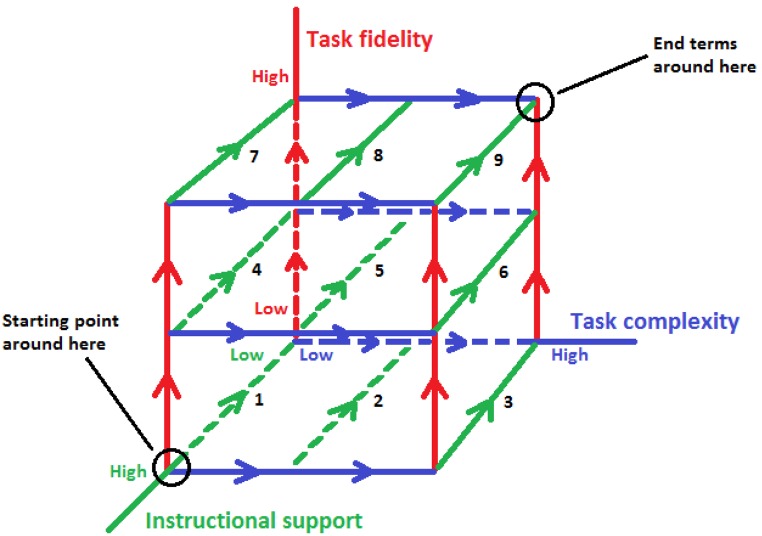
Cognitive Load Theory (CLT) has started to find more applications in medical education research. Unfortunately, misconceptions such as lower cognitive load always being beneficial to learning and the continued use of dated concepts and methods can result in improper applications of CLT principles in medical education design and research. This review outlines how CLT has evolved and presents a synthesis of current-day CLT principles in a holistic model for medical education design. This model distinguishes three dimensions: task fidelity: from literature (lowest) through simulated patients to real patients (highest); task complexity: the number of information elements; and instructional support: from worked examples (highest) through completion tasks to autonomous task performance (lowest). These three dimensions together constitute three steps to proficient learning: (I) start with high support on low-fidelity low-complexity tasks and gradually fade that support as learners become more proficient; (II) repeat I for low-fidelity but higher-complexity tasks; and (III) repeat I and II in that order at subsequent levels of fidelity. The numbers of fidelity levels and complexity levels within fidelity levels needed depend on the aims of the course, curriculum or individual learning trajectory. This paper concludes with suggestions for future research based on this model.
Overview
The claims and statistics of this paper haven’t been checked yet.
Run the check — free, no account needed. It reads the open-access text and checks the sources it cites.
Integrity signals
Registry
Cites
Statistics
Figures
Verification
Claims the paper makes
The claims and statistics of this paper haven’t been checked yet.
Run the check — free, no account needed. It reads the open-access text and checks the sources it cites.
Claims other papers make about this one
Each is checked against this paper’s own text: does it say what the citing paper says it does?
The source backs part of the claim, not all of it — or backs it for a different population, condition or comparison.
In the citing paper
“An assessment after the out-of-class instruction is an excellent way to evaluate student comprehension of a topic and facilitate the use of mastery learning techniques (22).”
From Applying learning theories and instructional design models for effective instruction (2016) · cites this paper as [22]
Experimental — accuracy not yet measured
Self-check
Percentages, sums and reported differences re-computed from the paper’s own numbers.
The self-check needs the paper’s full text.
Citations
Cites
Development of NASA-TLX (Task Load Index): Results of Empirical and Theoretical Research
(1988) · Advances in Psychology · doi:10.1016/s0166-4115(08)62386-9 · Cited by 15,003
(2011) · Cited by 14,317
Cognitive Load During Problem Solving: Effects on Learning
Sweller, J. (1988) · Cognitive Science · doi:10.1016/0364-0213(88)90023-7 · Cited by 11,048
The magical number 4 in short-term memory: A reconsideration of mental storage capacity
Cowan, N. (2001) · Behavioral and Brain Sciences · doi:10.1017/s0140525x01003922 · Cited by 6,779
Sweller, J., Ayres, P., & Kalyuga, S. (2011) · Elsevier eBooks · doi:10.1007/978-1-4419-1428-6_446 · Cited by 6,172
Cognitive Architecture and Instructional Design
Sweller, J., van Merrienboer, J. J. G., & Paas, F. G. W. C. (1998) · Educational Psychology Review · doi:10.1023/a:1022193728205 · Cited by 6,023
Cognitive load theory, learning difficulty, and instructional design
Sweller, J. (1994) · Learning and Instruction · doi:10.1016/0959-4752(94)90003-5 · Cited by 3,801 · cited 2×
“It goes without saying that the more working memory capacity is required for dealing with the way in which information is presented—a concept coined extraneous cognitive load [6]—the less working memory capacity remains for dealing with the intrinsic content of information—hereinafter referred to as intrinsic cognitiv…”
BackgroundCognitive Load Theory and the Format of Instruction
Chandler, P., & Sweller, J. (1991) · Cognition and Instruction · doi:10.1207/s1532690xci0804_2 · Cited by 2,894
Cognitive Load Measurement as a Means to Advance Cognitive Load Theory
Paas, F., Tuovinen, J. E., Tabbers, H., & Van Gerven, P. W. M. (2003) · Educational Psychologist · doi:10.1207/s15326985ep3801_8 · Cited by 2,527
Paas, F. G. W. C. (1992) · Journal of Educational Psychology · doi:10.1037/0022-0663.84.4.429 · Cited by 2,150
Element Interactivity and Intrinsic, Extraneous, and Germane Cognitive Load
Sweller, J. (2010) · Educational Psychology Review · doi:10.1007/s10648-010-9128-5 · Cited by 2,020
Kalyuga, S., Ayres, P., Chandler, P., & Sweller, J. (2003) · Educational Psychologist · doi:10.1207/s15326985ep3801_4 · Cited by 1,927
Cognitive load theory in health professional education: design principles and strategies
Van Merriënboer, J. J. G., & Sweller, J. (2010) · Medical Education · doi:10.1111/j.1365-2923.2009.03498.x · Cited by 1,511
Why Some Material Is Difficult to Learn
Sweller, J., & Chandler, P. (1994) · Cognition and Instruction · doi:10.1207/s1532690xci1203_1 · Cited by 1,455
The Use of Worked Examples as a Substitute for Problem Solving in Learning Algebra
Sweller, J., & Cooper, G. A. (1985) · Cognition and Instruction · doi:10.1207/s1532690xci0201_3 · Cited by 1,214
Paas, F. G. W. C., & Van Merriënboer, J. J. G. (1994) · Journal of Educational Psychology · doi:10.1037/0022-0663.86.1.122 · Cited by 1,198
Development of an instrument for measuring different types of cognitive load
Leppink, J., Paas, F., Van der Vleuten, C. P. M., Van Gog, T., & Van Merriënboer, J. J. G. (2013) · Behavior Research Methods · doi:10.3758/s13428-013-0334-1 · Cited by 1,066
Self-citationHancock, P. A., & Meshkati, N. (1988) · Cited by 954
Programmatic assessment: From assessment of learning to assessment for learning
Schuwirth, L. W. T., & Van der Vleuten, C. P. M. (2011) · Medical Teacher · doi:10.3109/0142159x.2011.565828 · Cited by 902
Using Electroencephalography to Measure Cognitive Load
Antonenko, P., PAAS, F. G. W. C., Grabner, R. H., & van Gog, T. (2010) · Educational Psychology Review · doi:10.1007/s10648-010-9130-y · Cited by 832
THE SPLIT‐ATTENTION EFFECT AS A FACTOR IN THE DESIGN OF INSTRUCTION
CHANDLER, P., & SWELLER, J. (1992) · British Journal of Educational Psychology · doi:10.1111/j.2044-8279.1992.tb01017.x · Cited by 767
Mental workload while driving: effects on visual search, discrimination, and decision making.
Recarte, M. A., & Nunes, L. (2003) · Journal of experimental psychology. Applied · doi:10.1037/1076-898x.9.2.119 · Cited by 757
Cognitive Load Theory: How Many Types of Load Does It Really Need?
Kalyuga, S. (2011) · Educational Psychology Review · doi:10.1007/s10648-010-9150-7 · Cited by 725
Cognitive load as a factor in the structuring of technical material.
Sweller, J., Chandler, P., Tierney, P., & Cooper, M. (1990) · Journal of Experimental Psychology: General · doi:10.1037/0096-3445.119.2.176 · Cited by 629
When two sensory modes are better than one.
Tindall-Ford, S., Chandler, P., & Sweller, J. (1997) · Journal of Experimental Psychology: Applied · doi:10.1037/1076-898x.3.4.257 · Cited by 559
DeLeeuw, K. E., & Mayer, R. E. (2008) · Journal of Educational Psychology · doi:10.1037/0022-0663.100.1.223 · Cited by 558
When problem solving is superior to studying worked examples.
Kalyuga, S., Chandler, P., Tuovinen, J., & Sweller, J. (2001) · Journal of Educational Psychology · doi:10.1037/0022-0663.93.3.579 · Cited by 548
Incorporating learner experience into the design of multimedia instruction.
Kalyuga, S., Chandler, P., & Sweller, J. (2000) · Journal of Educational Psychology · doi:10.1037/0022-0663.92.1.126 · Cited by 525
Effects of pairs of problems and examples on task performance and different types of cognitive load
Leppink, J., Paas, F., van Gog, T., van der Vleuten, C. P. M., & van Merriënboer, J. J. G. (2014) · Learning and Instruction · doi:10.1016/j.learninstruc.2013.12.001 · Cited by 520
Self-citationPhysiological workload reactions to increasing levels of task difficulty
VELTMAN, J. A., & GAILLARD, A. W. K. (1998) · Ergonomics · doi:10.1080/001401398186829 · Cited by 433
Cierniak, G., Scheiter, K., & Gerjets, P. (2009) · Computers in Human Behavior · doi:10.1016/j.chb.2008.12.020 · Cited by 412
International Handbook of Metacognition and Learning Technologies
Molenaar, I., van Boxtel, C., Sleegers, P. J. C., Azevedo, R., & Aleven, V. (2013) · Springer international handbooks of education · doi:10.1007/978-1-4419-5546-3 · Cited by 405
What is the relationship between mental workload factors and cognitive load types?
Galy, E., Cariou, M., & Mélan, C. (2012) · International Journal of Psychophysiology · doi:10.1016/j.ijpsycho.2011.09.023 · Cited by 395
Using subjective measures to detect variations of intrinsic cognitive load within problems
Ayres, P. (2006) · Learning and Instruction · doi:10.1016/j.learninstruc.2006.09.001 · Cited by 381
Assessment of Cognitive Load in Multimedia Learning Using Dual-Task Methodology
Brünken, R., Steinbacher, S., Plass, J. L., & Leutner, D. (2002) · Experimental Psychology (formerly Zeitschrift für Experimentelle Psychologie) · doi:10.1027//1618-3169.49.2.109 · Cited by 346
Emotion, cognitive load and learning outcomes during simulation training
Fraser, K. L., Ma, I. W. Y., Teteris, E., Baxter, H., Wright, B. J., & McLaughlin, K. (2012) · Medical Education · doi:10.1111/j.1365-2923.2012.04355.x · Cited by 341
Memory load and the cognitive pupillary response in aging
Van Gerven, P. W. M., Paas, F., Van Merriënboer, J. J. G., & Schmidt, H. G. (2004) · Psychophysiology · doi:10.1111/j.1469-8986.2003.00148.x · Cited by 292
(1992) · Applied Ergonomics · doi:10.1016/0003-6870(92)90229-o · Cited by 280
Brünken, R., Plass, J. L., & Leutner, D. (2004) · Instructional Science · doi:10.1023/b:truc.0000021812.96911.c5 · Cited by 277
Working memory span development: A time-based resource-sharing model account.
Barrouillet, P., Gavens, N., Vergauwe, E., Gaillard, V., & Camos, V. (2009) · Developmental Psychology · doi:10.1037/a0014615 · Cited by 242
Schmeck, A., Opfermann, M., van Gog, T., PAAS, F. G. W. C., & Leutner, D. (2014) · Instructional Science · doi:10.1007/s11251-014-9328-3 · Cited by 235
What do students learn while solving mathematics problems?
Owen, E., & Sweller, J. (1985) · Journal of Educational Psychology · doi:10.1037/0022-0663.77.3.272 · Cited by 206
Attention and automation: New perspectives on mental underload and performance
Young, M. S., & Stanton, N. A. (2002) · Theoretical Issues in Ergonomics Science · doi:10.1080/14639220210123789 · Cited by 194
Neuroimaging of cognitive load in instructional multimedia
Whelan, R. R. (2007) · Educational Research Review · doi:10.1016/j.edurev.2006.11.001 · Cited by 165
Patterson, F., Kerrin, M., Born, M. P., Oostrom, J. (., Prescott-Clements, L., Cleland, J., & Durning, S. J. (2015) · Wiley eBooks · doi:10.1002/9781118838983 · Cited by 163
Eysink, T. H. S., de Jong, T., Berthold, K., Kolloffel, B., Opfermann, M., & Wouters, P. (2009) · American Educational Research Journal · doi:10.3102/0002831209340235 · Cited by 158
Safety Aspects of CRT Touch Panel Controls in Automobiles
Zwahlen, H. T., Adams, C. C., & DeBals, D. P. (1988) · Medical Entomology and Zoology · Cited by 157
The influence of leads on cognitive load and learning in a hypertext environment
Antonenko, P. D., & Niederhauser, D. S. (2010) · Computers in Human Behavior · doi:10.1016/j.chb.2009.10.014 · Cited by 154
The Emotional and Cognitive Impact of Unexpected Simulated Patient Death
Fraser, K. L., Huffman, J., Ma, I. W. Y., Sobczak, M., McIlwrick, J., Wright, B. J., & McLaughlin, K. (2013) · CHEST Journal · doi:10.1378/chest.13-0987 · Cited by 153
Systematic Mathematical Errors and Cognitive Load
Ayres, P. (2001) · Contemporary Educational Psychology · doi:10.1006/ceps.2000.1051 · Cited by 143
Timing and Frequency of Mental Effort Measurement: Evidence in Favour of Repeated Measures
van Gog, T., Kirschner, F., Kester, L., & Paas, F. (2012) · Applied Cognitive Psychology · doi:10.1002/acp.2883 · Cited by 130
Yudkowsky, R., Otaki, J., Lowenstein, T., Riddle, J. M., Nishigori, H., & Bordage, G. (2009) · Medical Education · doi:10.1111/j.1365-2923.2009.03379.x · Cited by 116
Using cognitive theory to facilitate medical education
Qiao, Y. Q., Shen, J., Liang, X., Ding, S., Chen, F. Y., Shao, L., Zheng, Q., & Ran, Z. H. (2014) · BMC Medical Education · doi:10.1186/1472-6920-14-79 · Cited by 111
van Gog, T., & Jarodzka, H. M. (2013) · Springer international handbooks of education · doi:10.1007/978-1-4419-5546-3_10 · Cited by 105
Cognitive load theory: researching and planning teaching to maximise learning
Leppink, J., van Gog, T., PAAS, F. G. W. C., & Sweller, J. (2015) · Wiley eBooks · doi:10.1002/9781118838983.ch18 · Cited by 71
Self-citationInfluences of OSCE design on students’ diagnostic reasoning
Lafleur, A., Côté, L., & Leppink, J. (2015) · Medical Education · doi:10.1111/medu.12635 · Cited by 58
Self-citationData analysis in medical education research: a multilevel perspective
Leppink, J. (2015) · Perspectives on Medical Education · doi:10.1007/s40037-015-0160-5 · Cited by 53
Self-citationvan Merriënboer, J. J. G., Kirschner, P. A., & Frèrejean, J. (2024) · Routledge eBooks · doi:10.4324/9781003322481 · Cited by 33
Over the top: Are there exceptions to the basic capacity limit?
Wilding, J. P. H. (2001) · Behavioral and Brain Sciences · doi:10.1017/s0140525x01593929 · Cited by 17
On causality and mechanisms in medical education research: an example of path analysis
Leppink, J. (2015) · Perspectives on Medical Education · doi:10.1007/s40037-015-0174-z · Cited by 14
Self-citationManaging the load on a reader’s mind
Leppink, J. (2014) · Perspectives on Medical Education · doi:10.1007/s40037-014-0144-x · Cited by 4
Self-citation
Cited by
Sorted by citations
Skulmowski, A., & Xu, K. M. (2022) · Educational Psychology Review · doi:10.1007/s10648-021-09624-7 · Cited by 678
Longhurst, G. J., Stone, D. M., Dulohery, K., Scully, D. M., Campbell, T. J., & Smith, C. F. (2020) · Anatomical Sciences Education · doi:10.1002/ase.1967 · Cited by 538
Applying learning theories and instructional design models for effective instruction
Khalil, M. K., & Elkhider, I. A. (2016) · Advances in Physiology Education · doi:10.1152/advan.00138.2015 · Cited by 372
Effects of augmented reality on learning and cognitive load in university physics laboratory courses
Thees, M., Kapp, S., Strzys, M. P., Beil, F., Lukowicz, P., & Kühn, J. (2020) · Computers in Human Behavior · doi:10.1016/j.chb.2020.106316 · Cited by 414
Altmeyer, K., Kapp, S., Thees, M., Malone, S., Kühn, J., & Brünken, R. (2020) · British Journal of Educational Technology · doi:10.1111/bjet.12900 · Cited by 244
Metadata
- Authors
- Leppink, J., & Van den Heuvel, A.
- Affiliations
- Maastricht University (NL)
- Corresponding author
- Leppink, Jimmie
- ORCID
- Leppink, Jimmie
- Venue
- Perspectives on Medical Education
- Publisher
- Ubiquity Press, Ltd.
- Published
- 2015-05-28
- Volume
- 4
- Issue
- 3
- Pages
- 119-127
- ISSN
- 2212-2761 (ISSN-L)
- 2212-277X
- PMC
- PMC4456454
- OpenAlex
- W1499793228
- Cited by
- 299
- References
- 62
- Citations by year
- 2026: 40 · 2025: 28 · 2024: 20 · 2023: 29 · 2022: 35 · 2021: 35 · 2020: 31 · 2019: 28 · 2018: 21 · 2017: 13 · 2016: 17 · 2015: 2
- FWCI
- 18.95
- Type
- journal article
- Language
- en
- Open access
- diamond
- doi.org
- Licence
- Locations
- Perspectives on Medical Education (publishedVersion, cc-by)
- PubMed Central (publishedVersion, cc-by)
- PubMed (publishedVersion)
- Research Publications (Maastricht University) (publishedVersion, cc-by)
- DOAJ (DOAJ: Directory of Open Access Journals) (submittedVersion)
- Research Publications (Maastricht University) (submittedVersion, other-oa)
- Topics
- Social Sciences › Education › Innovations in Medical Education
- Social Sciences › Psychology › Experimental and Cognitive Psychology › Visual and Cognitive Learning Processes
- Health Sciences › Medicine › Family Practice › Clinical Reasoning and Diagnostic Skills
- Keywords
- cognitive load theory, medical education, instructional design, task complexity, pedagogical support, worked examples, standardized patients
About these checks
Registry, retraction, Cites and statistics results are computed, not judged, with one exception: a printed reference that no index lists is read once by a model before it counts as a citation error. Claims are extracted by a model and kept only when their quote appears verbatim in the text; each cited source is then checked, with a model’s help, for whether it says what the claim relies on. Those verdicts can be wrong — read the claim’s quote and the cited source before relying on one.
Statistics and arithmetic are recomputed, not judged.
Confidence bands are shown only for fields calibrated on our annotated test set. None is calibrated yet, so no band is shown.
What counts as a claim ›How we measure confidence ›How we check this ›
Are you an author, or do you see a problem with this page? Request a review
