

Efficacy and Safety of Esketamine Nasal Spray in Patients with Treatment-Resistant Depression Who Completed a Second Induction Period: Analysis of the Ongoing SUSTAIN-3 Study
Open accessThe DOI matches its Crossref record; 22 of the 22 references it cites were found in a registry or an index.
Abstract
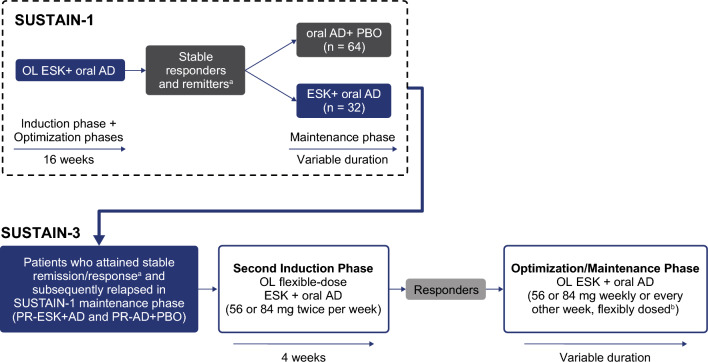
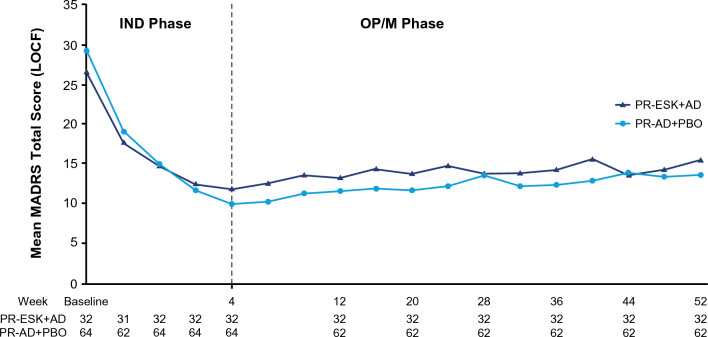
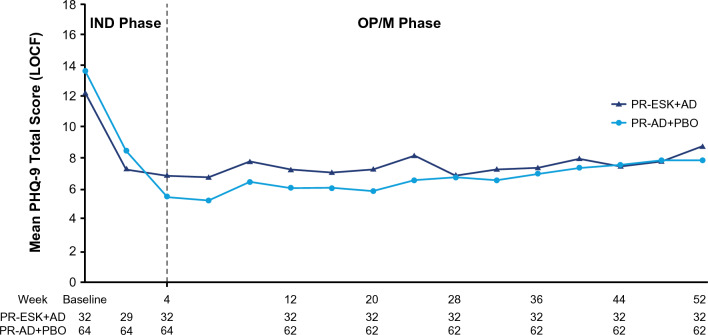
BACKGROUND: Treatment-resistant depression (TRD) is a chronic illness requiring long-term treatment. Esketamine nasal spray (ESK) has been studied in several long-term trials of patients with TRD, including SUSTAIN-1 (NCT02493868) and SUSTAIN-3 (NCT02782104). This subgroup analysis of SUSTAIN-3 evaluated patients with TRD who received a second induction (IND) and maintenance treatment with ESK plus oral antidepressant (AD) after a relapse in SUSTAIN-1. METHODS: Patients aged 18-64 years who achieved stable remission or response with ESK and subsequently relapsed after randomization to continue ESK or switch to placebo nasal spray (PBO) in SUSTAIN-1 and entered the IND phase of SUSTAIN-3 were included in this interim analysis. Response (≥50% improvement in total score from baseline for Montgomery-Åsberg Depression Rating Scale [MADRS] and Patient Health Questionnaire 9-item [PHQ-9]), remission (MADRS score ≤12; PHQ-9 total score <5), changes in depression rating scores (measured as mean change from baseline), and safety were evaluated (incidence of treatment-emergent and serious adverse events [AE]). RESULTS: Of the 96 eligible patients who entered IND in SUSTAIN-3, 32 (33.3%) were taking ESK+AD at the time of relapse in SUSTAIN-1 and 64 (66.7%) were taking AD+PBO. Substantial improvements in depressive symptoms were observed over the second IND phase in both groups and were maintained over the optimization/maintenance (OP/M) phase. MADRS response rates following a second IND were 71.9% and 73.4% for previously relapsed (PR) ESK+AD and PR-AD+PBO, respectively; remission rates were 62.5% and 60.9%, respectively. During the IND and OP/M phases, 58.3% and 83.3% of patients experienced a treatment-emergent AE, respectively. No patients discontinued due to an AE during the second IND. CONCLUSIONS: Patients with TRD benefitted from receiving a second IND and maintenance treatment with ESK and no new safety signals were identified.
Overview
The claims and statistics of this paper haven’t been checked yet.
Free: it reads the open-access text and checks the first 5 claims that cite a source we can check. Create a free account to check every claim.
Integrity signals
Registry
Cites
Statistics
Figures
Verification
Claims the paper makes
The claims and statistics of this paper haven’t been checked yet.
Free: it reads the open-access text and checks the first 5 claims that cite a source we can check. Create a free account to check every claim.
Claims other papers make about this one
Each is checked against this paper’s own text: does it say what the citing paper says it does?
The source backs part of the claim, not all of it — or backs it for a different population, condition or comparison.
In the citing paper
“ketamine and esketamine, both of which have demonstrated the ability to induce fast-acting antidepressant effects [13,16,17].”
From Variations in BDNF and Their Role in the Neurotrophic Antidepressant Mechanisms of Ketamine and Esketamine: A Review (2024) · cites this paper as [16]
Experimental — accuracy not yet measured
Self-check
Percentages, sums and reported differences re-computed from the paper’s own numbers.
The self-check needs the paper’s full text.
Citations
Cites
Spitzer, R. L. (1999) · JAMA · doi:10.1001/jama.282.18.1737 · Cited by 9,802
The National Committee for Quality Assurance
Iglehart, J. K. (1996) · New England Journal of Medicine · doi:10.1056/nejm199609263351322 · Cited by 1,824
Risk for recurrence in depression
Burcusa, S. L., & Iacono, W. G. (2007) · Clinical Psychology Review · doi:10.1016/j.cpr.2007.02.005 · Cited by 1,023 · cited 13×
“This subgroup analysis found that ESK was generally well tolerated and patients with TRD who previously responded to ESK and experienced a relapse benefited from receiving AD antidepressant, IND induction, LOCF last observation carried forward, MADRS Montgomery-Åsberg Depression Rating Scale, OP/M optimization/mainten…”
BackgroundInfluentialTreatment-resistant depression: therapeutic trends, challenges, and future directions
Al-harbi (2012) · Patient Preference and Adherence · doi:10.2147/ppa.s29716 · Cited by 796
Daly, E. J., Trivedi, M. H., Janik, A., Li, H., Zhang, Y., Li, X., Lane, R., Lim, P., Duca, A. R., Hough, D., et al. (2019) · JAMA Psychiatry · doi:10.1001/jamapsychiatry.2019.1189 · Cited by 795
Zhdanava, M., Pilon, D., Ghelerter, I., Chow, W., Joshi, K., Lefebvre, P., & Sheehan, J. J. (2021) · The Journal of Clinical Psychiatry · doi:10.4088/jcp.20m13699 · Cited by 523 · cited 1×
“9%) who exhibit treatment-resistant symptoms [1].”
Williams, J. B. W., & Kobak, K. A. (2008) · British Journal of Psychiatry · doi:10.1192/bjp.bp.106.032532 · Cited by 463
Management of Treatment-Resistant Depression: Challenges and Strategies
Voineskos, D., Daskalakis, Z. J., & Blumberger, D. M. (2020) · Neuropsychiatric Disease and Treatment · doi:10.2147/ndt.s198774 · Cited by 446 · cited 1×
“Individuals with treatment-resistant depression (TRD) often experience prolonged depressive episodes, which can lead to treatment discontinuation prior to reaching recovery [2].”
BackgroundWajs, E., Aluisio, L., Holder, R., Daly, E. J., Lane, R., Lim, P., George, J. E., Morrison, R. L., Sanacora, G., Young, A. H., et al. (2020) · The Journal of Clinical Psychiatry · doi:10.4088/jcp.19m12891 · Cited by 308 · cited 1×
“A recent study found that a subset of patients ≥65 years of age, who were nonresponders to ESK treatment after completing the double-blind induction (IND) phase of a randomized 4-week efficacy study and subsequently entered the IND phase of an open-label, long-term, safety and efficacy study of ESK (SUSTAIN-2), receiv…”
BackgroundSelf-citationResponse and remission criteria in major depression – A validation of current practice
Riedel, M., Möller, H.-J., Obermeier, M., Schennach-Wolff, R., Bauer, M., Adli, M., Kronmüller, K., Nickel, T., Brieger, P., Laux, G., et al. (2010) · Journal of Psychiatric Research · doi:10.1016/j.jpsychires.2010.03.006 · Cited by 288
Kennedy, S. H., Andersen, H. F., & Lam, R. W. (2006) · Journal of Psychiatry and Neuroscience · doi:10.1139/jpn.0615 · Cited by 216 · cited 1×
“For MADRS, response was defined as ≥50% improvement in total score from baseline, and remission was defined as a score ≤12 [19, 20].”
MethodMartinotti, G., Vita, A., Fagiolini, A., Maina, G., Bertolino, A., Dell'Osso, B., Siracusano, A., Clerici, M., Bellomo, A., Sani, G., et al. (2022) · Journal of Affective Disorders · doi:10.1016/j.jad.2022.09.043 · Cited by 146
Zaki, N., Chen, L., Lane, R., Doherty, T., Drevets, W. C., Morrison, R. L., Sanacora, G., Wilkinson, S. T., Popova, V., & Fu, D.-J. (2023) · Neuropsychopharmacology · doi:10.1038/s41386-023-01577-5 · Cited by 137
Self-citationMontgomery, S. A., & Möller, H.-J. (2009) · International Clinical Psychopharmacology · doi:10.1097/yic.0b013e32832a8eb2 · Cited by 121 · cited 1×
“For MADRS, response was defined as ≥50% improvement in total score from baseline, and remission was defined as a score ≤12 [19, 20].”
MethodDefining Success in Measurement-Based Care for Depression: A Comparison of Common Metrics
Coley, R. Y., Boggs, J. M., Beck, A., Hartzler, A. L., & Simon, G. E. (2020) · Psychiatric Services · doi:10.1176/appi.ps.201900295 · Cited by 87
Alam, M. Y., Jacobsen, P. L., Chen, Y., Serenko, M., & Mahableshwarkar, A. R. (2014) · International Clinical Psychopharmacology · doi:10.1097/yic.0000000000000010 · Cited by 75 · cited 1×
“2%) patients discontinued treatment early for a variety of reasons [25].”
BackgroundDefinition of Treatment-Resistant Depression in the Medicare Population
Bradley N. Gaynes, M. D., Gary Asher, M. D., Gerald Gartlehner, M. D., Valerie Hoffman, P. D., Josh Green, B. A., Erin Boland, M. S. P. H., Linda Lux, M. P. A., Charlotte Randolph, B. A., Carla Bann, P. D., Emmanuel Cokker-Schwimmer, M. P. H., et al. (2018) · Systematic Review Data Repository · doi:10.26300/4j7h-jk02 · Cited by 58
Takahashi, N., Yamada, A., Shiraishi, A., Shimizu, H., Goto, R., & Tominaga, Y. (2021) · BMC Psychiatry · doi:10.1186/s12888-021-03538-y · Cited by 57 · cited 1×
“Esketamine nasal spray (ESK) is a noncompetitive N-methyl-d-aspartate (NMDA) receptor antagonist approved by the United States Food and Drug Administration, as well as health authorities in other countries, in conjunction with an oral AD, for the treatment of TRD in adults and for the treatment of depressive symptoms…”
BackgroundTowards achieving remission in the treatment of depression
Mendlewicz, J. (2008) · Dialogues in Clinical Neuroscience · doi:10.31887/dcns.2008.10.4/jmendlewicz · Cited by 52 · cited 1×
“Response and remission are commonly used outcome criteria for the treatment of depression with the goal of achieving remission because these outcomes can be predictors of long-term stability [5, 7].”
Brendle, M., Ahuja, S., Valle, M. D., Moore, C., Thielking, P. D., Malone, D. C., & Robison, R. J. (2022) · Journal of Comparative Effectiveness Research · doi:10.2217/cer-2022-0149 · Cited by 47 · cited 12×
“This subgroup analysis found that ESK was generally well tolerated and patients with TRD who previously responded to ESK and experienced a relapse benefited from receiving AD antidepressant, IND induction, LOCF last observation carried forward, MADRS Montgomery-Åsberg Depression Rating Scale, OP/M optimization/mainten…”
BackgroundInfluentialSchueller, S. M., Kwasny, M. J., Dear, B. F., Titov, N., & Mohr, D. C. (2015) · General Hospital Psychiatry · doi:10.1016/j.genhosppsych.2015.05.009 · Cited by 22
Identifying Remission From Depression on 3 Self-Report Scales
Zimmerman, M., Walsh, E. K., Friedman, M. A., Boerescu, D. A., & Attiullah, N. (2017) · The Journal of Clinical Psychiatry · doi:10.4088/jcp.16m10641 · Cited by 16
Cited by
Pardossi, S., Fagiolini, A., & Cuomo, A. (2024) · International Journal of Molecular Sciences · doi:10.3390/ijms252313098 · Cited by 51
“However, the need for treatments that provide more rapid relief has focused attention on ketamine and esketamine, both of which have demonstrated the ability to induce fast-acting antidepressant effects [13,16,17].”
Esketamine in depression: putative biomarkers from clinical research
Johnston, J. N., Zarate, C. A., & Kvarta, M. D. (2024) · European Archives of Psychiatry and Clinical Neuroscience · doi:10.1007/s00406-024-01865-1 · Cited by 24
“In addition, a SUSTAIN-3 subgroup analysis in those who experienced a second induction and maintenance period after relapse found remission rates around 61% throughout the second optimization/maintenance period, suggesting that potential benefits are associated with a second induction period [76].”
Esketamine Nasal Spray: Rapid Relief for TRD and Suicide Prevention—Mechanisms and Pharmacodynamics
Song, H., Luo, Y., & Fang, L. (2024) · Neuropsychiatric Disease and Treatment · doi:10.2147/ndt.s486118 · Cited by 21
“11,12 14 The disinhibition hypothesis suggests that ketamine selectively targets NMDARs on GABAergic interneurons, releasing glutamate and disinhibiting pyramidal cells via AMPA receptor activation.”
BackgroundKetamine and Esketamine for Depression in Daily Practice: Opportunities and Challenges
Singh, B. (2024) · Journal of Clinical Psychopharmacology · doi:10.1097/jcp.0000000000001898 · Cited by 20
McIntyre, R. S., Mansur, R. B., Rosenblat, J. D., Teopiz, K. M., & Kwan, A. T. H. (2024) · Expert Opinion on Drug Safety · doi:10.1080/14740338.2024.2368827 · Cited by 16
“The long-term safety and efficacy of esketa-mine has also been documented [6,7].”
Metadata
- Authors
- Castro, M., Wilkinson, S. T., Al Jurdi, R. K., Petrillo, M. P., Zaki, N., Borentain, S., Fu, D. J., Turkoz, I., Sun, L., Brown, B., & Cabrera, P.
- Affiliations
- Janssen Scientific Affairs (United States) (US)
- Yale University (US)
- Cytel (United States) (US)
- Corresponding author
- Castro, Meredith
- ORCID
- Venue
- CNS Drugs
- Published
- 2023-08
- Volume
- 37
- Issue
- 8
- Pages
- 715-723
- ISSN
- 1172-7047 (ISSN-L)
- 1179-1934
- PMC
- PMC10439056
- OpenAlex
- W4385694402
- Cited by
- 25
- References
- 22
- Citations by year
- 2026: 5 · 2025: 8 · 2024: 11 · 2023: 1
- FWCI
- 3.88
- Type
- journal article
- Language
- en
- Open access
- hybrid
- doi.org
- Licence
- cc-by-nc
- creativecommons.org/licenses/by-nc/4.0 (tdm)
- creativecommons.org/licenses/by-nc/4.0 (vor, 8 d)
- Locations
- CNS Drugs (publishedVersion, cc-by-nc)
- PubMed Central (publishedVersion, cc-by-nc)
- PubMed (publishedVersion)
- Funders
- Janssen Scientific Affairs, LLC
- Topics
- Health Sciences › Medicine › Pharmacology (medical) › Treatment of Major Depression
- Health Sciences › Medicine › Psychiatry and Mental health › Electroconvulsive Therapy Studies
- Life Sciences › Neuroscience › Biological Psychiatry › Tryptophan and brain disorders
- Keywords
- esketamine nasal spray, treatment-resistant depression, relapse, maintenance therapy, oral antidepressant, long-term treatment, remission, treatment-emergent adverse events, ketamine, antidepressant efficacy and safety, Montgomery-Asberg Depression Rating Scale, PHQ-9, NMDA receptor antagonists
- MeSH terms
- Adolescent, Adult, Antidepressive Agents, Clinical Trials as Topic, Humans, Ketamine, Middle Aged, Treatment Outcome, Young Adult, Nasal Sprays, Depressive Disorder, Treatment-Resistant
About these checks
Registry, retraction, Cites and statistics results are computed, not judged, with one exception: a printed reference that no index lists is read once by a model before it counts as a citation error. Claims are extracted by a model and kept only when their quote appears verbatim in the text; each cited source is then checked, with a model’s help, for whether it says what the claim relies on. Those verdicts can be wrong — read the claim’s quote and the cited source before relying on one.
Statistics and arithmetic are recomputed, not judged.
Confidence bands are shown only for fields calibrated on our annotated test set. None is calibrated yet, so no band is shown.
What counts as a claim ›How we measure confidence ›How we check this ›
Are you an author, or do you see a problem with this page? Request a review
Data sources
Bibliographic data: Semantic Scholar, OpenAlex, Crossref.
Contains information from the Semantic Scholar Academic Graph Datasets, made available under the ODC Attribution License (ODC-BY 1.0).
Semantic Scholar’s data is described in: Kinney, R., et al. (2023). The Semantic Scholar Open Data Platform. arXiv:2301.10140.
