

The DOI matches its Crossref record; 17 of the 17 references it cites were found in a registry or an index.
Efficacy and Safety of RBX2660 in PUNCH CD3, a Phase III, Randomized, Double-Blind, Placebo-Controlled Trial with a Bayesian Primary Analysis for the Prevention of Recurrent Clostridioides difficile Infection
Open accessAbstract
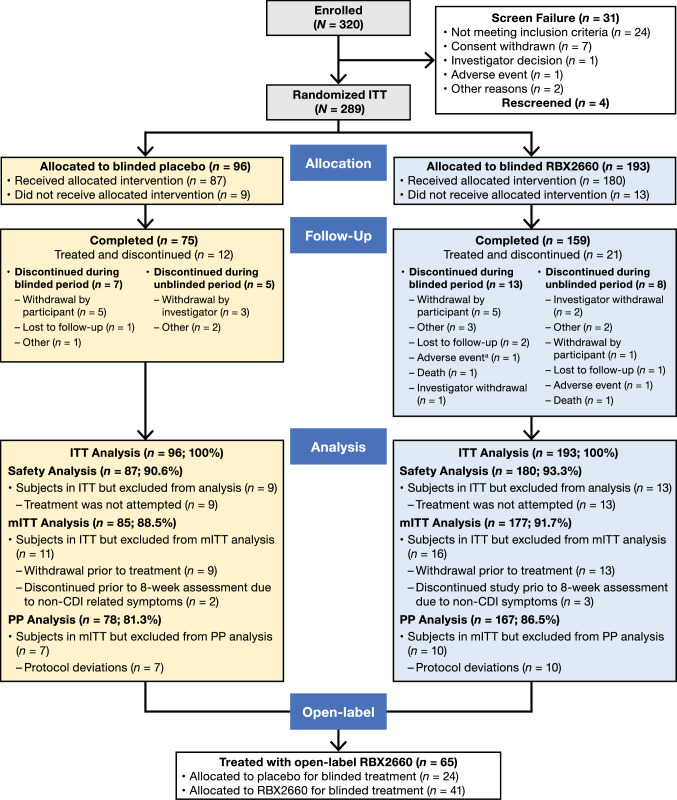
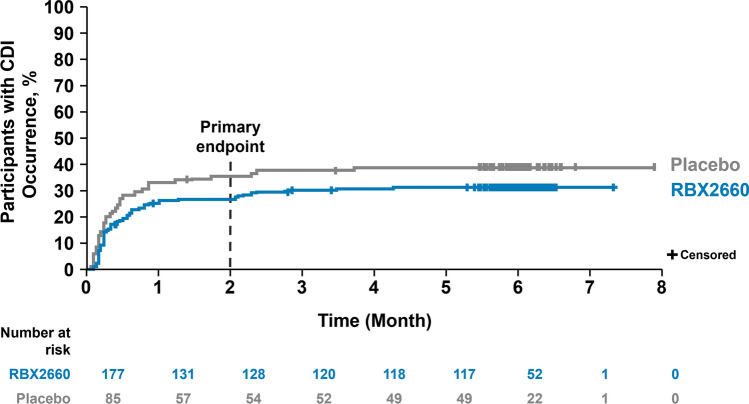
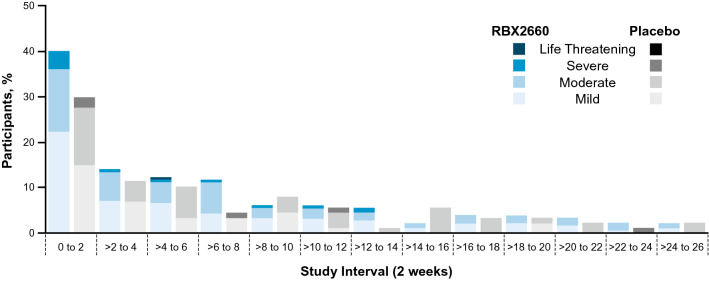
Recurrent Clostridioides difficile infection, associated with dysbiosis of gut microbiota, has substantial disease burden in the USA. RBX2660 is a live biotherapeutic product consisting of a broad consortium of microbes prepared from human stool that is under investigation for the reduction of recurrent C. difficile infection. A randomized, double-blind, placebo-controlled, phase III study, with a Bayesian primary analysis integrating data from a previous phase IIb study, was conducted. Adults who had one or more C. difficile infection recurrences with a positive stool assay for C. difficile and who were previously treated with standard-of-care antibiotics were randomly assigned 2:1 to receive a subsequent blinded, single-dose enema of RBX2660 or placebo. The primary endpoint was treatment success, defined as the absence of C. difficile infection diarrhea within 8 weeks of study treatment. Of the 320 patients screened, 289 were randomly assigned and 267 received blinded treatment (n = 180, RBX2660; n = 87, placebo). Original model estimates of treatment success were 70.4% versus 58.1% with RBX2660 and placebo, respectively. However, after aligning the data to improve the exchangeability and interpretability of the Bayesian analysis, the model-estimated treatment success rate was 70.6% with RBX2660 versus 57.5% with placebo, with an estimated treatment effect of 13.1% and a posterior probability of superiority of 0.991. More than 90% of the participants who achieved treatment success at 8 weeks had sustained response through 6 months in both the RBX2660 and the placebo groups. Overall, RBX2660 was well tolerated, with manageable adverse events. The incidence of treatment-emergent adverse events was higher in RBX2660 recipients compared with placebo and was mostly driven by a higher incidence of mild gastrointestinal events. RBX2660 is a safe and effective treatment to reduce recurrent C. difficile infection following standard-of-care antibiotics with a sustained response through 6 months. NCT03244644; 9 August, 2017. Clostridioides difficile is a diarrhea-causing bacterium that is associated with potentially serious and fatal consequences. Antibiotics used to treat or prevent infections have a side effect of damaging the healthy protective gut bacteria (microbiota). Damage to the gut microbiota can allow C. difficile to over-grow and produce toxins that injure the colon. Paradoxically, the standard of care treatment of C. difficile infection (CDI) is antibiotics. Although initially effective for the control of diarrhea, antibiotics can leave a patient at risk for CDI recurrence after antibiotic treatment is stopped. Live biotherapeutic products are microbiota-based treatments used to repair the gut microbiota. These products have been shown to reduce the recurrence of CDI. RBX2660 is an investigational microbiota-based live biotherapeutic. RBX2660 contains a diverse set of microorganisms. RBX2660 has been developed to reduce CDI recurrence in adults following antibiotic treatment for recurrent CDI. This study was conducted to demonstrate that RBX2660 is effective and safe in treating patients with recurrent CDI. Treatment was considered successful in participants who did not experience CDI recurrence within 8 weeks after administration. Overall, statistical modeling demonstrated that 70.6% of participants treated with RBX2660 and 57.5% of participants treated with placebo remained free of CDI recurrence through 8 weeks. A 13.1 percentage point increase in treatment success was observed with RBX2660 treatment compared with placebo. In participants who achieved treatment success at 8 weeks, more than 90% remained free of CDI recurrence through 6 months. The most common side effects with RBX2660 treatment were abdominal pain and diarrhea. No serious treatment-related side effects were reported. The current data from the comprehensive clinical development program support a positive benefit-risk profile for RBX2660 in the reduction of CDI recurrence in adults following antibiotic therapy for recurrent CDI.
Overview
The claims and statistics of this paper haven’t been checked yet.
Run the check — free, no account needed. It reads the open-access text and checks the sources it cites.
Integrity signals
Registry
Cites
Statistics
Figures
Verification
Claims the paper makes
The claims and statistics of this paper haven’t been checked yet.
Run the check — free, no account needed. It reads the open-access text and checks the sources it cites.
Claims other papers make about this one
Each is checked against this paper’s own text: does it say what the citing paper says it does?
In the citing paper
“Notably, FMT has achieved a significant milestone following the recent FDA approval of RBX2660 (Rebyota) and SER-109 (Vowst) for the prevention of recurrent Clostridioides difficile infection, highlighting the therapeutic potential of FMT in human disease.729–731”
From Microbiota–gut–brain axis and its therapeutic applications in neurodegenerative diseases (2024) · cites this paper as [730]
Self-check
Percentages, sums and reported differences re-computed from the paper’s own numbers.
The self-check needs the paper’s full text.
Citations
Cites
McDonald, L. C., Gerding, D. N., Johnson, S., Bakken, J. S., Carroll, K. C., Coffin, S. E., Dubberke, E. R., Garey, K. W., Gould, C. V., Kelly, C., et al. (2018) · Clinical Infectious Diseases · doi:10.1093/cid/cix1085 · Cited by 2,690
Drug-Resistant E. coli Bacteremia Transmitted by Fecal Microbiota Transplant
DeFilipp, Z., Bloom, P. P., Torres Soto, M., Mansour, M. K., Sater, M. R. A., Huntley, M. H., Turbett, S., Chung, R. T., Chen, Y.-B., & Hohmann, E. L. (2019) · New England Journal of Medicine · doi:10.1056/nejmoa1910437 · Cited by 1,281 · cited 1×
“In 2019, two immunocompromised adults developed serious infections after receiving FMT prepared with stool from the same donor containing a causative pathogen; one died [18].”
BackgroundTreating Clostridium difficile infection with fecal microbiota transplantation
Bakken, J. S., Borody, T., Brandt, L. J., Brill, J. V., Demarco, D. C., Franzos, M. A., Kelly, C., Khoruts, A., Louie, T., Martinelli, L. P., et al. (2011) · Clinical Gastroenterology and Hepatology · doi:10.1016/j.cgh.2011.08.014 · Cited by 1,003
Self-citationTrends in U.S. Burden of Clostridioides difficile Infection and Outcomes
Guh, A. Y., Mu, Y., Winston, L. G., Johnston, H. L., Olson, D. M., Farley, M. M., Wilson, L. E., Holzbauer, S., Phipps, E. C., Dumyati, G. K., et al. (2020) · New England Journal of Medicine · doi:10.1056/nejmoa1910215 · Cited by 874 · cited 2×
“Clinical guidelines recommend a two-step or three-step testing algorithm to diagnose CDI [5, 6], but clinical practice relies on symptoms and available testing, most frequently PCR in the USA [14].”
MethodJohnson, S., Lavergne, V., Skinner, A. M., Gonzales-Luna, A. J., Garey, K. W., Kelly, C. P., & Wilcox, M. H. (2021) · Clinical Infectious Diseases · doi:10.1093/cid/ciab549 · Cited by 696 · cited 1×
“Clinical guidelines recommend a two-step or three-step testing algorithm to diagnose CDI [5, 6], but clinical practice relies on symptoms and available testing, most frequently PCR in the USA [14].”
ACG Clinical Guidelines: Prevention, Diagnosis, and Treatment of Clostridioides difficile Infections
Kelly, C. R., Fischer, M., Allegretti, J. R., LaPlante, K. L., Stewart, D. B., Limketkai, B. N., & Stollman, N. (2021) · The American Journal of Gastroenterology · doi:10.14309/ajg.0000000000001278 · Cited by 638 · cited 1×
“Clinical guidelines recommend a two-step or three-step testing algorithm to diagnose CDI [5, 6], but clinical practice relies on symptoms and available testing, most frequently PCR in the USA [14].”
SER-109, an Oral Microbiome Therapy for Recurrent Clostridioides difficile Infection
Feuerstadt, P., Louie, T. J., Lashner, B., Wang, E. E. L., Diao, L., Bryant, J. A., Sims, M., Kraft, C. S., Cohen, S. H., Berenson, C. S., et al. (2022) · New England Journal of Medicine · doi:10.1056/nejmoa2106516 · Cited by 558 · cited 6×
“While several laboratory tests are available (e.g., PCR, glutamate dehydrogenase with EIA for toxin A/B, EIA for toxin A/B), no single test can reliably diagnose the disease in the absence of clinical symptoms.”
MethodInfluentialSelf-citationOrenstein, R., Dubberke, E., Hardi, R., Ray, A., Mullane, K., Pardi, D. S., & Ramesh, M. S. (2016) · Clinical Infectious Diseases · doi:10.1093/cid/civ938 · Cited by 197
Adverse events in faecal microbiota transplant: a review of the literature
Baxter, M., & Colville, A. (2015) · Journal of Hospital Infection · doi:10.1016/j.jhin.2015.10.024 · Cited by 188
Tariq, R., Pardi, D. S., Bartlett, M. G., & Khanna, S. (2018) · Clinical Infectious Diseases · doi:10.1093/cid/ciy721 · Cited by 180
Self-citation
Cited by
Sorted by citations
Items 301–301 of 301
A translational-readiness framework for natural and engineered probiotics
Hribernik, N., Maan, H., & Povolotsky, T. L. (2026) · Frontiers in Cellular and Infection Microbiology · doi:10.3389/fcimb.2026.1965075
Metadata
- Authors
- Khanna, S., Assi, M., Lee, C., Yoho, D., Louie, T., Knapple, W., Aguilar, H., Garcia-Diaz, J., Wang, G. P., Berry, S. M., Marion, J., Su, X., Braun, T., Bancke, L., & Feuerstadt, P.
- Affiliations
- Mayo Clinic (US)
- University of Kansas (US)
- University of Victoria (CA)
- Kaiser Permanente (US)
- University of Calgary (CA)
- University of Florida (US)
- Berry Consultants, LLC (United States) (US)
- Yale University (US)
- Corresponding author
- Khanna, Sahil
- ORCID
- Venue
- Drugs
- Published
- 2022-10
- Volume
- 82
- Issue
- 15
- Pages
- 1527-1538
- ISSN
- 0012-6667 (ISSN-L)
- 1179-1950
- PMC
- PMC9607700
- OpenAlex
- W4307250618
- Cited by
- 301
- References
- 17
- Citations by year
- 2026: 71 · 2025: 76 · 2024: 85 · 2023: 64 · 2022: 5
- FWCI
- 28.11
- Type
- journal article
- Language
- en
- Update notices
- correction (2022-11-07)
- Open access
- hybrid
- doi.org
- Licence
- Locations
- Drugs (publishedVersion, cc-by-nc)
- PubMed Central (publishedVersion, cc-by-nc)
- PubMed (publishedVersion)
- Figshare (submittedVersion, cc-by-nc)
- Figshare
- Funders
- Rebiotix Inc., a Ferring Company
- Topics
- Health Sciences › Medicine › Infectious Diseases › Clostridium difficile and Clostridium perfringens research
- Life Sciences › Biochemistry, Genetics and Molecular Biology › Molecular Biology › Gut microbiota and health
- Life Sciences › Agricultural and Biological Sciences › Food Science › Probiotics and Fermented Foods
- Keywords
- recurrent Clostridium difficile infection, RBX2660, live biotherapeutic products, recurrent infection prevention, fecal microbiota transplantation, enema, gut dysbiosis, treatment success, adverse events, antibiotic-associated diarrhea, treatment-emergent adverse events, sustained response, exchangeability, posterior probability
- MeSH terms
- Fecal Microbiota Transplantation, Adult, Anti-Bacterial Agents, Bayes Theorem, Clostridium Infections, Diarrhea, Humans, Recurrence, Clostridioides difficile, Treatment Outcome
About these checks
Registry, retraction, Cites and statistics results are computed, not judged, with one exception: a printed reference that no index lists is read once by a model before it counts as a citation error. Claims are extracted by a model and kept only when their quote appears verbatim in the text; each cited source is then checked, with a model’s help, for whether it says what the claim relies on. Those verdicts can be wrong — read the claim’s quote and the cited source before relying on one.
Statistics and arithmetic are recomputed, not judged.
Confidence bands are shown only for fields calibrated on our annotated test set. None is calibrated yet, so no band is shown.
What counts as a claim ›How we measure confidence ›How we check this ›
Are you an author, or do you see a problem with this page? Request a review
