

Resistance Training Induces Improvements in Range of Motion: A Systematic Review and Meta-Analysis
Open accessThe DOI matches its Crossref record; 107 of the 111 references it cites were found in a registry or an index, and 1 are not checked yet; 18 of the 60 sources its claims cite were checked for support.
Abstract
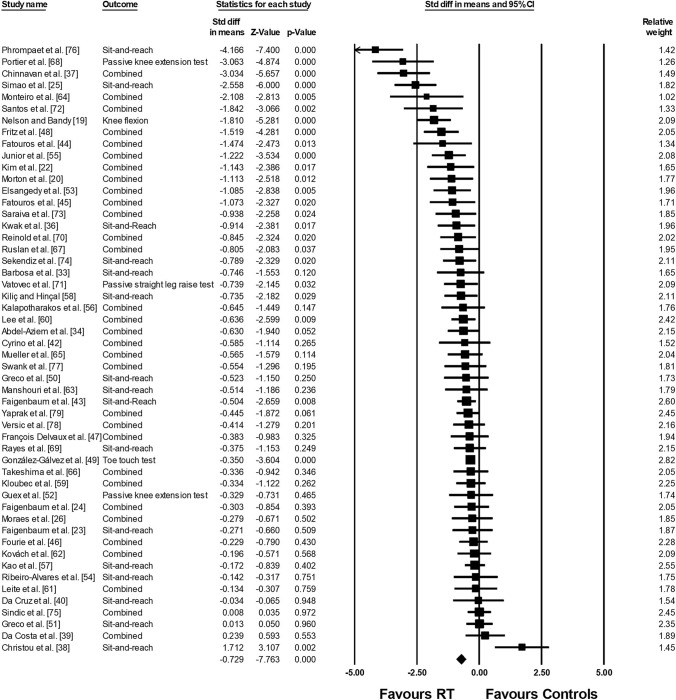
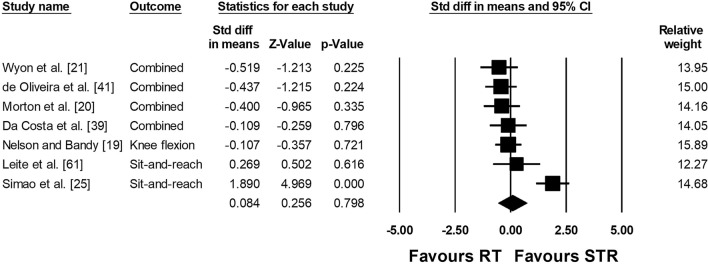
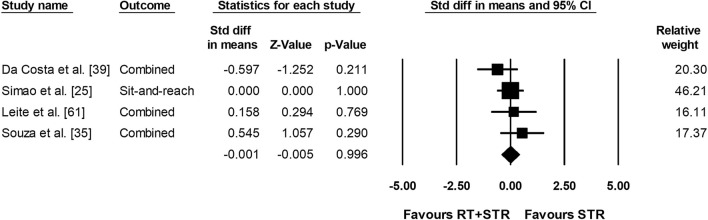
Background: Although it is known that resistance training can be as effective as stretch training to increase joint range of motion, to date no comprehensive meta-analysis has investigated the effects of resistance training on range of motion with all its potential affecting variables. Objective: The objective of this systematic review with meta-analysis was to evaluate the effect of chronic resistance training on range of motion compared either to a control condition or stretch training or to a combination of resistance training and stretch training to stretch training, while assessing moderating variables. Design: For the main analysis, a random-effect meta-analysis was used and for the subgroup analysis a mixed-effect model was implemented. Whilst subgroup analyses included sex and participants’ activity levels, meta-regression included age, frequency, and duration of resistance training. Data Sources: Following the systematic search in four databases (PubMed, Scopus, SPORTDiscus, and Web of Science) and reference lists, 55 studies were found to be eligible. Eligibility Criteria: Controlled or randomized controlled trials that separately compared the training effects of resistance training exercises with either a control group, stretching group, or combined stretch and resistance training group on range of motion in healthy participants. Results: Resistance training increased range of motion (effect size [ES] = 0.73; p < 0.001) with the exception of no significant range of motion improvement with resistance training using only body mass. There were no significant differences between resistance training versus stretch training (ES = 0.08; p = 0.79) or between resistance training and stretch training versus stretch training alone (ES = − 0.001; p = 0.99). Although “trained or active people” increased range of motion (ES = 0.43; p < 0.001) “untrained and sedentary” individuals had significantly ( p = 0.005) higher magnitude range of motion changes (ES = 1.042; p < 0.001). There were no detected differences between sex and contraction type. Meta-regression showed no effect of age, training duration, or frequency. Conclusions: As resistance training with external loads can improve range of motion, stretching prior to or after resistance training may not be necessary to enhance flexibility.
Verified 2026-11-22 · 1 reference not checked yet
Overview
CoChat Summary
TL;DR
This systematic review and meta-analysis of 55 studies found that chronic resistance training with external loads improves joint range of motion to a moderate degree (ES = 0.73, p < 0.001), with no significant difference from stretch training. Additional stretching before or after resistance training may not be necessary to enhance flexibility, though stretch training remains useful for warm-ups and other purposes.
Key findings
- Resistance training increased range of motion (ES = 0.73; p < 0.001), except resistance training using only body mass, which showed no significant improvement (p = 0.11; based on 4 effect sizes).
- There were no significant differences between resistance training and stretch training (ES = 0.08; p = 0.79) or between resistance training plus stretch training versus stretch training alone (ES = −0.001; p = 0.99).
- “Untrained and sedentary” individuals had significantly greater range-of-motion changes (ES = 1.042; p < 0.001) than “trained or active” individuals (ES = 0.43; p < 0.001; between-group p = 0.005).
- No significant differences were detected for sex, contraction type, or joint tested; meta-regression showed no effect of age, training duration, or frequency.
Methods
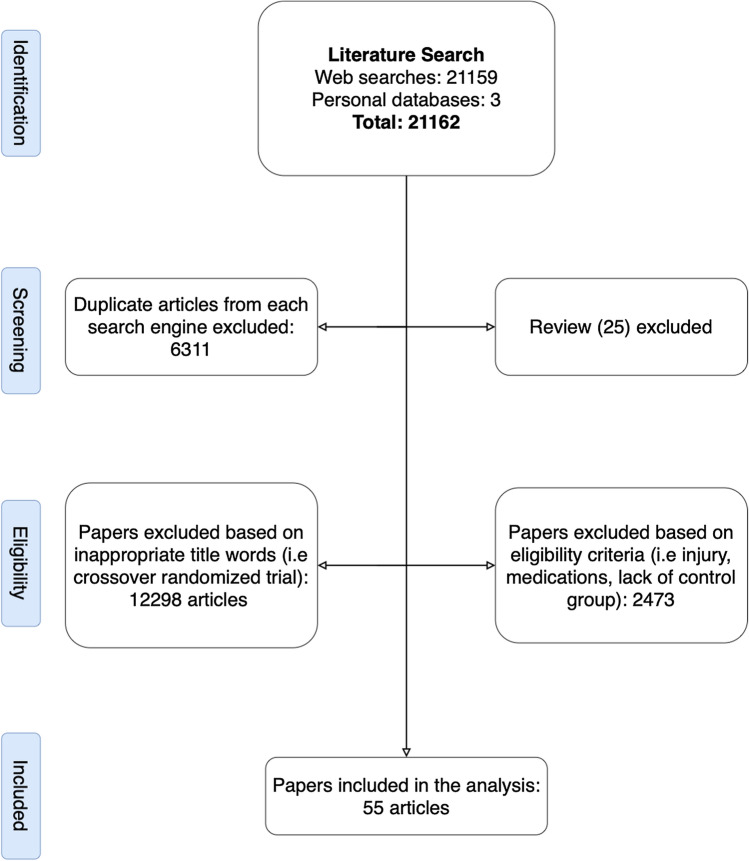
- Systematic review and meta-analysis following PRISMA; searches in PubMed, Scopus, SPORTDiscus, and Web of Science (with Google Scholar and reference/snowballing searches also described), ending May 2022, yielded 55 eligible studies with 2756 participants (mean age 23.9 ± 6.3 years; range 8.1–78.8) and 222 effect sizes.
- Included controlled or randomized controlled trials in healthy participants that separately compared resistance training with a control group, stretching group, or combined stretch and resistance training group on range of motion.
- Main analysis used random-effects meta-analysis; mixed-effects models were used for subgroup analyses (sex, activity level, contraction type, exercise type, joint tested), and meta-regression examined age, training duration, and frequency. Risk of bias was assessed with the PEDro scale and funnel plot/Egger’s test.
Limitations
- The authors state that Comprehensive Meta-Analysis calculates the arithmetic mean when more than one effect size comes from a study, which does not fully account for dependency of effect sizes and may contribute to imprecise estimates.
- The authors state that combining different range-of-motion tests and joints may be less sensitive than comparing the same joints and tests, and that including articles known to the authors could introduce bias, although a further analysis did not detect bias.
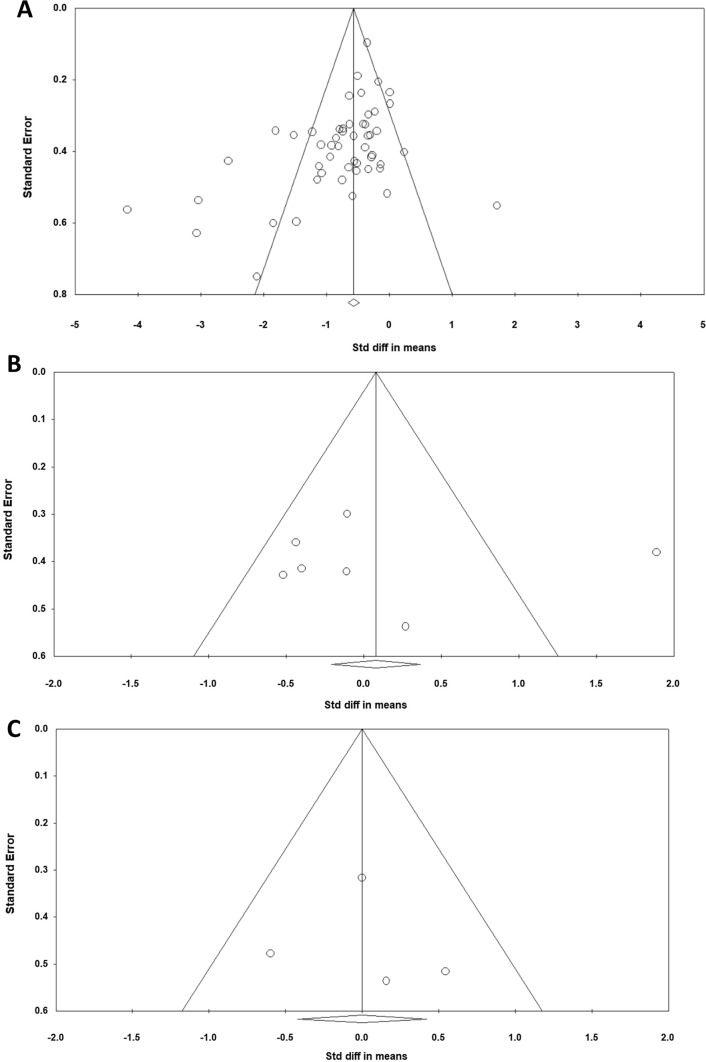
- Reporting bias was indicated for resistance training versus controls (Egger’s intercept −1.89; p = 0.002), but not for the other comparisons; heterogeneity was high in the main analysis (I² = 73.76) and in resistance training versus stretch training (I² = 79.12). The body-mass-only finding is based on only 4 effect sizes, which the authors caution should not be overemphasized.
Model-written summary. Check it against the paper before relying on it.
Integrity signals
Registry
Cites
Statistics
Figures
Verification
Claims the paper makes
15 Valid · 2 Not valid · 21 Not checked · 61 Own results and interpretations
The cited sources support only part of this claim — read each source’s verdict below.
In the paper
“However, neither the commentaries nor the meta-analysis evaluated the specific type of RT (i.e., free weights vs machine RT, vs Pilates, vs calisthenics) effects on ROM.”
§ Resistance Training Induces Improvements in Range of Motion: A Systematic Review and Meta-Analysis > Introduction
What the sources say
- Partly supportedcites [2] Afonso J Olivares-Jabalera J Andrade R Time to move from mandatory stretching? We need to differentiate "can I?" from "do I have to?" Front Physiol 2021 12 714166 10.3389/fphys.2021.714166 34366900 PMC8340604 sourceExperimental — accuracy not yet measured
In “Can I” Vs. “Do I Have To” Stretch To Chronically Improve Range of Motion? (page unavailable), the paper describes the meta-analysis as comparing strength training with stretching and notes heterogeneity in its protocols. It does not establish whether that meta-analysis or the other commentaries evaluated ROM effects by the specific resistance-training types listed in the claim. (LLM, conf=0.72)
- Not checked — no full text of the sourcecites [5] Nuzzo JL The case for retiring flexibility as a major component of physical fitness Sports Med 2020 50 5 853 870 10.1007/s40279-019-01248-w 31845202 source
- Partly supportedcites [12] Afonso J Ramirez-Campillo R Moscao J Rocha T Zacca R Martins A Strength training versus stretching for improving range of motion: a systematic review and meta-analysis Healthcare 2021 9 4 427 10.3390/healthcare9040427 33917036 PMC8067745 sourceExperimental — accuracy not yet measured
The Methods (§2.12, page unavailable) list the meta-analysis’s moderator analyses as ROM type and two risk-of-bias measures, not comparisons among specific resistance-training types. This supports the claim about the meta-analysis, but the cited paper does not establish what the separate prior commentaries evaluated. (LLM, conf=0.84)
plain- Asserted: passes — The authors put it forward as true.
- Checkable: passes — It can be checked against evidence.
- Load-bearing: passes — The paper’s conclusions depend on it.
- Based: passes — The paper gives a reason why it holds.
- Partly supported
The sources with a verdict support this claim; the rest weren’t checked yet, have no full text we could read, or their verdicts aren’t rated yet.
In the paper
“eccentric contractions can provide higher resistive forces or loads [15, 16] of a lengthening muscle–tendon unit”
§ Resistance Training Induces Improvements in Range of Motion: A Systematic Review and Meta-Analysis > Introduction
What the sources say
- Supportedcites [15] Hahn D Stretching the limits of maximal voluntary eccentric force production in vivo J Sport Health Sci 2018 7 3 275 281 10.1016/j.jshs.2018.05.003 30356655 PMC6189274 source
The Introduction (page unavailable) reports that eccentric contractions can produce greater force than comparable isometric contractions, including in some maximal voluntary contractions. The paper qualifies this as a capacity, not a result found in every experiment, which is consistent with the claim’s use of “can.” (LLM, conf=0.91)
- Not checked — no full text of the sourcecites [16] Hollander DB Kraemer RR Kilpatrick MW Ramadan ZG Reeves GV Francois M Maximal eccentric and concentric strength discrepancies between young men and women for dynamic resistance exercise J Strength Cond Res 2007 21 1 34 40 10.1519/00124278-200702000-00007 17313264 source
plainstates a cause- Asserted: passes — The authors put it forward as true.
- Checkable: passes — It can be checked against evidence.
- Load-bearing: passes — The paper’s conclusions depend on it.
- Based: passes — The paper gives a reason why it holds.
- Supported
The sources with a verdict support this claim; the rest weren’t checked yet, have no full text we could read, or their verdicts aren’t rated yet.
In the paper
“The current meta-analysis generally concurs with the findings of Nuzzo [5] and Afonso et al. [12] based on an expanded analysis of 55 studies.”
§ Resistance Training Induces Improvements in Range of Motion: A Systematic Review and Meta-Analysis > Discussion
What the sources say
- Not checked — no full text of the sourcecites Nuzzo [5] Nuzzo JL The case for retiring flexibility as a major component of physical fitness Sports Med 2020 50 5 853 870 10.1007/s40279-019-01248-w 31845202 source
- Supportedcites Afonso et al. [12] Afonso J Ramirez-Campillo R Moscao J Rocha T Zacca R Martins A Strength training versus stretching for improving range of motion: a systematic review and meta-analysis Healthcare 2021 9 4 427 10.3390/healthcare9040427 33917036 PMC8067745 source
The Results (§3.4) report no significant difference between strength training and stretching in range-of-motion gains. The cited paper analyzed 11 articles; the citing sentence describes 55 studies as part of its own expanded analysis, not Afonso et al.’s. (LLM, conf=0.94)
hedged- Asserted: passes — The authors put it forward as true.
- Checkable: passes — It can be checked against evidence.
- Load-bearing: passes — The paper’s conclusions depend on it.
- Based: passes — The paper gives a reason why it holds.
The cited sources that could be checked couldn’t confirm or dispute this claim.
In the paper
“Finally, by removing both the highest and lowest ES [38, 76], we also found a significant moderate effect in favor of RT while heterogeneity decreased (ES = − 0.696; p < 0.001, I2 = 64.07%).”
§ Resistance Training Induces Improvements in Range of Motion: A Systematic Review and Meta-Analysis > Results > Main Analysis
What the sources say
- Not checked — no full text of the sourcecites [38] Christou M Smilios I Sotiropoulos K Volaklis K Pilianidis T Tokmakidis SP Effects of resistance training on the physical capacities of adolescent soccer players J Strength Cond Res 2006 20 4 783 791 17194231 source
- Could not verifycites [76] Phrompaet S Paungmali A Pirunsan U Sitilertpisan P Effects of Pilates training on lumbo-pelvic stability and flexibility Asian J Sports Med 2011 2 1 16 22 10.5812/asjsm.34822 22375213 PMC3289190 sourceExperimental — accuracy not yet measured
The Methods and Results describe a Pilates-versus-control trial and report flexibility and lumbo-pelvic stability outcomes. Our copy does not report the citing authors’ sensitivity analysis, its pooled effect or heterogeneity, or whether this trial supplied the highest or lowest effect size (searched: effect size, sensitivity analysis, heterogeneity). (LLM, conf=0.78)
plainstates a cause- Asserted: passes — The authors put it forward as true.
- Checkable: passes — It can be checked against evidence.
- Load-bearing: unclear — It is unclear whether the paper’s conclusions depend on it.
- Based: passes — The paper gives a reason why it holds.
The sources with a verdict support this claim; the rest weren’t checked yet, have no full text we could read, or their verdicts aren’t rated yet.
In the paper
“There are several reports of substantial ROM increases following eccentric RT [17–19].”
§ Resistance Training Induces Improvements in Range of Motion: A Systematic Review and Meta-Analysis > Introduction
What the sources say
- Supportedcites [17] Delvaux F Schwartz C Decréquy T Devalckeneer T Paulus J Bornheim S Influence of a field hamstring eccentric training on muscle strength and flexibility Inter J Sports Med 2020 41 04 233 241 10.1055/a-1073-7809 31935778 source
The Flexibility results report a significant 11.4° increase in passive hamstring range of motion after eccentric training, with a large effect size. The Discussion also reports range-of-motion increases in two other studies. The paper distinguishes passive range of motion from active range of motion, which did not significantly change in its trial. (LLM, conf=0.92)
- Supportedcites [18] Kay AD Richmond D Talbot C Mina M Baross AW Blazevich AJ Stretching of active muscle elicits chronic changes in multiple strain risk factors Med Sci Sports Exerc 2016 48 7 1388 1396 10.1249/MSS.0000000000000887 27314411 source
The Introduction reports a consistent increase in joint ROM following isotonic eccentric training, comparable to gains from passive stretching programs. The paper’s own Results report a significant 14.7° increase in dorsiflexion ROM after its active-muscle stretching program, which the Discussion describes as qualitatively similar to isokinetic eccentric exercise. (LLM, conf=0.89)
- Not checked — no full text of the sourcecites [19] Nelson RT Bandy WD Eccentric training and static stretching improve hamstring flexibility of high school males J Athl Train 2004 39 3 254 258 15496995 PMC522148
plainstates a cause- Asserted: passes — The authors put it forward as true.
- Checkable: passes — It can be checked against evidence.
- Load-bearing: passes — The paper’s conclusions depend on it.
- Based: passes — The paper gives a reason why it holds.
- Supported
48 more claims · 3 with their cited sources checked
Create a free account to see all 99 claims and every source verdict.
- Probably not a substantial claim. 39
- It may state two separate claims as one. 16
Self-check
Percentages, sums and reported differences re-computed from the paper’s own numbers.
Each contradiction between two passages listed here was confirmed by an independent check.
Rated minor: it would not touch a result — a value no result rests on, a p-value that stays on the same side of the significance level, or a conflict that is clerical, resolved elsewhere in the paper, or outside its own findings.
In the paper
§ Resistance Training Induces Improvements in Range of Motion: A Systematic Review and Meta-Analysis > Abstract > Data Sources
“Following the systematic search in four databases (PubMed, Scopus, SPORTDiscus, and Web of Science) and reference lists, 55 studies were found to be eligible.”
§ Resistance Training Induces Improvements in Range of Motion: A Systematic Review and Meta-Analysis > Methods > Search Strategy
“A literature search following PRISMA review guidelines was performed by six of the co-authors in pairs of two using PubMed, SPORTDiscus, Web of Science, Scopus, and Google Scholar databases.”
Rated minor: it would not touch a result — a value no result rests on, a p-value that stays on the same side of the significance level, or a conflict that is clerical, resolved elsewhere in the paper, or outside its own findings.
In the paper
§ Resistance Training Induces Improvements in Range of Motion: A Systematic Review and Meta-Analysis > Abstract > Results
““untrained and sedentary” individuals had significantly (p = 0.005) higher magnitude range of motion changes (ES = 1.042; p < 0.001).”
§ Resistance Training Induces Improvements in Range of Motion: A Systematic Review and Meta-Analysis > Results > Moderating Variables
“| Untrained and sedentary | 22 | − 1.027 | (− 1.374 to − 0.680) | < 0.001* | |”
Citations
Cites
Measuring inconsistency in meta-analyses
Higgins, J. P. T., Thompson, S. G., Deeks, J. J., & Altman, D. G. (2003) · BMJ · doi:10.1136/bmj.327.7414.557 · Cited by 63,139
Preferred reporting items for systematic reviews and meta-analyses: The PRISMA statement
Moher, D., Liberati, A., Tetzlaff, J., Altman, D. G., & the PRISMA Group* (2009) · Annals of Internal Medicine · doi:10.7326/0003-4819-151-4-200908180-00135 · Cited by 37,554
Borenstein, M., Hedges, L. V., Higgins, J. P. T., & Rothstein, H. R. (2009) · doi:10.1002/9780470743386 · Cited by 14,225
Borenstein, M., Hedges, L. V., Higgins, J. P. T., & Rothstein, H. R. (2021) · doi:10.1002/9781119558378 · Cited by 9,799
Progressive Statistics for Studies in Sports Medicine and Exercise Science
HOPKINS, W. G., MARSHALL, S. W., BATTERHAM, A. M., & HANIN, J. (2009) · Medicine & Science in Sports & Exercise · doi:10.1249/mss.0b013e31818cb278 · Cited by 9,128 · cited 1×
“0 as trivial, small, moderate, large, very large, and extremely large, respectively [31].”
Publication bias in clinical research
Easterbrook, P. J., Gopalan, R., Berlin, J. A., & Matthews, D. R. (1991) · The Lancet · doi:10.1016/0140-6736(91)90201-y · Cited by 3,109 · cited 1×
“It is clearly established that significant positive results are more likely to be published with an increased probability that they would be published in higher impact journals and thus also achieve a higher number of citations [109, 110].”
BackgroundEmpirical assessment of effect of publication bias on meta-analyses
Sutton, A. J. (2000) · BMJ · doi:10.1136/bmj.320.7249.1574 · Cited by 1,398
Borenstein, M., Hedges, L. V., Higgins, J. P. T., Rothstein, H. R., & Ben Van Den, A. (2020) · International Coaching Psychology Review · doi:10.53841/bpsicpr.2020.15.2.121 · Cited by 1,215
Behm, D. G., Blazevich, A. J., Kay, A. D., & McHugh, M. (2016) · Applied Physiology, Nutrition, and Metabolism · doi:10.1139/apnm-2015-0235 · Cited by 762 · cited 4×
“However, a number of reviews [1, 3, 4, 6, 8] have demonstrated that the study designs used in many of these studies lacked ecological validity.”
BackgroundInfluentialSelf-citationA review of the acute effects of static and dynamic stretching on performance
Behm, D. G., & Chaouachi, A. (2011) · European Journal of Applied Physiology · doi:10.1007/s00421-011-1879-2 · Cited by 751 · cited 4×
“However, a number of reviews [1, 3, 4, 6, 8] have demonstrated that the study designs used in many of these studies lacked ecological validity.”
BackgroundInfluentialSelf-citationVelocity Specificity of Resistance Training
Behm, D. G., & Sale, D. G. (1993) · Sports Medicine · doi:10.2165/00007256-199315060-00003 · Cited by 460 · cited 1×
“, angle and task specificity), [13, 14] it might be expected that RT with a restricted ROM such as calisthenics or some machine-based RT might not provide similar flexibility improvements as with free weight training through a full ROM.”
BackgroundSelf-citationA mechanism for altered flexibility in human skeletal muscle.
Magnusson, S. P., Simonsen, E. B., Aagaard, P., Sørensen, H., & Kjaer, M. (1996) · The Journal of Physiology · doi:10.1113/jphysiol.1996.sp021768 · Cited by 406 · cited 1×
“There is also strong evidence with stretching for an increase in stretch (pain) tolerance (sensory theory) [106, 107].”
BackgroundEffect of Acute Static Stretch on Maximal Muscle Performance: A Systematic Review
KAY, A. D., & BLAZEVICH, A. J. (2012) · Medicine & Science in Sports & Exercise · doi:10.1249/mss.0b013e318225cb27 · Cited by 400 · cited 3×
“However, a number of reviews [1, 3, 4, 6, 8] have demonstrated that the study designs used in many of these studies lacked ecological validity.”
BackgroundHuman tendon behaviour and adaptation, in vivo
Magnusson, S. P., Narici, M. V., Maganaris, C. N., & Kjaer, M. (2008) · The Journal of Physiology · doi:10.1113/jphysiol.2007.139105 · Cited by 330 · cited 1×
“Magnusson and colleagues [99] contend that in response to loading, tendon metabolic activity is relatively high and can undergo significant length changes allowing the tendon to adapt to changing demands (i.”
BackgroundBandy, W. D., Irion, J. M., & Briggler, M. (1998) · Journal of Orthopaedic & Sports Physical Therapy · doi:10.2519/jospt.1998.27.4.295 · Cited by 303 · cited 1×
“While one study reported more than double the ROM improvements with static versus dynamic stretch training [86], another did not report any significant difference [87].”
ResultPilates for Improvement of Muscle Endurance, Flexibility, Balance, and Posture
Kloubec, J. A. (2010) · Journal of Strength and Conditioning Research · doi:10.1519/jsc.0b013e3181c277a6 · Cited by 296
Effects of Resistance Training on the Physical Capacities of Adolescent Soccer Players
Christou, M., Smilios, I., Sotiropoulos, K., Volaklis, K., Pilianidis, T., & Tokmakidis, S. P. (2006) · The Journal of Strength and Conditioning Research · doi:10.1519/r-17254.1 · Cited by 275 · cited 2×
“[38]) still provided a significant moderate effect in favor of RT with a similar heterogeneity (ES = − 0.”
BackgroundDifferential adaptations to eccentric versus conventional resistance training in older humans
Reeves, N. D., Maganaris, C. N., Longo, S., & Narici, M. V. (2009) · Experimental Physiology · doi:10.1113/expphysiol.2009.046599 · Cited by 274
Maximum Strength-Power-Performance Relationships in Collegiate Throwers
STONE, M. H., SANBORN, K., OʼBRYANT, H. S., HARTMAN, M., STONE, M. E., PROULX, C., WARD, B., & HRUBY, J. (2003) · Journal of Strength and Conditioning Research · doi:10.1519/00124278-200311000-00019 · Cited by 254
Effects of Pilates exercise on trunk strength, endurance and flexibility in sedentary adult females
Sekendiz, B., Altun, Ö., Korkusuz, F., & Akın, S. (2007) · Journal of Bodywork and Movement Therapies · doi:10.1016/j.jbmt.2006.12.002 · Cited by 242
Guissard, N., & Duchateau, J. (2004) · Muscle & Nerve · doi:10.1002/mus.10549 · Cited by 233 · cited 1×
“In terms of possible neural adaptations, there have been reports with static stretch training (3 and 6 weeks) of reductions in tonic Ia (facilitatory) afferent feedback from muscle spindles (T-reflexes and H-reflexes), which could reduce reflex-induced contractions inducing a more relaxed muscle (disfacilitation) [90,…”
BackgroundNeural Aspects of Muscle Stretching
Guissard, N., & Duchateau, J. (2006) · Exercise and Sport Sciences Reviews · doi:10.1249/01.jes.0000240023.30373.eb · Cited by 196 · cited 1×
“Golgi tendon organ inhibition is more likely to occur with large amplitude stretches [92] and higher muscle tension; however, Golgi tendon organ inhibition tends to subside almost immediately (60–100 ms post-stretching) after the stimulus discontinues [93], thus it is also an unlikely candidate for chronic dynamic str…”
BackgroundKonrad, A., & Tilp, M. (2014) · Clinical Biomechanics · doi:10.1016/j.clinbiomech.2014.04.013 · Cited by 195
Self-citationPotier, T. G., Alexander, C. M., & Seynnes, O. R. (2009) · European Journal of Applied Physiology · doi:10.1007/s00421-008-0980-7 · Cited by 194
Eccentric Training and Static Stretching Improve Hamstring Flexibility of High School Males.
(2004) · PubMed Central · Cited by 184
Comparison of 1 and 2 Days per Week of Strength Training in Children
Faigenbaum, A. D., Milliken, L. A., Loud, R. L., Burak, B. T., Doherty, C. L., & Westcott, W. L. (2002) · Research Quarterly for Exercise and Sport · doi:10.1080/02701367.2002.10609041 · Cited by 177
Effect of Static and Ballistic Stretching on the Muscle-Tendon Tissue Properties
MAHIEU, N. N., MCNAIR, P., DE MUYNCK, M., STEVENS, V., BLANCKAERT, I., SMITS, N., & WITVROUW, E. (2007) · Medicine & Science in Sports & Exercise · doi:10.1249/01.mss.0000247004.40212.f7 · Cited by 169 · cited 1×
“Morphologically, there is some evidence for dynamic ballistic stretch training to decrease tendon stiffness [96].”
BackgroundPerrier, E. T., Pavol, M. J., & Hoffman, M. A. (2011) · Journal of Strength and Conditioning Research · doi:10.1519/jsc.0b013e3181e73959 · Cited by 169 · cited 1×
“Dynamic stretching in some studies has been reported to produce similar [82, 83] as well as greater [84, 85] acute increases in ROM when compared to static stretching.”
ResultBehm, D. G., Kay, A. D., Trajano, G. S., & Blazevich, A. J. (2020) · European Journal of Applied Physiology · doi:10.1007/s00421-020-04538-8 · Cited by 169 · cited 3×
“However, a number of reviews [1, 3, 4, 6, 8] have demonstrated that the study designs used in many of these studies lacked ecological validity.”
BackgroundSelf-citationTendon properties in relation to muscular activity and physical training
Magnusson, S. P., Hansen, P., & Kjær, M. (2003) · Scandinavian Journal of Medicine & Science in Sports · doi:10.1034/j.1600-0838.2003.00308.x · Cited by 166 · cited 1×
“Furthermore, repeated loading of the tendon with stretching can shift the stress–strain curve to promote an elevated elastic modulus [100].”
BackgroundWilke, J., Müller, A.-L., Giesche, F., Power, G., Ahmedi, H., & Behm, D. G. (2020) · Sports Medicine · doi:10.1007/s40279-019-01205-7 · Cited by 164 · cited 1×
“Furthermore, any significant effects of RT on ROM may be moderated by variables such as the sex and trained state of the individual or the frequency and duration [27, 28] of RT.”
BackgroundSelf-citationKonrad, A., Stafilidis, S., & Tilp, M. (2017) · Scandinavian Journal of Medicine & Science in Sports · doi:10.1111/sms.12725 · Cited by 157 · cited 1×
“There are also reports of acute dynamic stretch-induced decreases in passive resistive torque [10] and muscle stiffness [10, 97], suggesting a more compliant musculotendinous unit following a single session of dynamic and ballistic stretching.”
BackgroundSelf-citationChaabene, H., Behm, D. G., Negra, Y., & Granacher, U. (2019) · Frontiers in Physiology · doi:10.3389/fphys.2019.01468 · Cited by 156
Self-citationFour Weeks of Nordic Hamstring Exercise Reduce Muscle Injury Risk Factors in Young Adults
Ribeiro-Alvares, J. B., Marques, V. B., Vaz, M. A., & Baroni, B. M. (2018) · Journal of Strength and Conditioning Research · doi:10.1519/jsc.0000000000001975 · Cited by 148
HOLLANDER, D. B., KRAEMER, R. R., KILPATRICK, M. W., RAMADAN, Z. G., REEVES, G. V., FRANCOIS, M., HEBERT, E. P., & TRYNIECKI, J. L. (2007) · Journal of Strength and Conditioning Research · doi:10.1519/00124278-200702000-00007 · Cited by 144
Fatouros, I. G., Taxildaris, K., Tokmakidis, S. P., Kalapotharakos, V., Aggelousis, N., Athanasopoulos, S., Zeeris, I., & Katrabasas, I. (2002) · International Journal of Sports Medicine · doi:10.1055/s-2002-20130 · Cited by 144
Effects of Pilates Training on Lumbo-Pelvic Stability and Flexibility
Phrompaet, S., Paungmali, A., Pirunsan, U., & Sitilertpisan, P. (2011) · Asian Journal of Sports Medicine · doi:10.5812/asjsm.34822 · Cited by 143 · cited 2×
“Finally, by removing both the highest and lowest ES [38, 76], we also found a significant moderate effect in favor of RT while heterogeneity decreased (ES = − 0.”
BackgroundRecurrent inhibition in humans
Katz, R., & Pierrot-Deseilligny, E. (1999) · Progress in Neurobiology · doi:10.1016/s0301-0082(98)00056-2 · Cited by 140 · cited 1×
“Recurrent or Renshaw cell inhibition is more prevalent with acute dynamic rather than tonic contractions [94] and can induce stabilizing effects on motoneuron discharge variability, and motor unit synchronization [95].”
BackgroundThe effect of different dynamic stretch velocities on jump performance
Fletcher, I. M. (2010) · European Journal of Applied Physiology · doi:10.1007/s00421-010-1386-x · Cited by 136 · cited 2×
“Dynamic stretching has been described as an action that involves controlled movement through the active joint ROM [3, 8, 80].”
BackgroundThe Case for Retiring Flexibility as a Major Component of Physical Fitness
Nuzzo, J. L. (2020) · Sports Medicine · doi:10.1007/s40279-019-01248-w · Cited by 127 · cited 7×
“The current metaanalysis generally concurs with the findings of Nuzzo [5] and Afonso et al.”
BackgroundResultInfluentialFATOUROS, I. G., KAMBAS, A., KATRABASAS, I., LEONTSINI, D., CHATZINIKOLAOU, A., JAMURTAS, A. Z., DOUROUDOS, I., AGGELOUSIS, N., & TAXILDARIS, K. (2006) · Journal of Strength and Conditioning Research · doi:10.1519/00124278-200608000-00027 · Cited by 126
Resistance Training vs. Static Stretching: Effects on Flexibility and Strength
Morton, S. K., Whitehead, J. R., Brinkert, R. H., & Caine, D. J. (2011) · Journal of Strength and Conditioning Research · doi:10.1519/jsc.0b013e31821624aa · Cited by 124
The Effects of a Twice-A-Week Strength Training Program on Children
Faigenbaum, A. D., Zaichkowsky, L. D., Westcott, W. L., Micheli, L. J., & Fehlandt, A. F. (1993) · Pediatric Exercise Science · doi:10.1123/pes.5.4.339 · Cited by 119
Hollander, D. B., Kraemer, R. R., Kilpatrick, M. W., et al. (2007) · PubMed · doi:10.1519/r-18725.1 · Cited by 107 · cited 1×
“As eccentric contractions can provide higher resistive forces or loads [15, 16] of a lengthening muscle–tendon unit, eccentric contractions may provide a greater stimulus for increasing ROM.”
BackgroundAmiri-Khorasani, M., Abu Osman, N. A., & Yusof, A. (2011) · Journal of Strength and Conditioning Research · doi:10.1519/jsc.0b013e3181db9f41 · Cited by 102 · cited 1×
“Dynamic stretching in some studies has been reported to produce similar [82, 83] as well as greater [84, 85] acute increases in ROM when compared to static stretching.”
ResultReinold, M. M., Macrina, L. C., Fleisig, G. S., et al. (2018) · Sports Health A Multidisciplinary Approach · doi:10.1177/1941738118779909 · Cited by 101
The Influence of Strength, Flexibility, and Simultaneous Training on Flexibility and Strength Gains
Simão, R., Lemos, A., Salles, B., Leite, T., Oliveira, É., Rhea, M., & Reis, V. M. (2011) · Journal of Strength and Conditioning Research · doi:10.1519/jsc.0b013e3181da85bf · Cited by 98
Neuromuscular factors influencing the maximum stretch limit of the human plantar flexors
Blazevich, A. J., Cannavan, D., Waugh, C. M., Fath, F., Miller, S. C., & Kay, A. D. (2012) · Journal of Applied Physiology · doi:10.1152/japplphysiol.00882.2012 · Cited by 98
Magnusson, P., & Renström, P. (2006) · European Journal of Sport Science · doi:10.1080/17461390600617865 · Cited by 91 · cited 1×
“There is also strong evidence with stretching for an increase in stretch (pain) tolerance (sensory theory) [106, 107].”
BackgroundEffect of PNF stretching training on the properties of human muscle and tendon structures
Konrad, A., Gad, M., & Tilp, M. (2015) · Scandinavian Journal of Medicine & Science in Sports · doi:10.1111/sms.12228 · Cited by 91
Self-citationEFFECTS OF A HEAVY AND A MODERATE RESISTANCE TRAINING ON FUNCTIONAL PERFORMANCE IN OLDER ADULTS
KALAPOTHARAKOS, V. I., MICHALOPOULOS, M., TOKMAKIDIS, S. P., GODOLIAS, G., & GOURGOULIS, V. (2005) · Journal of Strength and Conditioning Research · doi:10.1519/00124278-200508000-00028 · Cited by 91
Effects of Resistance Training on the Sit-and-Reach Test in Elderly Women
BARBOSA, A. R., SANTARÉM, J. M., FILHO, W. J., & DE FÁTIMA NUNES MARUCCI, M. (2002) · Journal of Strength and Conditioning Research · doi:10.1519/00124278-200202000-00003 · Cited by 91
Wiemann, K., & Hahn, K. (1997) · International Journal of Sports Medicine · doi:10.1055/s-2007-972643 · Cited by 90 · cited 1×
“While one study reported more than double the ROM improvements with static versus dynamic stretch training [86], another did not report any significant difference [87].”
ResultAfonso, J., Ramirez-Campillo, R., Moscão, J., Rocha, T., Zacca, R., Martins, A., Milheiro, A. A., Ferreira, J., Sarmento, H., & Clemente, F. M. (2021) · Healthcare · doi:10.3390/healthcare9040427 · Cited by 88 · cited 1×
“[89] who also reported significant improvements with RT in all joints analyzed; however, they did not make direct comparisons between joints.”
Cheol-Jin, K., Kim, Y. L., & Lee, S. M. (2016) · Journal of Physical Therapy Science · doi:10.1589/jpts.28.3189 · Cited by 87
Takeshima, N., Islam, M. M., Rogers, M. E., Rogers, N. L., 直子, 仙., Koizumi, D., Kitabayashi, Y., Imai, A., & Naruse, A. (2013) · Europe PMC (PubMed Central) · Cited by 80
Kovách, M. V., Plachy, J. K., Bognár, J., Balogh, Z. O., & Barthalos, I. (2013) · Biomedical Human Kinetics · doi:10.2478/bhk-2013-0005 · Cited by 76
Comparison between static stretching and the Pilates method on the flexibility of older women
de Oliveira, L. C., de Oliveira, R. G., & Pires-Oliveira, D. A. D. A. (2016) · Journal of Bodywork and Movement Therapies · doi:10.1016/j.jbmt.2016.01.008 · Cited by 75
Rayes, A. B. R., de Lira, C. A. B., Viana, R. B., Benedito‐Silva, A. A., Vancini, R. L., Mascarin, N., & Andrade, M. S. (2019) · PeerJ · doi:10.7717/peerj.6022 · Cited by 75
Behm, D. G. (2018) · doi:10.4324/9781315110745 · Cited by 73
Self-citationFoam Rolling Training Effects on Range of Motion: A Systematic Review and Meta-Analysis
Konrad, A., Nakamura, M., Tilp, M., Donti, O., & Behm, D. G. (2022) · Sports Medicine · doi:10.1007/s40279-022-01699-8 · Cited by 72 · cited 1×
“Furthermore, any significant effects of RT on ROM may be moderated by variables such as the sex and trained state of the individual or the frequency and duration [27, 28] of RT.”
BackgroundSelf-citationThe effects of dynamic stretching on the passive properties of the muscle-tendon unit
Herda, T. J., Herda, N. D., Costa, P. B., Walter-Herda, A. A., Valdez, A. M., & Cramer, J. T. (2013) · Journal of Sports Sciences · doi:10.1080/02640414.2012.736632 · Cited by 71 · cited 1×
“There are also reports of acute dynamic stretch-induced decreases in passive resistive torque [10] and muscle stiffness [10, 97], suggesting a more compliant musculotendinous unit following a single session of dynamic and ballistic stretching.”
BackgroundEffects of ballistic stretching training on the properties of human muscle and tendon structures
Konrad, A., & Tilp, M. (2014) · Journal of Applied Physiology · doi:10.1152/japplphysiol.00195.2014 · Cited by 66 · cited 1×
“However, a 6-week ballistic stretch training program did not detect any significant change in muscle morphology [98].”
BackgroundSelf-citationGérard, R., Gojon, L., Decleve, P., & Van Cant, J. (2020) · Journal of Athletic Training · doi:10.4085/1062-6050-194-19 · Cited by 64 · cited 1×
“A meta-analytical review of the literature demonstrated limited-to-moderate evidence that eccentric training induces significant increases in fascicle length [105].”
BackgroundKao, Y., Liou, T., Huang, Y.-C., Tsai, Y.-W., & Wang, K.-M. (2014) · Health Care For Women International · doi:10.1080/07399332.2014.900062 · Cited by 64
Marušič, J., Vatovec, R., Marković, G., & Šarabon, N. (2020) · Scandinavian Journal of Medicine & Science in Sports · doi:10.1111/sms.13770 · Cited by 61 · cited 1×
“Training studies (4–15 weeks) emphasizing either eccentric [102, 103] or concentric [103, 104] contractions have reported increases in fascicle length.”
BackgroundYahata, K., Konrad, A., Sato, S., Kiyono, R., Yoshida, R., Fukaya, T., Nunes, J. P., & Nakamura, M. (2021) · European Journal of Applied Physiology · doi:10.1007/s00421-021-04608-5 · Cited by 59 · cited 1×
“Based on the present studies and the literature, both stretching and RT can improve ROM, improve strength [1, 111, 112], and decrease musculotendinous injury incidence [113].”
ResultSelf-citationEffects of Stretching on Injury Risk Reduction and Balance
Behm, D. G., Kay, A. D., Trajano, G. S., Alizadeh, S., & Blazevich, A. J. (2021) · Journal of Clinical Exercise Physiology · doi:10.31189/2165-6193-10.3.106 · Cited by 59 · cited 1×
“Based on the present studies and the literature, both stretching and RT can improve ROM, improve strength [1, 111, 112], and decrease musculotendinous injury incidence [113].”
ResultSelf-citationInfluence of Strength Training on Adult Women's Flexibility
Monteiro, W. D., Simão, R., Polito, M. D., Santana, C. A., Chaves, R. B., Bezerra, E., & Fleck, S. J. (2008) · Journal of Strength and Conditioning Research · doi:10.1519/jsc.0b013e31816a5d45 · Cited by 57
Mattei, B., Schmied, A., Mazzocchio, R., Decchi, B., Rossi, A., & Vedel, J.-P. (2003) · The Journal of Physiology · doi:10.1113/jphysiol.2002.033126 · Cited by 54 · cited 1×
“Recurrent or Renshaw cell inhibition is more prevalent with acute dynamic rather than tonic contractions [94] and can induce stabilizing effects on motoneuron discharge variability, and motor unit synchronization [95].”
BackgroundValamatos, M. J., Tavares, F., Santos, R. M., Veloso, A. P., & Mil-Homens, P. (2018) · European Journal of Applied Physiology · doi:10.1007/s00421-018-3932-x · Cited by 54 · cited 1×
“Training studies (4–15 weeks) emphasizing either eccentric [102, 103] or concentric [103, 104] contractions have reported increases in fascicle length.”
BackgroundA Comparison of Two Warm-Ups on Joint Range of Motion
Beedle, B. B., & Mann, C. L. (2007) · The Journal of Strength and Conditioning Research · doi:10.1519/r-19415.1 · Cited by 54 · cited 1×
“Dynamic stretching in some studies has been reported to produce similar [82, 83] as well as greater [84, 85] acute increases in ROM when compared to static stretching.”
ResultFritz, N. B., Juesas, Á., Gargallo, P., Calatayud, J., Fernández-Garrido, J., Rogers, M. E., & Colado, J. C. (2018) · Biological Research For Nursing · doi:10.1177/1099800418757676 · Cited by 53
Effect of mat vs. apparatus pilates training on the functional capacity of elderly women
Mueller, D., Redkva, P. E., de Borba, E. F., Barbosa, S. C., Krause, M. P., & da Silva, S. G. (2020) · Journal of Bodywork and Movement Therapies · doi:10.1016/j.jbmt.2020.11.012 · Cited by 53
Influence of Moderately Intense Strength Training on Flexibility in Sedentary Young Women
Santos, E., Rhea, M. R., Simão, R., Dias, I., de Salles, B. F., Novaes, J., Leite, T., Blair, J. C., & Bunker, D. J. (2010) · Journal of Strength and Conditioning Research · doi:10.1519/jsc.0b013e3181e38027 · Cited by 51
Saraiva, A. R., Reis, V. M., Costa, P. B., Bentes, C. M., Silva, G. V. D. L. C. E., & Novaes, J. D. S. (2014) · Journal of Human Kinetics · doi:10.2478/hukin-2014-0015 · Cited by 46
Moraes, E., Fleck, S. J., Ricardo Dias, M., & Simão, R. (2013) · Journal of Strength and Conditioning Research · doi:10.1519/jsc.0b013e31828de8c3 · Cited by 42
Wyon, M. A., Smith, A., & Koutedakis, Y. (2013) · Journal of Strength and Conditioning Research · doi:10.1519/jsc.0b013e31828a4842 · Cited by 42
DAWSON, B., VLADICH, T., & BLANKSBY, B. A. (2002) · Journal of Strength and Conditioning Research · doi:10.1519/00124278-200211000-00001 · Cited by 41
Vatovec, R., Marušič, J., Marković, G., & Šarabon, N. (2021) · Journal of Sports Sciences · doi:10.1080/02640414.2021.1933350 · Cited by 41
Stretching the limits of maximal voluntary eccentric force production in vivo
Hahn, D. (2018) · Journal of Sport and Health Science · doi:10.1016/j.jshs.2018.05.003 · Cited by 40 · cited 1×
“As eccentric contractions can provide higher resistive forces or loads [15, 16] of a lengthening muscle–tendon unit, eccentric contractions may provide a greater stimulus for increasing ROM.”
BackgroundLeite, T., de Souza Teixeira, A., Saavedra, F., Leite, R. D., Rhea, M. R., & Simão, R. (2015) · Journal of Strength and Conditioning Research · doi:10.1519/jsc.0000000000000719 · Cited by 39
Lee, H.-L., Caguicla, J. M. C., Park, S., Kwak, D.-J., Won, D.-Y., Park, Y., Kim, J., & Kim, M.-K. (2016) · Journal of Exercise Rehabilitation · doi:10.12965/jer.1632630.315 · Cited by 39
Influence of Inter-Set Stretching on Strength, Flexibility and Hormonal Adaptations
Souza, A. C. D. R., Bentes, C. M., de Salles, B. F., Reis, V. M., Vilaça‐Alves, J., Miranda, H. L., & Novaes, J. D. S. (2013) · Journal of Human Kinetics · doi:10.2478/hukin-2013-0013 · Cited by 37 · cited 1×
“Souza et al.[35] Y Y N Y N N N Y Y Y Y 7”
BackgroundKim, E., Dear, A., Ferguson, S. L., Seo, D., & Bemben, M. G. (2011) · Journal of Strength and Conditioning Research · doi:10.1519/jsc.0b013e318212e3a2 · Cited by 36
Stretching of Active Muscle Elicits Chronic Changes in Multiple Strain Risk Factors
KAY, A. D., RICHMOND, D., TALBOT, C., MINA, M., BAROSS, A. W., & BLAZEVICH, A. J. (2016) · Medicine & Science in Sports & Exercise · doi:10.1249/mss.0000000000000887 · Cited by 36
Acute Effects of Stretching on Flexibility and Performance: A Narrative Review
Lima, C. D., Ruas, C. V., Behm, D. G., & Brown, L. E. (2019) · Journal of Science in Sport and Exercise · doi:10.1007/s42978-019-0011-x · Cited by 36 · cited 1×
“Hence, their scope of training-induced ROM increases would be blunted compared with previously untrained individuals [1, 108].”
ResultSelf-citation[Functional properties of the Golgi tendon organs].
Jami, L. (1988) · PubMed · Cited by 34
Influence of a Field Hamstring Eccentric Training on Muscle Strength and Flexibility
Delvaux, F., Schwartz, C., Decréquy, T., Devalckeneer, T., Paulus, J., Bornheim, S., Kaux, J.-F., & Croisier, J.-L. (2020) · International Journal of Sports Medicine · doi:10.1055/a-1073-7809 · Cited by 33
Comportamento da flexibilidade após 10 semanas de treinamento com pesos
Cyrino, E. S., de Oliveira, A. R., Leite, J. C., et al. (2004) · Revista Brasileira de Medicina do Esporte · doi:10.1590/s1517-86922004000400001 · Cited by 33
González-Gálvez, N., Vaquero‐Cristóbal, R., & Marcos-Pardo, P. J. (2020) · Journal of Bodywork and Movement Therapies · doi:10.1016/j.jbmt.2020.02.002 · Cited by 32
Elsangedy, H. M., Oliveira, G. T. A., Machado, D. G. D. S., Fernandes, M. C. T., Araújo, A. D. O., Krinski, K., Browne, R. A. V., & da Silva, S. G. (2020) · Perceptual and Motor Skills · doi:10.1177/0031512520967610 · Cited by 32
Guex, K., Lugrin, V., Borloz, S., & Millet, G. P. (2015) · The Journal of Strength and Conditioning Research · doi:10.1519/jsc.0000000000001103 · Cited by 31
Veršić, Š., Idrizović, K., Beqa, G., Sekulić, D., & Majerič, M. (2021) · Medicina · doi:10.3390/medicina57070654 · Cited by 28
Kawama, R., Yanase, K., Hojo, T., & Wakahara, T. (2022) · European Journal of Applied Physiology · doi:10.1007/s00421-022-04976-6 · Cited by 25 · cited 1×
“[81] reported significantly greater decreases in the shear modulus of the semimembranosus with eccentric RT through a wide ROM versus either eccentric RT through a narrow ROM or concentric RT with a wide ROM.”
BackgroundEffects of Different Long-Term Exercise Modalities on Tissue Stiffness
Thomas, E., Ficarra, S., Nakamura, M., Paoli, A., Bellafiore, M., Palma, A., & Bianco, A. (2022) · Sports Medicine - Open · doi:10.1186/s40798-022-00462-7 · Cited by 24 · cited 1×
“[101] indicated that the loading of a tendon with RT increases its stiffness by modifying elastic properties versus morphological adaptations such as an increased cross-sectional area.”
BackgroundEffects of Dynamic Stretching with Different Loads on Hip Joint Range of Motion in the Elderly.
(2019) · Europe PMC (PubMed Central) · Cited by 24
Influence of the Number of Sets at a Strength Training in the Flexibility Gains
Júnior, R., Leite, T., & Reis, V. M. (2011) · Journal of Human Kinetics · doi:10.2478/v10078-011-0058-1 · Cited by 22
Sinđić, M., Mačak, D., Todorović, N., Purda, B., & Batez, M. (2021) · Healthcare · doi:10.3390/healthcare9030312 · Cited by 22
Time to Move From Mandatory Stretching? We Need to Differentiate “Can I?” From “Do I Have To?”
Afonso, J., Olivares-Jabalera, J., & Andrade, R. (2021) · Frontiers in Physiology · doi:10.3389/fphys.2021.714166 · Cited by 21
Effectiveness of pilates training in improving hamstring flexibility of football players
Chinnavan, E., Gopaladhas, S., & Kaikondan, P. (2015) · Bangladesh Journal of Medical Science · doi:10.3329/bjms.v14i3.16322 · Cited by 21
Warneke, K., Keiner, M., Hillebrecht, M., & Schiemann, S. (2022) · International Journal of Environmental Research and Public Health · doi:10.3390/ijerph191811621 · Cited by 20
Abdel-aziem, A. A., Soliman, E. S., & Abdel‐Raouf, O. (2020) · Acta Orthopaedica et Traumatologica Turcica · doi:10.1016/j.aott.2018.05.003 · Cited by 20
Yaprak, Y. (2013) · Biology of Sport · doi:10.5604/20831862.1047500 · Cited by 15
Strength and Stretching Training and Detraining on Flexibility of Older Adults
da Costa, T. C., Locks, R. R., Koppe, S., Yamaguti, A. M., Formiga, A. C., & Gomes, A. R. S. (2013) · Topics in Geriatric Rehabilitation · doi:10.1097/tgr.0b013e31828f26a6 · Cited by 13
Kılıç, T., & Hınçal, S. (2021) · Education Quarterly Reviews · doi:10.31014/aior.1993.04.02.208 · Cited by 9
Effects of Eccentric Training Using Theraband on Hamstring Flexibility in Elderly
Ruslan, N.-H., Norman, W. M. N. W., Muhamad, A. S., et al. (2014) · Springer eBooks · doi:10.1007/978-981-287-107-7_13 · Cited by 3
Activate Physical Education With Medicine Ball Training
Faigenbaum, A. D., & Mediate, P. (2005) · Strength and Conditioning Journal · doi:10.1519/00126548-200506000-00003
Research works printed but not linked: 9
- Behm DG Neuromuscular implications and applications of resistance training J Strength Cond Res 1995 9 4 264 274
- Faigenbaum AD Mediate P Effects of medicine ball training on fitness performance of high-school physical education students Phys Educ 2006 63 3 160 167
- Fourie M Gildenhuys GM Shaw I Shaw BS Toriola AL Goon DT Effects of a mat pilates program on flexibility in elderly women Med Sport 2013 66 4 545 553 24756739
- Delvaux F Schwartz C Decréquy T Devalckeneer T Paulus J Bornheim S Influence of a field hamstring eccentric training on muscle strength and flexibility Int J Sports Med 2020 41 04 233 241 10.1055/a-1073-7809 31935778 · DOI · Paper page
- Greco G Patti A Cataldi S Iovane A Messina G Fischetti F Changes in physical fitness in young female volleyball players after an 8-week in-season Pilates training program Acta Medica Mediterranea 2019 35 3375 3381
- Greco G Messina G Angiulli A Patti A Iovane A Fischetti F A preliminary comparative study on the effects of Pilates training on physical fitness of young female volleyball players Acta Medica Mediterranea 2019 35 783 789
- Manshouri M Rahnama N Babaei KM Effects of pilates exercises on flexibility and volleyball serve skill in female college students Inter J Curr Res 2014 6 12 11188 11192
- Duncan MJ Woodfield LA Acute effects of warm-up protocol on flexibility and vertical jump in children J Exerc Physiol 2006 9 3 9 16
- Afonso J, Ramirez-Campillo R, Moscao J, Rocha T, Zacca R, Martins A, et al. Strength training versus stretching for improving range of motion: a systematic review and meta-Analysis. Healthcare (Basel). 2021 Apr 7;9(4). PMC8067745 33917036 · DOI · Paper page
Cited by
Konrad, A., Alizadeh, S., Daneshjoo, A., Anvar, S. H., Graham, A. P., Zahiri, A., Goudini, R., Edwards, C., Scharf, C., & Behm, D. G. (2023) · Journal of sport and health science/Journal of Sport and Health Science · doi:10.1016/j.jshs.2023.06.002 · Cited by 139
“The studies in our meta-analysis tended to recruit recreationally active or trained subjects but not individuals who need extreme in ROM, such as gymnasts and figure skaters.”
BackgroundSelf-citationBehm, D. G., Alizadeh, S., Daneshjoo, A., Anvar, S. H., Graham, A. P., Zahiri, A., Goudini, R., Edwards, C., Culleton, R., Scharf, C., et al. (2023) · Sports Medicine - Open · doi:10.1186/s40798-023-00652-x · Cited by 115
Self-citationBehm, D. G., Alizadeh, S., Daneshjoo, A., & Konrad, A. (2023) · Sports Medicine · doi:10.1007/s40279-023-01847-8 · Cited by 87
“, free weights, machines, elastic resistance bands, and Pilates) can induce moderate magnitude improvements in ROM [72].”
BackgroundSelf-citationPhysiology of Stretch-Mediated Hypertrophy and Strength Increases: A Narrative Review
Warneke, K., Lohmann, L. H., Lima, C. D., Hollander, K., Konrad, A., Zech, A., Nakamura, M., WIRTH, K. J., Keiner, M., & Behm, D. G. (2023) · Sports Medicine · doi:10.1007/s40279-023-01898-x · Cited by 61
Self-citationBehm, D. G., Konrad, A., Nakamura, M., Alizadeh, S., Culleton, R., Anvar, S. H., Pearson, L. T., Ramírez‐Campillo, R., & SALE, D. G. (2024) · Applied Physiology, Nutrition, and Metabolism · doi:10.1139/apnm-2024-0136 · Cited by 49
Self-citation
Metadata
- Authors
- Alizadeh, S., Daneshjoo, A., Zahiri, A., Anvar, S. H., Goudini, R., Hicks, J. P., Konrad, A., & Behm, D. G.
- Affiliations
- Memorial University of Newfoundland (CA)
- Shahid Bahonar University of Kerman (IR)
- Corresponding author
- Behm, David George
- ORCID
- Venue
- Sports Medicine
- Published
- 2023-01-09
- Volume
- 53
- Issue
- 3
- Pages
- 707-722
- ISSN
- 0112-1642 (ISSN-L)
- 1179-2035
- PMC
- PMC9935664
- OpenAlex
- W4313829071
- Cited by
- 99
- References
- 111
- Citations by year
- 2026: 20 · 2025: 32 · 2024: 35 · 2023: 11
- FWCI
- 5.34
- Type
- journal article
- Language
- en
- Open access
- hybrid
- doi.org
- Licence
- cc-by
- creativecommons.org/licenses/by/4.0 (tdm)
- creativecommons.org/licenses/by/4.0 (vor)
- Locations
- Sports Medicine (publishedVersion, cc-by)
- PubMed Central (publishedVersion, cc-by)
- PubMed (publishedVersion)
- mediaTUM (Technical University of Munich) (submittedVersion, other-oa)
- Funders
- Natural Science and Engineering Research Council of Canada (RGPIN-2017-03728)
- Austrian Science Fund (Project J 4484)
- Topics
- Health Sciences › Medicine › Orthopedics and Sports Medicine › Sports Performance and Training
- Health Sciences › Medicine › Public Health, Environmental and Occupational Health › Physical Activity and Health
- Physical Sciences › Engineering › Biomedical Engineering › Lower Extremity Biomechanics and Pathologies
- Keywords
- resistance training, range of motion, flexibility, stretching, joint mobility, external load, sedentary individuals, training frequency and duration, sex differences
- MeSH terms
- Exercise Therapy, Humans, Exercise, Range of Motion, Articular, Muscle, Skeletal, Resistance Training
About these checks
Registry, retraction, Cites and statistics results are computed, not judged, with one exception: a printed reference that no index lists is read once by a model before it counts as a citation error. Claims are extracted by a model and kept only when their quote appears verbatim in the text; each cited source is then checked, with a model’s help, for whether it says what the claim relies on. Those verdicts can be wrong — read the claim’s quote and the cited source before relying on one.
The claim verdicts this report counts are experimental: their accuracy is not yet measured.
A language model drew the claims from the paper on 2026-10-10, under version 3 of the claim definition (model deepseek-v4.1-flash, prompt extract-v3).
A second model labelled each claim on 2026-10-10 (model jev-1.13-20260917, definition revision gold-guideline-v0.2).
Cited sources are checked with a language model’s help (gpt-6-sol).
Statistics and arithmetic are recomputed, not judged.
Confidence bands are shown only for fields calibrated on our annotated test set. None is calibrated yet, so no band is shown.
What counts as a claim ›How we measure confidence ›How we check this ›
Are you an author, or do you see a problem with this page? Request a review
Data sources
Bibliographic data: Semantic Scholar, OpenAlex, Crossref.
Contains information from the Semantic Scholar Academic Graph Datasets, made available under the ODC Attribution License (ODC-BY 1.0).
Semantic Scholar’s data is described in: Kinney, R., et al. (2023). The Semantic Scholar Open Data Platform. arXiv:2301.10140.
