

Epidemiology, health-related quality of life and economic burden of binge eating disorder: a systematic literature review
Open accessThe DOI matches its Crossref record; 60 of the 60 references it cites were found in a registry or an index.
Abstract
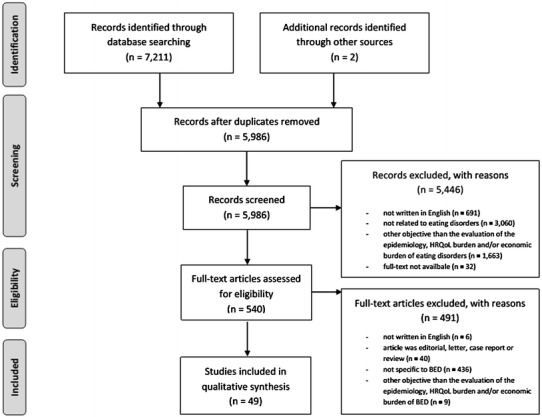
PURPOSE: To perform a systematic review on the epidemiology, the health-related quality of life (HRQoL) and economic burden of binge eating disorder (BED). METHODS: A systematic literature search of English-language articles was conducted using Medline, Embase, PsycINFO, PsycARTICLES, Academic Search Complete, CINAHL Plus, Business Source Premier and Cochrane Library. Literature search on epidemiology was limited to studies published between 2009 and 2013. Cost data were inflated and converted to 2012 US$ purchasing power parities. All of the included studies were assessed for quality. RESULTS: Forty-nine articles were included. Data on epidemiology were reported in 31, HRQoL burden in 16, and economic burden in 7 studies. Diagnosis of BED was made using 4th Edition of The Diagnostic and Statistical Manual of Mental Disorders (DSM-IV) criteria in 46 studies. Lifetime prevalence of BED was 1.1-1.9% in the general population (DSM-IV). BED was associated with significant impairment in aspects of HRQoL relating to both physical and mental health; the Short Form 36 Physical and Mental Component Summary mean scores varied between 31.1 to 47.3 and 32.0 to 49.8, respectively. Compared to individuals without eating disorder, BED was related to increased healthcare utilization and costs. Annual direct healthcare costs per BED patient ranged between $2,372 and $3,731. CONCLUSIONS: BED is a serious eating disorder that impairs HRQoL and is related to increased healthcare utilization and healthcare costs. The limited literature warrants further research, especially to better understand the long-term HRQoL and economic burden of BED.
Overview
The claims and statistics of this paper haven’t been checked yet.
Free: it reads the open-access text and checks the first 5 claims that cite a source we can check. Create a free account to check every claim.
Integrity signals
Registry
Cites
Statistics
Figures
Verification
Claims the paper makes
The claims and statistics of this paper haven’t been checked yet.
Free: it reads the open-access text and checks the first 5 claims that cite a source we can check. Create a free account to check every claim.
Self-check
Percentages, sums and reported differences re-computed from the paper’s own numbers.
The self-check needs the paper’s full text.
Citations
Cites
Diagnostic and Statistical Manual of Mental Disorders
American Psychiatric Association (2013) · doi:10.1176/appi.books.9780890425596 · Cited by 116,369
Diagnostic and Statistical Manual of Mental Disorders
Williams, J. B. W., & First, M. (2013) · Encyclopedia of Social Work · doi:10.1093/acrefore/9780199975839.013.104 · Cited by 109,519
Preferred Reporting Items for Systematic Reviews and Meta-Analyses: the PRISMA statement
Moher, D., Liberati, A., Tetzlaff, J., Altman, D. G., & for the PRISMA Group (2009) · BMJ · doi:10.1136/bmj.b2535 · Cited by 83,823
Preferred reporting items for systematic reviews and meta-analyses: the PRISMA Statement.
(2009) · PubMed Central · Cited by 44,859
Preferred reporting items for systematic reviews and meta-analyses: The PRISMA statement
Moher, D., Liberati, A., Tetzlaff, J., Altman, D. G., & the PRISMA Group* (2009) · Annals of Internal Medicine · doi:10.7326/0003-4819-151-4-200908180-00135 · Cited by 37,554
von Elm, E., Altman, D. G., Egger, M., Pocock, S. J., Gøtzsche, P. C., Vandenbroucke, J. P., & Initiative, F. T. S. (2007) · PLoS Medicine · doi:10.1371/journal.pmed.0040296 · Cited by 23,020
Preferred Reporting Items for Systematic Reviews and Meta-Analyses: The PRISMA Statement
Moher, D., Liberati, A., Tetzlaff, J., & Altman, D. G. (2009) · Journal of Clinical Epidemiology · doi:10.1016/j.jclinepi.2009.06.005 · Cited by 19,575
von Elm, E., Altman, D. G., Egger, M., Pocock, S. J., Gøtzsche, P. C., & Vandenbroucke, J. P. (2008) · Journal of Clinical Epidemiology · doi:10.1016/j.jclinepi.2007.11.008 · Cited by 17,893
von Elm, E., Altman, D. G., Egger, M., Pocock, S. J., Gøtzsche, P. C., Vandenbroucke, J. P., & Initiative, F. T. S. (2007) · Annals of Internal Medicine · doi:10.7326/0003-4819-147-8-200710160-00010 · Cited by 17,796
Diagnostic and Statistical Manual of Mental Disorders, Fourth Edition, Text Revision (DSM-IV-TR)
American Psychiatric Association (2000) · doi:10.1176/appi.books.9780890423349 · Cited by 11,069
von Elm, E., Altman, D. G., Egger, M., Pocock, S. J., Gøtzsche, P. C., & Vandenbroucke, J. P. (2014) · International Journal of Surgery · doi:10.1016/j.ijsu.2014.07.013 · Cited by 9,909
The prevalence and correlates of eating disorders in the National Comorbidity Survey Replication
Hudson, J. I., Hiripi, E., Pope, H. G., & Kessler, R. C. (2007) · Biological Psychiatry · doi:10.1016/j.biopsych.2006.03.040 · Cited by 4,973 · cited 1×
“[1] reported that using the proposed DSM-5 criteria instead DSM-IV criteria might increase the lifetime prevalence of BED with 2.”
MethodSwanson, S. A., Crow, S. J., Le Grange, D., Swendsen, J., & Merikangas, K. R. (2011) · Archives of General Psychiatry · doi:10.1001/archgenpsychiatry.2011.22 · Cited by 1,611 · cited 7×
“Some research did focus on suicidal ideations and attempts of patients with BED [4, 22, 44].”
BackgroundResultInfluentialKessler, R. C., Berglund, P. A., Chiu, W. T., Deitz, A. C., Hudson, J. I., Shahly, V., Aguilar-Gaxiola, S., Alonso, J., Angermeyer, M. C., Benjet, C., et al. (2013) · Biological Psychiatry · doi:10.1016/j.biopsych.2012.11.020 · Cited by 1,338
Stice, E., Marti, C. N., & Rohde, P. (2013) · Journal of Abnormal Psychology · doi:10.1037/a0030679 · Cited by 822 · cited 4×
“A sample of 496 adolescent females over an 8-year period found the incidence of BED (DSM-5) to be 343 per 100,000 person-years [16].”
BackgroundMethodInfluentialMarques, L., Alegria, M., Becker, A. E., Chen, C., Fang, A., Chosak, A., & Diniz, J. B. (2011) · International Journal of Eating Disorders · doi:10.1002/eat.20787 · Cited by 564 · cited 4×
“[13] examined mental health service utilization for differences among ethnic groups.”
BackgroundInfluentialThe epidemiology of eating disorders in six European countries: results of the ESEMeD-WMH project.
Preti, A., Girolamo, G. D., Vilagut, G., Alonso, J., Graaf, R. D., Bruffaerts, R., Demyttenaere, K., Pinto-Meza, A., Haro, J. M., & Morosini, P. (2009) · Journal of Psychiatric Research · doi:10.1016/j.jpsychires.2009.04.003 · Cited by 456 · cited 5×
“5–6 times more prevalent among females than males [3, 4, 21].”
BackgroundInfluentialPsychiatric disorders of patients seeking obesity treatment
Lin, H.-Y., Huang, C.-K., Tai, C.-M., Lin, H.-Y., Kao, Y.-H., Tsai, C.-C., Hsuan, C.-F., Lee, S.-L., Chi, S.-C., & Yen, Y.-C. (2013) · BMC Psychiatry · doi:10.1186/1471-244x-13-1 · Cited by 349 · cited 2×
“Point prevalence rate for BED was reported in 22 studies [12, 14, 20–39], 12-month prevalence rate in 4 studies [2– 4, 13] and lifetime prevalence rate in 11 studies [2–4, 13, 16, 17, 21, 36, 40–42].”
BackgroundMethodThe clinical significance of binge eating disorder
Wilfley, D. E., Wilson, G. T., & Agras, W. S. (2003) · International Journal of Eating Disorders · doi:10.1002/eat.10209 · Cited by 265 · cited 1×
“than anorexia nervosa (AN) and bulimia nervosa (BN) [1– 4], resulting in a clinically significant disorder [5].”
BackgroundBinge eating disorder in extreme obesity
Hsu, L., Mulliken, B., McDonagh, B., Krupa Das, S., Rand, W., Fairburn, C., Rolls, B., McCrory, M., Saltzman, E., Shikora, S., et al. (2002) · International Journal of Obesity · doi:10.1038/sj.ijo.0802081 · Cited by 204 · cited 3×
“AN, BN, BED DSM-IV BED 22 - 86% - not published between 2009 and 2013 TOTAL 1,439 23.4(6.8) 63% 22.6(3.4) Easter, 2013 [27] UK CS 2010- 2012 AN, BN, BED, EDNOS DSM-IV EDDS BED 13 - - - 6-12 months prior the pregnancy: 0.1% during pregnancy: 1.8% n.a. n.a. TOTAL (pregnants) 739 30.5(5.8) 100% 23.8(4.7) Faulconbridge, 2…”
BackgroundInfluentialCorrelations between binge eating and emotional eating in a sample of overweight subjects
Ricca, V., Castellini, G., Lo Sauro, C., Ravaldi, C., Lapi, F., Mannucci, E., Rotella, C. M., & Faravelli, C. (2009) · Appetite · doi:10.1016/j.appet.2009.07.008 · Cited by 201 · cited 5×
“Among subgroups of BED, obese BED patients had significantly worse HRQoL than non-obese BED patients (Table 1) [14, 34, 49].”
BackgroundMethodInfluentialHealth service utilization for eating disorders: Findings from a community‐based study
Mond, J. M., Hay, P. J., Rodgers, B., & Owen, C. (2007) · International Journal of Eating Disorders · doi:10.1002/eat.20382 · Cited by 192 · cited 3×
“Mond [54] BED sample (n): 20 Lifetime service use (%)”
BackgroundAssessing quality of life in eating disorder patients
Mond, J. M., Owen, C., Hay, P. J., Rodgers, B., & Beumont, P. J. V. (2005) · Quality of Life Research · doi:10.1007/s11136-004-2657-y · Cited by 187 · cited 7×
“2) Mond [49] SF-12 BED 10 SF-12 PCS: 40.”
BackgroundMethodInfluentialHealth-Related Quality of Life in Morbidly Obese Patients: Effect of Gastric Bypass Surgery
de Zwaan, M., Lancaster, K. L., Mitchell, J. E., Howell, L. M., Monson, N., Roerig, J. L., & Crosby, R. D. (2002) · Obesity Surgery · doi:10.1381/096089202320995547 · Cited by 172 · cited 3×
“%*) n.a. n.a. TOTAL (obese individuals) 157 41.0(10.4) 73% 47.1(5.7) First author, publication year Country Study design Study year Included eating disorders Diagnostic criteria of BED Diagnostic method of BED Sample Sample size Sample age range/ mean(SD) Percentage of female BMI range/ mean(SD) Point 12-month Lifetim…”
MethodInfluentialA comparison of quality of life in obese individuals with and without binge eating disorder
Rieger, E., Wilfley, D. E., Stein, R. I., Marino, V., & Crow, S. J. (2005) · International Journal of Eating Disorders · doi:10.1002/eat.20101 · Cited by 164 · cited 4×
“An obesity-specific measure was used in 5 studies (Impact of Weight on Quality of Life Lite (IWQOL-LITE) [18, 45, 51, 52] and Obesity Related WellBeing (ORWELL) [34]).”
MethodInfluentialPrevalence and correlates of eating disorders in 875 patients with bipolar disorder
McElroy, S. L., Frye, M. A., Hellemann, G., Altshuler, L., Leverich, G. S., Suppes, T., Keck, P. E., Nolen, W. A., Kupka, R., & Post, R. M. (2011) · Journal of Affective Disorders · doi:10.1016/j.jad.2010.06.037 · Cited by 162 · cited 3×
“BED is found to co-occur with several mental (anxiety, depression, obsessive–compulsive disorder) and somatic disorders (diabetes, hypertension) [2, 36, 40].”
BackgroundMethodDoll, H., Petersen, S., & Stewart-Brown, S. L. (2005) · Quality of Life Research · doi:10.1007/s11136-004-0792-0 · Cited by 151 · cited 3×
“6 87% 35.4- 86.9/48.4 Dickerson, 2011 [53] US CS - BED, RBE DSM-IV EDE BED 50 36.4(7.3) 100% 33.4(6.1) n.a. n.a. n.a. TOTAL 100 100% Doll, 2005 [47] UK CS -”
BackgroundInfluentialRecognising the Symptoms: How Common Are Eating Disorders in Pregnancy?
Easter, A., Bye, A., Taborelli, E., Corfield, F., Schmidt, U. H., Treasure, J. L., & Micali, N. (2013) · European Eating Disorders Review · doi:10.1002/erv.2229 · Cited by 146 · cited 2×
“Pregnancy and the post-partum period may be periods of particularly high-risk for BED [12, 27, 28, 32].”
BackgroundCassin, S. E., von Ranson, K. M., Heng, K., Brar, J., & Wojtowicz, A. E. (2008) · Psychology of Addictive Behaviors · doi:10.1037/0893-164x.22.3.417 · Cited by 143 · cited 2×
“Cassin [10] ESWLS BED, AMI 54 ESWLS General life score: 16.”
BackgroundMethodWilfley, D. E., Crow, S. J., Hudson, J. I., Mitchell, J. E., Berkowitz, R. I., Blakesley, V., Walsh, B. T., & The Sibutramine Binge Eating Disorder Research Group (2008) · American Journal of Psychiatry · doi:10.1176/appi.ajp.2007.06121970 · Cited by 142 · cited 2×
“Wilfley [18] IWQOL-LITE BED, sibutramine 152 IWQOL-LITE total score: 67.”
MethodTong, J., Miao, S., Wang, J., Yang, F., Lai, H., Zhang, C., Zhang, Y., & Hsu, L. K. G. (2013) · Social Psychiatry and Psychiatric Epidemiology · doi:10.1007/s00127-013-0694-y · Cited by 133 · cited 2×
“Point prevalence rate for BED was reported in 22 studies [12, 14, 20–39], 12-month prevalence rate in 4 studies [2– 4, 13] and lifetime prevalence rate in 11 studies [2–4, 13, 16, 17, 21, 36, 40–42].”
BackgroundMethodThe health-related quality of life in eating disorders
Padierna, Á., Quintana, J. M., Aróstegui, I., González, N., & Horcajo, M. J. (2004) · Quality of Life Research · doi:10.1023/a:1008973106611 · Cited by 127 · cited 7×
“8) Padierna [50] SF-36 BED 17 SF-36 PCS: 36.”
BackgroundInfluentialTwo Measures of Health‐Related Quality of Life in Morbid Obesity
de Zwaan, M., Mitchell, J. E., Howell, L. M., Monson, N., Swan‐Kremeier, L., Roerig, J. L., Kolotkin, R. L., & Crosby, R. D. (2002) · Obesity Research · doi:10.1038/oby.2002.155 · Cited by 123 · cited 2×
“%*) n.a. n.a. TOTAL (obese individuals) 157 41.0(10.4) 73% 47.1(5.7) First author, publication year Country Study design Study year Included eating disorders Diagnostic criteria of BED Diagnostic method of BED Sample Sample size Sample age range/ mean(SD) Percentage of female BMI range/ mean(SD) Point 12-month Lifetim…”
InfluentialWhite, S., Reynolds-Malear, J. B., & Cordero, E. (2011) · Eating Disorders · doi:10.1080/10640266.2011.584805 · Cited by 113
Eating disturbances among adolescent schoolgirls in Jordan
Mousa, T. Y., Al-Domi, H. A., Mashal, R. H., & Jibril, M. (2009) · Appetite · doi:10.1016/j.appet.2009.10.008 · Cited by 109
DSM‐5 reduces the proportion of ednos cases: Evidence from community samples
Machado, P. P. P., Gonçalves, S., & Hoek, H. W. (2013) · International Journal of Eating Disorders · doi:10.1002/eat.22040 · Cited by 107 · cited 2×
“6 % (in a sample of female high school and university students) [31] to 1.”
BackgroundMethodCourse and predictors of maternal eating disorders in the postpartum period
Berg, C. K., Holle, A. F. V., Zerwas, S. C., Torgersen, L., Tambs, K., Stoltenberg, C., Bulik, C. M., & Reichborn‐Kjennerud, T. (2013) · International Journal of Eating Disorders · doi:10.1002/eat.22088 · Cited by 94 · cited 2×
“The sample sizes of the included studies ranged from 31 [19] to 77,807 [12], with a mean ages from 13.”
BackgroundEating disorders in patients with obsessive–compulsive disorder: Prevalence and clinical correlates
Sallet, P. C., de Alvarenga, P. G., Ferrão, Y., de Mathis, M. A., Torres, A. R., Marques, A., Hounie, A. G., Fossaluza, V., do Rosario, M. C., Fontenelle, L. F., et al. (2010) · International Journal of Eating Disorders · doi:10.1002/eat.20697 · Cited by 93 · cited 2×
“BED is found to co-occur with several mental (anxiety, depression, obsessive–compulsive disorder) and somatic disorders (diabetes, hypertension) [2, 36, 40].”
BackgroundTrace, S. E., Thornton, L. M., Root, T. L., Mazzeo, S. E., Lichtenstein, P., Pedersen, N. L., & Bulik, C. M. (2012) · International Journal of Eating Disorders · doi:10.1002/eat.20955 · Cited by 91
Alexithymia and Suicide Ideation in a Sample of Patients with Binge Eating Disorder
Carano, A., De Berardis, D., Campanella, D., Serroni, N., Ferri, F., Di Iorio, G., Acciavatti, T., Mancini, L., Mariani, G., Martinotti, G., et al. (2012) · Journal of Psychiatric Practice · doi:10.1097/01.pra.0000410982.08229.99 · Cited by 91 · cited 2×
“Some research did focus on suicidal ideations and attempts of patients with BED [4, 22, 44].”
BackgroundResultBy how much will the proposed new DSM‐5 criteria increase the prevalence of binge eating disorder?
Hudson, J. I., Coit, C. E., Lalonde, J. K., & Pope, H. G. (2012) · International Journal of Eating Disorders · doi:10.1002/eat.20890 · Cited by 90 · cited 5×
“Diagnosis of BED was made using DSM-IV criteria in 44 [2–4, 10, 12–15, 17–20, 22–30, 32–41, 43–55], using the proposed DSM-5 criteria in 3 [11, 16, 31], and using both DSM-IV and the proposed DSM-5 criteria in 2 studies [21, 42].”
BackgroundMethodInfluentialZahodne, L. B., Susatia, F., Bowers, D., Ong, T. L., Jacobson, C. E., Okun, M. S., Rodriguez, R. L., Malaty, I. A., Foote, K. D., & Fernandez, H. H. (2011) · Journal of Neuropsychiatry · doi:10.1176/appi.neuropsych.23.1.56 · Cited by 87 · cited 2×
“Point prevalence rate for BED was reported in 22 studies [12, 14, 20–39], 12-month prevalence rate in 4 studies [2– 4, 13] and lifetime prevalence rate in 11 studies [2–4, 13, 16, 17, 21, 36, 40–42].”
BackgroundMethodAnderson, C., & Petrie, T. A. (2012) · Research Quarterly for Exercise and Sport · doi:10.1080/02701367.2012.10599833 · Cited by 83 · cited 2×
“Point prevalence rate for BED was reported in 22 studies [12, 14, 20–39], 12-month prevalence rate in 4 studies [2– 4, 13] and lifetime prevalence rate in 11 studies [2–4, 13, 16, 17, 21, 36, 40–42].”
BackgroundMethodFactors associated with binge eating disorder in pregnancy
Knoph Berg, C., Torgersen, L., Von Holle, A., Hamer, R. M., Bulik, C. M., & Reichborn‐Kjennerud, T. (2011) · International Journal of Eating Disorders · doi:10.1002/eat.20797 · Cited by 75 · cited 2×
“pregnancy may not only facilitate the recurrence of BED, but even contribute to its onset [28].”
BackgroundDoes Binge Eating Disorder Impact Weight‐Related Quality of Life?
Kolotkin, R. L., Westman, E. C., Østbye, T., Crosby, R. D., Eisenson, H. J., & Binks, M. (2004) · Obesity Research · doi:10.1038/oby.2004.122 · Cited by 71 · cited 3×
“First author, publication year Country Study design Study year Included eating disorders Diagnostic criteria of BED Diagnostic method of BED Sample Sample size Sample age range/ mean(SD) Percentage of female BMI range/ mean(SD) Point 12-month Lifetime Knoph, 2013 [12] Norway LS (36 months) 1998- 2008 AN, BN, BED, EDNO…”
MethodInfluentialLundgren, J. D., Rempfer, M. V., Brown, C. E., Goetz, J., & Hamera, E. (2010) · Psychiatry Research · doi:10.1016/j.psychres.2008.10.027 · Cited by 70 · cited 3×
“serious mental illness [30], 13.”
BackgroundMethodPerez, M., & Warren, C. S. (2012) · Obesity · doi:10.1038/oby.2011.89 · Cited by 63
Eating Disorders and Trauma History in Women with Perinatal Depression
Meltzer-Brody, S. E., Zerwas, S. C., Leserman, J., Holle, A. F. V., Regis, T., & Bulik, C. M. (2011) · Journal of Women s Health · doi:10.1089/jwh.2010.2360 · Cited by 62 · cited 1×
“Pregnancy and the post-partum period may be periods of particularly high-risk for BED [12, 27, 28, 32].”
BackgroundFaulconbridge, L. F., Wadden, T. A., Thomas, J. G., Jones-Corneille, L. R., Sarwer, D. B., & Fabricatore, A. N. (2013) · Surgery for Obesity and Related Diseases · doi:10.1016/j.soard.2012.10.010 · Cited by 61
Quality of life in patients with binge eating disorder
Masheb, R. M., & Grilo, C. M. (2004) · Eating and Weight Disorders - Studies on Anorexia Bulimia and Obesity · doi:10.1007/bf03325066 · Cited by 51 · cited 3×
“In BED, both physical and mental dimensions of HRQoL were significantly below population norms, with the mental component affected more [48, 50].”
BackgroundAckard, D. M., Fulkerson, J. A., & Neumark‐Sztainer, D. (2010) · International Journal of Eating Disorders · doi:10.1002/eat.20846 · Cited by 50 · cited 3×
“Some research did focus on suicidal ideations and attempts of patients with BED [4, 22, 44].”
BackgroundResultGrenon, R., Tasca, G. A., Cwinn, E., Coyle, D., Sumner, A., Gick, M. L., & Bissada, H. (2010) · Women s Health Issues · doi:10.1016/j.whi.2010.07.004 · Cited by 44 · cited 11×
“In one Canadian study [43], the annual healthcare cost of overweight/obese women with”
BackgroundMethodInfluentialDahl, J. K., Eriksen, L., Vedul‐Kjelsås, E., Strømmen, M., Kulseng, B. E., Mårvik, R., & Holen, A. (2010) · Eating and Weight Disorders - Studies on Anorexia Bulimia and Obesity · doi:10.1007/bf03325306 · Cited by 41 · cited 1×
“4 % in a sample waiting for bariatric surgery [39] and 23.”
BackgroundAzarbad, L., Corsica, J. A., Hall, B. J., & Hood, M. M. (2009) · Eating Behaviors · doi:10.1016/j.eatbeh.2009.10.001 · Cited by 39 · cited 1×
“[24] found no significant differences in the”
Change in binge eating and binge eating disorder associated with migration from Mexico to the US
Swanson, S. A., Saito, N., Borges, G., Benjet, C., Aguilar-Gaxiola, S., Medina-Mora, M. E., & Breslau, J. (2012) · Journal of Psychiatric Research · doi:10.1016/j.jpsychires.2011.10.008 · Cited by 37 · cited 2×
“Point prevalence rate for BED was reported in 22 studies [12, 14, 20–39], 12-month prevalence rate in 4 studies [2– 4, 13] and lifetime prevalence rate in 11 studies [2–4, 13, 16, 17, 21, 36, 40–42].”
BackgroundMethodToward an Understanding of Health Services Use in Women with Binge Eating Disorder
Striegel‐Moore, R. H., Dohm, F., Wilfley, D. E., Pike, K. M., Bray, N. L., Kraemer, H. C., & Fairburn, C. G. (2004) · Obesity Research · doi:10.1038/oby.2004.96 · Cited by 31 · cited 2×
“BED is associated with a high rate of hospitalization, outpatient care, and emergency department use [55].”
BackgroundAn open trial of reboxetine in obese patients with binge eating disorder
Silveira, R. O., Zanatto, V. C., Appolinário, J. C., & Kapczinski, F. P. (2005) · Eating and Weight Disorders - Studies on Anorexia Bulimia and Obesity · doi:10.1007/bf03327498 · Cited by 30 · cited 1×
“General HRQoL measures included the Extended Satisfaction With Life Scale (ESWLS) [10], EuroQol Five Dimensional Questionnaire (EQ-5D-3L) [43], Short Form-36 (SF-36) [11, 19, 45–48, 50], Short Form-12 (SF-12) [49] or World Health Organization Brief Quality of Life Assessment (WHOQOL-BREF) [15, 49].”
MethodHealth‐service use in women with binge eating disorders
Dickerson, J. F., DeBar, L., Perrin, N. A., Lynch, F., Wilson, G. T., Rosselli, F., Kraemer, H. C., & Striegel‐Moore, R. H. (2011) · International Journal of Eating Disorders · doi:10.1002/eat.20842 · Cited by 23 · cited 6×
“US study [53] compared healthcare utilization between women with BED (DSM-IV) and recurrent binge eating (individuals with at least 1 day per week with an objective bulimic episode over a 3-month period, with no periods of binge free time greater than 2 weeks, and did not meet DSM-IV criteria for BN or BED), and evalu…”
BackgroundMethodInfluentialBedrosian, R. C., Striegel‐Moore, R. H., & Wang, C. (2010) · International Journal of Eating Disorders · doi:10.1002/eat.20844 · Cited by 16
Czarlinski, J. A., Aase, D. M., & Jason, L. A. (2011) · European Eating Disorders Review · doi:10.1002/erv.1116 · Cited by 14 · cited 2×
“Point prevalence rate for BED was reported in 22 studies [12, 14, 20–39], 12-month prevalence rate in 4 studies [2– 4, 13] and lifetime prevalence rate in 11 studies [2–4, 13, 16, 17, 21, 36, 40–42].”
BackgroundMethod
Research works printed but not linked: 2
- Canan F Gungor A Onder E Celbek G Aydin Y Alcelik A The association of binge eating disorder with glycemic control in patients with type 2 diabetes Turk Jem 2011 15 26 27
- Saka M Türker FP Bas M Metin S Yilmaz B Köseler E An examination of food craving and eating behaviour with regard to eating disorders among adolescent HealthMED 2012 6 1331 1340
Cited by
Ágh, T., Kovács, G., Supina, D., Pawaskar, M., Herman, B. K., Vokó, Z., & Sheehan, D. V. (2016) · Eating and Weight Disorders - Studies on Anorexia, Bulimia and Obesity · doi:10.1007/s40519-016-0264-x · Cited by 377
Self-citationGiel, K. E., Bulik, C. M., Fernandez-Aranda, F., Hay, P., Keski-Rahkonen, A., Schag, K., Schmidt, U., & Zipfel, S. (2022) · Nature Reviews Disease Primers · doi:10.1038/s41572-022-00344-y · Cited by 296
Striegel Weissman, R., & Rosselli, F. (2017) · Behaviour Research and Therapy · doi:10.1016/j.brat.2016.09.006 · Cited by 184
Linardon, J. (2018) · International Journal of Eating Disorders · doi:10.1002/eat.22897 · Cited by 174
Medical comorbidity of binge eating disorder
Olguín, P., Fuentes, M., Gabler, G., Guerdjikova, A. I., Keck, P. E., & McElroy, S. L. (2016) · Eating and Weight Disorders - Studies on Anorexia Bulimia and Obesity · doi:10.1007/s40519-016-0313-5 · Cited by 164
Metadata
- Authors
- Ágh, T., Kovács, G., Pawaskar, M., Supina, D., Inotai, A., & Vokó, Z.
- Affiliations
- Syreon Research Institute (Hungary) (HU)
- Takeda (United States) (US)
- Eötvös Loránd University (HU)
- Corresponding author
- Ágh, Tamás
- Venue
- Eating and Weight Disorders - Studies on Anorexia, Bulimia and Obesity
- Published
- 2015-01-09
- Volume
- 20
- Issue
- 1
- Pages
- 1-12
- ISSN
- 1124-4909 (ISSN-L)
- 1590-1262
- PMC
- PMC4349998
- OpenAlex
- W2031462388
- Cited by
- 155
- References
- 60
- Citations by year
- 2026: 5 · 2025: 14 · 2024: 15 · 2023: 12 · 2022: 18 · 2021: 11 · 2020: 12 · 2019: 16 · 2018: 17 · 2017: 10 · 2016: 16 · 2015: 9
- FWCI
- 2.49
- Type
- journal article
- Language
- en
- Open access
- hybrid
- doi.org
- Locations
- Eating and Weight Disorders - Studies on Anorexia Bulimia and Obesity (publishedVersion, cc-by)
- PubMed Central (publishedVersion, cc-by)
- PubMed (publishedVersion)
- ELTE Digital Institutional Repository (EDIT) (Eötvös Loránd University) (submittedVersion, other-oa)
- Topics
- Social Sciences › Psychology › Clinical Psychology › Eating Disorders and Behaviors
- Health Sciences › Nursing › Nutrition and Dietetics › Nutrition, Health and Food Behavior
- Health Sciences › Medicine › Public Health, Environmental and Occupational Health › Obesity, Physical Activity, Diet
- Keywords
- binge eating disorder, prevalence, health-related quality of life, economic burden, health care costs, health care utilization, eating disorders
- MeSH terms
- Health Status, Humans, Quality of Life, Prevalence, Health Care Costs, Cost of Illness, Binge-Eating Disorder
About these checks
Registry, retraction, Cites and statistics results are computed, not judged, with one exception: a printed reference that no index lists is read once by a model before it counts as a citation error. Claims are extracted by a model and kept only when their quote appears verbatim in the text; each cited source is then checked, with a model’s help, for whether it says what the claim relies on. Those verdicts can be wrong — read the claim’s quote and the cited source before relying on one.
Statistics and arithmetic are recomputed, not judged.
Confidence bands are shown only for fields calibrated on our annotated test set. None is calibrated yet, so no band is shown.
What counts as a claim ›How we measure confidence ›How we check this ›
Are you an author, or do you see a problem with this page? Request a review
Data sources
Bibliographic data: Semantic Scholar, OpenAlex, Crossref.
Contains information from the Semantic Scholar Academic Graph Datasets, made available under the ODC Attribution License (ODC-BY 1.0).
Semantic Scholar’s data is described in: Kinney, R., et al. (2023). The Semantic Scholar Open Data Platform. arXiv:2301.10140.
