

Epidemiology, health-related quality of life and economic burden of binge eating disorder: a systematic literature review
Open accessThe DOI matches its Crossref record; 60 of the 60 references it cites were found in a registry or an index.
Abstract
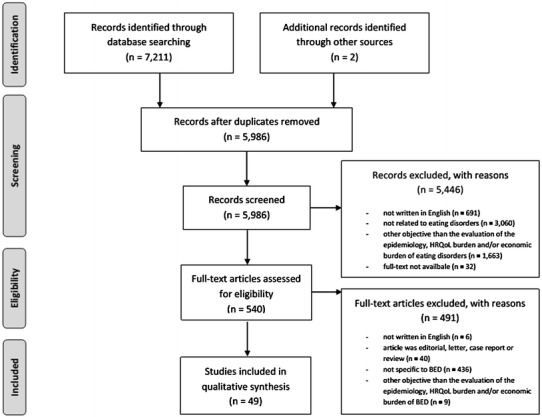
PURPOSE: To perform a systematic review on the epidemiology, the health-related quality of life (HRQoL) and economic burden of binge eating disorder (BED). METHODS: A systematic literature search of English-language articles was conducted using Medline, Embase, PsycINFO, PsycARTICLES, Academic Search Complete, CINAHL Plus, Business Source Premier and Cochrane Library. Literature search on epidemiology was limited to studies published between 2009 and 2013. Cost data were inflated and converted to 2012 US$ purchasing power parities. All of the included studies were assessed for quality. RESULTS: Forty-nine articles were included. Data on epidemiology were reported in 31, HRQoL burden in 16, and economic burden in 7 studies. Diagnosis of BED was made using 4th Edition of The Diagnostic and Statistical Manual of Mental Disorders (DSM-IV) criteria in 46 studies. Lifetime prevalence of BED was 1.1-1.9% in the general population (DSM-IV). BED was associated with significant impairment in aspects of HRQoL relating to both physical and mental health; the Short Form 36 Physical and Mental Component Summary mean scores varied between 31.1 to 47.3 and 32.0 to 49.8, respectively. Compared to individuals without eating disorder, BED was related to increased healthcare utilization and costs. Annual direct healthcare costs per BED patient ranged between $2,372 and $3,731. CONCLUSIONS: BED is a serious eating disorder that impairs HRQoL and is related to increased healthcare utilization and healthcare costs. The limited literature warrants further research, especially to better understand the long-term HRQoL and economic burden of BED.
Overview
The claims and statistics of this paper haven’t been checked yet.
Free: it reads the open-access text and checks the first 5 claims that cite a source we can check. Create a free account to check every claim.
Integrity signals
Registry
Cites
Statistics
Figures
Verification
Claims the paper makes
The claims and statistics of this paper haven’t been checked yet.
Free: it reads the open-access text and checks the first 5 claims that cite a source we can check. Create a free account to check every claim.
Self-check
Percentages, sums and reported differences re-computed from the paper’s own numbers.
The self-check needs the paper’s full text.
Citations
Cites
Diagnostic and Statistical Manual of Mental Disorders
American Psychiatric Association (2013) · doi:10.1176/appi.books.9780890425596 · Cited by 116,369
Diagnostic and Statistical Manual of Mental Disorders
Williams, J. B. W., & First, M. (2013) · Encyclopedia of Social Work · doi:10.1093/acrefore/9780199975839.013.104 · Cited by 109,519
Preferred Reporting Items for Systematic Reviews and Meta-Analyses: the PRISMA statement
Moher, D., Liberati, A., Tetzlaff, J., Altman, D. G., & for the PRISMA Group (2009) · BMJ · doi:10.1136/bmj.b2535 · Cited by 83,823
Preferred reporting items for systematic reviews and meta-analyses: the PRISMA Statement.
(2009) · PubMed Central · Cited by 44,859
Preferred reporting items for systematic reviews and meta-analyses: The PRISMA statement
Moher, D., Liberati, A., Tetzlaff, J., Altman, D. G., & the PRISMA Group* (2009) · Annals of Internal Medicine · doi:10.7326/0003-4819-151-4-200908180-00135 · Cited by 37,554
von Elm, E., Altman, D. G., Egger, M., Pocock, S. J., Gøtzsche, P. C., Vandenbroucke, J. P., & Initiative, F. T. S. (2007) · PLoS Medicine · doi:10.1371/journal.pmed.0040296 · Cited by 23,020
Preferred Reporting Items for Systematic Reviews and Meta-Analyses: The PRISMA Statement
Moher, D., Liberati, A., Tetzlaff, J., & Altman, D. G. (2009) · Journal of Clinical Epidemiology · doi:10.1016/j.jclinepi.2009.06.005 · Cited by 19,575
von Elm, E., Altman, D. G., Egger, M., Pocock, S. J., Gøtzsche, P. C., & Vandenbroucke, J. P. (2008) · Journal of Clinical Epidemiology · doi:10.1016/j.jclinepi.2007.11.008 · Cited by 17,893
von Elm, E., Altman, D. G., Egger, M., Pocock, S. J., Gøtzsche, P. C., Vandenbroucke, J. P., & Initiative, F. T. S. (2007) · Annals of Internal Medicine · doi:10.7326/0003-4819-147-8-200710160-00010 · Cited by 17,796
Diagnostic and Statistical Manual of Mental Disorders, Fourth Edition, Text Revision (DSM-IV-TR)
American Psychiatric Association (2000) · doi:10.1176/appi.books.9780890423349 · Cited by 11,069
Research works printed but not linked: 2
- Canan F Gungor A Onder E Celbek G Aydin Y Alcelik A The association of binge eating disorder with glycemic control in patients with type 2 diabetes Turk Jem 2011 15 26 27
- Saka M Türker FP Bas M Metin S Yilmaz B Köseler E An examination of food craving and eating behaviour with regard to eating disorders among adolescent HealthMED 2012 6 1331 1340
Cited by
Ágh, T., Kovács, G., Supina, D., Pawaskar, M., Herman, B. K., Vokó, Z., & Sheehan, D. V. (2016) · Eating and Weight Disorders - Studies on Anorexia, Bulimia and Obesity · doi:10.1007/s40519-016-0264-x · Cited by 377
Self-citationGiel, K. E., Bulik, C. M., Fernandez-Aranda, F., Hay, P., Keski-Rahkonen, A., Schag, K., Schmidt, U., & Zipfel, S. (2022) · Nature Reviews Disease Primers · doi:10.1038/s41572-022-00344-y · Cited by 296
Striegel Weissman, R., & Rosselli, F. (2017) · Behaviour Research and Therapy · doi:10.1016/j.brat.2016.09.006 · Cited by 184
Linardon, J. (2018) · International Journal of Eating Disorders · doi:10.1002/eat.22897 · Cited by 174
Medical comorbidity of binge eating disorder
Olguín, P., Fuentes, M., Gabler, G., Guerdjikova, A. I., Keck, P. E., & McElroy, S. L. (2016) · Eating and Weight Disorders - Studies on Anorexia Bulimia and Obesity · doi:10.1007/s40519-016-0313-5 · Cited by 164
Neural signature of food reward processing in bulimic-type eating disorders
Simon, J. J., Skunde, M., Walther, S., Bendszus, M., Herzog, W., & Friederich, H.-C. (2016) · Social Cognitive and Affective Neuroscience · doi:10.1093/scan/nsw049 · Cited by 125
“BED patients exhibit no compensatory behaviors, overweight or obesity in the long term occurs in the majority of cases (Ágh et al., 2015).”
BackgroundMarzilli, E., Cerniglia, L., & Cimino, S. (2018) · Adolescent Health, Medicine and Therapeutics · doi:10.2147/ahmt.s148050 · Cited by 107
Shobeiri, P., Kalantari, A., Teixeira, A. L., & Rezaei, N. (2022) · Biology of Sex Differences · doi:10.1186/s13293-022-00422-6 · Cited by 125
Development of the 7-Item Binge-Eating Disorder Screener (BEDS-7)
Herman, B. K., Deal, L. S., DiBenedetti, D. B., Nelson, L. M., Fehnel, S. E., & Brown, T. M. (2016) · The Primary Care Companion For CNS Disorders · doi:10.4088/pcc.15m01896 · Cited by 92
Epidemiology of binge eating disorder
Erskine, H. E., & Whiteford, H. A. (2018) · Current Opinion in Psychiatry · doi:10.1097/yco.0000000000000449 · Cited by 89
Overview of the treatment of binge eating disorder
McElroy, S. L., Guerdjikova, A. I., Mori, N., Munoz, M. R., & Keck, P. E. (2015) · CNS Spectrums · doi:10.1017/s1092852915000759 · Cited by 82
Appolinário, J. C., Sichieri, R., Lopes, C. D. S., de Moraes, C. E. F., da Veiga, G. V., de Freitas, S. R., Nunes, M. A., Wang, Y., & Hay, P. (2022) · Social Psychiatry and Psychiatric Epidemiology · doi:10.1007/s00127-022-02223-z · Cited by 99
The epidemiology and genetics of binge eating disorder (BED)
Davis, C. (2015) · CNS Spectrums · doi:10.1017/s1092852915000462 · Cited by 79
“In the former case, as with other eating disorders such as anorexia nervosa and bulimia nervosa, there is a pronounced female bias, although the differences are typically not as large in BED(18,28) and vary from approximately a 2:1 to a 6:1 ratio.(29)While there is little doubt that some of these male–female differenc…”
BackgroundGhaderi, A., Odeberg, J., Gustafsson, S., Råstam, M., Brolund, A., Pettersson, A., & Parling, T. (2018) · PeerJ · doi:10.7717/peerj.5113 · Cited by 79
E-Health Interventions for Eating Disorders: Emerging Findings, Issues, and Opportunities
Aardoom, J. J., Dingemans, A. E., & van Furth, E. F. (2016) · Current Psychiatry Reports · doi:10.1007/s11920-016-0673-6 · Cited by 99
The prevalence, correlates, and help-seeking of eating disorders in Switzerland
Mohler-Kuo, M., Schnyder, U., Dermota, P., Wei, W., & Milos, G. (2016) · Psychological Medicine · doi:10.1017/s0033291716001136 · Cited by 76
“As concluded in a recent systematic review (Agh et al. 2015), BED is a serious ED that significantly impairs quality of life in both the physical and mental domains and is associated with increases in both healthcare utilization and costs.”
BackgroundStress-induced eating in women with binge-eating disorder and obesity
Klatzkin, R. R., Gaffney, S., Cyrus, K., Bigus, E., & Brownley, K. A. (2016) · Biological Psychology · doi:10.1016/j.biopsycho.2016.11.002 · Cited by 95
“BED is more common than anorexia nervosa and bulimia nervosa and represents an equally substantial, if not greater, public health burden with respect to physical healthrelated quality of life, psychiatric comorbidity, and the stable and chronic nature of the disorder (Ágh et al., 2015; Hudson et al., 2007).”
InfluentialPrefrontal Cortical Opioids and Dysregulated Motivation: A Network Hypothesis
Baldo, B. A. (2016) · Trends in Neurosciences · doi:10.1016/j.tins.2016.03.004 · Cited by 76
“Collectively, drug or behavioral addictions, eating disorders, and other ‘disorders of motivational regulation’ exact a serious toll in public health [5,6].”
BackgroundTregarthen, J., Paik Kim, J., Sadeh-Sharvit, S., Neri, E., Welch, H., & Lock, J. (2019) · JMIR Mental Health · doi:10.2196/14972 · Cited by 67
“Recent systematic reviews found that as few as 23% of people with a diagnosable ED seek conventional treatment [5], and about only 1 in 10 individuals with this illness receive treatment [7].”
Binge Eating Disorder in Patients with Type 2 Diabetes: Diagnostic and Management Challenges
Chevinsky, J. D., Wadden, T. A., & Chao, A. M. (2020) · Diabetes Metabolic Syndrome and Obesity · doi:10.2147/dmso.s213379 · Cited by 79
Systematic review of the effects of acute stress in binge eating disorder
Naish, K. R., Laliberte, M., MacKillop, J., & Balodis, I. M. (2019) · European Journal of Neuroscience · doi:10.1111/ejn.14110 · Cited by 55
“BED is associated with both physical and psychiatric comorbidities, and it is estimated that 1–2% of the population meet the criteria for the disorder at some point during their lifetime (for a review, see Agh et al., 2015).”
BackgroundZeidan, R. K., Haddad, C., Hallit, R. R., Akel, M., Honein, K., Akiki, M., Kheir, N., Hallit, S. R., & Obeïd, S. (2019) · Journal of Eating Disorders · doi:10.1186/s40337-019-0270-2 · Cited by 65
Shame and binge eating pathology: A systematic review
O’Loghlen, E., Grant, S., & Galligan, R. F. (2021) · Clinical Psychology & Psychotherapy · doi:10.1002/cpp.2615 · Cited by 79
Schag, K., Rennhak, S. K., Leehr, E. J., Skoda, E.-M., Becker, S., Bethge, W., Martus, P., Zipfel, S., & Giel, K. E. (2019) · Psychotherapy and Psychosomatics · doi:10.1159/000499696 · Cited by 57
The economic cost of bulimia nervosa and binge eating disorder: a population-based study
Tannous, K., Hay, P., Girosi, F., Heriseanu, A. I., Ahmed, M. U., & Touyz, S. W. (2021) · Psychological Medicine · doi:10.1017/s0033291721000775 · Cited by 57
“Althoughmany studies of the health burden of EDs have only female participants (Agh et al., 2015, 2016; Dickerson et al., 2011; Grenon et al., 2010; Le et al., 2018; Mitchell et al., 2009; Stuhldreher et al., 2012), recent research has demonstrated an increase in the health burden of ED behaviour…”
BackgroundInfluentialLisdexamfetamine: A Review in Binge Eating Disorder
Heo, Y., & Duggan, S. T. (2017) · CNS Drugs · doi:10.1007/s40263-017-0477-1 · Cited by 66
Ruckwongpatr, K., Fung, X. C. C., Lin, C., Latner, J. D., & O’Brien, K. (2021) · American Journal of Health Behavior · doi:10.5993/ajhb.45.5.3 · Cited by 63
Epidemiology and Recognition of Binge-Eating Disorder in Psychiatry and Primary Care
Kornstein, S. G. (2017) · The Journal of Clinical Psychiatry · doi:10.4088/jcp.sh16003su1c.01 · Cited by 46
The Impact of Impulsivity on Weight Loss Four Years After Bariatric Surgery
Schag, K., Mack, I., Giel, K., Ölschläger, S., Skoda, E.-M., Von Feilitzsch, M., Zipfel, S., & Teufel, M. (2016) · Nutrients · doi:10.3390/nu8110721 · Cited by 45
König, H., Bleibler, F., Friederich, H., Herpertz, S., Lam, T., Mayr, A., Schmidt, F., Svaldi, J., Zipfel, S., Brettschneider, C., et al. (2018) · International Journal of Eating Disorders · doi:10.1002/eat.22822 · Cited by 45
“Although BED is a clinically significant disorder (Wilfley, Wilson, & Agras, 2003), associated with increased healthcare utilization (Agh et al., 2015) and impaired work productivity (Striegel, Bedrosian, & Wang, 2012), only a minority of patients receive specific treatment (Agh et al.”
BackgroundInfluentialSingleton, C., Kenny, T. E., Hallett, D., & Carter, J. C. (2019) · Frontiers in Psychology · doi:10.3389/fpsyg.2019.00209 · Cited by 44
Wyssen, A., Meyer, A. H., Messerli‐Bürgy, N., Forrer, F., Vanhulst, P., Lalanne, D., & Munsch, S. (2021) · European Eating Disorders Review · doi:10.1002/erv.2856 · Cited by 44
Grilo, C. M., McElroy, S. L., Hudson, J. I., Tsai, J., NAVIA, B. A., GOLDMAN, R. S., Deng, L., KENT, J. M., & Loebel, A. D. (2020) · CNS Spectrums · doi:10.1017/s1092852920001406 · Cited by 47
Night eating among veterans with obesity
Dorflinger, L. M., Ruser, C. B., & Masheb, R. M. (2017) · Appetite · doi:10.1016/j.appet.2017.07.011 · Cited by 44
“For example, binge eating, which tends to be more prevalent among women and 231 younger individuals (31,32), is also highly prevalent among veterans (33,34), and has been 232 associated with poorer outcomes among veterans engaging in weight management treatment 233 (35).”
BackgroundPruessner, L., Timm, C., Barnow, S., Rubel, J. A., Lalk, C., & Hartmann, S. F. (2024) · JAMA Network Open · doi:10.1001/jamanetworkopen.2024.11127 · Cited by 47
Spierling, S. R., Kreisler, A. D., Williams, C. A., Fang, S. Y., Pucci, S. N., Kines, K. T., & Zorrilla, E. P. (2018) · Physiology & Behavior · doi:10.1016/j.physbeh.2018.04.001 · Cited by 37
“In the full model with both sexes, a significant Group X Day Interaction (F(2,550)=556.”
BackgroundMethodInfluentialQuality of life and eating attitudes of health care students
Costa, D. G., Carleto, C. T., Santos, V. S., Haas, V. J., Gonçalves, R. M. D. D. A., & Pedrosa, L. A. K. (2018) · Revista Brasileira de Enfermagem · doi:10.1590/0034-7167-2017-0224 · Cited by 56
Max, S. M., Plewnia, C., Zipfel, S., Giel, K. E., & Schag, K. (2020) · European Archives of Psychiatry and Clinical Neuroscience · doi:10.1007/s00406-020-01164-5 · Cited by 47
Vollert, B., Beintner, I., Musiat, P., Gordon, G., Görlich, D., Nacke, B., Schmidt-Hantke, J., Potterton, R., Spencer, L., Grant, N., et al. (2019) · Internet Interventions · doi:10.1016/j.invent.2018.02.010 · Cited by 35
Bhattacharya, A., DeFilipp, L., & Timko, C. A. (2020) · Handbook of clinical neurology · doi:10.1016/b978-0-444-64123-6.00026-6 · Cited by 53
Shenoy, S., & Praharaj, S. K. (2019) · Asian Journal of Psychiatry · doi:10.1016/j.ajp.2019.07.017 · Cited by 41
Emotion regulation and mental well-being before and six months after bariatric surgery
Efferdinger, C., König, D., Klaus, A., & Jagsch, R. (2017) · Eating and Weight Disorders - Studies on Anorexia Bulimia and Obesity · doi:10.1007/s40519-017-0379-8 · Cited by 42
“Binge eating disorder in turn is associated with higher rates of psychological impairment such as depression [42] and with markedly affected HrQoL [43], thus making its assessment and consideration even more relevant.”
BackgroundNobles, C. J., Thomas, J. J., Valentine, S. E., Gerber, M. W., Vaewsorn, A. S., & Marques, L. M. (2016) · International Journal of Eating Disorders · doi:10.1002/eat.22539 · Cited by 43
“Young women are disproportionately affected by bulimia nervosa (BN) and binge-eating disorder (BED), disorders which increase the risk of chronic health problems (1, 2), reduce quality of life (3), and increase the risk of suicide attempts (4) and mortality (5).”
BackgroundPerko, V. L., Forbush, K. T., Siew, C. S. Q., & Tregarthen, J. (2019) · International Journal of Eating Disorders · doi:10.1002/eat.23170 · Cited by 34
Schmidt-Hantke, J., Vollert, B., Hagner, F., Beintner, I., Hütter, K., Nitsch, M., Jacobi, C., & Waldherr, K. (2021) · European Journal of Public Health · doi:10.1093/eurpub/ckab057 · Cited by 29
Bagaric, M., Touyz, S. W., Heriseanu, A. I., Conti, J., & Hay, P. (2020) · European Eating Disorders Review · doi:10.1002/erv.2726 · Cited by 37
Investigational drugs for the treatment of binge eating disorder (BED): an update
Appolinário, J. C., Nardi, A. E., & McElroy, S. L. (2019) · Expert Opinion on Investigational Drugs · doi:10.1080/13543784.2019.1692813 · Cited by 31
“ciated with reduced quality of life, disability, and increased health service utilization [10].”
BackgroundGkintoni, E., Κουρκούτας, Η., Vassilopoulos, S. P., & Mousi, M. (2024) · Journal of Clinical Medicine · doi:10.3390/jcm13144084 · Cited by 38
Woldeyohannes, H. O., Soczynska, J. K., Maruschak, N. A., Syeda, K., Wium‐Andersen, I. K., Lee, Y. L., Cha, D. S., Xiao, H. X., Gallaugher, L. A., Dale, R. M., et al. (2015) · Obesity Research & Clinical Practice · doi:10.1016/j.orcp.2015.10.002 · Cited by 28
“Binge eating disorder (BED) is the most common eating disorder among adults in the United States [1].”
BackgroundPilot study of the prevalence of binge eating disorder in non-alcoholic fatty liver disease patients
Zhang, J., Abbasi, O., Malevanchik, L., Mohan, N., Denicola, R., Tarangelo, N., & Marzio, D. H.-D. (2017) · Annals of Gastroenterology · doi:10.20524/aog.2017.0200 · Cited by 33
“In addition, patients with BED have been found to have a lower health-related quality of life and increased healthcare costs when compared to non-BED patients [11].”
BackgroundTreating Binge Eating Disorder With Physical Exercise: A Systematic Review and Meta-analysis
Raisi, A., Zerbini, V., Piva, T., Murri, M. B., Menegatti, E., Caruso, L., Masotti, S., Grazzi, G., Mazzoni, G., & Mandini, S. (2023) · Journal of Nutrition Education and Behavior · doi:10.1016/j.jneb.2023.03.010 · Cited by 34
Davis, C. A., Levitan, R. D., Kaplan, A. S., Carter, J. C., & Kennedy, J. L. (2015) · International Journal of Eating Disorders · doi:10.1002/eat.22493 · Cited by 26
Reward and Inhibitory Control as Mechanisms and Treatment Targets for Binge Eating Disorder
Pasquale, E. K., Boyar, A., & Boutelle, K. N. (2024) · Current Psychiatry Reports · doi:10.1007/s11920-024-01534-z · Cited by 31
Maranhão, M. F., Estella, N. M., Cury, M. E. G., Lastoria, V., Picasso, C. M., Berberian, A. D. A., Campbell, I. C., Schmidt, U. H., & Claudino, A. M. (2015) · BMC Psychiatry · doi:10.1186/s12888-015-0569-8 · Cited by 26
“(both physical and mental health) [4, 7].”
BackgroundGoode, R. W., Webster, C. K., & Gwira, R. (2022) · Current Psychiatry Reports · doi:10.1007/s11920-022-01383-8 · Cited by 27
Global and Regional Economic Burden of Eating Disorders: A Systematic Review and Critique of Methods
Ahmed, M. U., Islam, M. D., Aouad, P., Miskovic‐Wheatley, J., Touyz, S. W., Maguire, S., & Cunich, M. M. (2024) · International Journal of Eating Disorders · doi:10.1002/eat.24302 · Cited by 28
Binge Eating Disorder (BED) in Relation to Addictive Behaviors and Personality Risk Factors
Davis, C. A., Mackew, L., Levitan, R. D., Kaplan, A. S., Carter, J. C., & Kennedy, J. L. (2017) · Frontiers in Psychology · doi:10.3389/fpsyg.2017.00579 · Cited by 27
“Going forward, and given the pronounced female bias in the prevalence of BED – estimates vary from a 2:1 to a 6:1 ratio (Ágh et al., 2015) – selective recruitment will be necessary to provide balanced samples according to male–female ratios.”
BackgroundSolly, J. E., Chamberlain, S. R., Lust, K. A., & Grant, J. E. (2021) · CNS Spectrums · doi:10.1017/s1092852921000882 · Cited by 29
“treatment specifically for their eating disorder.(5,61) This may be related to low levels of recognition, as one internet-based survey found that only a small minority (3.”
BackgroundMesser, M., Fuller‐Tyszkiewicz, M., Liu, C., Anderson, C., & Linardon, J. (2024) · International Journal of Eating Disorders · doi:10.1002/eat.24213 · Cited by 18
Young adult mental health sequelae of eating and body image disturbances in adolescence
Linardon, J., Greenwood, C. J., Fuller‐Tyszkiewicz, M., Macdonald, J. A., Spry, E., Hutchinson, D. M., Youssef, G. J., Sanson, A. V., Wertheim, E. H., McIntosh, J. E., et al. (2021) · International Journal of Eating Disorders · doi:10.1002/eat.23575 · Cited by 31
Qasim, A., Mayhew, A., Ehtesham, S., Alyass, A., Volckmar, A., Herpertz, S., Hinney, A., Hebebrand, J., & Meyre, D. (2018) · Obesity Reviews · doi:10.1111/obr.12761 · Cited by 20
“Patients with BED also report comorbid mental disorders and other chronic conditions, decreased health-related quality of life and increased utilization of healthcare services (5,8).”
BackgroundKirson, D., Bagsic, S. R. S., Murphy, J., Chang, H., Vlkolinský, R., Pucci, S. N., Prinzi, J., Williams, C. A., Fang, S. Y., Roberto, M., et al. (2022) · Neuropharmacology · doi:10.1016/j.neuropharm.2022.108980 · Cited by 17
Ágh, T., Pawaskar, M. D., Nagy, B., Lachaîne, J., & Vokó, Z. (2016) · Clinical Drug Investigation · doi:10.1007/s40261-016-0381-3 · Cited by 13
“The choice of using NPT (placebo) as comparator is supported by the facts that (1) no comparative data with other intervention exist and there is no ongoing LDX clinical trial with active comparator, (2) no other drug therapy is approved for the treatment of BED in the USA, and (3) currently only a minority of BED pat…”
BackgroundMethodSelf-citationSchell, S., Brassard, S. L., & Racine, S. E. (2019) · Appetite · doi:10.1016/j.appet.2019.05.020 · Cited by 15
Binge-Eating: A Life-Threatening Eating Disorder
Mohajan, D., & Mohajan, H. K. (2023) · Innovation in Science and Technology · doi:10.56397/ist.2023.07.06 · Cited by 27
Long-term effectiveness of web-based cognitive behavioral therapy for patients with eating disorders
ter Huurne, E. D., de Haan, H. A., Postel, M. G., DeJong, C. A. J., VanDerNagel, J., & van der Palen, J. A. M. (2020) · Eating and Weight Disorders - Studies on Anorexia Bulimia and Obesity · doi:10.1007/s40519-020-00929-0 · Cited by 19
Lamontagne, S. J., Wilkin, M. M., Menard, J. L., & Olmstead, M. C. (2020) · Physiology & Behavior · doi:10.1016/j.physbeh.2020.113194 · Cited by 10
Righetti, R., Cinque, F., Volpe, M. T., & Sebastiani, G. (2024) · Expert Review of Gastroenterology & Hepatology · doi:10.1080/17474124.2024.2385487 · Cited by 13
“However, a direct correlation with the severity of MASLD has not been uniquely established [12,33–35], and there are no studies specifically examining the prevalence of MASLD or MASH in patients with binge eating disorders.”
Coimbra, M., Paixão, C., & Ferreira, C. (2021) · Eating and Weight Disorders - Studies on Anorexia Bulimia and Obesity · doi:10.1007/s40519-021-01163-y · Cited by 12
Senra, H., Gaglianone, C. G., McPherson, S., & Unterrainer, H. (2023) · Obesity Reviews · doi:10.1111/obr.13669 · Cited by 15
“…in self and interpersonal functioning With BED being an important risk factor for obesity, overweight, 1 – 4 and other mental health problems, 4,7 – 9 many obesity patients seen at obesity clinics are likely to belong to the sub-group of multimorbidity patients (obesity + BED + mental health).”
BackgroundChao, A. M., Rajagopalan, A. V., Tronieri, J. S., Walsh, O. A., & Wadden, T. A. (2019) · Journal of Nursing Scholarship · doi:10.1111/jnu.12468 · Cited by 15
“Over half of patients with BED experience impairments in role functioning (Hudson et al., 2007), and compared to individuals without BED, those with BED have worse physical and mental health-related quality of life (Ágh et al., 2015).”
BackgroundVinai, P., Ros, A. D., Cardetti, S., Halpern, C. H., Studt, S. K., Gentile, N., Tagliabue, A., Vinai, P., Vinai, P., Bruno, C., et al. (2015) · Eating and Weight Disorders - Studies on Anorexia Bulimia and Obesity · doi:10.1007/s40519-015-0218-8 · Cited by 10
“Since when the proposed DSM-5 criteria was posted for public comment in 2010, the researchers tested if the use of less restrictive criteria would lead to an increased prevalence of the syndrome [3].”
BackgroundInfluentialBrytek‐Matera, A., Touyz, S. W., & Hay, P. (2024) · European Eating Disorders Review · doi:10.1002/erv.3068 · Cited by 8
Pasquale, E. K., Strong, D. R., Manzano, M. A., Eichen, D. M., Peterson, C. B., & Boutelle, K. N. (2024) · Eating Behaviors · doi:10.1016/j.eatbeh.2024.101871 · Cited by 10
Pruessner, L., Hartmann, S. F., Rubel, J. A., Lalk, C., Barnow, S., & Timm, C. (2022) · Internet Interventions · doi:10.1016/j.invent.2022.100514 · Cited by 10
Kilpela, L. S., Marshall, V. B., Keel, P. K., LaCroix, A. Z., Espinoza, S. E., Hooper, S. C., & Musi, N. (2022) · Journal of Eating Disorders · doi:10.1186/s40337-022-00621-x · Cited by 10
“Importantly, the data used to establish this clinical frequency criterion originated from the general adult population of which most studies use an upper bound age limit of 60 or 65 [54].”
MethodKalaria, S. N., McElroy, S. L., Gobburu, J. V. S., & Gopalakrishnan, M. (2019) · Clinical and Translational Science · doi:10.1111/cts.12682 · Cited by 9
“Binge eating disorder (BED) is a psychiatric disorder characterized by recurrent and distressing binge-eating episodes, defined as eating unusually large quantities of food with a sense of lack of control over eating, without inappropriate compensatory weight loss behaviors.(9,10) BED is the most common eating disorde…”
BackgroundRom, S., Miskovic-Wheatley, J., Barakat, S., Aouad, P., Kim, M., Fuller-Tyszkiewicz, M., & Maguire, S. (2023) · Frontiers in Psychiatry · doi:10.3389/fpsyt.2023.1229261 · Cited by 7
Cross‐Cultural Validation of the Binge Eating Disorder Screener‐7 ( BEDS ‐7) Across 42 Countries
Gewirtz‐Meydan, A., Spivak‐Lavi, Z., Kraus, S. W., Nagy, L., Koós, M., Demetrovics, Z., Potenza, M. N., Ballester‐Arnal, R., Batthyány, D., Bergeron, S., et al. (2025) · International Journal of Eating Disorders · doi:10.1002/eat.24365 · Cited by 9
“When translating and applying questionnaires measuring eating disorders across different cultural contexts, challenges arise due to varying cultural norms related to food, body image, and mental health (Acle et al. 2021), which can affect how individuals interpret and respond to questions.”
Senra, H., Duarte, C., Carvalho, S. A., Simões, L., Ferreira, C., Palmeira, L., Matos, M., Cunha, M. I. V. A., Castilho, P., de Sousa, B. C., et al. (2025) · International Journal of Eating Disorders · doi:10.1002/eat.24432 · Cited by 8
Reese, E. D., Pollert, G. A., & Veilleux, J. C. (2015) · Eating Behaviors · doi:10.1016/j.eatbeh.2015.11.005 · Cited by 8
Richson, B. N., Forbush, K. T., Schaumberg, K., Crosby, R. D., Peterson, C. B., Crow, S. J., & Mitchell, J. E. (2020) · International Journal of Eating Disorders · doi:10.1002/eat.23383 · Cited by 8
Day, S., Mitchison, D., Tannous, K., Conti, J., Gill, K. H., Le, L. K., Mannan, H. R., Mihalopoulos, C., Ramjan, L. M., Rankin, R. M., et al. (2025) · International Journal of Eating Disorders · doi:10.1002/eat.24448 · Cited by 8
Horvath, S. A., Cox, S. J., Tabone, J. K., Tabone, L. E., Szoka, N. L., Abunnaja, S., & Aylward, L. (2022) · Surgery for Obesity and Related Diseases · doi:10.1016/j.soard.2022.11.003 · Cited by 7
van Riel, L., van den Berg, E. M., Polak, M., Geerts, M. M., Peen, J., Ingenhoven, T., & Dekker, J. (2023) · BMC Psychiatry · doi:10.1186/s12888-023-04626-x · Cited by 5
van Beers, E., Melisse, B., de Jonge, M., Peen, J., van den Berg, E. M., & de Beurs, E. (2024) · Frontiers in Psychiatry · doi:10.3389/fpsyt.2024.1332360 · Cited by 5
Cuzzolaro, M. (2015) · Springer eBooks · doi:10.1007/978-3-319-24532-4_8 · Cited by 8
Binge-eating disorder: emerging treatments for a new diagnosis
Tsappis, M. W., Freizinger, M., & Forman, S. F. (2016) · Current Opinion in Pediatrics · doi:10.1097/mop.0000000000000367 · Cited by 8
“Overall health-related quality of life in binge eating patients is significantly lower than noneating disorder patients and physical health-related quality of life in the BED group is lower than that of other eating disorder groups [30].”
BackgroundDahlgren, C. L., & Qvigstad, E. (2018) · Journal of Eating Disorders · doi:10.1186/s40337-018-0222-2 · Cited by 8
Li, H., Liu, C.-J., Shen, Y.-H., Zhao, L., Yin, C., Yu, J., & Mao, S.-S. (2024) · Scientific Reports · doi:10.1038/s41598-024-74395-4 · Cited by 10
Breaking the cycle: a pilot study on autonomous Digital CBTe for recurrent binge eating
Murphy, R., Khera, C., & Osborne, E. (2025) · Frontiers Digit. Health · doi:10.3389/fdgth.2024.1499350 · Cited by 6
“Bulimia nervosa and binge eating disorder co-occur with signi fi cant psychopathology, mental and physical comorbidity, and life impairment (4, 8, 10).”
Bardezard, Y. A., Khanjani, S., Asl, E. M., & Dolatshahi, B. (2021) · Iranian Journal of Psychiatry and Clinical Psychology · doi:10.32598/ijpcp.27.1.3246.1 · Cited by 11
Hildebrandt, B. A., Fisher, H., & Ahmari, S. E. (2023) · Behavioral Neuroscience · doi:10.1037/bne0000550 · Cited by 5
Gill, S. K., & Kaplan, A. S. (2020) · Eating and Weight Disorders - Studies on Anorexia Bulimia and Obesity · doi:10.1007/s40519-020-01026-y · Cited by 7
Clinical study on electroacupuncture for obese patients with binge eating disorder
Cheng, C., Liu, X., Zhu, S., Dong, C., Liu, L., Lin, W., Deng, H. W., Xu, Y., Ou, Z.-J., Lyu, W., et al. (2020) · Medicine · doi:10.1097/md.0000000000023362 · Cited by 8
“Obesity and other people with eating disorders are at higher risk than those with any single disease, [40] with about 76% of adults and 85% of adolescents suffering from mental illness, such as anxiety, substance use disorders, and other diseases, such as obesity, diabetes, and cardiovascular disease.([37]) Based on i…”
Scrandis, D. A., & Arnow, D. (2023) · The Nurse Practitioner · doi:10.1097/01.npr.0000000000000125 · Cited by 9
Binge eating disorder: epidemiological, clinical, pathophysiological, and treatment aspects
Starostina, E. G., & Ananyan, M. V. (2024) · Diabetes Mellitus · doi:10.14341/dm13122 · Cited by 5
Discounting of Hyper-Palatable Foods Is Associated with Eating Motives and Binge Eating Behavior
Bellitti, J. S., L’Insalata, A. M., & Fazzino, T. L. (2025) · Nutrients · doi:10.3390/nu17081356 · Cited by 5
“…be most robust among clinical populations with binge-spectrum disorders, both occur on a continuum among the general population [49] and are implicated in a variety of physical and mental health consequences such as insulin resistance (pre-diabetes), obesity, mood disturbances, and anxiety [50–53].”
Resurgence of Eating Disorders with Olanzapine
Wu, K. L., Lorenz, A. K., Christensen, K., Feely, M. A., Carey, E. C., & Strand, J. J. (2018) · Journal of Palliative Medicine · doi:10.1089/jpm.2018.0364 · Cited by 4
“19 In our case, BN behaviors were described within five weeks of initiating olanzapine at a dose of 2.5 mg twice daily and resolved within one week of decreasing the dose to olanzapine 2.5 mg daily at bedtime.”
InfluentialZyoud, S. H., Shakhshir, M. H., Abushanab, A. S., Koni, A. A., Shahwan, M. J., Jairoun, A. A., & Al‐Jabi, S. W. (2022) · World Journal of Psychiatry · doi:10.5498/wjp.v12.i7.982 · Cited by 5
Metadata
- Authors
- Ágh, T., Kovács, G., Pawaskar, M., Supina, D., Inotai, A., & Vokó, Z.
- Affiliations
- Syreon Research Institute (Hungary) (HU)
- Takeda (United States) (US)
- Eötvös Loránd University (HU)
- Corresponding author
- Ágh, Tamás
- Venue
- Eating and Weight Disorders - Studies on Anorexia, Bulimia and Obesity
- Published
- 2015-01-09
- Volume
- 20
- Issue
- 1
- Pages
- 1-12
- ISSN
- 1124-4909 (ISSN-L)
- 1590-1262
- PMC
- PMC4349998
- OpenAlex
- W2031462388
- Cited by
- 155
- References
- 60
- Citations by year
- 2026: 5 · 2025: 14 · 2024: 15 · 2023: 12 · 2022: 18 · 2021: 11 · 2020: 12 · 2019: 16 · 2018: 17 · 2017: 10 · 2016: 16 · 2015: 9
- FWCI
- 2.49
- Type
- journal article
- Language
- en
- Open access
- hybrid
- doi.org
- Locations
- Eating and Weight Disorders - Studies on Anorexia Bulimia and Obesity (publishedVersion, cc-by)
- PubMed Central (publishedVersion, cc-by)
- PubMed (publishedVersion)
- ELTE Digital Institutional Repository (EDIT) (Eötvös Loránd University) (submittedVersion, other-oa)
- Topics
- Social Sciences › Psychology › Clinical Psychology › Eating Disorders and Behaviors
- Health Sciences › Nursing › Nutrition and Dietetics › Nutrition, Health and Food Behavior
- Health Sciences › Medicine › Public Health, Environmental and Occupational Health › Obesity, Physical Activity, Diet
- Keywords
- binge eating disorder, prevalence, health-related quality of life, economic burden, health care costs, health care utilization, eating disorders
- MeSH terms
- Health Status, Humans, Quality of Life, Prevalence, Health Care Costs, Cost of Illness, Binge-Eating Disorder
About these checks
Registry, retraction, Cites and statistics results are computed, not judged, with one exception: a printed reference that no index lists is read once by a model before it counts as a citation error. Claims are extracted by a model and kept only when their quote appears verbatim in the text; each cited source is then checked, with a model’s help, for whether it says what the claim relies on. Those verdicts can be wrong — read the claim’s quote and the cited source before relying on one.
Statistics and arithmetic are recomputed, not judged.
Confidence bands are shown only for fields calibrated on our annotated test set. None is calibrated yet, so no band is shown.
What counts as a claim ›How we measure confidence ›How we check this ›
Are you an author, or do you see a problem with this page? Request a review
Data sources
Bibliographic data: Semantic Scholar, OpenAlex, Crossref.
Contains information from the Semantic Scholar Academic Graph Datasets, made available under the ODC Attribution License (ODC-BY 1.0).
Semantic Scholar’s data is described in: Kinney, R., et al. (2023). The Semantic Scholar Open Data Platform. arXiv:2301.10140.
