

The DOI matches its Crossref record; 37 of the 37 references it cites were found in a registry or an index; 1 of the 12 sources its claims cite were checked for support.
Instagram use is linked to increased symptoms of orthorexia nervosa.
Open accessAbstract
PURPOSE: Social media use is ever increasing amongst young adults and has previously been shown to have negative effects on body image, depression, social comparison, and disordered eating. One eating disorder of interest in this context is orthorexia nervosa, an obsession with eating healthily. High orthorexia nervosa prevalence has been found in populations who take an active interest in their health and body and is frequently comorbid with anorexia nervosa. Here, we investigate links between social media use, in particularly Instagram and orthorexia nervosa symptoms. METHODS: We conducted an online survey of social media users (N = 680) following health food accounts. We assessed their social media use, eating behaviours, and orthorexia nervosa symptoms using the ORTO-15 inventory. RESULTS: Higher Instagram use was associated with a greater tendency towards orthorexia nervosa, with no other social media channel having this effect. In exploratory analyses Twitter showed a small positive association with orthorexia symptoms. BMI and age had no association with orthorexia nervosa. The prevalence of orthorexia nervosa among the study population was 49%, which is significantly higher than the general population (<1%). CONCLUSIONS: Our results suggest that the healthy eating community on Instagram has a high prevalence of orthorexia symptoms, with higher Instagram use being linked to increased symptoms. These findings highlight the implications social media can have on psychological wellbeing, and the influence social media 'celebrities' may have over hundreds of thousands of individuals. These results may also have clinical implications for eating disorder development and recovery.
Overview
AI snapshot
Written from the paper’s full text.
TL;DR
In an online survey of 680 female social media users, higher Instagram use was associated with greater orthorexia nervosa symptoms as measured by ORTO-15. The sample showed a high prevalence of ON symptoms (49% using the <35 cut-off) compared with <1% in the general population.
Key findings
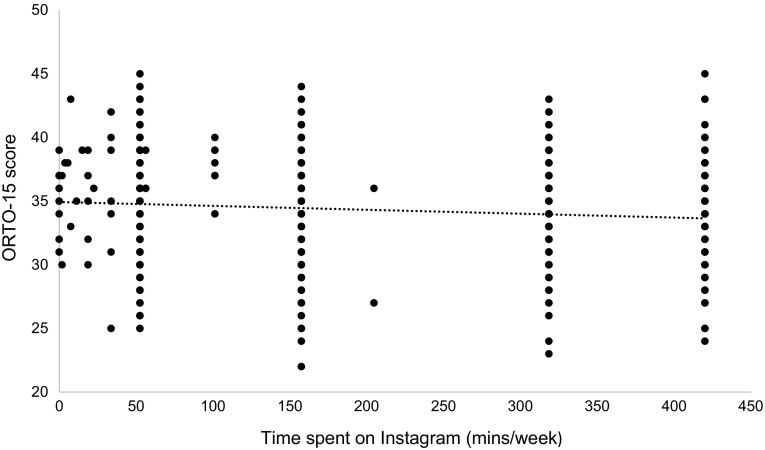
- Instagram use was negatively correlated with ORTO-15 score (r = −0.10, p = 0.01), meaning higher Instagram use was linked to greater ON symptoms; in regression, Instagram use (β = −0.12, p = 0.003) and country of residence (β = 0.23, p < 0.001) were significant predictors.
- ON prevalence in the sample was 49.0% with the <35 cut-off and 90.6% with the <40 cut-off; among Instagram users it was 49.3% and 90.4%, respectively, versus <1% in the general population.
- No significant relationships were found between ORTO-15 and number of food types eaten (r = −0.01, p = 0.87), number of social media channels used (r < 0.01, p = 0.99), age (r = −0.06, p = 0.13), or BMI (r = −0.03, p = 0.47); diet types also did not differ [F(5,674) = 0.705, p = 0.620].
- Twitter showed a small positive correlation with ORTO-15 score (r = 0.12, p = 0.04) in exploratory analysis; the paper describes this inconsistently as a positive association with ON symptoms in the abstract and as possibly protective in the discussion.
Methods
- Online Qualtrics survey; participants were recruited via unpaid advertisements on Instagram, Facebook, and Twitter, plus the “Plantbased Pixie” blog and “Health Bloggers Community” newsletter. Data were collected from 713 participants (23 males, 686 females, 4 other/prefer not to say; mean age 24.96 ± 8.17 years); final analysis included 680 females after excluding non-female participants and missing ORTO-15 data.
- Measures included social media channels and time spent, dietary choices (19 food types and diet label), ORTO-15, and demographics. ORTO-15 lower scores indicate higher ON symptoms; cut-offs of <40 and <35 were used.
- Analyses used Spearman correlations for social media use and ORTO-15, Pearson correlations for age/BMI, one-way ANOVA for diet types, and linear regression with Instagram use, age, BMI, ethnicity, and country of residence.
Limitations
- The paper states convenience non-random sampling, with 83% of participants recruited from the author’s Instagram account; the study title (“Health habits on social media”) may have attracted health-interested individuals; BMI was self-reported; medical diets were not assessed; and causality cannot be established due to the correlational design.
- The paper also notes possible interactions among multiple social media channels and that the sample was restricted to females because the number of male participants was too low for adequate power.
- The introduction notes ORTO-15 psychometric limitations, including internal consistency issues, lack of standardisation, cultural variation, and possible false positives from the high cut-off score.
Model-written summary. Check it against the paper before relying on it.
Integrity signals
Registry
Cites
Statistics
Figures
Verification
Claims the paper makes
12 Own result · 9 Own method · 8 Not checked yet · 5 Own interpretation · 1 Supported so far · 1 No basis given
A result the paper reports from its own data — it cites no other source for it, so there is none to check. The quote shows it is in the paper.
In the paper
“The prevalence of ON in our sample was 90.6% with a cut-off score of <40, or 49.0% with a cut-off score of <35.”
§ Instagram use is linked to increased symptoms of orthorexia nervosa > Results > Sample characteristics
plain- Asserted: passes — The authors put it forward as true.
- Checkable: passes — It can be checked against evidence.
- Load-bearing: unclear — It is unclear whether the paper’s conclusions depend on it.
- Based: passes — The paper gives a reason why it holds.
A result the paper reports from its own data — it cites no other source for it, so there is none to check. The quote shows it is in the paper.
In the paper
“No relationship was found between ORTO-15 scores and number of food types eaten (r = −0.01; p = 0.87), number of social media channels used (r < 0.01; p = 0.99), age (r = −0.06; p = 0.13), or BMI (r = −0.03; p = 0.47).”
§ Instagram use is linked to increased symptoms of orthorexia nervosa > Results > Inferential Results
plain- Asserted: passes — The authors put it forward as true.
- Checkable: passes — It can be checked against evidence.
- Load-bearing: unclear — It is unclear whether the paper’s conclusions depend on it.
- Based: passes — The paper gives a reason why it holds.
A result the paper reports from its own data — it cites no other source for it, so there is none to check. The quote shows it is in the paper.
In the paper
“except Twitter which showed a small positive correlation (r = 0.12, p = 0.04).”
§ Instagram use is linked to increased symptoms of orthorexia nervosa > Results > Inferential Results
plaincorrelational- Asserted: passes — The authors put it forward as true.
- Checkable: passes — It can be checked against evidence.
- Load-bearing: unclear — It is unclear whether the paper’s conclusions depend on it.
- Based: passes — The paper gives a reason why it holds.
A result the paper reports from its own data — it cites no other source for it, so there is none to check. The quote shows it is in the paper.
In the paper
“The overall model was significant [F(5,648) = 9.58, p < 0.001)] with Instagram use (β = −0.12, p = 0.003) and country of residence (β = 0.23, p < 0.001) being significant predictors.”
§ Instagram use is linked to increased symptoms of orthorexia nervosa > Results > Inferential Results
plaincorrelational- Asserted: passes — The authors put it forward as true.
- Checkable: passes — It can be checked against evidence.
- Load-bearing: passes — The paper’s conclusions depend on it.
- Based: passes — The paper gives a reason why it holds.
A result the paper reports from its own data — it cites no other source for it, so there is none to check. The quote shows it is in the paper.
In the paper
“No relationship was found between ORTO-15 scores and number of food types eaten (r = −0.01; p = 0.87), number of social media channels used (r < 0.01; p = 0.99), age (r = −0.06; p = 0.13), or BMI (r = −0.03; p = 0.47).”
§ Instagram use is linked to increased symptoms of orthorexia nervosa > Results > Inferential Results
plain- Asserted: passes — The authors put it forward as true.
- Checkable: passes — It can be checked against evidence.
- Load-bearing: unclear — It is unclear whether the paper’s conclusions depend on it.
- Based: passes — The paper gives a reason why it holds.
A result the paper reports from its own data — it cites no other source for it, so there is none to check. The quote shows it is in the paper.
In the paper
“There were also no significant differences in ORTO-15 score between diet types as determined by one-way ANOVA [F(5,674) = 0.705, p = 0.620].”
§ Instagram use is linked to increased symptoms of orthorexia nervosa > Results > Inferential Results
plain- Asserted: passes — The authors put it forward as true.
- Checkable: passes — It can be checked against evidence.
- Load-bearing: unclear — It is unclear whether the paper’s conclusions depend on it.
- Based: passes — The paper gives a reason why it holds.
A result the paper reports from its own data — it cites no other source for it, so there is none to check. The quote shows it is in the paper.
In the paper
“No relationship was found between ORTO-15 scores and number of food types eaten (r = −0.01; p = 0.87), number of social media channels used (r < 0.01; p = 0.99), age (r = −0.06; p = 0.13), or BMI (r = −0.03; p = 0.47).”
§ Instagram use is linked to increased symptoms of orthorexia nervosa > Results > Inferential Results
plain- Asserted: passes — The authors put it forward as true.
- Checkable: passes — It can be checked against evidence.
- Load-bearing: unclear — It is unclear whether the paper’s conclusions depend on it.
- Based: passes — The paper gives a reason why it holds.
A result the paper reports from its own data — it cites no other source for it, so there is none to check. The quote shows it is in the paper.
In the paper
“The overall model was significant [F(5,648) = 9.58, p < 0.001)] with Instagram use (β = −0.12, p = 0.003) and country of residence (β = 0.23, p < 0.001) being significant predictors.”
§ Instagram use is linked to increased symptoms of orthorexia nervosa > Results > Inferential Results
plaincorrelational- Asserted: passes — The authors put it forward as true.
- Checkable: passes — It can be checked against evidence.
- Load-bearing: unclear — It is unclear whether the paper’s conclusions depend on it.
- Based: passes — The paper gives a reason why it holds.
- Probably not a substantial claim. 15
- It may state two separate claims as one. 6
- The quote only partly states this claim. 1
The sources with a verdict support this claim; the rest weren’t checked yet, have no full text we could read, or their verdicts aren’t rated yet.
In the paper
“Higher prevalence has been found in yoga instructors [30], dieticians, [31], nutrition students [32], and exercise science students [33] compared to the general population.”
§ Instagram use is linked to increased symptoms of orthorexia nervosa > Introduction
What the sources say
- Not checked yetcites [30] Valera JH, Ruiz PA, Valdespino BR, Visioli F (2014) Prevalence of orthorexia nervosa among ashtanga yoga practitioners: a pilot study. Eat Weight Disord-Stud Anorex Bulim Obes 19(4):469–472 source
- Not checked yetcites [31] Asil E, Sürücüoğlu MS (2015) Orthorexia nervosa in Turkish dietitians. Ecol Food Nutr 54(4):303–313 source
- Supportedcites [32] Bo S, Zoccali R, Ponzo V, Soldati L, De Carli L, Benso A, Fea E, Rainoldi A, Durazzo M, Fassino S (2014) University courses, eating problems and muscle dysmorphia: are there any associations? J Transl Med 12(1):1 source
The Discussion (page unavailable) reports orthorexia traits in about one fourth of students across the schools studied, including Exercise and Sport Sciences, compared with about 7% in the general population. The paper describes these as traits or risk of orthorexia, rather than confirmed diagnoses. (LLM, conf=0.88)
plaincorrelational- Asserted: passes — The authors put it forward as true.
- Checkable: passes — It can be checked against evidence.
- Load-bearing: fails — The paper’s conclusions may not depend on it.
- Based: passes — The paper gives a reason why it holds.
Probably not a substantial claim. The paper’s conclusions may not depend on it.
A result the paper reports from its own data — it cites no other source for it, so there is none to check. The quote shows it is in the paper.
In the paper
“Higher Instagram use was associated with a greater tendency towards orthorexia nervosa, with no other social media channel having this effect.”
- Also stated in: § Inferential Results · plain
“As predicted, there was a negative correlation between ORTO-15 score and Instagram use (r = −0.10; p = 0.01) (Fig. 1).”
- Also stated in: § Discussion · plain
“We found a significant relationship between symptoms of ON as measured by the ORTO-15 test and Instagram use, with higher Instagram use being associated with a greater tendency towards ON.”
§ Instagram use is linked to increased symptoms of orthorexia nervosa > Abstract > Results
plaincorrelationaln = 680 ·- Asserted: passes — The authors put it forward as true.
- Checkable: passes — It can be checked against evidence.
- Load-bearing: passes — The paper’s conclusions depend on it.
- Based: passes — The paper gives a reason why it holds.
It may state two separate claims as one.
- Also stated in: § Inferential Results · plain
A result the paper reports from its own data — it cites no other source for it, so there is none to check. The quote shows it is in the paper.
In the paper
“with no other social media channel having this effect.”
- Also stated in: § Inferential Results · plain
“No significant relationship was found between ORTO-15 score and other social media use (Table 3), except Twitter which showed a small positive correlation (r = 0.12, p = 0.04).”
- Also stated in: § Discussion · hedged
“No other social media channels were found to have this effect, although Twitter seemed to have a small protective association.”
§ Instagram use is linked to increased symptoms of orthorexia nervosa > Abstract > Results
plain- Asserted: passes — The authors put it forward as true.
- Checkable: passes — It can be checked against evidence.
- Load-bearing: passes — The paper’s conclusions depend on it.
- Based: passes — The paper gives a reason why it holds.
It may state two separate claims as one.
- Also stated in: § Inferential Results · plain
A conclusion the paper draws from its own results — it cites no other source for it, so there is none to check. The quote shows it is in the paper.
In the paper
“although Twitter seemed to have a small protective association.”
§ Instagram use is linked to increased symptoms of orthorexia nervosa > Discussion
hedgedcorrelational- Asserted: passes — The authors put it forward as true.
- Checkable: passes — It can be checked against evidence.
- Load-bearing: fails — The paper’s conclusions may not depend on it.
- Based: passes — The paper gives a reason why it holds.
Probably not a substantial claim. The paper’s conclusions may not depend on it.
A conclusion the paper draws from its own results — it cites no other source for it, so there is none to check. The quote shows it is in the paper.
In the paper
“While the effect size was small, the large population of social media users, now over 500 million on Instagram alone, means that this is a meaningful effect at population level.”
§ Instagram use is linked to increased symptoms of orthorexia nervosa > Discussion
plaindirect- Asserted: passes — The authors put it forward as true.
- Checkable: passes — It can be checked against evidence.
- Load-bearing: passes — The paper’s conclusions depend on it.
- Based: passes — The paper gives a reason why it holds.
It may state two separate claims as one.
A conclusion the paper draws from its own results — it cites no other source for it, so there is none to check. The quote shows it is in the paper.
In the paper
“with higher Instagram use being linked to increased symptoms.”
§ Instagram use is linked to increased symptoms of orthorexia nervosa > Abstract > Conclusions
plaincorrelational- Asserted: passes — The authors put it forward as true.
- Checkable: passes — It can be checked against evidence.
- Load-bearing: passes — The paper’s conclusions depend on it.
- Based: passes — The paper gives a reason why it holds.
The quote only partly states this claim.
What the paper did — it cites no source for this, so there is none to check. The quote shows it is in the paper.
In the paper
“Furthermore, BMI was calculated from self-report rather than measured, accordingly, we cannot rule out error and deliberate miss-reporting.”
§ Instagram use is linked to increased symptoms of orthorexia nervosa > Discussion > Limitations and further research
plain- Asserted: passes — The authors put it forward as true.
- Checkable: passes — It can be checked against evidence.
- Load-bearing: fails — The paper’s conclusions may not depend on it.
- Based: passes — The paper gives a reason why it holds.
Probably not a substantial claim. The paper’s conclusions may not depend on it. It may state two separate claims as one.
What the paper did — it cites no source for this, so there is none to check. The quote shows it is in the paper.
In the paper
“Participants were recruited through convenient non-random sampling, with the majority coming from the author’s Instagram account (83%), which is not representative of the general population.”
§ Instagram use is linked to increased symptoms of orthorexia nervosa > Discussion > Limitations and further research
plain- Asserted: passes — The authors put it forward as true.
- Checkable: passes — It can be checked against evidence.
- Load-bearing: unclear — It is unclear whether the paper’s conclusions depend on it.
- Based: passes — The paper gives a reason why it holds.
It may state two separate claims as one.
What the paper did — it cites no source for this, so there is none to check. The quote shows it is in the paper.
In the paper
“We decided to concentrate on female participants as the N recruited for men was too low to provide adequate power for statistical analyses.”
§ Instagram use is linked to increased symptoms of orthorexia nervosa > Methods and materials > Participants
plainn = 27- Asserted: passes — The authors put it forward as true.
- Checkable: passes — It can be checked against evidence.
- Load-bearing: passes — The paper’s conclusions depend on it.
- Based: passes — The paper gives a reason why it holds.
Probably not a substantial claim.
What the paper did — it cites no source for this, so there is none to check. The quote shows it is in the paper.
In the paper
“All participants gave their informed consent before starting the questionnaire and the study was approved by the UCL ethics committee.”
§ Instagram use is linked to increased symptoms of orthorexia nervosa > Methods and materials > Participants
plain- Asserted: passes — The authors put it forward as true.
- Checkable: passes — It can be checked against evidence.
- Load-bearing: fails — The paper’s conclusions may not depend on it.
- Based: passes — The paper gives a reason why it holds.
Probably not a substantial claim. The paper’s conclusions may not depend on it. It may state two separate claims as one.
None of the sources cited for this claim have been checked yet.
In the paper
“We used two cut-off scores due to disagreement in the literature over the appropriate cut-off point: less than 40 (following [28]), and less than 35 (following [35]).”
§ Instagram use is linked to increased symptoms of orthorexia nervosa > Methods and materials > Assessment and analysis
What the sources say
- Not checked yetcites [28] Arusoğlu G, Kabakci E, Köksal G, Merdol TK (2008) Orthorexia nervosa and adaptaon of ORTO-11 into Turkish. Turk J Psychiatry 19(3):283–291
- Not checked yetcites [35] Missbach B, Dunn TM, König JS (2016) We need new tools to assess Orthorexia Nervosa. A commentary on “Prevalence of Orthorexia Nervosa among College Students Based on Bratman’s Test and Associated Tendencies”. Appetite 108:521 source
plain- Asserted: passes — The authors put it forward as true.
- Checkable: passes — It can be checked against evidence.
- Load-bearing: fails — The paper’s conclusions may not depend on it.
- Based: passes — The paper gives a reason why it holds.
Probably not a substantial claim. The paper’s conclusions may not depend on it.
In the paper
“social media use has been associated with higher levels of depression in young adults [14]”
§ Instagram use is linked to increased symptoms of orthorexia nervosa > Introduction
What the sources say
- Not checked yetcites [14] Sidani JE, Shensa A, Radovic A, Miller E, Colditz JB, Hoffman BL, Giles LM, Primack BA (2016) Association between social media use and depression among US young adults. Depress Anxiety 33(4):323–331 source
plaincorrelational- Asserted: passes — The authors put it forward as true.
- Checkable: passes — It can be checked against evidence.
- Load-bearing: fails — The paper’s conclusions may not depend on it.
- Based: passes — The paper gives a reason why it holds.
Probably not a substantial claim. The paper’s conclusions may not depend on it.
The paper states this without a source or data behind it here, so there is nothing to check it against. The quote shows it is in the paper.
In the paper
“Currently the relationship between ON and social media use is unclear, although links between social media use and AN have been reported.”
§ Instagram use is linked to increased symptoms of orthorexia nervosa > Introduction
plain- Asserted: passes — The authors put it forward as true.
- Checkable: passes — It can be checked against evidence.
- Load-bearing: passes — The paper’s conclusions depend on it.
- Based: passes — The paper gives a reason why it holds.
Probably not a substantial claim.
What the paper did — it cites no source for this, so there is none to check. The quote shows it is in the paper.
In the paper
“In addition, the research title (Health habits on social media) may have attracted individuals with an interest in health.”
§ Instagram use is linked to increased symptoms of orthorexia nervosa > Discussion > Limitations and further research
hedgedconditional- Asserted: passes — The authors put it forward as true.
- Checkable: passes — It can be checked against evidence.
- Load-bearing: fails — The paper’s conclusions may not depend on it.
- Based: passes — The paper gives a reason why it holds.
Probably not a substantial claim. The paper’s conclusions may not depend on it.
In the paper
“Previous work around similar disorders suggests that social media use may contribute to an ‘echo-chamber’ effect, where users perceive their values and world-views to be more common than they actually are, due to selectively viewing contributions of other, similarly minded people [5].”
§ Instagram use is linked to increased symptoms of orthorexia nervosa > Introduction
What the sources say
- Not checked yetcites [5] Salathé M, Khandelwal S (2011) Assessing vaccination sentiments with online social media: implications for infectious disease dynamics and control. PLoS Comput Biol 7(10):e1002199 source
hedgedconditional- Asserted: passes — The authors put it forward as true.
- Checkable: passes — It can be checked against evidence.
- Load-bearing: fails — The paper’s conclusions may not depend on it.
- Based: passes — The paper gives a reason why it holds.
Probably not a substantial claim. The paper’s conclusions may not depend on it.
What the paper did — it cites no source for this, so there is none to check. The quote shows it is in the paper.
In the paper
“To assess the robustness of the correlation between ORTO-15 and Instagram use when controlling for potentially confounding demographic variables, we additionally conducted linear regression analysis with ORTO-15 score as the outcome measure and Instagram use, age, BMI, ethnicity (dummy coded as white/non-white), and country of residence (dummy coded as UK/non-UK) as the predictor variables.”
§ Instagram use is linked to increased symptoms of orthorexia nervosa > Results > Inferential Results
plaincorrelational- Asserted: passes — The authors put it forward as true.
- Checkable: passes — It can be checked against evidence.
- Load-bearing: passes — The paper’s conclusions depend on it.
- Based: passes — The paper gives a reason why it holds.
Probably not a substantial claim.
In the paper
“Social media use is constantly increasing, with now 90% of UK young adults (aged 16–34 years) accessing social media platforms [1].”
§ Instagram use is linked to increased symptoms of orthorexia nervosa > Introduction
What the sources say
- Not checked yetcites [1] Ofcom (2015) Communications Market Report 2015. Ofcom
plaindirect- Asserted: passes — The authors put it forward as true.
- Checkable: passes — It can be checked against evidence.
- Load-bearing: fails — The paper’s conclusions may not depend on it.
- Based: passes — The paper gives a reason why it holds.
Probably not a substantial claim. The paper’s conclusions may not depend on it.
In the paper
“as well as eating disorders and related behaviours [15]”
§ Instagram use is linked to increased symptoms of orthorexia nervosa > Introduction
What the sources say
- Not checked yetcites [15] Carrotte ER, Vella AM, Lim MS (2015) Predictors of “liking” three types of health and fitness-related content on social media: a cross-sectional study. J Med Internet Res 17(8) source
plaincorrelational- Asserted: passes — The authors put it forward as true.
- Checkable: passes — It can be checked against evidence.
- Load-bearing: passes — The paper’s conclusions depend on it.
- Based: passes — The paper gives a reason why it holds.
Probably not a substantial claim.
What the paper did — it cites no source for this, so there is none to check. The quote shows it is in the paper.
In the paper
“Finally, we did not assess whether some participants followed a strict diet for medical reasons.”
§ Instagram use is linked to increased symptoms of orthorexia nervosa > Discussion > Limitations and further research
plain- Asserted: passes — The authors put it forward as true.
- Checkable: passes — It can be checked against evidence.
- Load-bearing: fails — The paper’s conclusions may not depend on it.
- Based: passes — The paper gives a reason why it holds.
Probably not a substantial claim. The paper’s conclusions may not depend on it.
In the paper
“There is some overlap between ON, AN and obsessive compulsive disorder (OCD) [25].”
§ Instagram use is linked to increased symptoms of orthorexia nervosa > Introduction
What the sources say
- Not checked yetcites [25] Koven NS, Abry AW (2015) The clinical basis of orthorexia nervosa: emerging perspectives. Neuropsychiatric Disease & Treatment 11
plaincorrelational- Asserted: passes — The authors put it forward as true.
- Checkable: passes — It can be checked against evidence.
- Load-bearing: fails — The paper’s conclusions may not depend on it.
- Based: passes — The paper gives a reason why it holds.
Probably not a substantial claim. The paper’s conclusions may not depend on it.
Claims other papers make about this one
Each is checked against this paper’s own text: does it say what the citing paper says it does?
The source backs part of the claim, not all of it — or backs it for a different population, condition or comparison.
In the citing paper
“A study of 713 participants confirmed orthorexia nervosa prevalence of 49% [70], far greater than the estimated <1% in the general UK population.”
From The social media diet: A scoping review to investigate the association between social media, body image and eating disorders amongst young people (2023) · cites this paper as [70]
Experimental — accuracy not yet measuredThe source backs part of the claim, not all of it — or backs it for a different population, condition or comparison.
In the citing paper
“Disturbingly high prevalence of body image dissatisfaction, disordered eating pathology and comorbid mental health outcomes were reported amongst young social media users in this review [57, 66, 70].”
From The social media diet: A scoping review to investigate the association between social media, body image and eating disorders amongst young people (2023) · cites this paper as [70]
Experimental — accuracy not yet measuredThe cited source says what the claim attributes to it.
In the citing paper
“One cross-sectional and one qualitative study indicated orthorexia nervosa symptomatology amongst participants, ranging from obsessions with ‘clean eating’ to avoidance of ‘demonised’ foods and compulsive exercise behaviours [64, 70].”
From The social media diet: A scoping review to investigate the association between social media, body image and eating disorders amongst young people (2023) · cites this paper as [70]
Statistics recomputed
Every reported test result, recomputed from its test statistic and degrees of freedom. A result shows as not adding up only once an independent check has confirmed it.
- ConsistentF(5, 674) = 0.705reported p = .62 · recomputed p = .620
“F(5,674) = 0.705, p = .620”
- ConsistentF(5, 648) = 9.58reported p < .001 · recomputed p < .001
“F(5,648) = 9.58, p < .001”
Self-check
Percentages, sums and reported differences re-computed from the paper’s own numbers.
Each contradiction between two passages listed here was confirmed by an independent check.
Rated minor: it would not touch a result — a value no result rests on, a p-value that stays on the same side of the significance level, or a conflict that is clerical, resolved elsewhere in the paper, or outside its own findings.
In the paper
§ Instagram use is linked to increased symptoms of orthorexia nervosa > Results > Sample characteristics
“| Number of social media channels (out of n = 7) | 3.55 ± 1.25 |”
§ Instagram use is linked to increased symptoms of orthorexia nervosa > Results > Sample characteristics
“| % using this channel | 94.5% | 88.1% | 41.0% | 54.9% | 12.3% | 20.7% | 29.0% |”
Rated minor: it would not touch a result — a value no result rests on, a p-value that stays on the same side of the significance level, or a conflict that is clerical, resolved elsewhere in the paper, or outside its own findings.
In the paper
§ Instagram use is linked to increased symptoms of orthorexia nervosa > Discussion
“exploratory analysis into other social media channels showed that Twitter had a positive association with ON symptoms.”
§ Instagram use is linked to increased symptoms of orthorexia nervosa > Discussion
“No other social media channels were found to have this effect, although Twitter seemed to have a small protective association.”
Citations
Cites
Diagnostic and Statistical Manual of Mental Disorders
American Psychiatric Association (2013) · doi:10.1176/appi.books.9780890425596 · Cited by 116,369
Diagnostic and Statistical Manual of Mental Disorders(DSM)
Leong, F. T. L. (2008) · Sage eBooks · doi:10.4135/9781412963978.n182 · Cited by 10,861
Lin, L. Y., Sidani, J. E., Shensa, A., Radovic, A., Miller, E., Colditz, J. B., Hoffman, B. L., Giles, L. M., & Primack, B. A. (2016) · Depression and Anxiety · doi:10.1002/da.22466 · Cited by 1,111
Instagram: Motives for its use and relationship to narcissism and contextual age
Sheldon, P., & Bryant, K. (2016) · Computers in Human Behavior · doi:10.1016/j.chb.2015.12.059 · Cited by 1,095 · cited 1×
“identified as motivations for Instagram use [12, 13], which corresponds well with the sharing of food images—both as a food diary (documentation/creativity) and searching for recipes and inspiration (surveillance).”
BackgroundKatzman, M. A., Bleau, P., Blier, P., Chokka, P., Kjernisted, K., Van Ameringen, M., & the Canadian Anxiety Guidelines Initiative Group on behalf of the Anxiety Disorders Association of Canada/Association Canadienne des troubles anxieux and McGill University (2014) · BMC Psychiatry · doi:10.1186/1471-244x-14-s1-s1 · Cited by 1,090
A tale of two sites: Twitter vs. Facebook and the personality predictors of social media usage
Hughes, D. J., Rowe, M., Batey, M., & Lee, A. (2012) · Computers in Human Behavior · doi:10.1016/j.chb.2011.11.001 · Cited by 1,011
Pittman, M., & Reich, B. (2016) · Computers in Human Behavior · doi:10.1016/j.chb.2016.03.084 · Cited by 907 · cited 1×
“However, image-based platforms such as Instagram have also been shown to confer a significant decrease in self-reported loneliness to users, whereas text-based platforms such as Twitter do not [21].”
BackgroundWhat We Instagram: A First Analysis of Instagram Photo Content and User Types
Hu, Y., Manikonda, L., & Kambhampati, S. (2014) · Proceedings of the International AAAI Conference on Web and Social Media · doi:10.1609/icwsm.v8i1.14578 · Cited by 807 · cited 2×
“[9] eight popular content types for the frequency with which they typically appear on their feed.”
BackgroundOn orthorexia nervosa: A review of the literature and proposed diagnostic criteria
Dunn, T. M., & Bratman, S. (2016) · Eating Behaviors · doi:10.1016/j.eatbeh.2015.12.006 · Cited by 635 · cited 4×
“However, Dunn and Bratman [24] make a compelling argument that there is sufficient evidence to suggest ON is a distinct condition.”
BackgroundInfluentialConditions for a Picture-Superiority Effect on Consumer Memory
Childers, T. L., & Houston, M. J. (1984) · Journal of Consumer Research · doi:10.1086/209001 · Cited by 622 · cited 1×
“1 3 First, the image-focused nature of Instagram, which plays to the picture-superiority effect—whereby images are more likely to be remembered than words [39]—and makes Instagram ideal for sharing food images.”
Background
Cited by
Sorted by citations
Items 201–300 of 379
Restrepo, J. E., & Quirama, T. C. (2020) · Revista Colombiana de Psiquiatría (English ed ) · doi:10.1016/j.rcpeng.2018.08.003 · Cited by 5
İçer, M. A., Yeşildemir, Ö., Çelik, M. N., & Karadağ, M. G. (2024) · International Journal of Environmental Health Research · doi:10.1080/09603123.2024.2384960 · Cited by 3
“Some studies did not observe a statistically significant difference between age and obsession with healthy eating (Herranz Valera et al. 2014; Turner and Lefevre 2017).”
BODY IMAGE PERCEPTIONS AT CRITICAL AGE PERIODS: FOCUS ON WOMEN’S SELF-CONFIDENCE AND WELL-BEING
Fedorchenko, Y. (2023) · Anti-Aging Eastern Europe · doi:10.56543/aaeeu.2023.2.2.04 · Cited by 3
Social networks use in the context of Schizophrenia: a review of the literature
Suárez-Llevat, C., Jiménez-Gómez, B., Ruíz-Núñez, C., Fernández-Quijano, I., Rodriguez-González, E. M., de la Torre-Domingo, C., & Herrera‐Peco, I. (2024) · Frontiers in Psychiatry · doi:10.3389/fpsyt.2024.1255073 · Cited by 4
Higher orthorexia tendency among female fashion models: an empirical international study
Bogár, N., Dukay‐Szabó, S., Simon, D., et al. (2024) · Eating and Weight Disorders - Studies on Anorexia Bulimia and Obesity · doi:10.1007/s40519-024-01674-4 · Cited by 3
“However, increased Instagram use is linked with higher ON tendencies [45].”
BackgroundInfluência da mídia nos Transtornos Alimentares em adolescentes: Revisão de literatura
Lopes, P. A., & Trajano, L. A. D. S. N. (2021) · Research Society and Development · doi:10.33448/rsd-v10i1.11649 · Cited by 3
Is it possible to teach good health practices using social media?
Paes, S. T., Scapim, S. N., de Lade, C. G., de Moura, H. B., Oliveira, H. Z., Coelho, F. D., Soares, R., & Neto, M. (2021) · Research Society and Development · doi:10.33448/rsd-v10i12.20600 · Cited by 3
“However, several studies indicate that content posted on Instagram can negatively influence the health of users (Holland & Tiggemann (2017); Turner & Lefevre, 2017; Slater et al. 2017; Tiggemann et al., 2018; Hanley et al. , 2019; Pilgrim & Bohnet-Joschko, 2019; Fioravanti et al., 2020).”
BackgroundRodríguez-Suárez, B., Montalbán, J. M. C., & Martínez‐Huertas, J. Á. (2022) · Behavioral Psychology/Psicología Conductual · doi:10.51668/bp.8322305n · Cited by 20
“Using Instagram has also been linked to other compulsive healthy eating pathologies such as orthorexia (Turner & Lefevre, 2017).”
Orthorexic Eating and Addictions: Links with Substance Use, Behavioral Addictions, and Research Gaps
Strahler, J., Moser, L., & Wachten, H. (2023) · Springer eBooks · doi:10.1007/978-3-031-16691-4_79 · Cited by 1
THE PREVALENCE AND SELECTED RISK FACTORS OF ORTHOREXIA NERVOSA DISORDER USING THE ORTO-15 TEST
Majoch, M., HOMONCIK, J., Mikulec, A. T., & Węgrzyn, I. (2023) · Zywnosc-nauka Technologia Jakosc · doi:10.15193/zntj/2023/136/455 · Cited by 3
KUMALA, T. F., Hartriyanti, Y., & Ermamilia, A. (2024) · Jurnal Sains Kesihatan Malaysia · doi:10.17576/jskm-2024-2201-11 · Cited by 3
Alim, N. E., Beşler, Z. N., AKIMAL, G. Ç., & Göküstün, K. K. (2021) · Amerta Nutrition · doi:10.20473/amnt.v5i4.2021.333-340 · Cited by 3
Andrzejewski, A. (2019) · Annales Universitatis Mariae Curie-Skłodowska sectio J – Paedagogia-Psychologia · doi:10.17951/j.2018.31.2.243-254 · Cited by 3
Akkuş, Ö. Ö., Asil, E., & Yılmaz, M. V. (2022) · Journal of Nutrition and Dietetics · doi:10.33076/2021.bdd.1514 · Cited by 3
Orthorexia nervosa – a new disease entity associated with dysfunctional eating patterns
Mróz, M., & Korek, E. (2020) · Medycyna Ogólna i Nauki o Zdrowiu · doi:10.26444/monz/122257 · Cited by 3
Safety and Privacy in Immersive Extended Reality: An Analysis and Policy RecommendationsPreprint
Hine, E., Rezende, I. N., Roberts, H., et al. (2023) · SSRN Electronic Journal · doi:10.2139/ssrn.4585963 · Cited by 3
Plichta, M., & Kowalkowska, J. (2024) · Frontiers in Nutrition · doi:10.3389/fnut.2024.1355871 · Cited by 2
Karaağaç, R. M., & Kalkan, İ. (2025) · Behavioral Sciences · doi:10.3390/bs15030301 · Cited by 2
“Additionally, peer pressure in academic or social settings can normalize restrictive dietary practices, increasing ON risk (Turner & Lefevre, 2017).”
Noonan, E. M., Solfermoser, B., & Heller, K. (2025) · Pediatrics in Review · doi:10.1542/pir.2024-006417 · Cited by 2
Faruga‐Lewicka, W., Staśkiewicz‐Bartecka, W., & Kardas, M. (2025) · BMC Nutrition · doi:10.1186/s40795-025-01087-1 · Cited by 2
“Additionally, some studies note a higher prevalence of orthorexia and a tendency toward orthorexia among those who use social media [50–52].”
Cossu, G., Riefler, A., & Hartmann, A. S. (2025) · Frontiers in Psychology · doi:10.3389/fpsyg.2025.1531142 · Cited by 5
“These associations were corroborated by a cross-sectional online questionnaire study that reported a higher prevalence of orthorexia nervosa symptoms in a convenience sample of social media using adult individuals who engage with CE content on Instagram (Turner and Lefevre, 2017).”
Assessment of the relation between orthorexia nervosa and self-esteem in high school students
Atak, R. K., Elbi, H., & Özcan, F. (2025) · Journal of Eating Disorders · doi:10.1186/s40337-025-01433-5 · Cited by 2
“There is also evidence that social media and cultural norms may increase societal pressures for healthy eating and body image, potentially supporting behaviors associated with Orthorexia Nervosa [51, 52].”
Problematic usage of the internet is associated with orthorexia nervosa tendency in adults
Boutouis, S., & Grant, J. E. (2025) · CNS Spectrums · doi:10.1017/s1092852925100771 · Cited by 3
Orthorexia Nervosa, Fear of Obesity
Cho, H.-B., & Hyun, M. (2020) · Korean Journal of Stress Research · doi:10.17547/kjsr.2020.28.2.68 · Cited by 2
Exploring the Impact of Social Media on Female Self Image
Ren, S., Wu, Y., & Zheng, Y. (2022) · Advances in Social Science, Education and Humanities Research/Advances in social science, education and humanities research · doi:10.2991/assehr.k.220504.213 · Cited by 2
The body dissatisfaction role in the adoption of compulsive healthy eating behaviors
Silva, S. C. L. D. C. E., Elmashhara, M. G., & Sousa, M. I. (2022) · International Review on Public and Nonprofit Marketing · doi:10.1007/s12208-022-00357-z · Cited by 4
Maternal Bonding as a Protective Factor for Orthorexia Nervosa Risk in Dietetics Students
Athanasaki, D., Lakoumentas, J., Milani, G. P., Agostoni, C. V., Berghea, F., Ionescu, M. D., & Vassilopoulou, Ε. (2023) · Nutrients · doi:10.3390/nu15163577 · Cited by 2
“did not explore the effect of the use of social media [95] or dating apps [96], presented as significant risk factors for ON by other investigators.”
BackgroundOrthorexia Nervosa as a Disorder of Less Intuition and Emotion Dysregulation
Demirgül, S. A., & Rigó, A. (2023) · Psikiyatride Guncel Yaklasimlar - Current Approaches in Psychiatry · doi:10.18863/pgy.1316560 · Cited by 2
Von-Polheim, P., Cano‐Orón, L., & Vengut‐Climent, E. (2023) · El Profesional de la Informacion · doi:10.3145/epi.2023.nov.18 · Cited by 2
“Healthy food users with a large number of followers can exert influence over a significant audience by consistently pos - ting images that depict a specific diet or behaviour ( Turner ; Lefevre , 2017).”
BackgroundBAYAR, B., & Şahin, M. K. (2024) · Turkish Journal of Family Medicine & Primary Care · doi:10.21763/tjfmpc.1333903 · Cited by 2
The impact of social media on women's physical appearance and self-esteem: A feminist perspective
Kushwaha, R. C. (2024) · World Journal of Advanced Research and Reviews · doi:10.30574/wjarr.2024.21.3.0577 · Cited by 7
Virtue and Disease: Narrative Accounts of Orthorexia Nervosa
Wynne, L. A., Hamalian, G., & Durrwachter, N. (2021) · Numanities - arts and humanities in progress · doi:10.1007/978-3-030-81115-0_13 · Cited by 2
Flauzino, P. A., & Carioca, A. A. F. (2021) · Revista de Nutrição · doi:10.1590/1678-9865202134e200314 · Cited by 2
“The lack of instruments for this purpose has been frequently reported in the literature [27].”
BackgroundResultDajon, M., & Sudres, J. (2022) · Cahiers de Nutrition et de Diététique · doi:10.1016/j.cnd.2022.01.005 · Cited by 2
Linking Orthorexia and Obsessive-Compulsive Symptoms
Tamam, L., & Yılmaz, H. (2022) · Springer eBooks · doi:10.1007/978-3-030-67929-3_80-1 · Cited by 2
Zalewa, K., Kapłan, W., Rachwał, D., et al. (2023) · Journal of Education Health and Sport · doi:10.12775/jehs.2023.33.01.008 · Cited by 2
Wood, C., & Fivian, E. (2018) · International Journal of Food Nutrition and Public Health · doi:10.47556/j.ijfnph.10.1.2018.3 · Cited by 2
Scraping Social Media Photos Posted in Kenya and Elsewhere to Detect and Analyze Food TypesPreprint
Wang, K., Jalal, M., Jefferson, S., et al. (2019) · arXiv (Cornell University) · doi:10.48550/arxiv.1909.00134 · Cited by 2
An Examination of Instagram Use and Body Image in a Sociocultural Model of Disordered Eating
Haller, S. (2020) · TSpace (University of Toronto) · Cited by 2
Provjera biopsihosocijalnog modela ortoreksije
Blažev, D. (2023) · doi:10.17234/diss.2023.8734 · Cited by 3
O'Shields, J. D., & Baldwin-White, A. (2022) · Alcoholism Treatment Quarterly · doi:10.1080/07347324.2022.2137447 · Cited by 1
“College students, because of who they choose to follow on SNS, may believe that certain behaviors are acceptable (Turner & Lefevre, 2017).”
BackgroundBerber, R., & KILINÇ, D. K. (2024) · Adnan Menderes Üniversitesi Sağlık Bilimleri Fakültesi Dergisi · doi:10.46237/amusbfd.1179507 · Cited by 1
Keyvanpour, S., Namazi, M., Hosseini, F., & Ebrahimi, N. (2025) · Medicine · doi:10.1097/md.0000000000041383 · Cited by 1
Zagreb, C., & Blažev, D. (2025) · Drustvena istrazivanja · doi:10.5559/di.34.1.05 · Cited by 2
Ruíz-Lázaro, J., Cuesta-Zamora, C., & Ros, L. (2025) · Psychological Reports · doi:10.1177/00332941251363905 · Cited by 2
Orthorexia Nervosa: A Pathological Pursuit of Healthy Eating
Mahadevaswamy, M., & Nathawat, S. (2025) · Indian Journal of Psychiatric Nursing · doi:10.4103/iopn.iopn_106_23 · Cited by 1
Pregnancy, power, and perception: An AI analysis of Instagram sentiment on prenatal weightlifting
Basralian, G., Wolford, C., Voity, K., et al. (2025) · Digital Health · doi:10.1177/20552076251383603 · Cited by 1
“13,14 17 Both large language models used (ChatGPT 3.5 and Monkeylearn) allow for the classi fi cation of text sentiment as positive, negative, or neutral for even large comments underneath a post or a reel.”
InfluentialManfrin, I. M., & Santos, A. C. D. C. P. (2025) · Research Society and Development · doi:10.33448/rsd-v14i11.50117 · Cited by 1
Ageism on geriatric dentistry Instagram posts
Guimarães, M. B., Machry, R. V., de Carvalho, J. C. F., Mota, M. M., Bulgarelli, A. F., Pinto, L. D. R., & Marchini, L. (2025) · PAJAR - Pan-American Journal of Aging Research · doi:10.15448/2357-9641.2025.1.48238 · Cited by 1
Concept Analysis of Orthorexia Nervosa
Sun, X., & Zhang, H. (2026) · Issues in Mental Health Nursing · doi:10.1080/01612840.2025.2608107 · Cited by 1
“Health trends and content sharing on social media can exacerbate the pursuit of the “perfect diet,” which in turn can increase the risk of developing positive eating disorders (Scheiber et al., 2023; Staśkiewicz-Bartecka et al., 2024; Turner & Lefevre, 2017).”
Lecaj, R., Iždonaitė-Medžiūnienė, I., Kavoliūnienė, O., & Batuchina, A. (2026) · Nutrients · doi:10.3390/nu18040616 · Cited by 1
“Platforms like Reddit, Instagram and TikTok have exacerbated ON symptoms among populations that set high self-expectations, exercise, and tend to compulsively obsess over nutritious content in food [27,28].”
Exploring the quality and credibility of nutritional advice for menstrual health on instagram
Marks, E., & Jones, H. M. (2026) · Women s Health · doi:10.1177/17455057261456878 · Cited by 1
“Greater Instagram use has also been associated with increased orthorexic symptoms, 33 suggesting that repeated exposure to idealised nutrition messaging may contribute to more rigid or perfectionistic attitudes towards food.”
Informatics Technologies in the Diagnosis and Treatment of Mental Health Conditions
Ingram, W. M., Khanna, R., & Weston, C. L. (2021) · Health informatics · doi:10.1007/978-3-030-70558-9_17 · Cited by 1
Grajek, M. K., Krupa-Kotara, K. H., Słoma-Krześlak, M., & Sas-Nowosielski, K. (2022) · Journal of Education Health and Sport · doi:10.12775/jehs.2022.12.12.048 · Cited by 1
Linking Orthorexia and Obsessive-Compulsive Symptoms
Tamam, L., & Yılmaz, H. (2023) · Springer eBooks · doi:10.1007/978-3-031-16691-4_80 · Cited by 1
Caldeira, E. M. M., CORAÇÃO, I. S. D. S., SILVA, M. C. C. E., CAMPOS, N. G., CARMINATI, C. T., SILVA, R. C., & VENTURIM, E. P. (2023) · doi:10.58871/ed.academic.00030.v1 · Cited by 1
Bak, M., Priniski, J. H., & Chin, J. (2023) · Communications in computer and information science · doi:10.1007/978-3-031-36001-5_2 · Cited by 2
Devrim-Lanpir, A., & Güzeldere, H. K. B. (2023) · Acibadem Universitesi Saglik Bilimleri Dergisi · doi:10.31067/acusaglik.1239014 · Cited by 1
“Turner and Lefevre (8) reported that a significant interaction between orthorexia and social media use, and Instagram is the most commonly used application to follow a healthy eating environment.”
BackgroundInfluentialShi, J., Hill, S., & Franzway, S. (2023) · Peter Lang eBooks · doi:10.3726/b20878 · Cited by 1
Sheremeta, S. (2023) · PSYCHOLOGY AND SOCIAL WORK · doi:10.32782/2707-0409.2023.1.6 · Cited by 1
Tanrıverdi, E. Ç., & Nas, M. A. (2023) · Atatürk Üniversitesi Tıp Fakültesi Cerrahi Tıp Bilimleri Dergisi · doi:10.61745/jsmsau.1389233 · Cited by 1
Styk, W., Gortat, M., Samardakiewicz-Kirol, E., Zmorzyński, S., & Samardakiewicz, M. (2024) · Nutrients · doi:10.3390/nu16071010 · Cited by 1
“The KZZJ consists of 30 items that make up the 3 scales of the questionnaire: Ha-Nutrients bitual Overeating (KZZJ_HO), Emotional Overeating (KZZJ_EO), and Diet Restrictions (KZZJ_DR) [32].”
BackgroundA influência das mídias sociais sobre a obsessão por uma alimentação saudável em adolescentes
Eugenio, K. D. A., Dutra, L. Y., de Sousa, B. H. G., Santana, I. D. C., Oliveira, L. E., & Bicalho, J. M. F. (2024) · Research Society and Development · doi:10.33448/rsd-v13i4.45639 · Cited by 1
Food-Related YouTube Influencer Marketing
Dam, L. (2024) · Advances in marketing, customer relationship management, and e-services book series · doi:10.4018/979-8-3693-0912-4.ch008 · Cited by 1
Prevalence of Orthorexia Nervosa in a Sample of Rock and Sport Climbers
Sas-Nowosielski, K., & Gutek, M. (2024) · Central European Journal of Sport Sciences and Medicine · doi:10.18276/cej.2024.2-07 · Cited by 1
“One of them is orthorexia nervosa (ON) defined as: a “pathological focus on healthy eating with the features of rigorous attention to food quality and preparation and nutrition standards” (Turner & Lefevre, 2017).”
BackgroundExploring Influence of Food-Related Social Media Content on Eating Habits of Undergraduate Students
Tan, Y. L., Pereira, D. J., & Yusoff, H. (2024) · Malaysian Journal of Medicine and Health Sciences · doi:10.47836/mjmhs.20.2.8 · Cited by 7
“Another previous study also suggested that a high percentage of social media users who followed health food accounts met criteria of eating disorder, with higher social media usage associated with more symptoms (37).”
Asociación entre el uso de las redes sociales y la Ortorexia Nerviosa en estudiantes universitarios
Gómez, K. R., Correa, L. M. J., Tobón, O. E. A., & Peña, J. G. (2022) · Revista de Psicología Universidad de Antioquia · doi:10.17533/udea.rp.e348711 · Cited by 1
Orthorexia - current research review
Niemczyk-Judas, A., Kozak, M., Ścisło, P., & Badura-Brzoza, K. (2023) · Zeszyty Naukowe Wyższej Szkoły Humanitas w Sosnowcu Pedagogika · doi:10.5604/01.3001.0053.7613 · Cited by 1
UK Dietary Changes Over the Last Two Decades: A Focus on Vitamin & Mineral Intakes
Derbyshire, E. J. (2019) · Cited by 1
Can healthy eating go too far? Identifying orthorexia
Patience, S. (2021) · Independent Nurse · doi:10.12968/indn.2021.2.18 · Cited by 1
Plasonja, N., & Décamps, G. (2021) · Psychologie Française · doi:10.1016/j.psfr.2021.02.002 · Cited by 1
Gambaran Kecenderungan Orthorexia Nervosa pada Mahasiswa Program Studi Kedokteran FK-KMK UGM
Zahra, M. A., Supriyanto, I., & Warsini, S. (2021) · Jurnal Keperawatan Klinis dan Komunitas (Clinical and Community Nursing Journal) · doi:10.22146/jkkk.67330 · Cited by 1
“Hasil bahwa IMT dan kecenderungan ON tidak berhubungan, didukung dengan penemuan pada penelitian lain yang juga tidak menemukan hubungan signifikan antara IMT dan kecenderungan ON.(6,14,15,31,32,37) Pada penelitian ini, hubungan frekuensi makan, diet khusus, dan alergi dengan kecenderungan ON adalah tidak signifikan.”
BackgroundInfluentialINFLUÊNCIA DA MÍDIA NOS TRANSTORNOS ALIMENTARES E DE AUTOIMAGEM EM ADOLESCENTES
de Albuquerque, R. N., Cabral, B. P., Gomes, G. D. N. D., et al. (2021) · Revista Destaques Acadêmicos · doi:10.22410/issn.2176-3070.v13i3a2021.2992 · Cited by 1
Self-Presentation by Young Ballet and Contemporary Dancers on Image-Based Social Media
Morrow, S. A. (2019) · White Rose eTheses Online (University of Leeds, The University of Sheffield, University of York) · Cited by 1
Social Media Use, Social Comparison, and Loneliness
Johnson, J. (2000) · doi:10.15760/etd.7445 · Cited by 1
Sepas, A., El‐Hussuna, A., Atıcı, S. D., & Yang, W. (2021) · SSRN Electronic Journal · doi:10.2139/ssrn.3956428 · Cited by 1
Mayer, G., Alvarez, S., Gronewold, N., et al. (2020) · doi:10.2196/preprints.20528 · Cited by 1
Polish Adaptation of the TOS Scale in the Adult Population and Comparison with the ORTO-15 ScalePreprint
Gortat, M., & Samardakiewicz, M. (2022) · Research Square · doi:10.21203/rs.3.rs-1425298/v1 · Cited by 1
Jenkins, E. L., Ilicic, J., Barklamb, A. M., & McCaffrey, T. (2019) · doi:10.2196/preprints.17296
Mayoh, J., & Jones, I. (2020) · doi:10.2196/preprints.17811 · Cited by 1
Eating Disorder and Body Image Content
Branley-Bell, D. (2026) · Springer eBooks · doi:10.1007/978-3-031-52643-5_43-1 · Cited by 1
Orthorektisches Ernährungsverhalten und Orthorexia nervosa
Greetfeld, M., & Voderholzer, U. (2019) · Elsevier eBooks · doi:10.1016/b978-3-437-22485-0.00040-3
The presence of orthorexia nervosa in the fitness and health practice - review
Bóna, E. (2018) · Recreation · doi:10.21486/recreation.2018.8.1.3
Η επίδραση της έκθεσης σε εικόνες προτύπων ελκυστικών ανθρώπων στην εικόνα σώματος των μεσηλίκων
Παράσχου, Σ., & Μoraitou, D. (2019) · Επιστημονική Επετηρίδα Παιδαγωγικού Τμήματος Νηπιαγωγών Πανεπιστημίου Ιωαννίνων · doi:10.12681/jret.19474
Orthorexia – a major problem in public health?
Krawiec, K. M., Szczurek-Żelazko, J., Giermaziak, W., et al. (2019) · Farmacja Polska · doi:10.32383/farmpol/116117
Sağlıklı Beslenme Takıntısının Sosyolojik Bağlantıları
Canbaz, E. A., & Özsöz, C. (2020) · İstanbul Üniversitesi Sosyoloji Dergisi / İstanbul University Journal of Sociology · doi:10.26650/sj.2020.40.1.0039
Orthorexie: Ist das noch gesund?
Schmitz, K. (2020) · Springer eBooks · doi:10.1007/978-3-662-61464-8_18
Az bilinen bir konu ‘Ortoreksiya Nervoza’: Bir olgu sunumu
Hocaoğlu, Ç. (2021) · Mersin üniversitesi sağlık bilimleri dergisi/Mersin üniversitesi sağlık bilimleri dergisi · doi:10.26559/mersinsbd.766245
Perfekcionizmus, PERMA optimálne prosperovanie a čas strávený na Instagrame
Filipčíková, L., & Šeboková, G. (2021) · Pomáhajúce profesie · doi:10.17846/pp.2021.4.1.49-57
Vie, C. L. (2021) · Fórum Linguístico · doi:10.5007/1984-8412.2021.e79652
ORTHOSTYLE OR MODERN NEUROSIS:
Sumariuk, B., Grinko, N., & Herasymiuk, I. (2021) · Art of Medicine · doi:10.21802/artm.2021.2.18.111
Pour une définition de la tendance verte sur les réseaux sociaux
Atkinson, L. (2021) · Tr@jectoires · doi:10.4000/trajectoires.6078
Appropriate Care for Adolescent Eating Disorders in Isolating and Disruptive Times
Smith, H. S., & Morain, S. R. (2021) · Journal of Cognitive Psychotherapy · doi:10.1891/jcpsy-d-20-00049
Orthorexia Nervosa Risk and associated factors among Chilean nutrition students: A pilot study.Preprint
Villa, M. A., Opawsky, N., Manriquez, S., et al. (2021) · Research Square · doi:10.21203/rs.3.rs-797425/v1
Claydon, E. A., Zullig, K. J., & Step, M. M. (2021) · Health Behavior Research · doi:10.4148/2572-1836.1103 · Cited by 1
“Because there are several types of disordered eating, we use the general term: “pro-ED” to refer to the wide range of messages intended to promote or perpetuate disordered eating. healthy’ eating and is often comorbid with anorexia nervosa (AN) (Turner & Lefevre, 2017).”
Instagram, Anxiety and Depression in College Students
Flannery, M. G. (2020)
Watch out for Overcorrecting—The Definition and Research Review of Orthorexia Nervosa
李, 丹. (2021) · Advances in Psychology · doi:10.12677/ap.2021.119230
A INFLUÊNCIA DAS REDES SOCIAIS NOS TRANSTORNOS ALIMENTARES E SUA ACENTUAÇÃO NA PANDEMIA DA COVID-19
Rocha, B. H. K., Jacinto, T. G., Borges, J. M. L., da Silva, M. E. C., & Rios, M. F. B. (2021) · Editora Pasteur eBooks · doi:10.29327/544304.2-41
Psihogios, A., Baggio, A., & Clouthier, S. N. (2021) · CAND Journal · doi:10.54434/candj.16
P.0660 Instagram and eating disorders: an internet survey
Tual, C., Angerville, B., Naassïla, M., & Dervaux, A. (2021) · European Neuropsychopharmacology · doi:10.1016/j.euroneuro.2021.10.623
Metadata
- Authors
- Turner, P. G., & Lefevre, C. E.
- Affiliations
- University College London (GB)
- Corresponding author
- Lefevre, Carmen E.
- ORCID
- Lefevre, Carmen E.
- Venue
- Eating and Weight Disorders - Studies on Anorexia, Bulimia and Obesity
- Published
- 2017-03-01
- Volume
- 22
- Issue
- 2
- Pages
- 277-284
- ISSN
- 1124-4909 (ISSN-L)
- 1590-1262
- PMC
- PMC5440477
- OpenAlex
- W2593519256
- Semantic Scholar
- 8fa58fca216d463d9400de92c0164d84018f7dc8
- Cited by
- 380
- References
- 37
- Citations by year
- 2026: 39 · 2025: 43 · 2024: 40 · 2023: 52 · 2022: 55 · 2021: 60 · 2020: 43 · 2019: 28 · 2018: 18 · 2017: 1
- FWCI
- 30.45
- Type
- journal article
- Language
- en
- Open access
- hybrid
- doi.org
- Licence
- Locations
- Eating and Weight Disorders - Studies on Anorexia Bulimia and Obesity (publishedVersion, cc-by)
- Europe PMC (PubMed Central) (publishedVersion, cc-by)
- PubMed Central (publishedVersion, cc-by)
- PubMed (publishedVersion)
- UCL Discovery (University College London) (submittedVersion)
- Topics
- Social Sciences › Psychology › Clinical Psychology › Eating Disorders and Behaviors
- Health Sciences › Nursing › Nutrition and Dietetics › Nutrition, Health and Food Behavior
- Social Sciences › Psychology › Clinical Psychology › Body Image and Dysmorphia Studies
- Keywords
- orthorexia nervosa, Instagram, social media use, eating disorders, disordered eating, young adults, ORTO-15, Twitter, body image, social media influencers
- MeSH terms
- Adolescent, Adult, Feeding and Eating Disorders, Body Image, Feeding Behavior, Female, Humans, Health Behavior, Young Adult, Social Media, Symptom Assessment
About these checks
Registry, retraction, Cites and statistics results are computed, not judged, with one exception: a printed reference that no index lists is read once by a model before it counts as a citation error. Claims are extracted by a model and kept only when their quote appears verbatim in the text; each cited source is then checked, with a model’s help, for whether it says what the claim relies on. Those verdicts can be wrong — read the claim’s quote and the cited source before relying on one.
A language model drew the claims from the paper on 2026-10-08, under version 3 of the claim definition (model deepseek-v4.1-flash, prompt extract-v3).
A second model labelled each claim on 2026-10-08 (model jev-1.13-20260917, definition revision gold-guideline-v0.2).
Cited sources are checked with a language model’s help (gpt-6-sol).
Statistics and arithmetic are recomputed, not judged.
Confidence bands are shown only for fields calibrated on our annotated test set. None is calibrated yet, so no band is shown.
What counts as a claim ›How we measure confidence ›How we check this ›
Are you an author, or do you see a problem with this page? Request a review
