

The DOI matches its Crossref record; 37 of the 37 references it cites were found in a registry or an index; 1 of the 12 sources its claims cite were checked for support.
Instagram use is linked to increased symptoms of orthorexia nervosa.
Open accessAbstract
PURPOSE: Social media use is ever increasing amongst young adults and has previously been shown to have negative effects on body image, depression, social comparison, and disordered eating. One eating disorder of interest in this context is orthorexia nervosa, an obsession with eating healthily. High orthorexia nervosa prevalence has been found in populations who take an active interest in their health and body and is frequently comorbid with anorexia nervosa. Here, we investigate links between social media use, in particularly Instagram and orthorexia nervosa symptoms. METHODS: We conducted an online survey of social media users (N = 680) following health food accounts. We assessed their social media use, eating behaviours, and orthorexia nervosa symptoms using the ORTO-15 inventory. RESULTS: Higher Instagram use was associated with a greater tendency towards orthorexia nervosa, with no other social media channel having this effect. In exploratory analyses Twitter showed a small positive association with orthorexia symptoms. BMI and age had no association with orthorexia nervosa. The prevalence of orthorexia nervosa among the study population was 49%, which is significantly higher than the general population (<1%). CONCLUSIONS: Our results suggest that the healthy eating community on Instagram has a high prevalence of orthorexia symptoms, with higher Instagram use being linked to increased symptoms. These findings highlight the implications social media can have on psychological wellbeing, and the influence social media 'celebrities' may have over hundreds of thousands of individuals. These results may also have clinical implications for eating disorder development and recovery.
Overview
AI snapshot
Written from the paper’s full text.
TL;DR
In an online survey of 680 female social media users, higher Instagram use was associated with greater orthorexia nervosa symptoms as measured by ORTO-15. The sample showed a high prevalence of ON symptoms (49% using the <35 cut-off) compared with <1% in the general population.
Key findings
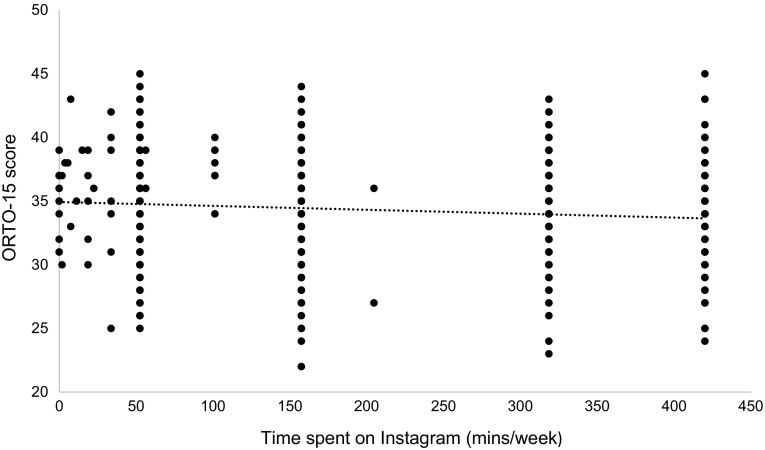
- Instagram use was negatively correlated with ORTO-15 score (r = −0.10, p = 0.01), meaning higher Instagram use was linked to greater ON symptoms; in regression, Instagram use (β = −0.12, p = 0.003) and country of residence (β = 0.23, p < 0.001) were significant predictors.
- ON prevalence in the sample was 49.0% with the <35 cut-off and 90.6% with the <40 cut-off; among Instagram users it was 49.3% and 90.4%, respectively, versus <1% in the general population.
- No significant relationships were found between ORTO-15 and number of food types eaten (r = −0.01, p = 0.87), number of social media channels used (r < 0.01, p = 0.99), age (r = −0.06, p = 0.13), or BMI (r = −0.03, p = 0.47); diet types also did not differ [F(5,674) = 0.705, p = 0.620].
- Twitter showed a small positive correlation with ORTO-15 score (r = 0.12, p = 0.04) in exploratory analysis; the paper describes this inconsistently as a positive association with ON symptoms in the abstract and as possibly protective in the discussion.
Methods
- Online Qualtrics survey; participants were recruited via unpaid advertisements on Instagram, Facebook, and Twitter, plus the “Plantbased Pixie” blog and “Health Bloggers Community” newsletter. Data were collected from 713 participants (23 males, 686 females, 4 other/prefer not to say; mean age 24.96 ± 8.17 years); final analysis included 680 females after excluding non-female participants and missing ORTO-15 data.
- Measures included social media channels and time spent, dietary choices (19 food types and diet label), ORTO-15, and demographics. ORTO-15 lower scores indicate higher ON symptoms; cut-offs of <40 and <35 were used.
- Analyses used Spearman correlations for social media use and ORTO-15, Pearson correlations for age/BMI, one-way ANOVA for diet types, and linear regression with Instagram use, age, BMI, ethnicity, and country of residence.
Limitations
- The paper states convenience non-random sampling, with 83% of participants recruited from the author’s Instagram account; the study title (“Health habits on social media”) may have attracted health-interested individuals; BMI was self-reported; medical diets were not assessed; and causality cannot be established due to the correlational design.
- The paper also notes possible interactions among multiple social media channels and that the sample was restricted to females because the number of male participants was too low for adequate power.
- The introduction notes ORTO-15 psychometric limitations, including internal consistency issues, lack of standardisation, cultural variation, and possible false positives from the high cut-off score.
Model-written summary. Check it against the paper before relying on it.
Integrity signals
Registry
Cites
Statistics
Figures
Verification
Claims the paper makes
12 Own result · 9 Own method · 8 Not checked yet · 5 Own interpretation · 1 Supported so far · 1 No basis given
A result the paper reports from its own data — it cites no other source for it, so there is none to check. The quote shows it is in the paper.
In the paper
“The prevalence of ON in our sample was 90.6% with a cut-off score of <40, or 49.0% with a cut-off score of <35.”
§ Instagram use is linked to increased symptoms of orthorexia nervosa > Results > Sample characteristics
plain- Asserted: passes — The authors put it forward as true.
- Checkable: passes — It can be checked against evidence.
- Load-bearing: unclear — It is unclear whether the paper’s conclusions depend on it.
- Based: passes — The paper gives a reason why it holds.
A result the paper reports from its own data — it cites no other source for it, so there is none to check. The quote shows it is in the paper.
In the paper
“No relationship was found between ORTO-15 scores and number of food types eaten (r = −0.01; p = 0.87), number of social media channels used (r < 0.01; p = 0.99), age (r = −0.06; p = 0.13), or BMI (r = −0.03; p = 0.47).”
§ Instagram use is linked to increased symptoms of orthorexia nervosa > Results > Inferential Results
plain- Asserted: passes — The authors put it forward as true.
- Checkable: passes — It can be checked against evidence.
- Load-bearing: unclear — It is unclear whether the paper’s conclusions depend on it.
- Based: passes — The paper gives a reason why it holds.
A result the paper reports from its own data — it cites no other source for it, so there is none to check. The quote shows it is in the paper.
In the paper
“except Twitter which showed a small positive correlation (r = 0.12, p = 0.04).”
§ Instagram use is linked to increased symptoms of orthorexia nervosa > Results > Inferential Results
plaincorrelational- Asserted: passes — The authors put it forward as true.
- Checkable: passes — It can be checked against evidence.
- Load-bearing: unclear — It is unclear whether the paper’s conclusions depend on it.
- Based: passes — The paper gives a reason why it holds.
A result the paper reports from its own data — it cites no other source for it, so there is none to check. The quote shows it is in the paper.
In the paper
“The overall model was significant [F(5,648) = 9.58, p < 0.001)] with Instagram use (β = −0.12, p = 0.003) and country of residence (β = 0.23, p < 0.001) being significant predictors.”
§ Instagram use is linked to increased symptoms of orthorexia nervosa > Results > Inferential Results
plaincorrelational- Asserted: passes — The authors put it forward as true.
- Checkable: passes — It can be checked against evidence.
- Load-bearing: passes — The paper’s conclusions depend on it.
- Based: passes — The paper gives a reason why it holds.
A result the paper reports from its own data — it cites no other source for it, so there is none to check. The quote shows it is in the paper.
In the paper
“No relationship was found between ORTO-15 scores and number of food types eaten (r = −0.01; p = 0.87), number of social media channels used (r < 0.01; p = 0.99), age (r = −0.06; p = 0.13), or BMI (r = −0.03; p = 0.47).”
§ Instagram use is linked to increased symptoms of orthorexia nervosa > Results > Inferential Results
plain- Asserted: passes — The authors put it forward as true.
- Checkable: passes — It can be checked against evidence.
- Load-bearing: unclear — It is unclear whether the paper’s conclusions depend on it.
- Based: passes — The paper gives a reason why it holds.
A result the paper reports from its own data — it cites no other source for it, so there is none to check. The quote shows it is in the paper.
In the paper
“There were also no significant differences in ORTO-15 score between diet types as determined by one-way ANOVA [F(5,674) = 0.705, p = 0.620].”
§ Instagram use is linked to increased symptoms of orthorexia nervosa > Results > Inferential Results
plain- Asserted: passes — The authors put it forward as true.
- Checkable: passes — It can be checked against evidence.
- Load-bearing: unclear — It is unclear whether the paper’s conclusions depend on it.
- Based: passes — The paper gives a reason why it holds.
A result the paper reports from its own data — it cites no other source for it, so there is none to check. The quote shows it is in the paper.
In the paper
“No relationship was found between ORTO-15 scores and number of food types eaten (r = −0.01; p = 0.87), number of social media channels used (r < 0.01; p = 0.99), age (r = −0.06; p = 0.13), or BMI (r = −0.03; p = 0.47).”
§ Instagram use is linked to increased symptoms of orthorexia nervosa > Results > Inferential Results
plain- Asserted: passes — The authors put it forward as true.
- Checkable: passes — It can be checked against evidence.
- Load-bearing: unclear — It is unclear whether the paper’s conclusions depend on it.
- Based: passes — The paper gives a reason why it holds.
A result the paper reports from its own data — it cites no other source for it, so there is none to check. The quote shows it is in the paper.
In the paper
“The overall model was significant [F(5,648) = 9.58, p < 0.001)] with Instagram use (β = −0.12, p = 0.003) and country of residence (β = 0.23, p < 0.001) being significant predictors.”
§ Instagram use is linked to increased symptoms of orthorexia nervosa > Results > Inferential Results
plaincorrelational- Asserted: passes — The authors put it forward as true.
- Checkable: passes — It can be checked against evidence.
- Load-bearing: unclear — It is unclear whether the paper’s conclusions depend on it.
- Based: passes — The paper gives a reason why it holds.
- Probably not a substantial claim. 15
- It may state two separate claims as one. 6
- The quote only partly states this claim. 1
The sources with a verdict support this claim; the rest weren’t checked yet, have no full text we could read, or their verdicts aren’t rated yet.
In the paper
“Higher prevalence has been found in yoga instructors [30], dieticians, [31], nutrition students [32], and exercise science students [33] compared to the general population.”
§ Instagram use is linked to increased symptoms of orthorexia nervosa > Introduction
What the sources say
- Not checked yetcites [30] Valera JH, Ruiz PA, Valdespino BR, Visioli F (2014) Prevalence of orthorexia nervosa among ashtanga yoga practitioners: a pilot study. Eat Weight Disord-Stud Anorex Bulim Obes 19(4):469–472 source
- Not checked yetcites [31] Asil E, Sürücüoğlu MS (2015) Orthorexia nervosa in Turkish dietitians. Ecol Food Nutr 54(4):303–313 source
- Supportedcites [32] Bo S, Zoccali R, Ponzo V, Soldati L, De Carli L, Benso A, Fea E, Rainoldi A, Durazzo M, Fassino S (2014) University courses, eating problems and muscle dysmorphia: are there any associations? J Transl Med 12(1):1 source
The Discussion (page unavailable) reports orthorexia traits in about one fourth of students across the schools studied, including Exercise and Sport Sciences, compared with about 7% in the general population. The paper describes these as traits or risk of orthorexia, rather than confirmed diagnoses. (LLM, conf=0.88)
plaincorrelational- Asserted: passes — The authors put it forward as true.
- Checkable: passes — It can be checked against evidence.
- Load-bearing: fails — The paper’s conclusions may not depend on it.
- Based: passes — The paper gives a reason why it holds.
Probably not a substantial claim. The paper’s conclusions may not depend on it.
A result the paper reports from its own data — it cites no other source for it, so there is none to check. The quote shows it is in the paper.
In the paper
“Higher Instagram use was associated with a greater tendency towards orthorexia nervosa, with no other social media channel having this effect.”
- Also stated in: § Inferential Results · plain
“As predicted, there was a negative correlation between ORTO-15 score and Instagram use (r = −0.10; p = 0.01) (Fig. 1).”
- Also stated in: § Discussion · plain
“We found a significant relationship between symptoms of ON as measured by the ORTO-15 test and Instagram use, with higher Instagram use being associated with a greater tendency towards ON.”
§ Instagram use is linked to increased symptoms of orthorexia nervosa > Abstract > Results
plaincorrelationaln = 680 ·- Asserted: passes — The authors put it forward as true.
- Checkable: passes — It can be checked against evidence.
- Load-bearing: passes — The paper’s conclusions depend on it.
- Based: passes — The paper gives a reason why it holds.
It may state two separate claims as one.
- Also stated in: § Inferential Results · plain
A result the paper reports from its own data — it cites no other source for it, so there is none to check. The quote shows it is in the paper.
In the paper
“with no other social media channel having this effect.”
- Also stated in: § Inferential Results · plain
“No significant relationship was found between ORTO-15 score and other social media use (Table 3), except Twitter which showed a small positive correlation (r = 0.12, p = 0.04).”
- Also stated in: § Discussion · hedged
“No other social media channels were found to have this effect, although Twitter seemed to have a small protective association.”
§ Instagram use is linked to increased symptoms of orthorexia nervosa > Abstract > Results
plain- Asserted: passes — The authors put it forward as true.
- Checkable: passes — It can be checked against evidence.
- Load-bearing: passes — The paper’s conclusions depend on it.
- Based: passes — The paper gives a reason why it holds.
It may state two separate claims as one.
- Also stated in: § Inferential Results · plain
A conclusion the paper draws from its own results — it cites no other source for it, so there is none to check. The quote shows it is in the paper.
In the paper
“although Twitter seemed to have a small protective association.”
§ Instagram use is linked to increased symptoms of orthorexia nervosa > Discussion
hedgedcorrelational- Asserted: passes — The authors put it forward as true.
- Checkable: passes — It can be checked against evidence.
- Load-bearing: fails — The paper’s conclusions may not depend on it.
- Based: passes — The paper gives a reason why it holds.
Probably not a substantial claim. The paper’s conclusions may not depend on it.
A conclusion the paper draws from its own results — it cites no other source for it, so there is none to check. The quote shows it is in the paper.
In the paper
“While the effect size was small, the large population of social media users, now over 500 million on Instagram alone, means that this is a meaningful effect at population level.”
§ Instagram use is linked to increased symptoms of orthorexia nervosa > Discussion
plaindirect- Asserted: passes — The authors put it forward as true.
- Checkable: passes — It can be checked against evidence.
- Load-bearing: passes — The paper’s conclusions depend on it.
- Based: passes — The paper gives a reason why it holds.
It may state two separate claims as one.
A conclusion the paper draws from its own results — it cites no other source for it, so there is none to check. The quote shows it is in the paper.
In the paper
“with higher Instagram use being linked to increased symptoms.”
§ Instagram use is linked to increased symptoms of orthorexia nervosa > Abstract > Conclusions
plaincorrelational- Asserted: passes — The authors put it forward as true.
- Checkable: passes — It can be checked against evidence.
- Load-bearing: passes — The paper’s conclusions depend on it.
- Based: passes — The paper gives a reason why it holds.
The quote only partly states this claim.
What the paper did — it cites no source for this, so there is none to check. The quote shows it is in the paper.
In the paper
“Furthermore, BMI was calculated from self-report rather than measured, accordingly, we cannot rule out error and deliberate miss-reporting.”
§ Instagram use is linked to increased symptoms of orthorexia nervosa > Discussion > Limitations and further research
plain- Asserted: passes — The authors put it forward as true.
- Checkable: passes — It can be checked against evidence.
- Load-bearing: fails — The paper’s conclusions may not depend on it.
- Based: passes — The paper gives a reason why it holds.
Probably not a substantial claim. The paper’s conclusions may not depend on it. It may state two separate claims as one.
What the paper did — it cites no source for this, so there is none to check. The quote shows it is in the paper.
In the paper
“Participants were recruited through convenient non-random sampling, with the majority coming from the author’s Instagram account (83%), which is not representative of the general population.”
§ Instagram use is linked to increased symptoms of orthorexia nervosa > Discussion > Limitations and further research
plain- Asserted: passes — The authors put it forward as true.
- Checkable: passes — It can be checked against evidence.
- Load-bearing: unclear — It is unclear whether the paper’s conclusions depend on it.
- Based: passes — The paper gives a reason why it holds.
It may state two separate claims as one.
What the paper did — it cites no source for this, so there is none to check. The quote shows it is in the paper.
In the paper
“We decided to concentrate on female participants as the N recruited for men was too low to provide adequate power for statistical analyses.”
§ Instagram use is linked to increased symptoms of orthorexia nervosa > Methods and materials > Participants
plainn = 27- Asserted: passes — The authors put it forward as true.
- Checkable: passes — It can be checked against evidence.
- Load-bearing: passes — The paper’s conclusions depend on it.
- Based: passes — The paper gives a reason why it holds.
Probably not a substantial claim.
What the paper did — it cites no source for this, so there is none to check. The quote shows it is in the paper.
In the paper
“All participants gave their informed consent before starting the questionnaire and the study was approved by the UCL ethics committee.”
§ Instagram use is linked to increased symptoms of orthorexia nervosa > Methods and materials > Participants
plain- Asserted: passes — The authors put it forward as true.
- Checkable: passes — It can be checked against evidence.
- Load-bearing: fails — The paper’s conclusions may not depend on it.
- Based: passes — The paper gives a reason why it holds.
Probably not a substantial claim. The paper’s conclusions may not depend on it. It may state two separate claims as one.
None of the sources cited for this claim have been checked yet.
In the paper
“We used two cut-off scores due to disagreement in the literature over the appropriate cut-off point: less than 40 (following [28]), and less than 35 (following [35]).”
§ Instagram use is linked to increased symptoms of orthorexia nervosa > Methods and materials > Assessment and analysis
What the sources say
- Not checked yetcites [28] Arusoğlu G, Kabakci E, Köksal G, Merdol TK (2008) Orthorexia nervosa and adaptaon of ORTO-11 into Turkish. Turk J Psychiatry 19(3):283–291
- Not checked yetcites [35] Missbach B, Dunn TM, König JS (2016) We need new tools to assess Orthorexia Nervosa. A commentary on “Prevalence of Orthorexia Nervosa among College Students Based on Bratman’s Test and Associated Tendencies”. Appetite 108:521 source
plain- Asserted: passes — The authors put it forward as true.
- Checkable: passes — It can be checked against evidence.
- Load-bearing: fails — The paper’s conclusions may not depend on it.
- Based: passes — The paper gives a reason why it holds.
Probably not a substantial claim. The paper’s conclusions may not depend on it.
In the paper
“social media use has been associated with higher levels of depression in young adults [14]”
§ Instagram use is linked to increased symptoms of orthorexia nervosa > Introduction
What the sources say
- Not checked yetcites [14] Sidani JE, Shensa A, Radovic A, Miller E, Colditz JB, Hoffman BL, Giles LM, Primack BA (2016) Association between social media use and depression among US young adults. Depress Anxiety 33(4):323–331 source
plaincorrelational- Asserted: passes — The authors put it forward as true.
- Checkable: passes — It can be checked against evidence.
- Load-bearing: fails — The paper’s conclusions may not depend on it.
- Based: passes — The paper gives a reason why it holds.
Probably not a substantial claim. The paper’s conclusions may not depend on it.
The paper states this without a source or data behind it here, so there is nothing to check it against. The quote shows it is in the paper.
In the paper
“Currently the relationship between ON and social media use is unclear, although links between social media use and AN have been reported.”
§ Instagram use is linked to increased symptoms of orthorexia nervosa > Introduction
plain- Asserted: passes — The authors put it forward as true.
- Checkable: passes — It can be checked against evidence.
- Load-bearing: passes — The paper’s conclusions depend on it.
- Based: passes — The paper gives a reason why it holds.
Probably not a substantial claim.
What the paper did — it cites no source for this, so there is none to check. The quote shows it is in the paper.
In the paper
“In addition, the research title (Health habits on social media) may have attracted individuals with an interest in health.”
§ Instagram use is linked to increased symptoms of orthorexia nervosa > Discussion > Limitations and further research
hedgedconditional- Asserted: passes — The authors put it forward as true.
- Checkable: passes — It can be checked against evidence.
- Load-bearing: fails — The paper’s conclusions may not depend on it.
- Based: passes — The paper gives a reason why it holds.
Probably not a substantial claim. The paper’s conclusions may not depend on it.
In the paper
“Previous work around similar disorders suggests that social media use may contribute to an ‘echo-chamber’ effect, where users perceive their values and world-views to be more common than they actually are, due to selectively viewing contributions of other, similarly minded people [5].”
§ Instagram use is linked to increased symptoms of orthorexia nervosa > Introduction
What the sources say
- Not checked yetcites [5] Salathé M, Khandelwal S (2011) Assessing vaccination sentiments with online social media: implications for infectious disease dynamics and control. PLoS Comput Biol 7(10):e1002199 source
hedgedconditional- Asserted: passes — The authors put it forward as true.
- Checkable: passes — It can be checked against evidence.
- Load-bearing: fails — The paper’s conclusions may not depend on it.
- Based: passes — The paper gives a reason why it holds.
Probably not a substantial claim. The paper’s conclusions may not depend on it.
What the paper did — it cites no source for this, so there is none to check. The quote shows it is in the paper.
In the paper
“To assess the robustness of the correlation between ORTO-15 and Instagram use when controlling for potentially confounding demographic variables, we additionally conducted linear regression analysis with ORTO-15 score as the outcome measure and Instagram use, age, BMI, ethnicity (dummy coded as white/non-white), and country of residence (dummy coded as UK/non-UK) as the predictor variables.”
§ Instagram use is linked to increased symptoms of orthorexia nervosa > Results > Inferential Results
plaincorrelational- Asserted: passes — The authors put it forward as true.
- Checkable: passes — It can be checked against evidence.
- Load-bearing: passes — The paper’s conclusions depend on it.
- Based: passes — The paper gives a reason why it holds.
Probably not a substantial claim.
In the paper
“Social media use is constantly increasing, with now 90% of UK young adults (aged 16–34 years) accessing social media platforms [1].”
§ Instagram use is linked to increased symptoms of orthorexia nervosa > Introduction
What the sources say
- Not checked yetcites [1] Ofcom (2015) Communications Market Report 2015. Ofcom
plaindirect- Asserted: passes — The authors put it forward as true.
- Checkable: passes — It can be checked against evidence.
- Load-bearing: fails — The paper’s conclusions may not depend on it.
- Based: passes — The paper gives a reason why it holds.
Probably not a substantial claim. The paper’s conclusions may not depend on it.
In the paper
“as well as eating disorders and related behaviours [15]”
§ Instagram use is linked to increased symptoms of orthorexia nervosa > Introduction
What the sources say
- Not checked yetcites [15] Carrotte ER, Vella AM, Lim MS (2015) Predictors of “liking” three types of health and fitness-related content on social media: a cross-sectional study. J Med Internet Res 17(8) source
plaincorrelational- Asserted: passes — The authors put it forward as true.
- Checkable: passes — It can be checked against evidence.
- Load-bearing: passes — The paper’s conclusions depend on it.
- Based: passes — The paper gives a reason why it holds.
Probably not a substantial claim.
What the paper did — it cites no source for this, so there is none to check. The quote shows it is in the paper.
In the paper
“Finally, we did not assess whether some participants followed a strict diet for medical reasons.”
§ Instagram use is linked to increased symptoms of orthorexia nervosa > Discussion > Limitations and further research
plain- Asserted: passes — The authors put it forward as true.
- Checkable: passes — It can be checked against evidence.
- Load-bearing: fails — The paper’s conclusions may not depend on it.
- Based: passes — The paper gives a reason why it holds.
Probably not a substantial claim. The paper’s conclusions may not depend on it.
In the paper
“There is some overlap between ON, AN and obsessive compulsive disorder (OCD) [25].”
§ Instagram use is linked to increased symptoms of orthorexia nervosa > Introduction
What the sources say
- Not checked yetcites [25] Koven NS, Abry AW (2015) The clinical basis of orthorexia nervosa: emerging perspectives. Neuropsychiatric Disease & Treatment 11
plaincorrelational- Asserted: passes — The authors put it forward as true.
- Checkable: passes — It can be checked against evidence.
- Load-bearing: fails — The paper’s conclusions may not depend on it.
- Based: passes — The paper gives a reason why it holds.
Probably not a substantial claim. The paper’s conclusions may not depend on it.
Claims other papers make about this one
Each is checked against this paper’s own text: does it say what the citing paper says it does?
The source backs part of the claim, not all of it — or backs it for a different population, condition or comparison.
In the citing paper
“A study of 713 participants confirmed orthorexia nervosa prevalence of 49% [70], far greater than the estimated <1% in the general UK population.”
From The social media diet: A scoping review to investigate the association between social media, body image and eating disorders amongst young people (2023) · cites this paper as [70]
Experimental — accuracy not yet measuredThe source backs part of the claim, not all of it — or backs it for a different population, condition or comparison.
In the citing paper
“Disturbingly high prevalence of body image dissatisfaction, disordered eating pathology and comorbid mental health outcomes were reported amongst young social media users in this review [57, 66, 70].”
From The social media diet: A scoping review to investigate the association between social media, body image and eating disorders amongst young people (2023) · cites this paper as [70]
Experimental — accuracy not yet measuredThe cited source says what the claim attributes to it.
In the citing paper
“One cross-sectional and one qualitative study indicated orthorexia nervosa symptomatology amongst participants, ranging from obsessions with ‘clean eating’ to avoidance of ‘demonised’ foods and compulsive exercise behaviours [64, 70].”
From The social media diet: A scoping review to investigate the association between social media, body image and eating disorders amongst young people (2023) · cites this paper as [70]
Statistics recomputed
Every reported test result, recomputed from its test statistic and degrees of freedom. A result shows as not adding up only once an independent check has confirmed it.
- ConsistentF(5, 674) = 0.705reported p = .62 · recomputed p = .620
“F(5,674) = 0.705, p = .620”
- ConsistentF(5, 648) = 9.58reported p < .001 · recomputed p < .001
“F(5,648) = 9.58, p < .001”
Self-check
Percentages, sums and reported differences re-computed from the paper’s own numbers.
Each contradiction between two passages listed here was confirmed by an independent check.
Rated minor: it would not touch a result — a value no result rests on, a p-value that stays on the same side of the significance level, or a conflict that is clerical, resolved elsewhere in the paper, or outside its own findings.
In the paper
§ Instagram use is linked to increased symptoms of orthorexia nervosa > Results > Sample characteristics
“| Number of social media channels (out of n = 7) | 3.55 ± 1.25 |”
§ Instagram use is linked to increased symptoms of orthorexia nervosa > Results > Sample characteristics
“| % using this channel | 94.5% | 88.1% | 41.0% | 54.9% | 12.3% | 20.7% | 29.0% |”
Rated minor: it would not touch a result — a value no result rests on, a p-value that stays on the same side of the significance level, or a conflict that is clerical, resolved elsewhere in the paper, or outside its own findings.
In the paper
§ Instagram use is linked to increased symptoms of orthorexia nervosa > Discussion
“exploratory analysis into other social media channels showed that Twitter had a positive association with ON symptoms.”
§ Instagram use is linked to increased symptoms of orthorexia nervosa > Discussion
“No other social media channels were found to have this effect, although Twitter seemed to have a small protective association.”
Citations
Cites
Diagnostic and Statistical Manual of Mental Disorders
American Psychiatric Association (2013) · doi:10.1176/appi.books.9780890425596 · Cited by 116,369
Diagnostic and Statistical Manual of Mental Disorders(DSM)
Leong, F. T. L. (2008) · Sage eBooks · doi:10.4135/9781412963978.n182 · Cited by 10,861
Lin, L. Y., Sidani, J. E., Shensa, A., Radovic, A., Miller, E., Colditz, J. B., Hoffman, B. L., Giles, L. M., & Primack, B. A. (2016) · Depression and Anxiety · doi:10.1002/da.22466 · Cited by 1,111
Instagram: Motives for its use and relationship to narcissism and contextual age
Sheldon, P., & Bryant, K. (2016) · Computers in Human Behavior · doi:10.1016/j.chb.2015.12.059 · Cited by 1,095 · cited 1×
“identified as motivations for Instagram use [12, 13], which corresponds well with the sharing of food images—both as a food diary (documentation/creativity) and searching for recipes and inspiration (surveillance).”
BackgroundKatzman, M. A., Bleau, P., Blier, P., Chokka, P., Kjernisted, K., Van Ameringen, M., & the Canadian Anxiety Guidelines Initiative Group on behalf of the Anxiety Disorders Association of Canada/Association Canadienne des troubles anxieux and McGill University (2014) · BMC Psychiatry · doi:10.1186/1471-244x-14-s1-s1 · Cited by 1,090
A tale of two sites: Twitter vs. Facebook and the personality predictors of social media usage
Hughes, D. J., Rowe, M., Batey, M., & Lee, A. (2012) · Computers in Human Behavior · doi:10.1016/j.chb.2011.11.001 · Cited by 1,011
Pittman, M., & Reich, B. (2016) · Computers in Human Behavior · doi:10.1016/j.chb.2016.03.084 · Cited by 907 · cited 1×
“However, image-based platforms such as Instagram have also been shown to confer a significant decrease in self-reported loneliness to users, whereas text-based platforms such as Twitter do not [21].”
BackgroundWhat We Instagram: A First Analysis of Instagram Photo Content and User Types
Hu, Y., Manikonda, L., & Kambhampati, S. (2014) · Proceedings of the International AAAI Conference on Web and Social Media · doi:10.1609/icwsm.v8i1.14578 · Cited by 807 · cited 2×
“[9] eight popular content types for the frequency with which they typically appear on their feed.”
BackgroundOn orthorexia nervosa: A review of the literature and proposed diagnostic criteria
Dunn, T. M., & Bratman, S. (2016) · Eating Behaviors · doi:10.1016/j.eatbeh.2015.12.006 · Cited by 635 · cited 4×
“However, Dunn and Bratman [24] make a compelling argument that there is sufficient evidence to suggest ON is a distinct condition.”
BackgroundInfluentialConditions for a Picture-Superiority Effect on Consumer Memory
Childers, T. L., & Houston, M. J. (1984) · Journal of Consumer Research · doi:10.1086/209001 · Cited by 622 · cited 1×
“1 3 First, the image-focused nature of Instagram, which plays to the picture-superiority effect—whereby images are more likely to be remembered than words [39]—and makes Instagram ideal for sharing food images.”
Background
Cited by
Sorted by citations
A meta-analytic review of the relationship between social media use and body image disturbance
Saiphoo, A. N., & Vahedi, Z. (2019) · Computers in Human Behavior · doi:10.1016/j.chb.2019.07.028 · Cited by 539
Definition and Diagnostic Criteria for Orthorexia Nervosa: A Narrative Review of the Literature
Cena, H., Barthels, F., Cuzzolaro, M., Bratman, S., Brytek-Matera, A., Dunn, T., Varga, M., Missbach, B., & Donini, L. M. (2019) · Eating and Weight Disorders - Studies on Anorexia, Bulimia and Obesity · doi:10.1007/s40519-018-0606-y · Cited by 398
Sherlock, M., & Wagstaff, D. L. (2019) · Psychology of Popular Media Culture · doi:10.1037/ppm0000182 · Cited by 324
Azizi, S. M., Soroush, A., & Khatony, A. (2019) · BMC Psychology · doi:10.1186/s40359-019-0305-0 · Cited by 306
Orthorexia nervosa: A review of psychosocial risk factors
McComb, S. E., & Mills, J. S. (2019) · Appetite · doi:10.1016/j.appet.2019.05.005 · Cited by 291
Pilgrim, K., & Bohnet-Joschko, S. (2019) · BMC Public Health · doi:10.1186/s12889-019-7387-8 · Cited by 365
Dane, A., & Bhatia, K. (2023) · PLOS Global Public Health · doi:10.1371/journal.pgph.0001091 · Cited by 289
The relationship between Instagram use and indicators of mental health: a systematic review
Faelens, L., Hoorelbeke, K., Cambier, R., van Put, J., Van de Putte, E., De Raedt, R., & Koster, E. H. W. (2021) · Computers in Human Behavior Reports · doi:10.1016/j.chbr.2021.100121 · Cited by 182
“Furthermore, five out of seven studies reported a small positive relationship between (intensity of) Instagram use and dietary behaviors or disordered eating (Griffiths et al., 2018; Stein et al., 2019; Teo & Collinson, 2019; Turner & Lefevre, 2017).”
BackgroundOrthorexia nervosa: A behavioral complex or a psychological condition?
Strahler, J., Hermann, A., Walter, B., & Stark, R. M. (2018) · Journal of Behavioral Addictions · doi:10.1556/2006.7.2018.129 · Cited by 171
Prevalence of Orthorexia Nervosa and Its Diagnostic Tools—A Literature Review
Niedzielski, A., & Kaźmierczak-Wojtaś, N. (2021) · International Journal of Environmental Research and Public Health · doi:10.3390/ijerph18105488 · Cited by 138
“Turner, Lefevre [99] 2017 online study -participants mostly from USA and Great Britain Participants were recruited via not-paid-for advertisements on Instagram, Facebook, and Twitter, as well as the blog “Plantbased Pixie”and the “Heath Bloggers Community“ newsletter 680 F = 680 ORTO-15 no data ORTO-15 range 40 pts—90.”
BackgroundInfluentialThe pursuit of wellness: Social media, body image and eating disorders
Marks, R. J., Foe, A. D., & Collett, J. (2020) · Children and Youth Services Review · doi:10.1016/j.childyouth.2020.105659 · Cited by 167
Serrano, B. G., Spiers, A. D. V., Ruotong, L., Gangadia, S., Toledano, M. B., & Simplicio, M. C. D. (2022) · European Child & Adolescent Psychiatry · doi:10.1007/s00787-022-02012-8 · Cited by 204
“Accordingly, recent research has focussed on potential harm from either broadcasted ideals driving feelings of inadequacy or social pressure to conform [85] or from normalising, triggering and contagion of harmful behaviour, such as self-harm [86] and orthorexia [87].”
BackgroundConsiderations for health and food choice in adolescents
Daly, A. N., O’Sullivan, E. J., & Kearney, J. M. (2021) · Proceedings of The Nutrition Society · doi:10.1017/s0029665121003827 · Cited by 157
“Adolescents have noted that social media tends to influence aspects of their diet and nutrition, providing opportunities to fall victim to unhealthy diet trends, with adolescents reporting that they often look up weight-loss tips online((42,83,86)).”
Jenkins, E. L., Ilicic, J., Barklamb, A. M., & McCaffrey, T. A. (2020) · Journal of Medical Internet Research · doi:10.2196/17296 · Cited by 157
“These recommendations are based on anecdotal evidence and pseudoscience, perpetuating disordered eating habits and nutritional imbalances [24].”
BackgroundPrevalence and characteristics of orthorexia nervosa in a sample of university students in Italy
Dell’Osso, L., Carpita, B., Muti, D., Cremone, I. M., Massimetti, G., Diadema, E., Gesi, C., & Carmassi, C. (2017) · Eating and Weight Disorders - Studies on Anorexia Bulimia and Obesity · doi:10.1007/s40519-017-0460-3 · Cited by 110
Logrieco, G., Marchili, M. R., Roversi, M., & Villani, A. (2021) · International Journal of Environmental Research and Public Health · doi:10.3390/ijerph18031041 · Cited by 141
“A study also proved how the models of beauty displayed on social media can lead adolescents to develop an eating disorder [4].”
BackgroundChae, J. (2018) · Telematics and Informatics · doi:10.1016/j.tele.2018.04.011 · Cited by 105
Introducing ORTO-R: a revision of ORTO-15
Rogoza, R., & Donini, L. M. (2020) · Eating and Weight Disorders - Studies on Anorexia Bulimia and Obesity · doi:10.1007/s40519-020-00924-5 · Cited by 93
“The ORTO-15 was used in many studies, providing empirical illustration [6] that, for example, that orthorexic thoughts and behaviours3 are positively associated with eating disorders [39], that there are no gender differences in the levels of orthorexic eating behaviours [16, 40], that orthorexic eating behaviours are…”
MethodCataldo, I., De Luca, I., Giorgetti, V., Cicconcelli, D., Bersani, F. S., Imperatori, C., Abdi, S., Negri, A., Esposito, G., & Corazza, O. (2021) · Emerging Trends in Drugs Addictions and Health · doi:10.1016/j.etdah.2021.100010 · Cited by 98
“…posts, such as restrictive eating, calories tracking, nd fasts, can lead to inadequate nutrition, with consequent impair- ent of daily functioning ( Tiggemann and Zaccardo, 2015 , Easton et al., 018 , Ratwatte and Mattacola, 2019 , Blackstone and Herrmann, 2018 , urner and Lefevre, 2017 ).”
BackgroundHorovitz, O., & Argyrides, M. (2023) · Nutrients · doi:10.3390/nu15173851 · Cited by 98
“Social media platforms, in particular, play a pivotal role in disseminating these trends, promoting harmful dietary practices, and fostering a sense of social comparison [21].”
BackgroundVegetarian diet and orthorexia nervosa: a review of the literature
Brytek‐Matera, A. (2019) · Eating and Weight Disorders - Studies on Anorexia Bulimia and Obesity · doi:10.1007/s40519-019-00816-3 · Cited by 76
Zeeni, N., Doumit, R., Kharma, J. A., & Sánchez‐Ruiz, M. (2018) · Worldviews on Evidence-Based Nursing · doi:10.1111/wvn.12298 · Cited by 74
Cheshire, A., Berry, M., & Fixsen, A. M. (2020) · Appetite · doi:10.1016/j.appet.2020.104798 · Cited by 73
Healthy Food on Instagram Social Network: Vegan, Homemade and Clean Eating
Pilař, L., Stanislavská, L. K., Kvasnička, R., Hartman, R. T., & Tichá, I. (2021) · Nutrients · doi:10.3390/nu13061991 · Cited by 85
“Size of Name of Lefevre [136] revealed that among Instagram users who participated in their study, 49% of them met the criteria for orthoexia.”
BackgroundIs the prevalence of orthorexia nervosa in an Australian university population 6.5%?
Reynolds, R. C. (2018) · Eating and Weight Disorders - Studies on Anorexia Bulimia and Obesity · doi:10.1007/s40519-018-0535-9 · Cited by 70
Clifford, T., & Blyth, C. (2018) · Eating and Weight Disorders - Studies on Anorexia Bulimia and Obesity · doi:10.1007/s40519-018-0584-0 · Cited by 68
Perspective: Classifying Orthorexia Nervosa as a New Mental Illness—Much Discussion, Little Evidence
Strahler, J., & Stark, R. M. (2020) · Advances in Nutrition · doi:10.1093/advances/nmaa012 · Cited by 64
Analysing Credibility of UK Social Media Influencers’ Weight-Management Blogs: A Pilot Study
Sabbagh, C., Boyland, E. J., Hankey, C., & Parrett, A. (2020) · International Journal of Environmental Research and Public Health · doi:10.3390/ijerph17239022 · Cited by 59
“The consequences of the public following opinionversus evidence-based advice, coupled with the power of SMI, could be harmful, with SMI already implicated in cases of orthorexia nervosa [12], an obsession with eating a healthy, or supposedly healthy diet [13].”
BackgroundInfluentialThe effects of body-positive Instagram posts on body image in adult women
Nelson, S. L., Harriger, J. A., Miller‐Perrin, C., & Rouse, S. V. (2022) · Body Image · doi:10.1016/j.bodyim.2022.07.013 · Cited by 73
Plichta, M., & Jeżewska-Zychowicz, M. (2019) · Appetite · doi:10.1016/j.appet.2019.02.022 · Cited by 57
Depboylu, G. Y., Kaner, G., & Özçakal, S. (2022) · Eating and Weight Disorders - Studies on Anorexia Bulimia and Obesity · doi:10.1007/s40519-022-01521-4 · Cited by 57
“An online study with adult women found that higher Instagram use was associated with a tendency toward ON [13].”
BackgroundInfluentialOrthorexia: eating right in the context of healthism
Hanganu-Bresch, C. (2019) · Medical Humanities · doi:10.1136/medhum-2019-011681 · Cited by 65
Siegel, J. A., Huellemann, K. L., Hillier, C. C., & Campbell, L. (2019) · Body Image · doi:10.1016/j.bodyim.2019.12.003 · Cited by 70
Sharma, A., & Vidal, C. (2023) · Journal of Eating Disorders · doi:10.1186/s40337-023-00898-6 · Cited by 53
“HVSM influences overvaluation of weight and shape, fear of weight gain, and preoccupation with weight and shape, contributing to core ED psychopathology [20, 23].”
BackgroundAdherence to Mediterranean Diet and Tendency to Orthorexia Nervosa in Professional Athletes
Martinović, D., Tokić, D., Martinovic, L., Vilović, M., Vrdoljak, J., Kumrić, M., Bukić, J., Kurir, T. T., Tavra, M., & Božić, J. (2022) · Nutrients · doi:10.3390/nu14020237 · Cited by 39
“Moreover, the infliction of the perfect body image through media and the internet has further boosted ON among the younger population [21].”
Background“Immune Boosting” in the time of COVID: selling immunity on Instagram
Wagner, D. N., Marcon, A. R., & Caulfield, T. (2020) · Allergy Asthma and Clinical Immunology · doi:10.1186/s13223-020-00474-6 · Cited by 49
Cross-cultural differences in orthorexic eating behaviors: Associations with personality traits
Strahler, J., Haddad, C., Salameh, P., Sacre, H., Obeïd, S., & Hallit, S. R. (2020) · Nutrition · doi:10.1016/j.nut.2020.110811 · Cited by 60
Scheiber, R., Diehl, S., & Karmasin, M. (2023) · Appetite · doi:10.1016/j.appet.2023.106522 · Cited by 67
“Second, we extend the insights of the first quantitative study that found a positive link between social media use and ON based on correlation analysis (Turner & Lefevre, 2017).”
BackgroundResultMañas-Viniegra, L., Núñez-Gómez, P., & Tur-Viñes, V. (2020) · Heliyon · doi:10.1016/j.heliyon.2020.e03578 · Cited by 43
“, 2017), and is useful in fighting the influence that models and celebrities might have on eating disorders (Turner and Lefevre, 2017).”
BackgroundValente, M., Brenner, R., Cesuroğlu, T., Bunders, J., & Syurina, E. V. (2020) · Appetite · doi:10.1016/j.appet.2020.104840 · Cited by 46
Orthorexic tendencies are linked with difficulties with emotion identification and regulation
Vuillier, L., Robertson, S., & Greville-Harris, M. (2020) · Journal of Eating Disorders · doi:10.1186/s40337-020-00291-7 · Cited by 46
#Socialfood: Virtuous or vicious? A systematic review
Ventura, V., Cavaliere, A., & Iannò, B. (2021) · Trends in Food Science & Technology · doi:10.1016/j.tifs.2021.02.018 · Cited by 47
Plichta, M., Jeżewska-Zychowicz, M., & Gębski, J. (2019) · Nutrients · doi:10.3390/nu11010100 · Cited by 46
“Nonetheless, patients with ON are concerned about food quality rather than food quantity in contrast to patients with AN [25].”
ResultHow Can Adolescents Benefit from the Use of Social Networks? The iGeneration on Instagram
Cipolletta, S., Malighetti, C., Cenedese, C., & Spoto, A. (2020) · International Journal of Environmental Research and Public Health · doi:10.3390/ijerph17196952 · Cited by 68
“On the contrary, some studies have highlighted online risks, such as depression due to negative social debate [28], body dissatisfaction, the drive for slimness [38–40] and orthorexia nervosa [41], cyber-bullying, social isolation, and exploitation [30,41–43].”
BackgroundThe Impact of Social Media on Health Behaviors, a Systematic Review
Paul, B. C., & Johnson, S.-A. H. (2025) · Healthcare · doi:10.3390/healthcare13212763 · Cited by 72
Santarossa, S., Lacasse, J., Larocque, J., & Woodruff, S. J. (2018) · Eating and Weight Disorders - Studies on Anorexia Bulimia and Obesity · doi:10.1007/s40519-018-0594-y · Cited by 48
Tóth‐Király, I., Gajdos, P., Román, N., Vass, N., & Rigó, A. (2019) · Eating and Weight Disorders - Studies on Anorexia Bulimia and Obesity · doi:10.1007/s40519-019-00826-1 · Cited by 50
López‐Gil, J. F., López, P. J. T., Hershey, M. S., López‐Bueno, R., Gutiérrez‐Espinoza, H., Soler, A., Fernández‐Montero, A., & Victoria‐Montesinos, D. (2023) · Journal of Global Health · doi:10.7189/jogh.13.04087 · Cited by 46
“More specifically, it has been suggested that the healthy eating community on Instagram (i.e. a social network) reports a high prevalence of ON symptoms, with higher use of this social network being associated with greater symptoms [114].”
BackgroundArtificial neural networks for predicting social comparison effects among female Instagram users
Jabłońska, M. R., & Zajdel, R. (2020) · PLoS ONE · doi:10.1371/journal.pone.0229354 · Cited by 48
“, 2017 [1]; Lup, Trub and Rosenthal, 2015 [4]; Utz and Muscanell, 2018 [6]; Alberga, Withnell and von Ranson, 2018 [28]; Weinstein, 2017 [30]; Turner and Lefevre, 2017 [31]; Chow and Wan, 2017 [33]; Robinson et al.”
Awad, E., Rogoza, R., Gerges, S., Obeïd, S., & Hallit, S. R. (2022) · Psychological Reports · doi:10.1177/00332941221132985 · Cited by 40
“Having said that, excessive use of social media increases exposure to dietary content associated with health, which can in fl uence the onset of ON (Turner & Lefevre, 2017).”
BackgroundUnregulated Health Research Using Mobile Devices: Ethical Considerations and Policy Recommendations
Rothstein, M. A., WILBANKS, J. T., Beskow, L. M., Brelsford, K. M., Brothers, K. B., Doerr, M. J., Evans, B. J., Hammack‐Aviran, C. M., McGowan, M. L., & Tovino, S. A. (2020) · The Journal of Law Medicine & Ethics · doi:10.1177/1073110520917047 · Cited by 37
Orthorexia Nervosa in Adolescents and Young Adults: A Literature Review
Gkiouleka, M., Stavraki, C., Sergentanis, T. Ν., & Vassilakou, T. (2022) · Children · doi:10.3390/children9030365 · Cited by 47
“However, two other studies in Italy [13] and Hungary [21] produced the opposite result, with ON being more common in older ages, whereas there were also studies that reported no significant differences according to age [11,44].”
BackgroundResultInfluentialToll, M., & Norman, M. E. (2020) · Qualitative Research in Sport Exercise and Health · doi:10.1080/2159676x.2020.1836512 · Cited by 42
Goh, A. Q. Y., Lo, N. Y. W., Davis, C., & Chew, C. S. E. (2021) · Eating and Weight Disorders - Studies on Anorexia Bulimia and Obesity · doi:10.1007/s40519-021-01279-1 · Cited by 28
Meegahapola, L., Ruiz-Correa, S., Robledo-Valero, V. D. C., Hernandez-Huerfano, E. E., Alvarez-Rivera, L., Chenu-Abente, R., & Gatica-Perez, D. (2021) · Proceedings of the ACM on Interactive Mobile Wearable and Ubiquitous Technologies · doi:10.1145/3448120 · Cited by 44
“These observations conform with prior literature that have indicated associations between social media use and food consumption [86, 121, 130].”
ResultSocial media use impacts body image and eating behavior in pregnant women
Zeeni, N., Kharma, J. A., & Mattar, L. (2021) · Current Psychology · doi:10.1007/s12144-021-01848-8 · Cited by 45
“TikTok Made Me Do It”: Teenagers’ Perception and Use of Food Content on TikTok
Wang, C.-H. A., Sher, S. T.-H., Salman, I., Janek, K., & Chung, C.-F. (2022) · ACM International Conference on Interaction Design and Children (IDC) · doi:10.1145/3501712.3535290 · Cited by 38
“Researchers have also investigated the opportunities and challenges of discussing teenagers’ bullying, stigma, privacy, and sexual health on social media [12, 28], as well as how social media have been correlated with eating disroder [23, 31], including orthorexia nervosa [13, 30], among teenagers.”
BackgroundAn unhealthy health behavior: analysis of orthorexic tendencies among Hungarian gym attendees
Bóna, E., Szél, Z., Kiss, D., & Gyarmathy, V. A. (2018) · Eating and Weight Disorders - Studies on Anorexia Bulimia and Obesity · doi:10.1007/s40519-018-0592-0 · Cited by 38
Riesmeyer, C., Hauswald, J., & Mergen, M. (2019) · Media and Communication · doi:10.17645/mac.v7i2.1871 · Cited by 36
A risky investment? Examining the outcomes of emotional investment in Instagram
Lowe-Calverley, E., Grieve, R., & Padgett, C. R. (2019) · Telematics and Informatics · doi:10.1016/j.tele.2019.101299 · Cited by 36
Sampson, A., Jeremiah, H. G., Andiappan, M., & Newton, T. (2020) · Journal of Orthodontics · doi:10.1177/1465312519899664 · Cited by 35
“, 2002, 2007; Vartanian and Dey, 2013) which may lead to the development of negative behaviours such as disordered eating habits (Saunders and Eaton, 2018) and orthorexia (Turner and Lefevre, 2017).”
BackgroundSyurina, E. V., Bood, Z. M., Ryman, F. V. M., & Muftugil-Yalcin, S. (2018) · Frontiers in Psychology · doi:10.3389/fpsyg.2018.01419 · Cited by 36
“In 2017, during an investigation on the link between use of Instagram and ON, it was discovered that a more frequent use of Instagram is significantly linked to a higher risk of developing ON symptoms (Turner and Lefevre, 2017).”
BackgroundOrthorexia tendency and social media addiction among candidate doctors and nurses
Yılmazel, G. (2021) · Perspectives In Psychiatric Care · doi:10.1111/ppc.12758 · Cited by 41
Safety and Privacy in Immersive Extended Reality: An Analysis and Policy Recommendations
Hine, E., Rezende, I. N., Roberts, H., Wong, D., Taddeo, M., & Floridi, L. (2024) · Digital Society · doi:10.1007/s44206-024-00114-1 · Cited by 48
“Traditional social media has been linked to eating disorders and self-harm (Jacob et al., 2017; Turner & Lefevre, 2017), with an especially grave impact on children and teenagers (Wells et al., 2021).”
Mañas-Viniegra, L., Veloso, A. I., & Cambra, U. C. (2019) · Sustainability · doi:10.3390/su11143977 · Cited by 35
The Influence of Instagram Influencers’ Activity on Green Consumption Behavior
Jalali, S. S., & Khalid, H. B. (2021) · Business Management and Strategy · doi:10.5296/bms.v12i1.18265 · Cited by 34
“In their study, Turner and Lefevre (2017) show that orthorexia symptoms are highly prevalent among the healthy eating community on Instagram, and they use Instagram more due to the increased symptoms.”
BackgroundParra-Fernández, M. L., Zafra, M. D. O., Fernández-Muñóz, J. J., & Martínez, E. F. (2019) · PLoS ONE · doi:10.1371/journal.pone.0216583 · Cited by 32
Domingues, R. B., & Carmo, C. (2020) · Eating and Weight Disorders - Studies on Anorexia Bulimia and Obesity · doi:10.1007/s40519-020-00911-w · Cited by 32
Carpita, B., Cremone, I. M., Amatori, G., Cappelli, A., Salerni, A., Massimetti, G., Borgioli, D., Carmassi, C., Massai, R., & Dell’Osso, L. (2021) · CNS Spectrums · doi:10.1017/s1092852921000420 · Cited by 33
Psychosocial Factors in Adolescence and Risk of Development of Eating Disorders
Mora, F., Álvarez-Mon, M. Á., Fernández-Rojo, S., Ortega, M. A., Félix-Alcántara, M. P., Gil, I. M., Rodríguez-Quiroga, A., Álvarez‐Mon, M., & Quintero, J. (2022) · Nutrients · doi:10.3390/nu14071481 · Cited by 30
“Several environmental factors have been identified as leading to increased risk of developing EDs such as harmful childhood experiences (e.g., negligence, physical or sexual abuse, or parental dysfunction) or harmful experiences related with food and weight (e.g., family diet plan, overweight parents, negative comment…”
BackgroundInfluentialGak, L., Olojo, S., & Salehi, N. (2022) · Proceedings of the ACM on Human-Computer Interaction · doi:10.1145/3555102 · Cited by 44
“One study demonstrates that an increased use of social media leads to an increased incidence of anorexia and internalization of the thin ideal [71].”
BackgroundGlobal Scientific Trends on Healthy Eating from 2002 to 2021: A Bibliometric and Visualized Analysis
Fang, T., Cao, H., Wang, Y., Gong, Y., & Wang, Z. (2023) · Nutrients · doi:10.3390/nu15061461 · Cited by 32
“Meanwhile, overweight/obesity among college students [70] is usually overestimated as a result of following the fashion of thinness, slim food recipes, or regimens that are frequently promoted on social media [71,72].”
BackgroundThe experience of orthorexia from the perspective of recovered orthorexics
McGovern, L., Gaffney, M., & Trimble, T. J. (2020) · Eating and Weight Disorders - Studies on Anorexia Bulimia and Obesity · doi:10.1007/s40519-020-00928-1 · Cited by 29
“Some literature suggests that increased BMI predicts a tendency for orthorexia, in combination with other factors such as dieting and disordered eating attitudes [25, 26].”
BackgroundInfluentialYoung adolescents’ experiences and views on eating and food
Gilmour, A., Gill, S., & Loudon, G. H. (2020) · Young Consumers Insight and Ideas for Responsible Marketers · doi:10.1108/yc-06-2020-1161 · Cited by 30
Young People’s Experiences of Engaging With Fitspiration on Instagram: Gendered Perspective
Mayoh, J., & Jones, I. (2021) · Journal of Medical Internet Research · doi:10.2196/17811 · Cited by 45
“Research exploring the nature of fitspiration on social media and Instagram has demonstrated that the content displays multiple potentially harmful themes and includes objectifying images that depict idealized bodies [2-4], can depict extreme and often restrictive healthy-eating content linked to disordered eating [13…”
BackgroundGkiouras, K., Grammatikopoulou, M. G., Tsaliki, T., Ntwali, L., Nigdelis, M. P., Gerontidis, A., Taousani, E., Tzimos, C., Rogoza, R., Bogdanos, D. P., et al. (2022) · HORMONES · doi:10.1007/s42000-022-00351-4 · Cited by 25
Blackburn, M. R., & Hogg, R. C. (2024) · PLOS ONE · doi:10.1371/journal.pone.0307597 · Cited by 31
Brytek‐Matera, A., Sacre, H., Staniszewska, A., & Hallit, S. R. (2020) · Nutrients · doi:10.3390/nu12123865 · Cited by 28
“A large number of studies found no link between ON and BMI [16,23,25,30,32,33].”
BackgroundResultCoimbra, M., & Ferreira, C. (2020) · Eating and Weight Disorders - Studies on Anorexia Bulimia and Obesity · doi:10.1007/s40519-020-00998-1 · Cited by 29
The Impact of Social Media on Body Image Perception in Young People
Czubaj, N., Szymańska, M., Nowak, B., & Grajek, M. K. (2025) · Nutrients · doi:10.3390/nu17091455 · Cited by 49
“Risk factors for ON include personality traits such as perfectionism, a tendency toward obsessive-compulsive behaviors, dissatisfaction with one’s appearance, a history of dieting, and exposure to idealized body images promoted in the media [24,25].”
Orthorexia nervosa risk and associated factors among Chilean nutrition students: a pilot study
Villa, M., Opawsky, N., Manriquez, S., Ananías, N., Vergara-Barra, P., & Leonario-Rodriguez, M. (2022) · Journal of Eating Disorders · doi:10.1186/s40337-022-00529-6 · Cited by 27
“These data suggest that avoidance as a coping strategy for this problem among sedentary subjects who present limited interaction with social media; the latter point is unprecedented in comparison with international evidence [15].”
MethodResultInfluentialScraping Social Media Photos Posted in Kenya and Elsewhere to Detect and Analyze Food Types
Jalal, M., Wang, K., Jefferson, S., Zheng, Y., Nsoesie, E. O., & Betke, M. (2019) · International Workshop on Multimedia Assisted Dietary Management (MADiMa) · doi:10.1145/3347448.3357170 · Cited by 26
Ngqangashe, Y., Maldoy, K., Backer, C. J. S. D., & Vandebosch, H. (2021) · Communications · doi:10.1515/commun-2019-0164 · Cited by 24
“However, the predominant use of online media as a source of information or inspiration, the preference for watching sweet foods, and the association of food media and health warrants concern given that food media are known to predominantly portray restrictive eating behaviors (Turner and Lefevre, 2017) and unhealthy f…”
BackgroundUniversity students’ views on the impact of Instagram on mental wellbeing: a qualitative study
Moreton, L., & Greenfield, S. (2022) · BMC Psychology · doi:10.1186/s40359-022-00743-6 · Cited by 40
“Public engagement with an individual’s post can be increased through the use of captions, geotags and hashtags (#) [15].”
BackgroundInfluentialTriggers for eating disorder onset in youth with anorexia nervosa across the weight spectrum
Lin, J., Jhe, G., Adhikari, R., Vitagliano, J. A., Rose, K. L., Freizinger, M., & Richmond, T. K. (2023) · Eating Disorders · doi:10.1080/10640266.2023.2201988 · Cited by 25
“Secondly, the rapid growth of social media has continued, and social media has been shown to not just cause body dissatisfaction, but also provide a plethora of pro-AN and pro-dieting content (Möri et al., 2022; Pruccoli et al., 2022; Turner & Lefevre, 2017).”
Backgroundda Silva, W. R., Marmol, C. H. C., Neves, Â. N., Marôco, J. P., & Campos, J. Á. D. B. (2021) · Perceptual and Motor Skills · doi:10.1177/00315125211029240 · Cited by 23
“This low frequency of orthorexia nervosa in our sample is consistent with findings in some previous studies (Depa et al., 2017; Strahler et al., 2018), though some other studies reported high rates (Agopyan et al., 2019; Turner & Lefevre, 2017).”
ResultDietary patterns and eating behaviors on the border between healthy and pathological orthorexia
Şentürk, E., Şentürk, B. G., Erus, S., Geniş, B., & Çoşar, B. (2022) · Eating and Weight Disorders - Studies on Anorexia Bulimia and Obesity · doi:10.1007/s40519-022-01457-9 · Cited by 24
“This finding may be related to the fact that Instagram users are frequently exposed to images that reinforce certain diets and behaviors [15].”
BackgroundInstagram Use and Mental Well-Being
Stefana, A., Dakanalis, A., Mura, M., Colmegna, F., & Clerici, M. (2022) · Journal of Nervous and Mental Disease · doi:10.1097/nmd.0000000000001577 · Cited by 26
Systematic review of social media addiction among health workers during the pandemic Covid-19
Prasetya, T. A. E., & Wardani, R. W. K. (2023) · Heliyon · doi:10.1016/j.heliyon.2023.e16784 · Cited by 25
“However, a UK study found that increasing Instagram usage was linked to an increased orthorexia tendency [48].”
BackgroundPuertas, D. G. (2020) · REVISTA ESPAÑOLA DE COMUNICACIÓN EN SALUD · doi:10.20318/recs.2020/5223 · Cited by 23
The #orthorexia community on Instagram
Valente, M., Renckens, S. C., Bunders, J., & Syurina, E. V. (2021) · Eating and Weight Disorders - Studies on Anorexia Bulimia and Obesity · doi:10.1007/s40519-021-01157-w · Cited by 22
Restrepo, J. E., & Quirama, T. C. (2018) · Revista Colombiana de Psiquiatría · doi:10.1016/j.rcp.2018.08.003 · Cited by 41
Conceptualización del comportamiento emocional y la adicción a las redes sociales virtuales
García del Castillo, J. A., García del Castillo-López, Á., Dias, P. C., & García-Castillo, F. (2019) · Health and Addictions/Salud y Drogas · doi:10.21134/haaj.v19i2.525 · Cited by 21
Perceived need for treatment associated with orthorexia nervosa symptoms
Walker-Swanton, F. E., Hay, P., & Conti, J. (2020) · Eating Behaviors · doi:10.1016/j.eatbeh.2020.101415 · Cited by 21
Tricás-Vidal, H. J., Vidal-Peracho, M. C., Lucha-López, M. O., Hidalgo-García, C., Lucha-López, A. C., Monti-Ballano, S., Corral-de-Toro, J., Márquez-Gonzalvo, S., & Tricás-Moreno, J. M. (2022) · Foods · doi:10.3390/foods11020239 · Cited by 42
“Studies are showing that Instagram promotes orthorexia nervosa, or obsession with healthy eating, which does not appear with other platforms, and, in the literature, this behavior occurred in more than 49% of Instagram users (general population < 1%) [19].”
BackgroundScott, G. G., Pinkosova, Z., Jardine, E., & Hand, C. J. (2022) · Computers in Human Behavior · doi:10.1016/j.chb.2022.107464 · Cited by 27
Levin, R. L., Mills, J. S., McComb, S. E., & Rawana, J. S. (2022) · Appetite · doi:10.1016/j.appet.2022.106398 · Cited by 26
Anastasiades, E., & Argyrides, M. (2023) · Appetite · doi:10.1016/j.appet.2023.106523 · Cited by 21
López-Gil, J. F., Chen, S., Jiménez-López, E., Abellán-Huerta, J., Herrera-Gutiérrez, E., Royo, J. M. P., Mesas, A. E., & Tárraga-López, P. J. (2024) · International Journal of Mental Health and Addiction · doi:10.1007/s11469-023-01081-3 · Cited by 20
“In this sense, previous studies have shown that exposure to messages promoting clean eating can lead to a preoccupation with food and an increased risk of developing disordered eating behaviors (Turner & Lefevre, 2017; Varga et al., 2013).”
Orthorexia as an Eating Disorder Spectrum—A Review of the Literature
Łucka, I., Mazur, A., Łucka, A., Sarzyńska, I., Trojniak, J., & Kopańska, M. (2024) · Nutrients · doi:10.3390/nu16193304 · Cited by 20
Metadata
- Authors
- Turner, P. G., & Lefevre, C. E.
- Affiliations
- University College London (GB)
- Corresponding author
- Lefevre, Carmen E.
- ORCID
- Lefevre, Carmen E.
- Venue
- Eating and Weight Disorders - Studies on Anorexia, Bulimia and Obesity
- Published
- 2017-03-01
- Volume
- 22
- Issue
- 2
- Pages
- 277-284
- ISSN
- 1124-4909 (ISSN-L)
- 1590-1262
- PMC
- PMC5440477
- OpenAlex
- W2593519256
- Semantic Scholar
- 8fa58fca216d463d9400de92c0164d84018f7dc8
- Cited by
- 380
- References
- 37
- Citations by year
- 2026: 39 · 2025: 43 · 2024: 40 · 2023: 52 · 2022: 55 · 2021: 60 · 2020: 43 · 2019: 28 · 2018: 18 · 2017: 1
- FWCI
- 30.45
- Type
- journal article
- Language
- en
- Open access
- hybrid
- doi.org
- Licence
- Locations
- Eating and Weight Disorders - Studies on Anorexia Bulimia and Obesity (publishedVersion, cc-by)
- Europe PMC (PubMed Central) (publishedVersion, cc-by)
- PubMed Central (publishedVersion, cc-by)
- PubMed (publishedVersion)
- UCL Discovery (University College London) (submittedVersion)
- Topics
- Social Sciences › Psychology › Clinical Psychology › Eating Disorders and Behaviors
- Health Sciences › Nursing › Nutrition and Dietetics › Nutrition, Health and Food Behavior
- Social Sciences › Psychology › Clinical Psychology › Body Image and Dysmorphia Studies
- Keywords
- orthorexia nervosa, Instagram, social media use, eating disorders, disordered eating, young adults, ORTO-15, Twitter, body image, social media influencers
- MeSH terms
- Adolescent, Adult, Feeding and Eating Disorders, Body Image, Feeding Behavior, Female, Humans, Health Behavior, Young Adult, Social Media, Symptom Assessment
About these checks
Registry, retraction, Cites and statistics results are computed, not judged, with one exception: a printed reference that no index lists is read once by a model before it counts as a citation error. Claims are extracted by a model and kept only when their quote appears verbatim in the text; each cited source is then checked, with a model’s help, for whether it says what the claim relies on. Those verdicts can be wrong — read the claim’s quote and the cited source before relying on one.
A language model drew the claims from the paper on 2026-10-08, under version 3 of the claim definition (model deepseek-v4.1-flash, prompt extract-v3).
A second model labelled each claim on 2026-10-08 (model jev-1.13-20260917, definition revision gold-guideline-v0.2).
Cited sources are checked with a language model’s help (gpt-6-sol).
Statistics and arithmetic are recomputed, not judged.
Confidence bands are shown only for fields calibrated on our annotated test set. None is calibrated yet, so no band is shown.
What counts as a claim ›How we measure confidence ›How we check this ›
Are you an author, or do you see a problem with this page? Request a review
