

The DOI matches its Crossref record; 37 of the 37 references it cites were found in a registry or an index; none of the 12 sources its claims cite is checked for support yet.
Instagram use is linked to increased symptoms of orthorexia nervosa.
Open accessAbstract
PURPOSE: Social media use is ever increasing amongst young adults and has previously been shown to have negative effects on body image, depression, social comparison, and disordered eating. One eating disorder of interest in this context is orthorexia nervosa, an obsession with eating healthily. High orthorexia nervosa prevalence has been found in populations who take an active interest in their health and body and is frequently comorbid with anorexia nervosa. Here, we investigate links between social media use, in particularly Instagram and orthorexia nervosa symptoms. METHODS: We conducted an online survey of social media users (N = 680) following health food accounts. We assessed their social media use, eating behaviours, and orthorexia nervosa symptoms using the ORTO-15 inventory. RESULTS: Higher Instagram use was associated with a greater tendency towards orthorexia nervosa, with no other social media channel having this effect. In exploratory analyses Twitter showed a small positive association with orthorexia symptoms. BMI and age had no association with orthorexia nervosa. The prevalence of orthorexia nervosa among the study population was 49%, which is significantly higher than the general population (<1%). CONCLUSIONS: Our results suggest that the healthy eating community on Instagram has a high prevalence of orthorexia symptoms, with higher Instagram use being linked to increased symptoms. These findings highlight the implications social media can have on psychological wellbeing, and the influence social media 'celebrities' may have over hundreds of thousands of individuals. These results may also have clinical implications for eating disorder development and recovery.
Overview
AI snapshot
Written from the paper’s full text.
TL;DR
In an online survey of 680 female social media users, higher Instagram use was associated with greater orthorexia nervosa symptoms as measured by ORTO-15. The sample showed a high prevalence of ON symptoms (49% using the <35 cut-off) compared with <1% in the general population.
Key findings
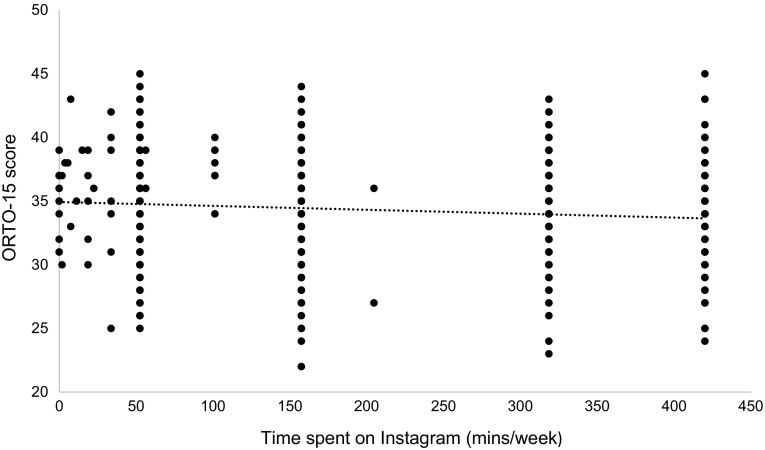
- Instagram use was negatively correlated with ORTO-15 score (r = −0.10, p = 0.01), meaning higher Instagram use was linked to greater ON symptoms; in regression, Instagram use (β = −0.12, p = 0.003) and country of residence (β = 0.23, p < 0.001) were significant predictors.
- ON prevalence in the sample was 49.0% with the <35 cut-off and 90.6% with the <40 cut-off; among Instagram users it was 49.3% and 90.4%, respectively, versus <1% in the general population.
- No significant relationships were found between ORTO-15 and number of food types eaten (r = −0.01, p = 0.87), number of social media channels used (r < 0.01, p = 0.99), age (r = −0.06, p = 0.13), or BMI (r = −0.03, p = 0.47); diet types also did not differ [F(5,674) = 0.705, p = 0.620].
- Twitter showed a small positive correlation with ORTO-15 score (r = 0.12, p = 0.04) in exploratory analysis; the paper describes this inconsistently as a positive association with ON symptoms in the abstract and as possibly protective in the discussion.
Methods
- Online Qualtrics survey; participants were recruited via unpaid advertisements on Instagram, Facebook, and Twitter, plus the “Plantbased Pixie” blog and “Health Bloggers Community” newsletter. Data were collected from 713 participants (23 males, 686 females, 4 other/prefer not to say; mean age 24.96 ± 8.17 years); final analysis included 680 females after excluding non-female participants and missing ORTO-15 data.
- Measures included social media channels and time spent, dietary choices (19 food types and diet label), ORTO-15, and demographics. ORTO-15 lower scores indicate higher ON symptoms; cut-offs of <40 and <35 were used.
- Analyses used Spearman correlations for social media use and ORTO-15, Pearson correlations for age/BMI, one-way ANOVA for diet types, and linear regression with Instagram use, age, BMI, ethnicity, and country of residence.
Limitations
- The paper states convenience non-random sampling, with 83% of participants recruited from the author’s Instagram account; the study title (“Health habits on social media”) may have attracted health-interested individuals; BMI was self-reported; medical diets were not assessed; and causality cannot be established due to the correlational design.
- The paper also notes possible interactions among multiple social media channels and that the sample was restricted to females because the number of male participants was too low for adequate power.
- The introduction notes ORTO-15 psychometric limitations, including internal consistency issues, lack of standardisation, cultural variation, and possible false positives from the high cut-off score.
Model-written summary. Check it against the paper before relying on it.
Integrity signals
Registry
Cites
Statistics
Figures
Verification
Claims the paper makes
12 Own result · 9 Not checked yet · 9 Own method · 5 Own interpretation · 1 No basis given
A result the paper reports from its own data — it cites no other source for it, so there is none to check. The quote shows it is in the paper.
In the paper
“The prevalence of ON in our sample was 90.6% with a cut-off score of <40, or 49.0% with a cut-off score of <35.”
§ Instagram use is linked to increased symptoms of orthorexia nervosa > Results > Sample characteristics
plain- Asserted: passes — The authors put it forward as true.
- Checkable: passes — It can be checked against evidence.
- Load-bearing: unclear — It is unclear whether the paper’s conclusions depend on it.
- Based: passes — The paper gives a reason why it holds.
A result the paper reports from its own data — it cites no other source for it, so there is none to check. The quote shows it is in the paper.
In the paper
“No relationship was found between ORTO-15 scores and number of food types eaten (r = −0.01; p = 0.87), number of social media channels used (r < 0.01; p = 0.99), age (r = −0.06; p = 0.13), or BMI (r = −0.03; p = 0.47).”
§ Instagram use is linked to increased symptoms of orthorexia nervosa > Results > Inferential Results
plain- Asserted: passes — The authors put it forward as true.
- Checkable: passes — It can be checked against evidence.
- Load-bearing: unclear — It is unclear whether the paper’s conclusions depend on it.
- Based: passes — The paper gives a reason why it holds.
A result the paper reports from its own data — it cites no other source for it, so there is none to check. The quote shows it is in the paper.
In the paper
“except Twitter which showed a small positive correlation (r = 0.12, p = 0.04).”
§ Instagram use is linked to increased symptoms of orthorexia nervosa > Results > Inferential Results
plaincorrelational- Asserted: passes — The authors put it forward as true.
- Checkable: passes — It can be checked against evidence.
- Load-bearing: unclear — It is unclear whether the paper’s conclusions depend on it.
- Based: passes — The paper gives a reason why it holds.
A result the paper reports from its own data — it cites no other source for it, so there is none to check. The quote shows it is in the paper.
In the paper
“The overall model was significant [F(5,648) = 9.58, p < 0.001)] with Instagram use (β = −0.12, p = 0.003) and country of residence (β = 0.23, p < 0.001) being significant predictors.”
§ Instagram use is linked to increased symptoms of orthorexia nervosa > Results > Inferential Results
plaincorrelational- Asserted: passes — The authors put it forward as true.
- Checkable: passes — It can be checked against evidence.
- Load-bearing: passes — The paper’s conclusions depend on it.
- Based: passes — The paper gives a reason why it holds.
A result the paper reports from its own data — it cites no other source for it, so there is none to check. The quote shows it is in the paper.
In the paper
“No relationship was found between ORTO-15 scores and number of food types eaten (r = −0.01; p = 0.87), number of social media channels used (r < 0.01; p = 0.99), age (r = −0.06; p = 0.13), or BMI (r = −0.03; p = 0.47).”
§ Instagram use is linked to increased symptoms of orthorexia nervosa > Results > Inferential Results
plain- Asserted: passes — The authors put it forward as true.
- Checkable: passes — It can be checked against evidence.
- Load-bearing: unclear — It is unclear whether the paper’s conclusions depend on it.
- Based: passes — The paper gives a reason why it holds.
A result the paper reports from its own data — it cites no other source for it, so there is none to check. The quote shows it is in the paper.
In the paper
“There were also no significant differences in ORTO-15 score between diet types as determined by one-way ANOVA [F(5,674) = 0.705, p = 0.620].”
§ Instagram use is linked to increased symptoms of orthorexia nervosa > Results > Inferential Results
plain- Asserted: passes — The authors put it forward as true.
- Checkable: passes — It can be checked against evidence.
- Load-bearing: unclear — It is unclear whether the paper’s conclusions depend on it.
- Based: passes — The paper gives a reason why it holds.
A result the paper reports from its own data — it cites no other source for it, so there is none to check. The quote shows it is in the paper.
In the paper
“No relationship was found between ORTO-15 scores and number of food types eaten (r = −0.01; p = 0.87), number of social media channels used (r < 0.01; p = 0.99), age (r = −0.06; p = 0.13), or BMI (r = −0.03; p = 0.47).”
§ Instagram use is linked to increased symptoms of orthorexia nervosa > Results > Inferential Results
plain- Asserted: passes — The authors put it forward as true.
- Checkable: passes — It can be checked against evidence.
- Load-bearing: unclear — It is unclear whether the paper’s conclusions depend on it.
- Based: passes — The paper gives a reason why it holds.
A result the paper reports from its own data — it cites no other source for it, so there is none to check. The quote shows it is in the paper.
In the paper
“The overall model was significant [F(5,648) = 9.58, p < 0.001)] with Instagram use (β = −0.12, p = 0.003) and country of residence (β = 0.23, p < 0.001) being significant predictors.”
§ Instagram use is linked to increased symptoms of orthorexia nervosa > Results > Inferential Results
plaincorrelational- Asserted: passes — The authors put it forward as true.
- Checkable: passes — It can be checked against evidence.
- Load-bearing: unclear — It is unclear whether the paper’s conclusions depend on it.
- Based: passes — The paper gives a reason why it holds.
- It may state two separate claims as one. 6
- Probably not a substantial claim. 15
- The quote only partly states this claim. 1
A result the paper reports from its own data — it cites no other source for it, so there is none to check. The quote shows it is in the paper.
In the paper
“Higher Instagram use was associated with a greater tendency towards orthorexia nervosa, with no other social media channel having this effect.”
- Also stated in: § Inferential Results · plain
“As predicted, there was a negative correlation between ORTO-15 score and Instagram use (r = −0.10; p = 0.01) (Fig. 1).”
- Also stated in: § Discussion · plain
“We found a significant relationship between symptoms of ON as measured by the ORTO-15 test and Instagram use, with higher Instagram use being associated with a greater tendency towards ON.”
§ Instagram use is linked to increased symptoms of orthorexia nervosa > Abstract > Results
plaincorrelationaln = 680 ·- Asserted: passes — The authors put it forward as true.
- Checkable: passes — It can be checked against evidence.
- Load-bearing: passes — The paper’s conclusions depend on it.
- Based: passes — The paper gives a reason why it holds.
It may state two separate claims as one.
- Also stated in: § Inferential Results · plain
A result the paper reports from its own data — it cites no other source for it, so there is none to check. The quote shows it is in the paper.
In the paper
“with no other social media channel having this effect.”
- Also stated in: § Inferential Results · plain
“No significant relationship was found between ORTO-15 score and other social media use (Table 3), except Twitter which showed a small positive correlation (r = 0.12, p = 0.04).”
- Also stated in: § Discussion · hedged
“No other social media channels were found to have this effect, although Twitter seemed to have a small protective association.”
§ Instagram use is linked to increased symptoms of orthorexia nervosa > Abstract > Results
plain- Asserted: passes — The authors put it forward as true.
- Checkable: passes — It can be checked against evidence.
- Load-bearing: passes — The paper’s conclusions depend on it.
- Based: passes — The paper gives a reason why it holds.
It may state two separate claims as one.
- Also stated in: § Inferential Results · plain
A conclusion the paper draws from its own results — it cites no other source for it, so there is none to check. The quote shows it is in the paper.
In the paper
“although Twitter seemed to have a small protective association.”
§ Instagram use is linked to increased symptoms of orthorexia nervosa > Discussion
hedgedcorrelational- Asserted: passes — The authors put it forward as true.
- Checkable: passes — It can be checked against evidence.
- Load-bearing: fails — The paper’s conclusions may not depend on it.
- Based: passes — The paper gives a reason why it holds.
Probably not a substantial claim. The paper’s conclusions may not depend on it.
A conclusion the paper draws from its own results — it cites no other source for it, so there is none to check. The quote shows it is in the paper.
In the paper
“While the effect size was small, the large population of social media users, now over 500 million on Instagram alone, means that this is a meaningful effect at population level.”
§ Instagram use is linked to increased symptoms of orthorexia nervosa > Discussion
plaindirect- Asserted: passes — The authors put it forward as true.
- Checkable: passes — It can be checked against evidence.
- Load-bearing: passes — The paper’s conclusions depend on it.
- Based: passes — The paper gives a reason why it holds.
It may state two separate claims as one.
A conclusion the paper draws from its own results — it cites no other source for it, so there is none to check. The quote shows it is in the paper.
In the paper
“with higher Instagram use being linked to increased symptoms.”
§ Instagram use is linked to increased symptoms of orthorexia nervosa > Abstract > Conclusions
plaincorrelational- Asserted: passes — The authors put it forward as true.
- Checkable: passes — It can be checked against evidence.
- Load-bearing: passes — The paper’s conclusions depend on it.
- Based: passes — The paper gives a reason why it holds.
The quote only partly states this claim.
What the paper did — it cites no source for this, so there is none to check. The quote shows it is in the paper.
In the paper
“Furthermore, BMI was calculated from self-report rather than measured, accordingly, we cannot rule out error and deliberate miss-reporting.”
§ Instagram use is linked to increased symptoms of orthorexia nervosa > Discussion > Limitations and further research
plain- Asserted: passes — The authors put it forward as true.
- Checkable: passes — It can be checked against evidence.
- Load-bearing: fails — The paper’s conclusions may not depend on it.
- Based: passes — The paper gives a reason why it holds.
Probably not a substantial claim. The paper’s conclusions may not depend on it. It may state two separate claims as one.
What the paper did — it cites no source for this, so there is none to check. The quote shows it is in the paper.
In the paper
“Participants were recruited through convenient non-random sampling, with the majority coming from the author’s Instagram account (83%), which is not representative of the general population.”
§ Instagram use is linked to increased symptoms of orthorexia nervosa > Discussion > Limitations and further research
plain- Asserted: passes — The authors put it forward as true.
- Checkable: passes — It can be checked against evidence.
- Load-bearing: unclear — It is unclear whether the paper’s conclusions depend on it.
- Based: passes — The paper gives a reason why it holds.
It may state two separate claims as one.
What the paper did — it cites no source for this, so there is none to check. The quote shows it is in the paper.
In the paper
“We decided to concentrate on female participants as the N recruited for men was too low to provide adequate power for statistical analyses.”
§ Instagram use is linked to increased symptoms of orthorexia nervosa > Methods and materials > Participants
plainn = 27- Asserted: passes — The authors put it forward as true.
- Checkable: passes — It can be checked against evidence.
- Load-bearing: passes — The paper’s conclusions depend on it.
- Based: passes — The paper gives a reason why it holds.
Probably not a substantial claim.
What the paper did — it cites no source for this, so there is none to check. The quote shows it is in the paper.
In the paper
“All participants gave their informed consent before starting the questionnaire and the study was approved by the UCL ethics committee.”
§ Instagram use is linked to increased symptoms of orthorexia nervosa > Methods and materials > Participants
plain- Asserted: passes — The authors put it forward as true.
- Checkable: passes — It can be checked against evidence.
- Load-bearing: fails — The paper’s conclusions may not depend on it.
- Based: passes — The paper gives a reason why it holds.
Probably not a substantial claim. The paper’s conclusions may not depend on it. It may state two separate claims as one.
None of the sources cited for this claim have been checked yet.
In the paper
“We used two cut-off scores due to disagreement in the literature over the appropriate cut-off point: less than 40 (following [28]), and less than 35 (following [35]).”
§ Instagram use is linked to increased symptoms of orthorexia nervosa > Methods and materials > Assessment and analysis
What the sources say
- Not checked yetcites [28] Arusoğlu G, Kabakci E, Köksal G, Merdol TK (2008) Orthorexia nervosa and adaptaon of ORTO-11 into Turkish. Turk J Psychiatry 19(3):283–291
- Not checked yetcites [35] Missbach B, Dunn TM, König JS (2016) We need new tools to assess Orthorexia Nervosa. A commentary on “Prevalence of Orthorexia Nervosa among College Students Based on Bratman’s Test and Associated Tendencies”. Appetite 108:521 source
plain- Asserted: passes — The authors put it forward as true.
- Checkable: passes — It can be checked against evidence.
- Load-bearing: fails — The paper’s conclusions may not depend on it.
- Based: passes — The paper gives a reason why it holds.
Probably not a substantial claim. The paper’s conclusions may not depend on it.
In the paper
“social media use has been associated with higher levels of depression in young adults [14]”
§ Instagram use is linked to increased symptoms of orthorexia nervosa > Introduction
What the sources say
- Not checked yetcites [14] Sidani JE, Shensa A, Radovic A, Miller E, Colditz JB, Hoffman BL, Giles LM, Primack BA (2016) Association between social media use and depression among US young adults. Depress Anxiety 33(4):323–331 source
plaincorrelational- Asserted: passes — The authors put it forward as true.
- Checkable: passes — It can be checked against evidence.
- Load-bearing: fails — The paper’s conclusions may not depend on it.
- Based: passes — The paper gives a reason why it holds.
Probably not a substantial claim. The paper’s conclusions may not depend on it.
The paper states this without a source or data behind it here, so there is nothing to check it against. The quote shows it is in the paper.
In the paper
“Currently the relationship between ON and social media use is unclear, although links between social media use and AN have been reported.”
§ Instagram use is linked to increased symptoms of orthorexia nervosa > Introduction
plain- Asserted: passes — The authors put it forward as true.
- Checkable: passes — It can be checked against evidence.
- Load-bearing: passes — The paper’s conclusions depend on it.
- Based: passes — The paper gives a reason why it holds.
Probably not a substantial claim.
What the paper did — it cites no source for this, so there is none to check. The quote shows it is in the paper.
In the paper
“In addition, the research title (Health habits on social media) may have attracted individuals with an interest in health.”
§ Instagram use is linked to increased symptoms of orthorexia nervosa > Discussion > Limitations and further research
hedgedconditional- Asserted: passes — The authors put it forward as true.
- Checkable: passes — It can be checked against evidence.
- Load-bearing: fails — The paper’s conclusions may not depend on it.
- Based: passes — The paper gives a reason why it holds.
Probably not a substantial claim. The paper’s conclusions may not depend on it.
In the paper
“Previous work around similar disorders suggests that social media use may contribute to an ‘echo-chamber’ effect, where users perceive their values and world-views to be more common than they actually are, due to selectively viewing contributions of other, similarly minded people [5].”
§ Instagram use is linked to increased symptoms of orthorexia nervosa > Introduction
What the sources say
- Not checked yetcites [5] Salathé M, Khandelwal S (2011) Assessing vaccination sentiments with online social media: implications for infectious disease dynamics and control. PLoS Comput Biol 7(10):e1002199 source
hedgedconditional- Asserted: passes — The authors put it forward as true.
- Checkable: passes — It can be checked against evidence.
- Load-bearing: fails — The paper’s conclusions may not depend on it.
- Based: passes — The paper gives a reason why it holds.
Probably not a substantial claim. The paper’s conclusions may not depend on it.
None of the sources cited for this claim have been checked yet.
In the paper
“Higher prevalence has been found in yoga instructors [30], dieticians, [31], nutrition students [32], and exercise science students [33] compared to the general population.”
§ Instagram use is linked to increased symptoms of orthorexia nervosa > Introduction
What the sources say
- Not checked yetcites [30] Valera JH, Ruiz PA, Valdespino BR, Visioli F (2014) Prevalence of orthorexia nervosa among ashtanga yoga practitioners: a pilot study. Eat Weight Disord-Stud Anorex Bulim Obes 19(4):469–472 source
- Not checked yetcites [31] Asil E, Sürücüoğlu MS (2015) Orthorexia nervosa in Turkish dietitians. Ecol Food Nutr 54(4):303–313 source
- Not checked yetcites [32] Bo S, Zoccali R, Ponzo V, Soldati L, De Carli L, Benso A, Fea E, Rainoldi A, Durazzo M, Fassino S (2014) University courses, eating problems and muscle dysmorphia: are there any associations? J Transl Med 12(1):1 source
plaincorrelational- Asserted: passes — The authors put it forward as true.
- Checkable: passes — It can be checked against evidence.
- Load-bearing: fails — The paper’s conclusions may not depend on it.
- Based: passes — The paper gives a reason why it holds.
Probably not a substantial claim. The paper’s conclusions may not depend on it.
What the paper did — it cites no source for this, so there is none to check. The quote shows it is in the paper.
In the paper
“To assess the robustness of the correlation between ORTO-15 and Instagram use when controlling for potentially confounding demographic variables, we additionally conducted linear regression analysis with ORTO-15 score as the outcome measure and Instagram use, age, BMI, ethnicity (dummy coded as white/non-white), and country of residence (dummy coded as UK/non-UK) as the predictor variables.”
§ Instagram use is linked to increased symptoms of orthorexia nervosa > Results > Inferential Results
plaincorrelational- Asserted: passes — The authors put it forward as true.
- Checkable: passes — It can be checked against evidence.
- Load-bearing: passes — The paper’s conclusions depend on it.
- Based: passes — The paper gives a reason why it holds.
Probably not a substantial claim.
In the paper
“Social media use is constantly increasing, with now 90% of UK young adults (aged 16–34 years) accessing social media platforms [1].”
§ Instagram use is linked to increased symptoms of orthorexia nervosa > Introduction
What the sources say
- Not checked yetcites [1] Ofcom (2015) Communications Market Report 2015. Ofcom
plaindirect- Asserted: passes — The authors put it forward as true.
- Checkable: passes — It can be checked against evidence.
- Load-bearing: fails — The paper’s conclusions may not depend on it.
- Based: passes — The paper gives a reason why it holds.
Probably not a substantial claim. The paper’s conclusions may not depend on it.
In the paper
“as well as eating disorders and related behaviours [15]”
§ Instagram use is linked to increased symptoms of orthorexia nervosa > Introduction
What the sources say
- Not checked yetcites [15] Carrotte ER, Vella AM, Lim MS (2015) Predictors of “liking” three types of health and fitness-related content on social media: a cross-sectional study. J Med Internet Res 17(8) source
plaincorrelational- Asserted: passes — The authors put it forward as true.
- Checkable: passes — It can be checked against evidence.
- Load-bearing: passes — The paper’s conclusions depend on it.
- Based: passes — The paper gives a reason why it holds.
Probably not a substantial claim.
What the paper did — it cites no source for this, so there is none to check. The quote shows it is in the paper.
In the paper
“Finally, we did not assess whether some participants followed a strict diet for medical reasons.”
§ Instagram use is linked to increased symptoms of orthorexia nervosa > Discussion > Limitations and further research
plain- Asserted: passes — The authors put it forward as true.
- Checkable: passes — It can be checked against evidence.
- Load-bearing: fails — The paper’s conclusions may not depend on it.
- Based: passes — The paper gives a reason why it holds.
Probably not a substantial claim. The paper’s conclusions may not depend on it.
In the paper
“There is some overlap between ON, AN and obsessive compulsive disorder (OCD) [25].”
§ Instagram use is linked to increased symptoms of orthorexia nervosa > Introduction
What the sources say
- Not checked yetcites [25] Koven NS, Abry AW (2015) The clinical basis of orthorexia nervosa: emerging perspectives. Neuropsychiatric Disease & Treatment 11
plaincorrelational- Asserted: passes — The authors put it forward as true.
- Checkable: passes — It can be checked against evidence.
- Load-bearing: fails — The paper’s conclusions may not depend on it.
- Based: passes — The paper gives a reason why it holds.
Probably not a substantial claim. The paper’s conclusions may not depend on it.
Claims other papers make about this one
Each is checked against this paper’s own text: does it say what the citing paper says it does?
The source backs part of the claim, not all of it — or backs it for a different population, condition or comparison.
In the citing paper
“A study of 713 participants confirmed orthorexia nervosa prevalence of 49% [70], far greater than the estimated <1% in the general UK population.”
From The social media diet: A scoping review to investigate the association between social media, body image and eating disorders amongst young people (2023) · cites this paper as [70]
Experimental — accuracy not yet measuredThe source backs part of the claim, not all of it — or backs it for a different population, condition or comparison.
In the citing paper
“Disturbingly high prevalence of body image dissatisfaction, disordered eating pathology and comorbid mental health outcomes were reported amongst young social media users in this review [57, 66, 70].”
From The social media diet: A scoping review to investigate the association between social media, body image and eating disorders amongst young people (2023) · cites this paper as [70]
Experimental — accuracy not yet measuredThe cited source says what the claim attributes to it.
In the citing paper
“One cross-sectional and one qualitative study indicated orthorexia nervosa symptomatology amongst participants, ranging from obsessions with ‘clean eating’ to avoidance of ‘demonised’ foods and compulsive exercise behaviours [64, 70].”
From The social media diet: A scoping review to investigate the association between social media, body image and eating disorders amongst young people (2023) · cites this paper as [70]
Statistics recomputed
Every reported test result, recomputed from its test statistic and degrees of freedom. A result shows as not adding up only once an independent check has confirmed it.
- ConsistentF(5, 674) = 0.705reported p = .62 · recomputed p = .620
“F(5,674) = 0.705, p = .620”
- ConsistentF(5, 648) = 9.58reported p < .001 · recomputed p < .001
“F(5,648) = 9.58, p < .001”
Self-check
Percentages, sums and reported differences re-computed from the paper’s own numbers.
Each contradiction between two passages listed here was confirmed by an independent check.
Rated minor: it would not touch a result — a value no result rests on, a p-value that stays on the same side of the significance level, or a conflict that is clerical, resolved elsewhere in the paper, or outside its own findings.
In the paper
§ Instagram use is linked to increased symptoms of orthorexia nervosa > Results > Sample characteristics
“| Number of social media channels (out of n = 7) | 3.55 ± 1.25 |”
§ Instagram use is linked to increased symptoms of orthorexia nervosa > Results > Sample characteristics
“| % using this channel | 94.5% | 88.1% | 41.0% | 54.9% | 12.3% | 20.7% | 29.0% |”
Rated minor: it would not touch a result — a value no result rests on, a p-value that stays on the same side of the significance level, or a conflict that is clerical, resolved elsewhere in the paper, or outside its own findings.
In the paper
§ Instagram use is linked to increased symptoms of orthorexia nervosa > Discussion
“exploratory analysis into other social media channels showed that Twitter had a positive association with ON symptoms.”
§ Instagram use is linked to increased symptoms of orthorexia nervosa > Discussion
“No other social media channels were found to have this effect, although Twitter seemed to have a small protective association.”
Citations
Cites
Diagnostic and Statistical Manual of Mental Disorders
American Psychiatric Association (2013) · doi:10.1176/appi.books.9780890425596 · Cited by 116,369
Diagnostic and Statistical Manual of Mental Disorders(DSM)
Leong, F. T. L. (2008) · Sage eBooks · doi:10.4135/9781412963978.n182 · Cited by 10,861
Lin, L. Y., Sidani, J. E., Shensa, A., Radovic, A., Miller, E., Colditz, J. B., Hoffman, B. L., Giles, L. M., & Primack, B. A. (2016) · Depression and Anxiety · doi:10.1002/da.22466 · Cited by 1,111
Instagram: Motives for its use and relationship to narcissism and contextual age
Sheldon, P., & Bryant, K. (2016) · Computers in Human Behavior · doi:10.1016/j.chb.2015.12.059 · Cited by 1,095 · cited 1×
“identified as motivations for Instagram use [12, 13], which corresponds well with the sharing of food images—both as a food diary (documentation/creativity) and searching for recipes and inspiration (surveillance).”
BackgroundKatzman, M. A., Bleau, P., Blier, P., Chokka, P., Kjernisted, K., Van Ameringen, M., & the Canadian Anxiety Guidelines Initiative Group on behalf of the Anxiety Disorders Association of Canada/Association Canadienne des troubles anxieux and McGill University (2014) · BMC Psychiatry · doi:10.1186/1471-244x-14-s1-s1 · Cited by 1,090
A tale of two sites: Twitter vs. Facebook and the personality predictors of social media usage
Hughes, D. J., Rowe, M., Batey, M., & Lee, A. (2012) · Computers in Human Behavior · doi:10.1016/j.chb.2011.11.001 · Cited by 1,011
Pittman, M., & Reich, B. (2016) · Computers in Human Behavior · doi:10.1016/j.chb.2016.03.084 · Cited by 907 · cited 1×
“However, image-based platforms such as Instagram have also been shown to confer a significant decrease in self-reported loneliness to users, whereas text-based platforms such as Twitter do not [21].”
BackgroundWhat We Instagram: A First Analysis of Instagram Photo Content and User Types
Hu, Y., Manikonda, L., & Kambhampati, S. (2014) · Proceedings of the International AAAI Conference on Web and Social Media · doi:10.1609/icwsm.v8i1.14578 · Cited by 807 · cited 2×
“[9] eight popular content types for the frequency with which they typically appear on their feed.”
BackgroundOn orthorexia nervosa: A review of the literature and proposed diagnostic criteria
Dunn, T. M., & Bratman, S. (2016) · Eating Behaviors · doi:10.1016/j.eatbeh.2015.12.006 · Cited by 635 · cited 4×
“However, Dunn and Bratman [24] make a compelling argument that there is sufficient evidence to suggest ON is a distinct condition.”
BackgroundInfluentialConditions for a Picture-Superiority Effect on Consumer Memory
Childers, T. L., & Houston, M. J. (1984) · Journal of Consumer Research · doi:10.1086/209001 · Cited by 622 · cited 1×
“1 3 First, the image-focused nature of Instagram, which plays to the picture-superiority effect—whereby images are more likely to be remembered than words [39]—and makes Instagram ideal for sharing food images.”
Background
Cited by
Sorted by citations
Items 301–379 of 379
Graffeo, I., Harron, M., & O’Mahony, E. (2020) · Research Square · doi:10.21203/rs.3.rs-48945/v1
Barnhill, A., & Civita, N. (2019) · Springer eBooks · doi:10.1007/978-3-319-75388-1_91-1
Hajok, D., Kniazev, N., Le, T. H. N., & Lindner, S. (2022) · Jugend Medien Schutz-Report · doi:10.5771/0170-5067-2022-2-2 · Cited by 2
Comportamento ortoréxico em estudantes de Nutrição
Rodrigues, A. M., Dargham, M. M., & de Oliveira, A. M. P. (2022) · Interação - Revista de Ensino Pesquisa e Extensão · doi:10.33836/interacao.v24i1.660
Attitude to Body-Risk Factor or Health Factor in Psychopathology
Izydorczyk, B., Enea, V., Lipowski, M., & Sitnik‐Warchulska, K. (2022) · Frontiers research topics · doi:10.3389/978-2-88976-289-7
Perspective Chapter: Social Networks and Eating Disorders - Beauty and the Beast?
Castillo, J. M. O.-D., Martínez-Quiñones, J. V., & Jáuregui‐Lobera, I. (2022) · IntechOpen eBooks · doi:10.5772/intechopen.106465
Talbot, C. V., Campbell, C. E. R., & Greville-Harris, M. (2022) · Research Square · doi:10.21203/rs.3.rs-2163564/v1
O impacto das midías sociais em transtornos alimentares
Costa, J. P. D., Figueiredo, R. S., & Ferreira, J. C. D. S. (2022) · Brazilian Journal of Health Review · doi:10.34119/bjhrv5n6-083
Tanrıverdi, E. Ç., & Nas, M. A. (2022) · Research Square · doi:10.21203/rs.3.rs-2349930/v1
Orthorexic Eating and Addictions: Links with Substance Use, Behavioral Addictions, and Research Gaps
Strahler, J., Moser, L., & Wachten, H. (2022) · Springer eBooks · doi:10.1007/978-3-030-67929-3_79-1 · Cited by 1
Rączy, K., Mirek-Rogowska, A., & Sztuba, D. (2022) · Social Communication · doi:10.2478/sc-2022-0006
Disinformation about diet and nutrition in social media. Scoping review (Preprint)Preprint
Segado-Fernández, S., Herrera‐Peco, I., Jiménez-Gómez, B., Hidalgo, P. J. J., Martín, P. J. S., & Lozano-Estevan, M. D. C. (2023) · doi:10.2196/preprints.46960
Orthorexia, lifestyle and social media pressure: what to do?
TESTINO, G., Pellicano, R., & Balbinot, P. (2023) · Minerva Gastroenterology · doi:10.23736/s2724-5985.23.03393-4
Sharma, A. A., & Vidal, C. (2023) · Research Square · doi:10.21203/rs.3.rs-2758446/v1
Santarossa, S., & Woodruff, S. J. (2023) · International Journal of Social Media and Online Communities · doi:10.4018/ijsmoc.324077
Features of a New Eating Disorder: Orthorexia Nervosa in the 21st Century
Didkovska, L., & Balahurak, O. (2023) · Lviv University Herald Series Psychological sciences · doi:10.30970/ps.2023.15.3
“На думку деяких дослідників моло - ді люди найбільш вразливі, тоді як інші вказують на відсутність зв'язку між віком і орторексі - єю [28].”
Kepemimpinan Efektif Leadership in Digital Transformation Era
Widiharto, B., Nurchayatun, N., & Marikar, R. H. (2023) · Jurnal Syntax Admiration · doi:10.46799/jsa.v4i2.556
Niger, L. (2023) · Acta Scientific Medical Sciences · doi:10.31080/asms.2023.07.1694
THE PREVALENCE OF ORTHOREXIA IN TOURISM EDUCATION ASSOCIATE DEGREE STUDENTS
Сормаз, У., & Şanlıer, N. (2023) · Mehmet Akif Ersoy Üniversitesi Sosyal Bilimler Enstitüsü Dergisi · doi:10.20875/makusobed.1260268
Genleri Beslemek Obezite Bilimi ve Popüler Diyetler Ardındaki Gerçekler ve İnsan İştahının Hikayesi
Durası, M. (2023) · Akademisyen Kitabevi eBooks · doi:10.37609/akya.2624
Beden İmgesinin Yaşam Niteliğine Etkisi
Alakaş, B., & Elmas, S. (2024) · Bingöl Üniversitesi Sağlık Dergisi · doi:10.58605/bingolsaglik.1397432
Caring for screenagers (Part 1): a pediatrician's primer on popular social media platforms
Cason, G., Margolis, A., Barile, J. G., & Milanaik, R. L. (2024) · Current Opinion in Pediatrics · doi:10.1097/mop.0000000000001342
Pawłowska, B., Świerczyńska, J. C., Dyzma-Kasprzak, A., & Kasprzak, K. (2024) · Medical Studies · doi:10.5114/ms.2024.137601
Kecenderungan orthorexia nervosa pada mahasiswa program studi gizi
Khusna, S., Warsini, S., & Helmiyanti, S. (2023) · Jurnal Gizi Klinik Indonesia · doi:10.22146/ijcn.76039
“Hasil penelitian ini sejalan dengan penelitian lain yang menyatakan bahwa IMT tidak berhubungan dengan kecenderungan ON [25].”
BackgroundImpactos da mídia na cultura alimentar de estudantes em comunidades tradicionais quilombolas
Mota, H. S., dos Santos, M. L., & de Araújo, Y. L. F. M. (2024) · Cuadernos de Educación y Desarrollo · doi:10.55905/cuadv16n6-172
Influencers: ¿impactan en las conductas alimentarias de sus seguidores?
Santillán-Rivera, M. S., & González-Martin, A. M. (2024) · Revista Ciencia UANL · doi:10.29105/cienciauanl27.128-5
Ulutaş, P. U., & Bakır, B. O. (2024) · Research Square · doi:10.21203/rs.3.rs-5075839/v1
Orthorexia Nervosa: Eating Disorder for a Pro-health Era
Fixsen, A. M. (2024) · The politics of mental health and illness · doi:10.1007/978-3-031-70318-8_9
EVALUATION OF ORTHOREXIA NERVOSA TENDENCY AND SOCIAL MEDIA ADDICTION IN UNIVERSITY STUDENTS
Bıyıklı, E. T., & Bıyıklı, A. E. (2024) · Genel Tıp Dergisi · doi:10.54005/geneltip.1557960 · Cited by 1
Patil, A., Salimath, G., & Angolkar, M. (2024) · Indian Journal of Health Sciences and Biomedical Research (KLEU) · doi:10.4103/kleuhsj.kleuhsj_551_23
Fixsen, A. M., Cheshire, A., & Tragantzopoulou, P. (2025) · Springer eBooks · doi:10.1007/978-3-658-47031-9_12
Gerçek, H. G., & Kara, A. (2025) · OSMANGAZİ JOURNAL OF MEDICINE · doi:10.20515/otd.1599009 · Cited by 1
Anabtawi, O., Irshaid, A., Ayoub, H., & Saleh, F. (2025) · Frontiers in Communication · doi:10.3389/fcomm.2025.1597682
Interdisciplinary trends in the promotion of sustainable food choices
Carfora, V., & Catellani, P. (2025) · Elsevier eBooks · doi:10.1016/b978-0-443-33140-4.00003-8
Zafar, M., Alhamashi, L. Z., Alshwihani, R. Y., Alshubrami, S. H., Alshertan, M. S., Alazmi, R. S., & Aljulaidi, M. O. (2025) · Journal of Hunger & Environmental Nutrition · doi:10.1080/19320248.2025.2542955
“6,7 8–12 From a public health nutrition perspective, dietary choices are not only individual behaviors but are also shaped by environmental determinants such as online content of nutrition choices which create unhealthy environments.”
Belli, A., Gobbi, E., Amatori, S., Preti, A., Perroni, F., Rocchi, M., & Sisti, D. (2025) · Epidemiology Biostatistics and Public Health · doi:10.54103/2282-0930/29193
Benefits and Risks of the Digital World
Ahuja, A., & Johns, G. (2025) · Cambridge University Press eBooks · doi:10.1017/9781009110266.017
Martin, C., & Malik, N. (2025) · Health Education · doi:10.1108/he-07-2025-0121
Role of Social Media Influence, Peer Pressure, and Emotional Well-Being in Healthy Eating Behavior
Gaur, D., Nair, S. S., Nagorao, A. S., & Vishnu, A. K. (2025) · International Conference on Computational Intelligence and Knowledge Economy (ICCIKE) · doi:10.1109/iccike67021.2025.11318159
“Similarly, studies [5] found that frequent engagement with “fitspiration” content is associated with guilt, body comparison, and disordered eating habits.”
Demirel, N. S. K., Ayhan, C. H., & Aslan, K. (2026) · The European Research Journal · doi:10.18621/eurj.1818275
Sağlıklı Beslenmeden Psikopatolojiye: Ortoreksiya Nervoza
DÖNMEZ, A., & Di̇ri̇k, G. (2026) · Ayna Klinik Psikoloji Dergisi · doi:10.31682/ayna.1685745 · Cited by 1
Instagrammable Food: The Impact of Instagram on Eating Behavior
Can, İ. I., & İflazoğlu, N. (2026) · Anadolu Kültürel Araştırmalar Dergisi · doi:10.63556/ankad.v10i1.329
Araç, F. Ö. Ö. (2026) · Nutrition Today · doi:10.1097/nt.0000000000000796
Inoue, T., Okada, S., Yamana, H., Horai, T., Shirai, T., Otsuka, I., & Hishimoto, A. (2026) · Psychiatry Research Case Reports · doi:10.1016/j.psycr.2026.100314
Khelalfa, Z. (2026) · Current Issues of Mass Communication · doi:10.17721/cimc.2026.39.60-70 · Cited by 1
Prävention und Prädiktion von Nahrungsmittelallergien auf Instagram: eine systematische Evaluation
Beyer, M., Hasseler, M., Rohr, M., et al. (2026) · Das Gesundheitswesen · doi:10.1055/a-2761-2238
“Die Social Media Plattform Instagram ist eine der beliebtesten Plattfor-men mit steigenden Nutzer:innenzahlen weltweit [5] und hat einen erheblichen Einfluss auf das Leben der Menschen mit positiven und negativen Auswirkungen auf die wahrgenommene soziale und psy-chische Lebensqualität [6, 7].”
Sweerts, S. J. (2019) · theses.fr (ABES) · doi:10.70675/4eff0dfdzb1c6z4668zbe45zcc1657991369
Compréhension du bien-être alimentaire des étudiants dans des environnements physiques et numériques
Sadoun, L. (2020) · theses.fr (ABES) · doi:10.70675/c949979czd7b4z475ezbbcazef00bacc4cca
Healthy Orthorexia and Orthorexia Nervosa Among Nurses in Qatar
Pattabi, A., Nazarene, A., Nashwan, A. J. J., Joy, G. V., Hassan, S. M., Samara, H., & Singh, K. (2026) · Health Science Reports · doi:10.1002/hsr2.71228
“These findings are clinically relevant for both the development and recovery from eating disorders [16].”
Baldwin‐White, A., Darville, G., Chess, S., & Beer, J. (2026) · American Journal of Sexuality Education · doi:10.1080/15546128.2026.2663444
Psychology in Social Media and Individual Restricted Diets
王, 雨. (2026) · Advances in Social Sciences · doi:10.12677/ass.2026.154352
From health to harm: Cross-sectional analysis of factors associated with orthorexia nervosa
Roth, A. M., Vollmeyer, R., & Matura, S. (2026) · Neuroscience Applied · doi:10.1016/j.nsa.2026.107011
“Participants were also asked to provide the amount of time they spent on each platform in minutes per day (Turner and Lefevre, 2017).”
InfluentialWhat is ‘clean eating’ and how can it affect wellbeing?
Sharp, G. (2026) · The Conversation · doi:10.64628/aa.gt5mr97tq
Bayazıtlı, E. Ö., Çakir, A. S., Turan, M. B., Uğur, C. A. B. A., Karaoğlu, B., Pepe, O., Pekel, A., Sevim, İ. H., & Dalbudak, İ. (2026) · Frontiers in Nutrition · doi:10.3389/fnut.2026.1847236
“The literature also indicates that social media use is associated with disordered eating behaviors and related cognitive-emotional processes (13, 14).”
Hematabadi, A., Rashidlamir, A., Motevalli, M. S., Schauer, M., & Arazi, H. (2026) · Health Education & Behavior · doi:10.1177/10901981261458638
Rogotzki, V., & Biehl, S. C. (2026) · Journal of Public Health · doi:10.1007/s10389-026-02842-9
Exploratory profiles of orthorexia nervosa among medical students: A clinical continuum
Uçak, E. F., AKGÜL, B., & Kısa, H. Ş. (2026) · Eating Behaviors · doi:10.1016/j.eatbeh.2026.102112
Porteous, K., Kemps, E., Powell, A., & Prichard, I. J. (2026) · Journal of Technology in Behavioral Science · doi:10.1007/s41347-026-00685-5
Adaptation of the orthorexia beliefs scale into Turkish: a validity and reliability study
Köksal, S., Temizarabacı, İ., Cantürk, S., Uçak, M. N., Katırcıoğlu, B., Ağır, G., Türker, P. F., & Baş, M. (2026) · Frontiers in Nutrition · doi:10.3389/fnut.2026.1877643
Shifa, A., Ali, G. M. N., & Henricks, D. E. (2026) · IEEE Systems Journal · doi:10.1109/jsyst.2026.3713492
An, L., Luan, M., Yang, Y., & Wang, S. (2026) · Frontiers in Public Health · doi:10.3389/fpubh.2026.1871219
“This gap is exploited by a perilous “eminence-based practice,” which influencers without formal training are considered unquestionable medical authorities simply because of their large follower counts and polished digital presence (9).”
InfluentialFood Influencers and Digital Nutrition Communication
Shukla, B. R. (2026) · IGI Global eBooks · doi:10.4018/979-8-2600-3845-1.ch012
Lu, J., & Zhu, J. (2026) · Social Sciences and Humanities · doi:10.63313/ssh.2011
Villodres, G. C., Vizcaíno-Cuenca, R., Pérez, F. S., & Muros, J. J. (2026) · School Mental Health · doi:10.1007/s12310-026-09909-8
Levchenko, E. V., Каганович, Е. М., Strelkova, E. A., Klesova, E. A., & Barvenova, I. M. (2026) · S S Korsakov Journal of Neurology and Psychiatry · doi:10.17116/jnevro2026126081104
Przepiórka, A., Błachnio, A., Kot, P., & Cudo, A. (2026) · Current Issues in Personality Psychology · doi:10.5114/cipp/223927
“Additionally, frequent Instagram use has been associated with symptoms of orthorexia nervo-sa among young adults (Turner & Lefevre, 2017).”
Pahr-Hosbach, S., Schembecker, P., & Wolf, R. (2026) · Essentials · doi:10.1007/978-3-662-73077-5_1
Grajek, M. K., Pers, P., Jurys, T., & Rozmiarek, M. (2026) · Frontiers in Public Health · doi:10.3389/fpubh.2026.1941731
Başpınar, B. (2026) · Current Psychology · doi:10.1007/s12144-026-10079-8
“Participants reported their use of YouTube, Instagram, and Facebook, including time spent per session, categorized as < 15, 15–30, 31–60, or > 60 min, consistent with the approach used by Turner and Lefevre (2017).”
Mocini, E., Greco, F., Gagliardi, A., Titi, L., Giannetta, E., & Tarsitano, M. G. (2026) · Frontiers in Nutrition · doi:10.3389/fnut.2026.1937445
Fitch, C., & Zibarras, L. (2026) · Counselling Psychology Review · doi:10.53841/bpscpr.2026.40.2.50
Doran, M., Zincirci, D. E., & Şahan, E. G. (2026) · Journal of Clinical Medicine · doi:10.3390/jcm15197678
Kiciak, A., Staśkiewicz‐Bartecka, W., Kuczka, N. K., Białek-Dratwa, A., Sapała, A.-M., Jaruga-Sękowska, S., Kardas, M., & Barczyńska, R. (2026) · Children · doi:10.3390/children13101355
Metadata
- Authors
- Turner, P. G., & Lefevre, C. E.
- Affiliations
- University College London (GB)
- Corresponding author
- Lefevre, Carmen E.
- ORCID
- Lefevre, Carmen E.
- Venue
- Eating and Weight Disorders - Studies on Anorexia, Bulimia and Obesity
- Published
- 2017-03-01
- Volume
- 22
- Issue
- 2
- Pages
- 277-284
- ISSN
- 1124-4909 (ISSN-L)
- 1590-1262
- PMC
- PMC5440477
- OpenAlex
- W2593519256
- Semantic Scholar
- 8fa58fca216d463d9400de92c0164d84018f7dc8
- Cited by
- 380
- References
- 37
- Citations by year
- 2026: 39 · 2025: 43 · 2024: 40 · 2023: 52 · 2022: 55 · 2021: 60 · 2020: 43 · 2019: 28 · 2018: 18 · 2017: 1
- FWCI
- 30.45
- Type
- journal article
- Language
- en
- Open access
- hybrid
- doi.org
- Licence
- Locations
- Eating and Weight Disorders - Studies on Anorexia Bulimia and Obesity (publishedVersion, cc-by)
- Europe PMC (PubMed Central) (publishedVersion, cc-by)
- PubMed Central (publishedVersion, cc-by)
- PubMed (publishedVersion)
- UCL Discovery (University College London) (submittedVersion)
- Topics
- Social Sciences › Psychology › Clinical Psychology › Eating Disorders and Behaviors
- Health Sciences › Nursing › Nutrition and Dietetics › Nutrition, Health and Food Behavior
- Social Sciences › Psychology › Clinical Psychology › Body Image and Dysmorphia Studies
- Keywords
- orthorexia nervosa, Instagram, social media use, eating disorders, disordered eating, young adults, ORTO-15, Twitter, body image, social media influencers
- MeSH terms
- Adolescent, Adult, Feeding and Eating Disorders, Body Image, Feeding Behavior, Female, Humans, Health Behavior, Young Adult, Social Media, Symptom Assessment
About these checks
Registry, retraction, Cites and statistics results are computed, not judged, with one exception: a printed reference that no index lists is read once by a model before it counts as a citation error. Claims are extracted by a model and kept only when their quote appears verbatim in the text; each cited source is then checked, with a model’s help, for whether it says what the claim relies on. Those verdicts can be wrong — read the claim’s quote and the cited source before relying on one.
A language model drew the claims from the paper on 2026-10-08, under version 3 of the claim definition (model deepseek-v4.1-flash, prompt extract-v3).
A second model labelled each claim on 2026-10-08 (model jev-1.13-20260917, definition revision gold-guideline-v0.2).
Statistics and arithmetic are recomputed, not judged.
Confidence bands are shown only for fields calibrated on our annotated test set. None is calibrated yet, so no band is shown.
What counts as a claim ›How we measure confidence ›How we check this ›
Are you an author, or do you see a problem with this page? Request a review
