

Rumination, mood, and maladaptive eating behaviors in overweight and healthy populations
Open accessThe DOI matches its Crossref record; 66 of the 66 references it cites were found in a registry or an index.
Abstract
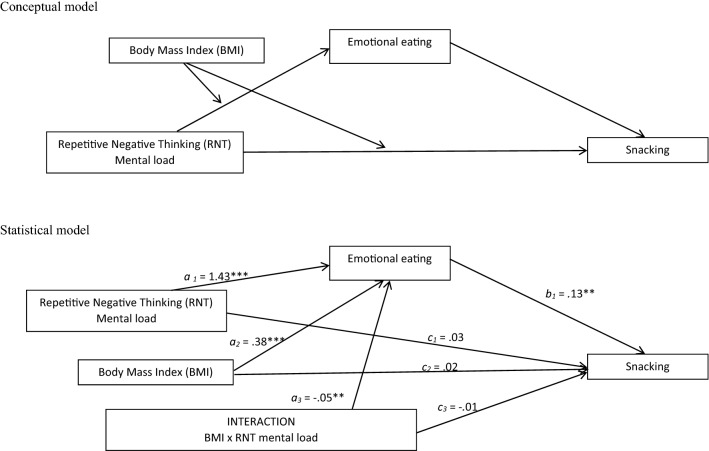
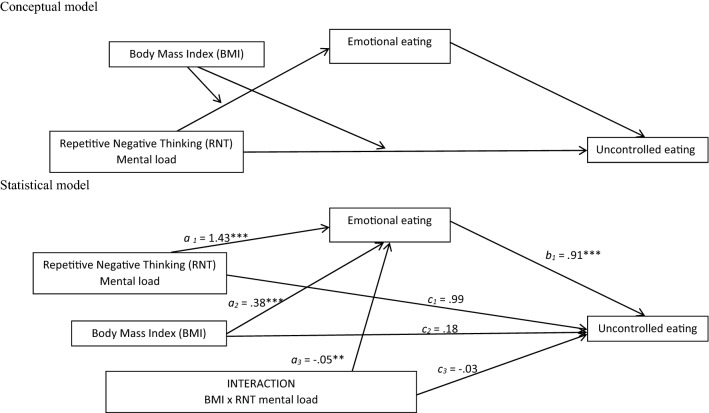
Purpose: The literature suggests that rumination (i.e., repetitive thinking about 1 or more negative concerns that is perceived as difficult to control) is linked to impaired emotional regulation and increases negative affect. Not only individuals suffering from overweight or obesity, but also healthy individuals might use emotional eating as a coping strategy to deal with negative affect caused by rumination. The aim of the present study was to determine the link between rumination and maladaptive eating strategies in participants with normal weight and overweight/obesity using trait and ecological momentary measures. Method: In Study 1, 88 individuals from overweight/obese (N = 33) and control group (N = 50) filled in a series of questionnaires assessing trait rumination, and eating behaviors. In Study 2 momentary affect, rumination and eating behavior of 26 participants were assessed using ecological momentary assessment (EMA) methodology. Results: In Study 1, the moderated mediation model revealed that emotional eating mediates the link between rumination and uncontrolled eating or snacking, but only in healthy participants and not in the participants with overweight. The results of Study 2 suggest that when both momentary rumination and sad mood are entered into the model predicting momentary daily emotional eating, only rumination remains a significant predictor of emotional eating. This relationship is not modified by the fact that the participants are from healthy controls or the overweight/obese group. Discussion: Study 1 provided evidence on the differential role of emotional eating in participants with normal weight and with overweight. Study 2 provided initial insights into the role of momentary mood and momentary repetitive thinking in the use of emotional eating in participants’ everyday lives. The differences in group effect in trait and EMA measures indicated also the importance of considering the consciousness of using rumination and emotional eating, while studying those processes in individuals with overweight. Level of evidence: Level III, case-control analytic study.
Overview
The claims and statistics of this paper haven’t been checked yet.
Free: it reads the open-access text and checks the first 5 claims that cite a source we can check. Create a free account to check every claim.
Integrity signals
Registry
Cites
Statistics
Figures
Verification
Claims the paper makes
The claims and statistics of this paper haven’t been checked yet.
Free: it reads the open-access text and checks the first 5 claims that cite a source we can check. Create a free account to check every claim.
Claims other papers make about this one
Each is checked against this paper’s own text: does it say what the citing paper says it does?
In the citing paper
“Such a phenomenon might pose a significant barrier to successful lifestyle changes, contributing to overeating and maladaptive eating behaviors, including emotional eating [29].”
From What Is Food Noise? A Conceptual Model of Food Cue Reactivity (2023) · cites this paper as [29]
Self-check
Percentages, sums and reported differences re-computed from the paper’s own numbers.
The self-check needs the paper’s full text.
Citations
Cites
(2013) · Cited by 44,563
Self-discrepancy: A theory relating self and affect.
Higgins, E. T. (1987) · Psychological Review · doi:10.1037/0033-295x.94.3.319 · Cited by 7,219
The Strength Model of Self-Control
Baumeister, R. F., Vohs, K. D., & Tice, D. M. (2007) · Current Directions in Psychological Science · doi:10.1111/j.1467-8721.2007.00534.x · Cited by 3,567
Constructive and unconstructive repetitive thought
Watkins, E. R. (2008) · Psychological Bulletin · doi:10.1037/0033-2909.134.2.163 · Cited by 2,421
Repetitive Negative Thinking as a Transdiagnostic Process
Ehring, T., & Watkins, E. R. (2008) · International Journal of Cognitive Therapy · doi:10.1521/ijct.2008.1.3.192 · Cited by 1,172
Repetitive negative thinking as a transdiagnostic process
Ehring, T., & Watkins, E. (2008) · International Journal of Cognitive Therapy · doi:10.1680/ijct.2008.1.3.192 · Cited by 1,141 · cited 2×
“Rumination refers to repetitive dwelling on one more negative issues that is perceived as difficult to control [15].”
BackgroundKarlsson, J., Persson, L.-O., Sjöström, L., & Sullivan, M. (2000) · International Journal of Obesity · doi:10.1038/sj.ijo.0801442 · Cited by 1,104
Ehring, T., Zetsche, U., Weidacker, K., Wahl, K., Schönfeld, S., & Ehlers, A. (2011) · Journal of Behavior Therapy and Experimental Psychiatry · doi:10.1016/j.jbtep.2010.12.003 · Cited by 888
Haedt-Matt, A. A., & Keel, P. K. (2011) · Psychological Bulletin · doi:10.1037/a0023660 · Cited by 799
Emotion regulation model in binge eating disorder and obesity - a systematic review
Leehr, E. J., Krohmer, K., Schag, K., Dresler, T., Zipfel, S., & Giel, K. E. (2015) · Neuroscience & Biobehavioral Reviews · doi:10.1016/j.neubiorev.2014.12.008 · Cited by 560
Research works printed but not linked: 5
- Rossy L The mindfulness-based eating solution: proven strategies to end overeating, satisfy your hunger, and savor your life 2016 Oakland New Harbin
- Bruh H Bruch H Hunger awareness and individuation eating disorders Eating disorders: obesity, anorexia nevrosa, and the person within 1973 New York Basic Book
- Kristeller JL (2015) Handbook of mindfulness and self-regulationitle. In: Ostafin B, Robinson M, Meier B (eds) Springer, New York; pp 199–215
- Martin LL Tesser A Wyer RSJ Some ruminative thoughts Advances in social cognition, Vol 9 Ruminative thoughts 1996 New Jersey Lawrence E. Hillsdale
- Raudenbush SW Bryk AS Congdon R HLM 7.00 for Windows 2011 Lincolnwood Scientific Software International Inc
Cited by
What Is Food Noise? A Conceptual Model of Food Cue Reactivity
Hayashi, D., Edwards, C., Emond, J. A., Gilbert-Diamond, D., Butt, M., Rigby, A., & Masterson, T. D. (2023) · Nutrients · doi:10.3390/nu15224809 · Cited by 80
“Such a phenomenon might pose a significant barrier to successful lifestyle changes, contributing to overeating and maladaptive eating behaviors, including emotional eating [29].”
BackgroundArexis, M., Féron, G., Brindisi, M., Billot, P.-É., & Chambaron, S. (2023) · Journal of Eating Disorders · doi:10.1186/s40337-023-00916-7 · Cited by 73
“…dysregulation, anxiety and depression have different impacts on emotional eating (EE) depending on obesity sever - ity", while Kornacka et al. [20] underlined that “the role of emotional eating in the link between rumination and uncontrolled eating is different in overweight vs. healthy…”
BackgroundResultInfluentialChew, H. S. J., Soong, R. Y., Ang, W. H. D., Ngooi, J. W., Park, J., Yong, J. Q. Y. O., & Goh, Y. S. S. (2025) · British Journal of Psychology · doi:10.1111/bjop.12768 · Cited by 52
“Understanding the prevalence of emotional eating has significant clinical implications for preventing and managing various health conditions (Brytek-Matera, 2021; Kornacka et al., 2021).”
Mikhail, M. E. (2021) · Frontiers in Psychiatry · doi:10.3389/fpsyt.2021.747854 · Cited by 33
Emotional Eating and Obesity: An Update and New Insights
Braden, A. L., Ahlich, E. M., & Koball, A. M. (2025) · Current Obesity Reports · doi:10.1007/s13679-025-00661-9 · Cited by 33
“Suppression and rumination appear to be particularly important targets for future EE interventions [59, 62, 63].”
Food-related behaviours among individuals with overweight/obesity and normal body weight
Brytek‐Matera, A., Czepczor‐Bernat, K., & Olejniczak, D. (2018) · Nutrition Journal · doi:10.1186/s12937-018-0401-7 · Cited by 28
Self-citationNight Eating Syndrome: A Review of Etiology, Assessment, and Suggestions for Clinical Treatment
Bargagna, M., & Casu, M. (2024) · Psychiatry International · doi:10.3390/psychiatryint5020020 · Cited by 30
“Moreover, it is important to consider that rumination does not only concern food and body weight but can also manifest in other areas of life of patients with eating disorders, contributing to fuel a negative and self-destructive thought pattern [44,45].”
BackgroundNaveed, M., Perez, C., Ahmad, E., Russell, L., Lees, Z., & Maybury, C. M. (2025) · Diabetes Obesity and Metabolism · doi:10.1111/dom.16405 · Cited by 29
“20,21 The presented findings provide insight into potential interventions that can facilitate weight loss with GLP-1s, such as additional dietary and exercise advice and psychological support to address ‘ food noise ’ and feeding behaviours.”
Emotion regulation and disordered eating behaviour in youths: Two daily‐diary studies
Dworschak, C., Polack, R. G., Winschel, J., Joormann, J., & Kober, H. (2023) · European Eating Disorders Review · doi:10.1002/erv.2993 · Cited by 22
“Similarly, Kornacka et al. (2021) found that momentary rumination was predictive of emotional eating in a sample including both overweight/obese adults as well as healthy controls.”
BackgroundRamírez-Garza, S. L., Santos, E. P. L., Moreno, J. J., Bodega, P., de Cos-Gandoy, A., de Miguel, M., Santos-Beneit, G., Fernández-Alvira, J. M., Fernández‐Jiménez, R., Martínez‐Gómez, J., et al. (2023) · Frontiers in Nutrition · doi:10.3389/fnut.2023.1216445 · Cited by 20
Hevron, H., & Weinbach, N. (2024) · Body image · doi:10.1016/j.bodyim.2024.101779 · Cited by 16
Klein, K. M., Fitzgerald, E. H., Forney, K. J., Kennedy, G. A., & Keel, P. K. (2022) · International Journal of Eating Disorders · doi:10.1002/eat.23751 · Cited by 13
Jebeile, H., Danielsen, Y. S., Sumithran, P., Lorien, S. J., Jardine, I. R., Baur, L. A., & Lister, N. B. (2025) · Obesity Reviews · doi:10.1111/obr.70049 · Cited by 17
“Persistent thoughts about food may contribute to overeating and maladaptive eating such as emotional eating [18].”
Waliłko, J., Bronowicka, P., He, J., & Brytek‐Matera, A. (2021) · Nutrients · doi:10.3390/nu13072475 · Cited by 18
Self-citationStrahm, A. M., Mitchell, A. M., Pan, X. J., & Christian, L. M. (2022) · Journal of Affective Disorders · doi:10.1016/j.jad.2022.09.067 · Cited by 8
Eating behavior as a form of self-attitude
Kokorina, Y., & Psatii, A. V. (2021) · Insight the psychological dimensions of society · doi:10.32999/2663-970x/2021-5-2 · Cited by 6
Perseverative Cognition and Snack Choice: An Online Pilot Investigation
Eschle, T. M., & McCarrick, D. J. (2021) · Behavioral Sciences · doi:10.3390/bs11030033 · Cited by 7
“While, other evidence has shown that rumination leads to uncontrolled eating, which may result in individuals seeking to modulate their own negative affect through food intake [52].”
BackgroundSalsabiela, A. S., & Putra, W. K. Y. (2022) · Indonesian Journal of Public Health Nutrition · doi:10.7454/ijphn.v2i2.5790 · Cited by 18
“function as one of many maladaptive coping strategies whenever someone is in a stressful situation (4) and it may lead to weight gain (5) and furthermore having an obesity and/or central obesity.”
BackgroundMüller, C., Rosenkranz, T., Schiller, A., Takano, K., Watkins, E. R., Mühlberger, A., Funk, J., & Ehring, T. W. (2025) · Behaviour Research and Therapy · doi:10.1016/j.brat.2025.104830 · Cited by 8
Dixit, U., Barnhart, W. R., Ahlich, E. M., Henderson, R. R., Love, A. A., He, J., & Zickgraf, H. F. (2025) · Appetite · doi:10.1016/j.appet.2025.108235 · Cited by 6
Snacking and anxiety during the coronavirus disease (COVID-19) pandemic: A prospective cohort study
Curtin, E. L., Johnson, L., Salway, R., & Hinton, E. C. (2023) · Appetite · doi:10.1016/j.appet.2023.106491 · Cited by 5
Rapelli, G., Spatola, C. A. M., Landi, G., Tossani, E., Grandi, S., Martino, G., Castelnuovo, G., Pietrabissa, G., & Cattivelli, R. (2025) · Journal of Personalized Medicine · doi:10.3390/jpm15110526 · Cited by 7
“In particular, Kornacka et al. [78] measured repetitive Negative Thinking with the PTQ and emotional eating with the Three-Factor Eating Questionnaire (TFEQ).”
InfluentialFunk, J., Müller, C., Rosenkranz, T., Aas, B., Botella, C., Burkhardt, F., Fontaine, J. R. J., Frost, M. M., García‐Palacios, A., Hößle, C., et al. (2025) · PLoS ONE · doi:10.1371/journal.pone.0318453 · Cited by 7
Kara, B. C., & Eryılmaz, A. (2026) · Psikiyatride Guncel Yaklasimlar - Current Approaches in Psychiatry · doi:10.18863/pgy.1847669 · Cited by 4
Regulación emocional y obesidad: un enfoque psicobiológico
Facultad de Psicología, U. D. M. E. I. M. D. I. B. (., Selva, J. M. M., Sánchez‐Navarro, J. P., & Facultad de Psicología, U. D. M. E. I. M. D. I. B. (. (2021) · Journal of Behavior and Feeding · doi:10.32870/jbf.v1i1.13 · Cited by 10
Body dissatisfaction, rumination and attentional disengagement toward computer-generated bodies
Volkmann, N. M., & de Castro, T. G. (2021) · Current Psychology · doi:10.1007/s12144-021-02180-x · Cited by 2
Az érzelmi evés és a rágódás kapcsolata
Kovács, P., & Czeglédi, E. (2025) · Orvosi Hetilap · doi:10.1556/650.2025.33268 · Cited by 1
Barnes, S., Szastok, M., Para, M., Morawiec, F., Grzeszczuk, M., Wójcik, S., Karpowicz, B., Zinevych, P., Jaskulska, A., Kopeć, W., et al. (2025) · JMIR Research Protocols · doi:10.2196/66067 · Cited by 1
“While rumination may not necessarily be wholly maladaptive, it can become so when overgeneralized and used inflexibly [13], in which case it has been shown to impair emotional regulation and increase negative affect [14].”
Self-citationDixit, U., Barnhart, W. R., Henderson, R. R., Larsen, J. D., Folk, E. G., & Ahlich, E. M. (2025) · Appetite · doi:10.1016/j.appet.2025.108419 · Cited by 1
Beliefs about negative emotions and emotional eating: the role of rumination and body mass index
Tuna, E., & Engin, E. (2026) · Current Issues in Personality Psychology · doi:10.5114/cipp/213403 · Cited by 1
“Previous research has linked rumination to EE (Kornacka et al., 2021; Smith et al., 2018); however, the present study was the first to examine its role as a mediating mechanism between EB and EE.”
Review of the Use of Digital Therapeutics for Obesity Treatment: Toward a Psychological Phenotyping
Plessis, C., Galmiche, M. C., Déchelotte, P., & Haro, A. (2026) · Advances in Nutrition · doi:10.1016/j.advnut.2026.100613 · Cited by 1
“In fact, feelings of guilt after episodes of emotional eating may paradoxically fuel further rumination, reinforcing the cycle [51].”
Deschamps, C., & Broering, C. V. (2026) · Psicologia e Saúde em Debate · doi:10.22289/2446-922x.v12a1a31 · Cited by 1
Emotional Eating Tendencies And General Health In Athletes: Gender Role
Süel, E., & Soylu, Y. (2020) · AMBIENT SCIENCE · doi:10.21276/ambi.2020.07.sp1.oa21 · Cited by 5
“(Kornacka et al., 2020).”
Teodoro, M. C. (2022) · Digital Library of Theses and Dissertations (Universidade de São Paulo) · doi:10.11606/t.59.2022.tde-01062022-103954 · Cited by 2
Conflictos de pareja y alimentación emocional: variables asociadas
Martín, C. P. (2022) · ReiDoCrea Revista electrónica de investigación Docencia Creativa · doi:10.30827/digibug.76396 · Cited by 2
“Los resultados revelaron que un mayor proceso de rumia se relaciona con una mayor alimentación emocional, debido a que las personas que rumian en exceso y descontroladamente, podrían encontrar en la alimentación emocional una estrategia de regulación a ese efecto negativo que se produce tras la rumia [17].”
BackgroundThe effect of ruminative thoughts on sexuality in obese women
Güç, H., Karatepe, H. T., Özdemir, A. A., & Başhan, İ. (2023) · Pakistan Journal of Medical Sciences · doi:10.12669/pjms.40.1.8625
Arexis, M., Féron, G., Brindisi, M., Billot, P.-É., & Chambaron, S. (2024) · Cahiers de Nutrition et de Diététique · doi:10.1016/j.cnd.2024.06.002 · Cited by 1
The Emotional Cascade Model of Borderline Personality Disorder
Salavati, M., & Selby, E. A. (2024) · Springer eBooks · doi:10.1007/978-3-031-75503-3_8
Vakili, M., Golmakani, Z. B., & Bolghan‐Abadi, M. (2024) · Journal of Psychological Science · doi:10.61186/jps.23.140.199
Usubini, A. G., Ducale, S., Bondesan, A., Frigerio, F., Tringali, G., Cornacchia, M., Nibbio, F., Castelnuovo, G., & Sartório, A. (2025) · Journal of Clinical Medicine · doi:10.3390/jcm14113871 · Cited by 2
Understanding Emotional Eating in Bipolar Disorder: Self-Reports vs. Objective Assessments
Hamurcu, P. (2025) · İstanbul Gelişim Üniversitesi Sağlık Bilimleri Dergisi · doi:10.38079/igusabder.1505802
Computational Approaches in Borderline Personality Disorder
Amjad, E., & Sokouti, B. (2025) · Springer eBooks · doi:10.1007/978-3-031-40858-8_571-1
Bevers, L. M., Rogers, A. H., Zvolensky, M. J., & Redmond, B. Y. (2026) · Journal of Behavioral Medicine · doi:10.1007/s10865-026-00680-4
“These findings highlight rumination as a potential mechanism contributing to maladaptive eating and related cognitions (Kornacka et al., 2021 ; Smith et al., al., 1986) 2018 ) in an at-risk population (McCuen‐Wurst et al., 2018 ; McVinnie, 2013 ; Wright et al., 2010).”
The interplay between ruminative thinking, stress and emotional eating
Yalçın, T., Çiftçi, S., & Öztürk, E. E. (2026) · BMC Psychology · doi:10.1186/s40359-026-05009-z
“Understanding these variables as part of an interconnected system may provide a more comprehensive perspective on how cognitive-emotional processes relate to health-related behaviours [18].”
InfluentialChiorri, C., Marchetti, I., Fiabane, E., Caselli, G., Mor, N., & Koster, E. H. W. (2026) · Journal of Personality Assessment · doi:10.1080/00223891.2026.2726459
Metadata
- Authors
- Kornacka, M., Czepczor-Bernat, K., Napieralski, P., & Brytek-Matera, A.
- Affiliations
- Université de Lille (FR)
- Lodz University of Technology (PL)
- Corresponding author
- Kornacka, Monika
- Venue
- Eating and Weight Disorders - Studies on Anorexia, Bulimia and Obesity
- Published
- 2020-02-18
- Volume
- 26
- Issue
- 1
- Pages
- 273-285
- ISSN
- 1124-4909 (ISSN-L)
- 1590-1262
- PMC
- PMC7895787
- OpenAlex
- W3008084019
- Semantic Scholar
- c8d14de54dc6551f95ab249104532f02ff7944a2
- Cited by
- 45
- References
- 66
- Citations by year
- 2026: 7 · 2025: 14 · 2024: 5 · 2023: 6 · 2022: 5 · 2021: 6 · 2020: 1
- FWCI
- 1.80
- Type
- journal article
- Language
- en
- Open access
- hybrid
- doi.org
- Licence
- cc-by
- creativecommons.org/licenses/by/4.0 (tdm)
- creativecommons.org/licenses/by/4.0 (vor)
- Locations
- Eating and Weight Disorders - Studies on Anorexia Bulimia and Obesity (publishedVersion, cc-by)
- PubMed Central (publishedVersion, cc-by)
- PubMed (publishedVersion)
- Funders
- Narodowe Centrum Nauki (2016/21/P/HS6/04009)
- Topics
- Social Sciences › Psychology › Clinical Psychology › Eating Disorders and Behaviors
- Health Sciences › Nursing › Nutrition and Dietetics › Nutrition, Health and Food Behavior
- Social Sciences › Psychology › Experimental and Cognitive Psychology › Anxiety, Depression, Psychometrics, Treatment, Cognitive Processes
- Keywords
- rumination, emotional eating, maladaptive eating behaviors, overweight, obesity, sad mood, uncontrolled eating, snacking, emotion regulation, negative affect, trait rumination, moderated mediation
- MeSH terms
- Ecological Momentary Assessment, Affect, Feeding Behavior, Humans, Obesity, Overweight
About these checks
Registry, retraction, Cites and statistics results are computed, not judged, with one exception: a printed reference that no index lists is read once by a model before it counts as a citation error. Claims are extracted by a model and kept only when their quote appears verbatim in the text; each cited source is then checked, with a model’s help, for whether it says what the claim relies on. Those verdicts can be wrong — read the claim’s quote and the cited source before relying on one.
Statistics and arithmetic are recomputed, not judged.
Confidence bands are shown only for fields calibrated on our annotated test set. None is calibrated yet, so no band is shown.
What counts as a claim ›How we measure confidence ›How we check this ›
Are you an author, or do you see a problem with this page? Request a review
Data sources
Bibliographic data: Semantic Scholar, OpenAlex, Crossref.
Contains information from the Semantic Scholar Academic Graph Datasets, made available under the ODC Attribution License (ODC-BY 1.0).
Semantic Scholar’s data is described in: Kinney, R., et al. (2023). The Semantic Scholar Open Data Platform. arXiv:2301.10140.
