

CBT at the crossroads: the rise of transdiagnostic treatments.
Open accessThe DOI matches its Crossref record; 166 of the 168 references it cites were found in a registry or an index.
Abstract
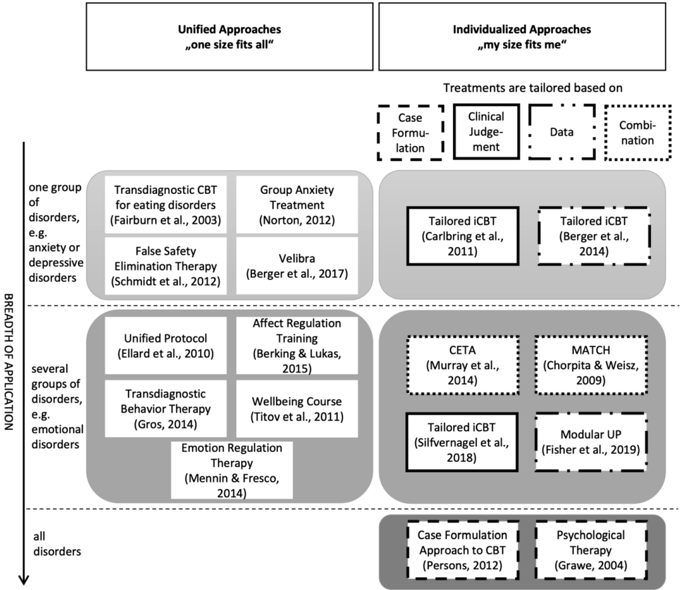
Transdiagnostic treatments span a heterogeneous group of interventions that target a wider range of disorders and can be applied to treat several disorders simultaneously. Several meta-analyses have highlighted the evidence base of these novel therapies. However, these meta-analyses adopt different definitions of transdiagnostic treatments, and the growing field of transdiagnostic therapies has become increasingly difficult to grasp. The current narrative review proposes a distinction of “one size fits all” unified and “my size fits me” individualized approaches within transdiagnostic therapies. Unified treatments are applied as “broadband” interventions to a range of disorders without tailoring to the individual, while individualized treatments are tailored to the specific problem presentation of the individual, e.g., by selecting modules within modular treatments. The underlying theoretical foundation and relevant empirical evidence for these different transdiagnostic approaches are examined. Advantages and limitations of the transdiagnostic treatments as well as future developments are discussed.
Overview
The claims and statistics of this paper haven’t been checked yet.
Free: it reads the open-access text and checks the first 5 claims that cite a source we can check. Create a free account to check every claim.
Integrity signals
Registry
Cites
Statistics
Figures
Verification
Claims the paper makes
The claims and statistics of this paper haven’t been checked yet.
Free: it reads the open-access text and checks the first 5 claims that cite a source we can check. Create a free account to check every claim.
Claims other papers make about this one
Each is checked against this paper’s own text: does it say what the citing paper says it does?
The source backs part of the claim, not all of it — or backs it for a different population, condition or comparison.
In the citing paper
“There is still a need for diagnosis-specific treatment, as some symptoms experienced by a client with a diagnosis, such as bipolar disorder, may not be addressed by a transdiagnostic intervention for depression and anxiety [9].”
From Needs and Expectations for the myNewWay Blended Digital and Face-to-Face Psychotherapy Model of Care for Depression and Anxiety (Part 2): Participatory Design Study including Mental Health Professionals (2025) · cites this paper as [9]
Experimental — accuracy not yet measuredThe source backs part of the claim, not all of it — or backs it for a different population, condition or comparison.
In the citing paper
“They also emphasize the therapeutic importance of targeting evidence-based change mechanisms, which are the underlying (psychological) processes responsible for positive treatment outcomes, instead of solely focusing on changing symptoms (11).”
From Developing a mechanism-based therapy for acute psychiatric inpatients with psychotic symptoms: an Intervention Mapping approach (2023) · cites this paper as [11]
Experimental — accuracy not yet measuredThe cited source says what the claim attributes to it.
In the citing paper
“Transdiagnostic psychotherapies are effective for depression and anxiety and are increasingly favored by the clinical community, as these psychotherapies target the shared symptoms, causes, and maintaining factors of co-occurring disorders, such as depression and anxiety [8-11].”
The cited source says what the claim attributes to it.
In the citing paper
“Change mechanisms thereby draw on impaired processes believed to contribute to the maintenance and onset of various mental health problems and thus often operate as transdiagnostic change factors (11).”
From Developing a mechanism-based therapy for acute psychiatric inpatients with psychotic symptoms: an Intervention Mapping approach (2023) · cites this paper as [11]
Self-check
Percentages, sums and reported differences re-computed from the paper’s own numbers.
The self-check needs the paper’s full text.
Citations
Cites
Diagnostic and Statistical Manual of Mental Disorders
American Psychiatric Association (2013) · doi:10.1176/appi.books.9780890425596 · Cited by 116,369
Diagnostic and Statistical Manual of Mental Disorders
Williams, J. B. W., & First, M. (2013) · Encyclopedia of Social Work · doi:10.1093/acrefore/9780199975839.013.104 · Cited by 109,519
Diagnostic and Statistical Manual of Mental Disorders, 5th ed.
Carter, M. J. (2014) · Therapeutic Recreation Journal · Cited by 15,166
Mindfulness-based interventions in context: Past, present, and future
Kabat-Zinn, J. (2003) · Clinical Psychology: Science and Practice · doi:10.1093/clipsy.bpg016 · Cited by 8,615 · cited 2×
“Mindfulness-based interventions subsume many different forms of interventions, ranging from stand-alone internet-based applications (Boettcher et al. 2014) to mindfulness-based stress reduction (Kabat-Zinn 2003) or mindfulnessbased cognitive therapy (Segal et al. 2002).”
BackgroundMethodMindfulness-based interventions in context: Past, present, and future.
Kabat-Zinn, J. (2003) · Clinical Psychology: Science and Practice · doi:10.1093/clipsy/bpg016 · Cited by 8,612
Diagnostic and Statistical Manual of Mental Disorders, 3rd ed
COOPER, A. M., & MICHELS, R. (1981) · American Journal of Psychiatry · doi:10.1176/ajp.138.1.128 · Cited by 7,356
(1993) · Cited by 7,136
Insel, T., Cuthbert, B., Garvey, M., Heinssen, R., Pine, D. S., Quinn, K., Sanislow, C., & Wang, P. (2010) · American Journal of Psychiatry · doi:10.1176/appi.ajp.2010.09091379 · Cited by 7,067
Emotion-regulation strategies across psychopathology: A meta-analytic review
Aldao, A., Nolen-Hoeksema, S., & Schweizer, S. (2010) · Clinical Psychology Review · doi:10.1016/j.cpr.2009.11.004 · Cited by 6,686
Acceptance and commitment therapy: model, processes and outcomes
Hayes, S. C., Luoma, J. B., Bond, F. W., Masuda, A., & Lillis, J. (2006) · Behaviour Research and Therapy · doi:10.1016/j.brat.2005.06.006 · Cited by 6,587
Research works printed but not linked: 3
- Grawe, K., Caspar, F., & Ambühl, H. (1990). Die Berner Therapievergleichsstudie: Fragestellung und Versuchsplan. Zeitschrift für Klinische Psychologie, 19(4), 294-315.
- Stratton, P. (2016). The evidence base of family therapy and systemic practice. UK: Association for Family Therapy.
- Young, J. E. (1999). Cognitive therapy for personality disorders: A schema-focused approach, 3rd ed (3rd ed.). Sarasota: Professional Resource Press.
Cited by
Grogans, S. E., Bliss‐Moreau, E., Buss, K. A., Clark, L. A., Fox, A. S., Keltner, D. J., Cowen, A., Kim, J. J., Kragel, P. A., MacLeod, C., et al. (2023) · Neuroscience & Biobehavioral Reviews · doi:10.1016/j.neubiorev.2023.105237 · Cited by 144
Schaeuffele, C., Meine, L. E., Schulz, A., Weber, M. C., Moser, A., Paersch, C., Recher, D., Boettcher, J., Renneberg, B., Flückiger, C., et al. (2024) · Nature Human Behaviour · doi:10.1038/s41562-023-01787-3 · Cited by 91
Self-citationWang, P., Wang, Z., & Qiu, S. (2024) · Child and Adolescent Psychiatry and Mental Health · doi:10.1186/s13034-024-00735-x · Cited by 78
“Transdiagnostic treatments are a range of therapies that can be applied broadly across different disorders [17].”
BackgroundHaller, K., Becker, P., Niemeyer, H., & Boettcher, J. (2023) · Internet Interventions · doi:10.1016/j.invent.2023.100635 · Cited by 57
Self-citationCognitive Behavior Therapy at the Crossroads
Blackwell, S. E., & Heidenreich, T. (2021) · International Journal of Cognitive Therapy · doi:10.1007/s41811-021-00104-y · Cited by 42
“In this special issue, Schaeuffele et al. (2020) address the concept and development of transdiagnostic treatments, which they categorize broadly as “one size fits all” vs. “my size fits me” approaches.”
BackgroundAdaptation, Personalization and Capacity in Mental Health Treatments: A Balancing Act?
Bennett, S. D., & Shafran, R. (2023) · Current Opinion in Psychiatry · doi:10.1097/yco.0000000000000834 · Cited by 36
Schaeuffele, C., Homeyer, S., Perea, L., Scharf, L., Schulz, A., Knaevelsrud, C., Renneberg, B., & Boettcher, J. (2022) · PLOS ONE · doi:10.1371/journal.pone.0270178 · Cited by 35
“While there is a growing evidence base for transdiagnostic treatments, transdiagnostic treatments encompass heterogeneous approaches that vary considerably in their foundation in theory [11].”
BackgroundSelf-citationVeilleux, J. C. (2022) · Clinical Psychological Science · doi:10.1177/21677026221118327 · Cited by 52
Carroll, S., Moon, Z., Hudson, J. L., Hulme, K., & Moss-Morris, R. E. (2022) · Psychosomatic Medicine · doi:10.1097/psy.0000000000001076 · Cited by 46
“Therefore, there is value in creating a TMA-LTC, which highlights common factors that precipitate and perpetuate distress across conditions, while also addressing multimorbidity (12,13).”
BackgroundBielinski, L. L., Trimpop, L., & Berger, T. (2021) · Psychotherapeut · doi:10.1007/s00278-021-00524-3 · Cited by 40
“Die Vorteile von transdiagnostischen Therapien, z. B. die Erreichung einer größeren Patientenpopulation (Schaeuffele et al. 2021), könnten ebenfalls mit den Vorteilen von Blended-PT (.”
BackgroundCuijpers, P. J., Harrer, M., & Furukawa, T. A. (2026) · World Psychiatry · doi:10.1002/wps.70002 · Cited by 37
“Transdiagnostic approaches have been claimed to offer more flexible, inclusive and effective treatment options 305 .”
Schaeuffele, C., Bär, J., Buengener, I., Grafiadeli, R., Heuthaler, E., Strieder, J., Ziehn, P., Knaevelsrud, C., Renneberg, B., & Boettcher, J. (2022) · Cognitive Therapy and Research · doi:10.1007/s10608-021-10272-y · Cited by 24
“But since the treatment was self-paced and the mean number of modules completed was M = 7.22 (Schaeuffele et al., 2020), this naturally meant that the assessments after completion of module 7 and 9 were limited to participants who progressed to this stage of treatment.”
BackgroundInfluentialSelf-citationTheurel, A., Witt, A., & Shankland, R. (2022) · International Journal of Environmental Research and Public Health · doi:10.3390/ijerph191610442 · Cited by 34
“, depression, alcohol misuse, anxiety) [59], recent recommendations suggest the use of multitheoretical digital mental health interventions to address the multiple issues raised by the COVID-19 pandemic [60].”
BackgroundCross, S. P. M., Nicholas, J., Mangelsdorf, S. N., Valentine, L., Baker, S. T. E., McGorry, P. D., Gleeson, J., & Álvarez‐Jiménez, M. (2023) · JMIR Formative Research · doi:10.2196/49846 · Cited by 28
“Established theories and approaches to mental health support are evident in the literature, most notably self-determination theory (SDT) [66] and transdiagnostic, mechanistic, process-focused psychological therapy approaches [13,14,67,68].”
BackgroundBielinski, L. L., Trimpop, L. F., & Berger, T. (2021) · Open Access CRIS of the University of Bern · doi:10.48350/164137
Păsărelu, C.-R., Dobrean, A., Andersson, G., & Zaharie, G. C. (2021) · Internet Interventions · doi:10.1016/j.invent.2021.100479 · Cited by 29
Rutschmann, R., Romanczuk-Seiferth, N., Gloster, A., & Richter, C. (2024) · Frontiers in Psychiatry · doi:10.3389/fpsyt.2024.1403718 · Cited by 21
“Traditionally, most clinical research on behavioral therapy focusses on speci fi c mental disorders rather than transdiagnostic treatments (1, 2).”
BackgroundKomischke-Konnerup, K. B., O’Connor, M., Hoijtink, H., & Boelen, P. A. (2023) · Cognitive and Behavioral Practice · doi:10.1016/j.cbpra.2023.11.001 · Cited by 27
Screening tools assessing mental illness in primary care: A systematic review
Neulinger, B., Ebert, C., Lochbühler, K., Bergmann, A., Gensichen, J., & Lukaschek, K. (2024) · European Journal of General Practice · doi:10.1080/13814788.2024.2418299 · Cited by 30
“…avoidance [60,61]) were identified. this indicates an additional area for further research. there is a growing number of transdiagnostic factors [22], many of which overlap in their conceptualisation [62]. thus, index tests screening for the spectrum of mood, anxiety and stress-related…”
BackgroundFackrell, K., Sereda, M., Smith, S., Sheldrake, J. B., & Hoare, D. J. (2022) · Brain Sciences · doi:10.3390/brainsci12121615 · Cited by 20
“, focusing on shared cognitive-emotional factors between pain and hyperacusis) and can be tailored to the individual needs of the patients [59].”
BackgroundWhat if we have too many models of worry and GAD?
Freeston, M. H. (2023) · Behavioural and Cognitive Psychotherapy · doi:10.1017/s1352465822000649 · Cited by 20
“The idea of modular treatment for anxiety disorders is not new, nor is the idea of transdiagnostic treatment, and these may overlap in some cases (e.g. Schaeuffele et al ., 2021).”
BackgroundBielinski, L. L., Bur, O. T., Wälchli, G., Suter, J. M., Walsh, N., Kley, M. A., Krieger, T., & Berger, T. (2022) · Internet Interventions · doi:10.1016/j.invent.2022.100586 · Cited by 16
“Several of these types of treatments also target mechanisms or processes independent of diagnoses, commonly termed transdiagnostic processes (Schaeuffele et al., 2021).”
Isbăşoiu, A. B., Tulbure, B. T., Rusu, A., & Sava, F. A. (2021) · Frontiers in Psychology · doi:10.3389/fpsyg.2021.752249 · Cited by 14
An interdisciplinary multimodal integrative healthcare program for depressive and anxiety disorders
Wijnen, J., Gordon, N. L., Hullenaar, G. V. ’., Pont, M. L., Geijselaers, M. W. H., Oosterwijck, J. V., & de Jong, J. (2023) · Frontiers in Psychiatry · doi:10.3389/fpsyt.2023.1113356 · Cited by 19
Lenz, A. S., Conte, G. S. D., Douglas, C., Crenshaw, A., Dobbs, C., Stogner, E., & Williford, V. (2021) · Journal of Counseling & Development · doi:10.1002/jcad.12416 · Cited by 14
The promise of compassion-based therapy as a novel intervention for adolescent PTSD
Brinckman, B., Alfaro, E., Wooten, W., & Herringa, R. J. (2023) · Journal of Affective Disorders Reports · doi:10.1016/j.jadr.2023.100694 · Cited by 17
“In recent years there has been a growing popularity and increased evidence of effectiveness for third-wave cognitive-behavioral psychotherapeutic approaches such as acceptance & commitment therapy (ACT) and dialectical behavioral therapy (DBT) (Schaeuffele et al., 2021).”
BackgroundBehr, S., Fenski, F., Boettcher, J., Knaevelsrud, C., Hammelrath, L., Kovacs, G., Schirmer, W., Petrick, H., Becker, P., & Schaeuffele, C. (2024) · Internet Interventions · doi:10.1016/j.invent.2024.100723 · Cited by 11
“To achieve a transdiagnostic intervention, we follow a modular “ my-size-fits-me ” -approach (Schaeuffele et al., 2021), allowing psychotherapists to tailor the content to the needs of their individual patients.”
BackgroundInfluentialSelf-citationPearson, R., Mendoza, C. T., Coppin, J. D., & Creech, S. K. (2024) · Depression and Anxiety · doi:10.1155/2024/9719635 · Cited by 14
“Available 9 Depression and Anxiety transdiagnostic treatments have grown exponentially over the last decade [64, 65], and dual diagnosis interventions, mostly for comorbid substance use disorders, are gaining ground within VA care [66].”
A systematic review on personalization of treatment components in IBIs for mental disorders
Schaeuffele, C., Zagorscak, P., Langerwisch, V., Wilke, J., Medvedeva, Y., & Knaevelsrud, C. (2025) · Internet Interventions · doi:10.1016/j.invent.2025.100840 · Cited by 15
Self-citationHartmann, J., Bräscher, A., Forbush, K. T., Sellbom, M., Watson, D., & Witthöft, M. (2022) · Psychosomatic Medicine · doi:10.1097/psy.0000000000001105 · Cited by 10
“, UP), as encouraged by HiTOP, might be more cost-effective and easier to learn, they may facilitate dissemination and implementation (71).”
BackgroundHow Effective Altruism Can Help Psychologists Maximize Their Impact
Gainsburg, I., Pauer, S., Abboub, N., Aloyo, E., Mourrat, J.-C., & Cristià, A. (2022) · Perspectives on Psychological Science · doi:10.1177/17456916221079596 · Cited by 15
“This is consistent with the call for transdiagnostic therapies (i.e., treatments that are appropriate for a range of mental-health issues; Schaeuffele et al., 2021).”
BackgroundSchaeuffele, C., Homeyer, S. L., Perea, L., Scharf, L., Schulz, A., Knaevelsrud, C., Renneberg, B., & Boettcher, J. (2020) · doi:10.31234/osf.io/528tw · Cited by 9
Self-citationKratzer, L., Heinz, P., Knefel, M., Weindl, D., Tschöke, S., Biedermann, S. V., Schröder, J., & Karatzias, T. (2023) · The Journal of Nervous and Mental Disease · doi:10.1097/nmd.0000000000001671 · Cited by 9
Liu, J., Li, C., Qiu, Y.-F., Yu, Y.-Q., Zeng, L., Wu, M., Han, Y., & Yang, F. (2024) · Psychiatry Research · doi:10.1016/j.psychres.2024.116324 · Cited by 10
Transdiagnostic Cognitive Behavioral Group Interventions: A Systematic Review
Joaquim, S. B., de Almeida, R. S., & Marques, A. J. (2023) · Cognitive Therapy and Research · doi:10.1007/s10608-023-10372-x · Cited by 15
“The tCBT interventions evaluated were modular and targeted at common processes among “one size fits all” interventions (Schaeuffele et al., 2021).”
BackgroundDepartment of Psychology, F. O. E. A. P., Ghaderi, F., Akrami, N., Department of Psychology, F. O. E. A. P., Namdari, K., Department of Psychology, F. O. E. A. P., Abedi, A., & Department of Psychology and Education of Children with Special Needs, F. O. E. A. P. (2022) · Iranian Journal of Psychiatry and Clinical Psychology · doi:10.32598/ijpcp.27.4.3067.3 · Cited by 7
Treating anxiety comorbidity: Lessons from exposure generalization studies
Zlomuzica, A., Kodzaga, I., Piovesan, K., & Lipp, A. (2024) · Behavioural Brain Research · doi:10.1016/j.bbr.2024.115409 · Cited by 9
Bannon, S. M., Rapoport, A., Applebaum, A. J., & Schleider, J. L. (2025) · Frontiers in Public Health · doi:10.3389/fpubh.2025.1515440 · Cited by 9
Heckendorf, H., & Lehr, D. (2025) · Journal of Medical Internet Research · doi:10.2196/58475 · Cited by 14
“However, responding to the personal needs of participants and tailoring interventions requires that interventions be flexible [64,73,74,165].”
Bähr, C., Phan, D., Murawska, N., Gerber, J., Jordan, A., Hoffmann, K., & Calvano, C. (2025) · Clinical Psychology Review · doi:10.1016/j.cpr.2025.102642 · Cited by 10
Development and validation of the Symptomatic Transdiagnostic Test (S2T)
Vancappel, A., Raysseguier, C., Coillot, H., Jansen, E., Bouyer, C., Mangolini, A., Barbe, P. G., Debout-Courtault, C., Seac'h, M. P.-L., Kazour, F., et al. (2023) · L Encéphale · doi:10.1016/j.encep.2022.11.004 · Cited by 7
Rasouli, A., Soumee, Z. N., Pourali, H., Jam, M. M., & Saed, O. (2025) · BMC Psychology · doi:10.1186/s40359-025-03131-y · Cited by 9
“…which targets specific diagnoses (e.g., insomnia or anxiety), tCBT employs a unified framework, such as the Unified Protocol for Transdiagnostic Treatment of Emotional Disorders, to target shared mechanisms, including emotion dysregulation, maladaptive cognitions, and behavioral avoidance [20].”
TRANSDIAGNOSTIC COGNITIVE-BEHAVIORAL THERAPY: A LITERATURE REVIEW
Almeida, D., & Marinho, G. (2021) · Psicologia Saúde & Doenças · doi:10.15309/21psd220317 · Cited by 12
Eckley, D., Allen, A., Millear, P. M. R., Rune, K. T., & Mason, J. (2023) · Cognitive Therapy and Research · doi:10.1007/s10608-023-10403-7 · Cited by 6
“…frameworks often fail to capture the common processes or mechanisms that underlie symptom expression and are vulnerable to relapse (Ali et al., 2017; Astle et al., 2022; Bakker, 2019; Dalgleish et al., 2020; Fusar-Poli et al., 2019; Probst, 2015; Ruggero et al., 2019; Schaeuffele et al., 2021).”
BackgroundKlein, B., Huy, N. V., McLaren, S., Andrews, B., & Shandley, K. A. (2023) · JMIR Formative Research · doi:10.2196/43385 · Cited by 8
“Second, although there have been dozens of studies evaluating transdiagnostic digital interventions, their impact on improving comorbidity symptoms has received far less examination [23,24].”
BackgroundClinical Staging for Psychiatry and Psychology
Dwyer, D., Ye, R. R., Nelson, B., & McGorry, P. D. (2025) · Annual Review of Clinical Psychology · doi:10.1146/annurev-clinpsy-081423-025310 · Cited by 13
Riddell, J. K., Neufeld, D. C., Kinley, J., Davidson, D., Mota, N. P., Unger, J. A., Henriksen, C., Conway, T., Jetté, J., & Jiang, D. (2025) · International Journal of Group Psychotherapy · doi:10.1080/00207284.2025.2454677 · Cited by 4
“EFFECTIVENESS OF DBT SKILLS CLASSES several disorders at the same time (Schaeuffele et al., 2021).”
Tridimensional model of CBT: a transdiagnostic and transtheoretical pragmatic model
Özdel, K., & Türkçapar, M. H. (2025) · Frontiers in Psychology · doi:10.3389/fpsyg.2025.1555047 · Cited by 8
Mind the gap – Ideas for making clinical research more relevant for practitioners and patients
Berg, M., Schemer, L., Kirchner, L., & Scholten, S. (2024) · Clinical Psychology in Europe · doi:10.32872/cpe.12419 · Cited by 5
“A plethora of therapeutic techniques exist to target (transdiagnostic) mechanisms (Schaeuffele et al., 2021).”
BackgroundHow Effective Altruism Can Help Psychologists Maximize Their ImpactPreprint
Gainsburg, I., Pauer, S., Abboub, N., Aloyo, E., Mourrat, J.-C., & Cristià, A. (2021) · doi:10.31234/osf.io/8dw59 · Cited by 5
Schäpermeier, M. T., Jesussek, A., Kirchherr, J., Monninger, M., Feneberg, A. C., & Hechler, T. (2025) · Journal of Affective Disorders Reports · doi:10.1016/j.jadr.2025.100970 · Cited by 8
Hadjistavropoulos, H. D., Peynenburg, V. A., Sapkota, R. P., Titov, N., & Dear, B. F. (2024) · Internet Interventions · doi:10.1016/j.invent.2024.100758 · Cited by 4
“Transdiagnostic ICBT is often offered in a “ one size fits all ” standardized format, meaning that all clients receive the same treatment materials (Schaeuffele et al., 2021).”
Salzano, S., Zappullo, I., Baiano, C., & Conson, M. (2023) · Journal of Cognitive Psychotherapy · doi:10.1891/jcp-2021-0020 · Cited by 5
González-Deleito, C. M., McCracken, L. M., & Tyrberg, M. J. (2024) · Cognitive Behaviour Therapy · doi:10.1080/16506073.2023.2300369 · Cited by 4
“As a response to the limitations of disorder-specific treatments, CBT now includes a focus on transdiagnostic processes of change, particularly for enhancing functioning and quality of life (Ong et al., 2022; Schaeuffele et al., 2021).”
BackgroundEtchemendy, E., Rasal, P., & Fernández‐Álvarez, J. (2024) · Revista de Psicoterapia · doi:10.5944/rdp.v35i127.39801 · Cited by 5
Miethe, S., Muehlhan, M., & Trautmann, S. (2022) · Psychiatry Research · doi:10.1016/j.psychres.2022.114478 · Cited by 5
Designing and conducting observational studies in rehabilitation: challenges and opportunities
Barbosa, S. P., Marques, L. M., Pacheco‐Barrios, K., Imamura, M., Battistella, L. R., Simis, M., & Fregni, F. (2021) · Principles and Practice of Clinical Research Journal · doi:10.21801/ppcrj.2021.73.7 · Cited by 4
Miller, R. K., O'Moore, K., Kikas, K., Matheson, J.-A. T., Whitton, A. E., Baldwin, P., Li, S., Black, M., Kampel, L., Cockayne, N., et al. (2025) · JMIR Human Factors · doi:10.2196/68789 · Cited by 3
“There is still a need for diagnosis-specific treatment, as some symptoms experienced by a client with a diagnosis, such as bipolar disorder, may not be addressed by a transdiagnostic intervention for depression and anxiety [9].”
Pedro, L. M. R., Francisco, C., Pereira, M., Fonseca, A., & Canavarro, M. C. (2025) · Clinical Case Studies · doi:10.1177/15346501251345480 · Cited by 3
Lam, M. I., Bai, W., Feng, Y., Zhang, Q., Zhang, Y., Jackson, T., Rao, S.-Y., Ho, T.-I., Su, Z., Cheung, T. C. C., et al. (2024) · Journal of Psychosomatic Research · doi:10.1016/j.jpsychores.2024.111910 · Cited by 4
Farrand, P. A., Raue, P. J., Ward, E. C., Healey, S., & Baker, J. (2025) · Academia Mental Health and Well-Being · doi:10.20935/mhealthwellb7785 · Cited by 3
Santens, E., Dom, G., Dierckx, E., & Claes, L. (2022) · Journal of Clinical Medicine · doi:10.3390/jcm11030591 · Cited by 4
“, mindfulnes-based interventions, Acceptance and Commitment Therapy (ACT), Dialectic Behavioral Therapy (DBT) can be seen as transdiagnostic treatments [70].”
BackgroundMilgrom, J., Burn, M., Rodrigues, A. L., Gemmill, A. W., & Hirshler, Y. (2023) · Elsevier eBooks · doi:10.1016/b978-0-323-85757-4.00025-0 · Cited by 3
Kornacka, M., Jaskulska, A., Skorupska, K., Szastok, M., Nadziejko, M., & Kopeć, W. (2023) · Mental Health and Social Inclusion · doi:10.1108/mhsi-01-2023-0015 · Cited by 3
Bates, E. J., Dodd, A., & Neave, N. (2023) · Journal of Affective Disorders Reports · doi:10.1016/j.jadr.2023.100682 · Cited by 4
Blackwell, S. E. (2024) · Administration and Policy in Mental Health and Mental Health Services Research · doi:10.1007/s10488-023-01340-4 · Cited by 5
Thomas, M. V., Ryckeghem, D. M. L. V., Schulz, A., Müller, R., Lambracht, K., Adermann, J., & Vögele, C. (2024) · European Journal of Health Psychology · doi:10.1027/2512-8442/a000142 · Cited by 5
Self-citationPedro, L. M. R., de Oliveira, M. C. S., Pereira, M., Fonseca, A., & Canavarro, M. C. (2024) · Administration and Policy in Mental Health and Mental Health Services Research · doi:10.1007/s10488-024-01391-1 · Cited by 4
Mental health in athletes: anxiety sensitivity as a transdiagnostic risk factor
DeWolfe, C. E. J., Watt, M., Galbraith, M. K., Olthuis, J., & Stewart, S. (2024) · International Journal of Sport and Exercise Psychology · doi:10.1080/1612197x.2024.2431253 · Cited by 3
Gussmann, E., Lucae, S., Falkai, P., Padberg, F., Egli, S., & Kopf-Beck, J. (2023) · Frontiers in Psychiatry · doi:10.3389/fpsyt.2023.1160075 · Cited by 2
“Change mechanisms thereby draw on impaired processes believed to contribute to the maintenance and onset of various mental health problems and thus often operate as transdiagnostic change factors (11).”
BackgroundSchaeuffele, C., Knaevelsrud, C., Renneberg, B., & Boettcher, J. (2024) · Cognitive Behaviour Therapy · doi:10.1080/16506073.2024.2399173 · Cited by 3
“Our findings also add to the discussion on the relationship and overlap of transdiagnostic processes (Mansell & McEvoy, 2017; Schaeuffele et al., 2020).”
Self-citationGhaderi, F., Akrami, N., Namdari, K., & Abedi, A. (2023) · Practice in Clinical Psychology · doi:10.32598/jpcp.11.2.862.1 · Cited by 2
Davey, E., Bryant‐Waugh, R., Bennett, S. D., Micali, N., Baudinet, J., Konstantellou, A., Clark-Stone, S., Green, A., & Shafran, R. (2025) · European Eating Disorders Review · doi:10.1002/erv.3171 · Cited by 3
“Transdiagnostic interventions offer significant benefits by addressing the heterogeneity and comorbidity often seen in real‐ world settings (Levinson et al. 2022; Schaeuffele et al. 2021).”
Regier, P. S., Gawrysiak, M. J., Jagannathan, K., Childress, A. R., Franklin, T. R., & Wetherill, R. R. (2022) · Drug and Alcohol Dependence Reports · doi:10.1016/j.dadr.2022.100098 · Cited by 3
Gussmann, E., Lindner, C., Lucae, S., Falkai, P., Padberg, F., Egli, S., & Kopf‐Beck, J. (2023) · European Archives of Psychiatry and Clinical Neuroscience · doi:10.1007/s00406-023-01690-y · Cited by 3
“In this context, change mechanisms rely on psychological processes found to be responsible for the onset and maintenance of disorders [17].”
BackgroundKim, J., Prins, A., Hirschhorn, E. W., Legrand, A. C., Macia, K. S., Yam, S. S., & Cloître, M. (2024) · Military Medicine · doi:10.1093/milmed/usae052 · Cited by 5
A Single Case Evaluation of an Emotion Regulation Training in Adolescents
Boelens, E., Wante, L., Vervoort, L., Verbeken, S., Goossens, L., & Braet, C. (2025) · Psychologica Belgica · doi:10.5334/pb.1337 · Cited by 2
Care for the Caregiver : Internet intervention for informal caregivers in Lithuania
Biliūnaitė, I. (2022) · Linköping studies in behavioural science · doi:10.3384/9789179291877 · Cited by 6
Jiménez-Molina, Á., Franco, P., Mac‐Ginty, S., & Martínez, V. (2022) · Depression and personality · doi:10.1007/978-3-031-13029-8_6 · Cited by 1
Södermark, M. (2023) · Linköping University medical dissertations · doi:10.3384/9789180753692 · Cited by 3
Diaz, M. A. V. –., Martínez, J. L. –., & Toro, R. (2025) · Journal of Contextual Behavioral Science · doi:10.1016/j.jcbs.2025.100895 · Cited by 2
Bergbom, S., Zetterberg, H., Flink, I. K., Linton, S. J., & Boersma, K. (2025) · Der Schmerz · doi:10.1007/s00482-025-00885-7 · Cited by 2
Seagly, K., Perrine, B. W., Mattes, A., Lake, A. J., Chao, D., Ellois, V., Noyes, E. T., & Johnson, A. (2025) · Oxford University Press eBooks · doi:10.1093/oxfordhb/9780197525456.013.0002 · Cited by 1
Towards a transdiagnostic approach to psychopathology in the postpartum period
Froelich, J. M., & Gerstein, E. D. (2025) · Clinical Psychology Review · doi:10.1016/j.cpr.2025.102646 · Cited by 1
Terapia do Esquema e Transtorno Depressivo: Uma revisão sistemática
Ribeiro, J., Cardoso, B. L. A., & Oliveira, M. D. S. (2025) · Revista Brasileira de Terapia Comportamental e Cognitiva · doi:10.31505/rbtcc.v27i1.1880 · Cited by 1
Ebert, C., Vogel, M., Gensichen, J., Reif, H., Junker, L., Grögor, L., Padberg, F., Falkai, P., Ehring, T. W., Hasan, A., et al. (2026) · BMC Family Practice · doi:10.1186/s12875-026-03377-4 · Cited by 1
“Furthermore, by streamlining therapist training [18] and accommodating brief session formats [12], it may be particularly suitable to help close the mental health treatment gap [19].”
Kovacevic, M., Murphy, J. M., Valdespino‐Hayden, Z., Pridgen, S., Smith, D. L., & Held, P. (2025) · European Journal of Psychotraumatology · doi:10.1080/20008066.2025.2553428 · Cited by 1
“Its prominence has paralleled a widening recognition by researchers and clinicians that comorbidity is common among psychiatric conditions, suggesting ER may be one of the shared mechanisms underlying different diagnostic categories (Hofmann & Hayes, 2019; Schaeuffele et al., 2021).”
Depressed mood as a transdiagnostic target relevant to anxiety and/or psychosis: a scoping review
Mavindidze, E., Dambi, J. M., Nyamayaro, P. C., Beji‐Chauke, R., Tunduwani, T. D., Shava, B. K., Mavhu, W. M., Abas, M., Chibanda, D., & Nhunzvi, C. (2025) · BMJ Open · doi:10.1136/bmjopen-2024-092233 · Cited by 2
Belli, S. R., Hoekstra, R. H. A., Pilling, S., Saunders, R., Stott, J. C. H., Suh, J. W., Ebrahimi, O. V., & O’Driscoll, C. (2025) · Journal of Affective Disorders · doi:10.1016/j.jad.2025.120937 · Cited by 3
Waiting for translation: A review of translational research in psychological treatment
Petrule, C., Bittermann, A., Ritter, V., Rief, W., Haberkamp, A., Berg, M., Christiansen, H., Haberkamp, A., Hermann, C., Hofmann, S. G., et al. (2026) · Clinical Psychology Review · doi:10.1016/j.cpr.2026.102708 · Cited by 1
Karlsson-Good, M., Holländare, F., Hesser, H., Östlund, B., Odén, I., Tallström, F., Stenelius, J., Kaldo, V., Forsell, E., Ljótsson, B., et al. (2026) · Cognitive Behaviour Therapy · doi:10.1080/16506073.2026.2632368 · Cited by 1
Muhammad, A., Ali, S., Afaq, R. M., & Shabbir, H. (2026) · Harvard Review of Psychiatry · doi:10.1097/hrp.0000000000000454 · Cited by 1
Online Training in Telepsychology: A Pre-Experimental Single Group Study in Mexico
Flores-Plata, L. A., la Rosa-Gómez, A. D., Díaz-Sosa, D. M., Esquivel-Santoveña, E. E., Torija, C. S. T., Flores, R. G., Ruaro, A. L., Ruiz, E. B., Silvestre-Ramírez, R., Elvira, A. I. F., et al. (2026) · Journal of Technology in Behavioral Science · doi:10.1007/s41347-025-00589-w · Cited by 1
Baquero-Sierra, A., Torres-Cuellar, L., Salamanca, S. L. C., Grau-Gonzalez, I. A., & Ortega, L. A. (2026) · Journal of Behavioral and Cognitive Therapy · doi:10.1016/j.jbct.2026.100608 · Cited by 1
Ferreira-de-Lima, M. C., Kunzler, L. S., Romero, A. C. G., Marinho, R. M., & Feng, Y. H. (2022) · Revista Brasileira de Terapias Cognitivas · doi:10.5935/1808-5687.20220011 · Cited by 2
Dedicated and designated approaches to task-shared psychological interventions
Mutamba, B. B., & Kumar, M. (2022) · The Lancet · doi:10.1016/s0140-6736(22)01984-5 · Cited by 2
Understanding Individual Differences in Mental Health and Video Games
Copeman, M., & Freeman, J. (2023) · Lecture notes in computer science · doi:10.1007/978-3-031-35979-8_13 · Cited by 3
“The strength of this approach is that by not necessarily treating any specific diagnosed condition but offering the patient support for a wide range of spectrum-based symptoms, the possibility exists for them to firstly reach clinical care, and secondly be more receptive to it [5], [27] – [29].”
Dambi, J. M., Mavindidze, E., Nyamayaro, P. C., Beji‐Chauke, R., Tunduwani, T. D., Shava, B. K., Mavhu, W. M., Abas, M., Chibanda, D., & Nhunzvi, C. (2024) · BMJ Open · doi:10.1136/bmjopen-2023-077695 · Cited by 3
Davey, E., Micali, N., Bryant‐Waugh, R., Bennett, S. D., Lau, C., & Shafran, R. (2024) · Journal of Eating Disorders · doi:10.1186/s40337-024-01113-w · Cited by 1
“The primary rationale for transdiagnostic interventions lies in their potential to effectively address the heterogeneity and comorbidity that is the modal presentation in real-life settings [57].”
BackgroundSelby, E. A. (2025) · International Journal of Cognitive Behavioral Therapy · doi:10.1007/s41811-025-00248-1 · Cited by 4
“Several modalities of CBT have been explored with regard to modular and transdiagnostic approaches (Pokowitz et al., 2024; Schaeuffele et al., 2021), where specific CBT elements are prescribed to ameliorate specific aspects of psychopathology that respond best to those techniques (e.g., exposure…”
Metadata
- Authors
- Schaeuffele, C., Schulz, A., Knaevelsrud, C., Renneberg, B., & Boettcher, J.
- Affiliations
- Freie Universität Berlin (DE)
- University of Zurich (CH)
- Psychologische Hochschule Berlin (DE)
- Corresponding author
- Schaeuffele, Carmen
- Venue
- International Journal of Cognitive Therapy
- Published
- 2020-11-20
- Volume
- 14
- Issue
- 1
- Pages
- 86-113
- ISSN
- 1937-1209 (ISSN-L)
- 1937-1217
- OpenAlex
- W3110294091
- Semantic Scholar
- 1939bfeb84093c5777838048f89450a79d29ae79
- Cited by
- 150
- References
- 168
- Citations by year
- 2026: 27 · 2025: 35 · 2024: 29 · 2023: 27 · 2022: 18 · 2021: 13 · 2020: 1
- FWCI
- 14.25
- Type
- journal article
- Language
- en
- Open access
- hybrid
- doi.org
- Licence
- cc-by
- creativecommons.org/licenses/by/4.0 (tdm)
- creativecommons.org/licenses/by/4.0 (vor)
- Locations
- International Journal of Cognitive Therapy (publishedVersion, cc-by)
- Refubium (Universitätsbibliothek der Freien Universität Berlin) (submittedVersion, cc-by)
- Universitätsbibliothek der FU Berlin Hochschulschriftenstelle u. Dokumentenserver (cc-by)
- Funders
- Freie Universität Berlin
- Topics
- Social Sciences › Psychology › Experimental and Cognitive Psychology › Anxiety, Depression, Psychometrics, Treatment, Cognitive Processes
- Social Sciences › Psychology › Clinical Psychology › Personality Disorders and Psychopathology
- Social Sciences › Psychology › Clinical Psychology › Psychotherapy Techniques and Applications
- Keywords
- transdiagnostic treatment, cognitive behavioral therapy
About these checks
Registry, retraction, Cites and statistics results are computed, not judged, with one exception: a printed reference that no index lists is read once by a model before it counts as a citation error. Claims are extracted by a model and kept only when their quote appears verbatim in the text; each cited source is then checked, with a model’s help, for whether it says what the claim relies on. Those verdicts can be wrong — read the claim’s quote and the cited source before relying on one.
Statistics and arithmetic are recomputed, not judged.
Confidence bands are shown only for fields calibrated on our annotated test set. None is calibrated yet, so no band is shown.
What counts as a claim ›How we measure confidence ›How we check this ›
Are you an author, or do you see a problem with this page? Request a review
Data sources
Bibliographic data: Semantic Scholar, OpenAlex, Crossref.
Contains information from the Semantic Scholar Academic Graph Datasets, made available under the ODC Attribution License (ODC-BY 1.0).
Semantic Scholar’s data is described in: Kinney, R., et al. (2023). The Semantic Scholar Open Data Platform. arXiv:2301.10140.
