

CBT at the crossroads: the rise of transdiagnostic treatments.
Open accessThe DOI matches its Crossref record; 166 of the 168 references it cites were found in a registry or an index.
Abstract
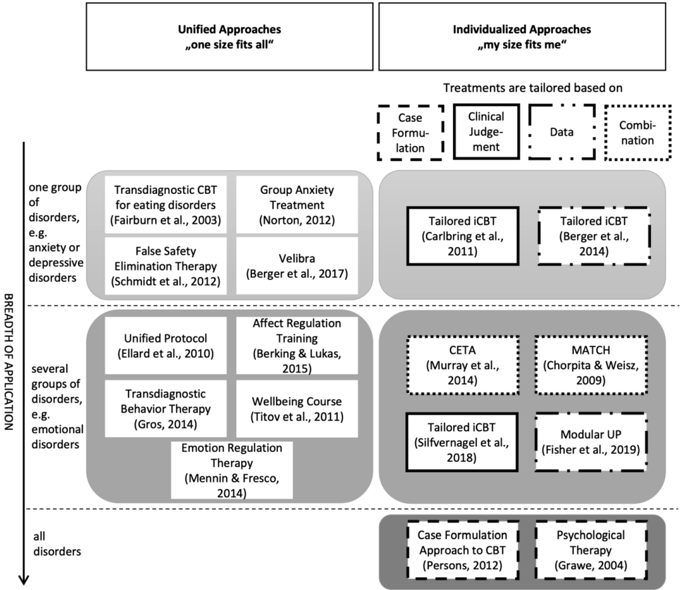
Transdiagnostic treatments span a heterogeneous group of interventions that target a wider range of disorders and can be applied to treat several disorders simultaneously. Several meta-analyses have highlighted the evidence base of these novel therapies. However, these meta-analyses adopt different definitions of transdiagnostic treatments, and the growing field of transdiagnostic therapies has become increasingly difficult to grasp. The current narrative review proposes a distinction of “one size fits all” unified and “my size fits me” individualized approaches within transdiagnostic therapies. Unified treatments are applied as “broadband” interventions to a range of disorders without tailoring to the individual, while individualized treatments are tailored to the specific problem presentation of the individual, e.g., by selecting modules within modular treatments. The underlying theoretical foundation and relevant empirical evidence for these different transdiagnostic approaches are examined. Advantages and limitations of the transdiagnostic treatments as well as future developments are discussed.
Overview
The claims and statistics of this paper haven’t been checked yet.
Free: it reads the open-access text and checks the first 5 claims that cite a source we can check. Create a free account to check every claim.
Integrity signals
Registry
Cites
Statistics
Figures
Verification
Claims the paper makes
The claims and statistics of this paper haven’t been checked yet.
Free: it reads the open-access text and checks the first 5 claims that cite a source we can check. Create a free account to check every claim.
Claims other papers make about this one
Each is checked against this paper’s own text: does it say what the citing paper says it does?
The source backs part of the claim, not all of it — or backs it for a different population, condition or comparison.
In the citing paper
“There is still a need for diagnosis-specific treatment, as some symptoms experienced by a client with a diagnosis, such as bipolar disorder, may not be addressed by a transdiagnostic intervention for depression and anxiety [9].”
From Needs and Expectations for the myNewWay Blended Digital and Face-to-Face Psychotherapy Model of Care for Depression and Anxiety (Part 2): Participatory Design Study including Mental Health Professionals (2025) · cites this paper as [9]
Experimental — accuracy not yet measuredThe source backs part of the claim, not all of it — or backs it for a different population, condition or comparison.
In the citing paper
“They also emphasize the therapeutic importance of targeting evidence-based change mechanisms, which are the underlying (psychological) processes responsible for positive treatment outcomes, instead of solely focusing on changing symptoms (11).”
From Developing a mechanism-based therapy for acute psychiatric inpatients with psychotic symptoms: an Intervention Mapping approach (2023) · cites this paper as [11]
Experimental — accuracy not yet measuredThe cited source says what the claim attributes to it.
In the citing paper
“Transdiagnostic psychotherapies are effective for depression and anxiety and are increasingly favored by the clinical community, as these psychotherapies target the shared symptoms, causes, and maintaining factors of co-occurring disorders, such as depression and anxiety [8-11].”
The cited source says what the claim attributes to it.
In the citing paper
“Change mechanisms thereby draw on impaired processes believed to contribute to the maintenance and onset of various mental health problems and thus often operate as transdiagnostic change factors (11).”
From Developing a mechanism-based therapy for acute psychiatric inpatients with psychotic symptoms: an Intervention Mapping approach (2023) · cites this paper as [11]
Self-check
Percentages, sums and reported differences re-computed from the paper’s own numbers.
The self-check needs the paper’s full text.
Citations
Cites
Diagnostic and Statistical Manual of Mental Disorders
American Psychiatric Association (2013) · doi:10.1176/appi.books.9780890425596 · Cited by 116,369
Diagnostic and Statistical Manual of Mental Disorders
Williams, J. B. W., & First, M. (2013) · Encyclopedia of Social Work · doi:10.1093/acrefore/9780199975839.013.104 · Cited by 109,519
Diagnostic and Statistical Manual of Mental Disorders, 5th ed.
Carter, M. J. (2014) · Therapeutic Recreation Journal · Cited by 15,169
Mindfulness-based interventions in context: Past, present, and future
Kabat-Zinn, J. (2003) · Clinical Psychology: Science and Practice · doi:10.1093/clipsy.bpg016 · Cited by 8,615 · cited 2×
“Mindfulness-based interventions subsume many different forms of interventions, ranging from stand-alone internet-based applications (Boettcher et al. 2014) to mindfulness-based stress reduction (Kabat-Zinn 2003) or mindfulnessbased cognitive therapy (Segal et al. 2002).”
BackgroundMethodMindfulness-based interventions in context: Past, present, and future.
Kabat-Zinn, J. (2003) · Clinical Psychology: Science and Practice · doi:10.1093/clipsy/bpg016 · Cited by 8,612
Diagnostic and Statistical Manual of Mental Disorders, 3rd ed
COOPER, A. M., & MICHELS, R. (1981) · American Journal of Psychiatry · doi:10.1176/ajp.138.1.128 · Cited by 7,356
(1993) · Cited by 7,136
Insel, T., Cuthbert, B., Garvey, M., Heinssen, R., Pine, D. S., Quinn, K., Sanislow, C., & Wang, P. (2010) · American Journal of Psychiatry · doi:10.1176/appi.ajp.2010.09091379 · Cited by 7,067
Emotion-regulation strategies across psychopathology: A meta-analytic review
Aldao, A., Nolen-Hoeksema, S., & Schweizer, S. (2010) · Clinical Psychology Review · doi:10.1016/j.cpr.2009.11.004 · Cited by 6,686
Acceptance and commitment therapy: model, processes and outcomes
Hayes, S. C., Luoma, J. B., Bond, F. W., Masuda, A., & Lillis, J. (2006) · Behaviour Research and Therapy · doi:10.1016/j.brat.2005.06.006 · Cited by 6,587
(1999) · Cited by 5,934
Diagnostic and Statistical Manual of Mental Disorders, 3rd ed
KENDELL, R. E. (1980) · American Journal of Psychiatry · doi:10.1176/ajp.137.12.1630 · Cited by 5,189
(2001) · Cited by 3,666
Hayes, S. C., Wilson, K. G., Gifford, E. V., Follette, V. M., & Strosahl, K. (1996) · Journal of Consulting and Clinical Psychology · doi:10.1037//0022-006x.64.6.1152 · Cited by 3,595 · cited 2×
“2017), experiential avoidance (Hayes et al. 1996), and neuroticism (Barlow et al.”
BackgroundThe Efficacy of Cognitive Behavioral Therapy: A Review of Meta-analyses
Hofmann, S. G., Asnaani, A., Vonk, I. J. J., Sawyer, A. T., & Fang, A. (2012) · Cognitive Therapy and Research · doi:10.1007/s10608-012-9476-1 · Cited by 3,445
Cognitive behaviour therapy for eating disorders: a “transdiagnostic” theory and treatment
Fairburn, C. G., Cooper, Z., & Shafran, R. (2003) · Behaviour Research and Therapy · doi:10.1016/s0005-7967(02)00088-8 · Cited by 3,374
Kotov, R., Krueger, R. F., Watson, D., Achenbach, T. M., Althoff, R. R., Bagby, R. M., Brown, T. A., Carpenter, W. T., Caspi, A., Clark, L. A., et al. (2017) · Journal of Abnormal Psychology · doi:10.1037/abn0000258 · Cited by 3,335
Handbook of emotion regulation
(2014) · Choice Reviews Online · doi:10.5860/choice.52-1127 · Cited by 3,280
(1993) · Medical Entomology and Zoology · Cited by 2,491
The p Factor: One General Psychopathology Factor in the Structure of Psychiatric Disorders?
Caspi, A., Houts, R. M., Belsky, D. W., Goldman-Mellor, S. J., Harrington, H., Israel, S., Meier, M. H., Ramrakha, S., Shalev, I., Poulton, R., et al. (2014) · Clinical Psychological Science · doi:10.1177/2167702613497473 · Cited by 2,449
Mindfulness-Based Cognitive Therapy for Depression: A New Approach to Preventing Relapse
Morgan, D. (2003) · Psychotherapy Research · doi:10.1080/713869628 · Cited by 1,193
Repetitive Negative Thinking as a Transdiagnostic Process
Ehring, T., & Watkins, E. R. (2008) · International Journal of Cognitive Therapy · doi:10.1521/ijct.2008.1.3.192 · Cited by 1,172
Metacognitive therapy for anxiety and depression
Veeraraghavan, V. (2009) · Anxiety, Stress & Coping · doi:10.1080/10615800902833770 · Cited by 1,165
Mindfulness-based interventions for psychiatric disorders: A systematic review and meta-analysis
Goldberg, S. B., Tucker, R. P., Greene, P. A., Davidson, R. J., Wampold, B. E., Kearney, D. J., & Simpson, T. L. (2018) · Clinical Psychology Review · doi:10.1016/j.cpr.2017.10.011 · Cited by 1,145
Repetitive negative thinking as a transdiagnostic process
Ehring, T., & Watkins, E. (2008) · International Journal of Cognitive Therapy · doi:10.1680/ijct.2008.1.3.192 · Cited by 1,141 · cited 1×
“…therapy (Watkins et al. 2007, 2011) Worry and sadness program (Newby et al. 2013) Repetitive negative thinking/rumination (Ehring and Watkins 2008; Harvey et al. 2004) Metacognitive therapy (Wells 2011) Metacognitive beliefs (Harvey et al. 2004) Attentional bias…”
BackgroundInto the unknown: A review and synthesis of contemporary models involving uncertainty
Carleton, R. N. (2016) · Journal of Anxiety Disorders · doi:10.1016/j.janxdis.2016.02.007 · Cited by 1,104 · cited 2×
“Treatment model by Einstein (2014) Intolerance of uncertainty (Carleton 2016; Einstein 2014; Mahoney and McEvoy 2012; McEvoy and Erceg-Hurn 2016; Shihata et al. 2016)”
BackgroundMethodAdvances in cognitive theory and therapy: The generic cognitive model
Beck, A. T., & Haigh, E. A. P. (2014) · Annual Review of Clinical Psychology · doi:10.1146/annurev-clinpsy-032813-153734 · Cited by 1,055
Sloan, E., Hall, K., Moulding, R., Bryce, S., Mildred, H., & Staiger, P. K. (2017) · Clinical Psychology Review · doi:10.1016/j.cpr.2017.09.002 · Cited by 1,052
A-Tjak, J. G. L., Davis, M. L., Morina, N., Powers, M. B., Smits, J. A. J., & Emmelkamp, P. M. G. (2015) · Psychotherapy and Psychosomatics · doi:10.1159/000365764 · Cited by 1,031
(2008) · Research Explorer (The University of Manchester) · Cited by 988
(2004) · Cited by 964
Perfectionism as a transdiagnostic process: A clinical review
Egan, S. J., Wade, T. D., & Shafran, R. (2011) · Clinical Psychology Review · doi:10.1016/j.cpr.2010.04.009 · Cited by 961
The Future of Intervention Science: Process-Based Therapy
Hofmann, S. G., & Hayes, S. C. (2019) · Clinical Psychological Science · doi:10.1177/2167702618772296 · Cited by 888
Transdiagnostic approaches to mental health problems: Current status and future directions.
Dalgleish, T., Black, M., Johnston, D., & Bevan, A. (2020) · Journal of Consulting and Clinical Psychology · doi:10.1037/ccp0000482 · Cited by 883
Cognitive Behavioural Processes across Psychological Disorders (DRAFT)
Harvey, A., Watkins, E., Mansell, W., & Shafran, R. (2004) · doi:10.1093/med:psych/9780198528883.001.0001 · Cited by 869
Specificity of cognitive emotion regulation strategies: a transdiagnostic examination
Aldao, A., & Nolen-Hoeksema, S. (2010) · Behaviour Research and Therapy · doi:10.1016/j.brat.2010.06.002 · Cited by 860
The Nature, Diagnosis, and Treatment of Neuroticism: Back to the Future
Barlow, D. H., Sauer-Zavala, S., Carl, J. R., Bullis, J. R., & Ellard, K. K. (2014) · Clinical Psychological Science · doi:10.1177/2167702613505532 · Cited by 850 · cited 4×
“…et al. 2010, 2016; Berking and Wupperman 2012; Sloan et al. 2017) * Unified Protocol (Barlow 2011; Ellard et al. 2010) Negative affect/neuroticism (Barlow et al. 2013; Shackman et al. 2016) * Several studies have begun to investigate the interplay and underlying structure of transdiagnostic…”
BackgroundInfluentialInsel, T. R., & Cuthbert, B. N. (2015) · Science · doi:10.1126/science.aab2358 · Cited by 840
Emotion regulation and mental health: recent findings, current challenges, and future directions
Berking, M., & Wupperman, P. (2012) · Current Opinion in Psychiatry · doi:10.1097/yco.0b013e3283503669 · Cited by 836
Fairburn, C. G., Cooper, Z., Doll, H. A., O’Connor, M. E., Bohn, K., Hawker, D. M., Wales, J. A., & Palmer, R. L. (2009) · American Journal of Psychiatry · doi:10.1176/appi.ajp.2008.08040608 · Cited by 829
Weisz, J. R. (2012) · Archives of General Psychiatry · doi:10.1001/archgenpsychiatry.2011.147 · Cited by 827
Psychotherapie im Wandel: von der Konfession zur Profession
Grawe, K., Donati, R., & Bernauer, F. (2001) · Cited by 773
Efficacy of the third wave of behavioral therapies: A systematic review and meta- analysis
Öst, L.-G. (2008) · Behaviour Research and Therapy · doi:10.1016/j.brat.2007.12.005 · Cited by 727 · cited 4×
“While earlier meta-analyses questioned the evidence-base for ACT (Ost 2008, 2014), newer meta-analyses have strengthened ACT’s evidence base for treating anxiety disorders, depression, addiction, and somatic health problems with similar outcomes as established psychological interventions (A-Tjak et…”
BackgroundInfluentialAldao, A., Gee, D. G., De Los Reyes, A., & Seager, I. (2016) · Development and Psychopathology · doi:10.1017/s0954579416000638 · Cited by 636
Cognitive Bias Modification Approaches to Anxiety
MacLeod, C., & Mathews, A. (2012) · Annual Review of Clinical Psychology · doi:10.1146/annurev-clinpsy-032511-143052 · Cited by 612
The structure of common emotion regulation strategies: A meta-analytic examination
Naragon-Gainey, K., McMahon, T. P., & Chacko, T. P. (2017) · Psychological Bulletin · doi:10.1037/bul0000093 · Cited by 588 · cited 2×
“Several studies have begun to investigate the interplay and underlying structure of transdiagnostic processes using factorial analyses (e.g., Bird et al. 2013; Mansell and McEvoy 2017; Naragon-Gainey et al. 2017; Naragon-Gainey and Watson 2018).”
MethodJacobi, F., Höfler, M., Siegert, J., Mack, S., Gerschler, A., Scholl, L., Busch, M. A., Hapke, U., Maske, U., Seiffert, I., et al. (2014) · International Journal of Methods in Psychiatric Research · doi:10.1002/mpr.1439 · Cited by 586 · cited 1×
“The focus on disorder-specifics is, however, in stark contrast to high comorbidity between disorders with 40% of patients reporting more than one diagnosis (Jacobi et al. 2014).”
Newby, J. M., McKinnon, A., Kuyken, W., Gilbody, S., & Dalgleish, T. (2015) · Clinical Psychology Review · doi:10.1016/j.cpr.2015.06.002 · Cited by 545
Toward a unified treatment for emotional disorders - republished Article
Barlow, D. H., Allen, L. B., & Choate, M. L. (2016) · Behavior Therapy · doi:10.1016/j.beth.2016.11.005 · Cited by 536
Erbe, D., Eichert, H.-C., Riper, H., & Ebert, D. D. (2017) · Journal of Medical Internet Research · doi:10.2196/jmir.6588 · Cited by 532
Ellard, K. K., Fairholme, C. P., Boisseau, C. L., Farchione, T. J., & Barlow, D. H. (2010) · Cognitive and Behavioral Practice · doi:10.1016/j.cbpra.2009.06.002 · Cited by 523
Cognitive-behavioral treatment of borderline personality disorder
Brasfield, C. R. (1994) · Behaviour Research and Therapy · doi:10.1016/0005-7967(94)90183-x · Cited by 515
DeRubeis, R. J., Cohen, Z. D., Forand, N. R., Fournier, J. C., Gelfand, L. A., & Lorenzo-Luaces, L. (2014) · PLoS ONE · doi:10.1371/journal.pone.0083875 · Cited by 509 · cited 1×
“Optimally matching patients to treatments according to certain baseline characteristics has the potential to enhance treatment outcomes (Cohen and DeRubeis 2018; DeRubeis et al. 2014).”
BackgroundThe efficacy of Acceptance and Commitment Therapy: An updated systematic review and meta-analysis
Öst, L.-G. (2014) · Behaviour Research and Therapy · doi:10.1016/j.brat.2014.07.018 · Cited by 476 · cited 4×
“While earlier meta-analyses questioned the evidence-base for ACT (Ost 2008, 2014), newer meta-analyses have strengthened ACT’s evidence base for treating anxiety disorders, depression, addiction, and somatic health problems with similar outcomes as established psychological interventions (A-Tjak et…”
BackgroundInfluentialLambert, M. J., & Shimokawa, K. (2011) · Psychotherapy · doi:10.1037/a0022238 · Cited by 452
A hierarchical causal taxonomy of psychopathology across the life span.
Lahey, B. B., Krueger, R. F., Rathouz, P. J., Waldman, I. D., & Zald, D. H. (2017) · Psychological Bulletin · doi:10.1037/bul0000069 · Cited by 443
Treatment selection in depression.
Cohen, Z. D., & DeRubeis, R. J. (2018) · Annual Review of Clinical Psychology · doi:10.1146/annurev-clinpsy-050817-084746 · Cited by 435
Watkins, E. R., Mullan, E., Wingrove, J., Rimes, K., Steiner, H., Bathurst, N., Eastman, R., & Scott, J. (2011) · British Journal of Psychiatry · doi:10.1192/bjp.bp.110.090282 · Cited by 410
Transdiagnostic psychiatry: a systematic review
Fusar‐Poli, P., Solmi, M., Brondino, N., Davies, C., Chae, C., Politi, P., Borgwardt, S., Lawrie, S. M., Parnas, J., & McGuire, P. (2019) · World Psychiatry · doi:10.1002/wps.20631 · Cited by 409
Murray, L. K., Dorsey, S., Haroz, E., Lee, C., Alsiary, M. M., Haydary, A., Weiss, W. M., & Bolton, P. (2014) · Cognitive and Behavioral Practice · doi:10.1016/j.cbpra.2013.06.005 · Cited by 403 · cited 6×
“Common-Elements-Treatment-Approach (CETA) CETA (Murray et al. 2014) is a tailored intervention addressing symptoms of depressive and anxiety disorders, PTSD, and substance abuse.”
BackgroundInfluentialNeacsiu, A. D., Eberle, J. W., Kramer, R., Wiesmann, T., & Linehan, M. M. (2014) · Behaviour Research and Therapy · doi:10.1016/j.brat.2014.05.005 · Cited by 394
Dindo, L., Van Liew, J. R., & Arch, J. J. (2017) · Neurotherapeutics · doi:10.1007/s13311-017-0521-3 · Cited by 371
Current Definitions of “Transdiagnostic” in Treatment Development: A Search for Consensus
Sauer-Zavala, S., Gutner, C. A., Farchione, T. J., Boettcher, H. T., Bullis, J. R., & Barlow, D. H. (2017) · Behavior Therapy · doi:10.1016/j.beth.2016.09.004 · Cited by 371
Sakiris, N., & Berle, D. (2019) · Clinical Psychology Review · doi:10.1016/j.cpr.2019.101751 · Cited by 369
Conceptual foundations of the transdiagnostic approach to CBT
Mansell, W., Harvey, A., Watkins, E., & Shafran, R. (2009) · Journal of Cognitive Psychotherapy · doi:10.1891/0889-8391.23.1.6 · Cited by 347
McEvoy, P. M., Nathan, P., & Norton, P. J. (2009) · Journal of Cognitive Psychotherapy · doi:10.1891/0889-8391.23.1.20 · Cited by 346 · cited 2×
“…as treatments that “apply the same underlying treatment principles across mental disorders, without tailoring the protocol to specific diagnoses” (McEvoy et al. 2009, p. 21) or “are made available to individuals with a wide range of diagnosis, and that do not rely on knowledge of these…”
BackgroundPăsărelu, C. R., Andersson, G., Bergman Nordgren, L., & Dobrean, A. (2017) · Cognitive Behaviour Therapy · doi:10.1080/16506073.2016.1231219 · Cited by 335
Behavioral Activation for Depression: A Clinician's Guide
Dahl, J. (2011) · Cognitive Behaviour Therapy · doi:10.1080/16506073.2010.514119 · Cited by 334
Rumination-focused cognitive behaviour therapy for residual depression: A case series
Watkins, E., Scott, J., Wingrove, J., Rimes, K., Bathurst, N., Steiner, H., Kennell–Webb, S., Moulds, M., & Malliaris, Y. (2007) · Behaviour Research and Therapy · doi:10.1016/j.brat.2006.09.018 · Cited by 327
Acceptance and Commitment Therapy (ACT) to reduce depression: a systematic review and meta-analysis
Bai, Z., Luo, S., Zhang, L., Wu, S., & Chi, I. (2020) · Journal of Affective Disorders · doi:10.1016/j.jad.2019.09.040 · Cited by 321
Bolton, P., Lee, C., Haroz, E. E., Murray, L., Dorsey, S., Robinson, C., Ugueto, A. M., & Bass, J. (2014) · PLoS Medicine · doi:10.1371/journal.pmed.1001757 · Cited by 319
Intolerance of uncertainty in emotional disorders: what uncertainties remain?
Shihata, S., McEvoy, P. M., Mullan, B. A., & Carleton, R. N. (2016) · Journal of Anxiety Disorders · doi:10.1016/j.janxdis.2016.05.001 · Cited by 301
Meta-Analysis and Systematic Review Assessing the Efficacy of Dialectical Behavior Therapy (DBT)
Panos, P. T., Jackson, J. W., Hasan, O., & Panos, A. (2014) · Research on Social Work Practice · doi:10.1177/1049731513503047 · Cited by 299
Leichsenring, F., Salzer, S., Beutel, M. E., Herpertz, S., Hiller, W., Hoyer, J., Huesing, J., Joraschky, P., Nolting, B., Poehlmann, K., et al. (2013) · American Journal of Psychiatry · doi:10.1176/appi.ajp.2013.12081125 · Cited by 298
Transdiagnostic internet treatment for anxiety and depression: a randomised controlled trial
Titov, N., Dear, B. F., Schwencke, G., Andrews, G., Johnston, L., Craske, M. G., & McEvoy, P. (2011) · Behaviour Research and Therapy · doi:10.1016/j.brat.2011.03.007 · Cited by 285
Johansson, R., Sjöberg, E., Sjögren, M., Johnsson, E., Carlbring, P., Andersson, T., Rousseau, A., & Andersson, G. (2012) · PLoS ONE · doi:10.1371/journal.pone.0036905 · Cited by 268
Personalized Models of Psychopathology
Wright, A. G. C., & Woods, W. C. (2020) · Annual Review of Clinical Psychology · doi:10.1146/annurev-clinpsy-102419-125032 · Cited by 264
The Case Formulation Approach to Cognitive-Behavior Therapy
Persons, J. B. (2008) · Cited by 260
A new therapy for each patient: Evidence‐based relationships and responsiveness
Norcross, J. C., & Wampold, B. E. (2018) · Journal of Clinical Psychology · doi:10.1002/jclp.22678 · Cited by 247 · cited 3×
“…suggests, however, that tailoring treatments to transdiagnostic patient characteristics, e.g., in terms of cultural adaptation, religion/spirituality or to treatment preference, will enhance treatment effects which could be incorporated in individual case formulation (Norcross and Wampold 2018).”
BackgroundInfluentialWeisz, J. R., Ng, M. Y., & Bearman, S. K. (2014) · Clinical Psychological Science · doi:10.1177/2167702613501307 · Cited by 246 · cited 1×
“Transdiagnostic unified treatments have also been portrayed as promising developments to help solve the “too many empirically supported treatments problem” and facilitate the dissemination of evidence-based treatments into clinical practice (Weisz et al. 2014).”
BackgroundInternet-based mindfulness treatment for anxiety disorders: a randomized controlled trial
Boettcher, J., Åström, V., Påhlsson, D., Schenström, O., Andersson, G., & Carlbring, P. (2014) · Behavior Therapy · doi:10.1016/j.beth.2013.11.003 · Cited by 245
Self-citationA Transdiagnostic Examination of Intolerance of Uncertainty Across Anxiety and Depressive Disorders
Mahoney, A. E. J., & McEvoy, P. M. (2012) · Cognitive Behaviour Therapy · doi:10.1080/16506073.2011.622130 · Cited by 237
The unified protocol for transdiagnostic treatment of emotional disorders
Barlow, D. H., Harris, B. A., Eustis, E. H., & Farchione, T. J. (2020) · World Psychiatry · doi:10.1002/wps.20748 · Cited by 236 · cited 1×
“Some of the treatments discussed have already been applied as modular approaches or have been extended to address further diagnoses and comorbidities (e.g., Barlow and Farchione 2018).”
Dispositional negativity: An integrative psychological and neurobiological perspective.
Shackman, A. J., Tromp, D. P. M., Stockbridge, M. D., Kaplan, C. M., Tillman, R. M., & Fox, A. S. (2016) · Psychological Bulletin · doi:10.1037/bul0000073 · Cited by 234
Dear, B. F., Staples, L. G., Terides, M. D., Karin, E., Zou, J., Johnston, L., Gandy, M., Fogliati, V. J., Wootton, B. M., McEvoy, P. M., et al. (2015) · Journal of Anxiety Disorders · doi:10.1016/j.janxdis.2015.09.003 · Cited by 230
Individually-tailored, internet-based treatment for anxiety disorders: a randomized controlled trial
Carlbring, P., Maurin, L., Törngren, C., Linna, E., Eriksson, T., Sparthan, E., Strååt, M., Marquez von Hage, C., Bergman-Nordgren, L., & Andersson, G. (2011) · Behaviour Research and Therapy · doi:10.1016/j.brat.2010.10.002 · Cited by 227
Einstein, D. A. (2014) · Clinical Psychology: Science and Practice · doi:10.1111/cpsp.12077 · Cited by 223 · cited 2×
“…et al. 2007; Shafran et al. 2004) Perfectionism (Egan et al. 2011) Treatment model by Einstein (2014) Intolerance of uncertainty (Carleton 2016; Einstein 2014; Mahoney and McEvoy 2012; McEvoy and Erceg-Hurn 2016; Shihata et al. 2016) Dialectic behavioral therapy/skills training (Linehan 1993a,…”
BackgroundChorpita, B. F., Daleiden, E. L., Park, A. L., Ward, A. M., Levy, M. C., Cromley, T., Chiu, A. W., Letamendi, A. M., Tsai, K. H., & Krull, J. L. (2017) · Journal of Consulting and Clinical Psychology · doi:10.1037/ccp0000133 · Cited by 210
Ehrenreich-May, J., Rosenfield, D., Queen, A. H., Kennedy, S. M., Remmes, C. S., & Barlow, D. H. (2017) · Journal of Anxiety Disorders · doi:10.1016/j.janxdis.2016.10.006 · Cited by 208
Leichsenring, F., Salzer, S., Jaeger, U., Kächele, H., Kreische, R., Leweke, F., Rüger, U., Winkelbach, C., & Leibing, E. (2009) · American Journal of Psychiatry · doi:10.1176/appi.ajp.2009.09030441 · Cited by 207 · cited 1×
“These unified psychodynamic protocols integrate components that have been shown to be efficacious in randomized controlled trials (RCTs) for specific groups of disorders, e.g., for social anxiety and generalized anxiety disorders (Leichsenring et al. 2009, 2013).”
BackgroundWeiss, W. M., Murray, L. K., Zangana, G. A. S., Mahmooth, Z., Kaysen, D., Dorsey, S., Lindgren, K., Gross, A., Murray, S. M., Bass, J. K., et al. (2015) · BMC Psychiatry · doi:10.1186/s12888-015-0622-7 · Cited by 206
Behavioral Activation for Depression: A Clinician's Guide
Rodgman, C. (2012) · Psychiatric Services · doi:10.1176/appi.ps.2012p837a · Cited by 205
Enhancing the Personalization of Psychotherapy With Dynamic Assessment and Modeling
Fisher, A. J., & Boswell, J. F. (2016) · Assessment · doi:10.1177/1073191116638735 · Cited by 204
Hong, R. Y., & Cheung, M. W.-L. (2015) · Clinical Psychological Science · doi:10.1177/2167702614553789 · Cited by 201
Transdiagnostic Internet treatment for anxiety disorders: A randomized controlled trial
Titov, N., Andrews, G., Johnston, L., Robinson, E., & Spence, J. (2010) · Behaviour Research and Therapy · doi:10.1016/j.brat.2010.05.014 · Cited by 196
Morris, L., & Mansell, W. (2018) · Journal of Experimental Psychopathology · doi:10.1177/2043808718779431 · Cited by 195
Norton, P. J., & Barrera, T. L. (2012) · Depression and Anxiety · doi:10.1002/da.21974 · Cited by 193 · cited 2×
“RCTs investigating the efficacy of this protocol revealed large within group effects regarding the reduction of anxiety and depression (Norton 2012; Norton and Hope 2005), as well as non-inferiority when compared to diagnosis-specific group CBT (Norton and Barrera 2012).”
BackgroundResultMansell, W., Harvey, A., Watkins, E. R., & Shafran, R. (2008) · International Journal of Cognitive Therapy · doi:10.1521/ijct.2008.1.3.181 · Cited by 193
Cheavens, J. S., Strunk, D. R., Lazarus, S. A., & Goldstein, L. A. (2012) · Behaviour Research and Therapy · doi:10.1016/j.brat.2012.08.002 · Cited by 191
Newby, J. M., Twomey, C., Yuan Li, S. S., & Andrews, G. (2016) · Journal of Affective Disorders · doi:10.1016/j.jad.2016.03.018 · Cited by 189
Schema Therapy for Personality Disorders—A Review
Jacob, G. A., & Arntz, A. (2013) · International Journal of Cognitive Therapy · doi:10.1521/ijct.2013.6.2.171 · Cited by 181
Newby, J. M., Mackenzie, A., Williams, A. D., McIntyre, K., Watts, S., Wong, N., & Andrews, G. (2013) · Psychological Medicine · doi:10.1017/s0033291713000111 · Cited by 181
Cassiello-Robbins, C., Southward, M. W., Tirpak, J. W., & Sauer-Zavala, S. (2020) · Clinical Psychology Review · doi:10.1016/j.cpr.2020.101852 · Cited by 179
Internet-Based Cognitive Behavior Therapy for Loneliness: A Pilot Randomized Controlled Trial
Käll, A., Jägholm, S., Hesser, H., Andersson, F., Mathaldi, A., Norkvist, B. T., Shafran, R., & Andersson, G. (2020) · Behavior Therapy · doi:10.1016/j.beth.2019.05.001 · Cited by 176
Holroyd, K. A. (2007) · Headache Clinics: Organization, Patients And Treatment · doi:10.1093/oso/9780199296569.003.0031 · Cited by 168
Berger, T., Boettcher, J., & Caspar, F. (2014) · Psychotherapy · doi:10.1037/a0032527 · Cited by 158 · cited 7×
“2012), adding disorderspecific information to the same sequence of modules (Berger et al. 2014), or combining elements from evidence-based treatments for an individual treatment plan (Grawe 2004; Persons 2012).”
BackgroundResultInfluentialSelf-citationPearl, S. B., & Norton, P. J. (2017) · Journal of Anxiety Disorders · doi:10.1016/j.janxdis.2016.07.004 · Cited by 156
Open trial of a personalized modular treatment for mood and anxiety
Fisher, A. J., Bosley, H. G., Fernandez, K. C., Reeves, J. W., Soyster, P. D., Diamond, A. E., & Barkin, J. (2019) · Behaviour Research and Therapy · doi:10.1016/j.brat.2019.01.010 · Cited by 156
McEvoy, P. M., & Erceg-Hurn, D. M. (2016) · Journal of Anxiety Disorders · doi:10.1016/j.janxdis.2016.02.002 · Cited by 155 · cited 4×
“…(Egan et al. 2011) Treatment model by Einstein (2014) Intolerance of uncertainty (Carleton 2016; Einstein 2014; Mahoney and McEvoy 2012; McEvoy and Erceg-Hurn 2016; Shihata et al. 2016) Dialectic behavioral therapy/skills training (Linehan 1993a, 1993b) Affect regulation training…”
BackgroundMethodInfluentialBerking, M., & Lukas, C. A. (2015) · Current Opinion in Psychology · doi:10.1016/j.copsyc.2015.02.002 · Cited by 155 · cited 5×
“…Erceg-Hurn 2016; Shihata et al. 2016) Dialectic behavioral therapy/skills training (Linehan 1993a, 1993b) Affect regulation training (Berking and Lukas 2015) Emotion regulation training (Mennin and Fresco 2014; Renna et al. 2017) Emotion regulation (Aldao et al. 2010, 2016; Berking and…”
BackgroundInfluentialEmotion Regulation Therapy: A Mechanism-Targeted Treatment for Disorders of Distress
Renna, M. E., Quintero, J. M., Fresco, D. M., & Mennin, D. S. (2017) · Frontiers in Psychology · doi:10.3389/fpsyg.2017.00098 · Cited by 152 · cited 4×
“…training (Linehan 1993a, 1993b) Affect regulation training (Berking and Lukas 2015) Emotion regulation training (Mennin and Fresco 2014; Renna et al. 2017) Emotion regulation (Aldao et al. 2010, 2016; Berking and Wupperman 2012; Sloan et al. 2017) * Unified Protocol (Barlow 2011;…”
BackgroundInfluentialReinholt, N., & Krogh, J. (2014) · Cognitive Behaviour Therapy · doi:10.1080/16506073.2014.897367 · Cited by 146
Riley, C., Lee, M., Cooper, Z., Fairburn, C. G., & Shafran, R. (2007) · Behaviour Research and Therapy · doi:10.1016/j.brat.2006.12.003 · Cited by 142
Norton, P. J. (2012) · Behavior Therapy · doi:10.1016/j.beth.2010.08.011 · Cited by 141 · cited 2×
“RCTs investigating the efficacy of this protocol revealed large within group effects regarding the reduction of anxiety and depression (Norton 2012; Norton and Hope 2005), as well as non-inferiority when compared to diagnosis-specific group CBT (Norton and Barrera 2012).”
BackgroundResultAcceptance and Commitment Therapy in group format for anxiety and depression. A systematic review.
Coto-Lesmes, R., Fernández-Rodríguez, C., & González-Fernández, S. (2020) · Journal of Affective Disorders · doi:10.1016/j.jad.2019.11.154 · Cited by 141
Preliminary evaluation of a broad-spectrum cognitive-behavioral group therapy for anxiety
Norton, P. J., & Hope, D. A. (2005) · Journal of Behavior Therapy and Experimental Psychiatry · doi:10.1016/j.jbtep.2004.07.002 · Cited by 132
Hacker, T., Stone, P., & MacBeth, A. (2016) · Journal of Affective Disorders · doi:10.1016/j.jad.2015.10.053 · Cited by 130
Schmidt, N. B., Buckner, J. D., Pusser, A., Woolaway-Bickel, K., Preston, J. L., & Norr, A. (2012) · Behavior Therapy · doi:10.1016/j.beth.2012.02.004 · Cited by 126
Mansell, W., Harvey, A. G., Watkins, E. R., et al. (2008) · International Journal of Cognitive Therapy · doi:10.1680/ijct.2008.1.3.181 · Cited by 125 · cited 1×
“Instead of unique processes responsible for the onset and maintenance of single disorders, shared transdiagnostic processes that are causally interrelated with several mental disorders have been identified (see Harvey et al. (2004) and Mansell et al. (2008) for an overview).”
Background(n.d.) · Cited by 118
Mennin, D. S., & Quintero, J. M. (2017) · Sage eBooks · doi:10.4135/9781483365817.n528 · Cited by 116 · cited 2×
“Dialectic behavioral therapy/skills training (Linehan 1993a, 1993b) Affect regulation training (Berking and Lukas 2015) Emotion regulation training (Mennin and Fresco 2014; Renna et al. 2017) Emotion regulation (Aldao et al.”
BackgroundPhilipp, R., Kriston, L., Lanio, J., Kühne, F., Härter, M., Moritz, S., & Meister, R. (2019) · Clinical Psychology & Psychotherapy · doi:10.1002/cpp.2345 · Cited by 114
Transdiagnostic applications of DBT for adolescents and adults
Ritschel, L. A., Lim, N. E., & Stewart, L. M. (2015) · American Journal of Psychotherapy · doi:10.1176/appi.psychotherapy.2015.69.2.111 · Cited by 112
The Oxford Handbook of Cognitive and Behavioral Therapies
(2015) · Oxford University Press eBooks · doi:10.1093/oxfordhb/9780199733255.001.0001 · Cited by 109
Efficacy of systemic therapy on adults with mental disorders: A meta-analysis
Pinquart, M., Oslejsek, B., & Teubert, D. (2014) · Psychotherapy Research · doi:10.1080/10503307.2014.935830 · Cited by 108
Kramer, U., Kolly, S., Berthoud, L., Keller, S., Preisig, M., Caspar, F., Berger, T., de Roten, Y., Marquet, P., & Despland, J.-N. (2014) · Psychotherapy and Psychosomatics · doi:10.1159/000358528 · Cited by 103
Forsell, E., Jernelöv, S., Blom, K., Kraepelien, M., Svanborg, C., Andersson, G., Lindefors, N., & Kaldo, V. (2019) · American Journal of Psychiatry · doi:10.1176/appi.ajp.2018.18060699 · Cited by 100 · cited 1×
“Combining patient-rated questionnaire data with clinical impressions and more objective data like adherence to online modules has also proven a fruitful way of preventing treatment failure in internet-based treatments (Forsell et al. 2019).”
BackgroundBerger, T., Urech, A., Krieger, T., Stolz, T., Schulz, A., Vincent, A., Moser, C. T., Moritz, S., & Meyer, B. (2017) · Psychological Medicine · doi:10.1017/s0033291716002270 · Cited by 98
Self-citationLeichsenring, F., & Schauenburg, H. (2014) · Journal of Affective Disorders · doi:10.1016/j.jad.2014.08.007 · Cited by 96
Integrating psychotherapy with the hierarchical taxonomy of psychopathology (HiTOP).
Hopwood, C. J., Bagby, R. M., Gralnick, T., Ro, E., Ruggero, C., Mullins-Sweatt, S., Kotov, R., Bach, B., Cicero, D. C., Krueger, R. F., et al. (2020) · Journal of Psychotherapy Integration · doi:10.1037/int0000156 · Cited by 91 · cited 2×
“A necessary next step is to identify relevant processes across diagnoses and derive therapeutic approaches that target these processes (Hofmann and Hayes 2019; Hopwood et al. 2019).”
BackgroundMethodUnified Protocol for Transdiagnostic Treatment of Emotional Disorders: Workbook
Barlow, D. H., Ellard, K. K., Fairholme, C. P., Farchione, T. J., Boisseau, C. L., Allen, L. B., & Ehrenreich-May, J. T. (2010) · doi:10.1093/med:psych/9780199772674.001.0001 · Cited by 83
Grös, D. F. (2014) · Psychiatry Research · doi:10.1016/j.psychres.2014.08.018 · Cited by 81 · cited 2×
“…(MacLeod and Mathews 2012) Attentional bias (Harvey et al. 2004) Behavioral activation (Martell et al. 2013) Transdiagnostic behavior therapy (Gros 2014) Avoidance behavior (Harvey et al. 2004) Acceptance and commitment therapy (Hayes et al. 1999) Experiential avoidance (Harvey et al. 2004)…”
BackgroundClark, D. A., & Taylor, S. (2009) · Journal of Cognitive Psychotherapy · doi:10.1891/0889-8391.23.1.60 · Cited by 80
Leichsenring, F., & Salzer, S. (2014) · Psychotherapy · doi:10.1037/a0033815 · Cited by 79 · cited 1×
“Unified psychodynamic treatments have been proposed for anxiety disorders (Leichsenring and Salzer 2014), depressive disorders (Leichsenring and Schauenburg 2014), and emotional disorders (Leichsenring and Steinert 2018).”
BackgroundBallard, E. D., Yarrington, J. S., Farmer, C. A., Lener, M. S., Kadriu, B., Lally, N., Williams, D., Machado-Vieira, R., Niciu, M. J., Park, L., et al. (2018) · Journal of Affective Disorders · doi:10.1016/j.jad.2018.01.027 · Cited by 74
Validity and utility of the general factor of psychopathology
Lahey, B. B., Krueger, R. F., Rathouz, P. J., Waldman, I. D., & Zald, D. H. (2017) · World Psychiatry · doi:10.1002/wps.20410 · Cited by 71
Silfvernagel, K., Carlbring, P., Kabo, J., Edström, S., Eriksson, J., Månson, L., & Andersson, G. (2012) · Journal of Medical Internet Research · doi:10.2196/jmir.1853 · Cited by 69
Development and initial implementation of the Dynamic Assessment Treatment Algorithm (DATA)
Fernandez, K. C., Fisher, A. J., & Chi, C. (2017) · PLOS ONE · doi:10.1371/journal.pone.0178806 · Cited by 68
Applications of the Unified Protocol for Transdiagnostic Treatment of Emotional Disorders
(2017) · Oxford Clinical Psychology · doi:10.1093/med-psych/9780190255541.001.0001 · Cited by 68
Naragon-Gainey, K., & Watson, D. (2018) · Assessment · doi:10.1177/1073191116659741 · Cited by 67 · cited 2×
“Several studies have begun to investigate the interplay and underlying structure of transdiagnostic processes using factorial analyses (e.g., Bird et al. 2013; Mansell and McEvoy 2017; Naragon-Gainey et al. 2017; Naragon-Gainey and Watson 2018).”
MethodSauer-Zavala, S., Cassiello-Robbins, C., Ametaj, A. A., Wilner, J. G., & Pagan, D. (2019) · Behavior Modification · doi:10.1177/0145445518774914 · Cited by 67 · cited 1×
“A single case study investigating the Unified Protocol modules ordered according to strengths versus weaknesses found that capitalizing on patients’ strengths led to greater effectiveness and earlier symptom improvement (Sauer-Zavala et al. 2019).”
BackgroundEffects of Systemic Therapy on Mental Health of Children and Adolescents: A Meta-Analysis
Riedinger, V., Pinquart, M., & Teubert, D. (2015) · Journal of Clinical Child & Adolescent Psychology · doi:10.1080/15374416.2015.1063427 · Cited by 66
Silfvernagel, K., Westlinder, A., Andersson, S., Bergman, K., Diaz Hernandez, R., Fallhagen, L., Lundqvist, I., Masri, N., Viberg, L., Forsberg, M.-L., et al. (2018) · Cognitive Behaviour Therapy · doi:10.1080/16506073.2017.1388276 · Cited by 65
Transdiagnostic group CBT for anxiety disorders: the unified protocol in mental health services
Reinholt, N., Aharoni, R., Winding, C., Rosenberg, N., Rosenbaum, B., & Arnfred, S. (2017) · Cognitive Behaviour Therapy · doi:10.1080/16506073.2016.1227360 · Cited by 59
The case formulation approach to cognitive-behavior therapy
Arnow, B. A. (2012) · Psychotherapy Research · doi:10.1080/10503307.2011.638678 · Cited by 57
Riccardi, C. J., Korte, K. J., & Schmidt, N. B. (2017) · Journal of Anxiety Disorders · doi:10.1016/j.janxdis.2016.06.003 · Cited by 55
Towards an evidence-based unified psychodynamic protocol for emotional disorders
Leichsenring, F., & Steinert, C. (2017) · Journal of Affective Disorders · doi:10.1016/j.jad.2017.11.036 · Cited by 48
Emotion-Focused Therapy: A Transdiagnostic Formulation
Timulák, L., & Keogh, D. (2019) · Journal of Contemporary Psychotherapy · doi:10.1007/s10879-019-09426-7 · Cited by 48
Bentley, K. H., Sauer-Zavala, S., Cassiello-Robbins, C. F., Conklin, L. R., Vento, S., & Homer, D. (2017) · Behavior Modification · doi:10.1177/0145445516689661 · Cited by 45
Maia, A. C. C. D. O., Braga, A. A., Nunes, C. A., Nardi, A. E., & Silva, A. C. (2013) · Trends in Psychiatry and Psychotherapy · doi:10.1590/s2237-60892013000200007 · Cited by 43
Tulbure, B. T., Rusu, A., Sava, F. A., Sălăgean, N., & Farchione, T. J. (2018) · JMIR Mental Health · doi:10.2196/mental.8901 · Cited by 43
Smith, E. C., & Grawe, K. (2005) · Clinical Psychology & Psychotherapy · doi:10.1002/cpp.427 · Cited by 39 · cited 2×
“The transdiagnostic approach might (a) reduce overall treatment length and cost, (b) enhance clinical practicability and simplify clinical training, (c) bridge the gap between research and practice and facilitate the dissemination of evidence-based treatments, and (d) help therapists to factor in all processes importa…”
BackgroundThe Case Formulation Approach to Psychotherapy Research Revisited
Eells, T. D. (2013) · Pragmatic Case Studies in Psychotherapy · doi:10.14713/pcsp.v9i4.1834 · Cited by 36 · cited 1×
“Clinical case formulation has been seldomly compared to manualized treatments in a systematic way (Eells 2013).”
MethodPlan analysis toward optimizing psychotherapy
Caspar, F. (1995) · Cited by 36
CLINICAL PERFECTIONISM: A CASE REPORT
Shafran, R., Lee, M., & Fairburn, C. G. (2004) · Behavioural and Cognitive Psychotherapy · doi:10.1017/s1352465804001420 · Cited by 32
Is There a Core Process Across Depression and Anxiety?
Bird, T., Mansell, W., Dickens, C., & Tai, S. (2013) · Cognitive Therapy and Research · doi:10.1007/s10608-012-9475-2 · Cited by 31
Mansell, W., & McEvoy, P. M. (2017) · Journal of Anxiety Disorders · doi:10.1016/j.janxdis.2016.06.008 · Cited by 30 · cited 3×
“Several studies have begun to investigate the interplay and underlying structure of transdiagnostic processes using factorial analyses (e.g., Bird et al. 2013; Mansell and McEvoy 2017; Naragon-Gainey et al. 2017; Naragon-Gainey and Watson 2018).”
BackgroundMethodGonzález-Robles, A., Díaz-García, A., Miguel, C., García-Palacios, A., & Botella, C. (2018) · PLOS ONE · doi:10.1371/journal.pone.0207396 · Cited by 30
Applications of the unified protocol for transdiagnostic treatment of emotional disorders
Barlow, D. H., & Farchione, T. J. (2018) · Cited by 25
Black, M., Hitchcock, C., Bevan, A., O Leary, C., Clarke, J., Elliott, R., Watson, P., LaFortune, L., Rae, S., Gilbody, S., et al. (2018) · BMJ Open · doi:10.1136/bmjopen-2018-024546 · Cited by 24
Research-Informed Practice of Systemic Therapy
Carr, A., Pinquart, M., & Haun, M. W. (2020) · European Family Therapy Association series · doi:10.1007/978-3-030-36560-8_18 · Cited by 24
Thrive: How Better Mental Health Care Transforms Lives and Saves Money
Layard, R., & Clark, D. M. (2015) · doi:10.1515/9781400873333 · Cited by 20
Plan Analysis and the Motive-Oriented Therapeutic Relationship
Caspar, F. (2019) · Elsevier eBooks · doi:10.1016/b978-0-12-813521-1.00014-x · Cited by 18
Individually tailored internet treatment in routine care: A feasibility study
Kraepelien, M., Svanborg, C., Lallerstedt, L., Sennerstam, V., Lindefors, N., & Kaldo, V. (2019) · Internet Interventions · doi:10.1016/j.invent.2019.100263 · Cited by 15
Nordgren, L. B., Andersson, G., Kadowaki, Å., & Carlbring, P. (2012) · Trials · doi:10.1186/1745-6215-13-16 · Cited by 12
Science in Practice in Cognitive Behavior Therapy
Persons, J. B. (2016) · Cognitive and Behavioral Practice · doi:10.1016/j.cbpra.2016.01.003 · Cited by 9 · cited 2×
“Even if all protocols from which components were chosen are evidence-based the combined treatment might not be (Persons 2016).”
Background
Research works printed but not linked: 3
- Grawe, K., Caspar, F., & Ambühl, H. (1990). Die Berner Therapievergleichsstudie: Fragestellung und Versuchsplan. Zeitschrift für Klinische Psychologie, 19(4), 294-315.
- Stratton, P. (2016). The evidence base of family therapy and systemic practice. UK: Association for Family Therapy.
- Young, J. E. (1999). Cognitive therapy for personality disorders: A schema-focused approach, 3rd ed (3rd ed.). Sarasota: Professional Resource Press.
Cited by
Grogans, S. E., Bliss‐Moreau, E., Buss, K. A., Clark, L. A., Fox, A. S., Keltner, D. J., Cowen, A., Kim, J. J., Kragel, P. A., MacLeod, C., et al. (2023) · Neuroscience & Biobehavioral Reviews · doi:10.1016/j.neubiorev.2023.105237 · Cited by 146
Schaeuffele, C., Meine, L. E., Schulz, A., Weber, M. C., Moser, A., Paersch, C., Recher, D., Boettcher, J., Renneberg, B., Flückiger, C., et al. (2024) · Nature Human Behaviour · doi:10.1038/s41562-023-01787-3 · Cited by 91
Self-citationWang, P., Wang, Z., & Qiu, S. (2024) · Child and Adolescent Psychiatry and Mental Health · doi:10.1186/s13034-024-00735-x · Cited by 77
“Transdiagnostic treatments are a range of therapies that can be applied broadly across different disorders [17].”
BackgroundHaller, K., Becker, P., Niemeyer, H., & Boettcher, J. (2023) · Internet Interventions · doi:10.1016/j.invent.2023.100635 · Cited by 57
Self-citationCognitive Behavior Therapy at the Crossroads
Blackwell, S. E., & Heidenreich, T. (2021) · International Journal of Cognitive Therapy · doi:10.1007/s41811-021-00104-y · Cited by 42
“In this special issue, Schaeuffele et al. (2020) address the concept and development of transdiagnostic treatments, which they categorize broadly as “one size fits all” vs. “my size fits me” approaches.”
Background
Metadata
- Authors
- Schaeuffele, C., Schulz, A., Knaevelsrud, C., Renneberg, B., & Boettcher, J.
- Affiliations
- Freie Universität Berlin (DE)
- University of Zurich (CH)
- Psychologische Hochschule Berlin (DE)
- Corresponding author
- Schaeuffele, Carmen
- Venue
- International Journal of Cognitive Therapy
- Published
- 2020-11-20
- Volume
- 14
- Issue
- 1
- Pages
- 86-113
- ISSN
- 1937-1209 (ISSN-L)
- 1937-1217
- OpenAlex
- W3110294091
- Semantic Scholar
- 1939bfeb84093c5777838048f89450a79d29ae79
- Cited by
- 150
- References
- 168
- Citations by year
- 2026: 27 · 2025: 35 · 2024: 29 · 2023: 27 · 2022: 18 · 2021: 13 · 2020: 1
- FWCI
- 14.25
- Type
- journal article
- Language
- en
- Open access
- hybrid
- doi.org
- Licence
- cc-by
- creativecommons.org/licenses/by/4.0 (tdm)
- creativecommons.org/licenses/by/4.0 (vor)
- Locations
- International Journal of Cognitive Therapy (publishedVersion, cc-by)
- Refubium (Universitätsbibliothek der Freien Universität Berlin) (submittedVersion, cc-by)
- Universitätsbibliothek der FU Berlin Hochschulschriftenstelle u. Dokumentenserver (cc-by)
- Funders
- Freie Universität Berlin
- Topics
- Social Sciences › Psychology › Experimental and Cognitive Psychology › Anxiety, Depression, Psychometrics, Treatment, Cognitive Processes
- Social Sciences › Psychology › Clinical Psychology › Personality Disorders and Psychopathology
- Social Sciences › Psychology › Clinical Psychology › Psychotherapy Techniques and Applications
- Keywords
- transdiagnostic treatment, cognitive behavioral therapy
About these checks
Registry, retraction, Cites and statistics results are computed, not judged, with one exception: a printed reference that no index lists is read once by a model before it counts as a citation error. Claims are extracted by a model and kept only when their quote appears verbatim in the text; each cited source is then checked, with a model’s help, for whether it says what the claim relies on. Those verdicts can be wrong — read the claim’s quote and the cited source before relying on one.
Statistics and arithmetic are recomputed, not judged.
Confidence bands are shown only for fields calibrated on our annotated test set. None is calibrated yet, so no band is shown.
What counts as a claim ›How we measure confidence ›How we check this ›
Are you an author, or do you see a problem with this page? Request a review
Data sources
Bibliographic data: Semantic Scholar, OpenAlex, Crossref.
Contains information from the Semantic Scholar Academic Graph Datasets, made available under the ODC Attribution License (ODC-BY 1.0).
Semantic Scholar’s data is described in: Kinney, R., et al. (2023). The Semantic Scholar Open Data Platform. arXiv:2301.10140.
