

The role of attitude toward chatbots and privacy concern on the relationship between attitude toward mobile advertising and behavioral intent to use chatbots
Open accessThe DOI matches its Crossref record; 118 of the 119 references it cites were found in a registry or an index.
Abstract
Chatbots are technological tools equipped with artificial intelligence that allow companies to interact with their consumers. Through their computers or mobile devices, consumers can use this technology to search for information, make purchases or request after-sales services. This study aims to identify the role of attitude toward chatbots and privacy concern in the relationship between attitude toward mobile advertising and behavioral intent to use chatbots. After reviewing the literature, the study proposes a moderated mediation model. Through a survey, the study shows that attitude toward mobile advertising does not have a direct effect on the behavioral intent to use chatbot, but is rather mediated by one’s attitude toward chatbots. In fact, the interactivity is unidirectional in the case of mobile advertising (from the company to the consumer), but bidirectional in the case of chatbots (in which consumers have an active role in communication). In line with these assumptions, the data analysis shows that internet privacy concerns only negatively moderate the relationship between attitude toward chatbots and behavioral intent to use this technology. These results can be useful for companies and researchers in terms of developing and testing new digital marketing strategies. The paper concludes with a discussion of the results’ theoretical and managerial implications.
Overview
The claims and statistics of this paper haven’t been checked yet.
Free: it reads the open-access text and checks the first 5 claims that cite a source we can check. Create a free account to check every claim.
Integrity signals
Registry
Cites
Statistics
Figures
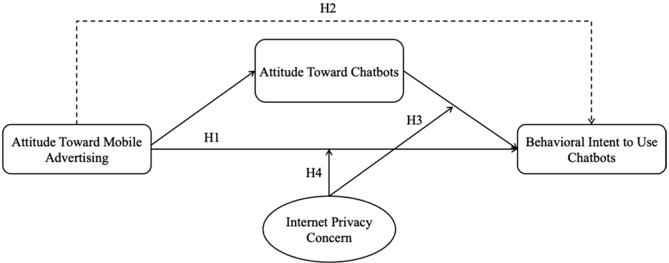
Verification
Claims the paper makes
The claims and statistics of this paper haven’t been checked yet.
Free: it reads the open-access text and checks the first 5 claims that cite a source we can check. Create a free account to check every claim.
Claims other papers make about this one
Each is checked against this paper’s own text: does it say what the citing paper says it does?
The cited source says what the claim attributes to it.
In the citing paper
“Contrary to prior studies on chatbots [125,126], privacy was not a significant concern regarding the usage of ChatGPT.”
From “Chatting with ChatGPT”: Analyzing the factors influencing users' intention to Use the Open AI's ChatGPT using the UTAUT model (2023) · cites this paper as [126]
In the citing paper
“Furthermore, privacy concerns [125,126] emerged as a crucial factor in accepting AI-powered chatbots.”
From “Chatting with ChatGPT”: Analyzing the factors influencing users' intention to Use the Open AI's ChatGPT using the UTAUT model (2023) · cites this paper as [126]
In the citing paper
“Prior research has highlighted the importance of privacy concerns in adopting and using AI-based technologies, including chatbots [125,126].”
From “Chatting with ChatGPT”: Analyzing the factors influencing users' intention to Use the Open AI's ChatGPT using the UTAUT model (2023) · cites this paper as [126]
Self-check
Percentages, sums and reported differences re-computed from the paper’s own numbers.
The self-check needs the paper’s full text.
Citations
Cites
Evaluating Structural Equation Models with Unobservable Variables and Measurement Error
Fornell, C., & Larcker, D. F. (1981) · Journal of Marketing Research · doi:10.2307/3151312 · Cited by 109,314 · cited 1×
“The analysis suggests a robust convergent validity of the measurement model (Fornell & Larcker, 1981; Hair et al., 1998).”
BackgroundEvaluating structural equation models with unobservable variables and measurement error
Fornell, C., & Larcker, D. F. (1981) · Journal of Marketing Research · doi:10.1177/002224378101800104 · Cited by 109,190
Podsakoff, P. M., MacKenzie, S. B., Lee, J.-Y., & Podsakoff, N. P. (2003) · Journal of Applied Psychology · doi:10.1037/0021-9010.88.5.879 · Cited by 82,194
(2013) · Cited by 44,563
(1975) · PhilPapers (PhilPapers Foundation) · Cited by 36,737
User Acceptance of Computer Technology: A Comparison of Two Theoretical Models
Davis, F. D., Bagozzi, R. P., & Warshaw, P. R. (1989) · Management Science · doi:10.1287/mnsc.35.8.982 · Cited by 25,709 · cited 2×
“In particular, the survey featured: (1) a 2-item scale measuring behavioral intent to use chatbots (Fishbein & Ajzen, 1975); (2) a 3-item scale measuring attitude toward chatbots (adapted from Davis et al., 1989); (3) a 6-item Fig.”
BackgroundMethodVenkatesh, V., Thong, J. Y. L., & Xu, X. (2012) · MIS Quarterly · doi:10.2307/41410412 · Cited by 15,756
MacKenzie, S. B., & Lutz, R. J. (1989) · Journal of Marketing · doi:10.2307/1251413 · Cited by 4,880
Measures of multivariate skewness and kurtosis with applications
MARDIA, K. V. (1970) · Biometrika · doi:10.1093/biomet/57.3.519 · Cited by 4,792 · cited 1×
“Using SPSS, we applied Mardia’s test for the multivariate skewness and kurtosis (DeCarlo, 1997; Mardia, 1970).”
MethodInternet Users' Information Privacy Concerns (IUIPC): The Construct, the Scale, and a Causal Model
Malhotra, N. K., Kim, S. S., & Agarwal, J. (2004) · Information Systems Research · doi:10.1287/isre.1040.0032 · Cited by 3,173
Research works printed but not linked: 9
- Chiem, R., Arriola, J., Browers, D., Gross, J., Limman, E., Nguyen, P. V., Sembodo, D., Young, S., & Seal, K. C. (2010). The critical success factors for marketing with downloadable applications: Lessons learned from selected European countries. International Journal of Mobile Marketing, 5(2), 43-56.
- de Cosmo, L. M., & Piper, L. (2020). L'atteggiamento dei consumatori nei confronti dell'Intelligenza Artificiale. Uno studio degli effetti della messaggistica mobile via chatbot sulle risposte com- portamentali del consumatore. In: A. F. Uricchio, G. Riccio, & U. Ruffolo (Eds.), Intelligenza Artificiale tra etica e diritti. Prime riflessioni a seguito del libro bianco dell'Unione europea. Cacucci Editore.
- Hair, J. F., Anderson, R. E., Tatham, R. L., & Black, W. C. (1998). Multivariate data analysis (5th ed.). Prentice Hall.
- Harkous, H., Fawaz, K., Shin, K. G., & Aberer, K. (2016). PriBots: Conversational Privacy with chat- bots, workshop on the future of privacy indicators, at the twelfth symposium on usable privacy and security (SOUPS) 2016, June 22-24, 2016. Denver, Colorado.
- Ling, K. C., Piew, T. H., & Chai, L. T. (2010). The determinants of consumers' attitude toward advertis- ing. Canadian Social Science, 6(4), 114-126.
- Marsden, P. (2010). Social Commerce: Monetizing Social Media. GRIN Verlag.
- Nunnally, J. C. (1978). Psychometric theory (2nd ed.). McGraw-Hill.
- Priscilla, C., Lestari, D. P., & Dharma, D. (2018). Based conversational commerce with user-centered design. In 5th International conference on advanced informatics: Concept theory and applications (ICAICTA), 14-17 Aug., 2018
- Ricotta, F. (2020). Marketing nell'era dell'iperconnessione. Pearson Italia.
Cited by
Menon, D., & Shilpa, K. (2023) · Heliyon · doi:10.1016/j.heliyon.2023.e20962 · Cited by 359
“Prior research has highlighted the importance of privacy concerns in adopting and using AI-based technologies, including chatbots [125,126].”
BackgroundResultVirtual agents and flow experience: an empirical examination of AI-powered chatbots
Baabdullah, A. M., Alalwan, A. A., Algharabat, R. S., Metri, B., & Rana, N. P. (2022) · Technological Forecasting and Social Change · doi:10.1016/j.techfore.2022.121772 · Cited by 171
Priya, B., & Sharma, V. (2023) · Computers in Human Behavior · doi:10.1016/j.chb.2023.107912 · Cited by 176
From concerns to benefits: A comprehensive study of ChatGPT usage in education
Jo, H. (2024) · International Journal of Educational Technology in Higher Education · doi:10.1186/s41239-024-00471-4 · Cited by 146
“In line with prior studies (de Cosmo et al., 2021; Lutz & Tamò-Larrieux, 2021; Zhu et al., 2022), privacy concern was negatively associated with behavioral intention (H8).”
BackgroundResultMachine learning and artificial intelligence use in marketing: a general taxonomy
Mauro, A. D., Sestino, A., & Bacconi, A. (2022) · Italian Journal of Marketing · doi:10.1007/s43039-022-00057-w · Cited by 182
“With regards to price actions, retail processes can be optimized using IoT (Amatulli et al., 2021; Nguyen & Simkin, 2017), while frontend presence can be automated with 24/7 consumer service chatbots (de Cosmo et al., 2021; Kurachi et al., 2018).”
MethodTrust and digital privacy: willingness to disclose personal information to banking chatbot services
Lappeman, J., Marlie, S., Johnson, T., & Poggenpoel, S. (2023) · Journal of Financial Services Marketing · doi:10.1057/s41264-022-00154-z · Cited by 103
“Factors such as perceived risk, perceived benefits, data ownership, ethical use of data, privacy policy, involvement and trans-parency may also affect user willingness to disclose (de Cosmo et al. 2021; Følstad et al. 2021; Isaac and Hanna 2018; Nyugen and Khoa 2019).”
BackgroundMethodInfluentialDrivers of privacy concerns when interacting with a chatbot in a customer service encounter
Bouhia, M., Rajaobelina, L., Tep, S. P., Arcand, M., & Ricard, L. (2022) · International Journal of Bank Marketing · doi:10.1108/ijbm-09-2021-0442 · Cited by 109
A literature review on users' behavioral intention toward chatbots' adoption
Gatzioufa, P., & Saprikis, V. (2026) · Applied Computing and Informatics · doi:10.1108/aci-01-2022-0021 · Cited by 71
Schillaci, C. E., de Cosmo, L. M., Piper, L., Nicotra, M., & Guido, G. (2023) · Technological Forecasting and Social Change · doi:10.1016/j.techfore.2023.123025 · Cited by 97
Self-citationBusiness types matter: new insights into the effects of anthropomorphic cues in AI chatbots
Youn, K., & Cho, M. (2023) · Journal of Services Marketing · doi:10.1108/jsm-04-2022-0126 · Cited by 72
Jo, H., & Park, D.-H. (2024) · Scientific Reports · doi:10.1038/s41598-024-57977-0 · Cited by 87
“It is a key facet of user experience and has been shown to affect technology adoption and usage behavior 17 .”
BackgroundSocial Media Analysis to Enhance Sustainable Knowledge Management: A Concise Literature Review
Alghamdi, A. M., Pileggi, S. F., & Sohaib, O. (2023) · Sustainability · doi:10.3390/su15139957 · Cited by 75
Gumusel, E. (2024) · Journal of the Association for Information Science and Technology · doi:10.1002/asi.24898 · Cited by 86
“…self-disclosure often occurs through manipulative design and algorithms which affect user decision-making (e.g., Balaji, 2019; Cheng & Jiang, 2020; de Cosmo et al., 2021; Kim et al., 2022; Lappeman et al., 2023; Pizzi et al., 2023) and the development of trust exacerbates privacy concerns (e.g.,…”
InfluentialThe Role of AI Enabled Chatbots in Omnichannel Customer Service
Ghosh, S., Ness, S., & Salunkhe, S. (2024) · Journal of Engineering Research and Reports · doi:10.9734/jerr/2024/v26i61184 · Cited by 80
Ngo, T. T. A., Phan, T. Y. N., Nguyen, T. K., Le, N. B. T., Nguyen, N. T. A., & Le, T. T. D. (2025) · Acta Psychologica · doi:10.1016/j.actpsy.2025.105468 · Cited by 70
Liu, Y., Yan, W., Hu, B., Zhi, L., & Song, Y. (2023) · International Journal of Human-Computer Interaction · doi:10.1080/10447318.2023.2238974 · Cited by 55
“For example, de Cosmo et al. (2021) have proven that privacy concerns towards the Internet can moderate the relationship between people ’ s attitudes towards chatbot services and usage intention.”
BackgroundBalaji, D., He, L., Giani, S., Bosse, T., Wiers, R., & de Bruijn, G.-J. (2022) · Sexual Health · doi:10.1071/sh22016 · Cited by 44
The Dynamics of Influencer Marketing: A Multidisciplinary Approach
Monzoncillo, J. M. Á. (2022) · Routledge eBooks · doi:10.4324/9781003134176 · Cited by 82
Consumers’ behavior in conversational commerce marketing based on messenger chatbots
Mehta, R., Verghese, J., Mahajan, S., Barykin, S., Bozhuk, S., Kozlova, N., Kapustina, I., Mikhaylov, A. Y., Naumova, E. A., & Dedyukhina, N. (2022) · F1000Research · doi:10.12688/f1000research.122037.1 · Cited by 51
“The privacy issues on the Internet negatively affect the relationship between the attitude towards chatbots and the behavioral intention to use this technology.(13)”
BackgroundGatzioufa, P., Saprikis, V., & Avlogiaris, G. (2023) · Human Behavior and Emerging Technologies · doi:10.1155/2023/8859989 · Cited by 45
“Shaw et al. [92]; De Cosmo et al. [93]; Xu et al. [94] PC2: I am worried that providers (companies) will use chatbot information improperly.”
BackgroundJha, S., Gupta, S., & Mahajan, R. (2023) · Asia Pacific Journal of Tourism Research · doi:10.1080/10941665.2023.2264972 · Cited by 39
“These results align with previous studies emphasizing the importance of trust and attitude as crucial determinants of intention to use technology (De Cicco et al., 2020; de Cosmo et al., 2021).”
BackgroundResultIslam, M. N. (2023) · Heliyon · doi:10.1016/j.heliyon.2023.e14691 · Cited by 45
“Privacy concerns also moderate the negative relationship between attitudes toward technology and the intention to use the technology [67].”
BackgroundJin, E., & Eastin, M. S. (2022) · Cyberpsychology Behavior and Social Networking · doi:10.1089/cyber.2021.0318 · Cited by 30
Public attitudes toward chatgpt on twitter: sentiments, topics, and occupations
Koonchanok, R., Pan, Y., & Jang, H. (2024) · Social Network Analysis and Mining · doi:10.1007/s13278-024-01260-7 · Cited by 25
“In marketing, for example, understanding the attitude toward chatbots in mobile advertising can help companies develop and test new strategies (de Cosmo et al. 2021).”
Jalali, N. A., & Hongsong, C. (2024) · Cluster Computing · doi:10.1007/s10586-024-04515-2 · Cited by 29
“First, the collection of personal data; second, control over the data; and third, knowledge of laws and regulations related to data processing and privacy [39].”
Xia, Y., Liu, Z., Wang, S., Huang, C., & Zhao, W. (2024) · Journal of the Knowledge Economy · doi:10.1007/s13132-024-02153-y · Cited by 26
“Users’ confidence in their ability to participate in advertising activities is bolstered by enhanced privacy measures, which also assist in alleviating concerns regarding data delivery without discrimination (De Cosmo et al., 2021).”
RetractedPutri, L. T., Aini, A. P. N., Solekah, N. A., & Istiqomah, D. F. (2023) · International Journal of Business Economics (IJBE) · doi:10.30596/ijbe.v5i1.16262 · Cited by 26
Unraveling the influential factors driving persistent adoption of ChatGPT in learning environments
Moghavvemi, S., & Jam, F. A. (2025) · Education and Information Technologies · doi:10.1007/s10639-025-13662-x · Cited by 53
“Previous studies have emphasized the significance of privacy issues in the acceptance and use of AI-driven technologies, such as chatbots (Cheng & Jiang, 2020; de Cosmo et al., 2021).”
Consumers’ Intentions to Use AI Chatbots on Online Shopping Platforms
Thi, T. D. P., & Duong, N. T. (2025) · Journal of Computer Information Systems · doi:10.1080/08874417.2025.2456750 · Cited by 21
Public Attitudes Toward ChatGPT on Twitter: Sentiments, Topics, and OccupationsPreprint
Koonchanok, R., Pan, Y., & Jang, H. (2024) · Research Square · doi:10.21203/rs.3.rs-3945065/v1 · Cited by 20
Review of Chatbot Security Systems
Eltahir, A. M., Abdulla, H. M. D., Platoš, J., & Snåšel, V. (2022) · International Conference on Circuits, Systems, Communications and Computers (CSCC) · doi:10.1109/cscc55931.2022.00037 · Cited by 14
“In [47], the authors provided a framework for analyzing chatbot communication qualitatively in the context of consumer service.”
BackgroundBilici, F., & Türkoğlu, İ. K. (2024) · Fırat Üniversitesi Mühendislik Bilimleri Dergisi · doi:10.35234/fumbd.1385541 · Cited by 14
Determinants of Chatbot adoption among older adults: An extended TAM approach using PLS-SEM
Wu, C., Chen, C.-T., Huang, K., & Chou, Y.-Y. (2025) · Information Development · doi:10.1177/02666669251315839 · Cited by 14
“Favorable attitudes toward chatbots encouraged usage in domains such as hospitality and banking (Pillai & Sivathanu, 2020; De Cosmo et al., 2021).”
Sestino, A., Prete, M. I., Piper, L., & Guido, G. (2021) · International Journal of Electronic Trade · doi:10.1504/ijetrade.2021.10042594 · Cited by 16
Self-citationSuryadi, N., Zulfikar, R., Prasarry, Y. V., & Islam, M. F. (2025) · Cogent Social Sciences · doi:10.1080/23311886.2025.2526799 · Cited by 15
“…an important role in shaping an individual’s intention to use ai. a positive attitude toward technology can increase the likelihood of its adoption (de Cosmo et al., 2021). in addition, attitudes have been shown to have a direct and positive impact on behavioral intentions to use ai (Yu & huang,…”
Dong, Z., Yang, T., Hou, Y., Cao, Y., & Feng, M. (2024) · Computers in Human Behavior · doi:10.1016/j.chb.2024.108140 · Cited by 12
Investigating tourism chatbot adoption: the moderating role of privacy concerns
Cheikh, A. B., & Zarrad, H. (2025) · Journal of Hospitality and Tourism Insights · doi:10.1108/jhti-10-2024-1161 · Cited by 9
Sujood, Kumar, A. A., Singh, S., Srivastava, N., Srivastava, A., Jain, A., Ayaz, M., Solomon, P., & Kumar, A. (2026) · International Journal of Quality and Service Sciences · doi:10.1108/ijqss-08-2025-0220 · Cited by 10
Lee, J., You, J. S., & Lee, D. (2024) · International Journal of Human-Computer Interaction · doi:10.1080/10447318.2024.2307695 · Cited by 11
“In AI chatbot studies as well, attitude also had a positive effect on intention to use (e.g., see Ashfaq et al. (2020), de Cosmo et al. (2021), and Kasilingam (2020)).”
Mapping user gratifications in the age of LLM-based chatbots: An affordance perspective
Go, E., & Kim, T. (2025) · Computers in Human Behavior Artificial Humans · doi:10.1016/j.chbah.2025.100240 · Cited by 7
Exploring user acceptance of physical intelligent assistants: A study on AI-powered eyewear
Niu, B., & Mvondo, G. F. N. (2025) · Technological Forecasting and Social Change · doi:10.1016/j.techfore.2025.124300 · Cited by 7
Jeon, Y. A., Ryoo, Y., Lee, S., & Yoon, H. J. (2025) · Journal of Advertising Research · doi:10.1080/00218499.2025.2537503 · Cited by 6
A study intention, implementation and adoption of e-wallet in Indonesia
Sinulingga, N. A. B., Ginting, P., Sembiring, B. K. F., & Silalahi, A. S. (2024) · Journal of Infrastructure Policy and Development · doi:10.24294/jipd.v8i11.8857 · Cited by 6
“…on the adoption and use of FinTech on E-Wallets in Indonesia, which is corroborated by prior research (Afolabi et al., 2021; Alshami et al., 2022; Cosmo et al., 2021; Fan et al., 2021; Velicia-Martin et al., 2021) that respondents who use E-Wallets do not consider privacy issues when it comes to…”
BackgroundMethodChatbot usage at fast food restaurants in Ghana: Exploring the perception-attitude-behaviour nexus
Osei, B. A., Aflakpui, B. E., Adamtey, F. N. A., & Nutsugbodo, R. Y. (2024) · Tourism and Hospitality Research · doi:10.1177/14673584241303861 · Cited by 6
“Studies on chatbot ’ s adoption have emphasised the interplay between users ’ attitude and use of the system (De Cosmo et al., 2021; Kim et al., 2020; Zhang et al., 2023).”
Public Attitudes Toward ChatGPT on Twitter: Sentiments, Topics, and Occupations
Koonchanok, R., Pan, Y., & Jang, H. (2023) · arXiv · doi:10.48550/arxiv.2306.12951 · Cited by 5
“In marketing, for example, understanding the attitude toward chatbots in mobile advertising can help companies develop and test new strategies (de Cosmo et al. 2021).”
Mathematics Student Teachers’ Behavioural Intention Using ChatGPT
Tăng, M. D., Nguyen, V. K., Tri, D. C. M., Quoc, P. L. C., & Ban, B. H. D. (2025) · Canadian Journal of Learning and Technology · doi:10.21432/cjlt28665 · Cited by 7
Hamdy, A., Zhang, J., Peng, S., Agag, G., & Eid, R. (2026) · Journal of Travel Research · doi:10.1177/00472875261450095 · Cited by 5
What are the Drivers of Using Chatbots in Online Shopping A Cross-Country Analysis
Çelik, A. A., Hüseyinli, T., & Can, M. (2022) · Journal of Business Research - Turk · doi:10.20491/isarder.2022.1497 · Cited by 5
Does AI Chatbot Service Quality Impact Customer Loyalty? Examining Satisfaction and Attitudes
Rupali, A., Sharma, N., Arora, P., & Mishra, P. (2024) · Advances in finance, accounting, and economics book series · doi:10.4018/979-8-3693-1503-3.ch002 · Cited by 7
Exploring the Behavioral Intentions to Use AI-Based Chatbots for Apparel Shopping
Myin, M. T. A., & Watchravesringkan, K. (2025) · doi:10.31274/itaa.18723 · Cited by 6
Dai, Y., Feng, H., & Gao, Y. (2025) · International Conference on Generative Artificial Intelligence for Business · doi:10.1145/3766918.3766928 · Cited by 4
From Direct Marketing Toward Interactive Marketing: The Evolving Interactive Marketing Tools
Moes, A., Fransen, M. L., Verhagen, T., & Fennis, B. M. (2023) · Springer eBooks · doi:10.1007/978-3-031-14961-0_3 · Cited by 6
AI-Driven Algorithms for Optimizing Social Media Advertising: Prospects and Challenges
Jha, A. (2024) · Advances in e-business research series · doi:10.4018/979-8-3693-1781-5.ch004 · Cited by 6
Nasution, M. D. T. P., Rafiki, A., Rossanty, Y., & Pahlufi, C. K. (2024) · IQTISHODUNA Jurnal Ekonomi Islam · doi:10.54471/iqtishoduna.v13i1.2364 · Cited by 6
Exploring Some Impacts of Advances in Artificial Intelligence: A Social Informatics Approach
Rosenbaum, H. S., Gumusel, E., Sanfilippo, M. R., Sweeney, M. E., Sawyer, S., & Zhou, Z. (2024) · Proceedings of the Association for Information Science and Technology · doi:10.1002/pra2.1109 · Cited by 3
“This is particularly crucial when considering the personalization feature of chatbots, which collects sensitive data and manipulates user decision-making (Balaji, 2019; de Cosmo et al., 2021).”
Chatbots in the Service Sector: A Successful Customer Experience
BENABDELOUAHED, R., & Elkhatibi, Y. (2023) · International Journal of Innovative Research in Multidisciplinary Education · doi:10.58806/ijirme.2024.v3i1n14 · Cited by 2
Ventura, K., & Karabaşak, T. (2024) · Afyon Kocatepe Üniversitesi İktisadi ve İdari Bilimler Fakültesi Dergisi · doi:10.33707/akuiibfd.1459114 · Cited by 4
The power of algorithms and keys of participation
Esteves, J. (2022) · Routledge eBooks · doi:10.4324/9781003134176-4 · Cited by 3
DADOUCH, T., Bennani, B., & Haoucha, M. (2023) · International Journal of Accounting, Finance, Auditing, Management and Economics · doi:10.5281/zenodo.8299493 · Cited by 5
Borole, P. (2024) · International Journal of Artificial Intelligence and Machine Learning · doi:10.4018/ijaiml.338379 · Cited by 4
Data Protection—Issues and Perspectives
Gupta, I. (2024) · Springer eBooks · doi:10.1007/978-981-99-6778-0_4 · Cited by 1
Research on the Tolerance of Privacy Leakage Among Consumers in Offline Retail Shopping Scenarios
Wang, W., Li, M., & Lai, E. (2025) · Asia Pacific Economic and Management Review · doi:10.62177/apemr.v2i2.246 · Cited by 1
28. Pazarlama Kongresi Tam Metin Bildiri Kitabı
Sarıyer, N., Işık, D. A., Kitapçı, H., Yazar, E. E., Karabulut, A. N., & TUNCER, B. (2025) · Özgür Yayınları eBooks · doi:10.58830/ozgur.pub988 · Cited by 1
The effect of non-facial emojis-text congruency on user satisfaction in chatbot interactions
Pescatore, M., & Farace, S. (2026) · Italian Journal of Marketing · doi:10.1007/s43039-025-00126-w · Cited by 1
“…and rapid response times (Adam et al., 2021; Gnewuch et al., 2017; Wirtz & Pitardi, 2023), they also face challenges like user distrust, privacy con - cerns, misunderstanding, and a sense of dehumanization in their interactions (e.g., De Cosmo et al., 2021; Luo et al., 2019; Sands et al., 2021).”
When AI Remembers: Investigating the Dual Role of Long‐Term Memory in Chatbots
Parvizian, M., Whittaker, L., Daronkola, H. K., Pallant, J. L., & Johnson, L. W. (2026) · Psychology and Marketing · doi:10.1002/mar.70267 · Cited by 1
AI-Based Chatbot Agents as Drivers of Purchase Intentions: An Interdisciplinary Study
Tyagi, P., & Jain, A. (2023) · Internet of things · doi:10.1007/978-3-031-33808-3_5 · Cited by 3
Rangasamy, S., Nagarathinam, A., Chellasamy, A., & Elangovan, N. (2023) · International Journal on Recent and Innovation Trends in Computing and Communication · doi:10.17762/ijritcc.v11i10s.7652 · Cited by 2
“Through chatbots, companies can increase customer engagement in their marketing actions more than the other marketing tools that do not use artificial Intelligence [14].”
Saah, P., Mbohwa, C., & Madonsela, N. S. (2024) · Asian Development Policy Review · doi:10.55493/5008.v12i1.4960 · Cited by 1
“On the other hand, De Cosmo, Piper, and Di Vittorio (2021) claim that a bad opinion of chatbots can make people reluctant to interact with them, which lowers the behavioural intention to utilise these virtual assistants.”
BackgroundExploring the Intention of Travel Agencies to Adopt Chatbots: Integrating TOE and MGB
Başer, M. Y., & Büyükbeşe, T. (2024) · Journal of Quality Assurance in Hospitality & Tourism · doi:10.1080/1528008x.2024.2386588 · Cited by 2
“The measurements of different authors were used for ES (Sekli & De La Vega, 2021), ATT (de Cosmo et al., 2021), BD (Piçarra & Giger, 2018), and SN and BC (White Baker et al., 2007).”
Interview with the AI: a quantitative analysis of AI companions’ relationship formation features
Dede, E., Sungur, H., Lemmens, J. S., & Peter, J. (2026) · AI & Society · doi:10.1007/s00146-026-03368-0 · Cited by 1
الاتجاهات الحدیثة فی دراسات تصمیم إعلانات الإنترنت
صبحی, م. (2022) · المجلة العلمية لبحوث العلاقات العامة و الإعلان · doi:10.21608/sjocs.2022.292640
اللطيف, م. م. ع. (2024) · المجلة العملیة التجارة والتمویل · doi:10.21608/caf.2024.345623
Ahmed, E. H. (2024) · Arab Media and Society. · doi:10.70090/eoa24uca
AI healer helps redefining pandemic response
Kadir, R. A., & Pakray, P. (2025) · Elsevier eBooks · doi:10.1016/b978-0-443-33871-7.00008-8
Satışta Dijitalleşme ve Teknoloji Kullanımı
Öniz, C. (2025) · Özgür Yayınları eBooks · doi:10.58830/ozgur.pub761.c3112
Porancea-Răulea, A. S. (2025) · International conference KNOWLEDGE-BASED ORGANIZATION · doi:10.2478/kbo-2025-0037
Dahake, P. S. (2025) · IGI Global eBooks · doi:10.4018/979-8-3373-3336-6.ch007
Evaluation of Chat Generative AI Usage: What Influences Users' Intention to Continue Using It?
Autavia, V., Cahya, V., & Ferdianto, F. (2025) · International Conference on Circuit, Systems and Communication (ICCSC) · doi:10.1109/iccsc66714.2025.11134914
Bahar, R. (2025) · Bulletin of Economic Theory and Analysis · doi:10.25229/beta.1669811
THE STRANGER IN MY POCKET: A RESEARCH ON THE INTENTION TO USE DIGITAL VOICE ASSISTANTS
Çizer, E. Ö., Köse, Ş. G., & Bulut, Z. A. (2025) · Journal of Yaşar University · doi:10.19168/jyasar.1712029
(2022) · OAPEN (The OAPEN Foundation)
Saleh, P. (2023) · Huddersfield Research Portal (University of Huddersfield)
Baccouche, M. K. (2023) · Corpus Université Laval (Université Laval)
Exploring technology acceptance in E-Ticketing Systems : A Tam perspective
Siti Kamilah, O. (2024) · UUM Electronic Theses and Dissertation [eTheses] (Northern University of Malaysia)
Sumarjan, N., Mazlan, N., Saiful Azmi, N. S., Kamaruddin, M. A., & Salleh, A. (2023) · UiTM Institutional Repositories (Universiti Teknologi MARA) · Cited by 17
Fake Out of Home: El fals street marketing digital. On la realitat i el digital es creuen
Gómez Gonzalez, Ò., & de la Comunicació, U. A. D. B. F. D. C. (2024) · Dipòsit Digital de Documents de la UAB (Universitat Autònoma de Barcelona)
Millecamps, T., & Vlemmix, G. (2024) · Document Server@UHasselt (UHasselt)
Sinulingga, N. A. B. (2025) · IJBE (Integrated Journal of Business and Economics) · doi:10.33019/ijbe.v9i4.1350 · Cited by 1
Chatbot Acceptance in Marketing: Literature Review
Sfar, N. (2025) · International Journal of Research and Innovation in Social Science · doi:10.47772/ijriss.2025.914mg00245
Chatbot Adoption in Mobile Commerce
Sfar, N., Baati, O., & Sboui, M. (2026) · Springer eBooks · doi:10.1007/978-3-031-75316-9_41-1
A Systematic Review of the Chatbot Technologies: Trends, Innovations, and their Influence on Society
Casanova, J., Antonio, J., Rivera, C., Valenzuela, E., & Evale, D. S. (2026) · International Journal of Multidisciplinary Educational Research and Innovation · doi:10.64637/688000
Kaba, A., Shimray, S. R., Zaitoun, E. A., & Refae, G. A. E. (2026) · Open Information Science · doi:10.1515/opis-2025-0038
“Meanwhile, internet privacy ap-prehensions negatively in fl uence individuals ’ attitudes toward chatbots and their intent to use this technology (De Cosmo et al. 2021).”
Bashar, A., Nyagadza, B., Khan, I., & Chuchu, T. (2026) · Quality & Quantity · doi:10.1007/s11135-026-02696-z
“…light on the technical aspects such as data quality for handling covariate shifts in dynamic markets, privacy-preserving ML for embeddings of anonymized user data and algorithmic accountability for combating bias in ad delivery (de Cosmo et al. 2021 ; Sharma and Sharma 2023 ; White et al. 2020 ).”
The Impact of Bots and Chatbots on Customer Experience in Digital Marketing
Al-Aqrabawi, R., Abu-AlSondos, I. A., Mahafdhah, A. R. M., Melhem, W. A. A., Alghizzawi, M., & Jos, R. A. G. (2026) · Studies in computational intelligence · doi:10.1007/978-3-032-23897-9_60
Vijayalakshmi, D., Thandayuthapani, S., Deivasigamani, S., Datta, A., Reddy, K. K. K., & Prakash, C. (2026) · AIP conference proceedings · doi:10.1063/5.0330916
Hung, T. H., Dao, T. C., Nguyen, H. L., Luu, T. M. N., Nguyen, P. M., & Trieu, M. A. (2026) · Springer proceedings in business and economics · doi:10.1007/978-981-95-9113-8_36
Shen, H., Chen, J., Gumusel, E., Liu, Z., Wei, M., Jiang, W., Lamba, M., & Zhou, K. Z. (2026) · International Conference on Computer Supported Cooperative Work in Design (CSCWD) · doi:10.1109/cscwd68734.2026.11582561
“In e-commerce, AI chatbots play a crucial role in implementing marketing strategies [6], [11]; however, their use also raises significant concerns regarding user perception and decision-making.”
Moreira, A. M. Á., & García, J. G. (2026) · Educación Arte Comunicación Revista Académica e Investigativa · doi:10.54753/eac.v15i2.2689
From Wine to Heritage: Heurigen and Vienna’s Cultural Identity
Theodoropoulou, A., Kalliampakou, I., & Bakalis, A. (2026) · Springer proceedings in business and economics · doi:10.1007/978-3-032-33052-9_2
Metadata
- Authors
- de Cosmo, L. M., Piper, L., & Di Vittorio, A.
- Affiliations
- University of Bari Aldo Moro (IT)
- ORCID
- Piper, Luigi
- Venue
- Italian Journal of Marketing
- Published
- 2021-03-16
- Volume
- 2021
- Issue
- 1-2
- Pages
- 83-102
- ISSN
- 2662-3323 (ISSN-L)
- 2662-3331
- OpenAlex
- W3138821615
- Cited by
- 82
- References
- 119
- Citations by year
- 2026: 13 · 2025: 19 · 2024: 23 · 2023: 15 · 2022: 12
- FWCI
- 4.42
- Type
- journal article
- Language
- en
- Open access
- hybrid
- doi.org
- Licence
- cc-by
- creativecommons.org/licenses/by/4.0 (tdm)
- creativecommons.org/licenses/by/4.0 (vor)
- Locations
- Italian Journal of Marketing (publishedVersion, cc-by)
- AIRUS (submittedVersion, cc-by-nc-nd)
- RePEc: Research Papers in Economics (submittedVersion)
- CINECA IRIS Institutional Research Information System (University of Bari Aldo Moro) (submittedVersion, cc-by)
- INFM-OAR (INFN Catania) (submittedVersion, cc-by)
- Funders
- Università degli Studi di Bari Aldo Moro
- Topics
- Social Sciences › Business, Management and Accounting › Marketing › AI in Service Interactions
- Social Sciences › Decision Sciences › Information Systems and Management › Technology Adoption and User Behaviour
- Social Sciences › Business, Management and Accounting › Marketing › Digital Marketing and Social Media
- Keywords
- chatbots, privacy concerns, mobile advertising, behavioral intention, moderated mediation, digital marketing
About these checks
Registry, retraction, Cites and statistics results are computed, not judged, with one exception: a printed reference that no index lists is read once by a model before it counts as a citation error. Claims are extracted by a model and kept only when their quote appears verbatim in the text; each cited source is then checked, with a model’s help, for whether it says what the claim relies on. Those verdicts can be wrong — read the claim’s quote and the cited source before relying on one.
Statistics and arithmetic are recomputed, not judged.
Confidence bands are shown only for fields calibrated on our annotated test set. None is calibrated yet, so no band is shown.
What counts as a claim ›How we measure confidence ›How we check this ›
Are you an author, or do you see a problem with this page? Request a review
Data sources
Bibliographic data: Semantic Scholar, OpenAlex, Crossref.
Contains information from the Semantic Scholar Academic Graph Datasets, made available under the ODC Attribution License (ODC-BY 1.0).
Semantic Scholar’s data is described in: Kinney, R., et al. (2023). The Semantic Scholar Open Data Platform. arXiv:2301.10140.
