

The role of attitude toward chatbots and privacy concern on the relationship between attitude toward mobile advertising and behavioral intent to use chatbots
Open accessThe DOI matches its Crossref record; 118 of the 120 references it cites were found in a registry or an index.
Abstract
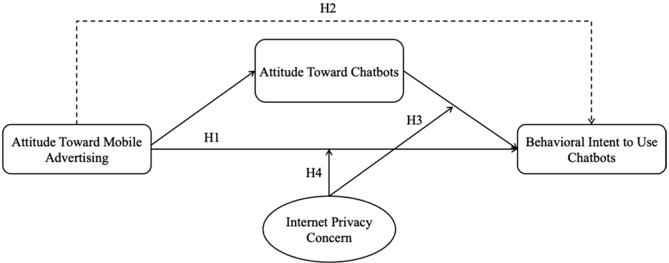
Chatbots are technological tools equipped with artificial intelligence that allow companies to interact with their consumers. Through their computers or mobile devices, consumers can use this technology to search for information, make purchases or request after-sales services. This study aims to identify the role of attitude toward chatbots and privacy concern in the relationship between attitude toward mobile advertising and behavioral intent to use chatbots. After reviewing the literature, the study proposes a moderated mediation model. Through a survey, the study shows that attitude toward mobile advertising does not have a direct effect on the behavioral intent to use chatbot, but is rather mediated by one’s attitude toward chatbots. In fact, the interactivity is unidirectional in the case of mobile advertising (from the company to the consumer), but bidirectional in the case of chatbots (in which consumers have an active role in communication). In line with these assumptions, the data analysis shows that internet privacy concerns only negatively moderate the relationship between attitude toward chatbots and behavioral intent to use this technology. These results can be useful for companies and researchers in terms of developing and testing new digital marketing strategies. The paper concludes with a discussion of the results’ theoretical and managerial implications.
Overview
The claims and statistics of this paper haven’t been checked yet.
Free: it reads the open-access text and checks the first 5 claims that cite a source we can check. Create a free account to check every claim.
Integrity signals
Registry
Cites
Statistics
Figures
Verification
Claims the paper makes
The claims and statistics of this paper haven’t been checked yet.
Free: it reads the open-access text and checks the first 5 claims that cite a source we can check. Create a free account to check every claim.
Claims other papers make about this one
Each is checked against this paper’s own text: does it say what the citing paper says it does?
The cited source says what the claim attributes to it.
In the citing paper
“Contrary to prior studies on chatbots [125,126], privacy was not a significant concern regarding the usage of ChatGPT.”
From “Chatting with ChatGPT”: Analyzing the factors influencing users' intention to Use the Open AI's ChatGPT using the UTAUT model (2023) · cites this paper as [126]
In the citing paper
“Furthermore, privacy concerns [125,126] emerged as a crucial factor in accepting AI-powered chatbots.”
From “Chatting with ChatGPT”: Analyzing the factors influencing users' intention to Use the Open AI's ChatGPT using the UTAUT model (2023) · cites this paper as [126]
In the citing paper
“Prior research has highlighted the importance of privacy concerns in adopting and using AI-based technologies, including chatbots [125,126].”
From “Chatting with ChatGPT”: Analyzing the factors influencing users' intention to Use the Open AI's ChatGPT using the UTAUT model (2023) · cites this paper as [126]
Self-check
Percentages, sums and reported differences re-computed from the paper’s own numbers.
The self-check needs the paper’s full text.
Citations
Cites
Evaluating Structural Equation Models with Unobservable Variables and Measurement Error
Fornell, C., & Larcker, D. F. (1981) · Journal of Marketing Research · doi:10.2307/3151312 · Cited by 109,314 · cited 1×
“The analysis suggests a robust convergent validity of the measurement model (Fornell & Larcker, 1981; Hair et al., 1998).”
BackgroundEvaluating structural equation models with unobservable variables and measurement error
Fornell, C., & Larcker, D. F. (1981) · Journal of Marketing Research · doi:10.1177/002224378101800104 · Cited by 109,190
Podsakoff, P. M., MacKenzie, S. B., Lee, J.-Y., & Podsakoff, N. P. (2003) · Journal of Applied Psychology · doi:10.1037/0021-9010.88.5.879 · Cited by 82,194
(2013) · Cited by 44,563
(1975) · PhilPapers (PhilPapers Foundation) · Cited by 36,737
User Acceptance of Computer Technology: A Comparison of Two Theoretical Models
Davis, F. D., Bagozzi, R. P., & Warshaw, P. R. (1989) · Management Science · doi:10.1287/mnsc.35.8.982 · Cited by 25,709 · cited 2×
“In particular, the survey featured: (1) a 2-item scale measuring behavioral intent to use chatbots (Fishbein & Ajzen, 1975); (2) a 3-item scale measuring attitude toward chatbots (adapted from Davis et al., 1989); (3) a 6-item Fig.”
BackgroundMethodVenkatesh, V., Thong, J. Y. L., & Xu, X. (2012) · MIS Quarterly · doi:10.2307/41410412 · Cited by 15,756
MacKenzie, S. B., & Lutz, R. J. (1989) · Journal of Marketing · doi:10.2307/1251413 · Cited by 4,880
Measures of multivariate skewness and kurtosis with applications
MARDIA, K. V. (1970) · Biometrika · doi:10.1093/biomet/57.3.519 · Cited by 4,792 · cited 1×
“Using SPSS, we applied Mardia’s test for the multivariate skewness and kurtosis (DeCarlo, 1997; Mardia, 1970).”
MethodInternet Users' Information Privacy Concerns (IUIPC): The Construct, the Scale, and a Causal Model
Malhotra, N. K., Kim, S. S., & Agarwal, J. (2004) · Information Systems Research · doi:10.1287/isre.1040.0032 · Cited by 3,173
Research works printed but not linked: 9
- Chiem, R., Arriola, J., Browers, D., Gross, J., Limman, E., Nguyen, P. V., Sembodo, D., Young, S., & Seal, K. C. (2010). The critical success factors for marketing with downloadable applications: Lessons learned from selected European countries. International Journal of Mobile Marketing, 5(2), 43-56.
- de Cosmo, L. M., & Piper, L. (2020). L'atteggiamento dei consumatori nei confronti dell'Intelligenza Artificiale. Uno studio degli effetti della messaggistica mobile via chatbot sulle risposte com- portamentali del consumatore. In: A. F. Uricchio, G. Riccio, & U. Ruffolo (Eds.), Intelligenza Artificiale tra etica e diritti. Prime riflessioni a seguito del libro bianco dell'Unione europea. Cacucci Editore.
- Hair, J. F., Anderson, R. E., Tatham, R. L., & Black, W. C. (1998). Multivariate data analysis (5th ed.). Prentice Hall.
- Harkous, H., Fawaz, K., Shin, K. G., & Aberer, K. (2016). PriBots: Conversational Privacy with chat- bots, workshop on the future of privacy indicators, at the twelfth symposium on usable privacy and security (SOUPS) 2016, June 22-24, 2016. Denver, Colorado.
- Ling, K. C., Piew, T. H., & Chai, L. T. (2010). The determinants of consumers' attitude toward advertis- ing. Canadian Social Science, 6(4), 114-126.
- Marsden, P. (2010). Social Commerce: Monetizing Social Media. GRIN Verlag.
- Nunnally, J. C. (1978). Psychometric theory (2nd ed.). McGraw-Hill.
- Priscilla, C., Lestari, D. P., & Dharma, D. (2018). Based conversational commerce with user-centered design. In 5th International conference on advanced informatics: Concept theory and applications (ICAICTA), 14-17 Aug., 2018
- Ricotta, F. (2020). Marketing nell'era dell'iperconnessione. Pearson Italia.
Cited by
Items 101–104 of 104
Peran Kecerdasan Buatan dalam Transformasi Strategi Pemasaran Bisnis di Era Digital
Siagian, I., Tambunan, D. P., Purba, N., Simbolon, E., Tarigan, S. B., Ginting, A. A. B., & Surbakti, C. N. B. (2026) · RIGGS Journal of Artificial Intelligence and Digital Business · doi:10.31004/riggs.v5i2.9787
“De Cosmo et al. menunjukkan bahwa sikap terhadap chatbot menjadi penghubung penting antara persepsi konsumen terhadap iklan seluler dan niat menggunakan chatbot, sedangkan kekhawatiran privasi dapat membatasi penerimaan [17].”
Dijital tüketimde gizlilik endişesi ve dijital reklamlar üzerine bir araştırma
Işıkay, T. (2025) · Yildiz Technical University - AVESIS
Evaluating Smart Home Device Users’ Responses to their (Un)Confirmed Privacy Expectations
Khatun, T., Rezaei, M. S., Huang, D. Y., Nov, O., & Anaraky, R. G. (2026) · ACM Transactions on Computer-Human Interaction · doi:10.1145/3858671
“Therefore, many users are worried about sharing data with ad domains [21], yet many remain unaware that their data is shared with external parties via third-party apps [75].”
Tarikh, A. M. A., Bako, D. S., Cahya, M., & Alamsyah, D. P. (2026) · International Conference on Wireless and Telematics (ICWT) · doi:10.1109/icwt71445.2026.11751609
Metadata
- Authors
- de Cosmo, L. M., Piper, L., & Di Vittorio, A.
- Affiliations
- University of Bari Aldo Moro (IT)
- ORCID
- Piper, Luigi
- Venue
- Italian Journal of Marketing
- Published
- 2021-03-16
- Volume
- 2021
- Issue
- 1-2
- Pages
- 83-102
- ISSN
- 2662-3323 (ISSN-L)
- 2662-3331
- OpenAlex
- W3138821615
- Semantic Scholar
- d4950a085524db44fea979a87268c1e93c0a7a25
- Cited by
- 82
- References
- 119
- Citations by year
- 2026: 13 · 2025: 19 · 2024: 23 · 2023: 15 · 2022: 12
- FWCI
- 4.42
- Type
- journal article
- Language
- en
- Open access
- hybrid
- doi.org
- Licence
- cc-by
- creativecommons.org/licenses/by/4.0 (tdm)
- creativecommons.org/licenses/by/4.0 (vor)
- Locations
- Italian Journal of Marketing (publishedVersion, cc-by)
- AIRUS (submittedVersion, cc-by-nc-nd)
- RePEc: Research Papers in Economics (submittedVersion)
- CINECA IRIS Institutional Research Information System (University of Bari Aldo Moro) (submittedVersion, cc-by)
- INFM-OAR (INFN Catania) (submittedVersion, cc-by)
- Funders
- Università degli Studi di Bari Aldo Moro
- Topics
- Social Sciences › Business, Management and Accounting › Marketing › AI in Service Interactions
- Social Sciences › Decision Sciences › Information Systems and Management › Technology Adoption and User Behaviour
- Social Sciences › Business, Management and Accounting › Marketing › Digital Marketing and Social Media
- Keywords
- chatbots, privacy concerns, mobile advertising, behavioral intention, moderated mediation, digital marketing
About these checks
Registry, retraction, Cites and statistics results are computed, not judged, with one exception: a printed reference that no index lists is read once by a model before it counts as a citation error. Claims are extracted by a model and kept only when their quote appears verbatim in the text; each cited source is then checked, with a model’s help, for whether it says what the claim relies on. Those verdicts can be wrong — read the claim’s quote and the cited source before relying on one.
Statistics and arithmetic are recomputed, not judged.
Confidence bands are shown only for fields calibrated on our annotated test set. None is calibrated yet, so no band is shown.
What counts as a claim ›How we measure confidence ›How we check this ›
Are you an author, or do you see a problem with this page? Request a review
Data sources
Bibliographic data: Semantic Scholar, OpenAlex, Crossref.
Contains information from the Semantic Scholar Academic Graph Datasets, made available under the ODC Attribution License (ODC-BY 1.0).
Semantic Scholar’s data is described in: Kinney, R., et al. (2023). The Semantic Scholar Open Data Platform. arXiv:2301.10140.
