

The role of attitude toward chatbots and privacy concern on the relationship between attitude toward mobile advertising and behavioral intent to use chatbots
Open accessThe DOI matches its Crossref record; 118 of the 119 references it cites were found in a registry or an index.
Abstract
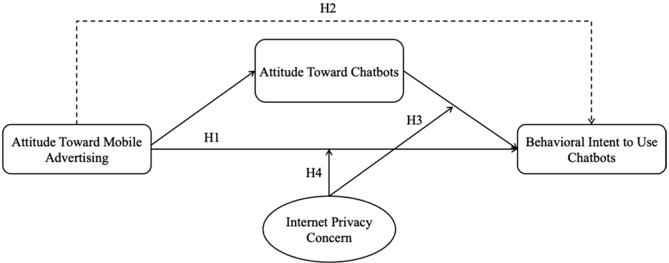
Chatbots are technological tools equipped with artificial intelligence that allow companies to interact with their consumers. Through their computers or mobile devices, consumers can use this technology to search for information, make purchases or request after-sales services. This study aims to identify the role of attitude toward chatbots and privacy concern in the relationship between attitude toward mobile advertising and behavioral intent to use chatbots. After reviewing the literature, the study proposes a moderated mediation model. Through a survey, the study shows that attitude toward mobile advertising does not have a direct effect on the behavioral intent to use chatbot, but is rather mediated by one’s attitude toward chatbots. In fact, the interactivity is unidirectional in the case of mobile advertising (from the company to the consumer), but bidirectional in the case of chatbots (in which consumers have an active role in communication). In line with these assumptions, the data analysis shows that internet privacy concerns only negatively moderate the relationship between attitude toward chatbots and behavioral intent to use this technology. These results can be useful for companies and researchers in terms of developing and testing new digital marketing strategies. The paper concludes with a discussion of the results’ theoretical and managerial implications.
Overview
The claims and statistics of this paper haven’t been checked yet.
Free: it reads the open-access text and checks the first 5 claims that cite a source we can check. Create a free account to check every claim.
Integrity signals
Registry
Cites
Statistics
Figures
Verification
Claims the paper makes
The claims and statistics of this paper haven’t been checked yet.
Free: it reads the open-access text and checks the first 5 claims that cite a source we can check. Create a free account to check every claim.
Claims other papers make about this one
Each is checked against this paper’s own text: does it say what the citing paper says it does?
The cited source says what the claim attributes to it.
In the citing paper
“Contrary to prior studies on chatbots [125,126], privacy was not a significant concern regarding the usage of ChatGPT.”
From “Chatting with ChatGPT”: Analyzing the factors influencing users' intention to Use the Open AI's ChatGPT using the UTAUT model (2023) · cites this paper as [126]
In the citing paper
“Furthermore, privacy concerns [125,126] emerged as a crucial factor in accepting AI-powered chatbots.”
From “Chatting with ChatGPT”: Analyzing the factors influencing users' intention to Use the Open AI's ChatGPT using the UTAUT model (2023) · cites this paper as [126]
In the citing paper
“Prior research has highlighted the importance of privacy concerns in adopting and using AI-based technologies, including chatbots [125,126].”
From “Chatting with ChatGPT”: Analyzing the factors influencing users' intention to Use the Open AI's ChatGPT using the UTAUT model (2023) · cites this paper as [126]
Self-check
Percentages, sums and reported differences re-computed from the paper’s own numbers.
The self-check needs the paper’s full text.
Citations
Cites
Evaluating Structural Equation Models with Unobservable Variables and Measurement Error
Fornell, C., & Larcker, D. F. (1981) · Journal of Marketing Research · doi:10.2307/3151312 · Cited by 109,314 · cited 1×
“The analysis suggests a robust convergent validity of the measurement model (Fornell & Larcker, 1981; Hair et al., 1998).”
BackgroundEvaluating structural equation models with unobservable variables and measurement error
Fornell, C., & Larcker, D. F. (1981) · Journal of Marketing Research · doi:10.1177/002224378101800104 · Cited by 109,190
Podsakoff, P. M., MacKenzie, S. B., Lee, J.-Y., & Podsakoff, N. P. (2003) · Journal of Applied Psychology · doi:10.1037/0021-9010.88.5.879 · Cited by 82,194
(2013) · Cited by 44,563
(1975) · PhilPapers (PhilPapers Foundation) · Cited by 36,737
User Acceptance of Computer Technology: A Comparison of Two Theoretical Models
Davis, F. D., Bagozzi, R. P., & Warshaw, P. R. (1989) · Management Science · doi:10.1287/mnsc.35.8.982 · Cited by 25,709 · cited 2×
“In particular, the survey featured: (1) a 2-item scale measuring behavioral intent to use chatbots (Fishbein & Ajzen, 1975); (2) a 3-item scale measuring attitude toward chatbots (adapted from Davis et al., 1989); (3) a 6-item Fig.”
BackgroundMethodVenkatesh, V., Thong, J. Y. L., & Xu, X. (2012) · MIS Quarterly · doi:10.2307/41410412 · Cited by 15,756
MacKenzie, S. B., & Lutz, R. J. (1989) · Journal of Marketing · doi:10.2307/1251413 · Cited by 4,880
Measures of multivariate skewness and kurtosis with applications
MARDIA, K. V. (1970) · Biometrika · doi:10.1093/biomet/57.3.519 · Cited by 4,792 · cited 1×
“Using SPSS, we applied Mardia’s test for the multivariate skewness and kurtosis (DeCarlo, 1997; Mardia, 1970).”
MethodInternet Users' Information Privacy Concerns (IUIPC): The Construct, the Scale, and a Causal Model
Malhotra, N. K., Kim, S. S., & Agarwal, J. (2004) · Information Systems Research · doi:10.1287/isre.1040.0032 · Cited by 3,173
International Journal of Business and Management
(2017) · International Journal of Business and Management · doi:10.26666/rmp.ijbm · Cited by 2,886
Pavlou, P. A., Liang, H., & Xue, Y. (2007) · MIS Quarterly · doi:10.2307/25148783 · Cited by 2,646
From Multi-Channel Retailing to Omni-Channel Retailing
Verhoef, P. C., Kannan, P. K., & Inman, J. J. (2015) · Journal of Retailing · doi:10.1016/j.jretai.2015.02.005 · Cited by 2,579
Wu, J.-H., & Wang, S.-C. (2005) · Information & Management · doi:10.1016/j.im.2004.07.001 · Cited by 2,284
Information Privacy: Measuring Individuals’ Concerns About Organizational Practices1
Smith, H. J., Milberg, S. J., & Burke, S. J. (1996) · MIS Quarterly · doi:10.2307/249477 · Cited by 2,266
Readings in Attitude Theory and Measurement
Jahoda, M., & Fishbein, M. (1968) · The British Journal of Sociology · doi:10.2307/588703 · Cited by 2,124
On the meaning and use of kurtosis.
DeCarlo, L. T. (1997) · Psychological Methods · doi:10.1037//1082-989x.2.3.292 · Cited by 1,755 · cited 1×
“Using SPSS, we applied Mardia’s test for the multivariate skewness and kurtosis (DeCarlo, 1997; Mardia, 1970).”
MethodDiamantopoulos, A., Sarstedt, M., Fuchs, C., Wilczynski, P., & Kaiser, S. (2012) · Journal of the Academy of Marketing Science · doi:10.1007/s11747-011-0300-3 · Cited by 1,736
Bart, Y., Shankar, V., Sultan, F., & Urban, G. L. (2005) · Journal of Marketing · doi:10.1509/jmkg.2005.69.4.133 · Cited by 1,482
Consumer e-shopping acceptance: Antecedents in a technology acceptance model
Ha, S., & Stoel, L. (2009) · Journal of Business Research · doi:10.1016/j.jbusres.2008.06.016 · Cited by 1,353
Privacy in the Digital Age: a Review of Information Privacy Research in Information Systems1
Bélanger, F., & Crossler, R. E. (2011) · MIS Quarterly · doi:10.2307/41409971 · Cited by 1,339
Vijayasarathy, L. R. (2004) · Information & Management · doi:10.1016/j.im.2003.08.011 · Cited by 1,218 · cited 1×
“However, when considering the literature about people’s acceptance of new intelligent technologies (Vijayasarathy, 2004), some scholars argue that a favorable attitude toward using intelligent technology is an antecedent of the intention to use it (Zarouali et al., 2018).”
BackgroundConsumer Attitudes Toward Mobile Advertising: An Empirical Study
Tsang, M. M., Ho, S.-C., & Liang, T.-P. (2004) · International Journal of Electronic Commerce · doi:10.1080/10864415.2004.11044301 · Cited by 1,186
Cain, M. K., Zhang, Z., & Yuan, K.-H. (2017) · Behavior Research Methods · doi:10.3758/s13428-016-0814-1 · Cited by 1,164
Alexa, Siri, Cortana, and more: An introduction to voice assistants.
Hoy, M. B. (2018) · Medical Reference Services Quarterly · doi:10.1080/02763869.2018.1404391 · Cited by 965 · cited 1×
“There have been recent studies on the functional characteristics of voice assistants (Hoy, 2018); on the effectiveness of chatbots based on accuracy, consistency and repeatability of recommendations (Sadeddin et al., 2007); on how their adoption relates to consumers’ social roles (Schweitzer…”
BackgroundSchlosser, A. E., White, T. B., & Lloyd, S. M. (2006) · Journal of Marketing · doi:10.1509/jmkg.70.2.133 · Cited by 947
Hill, J., Randolph Ford, W., & Farreras, I. G. (2015) · Computers in Human Behavior · doi:10.1016/j.chb.2015.02.026 · Cited by 856
The Effect of Online Privacy Information on Purchasing Behavior: An Experimental Study
Tsai, J. Y., Egelman, S., Cranor, L., & Acquisti, A. (2011) · Information Systems Research · doi:10.1287/isre.1090.0260 · Cited by 855
Intimate Exchanges: Using Computers to Elicit Self-Disclosure from Consumers
Moon, Y. (2000) · Journal of Consumer Research · doi:10.1086/209566 · Cited by 842 · cited 1×
“Several empirical studies of customer data management have addressed how consumers disclose personal information (Moon, 2000; White, 2004) and begin to trust firms and their data management processes (Bart et al., 2005; Schlosser et al., 2006).”
BackgroundLocation‐Based Services: Fundamentals and Operation
Küpper, A. (2005) · Wiley eBooks · doi:10.1002/0470092335 · Cited by 801 · cited 1×
“As a result, companies can tailor their services, product offerings, or advertising actions based on consumers’ geographical location (known as location-based marketing or LBM) (Küpper, 2005).”
BackgroundUnderstanding the Role of Artificial Intelligence in Personalized Engagement Marketing
Kumar, V., Rajan, B., Venkatesan, R., & Lecinski, J. (2019) · California Management Review · doi:10.1177/0008125619859317 · Cited by 797
Exploring the Implications of M-Commerce for Markets and Marketing
Balasubraman, S., Peterson, R. A., & Jarvenpaa, S. L. (2002) · Journal of the Academy of Marketing Science · doi:10.1177/009207002236910 · Cited by 683
Li, X., Hess, T. J., & Valacich, J. S. (2008) · The Journal of Strategic Information Systems · doi:10.1016/j.jsis.2008.01.001 · Cited by 635
Permission-based mobile advertising
Barwise, P., & Strong, C. (2002) · Journal of Interactive Marketing · doi:10.1002/dir.10000 · Cited by 594
Eastlick, M. A., Lotz, S. L., & Warrington, P. (2006) · Journal of Business Research · doi:10.1016/j.jbusres.2006.02.006 · Cited by 568
Internet of Things and Big Data as enablers for business digitalization strategies
Sestino, A., Prete, M. I., Piper, L., & Guido, G. (2020) · Technovation · doi:10.1016/j.technovation.2020.102173 · Cited by 559
Self-citationEnabling smart retail settings via mobile augmented reality shopping apps
Dacko, S. G. (2017) · Technological Forecasting and Social Change · doi:10.1016/j.techfore.2016.09.032 · Cited by 543 · cited 2×
“Furthermore, the growth of m-commerce has bolstered the number of mobile applications (apps), particularly ones dealing with messaging (Dacko, 2017; Garg & Telang, 2013), but few studies have explored the impact of such apps on the behavioral intent to use the technology (Dacko, 2017; de Cosmo &…”
BackgroundCustomerization: The next revolution in mass customization
Wind, J., & Rangaswamy, A. (2001) · Journal of Interactive Marketing · doi:10.1002/1520-6653(200124)15:1<13::aid-dir1001>3.0.co;2-# · Cited by 533
A review for mobile commerce research and applications
Ngai, E. W. T., & Gunasekaran, A. (2007) · Decision Support Systems · doi:10.1016/j.dss.2005.05.003 · Cited by 528
User needs for location-aware mobile services
Kaasinen, E. (2003) · Personal and Ubiquitous Computing · doi:10.1007/s00779-002-0214-7 · Cited by 521 · cited 2×
“Just as the quality of information on a company’s website has a direct influence on customer brand perceptions (Kaasinen, 2003), the information or content provided via mobile devices must also show qualitative characteristics such as relevance, timeliness, and utility for the consumer (Siau &…”
BackgroundDiffusion and success factors of mobile marketing
Scharl, A., Dickinger, A., & Murphy, J. (2005) · Electronic Commerce Research and Applications · doi:10.1016/j.elerap.2004.10.006 · Cited by 509
Mobile marketing: A synthesis and prognosis
Shankar, V., & Balasubramanian, S. (2009) · Journal of Interactive Marketing · doi:10.1016/j.intmar.2009.02.002 · Cited by 484
Mobile Commerce: Framework, Applications and Networking Support
Varshney, U., & Vetter, R. (2002) · Mobile Networks and Applications · doi:10.1023/a:1014570512129 · Cited by 476
Advertising Attitudes and Advertising Effectiveness
Mehta, A. (2000) · Journal of Advertising Research · doi:10.2501/jar-40-3-67-72 · Cited by 471 · cited 1×
“Consequently, one’s attitude toward mobile advertising is considered a cognitive indicator of the advertising’s effectiveness and, by extension, a determinant of behavior (Ling et al., 2010; Mackenzie & Lutz, 1989; Mehta, 2000).”
BackgroundBansal, G., Zahedi, F. M., & Gefen, D. (2016) · Information & Management · doi:10.1016/j.im.2015.08.001 · Cited by 457
From Consumer Response to Active Consumer: Measuring the Effectiveness of Interactive Media
Stewart, D. W., & Pavlou, P. A. (2002) · Journal of the Academy of Marketing Science · doi:10.1177/009207002236912 · Cited by 441
Interactive Marketing: Exploiting the Age of Addressability
Deighton, J., & Blattberg, R. C. (1991) · Cited by 412
Fan, H., & Poole, M. S. (2006) · Journal of Organizational Computing and Electronic Commerce · doi:10.1080/10919392.2006.9681199 · Cited by 404 · cited 1×
“Customization (also called web-customization, explicit personalization or adaptability), meanwhile, is an activity that customers initiate when configuring websites and mobile applications (Fan & Poole, 2006).”
BackgroundEthics and Target Marketing: The Role of Product Harm and Consumer Vulnerability
Smith, N. C., & Cooper-Martin, E. (1997) · Journal of Marketing · doi:10.1177/002224299706100301 · Cited by 403
Mobile marketing: the role of permission and acceptance
Barnes, S. J., & Scornavacca, E. (2004) · International Journal of Mobile Communications · doi:10.1504/ijmc.2004.004663 · Cited by 365
Mobile Ad Effectiveness: Hyper-Contextual Targeting with Crowdedness
Andrews, M., Luo, X., Fang, Z., & Ghose, A. (2016) · Marketing Science · doi:10.1287/mksc.2015.0905 · Cited by 355 · cited 2×
“…has been accompanied by an evolving research base, focused on topics such as: mobile marketing (Shankar & Balasubramanian, 2009; Venkatesh et al., 2012), mobile advertising and pro-motions (Andrews et al., 2015; Bart et al., 2014; Fong et al., 2015), and mobile shopping (Shankar et al., 2016).”
BackgroundMobile Shopper Marketing: Key Issues, Current Insights, and Future Research Avenues
Shankar, V., Kleijnen, M., Ramanathan, S., Rizley, R., Holland, S., & Morrissey, S. (2016) · Journal of Interactive Marketing · doi:10.1016/j.intmar.2016.03.002 · Cited by 348
Personalization technologies: a process-oriented perspective
Adomavicius, G., & Tuzhilin, A. (2005) · Communications of the ACM · doi:10.1145/1089107.1089109 · Cited by 342
Artificial Intelligence for Marketing: Practical Applications
Sterne, J. (2017) · Wiley eBooks · doi:10.1002/9781119406341 · Cited by 332 · cited 1×
“For instance, scholars can use AI to better understand the decision-making chain and develop new marketing strategies based on Big Data (Kumar et al., 2019; Sterne, 2017; Yang & Siau, 2018).”
Geo-Conquesting: Competitive Locational Targeting of Mobile Promotions
Fong, N. M., Fang, Z., & Luo, X. (2015) · Journal of Marketing Research · doi:10.1509/jmr.14.0229 · Cited by 323
Mobile advertising: A framework and research agenda
Grewal, D., Bart, Y., Spann, M., & Zubcsek, P. P. (2016) · Journal of Interactive Marketing · doi:10.1016/j.intmar.2016.03.003 · Cited by 316
Factors influencing consumers' willingness to accept mobile advertising: a conceptual model
Leppaniemi, M., & Karjaluoto, H. (2005) · International Journal of Mobile Communications · doi:10.1504/ijmc.2005.006580 · Cited by 313
Mobile communications and mobile services
Siau, K., & Shen, Z. (2003) · International Journal of Mobile Communications · doi:10.1504/ijmc.2003.002457 · Cited by 300
Luo, X., Andrews, M., Fang, Z., & Phang, C. W. (2014) · Management Science · doi:10.1287/mnsc.2013.1836 · Cited by 299
Building Trust in Virtual Teams
Coppola, N. W., Hiltz, S. R., & Rotter, N. G. (2004) · IEEE Transactions on Professional Communication · doi:10.1109/tpc.2004.828203 · Cited by 298
Okay, Google!: An empirical study on voice assistants on consumer engagement and loyalty
Moriuchi, E. (2019) · Psychology & Marketing · doi:10.1002/mar.21192 · Cited by 297 · cited 1×
“…on accuracy, consistency and repeatability of recommendations (Sadeddin et al., 2007); on how their adoption relates to consumers’ social roles (Schweitzer et al., 2019); on consumers’ attitudes toward technology (Moriuchi, 2019), and on chatbots’ applications for marketing (Kumar et al., 2016).”
BackgroundPeppers, D., Rogers, M., & Sengupta, S. (1995) · International Business Review · doi:10.1016/0969-5931(95)90009-8 · Cited by 297 · cited 1×
“While personalization is mainly individual-oriented and initiated by a system (Adomavicius & Tuzhilin, 2005; Peppers & Rogers, 1997; Vesanen & Raulas, 2006), it can also be addressed to several people (known as mass-personalization).”
BackgroundBart, Y., Stephen, A. T., & Sarvary, M. (2014) · Journal of Marketing Research · doi:10.1509/jmr.13.0503 · Cited by 297
Innovative mobile marketing via smartphones: Are consumers ready?
Persaud, A., & Azhar, I. (2012) · Marketing Intelligence & Planning · doi:10.1108/02634501211231883 · Cited by 288
An Empirical Analysis of User Content Generation and Usage Behavior on the Mobile Internet
Ghose, A., & Han, S. P. (2011) · Management Science · doi:10.1287/mnsc.1110.1350 · Cited by 282
The Rise of Bots: A Survey of Conversational Interfaces, Patterns, and Paradigms
Klopfenstein, L. C., Delpriori, S., Malatini, S., & Bogliolo, A. (2017) · Proceedings of the 2017 Conference on Designing Interactive Systems · doi:10.1145/3064663.3064672 · Cited by 252
Hallam, C., & Zanella, G. (2017) · Computers in Human Behavior · doi:10.1016/j.chb.2016.11.033 · Cited by 247
Servant, friend or master? The relationships users build with voice-controlled smart devices
Schweitzer, F., Belk, R., Jordan, W., & Ortner, M. (2019) · Journal of Marketing Management · doi:10.1080/0267257x.2019.1596970 · Cited by 246
An analysis of consumer power on the Internet
Umit Kucuk, S., & Krishnamurthy, S. (2007) · Technovation · doi:10.1016/j.technovation.2006.05.002 · Cited by 240
Kumar, V., Dixit, A., Javalgi, R. G., & Dass, M. (2016) · Journal of the Academy of Marketing Science · doi:10.1007/s11747-015-0426-9 · Cited by 231
Predicting consumer responses to a chatbot on facebook
Zarouali, B., Van den Broeck, E., Walrave, M., & Poels, K. (2018) · Cyberpsychology, Behavior, and Social Networking · doi:10.1089/cyber.2017.0518 · Cited by 229
Inferring App Demand from Publicly Available Data1
Garg, R., & Telang, R. (2013) · MIS Quarterly · doi:10.25300/misq/2013/37.4.12 · Cited by 227
Improving the Quality of Shopping Center Sampling
Sudman, S. (1980) · Journal of Marketing Research · doi:10.1177/002224378001700402 · Cited by 227 · cited 1×
“The interviewers worked to ensure that the sample was balanced in terms of gender and age (Sudman, 1980).”
BackgroundConsumer attitudes towards mobile marketing in the smart phone era
Watson, C., McCarthy, J., & Rowley, J. (2013) · International Journal of Information Management · doi:10.1016/j.ijinfomgt.2013.06.004 · Cited by 223
Xu, X., Wang, X., Li, Y., & Haghighi, M. (2017) · International Journal of Information Management · doi:10.1016/j.ijinfomgt.2017.06.004 · Cited by 220
Building bridges for personalization: A process model for marketing
Vesanen, J., & Raulas, M. (2006) · Journal of Interactive Marketing · doi:10.1002/dir.20052 · Cited by 216
Factors Influencing Consumer Acceptance of Mobile Marketing: A Two-Country Study of Youth Markets
Sultan, F., Rohm, A. J., & Gao, T. (. (2009) · Journal of Interactive Marketing · doi:10.1016/j.intmar.2009.07.003 · Cited by 214
Gutierrez, A., O'Leary, S., Rana, N. P., Dwivedi, Y. K., & Calle, T. (2019) · Computers in Human Behavior · doi:10.1016/j.chb.2018.09.015 · Cited by 214
Willems, K., Smolders, A., Brengman, M., Luyten, K., & Schöning, J. (2017) · Technological Forecasting and Social Change · doi:10.1016/j.techfore.2016.10.066 · Cited by 207
Ling, K. C., Piew, T. H., & Lau, T. C. (2010) · Canadian social science · doi:10.3968/j.css.1923669720100604.012 · Cited by 199 · cited 3×
“Consequently, one’s attitude toward mobile advertising is considered a cognitive indicator of the advertising’s effectiveness and, by extension, a determinant of behavior (Ling et al., 2010; Mackenzie & Lutz, 1989; Mehta, 2000).”
BackgroundWhy young consumers are not open to mobile marketing communication
Grant, I., & O’Donohoe, S. (2007) · International Journal of Advertising · doi:10.1080/10803548.2007.11073008 · Cited by 195
Consumer Disclosure and Disclosure Avoidance: A Motivational Framework
Barnett White, T. (2004) · Journal of Consumer Psychology · doi:10.1207/s15327663jcp1401&2_6 · Cited by 187
Adaptive personalization using social networks
Chung, T. S., Wedel, M., & Rust, R. T. (2016) · Journal of the Academy of Marketing Science · doi:10.1007/s11747-015-0441-x · Cited by 184
Antecedents to permission based mobile marketing: an initial examination
Jayawardhena, C., Kuckertz, A., Karjaluoto, H., & Kautonen, T. (2009) · European Journal of Marketing · doi:10.1108/03090560910935541 · Cited by 179
Factors Affecting Web Site Visit Duration: A Cross-Domain Analysis
Danaher, P. J., Mullarkey, G. W., & Essegaier, S. (2006) · Journal of Marketing Research · doi:10.1509/jmkr.43.2.182 · Cited by 175 · cited 1×
“For example, elderly appear to have favorable attitudes toward Internet sites with a high advertising rate (Danaher et al., 2006), generally frequenting them more often and for more time than sites with less advertising content.”
BackgroundThe Practical Handbook of Internet Computing
(2004) · Chapman & Hall/CRC eBooks · doi:10.1201/9780203507223 · Cited by 170 · cited 1×
“This paper specifically focuses on the chatbot: an electronic conversation agent that uses AI to automate the interaction between a company and customers (Mott et al., 2004).”
BackgroundLocation management for mobile commerce applications in wireless Internet environment
Varshney, U. (2003) · ACM Transactions on Internet Technology · doi:10.1145/857166.857169 · Cited by 170 · cited 1×
“Studies on m-advertising tell us that content is a valuable incentive in mobile messaging (Varshney, 2003).”
BackgroundLarivière, B., Joosten, H., Malthouse, E. C., van Birgelen, M., Aksoy, P., Kunz, W. H., & Huang, M. (2013) · Journal of Service Management · doi:10.1108/09564231311326996 · Cited by 166
The Impact of Shopbots on Electronic Markets
Smith, M. D. (2002) · Journal of the Academy of Marketing Science · doi:10.1177/009207002236916 · Cited by 155 · cited 1×
“To that end, they can respond with messages, recommendations, updates, or links/buttons that offer a call to action, such as purchasing a product (Rowley, 2000; Smith, 2002).”
BackgroundMarketing m-services: Establishing a usage benefit typology related to mobile user characteristics
Mort, G. S., & Drennan, J. C. (2005) · Journal of Database Marketing & Customer Strategy Management · doi:10.1057/palgrave.dbm.3240269 · Cited by 148
Modeling Customer Opt-In and Opt-Out in a Permission-Based Marketing Context
Kumar, V., Zhang, X. (., & Luo, A. (2014) · Journal of Marketing Research · doi:10.1509/jmr.13.0169 · Cited by 144
Brand in the hand: A cross-market investigation of consumer acceptance of mobile marketing
Rohm, A. J., Gao, T., Sultan, F., & Pagani, M. (2012) · Business Horizons · doi:10.1016/j.bushor.2012.05.004 · Cited by 124
Readings In Attitude Theory And Measurement
Fishbein, M. (1967) · Cited by 116
Can Marketing Campaigns Induce Multichannel Buying and More Profitable Customers? A Field Experiment
Montaguti, E., Neslin, S. A., & Valentini, S. (2015) · Marketing Science · doi:10.1287/mksc.2015.0923 · Cited by 113
AN AUTOMATIC DIALOG SIMULATION TECHNIQUE TO DEVELOP AND EVALUATE INTERACTIVE CONVERSATIONAL AGENTS
Griol, D., Carbó, J., & Molina, J. M. (2013) · Applied Artificial Intelligence · doi:10.1080/08839514.2013.835230 · Cited by 109
Business analytics use in CRM: A nomological net from IT competence to CRM performance
Nam, D., Lee, J., & Lee, H. (2019) · International Journal of Information Management · doi:10.1016/j.ijinfomgt.2018.01.005 · Cited by 100
Dinev, & Hart (2006) · e-Service Journal · doi:10.2979/esj.2006.4.3.25 · Cited by 98
Hew, J.-J. (2016) · Telematics and Informatics · doi:10.1016/j.tele.2016.04.003 · Cited by 98 · cited 1×
“However, there are still relatively few studies on mobile shopping—and more specifically, on consumer adoption of mobile technologies (Hew, 2017).”
BackgroundExamining The Impact Of Mobile Marketing On Consumers' Attitudes and Purchase Intentions.
Al-alak, B. A., & Alnawas, I. A. (2010) · International Journal of Business and Management · doi:10.5539/ijbm.v5n3p28 · Cited by 93
Artificial Intelligence for Marketing: Practical Applications
Sterne, J. (2017) · Cited by 77
Al Alak, B. A. M., & Alnawas, I. A. M. (2010) · Cited by 74
The effectiveness of targeted mobile advertising in selling mobile services: an empirical study
Merisavo, M., Vesanen, J., Arponen, A., Kajalo, S., & Raulas, M. (2006) · International Journal of Mobile Communications · doi:10.1504/ijmc.2006.008604 · Cited by 65
A Qualitative Research on Marketing and Sales in the Artificial Intelligence Age
Yang, Y., & Siau, K. L. (2018) · Singapore Management University Institutional Knowledge (InK) (Singapore Management University) · Cited by 64
Consumers' attitudes towards and intention to participate in mobile marketing
Karjaluoto, H., & Alatalo, T. (2007) · International Journal of Services Technology and Management · doi:10.1504/ijstm.2007.012866 · Cited by 62
Effectiveness of Location-Based Advertising and the Impact of Interface Design
Molitor, D., Spann, M., Ghose, A., & Reichhart, P. (2020) · Journal of Management Information Systems · doi:10.1080/07421222.2020.1759922 · Cited by 55
Voice Commerce: Understanding Shopping-Related Voice Assistants and their Effect on Brands
Mari, A. (2019) · Zurich Open Repository and Archive (University of Zurich) · doi:10.5167/uzh-197725 · Cited by 54
Product searching with shopping bots
Rowley, J. (2000) · Internet Research · doi:10.1108/10662240010331957 · Cited by 51 · cited 1×
“To that end, they can respond with messages, recommendations, updates, or links/buttons that offer a call to action, such as purchasing a product (Rowley, 2000; Smith, 2002).”
BackgroundMott, B., Lester, J. C., & Branting, K. (2004) · Chapman & Hall/CRC computer and information science series · doi:10.1201/9780203507223.ch10 · Cited by 46 · cited 1×
“This paper specifically focuses on the chatbot: an electronic conversation agent that uses AI to automate the interaction between a company and customers (Mott et al., 2004).”
BackgroundMartínez-Román, J. A., Gamero, J., Gallego, J. A. T., & Delgado-González, M. D. L. (2020) · Technovation · doi:10.1016/j.technovation.2020.102145 · Cited by 44
The Segmentation of Elderly Consumers: A Literature Review
Guido, G., Pichierri, M., Pino, G., & Conoci, R. (2018) · Journal of Customer Behaviour · doi:10.1362/147539218x15445233217805 · Cited by 37
Guido, G., Piper, L., Prete, M. I., Mileti, A., & Trisolini, C. M. (2017) · Psychology and Marketing · doi:10.1002/mar.20984 · Cited by 31
Self-citationThat's Entertainment! Designing Streaming, Multimedia Web Experiences
Karat, C.-M., Karat, J., Vergo, J. G., Pinhanez, C. S., Riecken, D., & Cofino, T. (2002) · International Journal of Human-Computer Interaction · doi:10.1080/10447318.2002.9669125 · Cited by 30
Online shopping bots for electronic commerce: the comparison of functionality and performance
Sadeddin, K. W., Serenko, A., & Hayes, J. (2007) · International Journal of Electronic Business · doi:10.1504/ijeb.2007.016472 · Cited by 20
The rise of conversational commerce: What brands need to know
Vassinen, R. (2018) · Journal of brand strategy · doi:10.69554/jhvl9858 · Cited by 14 · cited 2×
“This attitude is a response to the technol-ogy’s autonomous ability to offer personalized digital services (Vassinen, 2018).”
BackgroundChannel Strategies and Marketing Mix in a Connected World
(2019) · Springer series in supply chain management · doi:10.1007/978-3-030-31733-1 · Cited by 13
When Second Life Becomes Real Life: The Evolution of Self-Presentation
Wiederhold, B. K. (2018) · Cyberpsychology Behavior and Social Networking · doi:10.1089/cyber.2017.29095.bkw · Cited by 8
Living with artificial intelligence – developing a theory on trust in health chatbots
Wang, W., & SIAU, K. (2018) · Singapore Management University Institutional Knowledge (InK) (Singapore Management University) · Cited by 7
New Models of Strategic Customers in the Age of Omnichannel Retailing
Gao, F., & Su, X. (2019) · Springer series in supply chain management · doi:10.1007/978-3-030-31733-1_6 · Cited by 3 · cited 1×
“…that determine effectiveness are the utility and value of perceived advertising (Siau & Shen, 2003), the degree of relevance and personalization, and trust in e-tailers and Internet technology (Gao & Su, 2020; Ha & Stoel, 2009; Merisavo et al., 2006; Persaud & Azhar, 2012; Watson et al., 2013).”
Background
Research works printed but not linked: 9
- Chiem, R., Arriola, J., Browers, D., Gross, J., Limman, E., Nguyen, P. V., Sembodo, D., Young, S., & Seal, K. C. (2010). The critical success factors for marketing with downloadable applications: Lessons learned from selected European countries. International Journal of Mobile Marketing, 5(2), 43-56.
- de Cosmo, L. M., & Piper, L. (2020). L'atteggiamento dei consumatori nei confronti dell'Intelligenza Artificiale. Uno studio degli effetti della messaggistica mobile via chatbot sulle risposte com- portamentali del consumatore. In: A. F. Uricchio, G. Riccio, & U. Ruffolo (Eds.), Intelligenza Artificiale tra etica e diritti. Prime riflessioni a seguito del libro bianco dell'Unione europea. Cacucci Editore.
- Hair, J. F., Anderson, R. E., Tatham, R. L., & Black, W. C. (1998). Multivariate data analysis (5th ed.). Prentice Hall.
- Harkous, H., Fawaz, K., Shin, K. G., & Aberer, K. (2016). PriBots: Conversational Privacy with chat- bots, workshop on the future of privacy indicators, at the twelfth symposium on usable privacy and security (SOUPS) 2016, June 22-24, 2016. Denver, Colorado.
- Ling, K. C., Piew, T. H., & Chai, L. T. (2010). The determinants of consumers' attitude toward advertis- ing. Canadian Social Science, 6(4), 114-126.
- Marsden, P. (2010). Social Commerce: Monetizing Social Media. GRIN Verlag.
- Nunnally, J. C. (1978). Psychometric theory (2nd ed.). McGraw-Hill.
- Priscilla, C., Lestari, D. P., & Dharma, D. (2018). Based conversational commerce with user-centered design. In 5th International conference on advanced informatics: Concept theory and applications (ICAICTA), 14-17 Aug., 2018
- Ricotta, F. (2020). Marketing nell'era dell'iperconnessione. Pearson Italia.
Cited by
Menon, D., & Shilpa, K. (2023) · Heliyon · doi:10.1016/j.heliyon.2023.e20962 · Cited by 359
“Prior research has highlighted the importance of privacy concerns in adopting and using AI-based technologies, including chatbots [125,126].”
BackgroundResultVirtual agents and flow experience: an empirical examination of AI-powered chatbots
Baabdullah, A. M., Alalwan, A. A., Algharabat, R. S., Metri, B., & Rana, N. P. (2022) · Technological Forecasting and Social Change · doi:10.1016/j.techfore.2022.121772 · Cited by 171
Priya, B., & Sharma, V. (2023) · Computers in Human Behavior · doi:10.1016/j.chb.2023.107912 · Cited by 176
From concerns to benefits: A comprehensive study of ChatGPT usage in education
Jo, H. (2024) · International Journal of Educational Technology in Higher Education · doi:10.1186/s41239-024-00471-4 · Cited by 146
“In line with prior studies (de Cosmo et al., 2021; Lutz & Tamò-Larrieux, 2021; Zhu et al., 2022), privacy concern was negatively associated with behavioral intention (H8).”
BackgroundResultMachine learning and artificial intelligence use in marketing: a general taxonomy
Mauro, A. D., Sestino, A., & Bacconi, A. (2022) · Italian Journal of Marketing · doi:10.1007/s43039-022-00057-w · Cited by 182
“With regards to price actions, retail processes can be optimized using IoT (Amatulli et al., 2021; Nguyen & Simkin, 2017), while frontend presence can be automated with 24/7 consumer service chatbots (de Cosmo et al., 2021; Kurachi et al., 2018).”
Method
Metadata
- Authors
- de Cosmo, L. M., Piper, L., & Di Vittorio, A.
- Affiliations
- University of Bari Aldo Moro (IT)
- ORCID
- Piper, Luigi
- Venue
- Italian Journal of Marketing
- Published
- 2021-03-16
- Volume
- 2021
- Issue
- 1-2
- Pages
- 83-102
- ISSN
- 2662-3323 (ISSN-L)
- 2662-3331
- OpenAlex
- W3138821615
- Cited by
- 82
- References
- 119
- Citations by year
- 2026: 13 · 2025: 19 · 2024: 23 · 2023: 15 · 2022: 12
- FWCI
- 4.42
- Type
- journal article
- Language
- en
- Open access
- hybrid
- doi.org
- Licence
- cc-by
- creativecommons.org/licenses/by/4.0 (tdm)
- creativecommons.org/licenses/by/4.0 (vor)
- Locations
- Italian Journal of Marketing (publishedVersion, cc-by)
- AIRUS (submittedVersion, cc-by-nc-nd)
- RePEc: Research Papers in Economics (submittedVersion)
- CINECA IRIS Institutional Research Information System (University of Bari Aldo Moro) (submittedVersion, cc-by)
- INFM-OAR (INFN Catania) (submittedVersion, cc-by)
- Funders
- Università degli Studi di Bari Aldo Moro
- Topics
- Social Sciences › Business, Management and Accounting › Marketing › AI in Service Interactions
- Social Sciences › Decision Sciences › Information Systems and Management › Technology Adoption and User Behaviour
- Social Sciences › Business, Management and Accounting › Marketing › Digital Marketing and Social Media
- Keywords
- chatbots, privacy concerns, mobile advertising, behavioral intention, moderated mediation, digital marketing
About these checks
Registry, retraction, Cites and statistics results are computed, not judged, with one exception: a printed reference that no index lists is read once by a model before it counts as a citation error. Claims are extracted by a model and kept only when their quote appears verbatim in the text; each cited source is then checked, with a model’s help, for whether it says what the claim relies on. Those verdicts can be wrong — read the claim’s quote and the cited source before relying on one.
Statistics and arithmetic are recomputed, not judged.
Confidence bands are shown only for fields calibrated on our annotated test set. None is calibrated yet, so no band is shown.
What counts as a claim ›How we measure confidence ›How we check this ›
Are you an author, or do you see a problem with this page? Request a review
Data sources
Bibliographic data: Semantic Scholar, OpenAlex, Crossref.
Contains information from the Semantic Scholar Academic Graph Datasets, made available under the ODC Attribution License (ODC-BY 1.0).
Semantic Scholar’s data is described in: Kinney, R., et al. (2023). The Semantic Scholar Open Data Platform. arXiv:2301.10140.
