

Environmental effects of stratospheric ozone depletion, UV radiation, and interactions with climate change: UNEP Environmental Effects Assessment Panel, Update 2021
Open accessThe DOI matches its Crossref record; 229 of the 229 references it cites were found in a registry or an index.
Abstract
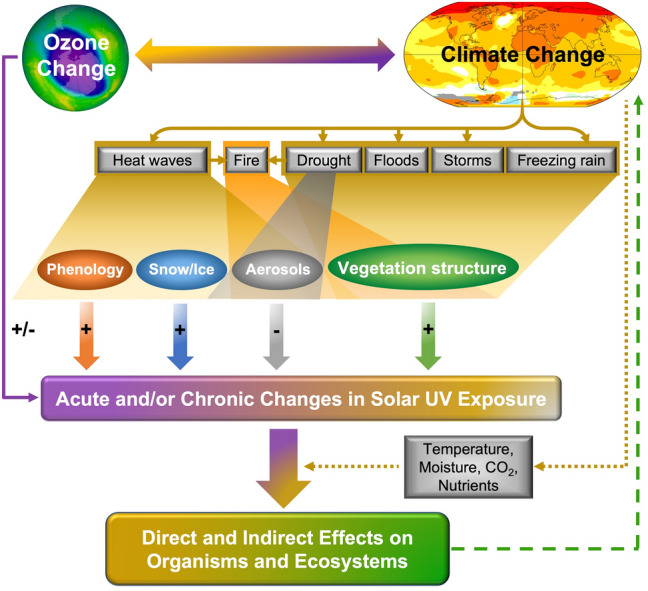
The Environmental Effects Assessment Panel of the Montreal Protocol under the United Nations Environment Programme evaluates effects on the environment and human health that arise from changes in the stratospheric ozone layer and concomitant variations in ultraviolet (UV) radiation at the Earth’s surface. The current update is based on scientific advances that have accumulated since our last assessment (Photochem and Photobiol Sci 20(1):1–67, 2021). We also discuss how climate change affects stratospheric ozone depletion and ultraviolet radiation, and how stratospheric ozone depletion affects climate change. The resulting interlinking effects of stratospheric ozone depletion, UV radiation, and climate change are assessed in terms of air quality, carbon sinks, ecosystems, human health, and natural and synthetic materials. We further highlight potential impacts on the biosphere from extreme climate events that are occurring with increasing frequency as a consequence of climate change. These and other interactive effects are examined with respect to the benefits that the Montreal Protocol and its Amendments are providing to life on Earth by controlling the production of various substances that contribute to both stratospheric ozone depletion and climate change.
Overview
The claims and statistics of this paper haven’t been checked yet.
Free: it reads the open-access text and checks the first 5 claims that cite a source we can check. Create a free account to check every claim.
Integrity signals
Registry
Cites
Statistics
Figures
Verification
Claims the paper makes
The claims and statistics of this paper haven’t been checked yet.
Free: it reads the open-access text and checks the first 5 claims that cite a source we can check. Create a free account to check every claim.
Claims other papers make about this one
Each is checked against this paper’s own text: does it say what the citing paper says it does?
The source backs part of the claim, not all of it — or backs it for a different population, condition or comparison.
In the citing paper
“Photodegradation by shortwave radiation (UV-B, UV-A, and blue light) has been identified as a ubiquitous contributing driver of litter decomposition and carbon cycling over the Earth’s biomes [138, 200].”
From Environmental consequences of interacting effects of changes in stratospheric ozone, ultraviolet radiation, and climate: UNEP Environmental Effects Assessment Panel, Update 2024 (2025) · cites this paper as [200]
Experimental — accuracy not yet measured
Self-check
Percentages, sums and reported differences re-computed from the paper’s own numbers.
The self-check needs the paper’s full text.
Citations
Cites
Climate Change 2007: The Physical Science Basis.
Schiavon, S., & Zecchin, R. (2007) · eScholarship (California Digital Library) · Cited by 16,994
Plasticenta: First evidence of microplastics in human placenta
Ragusa, A., Svelato, A., Santacroce, C., Catalano, P., Notarstefano, V., Carnevali, O., Papa, F., Rongioletti, M. C. A., Baiocco, F., Draghi, S., et al. (2021) · Environment International · doi:10.1016/j.envint.2020.106274 · Cited by 3,474 · cited 1×
“In the first study, 12 polypropylene (PP) particles, 5–10 μm in size, were found in four placentae from vaginal deliveries [161].”
Environmental exposure to microplastics: An overview on possible human health effects
Prata, J. C., da Costa, J. P., Lopes, I., Duarte, A. C., & Rocha-Santos, T. (2020) · Science of The Total Environment · doi:10.1016/j.scitotenv.2019.134455 · Cited by 2,690 · cited 1×
“Photodegradation of plastics by solar UV radiation is primarily responsible for the generation of secondary microand nanoplastics [164], which are taken up by humans via inhalation, ingestion, and dermal contact [165, 166].”
The shared socio-economic pathway (SSP) greenhouse gas concentrations and their extensions to 2500
Meinshausen, M., Nicholls, Z. R. J., Lewis, J., Gidden, M. J., Vogel, E., Freund, M., Beyerle, U., Gessner, C., Nauels, A., Bauer, N., et al. (2020) · Geoscientific Model Development · doi:10.5194/gmd-13-3571-2020 · Cited by 1,815 · cited 6×
“In addition to protecting the biosphere from harmful increases in UV radiation, the Montreal Protocol is helping to reduce global warming as many ODSs are also potent GHGs [61].”
InfluentialPresence of airborne microplastics in human lung tissue
Amato-Lourenço, L. F., Carvalho-Oliveira, R., Júnior, G. R., dos Santos Galvão, L., Ando, R. A., & Mauad, T. (2021) · Journal of Hazardous Materials · doi:10.1016/j.jhazmat.2021.126124 · Cited by 1,329 · cited 2×
“Inhaled microplastics and microfibres detected in lung tissue [166] may potentially access systemic circulation [168], resulting in adverse effects.”
Current Contributions of Organofluorine Compounds to the Agrochemical Industry
Ogawa, Y., Tokunaga, E., Kobayashi, O., Hirai, K., & Shibata, N. (2020) · iScience · doi:10.1016/j.isci.2020.101467 · Cited by 1,253
Emergence of Nanoplastic in the Environment and Possible Impact on Human Health
Lehner, R., Weder, C., Petri-Fink, A., & Rothen-Rutishauser, B. (2019) · Environmental Science & Technology · doi:10.1021/acs.est.8b05512 · Cited by 1,242 · cited 1×
“Inhaled microplastics and microfibres detected in lung tissue [166] may potentially access systemic circulation [168], resulting in adverse effects.”
SOLAR UV IRRADIATION AND THE GROWTH AND DEVELOPMENT OF HIGHER PLANTS
Caldwell, M. M. (1971) · Photophysiology · doi:10.1016/b978-0-12-282606-1.50010-6 · Cited by 1,088 · cited 2×
“However, these estimates have large uncertainties and should be viewed with caution because the “generalised plant damage action spectrum” [63] used in the calculations does not account for the variety of plant responses across species and ecosystems.”
BackgroundMethodImpact of Microplastics and Nanoplastics on Human Health
Yee, M. S.-L., Hii, L.-W., Looi, C. K., Lim, W.-M., Wong, S.-F., Kok, Y.-Y., Tan, B.-K., Wong, C.-Y., & Leong, C.-O. (2021) · Nanomaterials · doi:10.3390/nano11020496 · Cited by 1,031 · cited 1×
“Photodegradation of plastics by solar UV radiation is primarily responsible for the generation of secondary microand nanoplastics [164], which are taken up by humans via inhalation, ingestion, and dermal contact [165, 166].”
Entrenas Castillo, M., Entrenas Costa, L. M., Vaquero Barrios, J. M., Alcalá Díaz, J. F., López Miranda, J., Bouillon, R., & Quesada Gomez, J. M. (2020) · The Journal of Steroid Biochemistry and Molecular Biology · doi:10.1016/j.jsbmb.2020.105751 · Cited by 732
Research works printed but not linked: 3
- IPCC (2019). Summary for Policymakers. In: Climate Change and Land: an IPCC special report on climate change, desertification, land degradation, sustainable land management, food security, and greenhouse gas fluxes in terrestrial ecosystems. In J. S. P.R. Shukla, E. Calvo Buendia, V. Masson-Delmotte, H.- O. Pörtner, D. C. Roberts, P. Zhai, R. Slade, S. Connors, R. van Diemen, M. Ferrat, E. Haughey, S. Luz, S. Neogi, M. Pathak, J. Petzold, J. Portugal Pereira, P. Vyas, E. Huntley, K. Kissick, M. Belkacemi, J. Malley (Ed.). Geneva, Switzerland.
- Chekir N Tassalit D Mellal M Benhabiles O Sahraoui N Technology, Fixed bed reactor performance for herbicide degradation under solar radiation European Journal of Engineering Science and Technology 2020 3 1 38 43 10.3342/ejest.v3i1.159 · doi:10.3342/ejest.v3i1.159
- Hoegh-Guldberg, O., Cai, R., Poloczanska, E. S., Brewer, P. G., Sundby, S., Hilmi, K., Fabry, V. J., & S. Jung (2014). The ocean. In V. R. Barros, C. B. Field, D. J. Dokken, M. D. Mastrandrea, K. J. Mach, T. E. Bilir, et al. (Eds.), Climate Change 2014: Impacts, Adaptation, and Vulnerability. Part B: Regional Aspects. Contribution of Working Group II to the Fifth Assessment Report of the Intergovernmental Panel on Climate Change (pp. 1655–1731). Cambridge, United Kingdom: Cambridge University Press.
Cited by
Andrady, A. L., Barnes, P. W., Bornman, J. F., Gouin, T., Madronich, S., White, C. C., Zepp, R. G., & Jansen, M. A. K. (2022) · Science of The Total Environment · doi:10.1016/j.scitotenv.2022.158022 · Cited by 422
“…changes in terrestrial solar UVR with ongoing and potential future changes in the stratospheric ozone layer and in the global climate, (Bais et al., 2019; Barnes et al., 2022), it is relevant to ask how these changes will impact the photo-assisted fragmentation of plastics in the environment.”
BackgroundSelf-citationThe effects of exposure to solar radiation on human health
Neale, R. E., Lucas, R. M., Byrne, S. N., Hollestein, L., Rhodes, L. E., Yazar, S., Young, A. R., Berwick, M., Ireland, R. A., & Olsen, C. M. (2023) · Photochemical & Photobiological Sciences · doi:10.1007/s43630-023-00375-8 · Cited by 162
Self-citationStratospheric ozone, UV radiation, and climate interactions
Bernhard, G. H., Bais, A. F., Aucamp, P. J., Klekociuk, A. R., Liley, J. B., & McKenzie, R. L. (2023) · Photochemical & Photobiological Sciences · doi:10.1007/s43630-023-00371-y · Cited by 138
Self-citationBarnes, P. W., Robson, T. M., Zepp, R. G., Bornman, J. F., Jansen, M. A. K., Ossola, R., Wang, Q.-W., Robinson, S. A., Foereid, B., Klekociuk, A. R., et al. (2023) · Photochemical & Photobiological Sciences · doi:10.1007/s43630-023-00376-7 · Cited by 113
“Other relevant contributions of the Montreal Protocol are related to pollution and contamination (SDG 3: Good health and well-being ), and climate change ( SGD 13: Climate action ).”
BackgroundMethodInfluentialSelf-citationPeng, M., Liu, Y., Khan, A., Ahmed, B., Sarker, S. K., Ghadi, Y. Y., Bhatti, U. A., Al‐Razgan, M., & Ali, Y. A. (2024) · Big Data Research · doi:10.1016/j.bdr.2024.100448 · Cited by 119
Forest understory vegetation study: current status and future trends
Deng, J., Fang, S., Fang, X.-M., Jin, Y., Kuang, Y., Lin, F., Liu, J., Ma, J., Nie, Y., Ouyang, S., et al. (2023) · Forestry Research · doi:10.48130/fr-2023-0006 · Cited by 179
Self-citationBănăduc, D., Curtean–Bănăduc, A., Barinova, S. S., Lozano, V. L., Afanasyev, S. A., Leite, T., Branco, P., Isaza, D. F. G., Geist, J. P., Tegos, A., et al. (2024) · Water · doi:10.3390/w16111483 · Cited by 117
Ultraviolet-B radiation in relation to agriculture in the context of climate change: a review
Liaqat, W., Altaf, M. T., Barutçular, C., Nawaz, H., Ullah, I., Basıt, A., & Mohamed, H. I. (2023) · Cereal Research Communications · doi:10.1007/s42976-023-00375-5 · Cited by 85
“It is imperative to fully recognize how the plants will react to the increase or decrease in UV radiation under open conditions within the framework of climate change (Barnes et al. 2019, 2022a, b).”
PM2.5 and O3 concentration estimation based on interpretable machine learning
Wang, S., Ren, Y., & Xia, B. (2023) · Atmospheric Pollution Research · doi:10.1016/j.apr.2023.101866 · Cited by 60
Toxic External Exposure Leading to Ocular Surface Injury
Rauchman, S. H., Locke, B., Albert, J., Leon, J. D., Peltier, M. R., & Reiss, A. B. (2023) · Vision · doi:10.3390/vision7020032 · Cited by 61
Rádis‐Baptista, G. (2023) · Journal of Xenobiotics · doi:10.3390/jox13010010 · Cited by 62
“Atmospheric pollution due to VOCs, mainly from fossil fuel origin, is of significant concern because they are responsible for deleterious effects on Earth’s climate and human health, like depletion of the stratospheric ozone layer and formation of tropospheric ozone, which are interconnected with the global warming du…”
BackgroundBacterial Biological Factories Intended for the Desulfurization of Petroleum Products in Refineries
Ahmad, A., Zamzami, M. A., Ahmad, V., Al-Thawadi, S. M., Akhtar, S., & Khan, M. J. (2023) · Fermentation · doi:10.3390/fermentation9030211 · Cited by 42
Zerefos, C., Fountoulakis, I., Eleftheratos, K., & Kazantzidis, A. (2023) · Physiological Reviews · doi:10.1152/physrev.00031.2022 · Cited by 37
Miller, F. W. (2024) · Arthritis Care & Research · doi:10.1002/acr.25423 · Cited by 45
Downie, A. T., Wu, N. C., Cramp, R. L., & Franklin, C. E. (2023) · Global Change Biology · doi:10.1111/gcb.16848 · Cited by 34
Environmental & health impacts of ultraviolet radiation: current trends and mitigation strategies
Mmbando, G. S., & Ngongolo, K. (2024) · Discover Sustainability · doi:10.1007/s43621-024-00698-1 · Cited by 40
“All of these changes will affect the predator–prey relationship, which eventually affects the whole food chain Discover Sustainability (2024) 5:436 | https://doi.org/10.1007/s43621-024-00698-1 Review due to the loss of the ozone layer [27, 28].”
InfluentialLiu, W., Giuriani, G., Havlikova, A., Li, D., Lamont, D. J., Neugart, S., Velanis, C. N., Petersen, J., Hoecker, U., Christie, J. M., et al. (2024) · Nature Communications · doi:10.1038/s41467-024-45575-7 · Cited by 37
Recent advances in UV-B signalling: interaction of proteins with the UVR8 photoreceptor
Liu, W., & Jenkins, G. I. (2024) · Journal of Experimental Botany · doi:10.1093/jxb/erae132 · Cited by 30
Neale, P. J., Hylander, S., Banaszak, A. T., Häder, D.-P., Rose, K. C., Vione, D., Wängberg, S.-Å., Jansen, M. A. K., Busquets, R., Andersen, M. P. S., et al. (2025) · Photochemical & Photobiological Sciences · doi:10.1007/s43630-025-00687-x · Cited by 32
“Photodegradation by shortwave radiation (UV-B, UV-A, and blue light) has been identified as a ubiquitous contributing driver of litter decomposition and carbon cycling over the Earth’s biomes [138, 200].”
Self-citationLearning from nature: phytochemical strategies to protect against UV-B damage
Bulut, M., Tohge, T., Chen, W., Luo, J., Wang, Z., Huang, X., Zhou, M., & Fernie, A. R. (2025) · Nature Communications · doi:10.1038/s41467-025-66135-7 · Cited by 33
Dwivedi, S., & Ahmad, I. Z. (2022) · Environmental Research · doi:10.1016/j.envres.2022.114943 · Cited by 28
National scale down‐the‐drain environmental risk assessment of oxybenzone in the United States
Burns, E. E., Csiszar, S., Roush, K., & Davies, I. A. (2021) · Integrated Environmental Assessment and Management · doi:10.1002/ieam.4430 · Cited by 21
The Montreal Protocol and the fate of environmental plastic debris
Jansen, M. A. K., Barnes, P. W., Bornman, J. F., Rose, K. C., Madronich, S., White, C. C., Zepp, R. G., & Andrady, A. L. (2023) · Photochemical & Photobiological Sciences · doi:10.1007/s43630-023-00372-x · Cited by 20
“Both stratospheric ozone depletion and climate change can alter the irradiance of solar UV radiation reaching the Earth’s surface [41], thus affecting photo-oxidation of plastics.”
BackgroundSelf-citationUV Dosage Unveils Toxic Properties of Weathered Commercial Bioplastic Bags
Quade, J., López‐Ibáñez, S., & Beiras, R. (2023) · Environmental Science & Technology · doi:10.1021/acs.est.3c02193 · Cited by 19
Liu, F., Liu, Y., Li, X., Wang, Y., Jing, Z., & Chen, Y. (2025) · Environmental Research · doi:10.1016/j.envres.2025.121121 · Cited by 18
Mishra, R., Kaur, P., Soni, R., Madan, A., Agarwal, P., & Singh, G. (2024) · Plant Physiology and Biochemistry · doi:10.1016/j.plaphy.2024.108744 · Cited by 17
Impacts of climate change on ocular health: A scoping review
Wong, Y. L., Wong, S. W., Ting, D. S. J., Muralidhar, A., Sen, S., Schaff, O., Istre-Wilz, H. M., & Erny, B. C. (2023) · The Journal of Climate Change and Health · doi:10.1016/j.joclim.2023.100296 · Cited by 25
“Atmospheric ozone depletion leads to increasing levels of ultraviolet radiation (UVR) causing photodamage to plant and animals, which subsequently increases the risk of cataracts, pterygium and periocular skin cancers especially in countries in close proximity to the equator [16 − 20].”
Patrick, D. S., Archana, J., NAVANEETHAN, M., & Mohan, M. K. (2024) · Journal of environmental chemical engineering · doi:10.1016/j.jece.2024.113367 · Cited by 14
Global impacts of an extreme solar particle event under different geomagnetic field strengths
Arsenović, P., Rozanov, E., USOSKIN, I. G., TURNEY, C. S. M., Sukhodolov, T., McCracken, K. G., Friedel, M., Anet, J., Simić, S., Maliniemi, V., et al. (2024) · Proceedings of the National Academy of Sciences · doi:10.1073/pnas.2321770121 · Cited by 19
Zhou, X., Gong, F., Cao, K., Xu, H., & Zhou, X. (2024) · Plant Cell Reports · doi:10.1007/s00299-024-03308-6 · Cited by 13
“The significant loss of Arctic ozone has led to an increase in the amount of ultraviolet radiation reaching the Earth’s surface, and the measures taken by the Montreal Protocol can have a positive effect on the reduction of ultraviolet radiation (Barnes et al. 2022).”
Thermal compensation reduces DNA damage from UV radiation
Hird, C., Cramp, R. L., & Franklin, C. E. (2023) · Journal of Thermal Biology · doi:10.1016/j.jtherbio.2023.103711 · Cited by 11
Novel elastomeric spiropyran-doped poly(dimethylsiloxane) optical waveguide for UV sensing
Zimmermann, C. A., Amouzou, K. N., Sengupta, D., Kumar, A., Demarquette, N. R., & Ung, B. (2024) · Frontiers of Optoelectronics · doi:10.1007/s12200-024-00124-4 · Cited by 11
Feng, F., Ma, Y., Zhao, Y., Wan, Z., Zhang, R., & Yang, S. (2025) · Scientific Reports · doi:10.1038/s41598-025-23066-z · Cited by 12
Genotoxic risk assessment of solar UV radiation in tadpoles from Brazilian wetlands
Santos, M. B. D., Londero, J. E. L., Mainardi, Á. A., Cechin, S. Z., & Schuch, A. P. (2023) · Mutation Research/Genetic Toxicology and Environmental Mutagenesis · doi:10.1016/j.mrgentox.2022.503578 · Cited by 10
Wang, X., Zhu, H., Hou, S., Hu, C., & Yan, B. (2024) · Journal of Cleaner Production · doi:10.1016/j.jclepro.2024.142947 · Cited by 10
Wang, Y., Zhou, X., Meng, J., Xu, H., & Zhou, X. (2025) · Plants · doi:10.3390/plants14010133 · Cited by 9
Singh, P., & Choudhary, K. K. (2025) · Plant Physiology and Biochemistry · doi:10.1016/j.plaphy.2025.109682 · Cited by 10
Environmental and Ecological Monitoring with Biodegradable Technologies
Bathaei, M. J., Bathaei, Y., Liao, Z., Yazdanmehr, M., Sethi, S. S., Nikolayev, D., Cardoso, F. A., & Boutry, C. M. (2025) · Advanced Science · doi:10.1002/advs.202511452 · Cited by 18
Molecular Effects of Silicon on Arabidopsis thaliana Seedlings under UV‐B Stress
Celayir, T., Yeni, O., Yeşildirek, Y. V., Arıkan, B., & Kara, N. T. (2023) · Photochemistry and Photobiology · doi:10.1111/php.13788 · Cited by 10
León-Rodríguez, S. G. D., Aguilar-Flores, C., Gajón, J. A., Mantilla, A., Gerson-Cwilich, R., Martínez‐Herrera, J. F., Rodríguez-Soto, B. E., Gutiérrez-Quiroz, C. T., Pérez‐Koldenkova, V., Muñoz-Cruz, S., et al. (2023) · International Journal of Molecular Sciences · doi:10.3390/ijms24054786 · Cited by 11
“Melanoma usually develops in sun-exposed areas of the skin as a consequence of ultraviolet (UV) radiation exposure, disproportionately affecting fair-skinned individuals [4].”
BackgroundZhou, X., Wang, Y., Gong, F., Xu, H., Lyu, J., & Zhou, X. (2024) · Plants · doi:10.3390/plants13131856 · Cited by 8
“Despite measures to reduce the use of ozone-depleting substances, UV-B radiation levels will increase in the future [2].”
BackgroundExtreme surface solar ultraviolet radiation events reduce maize yields in China
Guan, H., Zhu, P., Huang, J., Jin, Z., Ma, Y., Li, X., Zeng, Y., Su, W., Miao, S., Wu, W., et al. (2025) · Communications Earth & Environment · doi:10.1038/s43247-025-02432-9 · Cited by 11
“Although the global success of the Montreal Protocol has mitigated UV radiation increases by aiding ozone layer recovery 36,67 , our projected increases in extreme UV event frequency indirectly suggest that regionalfactors,suchasChina ’ srecentcleanairinitiativesandreductionsin aerosol emissions 68…”
Parvathy, S. U., Kolil, V. K., & Achuthan, K. (2025) · Food Science & Nutrition · doi:10.1002/fsn3.70573 · Cited by 11
Global ozone loss following extreme solar proton storms based on the July 2012 coronal mass ejection
Kalakoski, N., Verronen, P. T., Szeląg, M. E., & Jackman, C. H. (2023) · Scientific Reports · doi:10.1038/s41598-023-40129-1 · Cited by 10
The trade-offs associated with the adaptions of marine microalgae to high CO2 and warming
Liang, X. P., Raven, J. A., Beardall, J., Overmans, S., Xia, J., & Jin, P. (2024) · Marine Environmental Research · doi:10.1016/j.marenvres.2024.106853 · Cited by 9
Autumn sunlight promotes aboveground carbon loss in a temperate mixed forest
Li, X., Wang, Y., Zhang, J., Robson, T. M., Kurokawa, H., Peng, H., Zhou, L., Yu, D., Deng, J., & Wang, Q.-W. (2024) · Ecological Processes · doi:10.1186/s13717-024-00528-2 · Cited by 7
“These researches broaden our knowledge that photo-degradation is a ubiquitous contributing driver of decomposition across biomes (Barnes et al. 2022).”
BackgroundSelf-citationNurtono, T., Ajiz, H. A., Widiyastuti, W., & Setyawan, H. (2024) · Advanced Powder Technology · doi:10.1016/j.apt.2024.104697 · Cited by 6
Wang, L., Chi, Y., Li, J., & Yuan, X. (2025) · Frontiers in Public Health · doi:10.3389/fpubh.2025.1674975 · Cited by 8
Wong, H. M., Hofmann, R. W., & Reichman, S. M. (2022) · Environmental and Experimental Botany · doi:10.1016/j.envexpbot.2022.105201 · Cited by 6
The UV Index color palette revisited
Luccini, E., Orte, F., Lell, J., Nollas, F. M., Carbajal, G., & Wolfram, E. A. (2023) · Journal of Photochemistry and Photobiology · doi:10.1016/j.jpap.2023.100180 · Cited by 8
Vatan, Ö., Sevinç, D., Çelik, D. Y., Allounan, A. C. A., Teksoy, Ö., Oral, N., Huriyet, H., Çavaş, T., & Çinkılıç, N. (2023) · All Life · doi:10.1080/26895293.2023.2270171 · Cited by 8
Amin, N., Sharma, R. K., Katiyar, D., Kannaujiya, V. K., & Sinha, R. P. (2024) · Journal of Proteins and Proteomics · doi:10.1007/s42485-024-00128-w · Cited by 6
“Continuous release of anthropogenic and non-anthropogenic pollutants has enormously increased the rate of stratospheric ozone layer depletion resulting into an alarming increase in UV-B radiation on the Earth’s surface (Barnes et al. 2022).”
Spirulina-Based Self-Powered Biological UV Photodetectors
Chatterjee, A., Shyam, A., Manivasagam, T. G., & Batabyal, S. K. (2025) · ACS Applied Electronic Materials · doi:10.1021/acsaelm.4c02295 · Cited by 7
Grandi, C., Lancia, A., & D’Ovidio, M. C. (2023) · Atmosphere · doi:10.3390/atmos14071183 · Cited by 9
Life cycle assessment of ocean alkalinity enhancement using hydrated carbonate minerals
Katish, M., Millar, R., Foteinis, S., & Renforth, P. (2026) · Environmental Technology & Innovation · doi:10.1016/j.eti.2026.104849 · Cited by 5
Patwary, A. K., Ahmad, I. N., Khreis, S. H. A., & Abbas, A. (2025) · Journal of Culinary Science & Technology · doi:10.1080/15428052.2025.2481925 · Cited by 6
On the pattern of interannual polar vortex–ozone co-variability during northern hemispheric winter
Harzer, F., Garny, H., Ploeger, F., Bönisch, H., Hoor, P. M., & Birner, T. (2023) · Atmospheric chemistry and physics · doi:10.5194/acp-23-10661-2023 · Cited by 6
Fractal-based approach on analyzing the trends of climate dynamics
Meenakshi, M., & Gowrisankar, A. (2023) · International Journal of Modern Physics B · doi:10.1142/s021797922440006x · Cited by 5
Chang, L., Deng, J., Zhang, J., Fu, Q., Wang, T., Osono, T., Peng, H., Robson, T. M., Kurokawa, H., & Wang, Q. (2025) · Journal of Forestry Research · doi:10.1007/s11676-024-01811-w · Cited by 6
“The influence of solar radiation on litter degradation should be considered as a significant driver of organic matter turnover in terrestrial ecosystems in the context of climate change and land-use (Barnes et al. 2022).”
Self-citationHe, T., Han, J., Liang, S., Ma, Y., Zhang, X., Zhao, X., & Si, L. (2025) · Remote Sensing of Environment · doi:10.1016/j.rse.2025.115021 · Cited by 4
Assessment of spectral UV radiation at Marambio Base, Antarctic Peninsula
Čížková, K., Láska, K., Metelka, L., & Staněk, M. (2023) · Atmospheric chemistry and physics · doi:10.5194/acp-23-4617-2023 · Cited by 6
Indrebø, T. L., Flatabø, G. Ø., Stoknes, K., & Samarakoon, G. (2025) · Bioresource Technology · doi:10.1016/j.biortech.2025.133431 · Cited by 8
de Carvalho, F. A. B., Strehl, C., Dias, J. B., Castela, M. M., Gobba, F., Lapão, L. V., Loney, T., Maia, M. R., Modenese, A., John, S. M., et al. (2025) · Frontiers in Public Health · doi:10.3389/fpubh.2025.1659663 · Cited by 5
Unraveling the Fundamentals of Air Pollutants
Etim, N. G., & Imarhiagbe, O. (2024) · The handbook of environmental chemistry · doi:10.1007/698_2024_1126 · Cited by 4
Peng, B., Li, J., Zhang, H., Overmans, S., Wang, Y., Xu, L., Jia, Y., Huang, B., Liu, F., Liu, P., et al. (2024) · Marine Environmental Research · doi:10.1016/j.marenvres.2024.106707 · Cited by 4
Investigating Marine Radiation: Sources, Classification, and Impacts on Ecosystems and Human Health
Kurre, D., Akhtar, S. A., & Samantaray, S. (2025) · Springer oceanography · doi:10.1007/978-3-031-82403-6_2 · Cited by 6
Research hotspots and global trends in plant responses under UV-B radiation
Singh, P., & Choudhary, K. K. (2025) · Discover Plants. · doi:10.1007/s44372-025-00204-5 · Cited by 3
“Both can influence each other i.e. operates in tandem manner [25].”
Cropping Beyond the Visible; Innovative, UV‐Emitting LED Applications for the Horticultural Industry
Crestani, G., Urbano, B., Morrison, A. P., & Jansen, M. A. K. (2025) · Journal of Sustainable Agriculture and Environment · doi:10.1002/sae2.70083 · Cited by 3
Self-citationYang, R., Zheng, Y., Inta, A., Li, J., & Yang, L. (2025) · Cleaner Engineering and Technology · doi:10.1016/j.clet.2025.101050 · Cited by 6
Fang, S., Cong, B., Zhao, L., Liu, C., Zhang, Z., & Liu, S. (2023) · International Journal of Molecular Sciences · doi:10.3390/ijms24065757 · Cited by 4
“In 2020, the Antarctic ozone hole still led to record-breaking increases and had extended to most areas of the Antarctic continent according to a report by the World Meteorological Organization [8].”
BackgroundVargin, P. N., Fomin, B. A., & Семенов, В. А. (2023) · Atmospheric and Oceanic Optics · doi:10.1134/s1024856023050172 · Cited by 3
Cold‐induced skin darkening does not protect amphibian larvae from UV‐associated DNA damage
Hird, C., Flanagan, E., Franklin, C. E., & Cramp, R. L. (2024) · Journal of Experimental Zoology Part A Ecological and Integrative Physiology · doi:10.1002/jez.2780 · Cited by 5
Park, S. U., Koo, K. A., Tho, J.-H., & Jung, C. (2023) · Journal of Climate Change Research · doi:10.15531/ksccr.2023.14.1.067 · Cited by 3
Li, H., Meng, W., Xiao, H., Li, M., Yan, K., Li, Y., & He, Y. (2025) · BMC Plant Biology · doi:10.1186/s12870-025-07816-9 · Cited by 2
“℃ Moreover, greenhouse gases capture surface radiation, which reduces stratospheric temperatures, worsening ozone layer depletion and resulting in higher levels of ultraviolet B (UV-B, 280– 320 nm) radiation reaching the troposphere [3].”
Lee, E., & Kim, G. (2023) · Living signs of law · doi:10.1007/978-3-031-46142-2_8 · Cited by 2
The sea urchin embryo and the cell stress responses: new perspectives
Deidda, I., Russo, R., Lampiasi, N., Zito, F., & Bonaventura, R. (2024) · Frontiers in Cell Death · doi:10.3389/fceld.2024.1422224 · Cited by 3
Environmental Exposures of Concern for Rheumatologists
Khosravi‐Hafshejani, T., Ali, H., Gomes, L. L. A., & Werth, V. P. (2025) · Rheumatic Disease Clinics of North America · doi:10.1016/j.rdc.2025.09.006 · Cited by 2
Hird, C., Cramp, R. L., & Franklin, C. E. (2023) · bioRxiv (Cold Spring Harbor Laboratory) · doi:10.1101/2023.06.25.546466 · Cited by 2
Ervianto, E., Marpaung, N. L., Raisal, A. Y., Hutabarat, S., Hassan, R., Siagian, R. C., Nurhalim, N., & Amri, R. (2023) · Indonesian Review of Physics · doi:10.12928/irip.v6i2.8216 · Cited by 3
“As global warming increases and the ozone layer depletes, the intensity of UV exposure, particularly UVA and UVB, increases [1]–[3].”
BackgroundBehera, S., Kalim, M. D., Kumar, N., Das, V. N. R., Siddiqui, N. A., Pandey, K. M., Singh, S. K., & Ali, V. (2025) · Scientific Reports · doi:10.1038/s41598-025-08738-0 · Cited by 1
Self-citationJabeen, N., Yaqoob, A., Hussain, A., Smerat, A., NASSAN, M. A., & Khedher, N. B. (2025) · Inorganica Chimica Acta · doi:10.1016/j.ica.2025.123046 · Cited by 1
Emerging Concepts About Applications of Microalgae Pigments: Cosmetics and Cosmeceutical Approaches
Pangestuti, R., Indrianingsih, A. W., Nisa, K., Azim, M., Satya, A., Rahmadi, P., Kusmita, L., & Hastuti, F. T. (2026) · Springer eBooks · doi:10.1007/978-3-032-05253-7_17 · Cited by 1
Farvin, K. H. S., Alagarsamy, S., Sebastian, J., Al‐Ghunaim, A., Said, T. A., & Al‐Yamani, F. (2026) · Algal Research · doi:10.1016/j.algal.2026.104677 · Cited by 1
Prediction of Ozone Depletion Levels using Intelligent CNN-SVM Classification System
Gnana, S., Ahilan, A., Jayapriya, & Arun, V. (2024) · Global NEST Journal · doi:10.30955/gnj.005461 · Cited by 1
IMPACT OF URBAN DEVELOPMENT ON UV EXPOSURE: A CLUSTERING AND MACHINE LEARNING ASSESSMENT
(2024) · Journal of Environmental Science and Sustainable Development · doi:10.7454/jessd.v7i2.1258 · Cited by 2
Photosynthetic and Growth Responses of Planktonic Diatoms to Ocean Global Changes
Jin, P., Beardall, J., & Gao, K. (2024) · Wiley eBooks · doi:10.1002/9781119842156.ch13 · Cited by 2
Avaliação do potencial fotoprotetor de fungos marinhos isolados do continente Antártico
Parizzi, C. (2022) · Digital Library of Theses and Dissertations (Universidade de São Paulo) · doi:10.11606/d.60.2022.tde-18072022-135419
Usage of Vitamin D Supplements During Covid19 Pandemic in Baghdad City, Iraq
Ghazi, H. F., & Hasan, T. N. (2022) · Medical and Health Science Journal · doi:10.33086/mhsj.v6i02.3386
Revisiting Genesis: Living as Misspelling
Băcăran, M. (2023) · Girasol/Revista humanidades · doi:10.15517/h.v13i1.52598
Chatzopoulou, A., Tourpali, K., Bais, A. F., Braesicke, P., & Ruhnke, R. (2023) · International Conference on Meteorology, Climatology and Atmospheric Physics (COMECAP) · doi:10.3390/environsciproc2023026119
Self-citationAllenson, K. C., Esnaola, N. F., & Bernicker, E. (2023) · Springer eBooks · doi:10.1007/978-3-031-33750-5_6 · Cited by 1
Satellite ozone and UV measurements over Cyprus
Charalampous, G., Fragkos, K., Nisantzi, A., Fountoulakis, I., Papachristopoulou, K., Hadjimitsis, D. G., & Kazadzis, S. (2023) · International Conference on Remote Sensing and Geoinformation of the Environment (RSCy) · doi:10.1117/12.2683103
Radiation Transfer in the Atmosphere: Ultraviolet, Surface
McKenzie, R., & Madronich, S. (2024) · Elsevier eBooks · doi:10.1016/b978-0-323-96026-7.00055-2
Self-citationMogaraju, J. K. (2024) · Journal of Public Health · doi:10.1007/s10389-024-02326-8
Safta, L., Jaya, I. K. D., Suheri, H., & Sudirman, S. (2025) · Jurnal Penelitian Pendidikan IPA · doi:10.29303/jppipa.v11i1.10259
“In addition to the high light intensity, the sunlight in the tropics also carry high ultraviolet (UV) radiation due to ozone depletion in the atmosphere (Bais et al., 2019; Barnes et al., 2022).”
An Analysis of Ozone and NO2 Variations during the 2014 Solar Proton Event
Zenchanka, S., Schlender, T., Krasouski, A., Zhuchkevich, V., Barodka, S., & Bruchkouski, I. (2025) · The Open Environmental Research Journal · doi:10.2174/0118742130367787250311065323
Current Solutions for Sustainable Ecosystems
Hatvate, N. T., Satdive, A. M., Akolkar, H. N., & Haghi, A. K. (2025) · Synthesis lectures on sustainable development · doi:10.1007/978-3-031-96660-6_2
Fungal Pathogenesis and Virulence in the Anthropocene: Multidimensional Impacts of Climate Change
Araújo, G. R. D. S., & Frasés, S. (2025) · Current Clinical Microbiology Reports · doi:10.1007/s40588-025-00252-1
“Ultraviolet (UV) radiation stress, exacerbated by strato-spheric ozone depletion, impacts various organisms including fungi [50].”
Topography-Driven UVC Detection: ZnO Nanoflowers on Etched Silicon Inverted Pyramids
Juang, F.-R., & Ciou, Y.-K. (2025) · IEEE Sensors Journal · doi:10.1109/jsen.2025.3611073
“Although most UVC radiation from the sun is absorbed by the Earth’s upper atmosphere, the increasing depletion of the ozone layer—partly due to human emissions of chlorofluorocarbons (CFCs)— has raised concerns over potential UVC exposure at the ground level [4].”
Xu, T., Hutchins, D. A., & Gao, K. (2025) · Limnology and Oceanography · doi:10.1002/lno.70230
“While the photobio-logical effects of UVA and UVB may vary signi fi cantly (Barnes et al. 2022), we observed that UVA enhanced the quantum yield in the cells grown under P-replete condition, while UVB enhanced it in both P-limited and P-replete growth conditions (Fig.”
Metadata
- Authors
- Barnes, P. W., Robson, T. M., Neale, P. J., Williamson, C. E., Zepp, R. G., Madronich, S., Wilson, S. R., Andrady, A. L., Heikkilä, A. M., Bernhard, G. H., Bais, A. F., Neale, R. E., Bornman, J. F., Jansen, M. A. K., Klekociuk, A. R., Martinez-Abaigar, J., Robinson, S. A., Wang, Q.-W., Banaszak, A. T., Häder, D.-P., Hylander, S., Rose, K. C., Wängberg, S.-Å., Foereid, B., Hou, W.-C., Ossola, R., Paul, N. D., Ukpebor, J. E., Andersen, M. P. S., Longstreth, J., Schikowski, T., Solomon, K. R., Sulzberger, B., Bruckman, L. S., Pandey, K. K., White, C. C., Zhu, L., Zhu, M., Aucamp, P. J., Liley, J. B., McKenzie, R. L., Berwick, M., Byrne, S. N., Hollestein, L. M., Lucas, R. M., Olsen, C. M., Rhodes, L. E., Yazar, S., & Young, A. R.
- Affiliations
- Loyola University New Orleans (US)
- University of Helsinki (FI)
- Smithsonian Environmental Research Center (US)
- Miami University (US)
- Environmental Protection Agency (US)
- NSF National Center for Atmospheric Research (US)
- University of Wollongong (AU)
- North Carolina State University (US)
- Finnish Meteorological Institute (FI)
- Biospherical Instruments (United States) (US)
- Aristotle University of Thessaloniki (GR)
- Murdoch University (AU)
- University College Cork (IE)
- Australian Antarctic Division (AU)
- Chinese Academy of Sciences (CN)
- Universidad Nacional Autónoma de México (MX)
- Friedrich-Alexander-Universität Erlangen-Nürnberg (DE)
- Linnaeus University (SE)
- Rensselaer Polytechnic Institute (US)
- University of Gothenburg (SE)
- Norwegian Institute of Bioeconomy Research (NO)
- National Cheng Kung University (TW)
- ETH Zurich (CH)
- Lancaster University (GB)
- University of Benin (NG)
- University of Copenhagen (DK)
- Leibniz Institute of Environmental Medicine (DE)
- University of Guelph (CA)
- Swiss Federal Institute of Aquatic Science and Technology (CH)
- Case Western Reserve University (US)
- Institute of Wood Science and Technology (IN)
- Donghua University (CN)
- National Institute of Water and Atmospheric Research (NZ)
- University of New Mexico (US)
- The University of Sydney (AU)
- Erasmus MC Cancer Institute (NL)
- Australian National University (AU)
- QIMR Berghofer Medical Research Institute (AU)
- University of Manchester (GB)
- Garvan Institute of Medical Research (AU)
- King's College London (GB)
- Corresponding author
- Bornman, J. F.
- Hylander, S.
- ORCID
- Barnes, P. W.
- Robson, T. M.
- Neale, P. J.
- Williamson, C. E.
- Zepp, R. G.
- Madronich, S.
- Wilson, S. R.
- Andrady, A. L.
- Heikkilä, A. M.
- Bernhard, G. H.
- Bais, A. F.
- Neale, R. E.
- Bornman, J. F.
- Jansen, M. A. K.
- Klekociuk, A. R.
- Martinez-Abaigar, J.
- Robinson, S. A.
- Wang, Q.-W.
- Banaszak, A. T.
- Häder, D.-P.
- Hylander, S.
- Rose, K. C.
- Wängberg, S.-Å.
- Foereid, B.
- Hou, W.-C.
- Ossola, R.
- Paul, N. D.
- Ukpebor, J. E.
- Andersen, M. P. S.
- Longstreth, J.
- Schikowski, T.
- Solomon, K. R.
- Sulzberger, B.
- Bruckman, L. S.
- Pandey, K. K.
- White, C. C.
- Zhu, L.
- Zhu, M.
- Aucamp, P. J.
- Liley, J. B.
- McKenzie, R. L.
- Berwick, M.
- Byrne, S. N.
- Hollestein, L. M.
- Lucas, R. M.
- Olsen, C. M.
- Rhodes, L. E.
- Yazar, S.
- Young, A. R.
- Venue
- Photochemical & Photobiological Sciences
- Published
- 2022-02-21
- Volume
- 21
- Issue
- 3
- Pages
- 275-301
- ISSN
- 1474-905X (ISSN-L)
- 1474-9092
- PMC
- PMC8860140
- OpenAlex
- W4213095676
- Cited by
- 121
- References
- 228
- Citations by year
- 2026: 19 · 2025: 34 · 2024: 27 · 2023: 34 · 2022: 6
- FWCI
- 9.67
- Type
- journal article
- Language
- en
- Open access
- hybrid
- doi.org
- Licence
- cc-by
- creativecommons.org/licenses/by/4.0 (tdm)
- creativecommons.org/licenses/by/4.0 (vor)
- Locations
- Photochemical & Photobiological Sciences (publishedVersion, cc-by)
- PubMed Central (publishedVersion, cc-by)
- PubMed (publishedVersion)
- Research at the University of Copenhagen (University of Copenhagen) (publishedVersion, cc-by)
- EUR Research Repository (Erasmus University Rotterdam) (publishedVersion, cc-by)
- ANU Open Research (Australian National University) (submittedVersion, cc-by)
- DORA Eawag (Swiss Federal Institute of Aquatic Science and Technology (Eawag)) (submittedVersion, other-oa)
- Murdoch University Research Portal (submittedVersion)
- Scholarly Commons @ Case Western Reserve University (submittedVersion, cc-by)
- Research Online (University of Wollongong) (submittedVersion)
- EUR Research Repository (Erasmus University Rotterdam) (submittedVersion, cc-by)
- Diva portal (Dalarna University Library) (submittedVersion, other-oa)
- Lancaster EPrints (Lancaster University) (submittedVersion)
- Figshare (submittedVersion)
- Työväentutkimus Vuosikirja (submittedVersion)
- Research Portal (King's College London) (submittedVersion, other-oa)
- NORA - Norwegian Open Research Archives (submittedVersion, other-oa)
- RIUR (Universidad de La Rioja) (submittedVersion, other-oa)
- Research Explorer (The University of Manchester) (submittedVersion)
- Repository for Publications and Research Data (ETH Zurich) (submittedVersion, cc-by)
- ETH Zürich Research Collection (cc-by)
- Greater South Information System
- Funders
- Linnaeus University
- Topics
- Physical Sciences › Earth and Planetary Sciences › Atmospheric Science › Atmospheric Ozone and Climate
- Physical Sciences › Environmental Science › Global and Planetary Change › Climate Change and Environmental Impact
- Physical Sciences › Earth and Planetary Sciences › Atmospheric Science › Atmospheric chemistry and aerosols
- Keywords
- stratospheric ozone depletion, ultraviolet radiation, climate change, Montreal Protocol, ozone layer, air quality, carbon sink, ecosystems, human health, climate extremes, ozone-climate interactions
- MeSH terms
- Humans, Ozone, Ultraviolet Rays, Ecosystem, Climate Change, Stratospheric Ozone, Ozone Depletion
About these checks
Registry, retraction, Cites and statistics results are computed, not judged, with one exception: a printed reference that no index lists is read once by a model before it counts as a citation error. Claims are extracted by a model and kept only when their quote appears verbatim in the text; each cited source is then checked, with a model’s help, for whether it says what the claim relies on. Those verdicts can be wrong — read the claim’s quote and the cited source before relying on one.
Statistics and arithmetic are recomputed, not judged.
Confidence bands are shown only for fields calibrated on our annotated test set. None is calibrated yet, so no band is shown.
What counts as a claim ›How we measure confidence ›How we check this ›
Are you an author, or do you see a problem with this page? Request a review
Data sources
Bibliographic data: Semantic Scholar, OpenAlex, Crossref.
Contains information from the Semantic Scholar Academic Graph Datasets, made available under the ODC Attribution License (ODC-BY 1.0).
Semantic Scholar’s data is described in: Kinney, R., et al. (2023). The Semantic Scholar Open Data Platform. arXiv:2301.10140.
