

A review of air-breathing electric propulsion: from mission studies to technology verification
Open accessThe DOI matches its Crossref record; 95 of the 100 references it cites were found in a registry or an index, and 2 are not checked yet; 18 of the 243 sources its claims cite were checked for support.
Abstract
Air-breathing electric propulsion (ABEP) allows for lowering the altitude of spacecraft operations below 250 km, in the so-called Very Low Earth Orbits (VLEOs). Operations in VLEOs will give radical advantages in terms of orbit accessibility, payload performance, protection from radiations, and end-of-life disposal. ABEP combines an intake to collect the residual atmosphere in front of the spacecraft and an electric thruster to ionize and accelerate the atmospheric particles. Such residual gas can be exploited as a renewable resource not only to keep the spacecraft on a VLEO, but also to remove the main limiting factor of spacecraft lifetime, i.e., the amount of stored propellant. Several realizations of the ABEP concept have been proposed, but the few end-to-end experimental campaigns highlighted the need to improve the concept functional design and the representativeness of simulated atmospheric flows. The difficulty in recreating the VLEO environment in a laboratory limits the data available to validate scaling laws and modelling efforts. This paper presents a comprehensive review of the main research and development efforts on the ABEP technology.
Verified 2026-10-05 · 2 references not checked yet
Overview
CoChat Summary
TL;DR
This review synthesizes ABEP research from early mission concepts to recent technology verification, focusing on VLEO system design, intakes, thrusters, neutralization, and ground testing. It finds that ABEP remains promising for long-duration VLEO operation, but no concept has yet demonstrated full drag compensation.
Key findings
- ABEP targets VLEO below 250 km, where residual atmosphere causes drag of about 1–100 mN/m² and thrusters must reach exhaust velocities several times the ~7.8 km/s orbital velocity to compensate drag.
- Passive intakes can increase pressure by up to two orders of magnitude, but collection and compression trade off; reported collection efficiencies include 0.25–0.45 for JAXA ABIE, 0.28–0.32 for SITAEL/ESA/VKI, 0.59–0.94 for IRS specular designs, and 0.65–0.81 with compression 210–100 for NUDT.
- End-to-end tests were performed only by Busek, JAXA, and SITAEL; SITAEL’s 2017 RAM-EP test measured drag of 26±1 mN and thrust of 6±1 mN, proving feasibility but not full drag compensation, while JAXA’s ABIE reached a maximum beam current of about 16 mA and estimated thrust of 0.13 mN at 200 V.
- Conventional thrusters fed with atmospheric propellants showed degraded performance versus xenon; examples include Busek’s air-simulant Hall thruster reaching about 27% anodic efficiency versus typical 50% with xenon, and SITAEL’s HT5k producing 30–120 mN at 1.2–5.2 kW with N₂/O₂ mixtures.
Methods
- Design: comprehensive narrative review of ABEP research and development, covering system and mission studies, VLEO environment models, passive and active intakes, conventional and ABEP thrusters, neutralization, concept verification, VLEO flow simulators, end-to-end testing, and modeling.
- Data: literature-based synthesis, including tables of ABEP platform concepts, intake studies, electric propulsion devices tested with atmospheric propellants, ABEP concepts, and VLEO flow simulators.
- Analysis: qualitative comparison and synthesis of cited studies, with reported performance metrics and experimental results drawn from the referenced literature.
Limitations
- The paper states that no ABEP concept has demonstrated full drag compensation, that on-ground testing is the main obstacle, that intake simulations lack experimental validation, that cathode operation in air-breathing mode has never been verified experimentally, and that a comprehensive flight-representative ABEP mission study is still missing.
- Evident from the text: as a review, it generates no new experimental data and relies on cited literature; Table 3 notes that some performance values are partially extracted from graphs or estimated and should be considered only as indications of operating ranges.
Model-written summary. Check it against the paper before relying on it.
Integrity signals
Registry
Cites
Statistics
Figures
Verification
Claims the paper makes
17 Valid · 23 Not valid · 175 Not checked · 135 Own results and interpretations
The sources with a verdict support this claim; the rest weren’t checked yet, have no full text we could read, or their verdicts aren’t rated yet.
In the paper
“Thanks to the emergence of a new-space economy and to a renewed understanding of the untapped potential of very low altitude orbits, the exploitation of VLEO gained a strong interest among the space community [8,9].”
§ A review of air-breathing electric propulsion: from mission studies to technology verification > Introduction
What the sources say
- Supportedcites [8] Crisp NH, Roberts PC, Livadiotti S, Oiko VT, Edmondson S, Haigh SJ, Huyton C, Sinpetru LA, Smith KL, Worrall SD, Becedas J, Domínguez RM, González D, Hanessian V, Mølgaard A, Nielsen J, Bisgaard M, Chan YA, Fasoulas S, Herdrich GH, Romano F, Traub C, García-Almiñana D, Rodríguez-Donaire S, Sureda M, Kataria D, Outlaw R, Belk- ouchi B, Conte A, Perez JS, Villain R, Heißerer B, Schwalber A (2020) The benefits of very low earth orbit for earth observation missions. Prog Aerosp Sci 117(September). arXiv: 2007. 07699. https:// doi. org/ 10. 1016/j. paero sci. 2020. 100619 source
The Introduction (p.1) attributes the rise of the commercial 'NewSpace' industry to miniaturisation-driven cost reduction and states that, with affordable insertion opportunities and new commercial launch vehicles, VLEO 'has recently become an attractive proposition' whose 'commercial exploitation ... has already begun'. The Introduction also records 'the mounting interest in operating spacecraft in the VLEO altitude range', and the Conclusions (p.1) a 'renewed push to revisit the challenges' given the benefits VLEO 'may be realised' — together covering both drivers and the resulting strong community interest the claim attributes. (LLM, conf=0.85)
- Not checked yetcites [9] Spektor R, Jones KL (2021) A breath of fresh air: air-scooping electric propulsion in very low earth orbit. Cent Space Policy Strateg. https:// csps. aeros pace. org/ sites/ defau lt/ files/ 2021-08/ Spekt or-Jones_ AirBr eathi ng_ 20210 318. pdf. Accessed 15 Nov 2022.
plainstates a cause- Asserted: passes — The authors put it forward as true.
- Checkable: passes — It can be checked against evidence.
- Load-bearing: unclear — It is unclear whether the paper’s conclusions depend on it.
- Based: passes — The paper gives a reason why it holds.
- Supported
The cited sources support only part of this claim — read each source’s verdict below.
In the paper
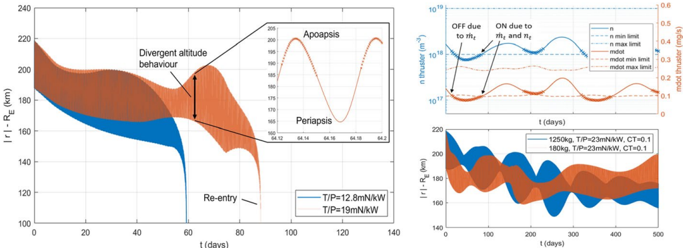
“Due to the set constraint on minimum operating number density and mass flow rate, the thruster could only be operated in the lower part of the orbit while only experiencing drag in the upper altitude regions.”
§ A review of air-breathing electric propulsion: from mission studies to technology verification > ABEP Mission studies
What the sources say
- Partly supportedcites [50] Tisaev M, Ferrato E, Giannetti V, Paissoni C, Baresi N, Lucca Fabris A, Andreussi T (2021) Air-breathing electric pro- pulsion: Flight envelope identification and development of control for long-term orbital stability. Acta Astronau- tica 191(2021):374-393. https:// doi. org/ 10. 1016/j. actaa stro. 2021. 11. 011 sourceExperimental — accuracy not yet measured
Section 6.4 'Uncontrolled thruster behaviour' directly supports the first half of the claim: 'The thruster is seen to only turn on around the periapsis of the orbit, when the density and mass flow rate values are above the minimum level', and 'the periapsis continues to fall since the thruster does not function in the higher regions of its orbit'; Section 6.5 repeats that 'The thruster does not fire around apoapsis due to insufficient ṁ_t', and Section 6.7 notes 'significant periods of a realistic, eccentric orbit where the thruster cannot fire due to air density and mass flow limitations'. However, our copy never says drag is experienced only in the upper altitude regions — it says the opposite about magnitude ('the descending periapsis incurs high levels of drag') and frames the upper-region problem as the thruster being unable to fire there, leaving periapsis decay uncompensated. So the drag clause of the citing sentence is a distorted rendering of the source's mechanism rather than a statement it makes. (LLM, conf=0.72)
hedgedstates a cause- Asserted: passes — The authors put it forward as true.
- Checkable: passes — It can be checked against evidence.
- Load-bearing: passes — The paper’s conclusions depend on it.
- Based: passes — The paper gives a reason why it holds.
- Partly supported
The sources with a verdict support this claim; the rest weren’t checked yet, have no full text we could read, or their verdicts aren’t rated yet.
In the paper
“By considering a spacecraft mass of 200 kg, a frontal area of 0.1 m 2 , and ABEP performance equivalent to the one reported by Cifali et al. [68] for the RIT-10 thruster operated with N 2 /O 2 mixtures, orbital simulation performed by Tisaev et al. [50] showed a divergent altitude behavior leading to a premature spacecraft re-entry within 90 days.”
§ A review of air-breathing electric propulsion: from mission studies to technology verification > ABEP Mission studies
What the sources say
- Supportedcites [50] Tisaev M, Ferrato E, Giannetti V, Paissoni C, Baresi N, Lucca Fabris A, Andreussi T (2021) Air-breathing electric pro- pulsion: Flight envelope identification and development of control for long-term orbital stability. Acta Astronau- tica 191(2021):374-393. https:// doi. org/ 10. 1016/j. actaa stro. 2021. 11. 011 source
Our copy matches every element the citing sentence attributes to Tisaev et al.: a 200 kg spacecraft is adopted as the representative mass for the propagations (Sec. 6.3, and Fig. 20 caption '200 kg s/c mass'); the intake, which in the assumed Sitael concept 'forms the full frontal area of the satellite' (Sec. 4.1), is sized as A_i = 0.1 m^2 (Table 6 discussion); and the thruster data are the RIT-10-EBBM tested with 0.56N2+0.44O2, credited to Cifali et al. [32] with T/P = 12.8 mN/kW (Sec. 6.1, Table 6). The uncontrolled propagations are explicitly described as exhibiting 'a divergent altitude behaviour' leading to re-entry, at 59 days with the as-tested Cifali value and at 88 days once T/P is raised to 19 mN/kW (Sec. 6.4), and the Conclusion states generally that 'the orbital simulations show a divergent altitude behaviour which results in re-entry' — both re-entry times fall within the 90 days the citing sentence gives. The only shading is that the paper's named 88-day divergent case uses an improved T/P rather than the as-tested N2/O2 figure, but the as-tested case still re-enters (59 days), so no attributed part fails. (LLM, conf=0.82)
- Not checked yetcites [68] Cifali G, Misuri T, Rossetti P, Andrenucci M, Valentian D, Feili D (2011) Preliminary characterization test of HET and RIT with nitrogen and oxygen. 47th AIAA/ASME/SAE/ASEE Joint Propulsion Conference and Exhibit 2011. https:// doi. org/ 10. 2514/6. 2011-6073 source
plainstates a cause- Asserted: passes — The authors put it forward as true.
- Checkable: passes — It can be checked against evidence.
- Load-bearing: passes — The paper’s conclusions depend on it.
- Based: passes — The paper gives a reason why it holds.
- Supported
The sources with a verdict support this claim; the rest weren’t checked yet, have no full text we could read, or their verdicts aren’t rated yet.
In the paper
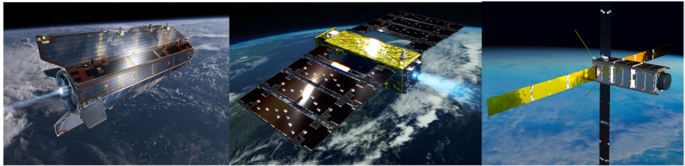
“However, apart from recent JAXA's SLATS (Fujita and Noda [11]), ESA's GOCE (Drinkwater et al. [6]) and SOAR (Crisp et al. [12]) missions, Fig. 1, satellites do not usually operate in VLEO.”
§ A review of air-breathing electric propulsion: from mission studies to technology verification > VLEO Environment
What the sources say
- Not checked yetcites [11] Fujita K, Noda A (2009) Rarefied aerodynamics of a Super Low Altitude Test Satellite. 41st AIAA Thermophysics Conference (June):22-25. https:// doi. org/ 10. 2514/6. 2009-3606 source
- Not checked yetcites [6] Drinkwater MR, Floberghagen R, Haagmans R, Muzi D, Popescu A (2003) GOCE: ESA's First Earth Explorer Core Mis- sion. Springer Netherlands, Dordrecht, pp 419-432. https:// doi. org/ 10. 1007/ 978-94-017-1333-7_ 36 source
- Supportedcites [12] Crisp N, Roberts P, Hanessian V, Sulliotti-Linner V, Herdrichd G, Garcia-Almiñana D, Kataria D (2022) A method for the experimental characterisation of novel drag-reducing materials for very low earth orbits using the satellite for orbital aerodynamics research (soar) mission. CEAS Space J 1-20. https:// doi. org/ 10. 1007/ s12567-022-00434-3 source
The citation to Crisp et al. identifies SOAR as the VLEO mission in the list, rather than sourcing the other named missions. Section 3 states that SOAR was deployed in 2021 and would conduct experiments at different VLEO altitudes; the Introduction contrasts VLEO with higher, traditional LEO altitudes. (LLM, conf=0.94)
plain- Asserted: passes — The authors put it forward as true.
- Checkable: passes — It can be checked against evidence.
- Load-bearing: unclear — It is unclear whether the paper’s conclusions depend on it.
- Based: passes — The paper gives a reason why it holds.
The sources with a verdict support this claim; the rest weren’t checked yet, have no full text we could read, or their verdicts aren’t rated yet.
In the paper
“These interactions, well reviewed by Mostaza-Prieto et al. [27] and Livadiotti et al. [28], are sensitive to several parameters, including energy and momentum accommodation, properties of the incoming particles (mass, velocity, angle, temperature), and surface characteristics (roughness, contamination, composition, and morphology).”
§ A review of air-breathing electric propulsion: from mission studies to technology verification > VLEO Environment
What the sources say
- Not checked yetcites [27] Mostaza Prieto D, Graziano BP, Roberts PC (2014) Spacecraft drag modelling. Prog Aerosp Sci 64:56-65. https:// doi. org/ 10. 1016/j. paero sci. 2013. 09. 001 source
- Supportedcites [28] Livadiotti S, Crisp NH, Roberts PC, Worrall SD, Oiko VT, Edmondson S, Haigh SJ, Huyton C, Smith KL, Sinpetru LA, Holmes BE, Becedas J, Domínguez RM, Cañas V, Christensen S, Mølgaard A, Nielsen J, Bisgaard M, Chan YA, Herdrich GH, Romano F, Fasoulas S, Traub C, Garcia-Almiñana D, Rodriguez-Donaire S, Sureda M, Kataria D, Belkouchi B, Conte A, Perez JS, Villain R, Outlaw R (2020) A review of gas-surface interaction models for orbital aerodynamics applications. Prog Aerosp Sci 119(June). arXiv: 2010. 00489. https:// doi. org/ 10. 1016/j. paero sci. 2020. 100675 source
Section 1 (The Aerodynamic Environment) states that aerodynamic coefficients are 'a complex function of a number of parameters' with agreement on 'the so-called accommodation coefficients, the wall temperature... the incident gas kinetic temperature and the molecular speed ratio', which 'depart from their initial value with variations in surface contamination, composition and structure... and incident particle energy and velocity'. Section 4 (Comparison of GSI Models with Gas-Beam Experiments) adds that scattering behaviour changes with the gas/surface mass ratio, incident beam energy/temperature, presence of adsorbents, and 'the morphology of the surface considered despite the level of roughness'; the washboard-model passage (Sec. 3.3) and the thermal-scattering trends (Sec. 4) likewise list incident angle, incident kinetic energy and surface temperature. All three parameter groups in the claim (energy/momentum accommodation, incoming-particle properties, surface characteristics) are therefore covered by our copy, which is itself a review of GSI models. (LLM, conf=0.89)
plainstates an association- Asserted: passes — The authors put it forward as true.
- Checkable: passes — It can be checked against evidence.
- Load-bearing: unclear — It is unclear whether the paper’s conclusions depend on it.
- Based: passes — The paper gives a reason why it holds.
147 more claims · 11 with their cited sources checked
Create a free account to see all 350 claims and to verify the 225 references still open.
- It may state two separate claims as one. 132
- Probably not a substantial claim. 91
- The quote only partly states this claim. 2
Claims other papers make about this one
Each is checked against this paper’s own text: does it say what the citing paper says it does?
The source backs part of the claim, not all of it — or backs it for a different population, condition or comparison.
In the citing paper
“Among the different kinetic approaches 31 available, the particle representation allows a simple and intuitive implementation to account for a detailed description of plasma-gas and plasma-wall interactions, although it suffers from the inevitable but controllable limitation due to inherent discrete particle noise 32-35 and from its computationally intensive nature.”
From Plasma propulsion modeling with particle-based algorithms (2023) · cites this paper as [32]
Experimental — accuracy not yet measuredIn the citing paper
“In these systems, mass is harvested in orbit (i.e., in-situ resource utilization) as a source of propellant and used to compensate for drag [3].”
From Requirements for air-breathing electric propulsion in low-altitude orbits (2024) · doi:10.1007/s44205-024-00095-w · cites this paper as [3]
In the citing paper
“Propellant harvesting can be designed in a passive or active configuration to feed a thruster (Fig. 4B) [3,29].”
From Requirements for air-breathing electric propulsion in low-altitude orbits (2024) · doi:10.1007/s44205-024-00095-w · cites this paper as [3]
Self-check
Percentages, sums and reported differences re-computed from the paper’s own numbers.
Each contradiction between two passages listed here was confirmed by an independent check.
Rated minor: it would not touch a result — a value no result rests on, a p-value that stays on the same side of the significance level, or a conflict that is clerical, resolved elsewhere in the paper, or outside its own findings.
In the paper
§ A review of air-breathing electric propulsion: from mission studies to technology verification > Passive compression
“which was proposed also by Kuznetsov et al. [86] in 1997”
§ A review of air-breathing electric propulsion: from mission studies to technology verification > References
“86. Kuznetsov Y, Flaksman Y (1977) Influence of the cross-sectional shape of the channel on the characteristics of free- molecular air intake vents.”
Citations
Cites
Molecular Gas Dynamics And The Direct Simulation Of Gas Flows
Bird, G. A. (1994) · doi:10.1093/oso/9780198561958.001.0001 · Cited by 7,269
NRLMSISE‐00 empirical model of the atmosphere: Statistical comparisons and scientific issues
Picone, J. M., Hedin, A. E., Drob, D. P., & Aikin, A. C. (2002) · Journal of Geophysical Research: Space Physics · doi:10.1029/2002ja009430 · Cited by 3,749
Extension of the MSIS Thermosphere Model into the middle and lower atmosphere
Hedin, A. E. (1991) · Journal of Geophysical Research: Space Physics · doi:10.1029/90ja02125 · Cited by 2,299 · cited 9×
“Thanks to the increased number of successful space missions and data available, the first NASA Goddard SFC Mass Spectrometer and Incoherent Scatter (MSIS) model was developed in the 1970s to also include temperature and partial densities of N 2 , O 2 , O, He, Ar, and H species in the 120 km to 150 km altitude range (H…”
BackgroundInfluentialHedin, A. E. (1987) · Journal of Geophysical Research: Space Physics · doi:10.1029/ja092ia05p04649 · Cited by 1,720 · cited 9×
“Thanks to the increased number of successful space missions and data available, the first NASA Goddard SFC Mass Spectrometer and Incoherent Scatter (MSIS) model was developed in the 1970s to also include temperature and partial densities of N 2 , O 2 , O, He, Ar, and H species in the 120 km to 150 km altitude range (H…”
BackgroundInfluentialInternational Geomagnetic Reference Field: the thirteenth generation
Alken, P., Thébault, E., Beggan, C. D., Amit, H., Aubert, J., Baerenzung, J., Bondar, T. N., Brown, W. J., Califf, S., Chambodut, A., et al. (2021) · Earth, Planets and Space · doi:10.1186/s40623-020-01288-x · Cited by 968 · cited 1×
“[25]), and the Horizontal Wind Model HWM14 (Drob et al.”
BackgroundAn update to the Horizontal Wind Model (HWM): The quiet time thermosphere
Drob, D. P., Emmert, J. T., Meriwether, J. W., Makela, J. J., Doornbos, E., Conde, M., Hernandez, G., Noto, J., Zawdie, K. A., McDonald, S. E., et al. (2015) · Earth and Space Science · doi:10.1002/2014ea000089 · Cited by 700
A Revised thermospheric model based on mass spectrometer and incoherent scatter data: MSIS‐83
Hedin, A. E. (1983) · Journal of Geophysical Research: Space Physics · doi:10.1029/ja088ia12p10170 · Cited by 544 · cited 9×
“Thanks to the increased number of successful space missions and data available, the first NASA Goddard SFC Mass Spectrometer and Incoherent Scatter (MSIS) model was developed in the 1970s to also include temperature and partial densities of N 2 , O 2 , O, He, Ar, and H species in the 120 km to 150 km altitude range (H…”
BackgroundInfluentialHedin, A. E., Reber, C. A., Newton, G. P., Spencer, N. W., Brinton, H. C., Mayr, H. G., & Potter, W. E. (1977) · Journal of Geophysical Research · doi:10.1029/ja082i016p02148 · Cited by 405
A New Empirical Thermospheric Density Model JB2008 Using New Solar and Geomagnetic Indices
Bowman, B., Tobiska, W. K., Marcos, F., Huang, C., Lin, C., & Burke, W. (2008) · AIAA/AAS Astrodynamics Specialist Conference and Exhibit · doi:10.2514/6.2008-6438 · Cited by 385
GOCE: ESA’s First Earth Explorer Core Mission
Drinkwater, M. R., Floberghagen, R., Haagmans, R., Muzi, D., & Popescu, A. (2003) · Space Sciences Series of ISSI · doi:10.1007/978-94-017-1333-7_36 · Cited by 312 · cited 1×
“The maturity of solar electric propulsion systems and the interest toward VLEOs, demonstrated by the presentation in the same years of the GOCE mission [6], drove the investigation of ABEP systems, balancing the power needed to compensate the drag with that provided by solar arrays.”
BackgroundGas–surface interactions and satellite drag coefficients
Moe, K., & Moe, M. M. (2005) · Planetary and Space Science · doi:10.1016/j.pss.2005.03.005 · Cited by 297
The benefits of very low earth orbit for earth observation missions
Crisp, N. H., Roberts, P. C. E., Livadiotti, S., Oiko, V. T. A., Edmondson, S., Haigh, S. J., Huyton, C., Sinpetru, L. A., Smith, K. L., Worrall, S. D., et al. (2020) · Progress in Aerospace Sciences · doi:10.1016/j.paerosci.2020.100619 · Cited by 255 · cited 2×
“Thanks to the emergence of a new-space economy and to a renewed understanding of the untapped potential of very low altitude orbits, the exploitation of VLEO gained a strong interest among the space community [8, 9].”
BackgroundA high flux source of energetic oxygen atoms for material degradation studies
Caledonia, G. E., Krech, R. H., & Green, B. D. (1987) · AIAA Journal · doi:10.2514/3.9580 · Cited by 220
The DTM-2013 thermosphere model
Bruinsma, S. (2015) · Journal of Space Weather and Space Climate · doi:10.1051/swsc/2015001 · Cited by 212 · cited 1×
“Other models of use include the Drag Temperature Model DTM2013 (Bruinsma [24]), the International Geomagnetic Reference Field IGRF13 (Alken et al.”
Method2.6. 41st international astronautical congress
(1990) · COSPAR Information Bulletin · doi:10.1016/0045-8732(90)90119-9 · Cited by 183
The JB2006 empirical thermospheric density model
Bowman, B. R., Tobiska, W. K., Marcos, F. A., & Valladares, C. E. (2007) · Journal of Atmospheric and Solar-Terrestrial Physics · doi:10.1016/j.jastp.2007.10.002 · Cited by 154 · cited 1×
“[22]), which was then updated to the JB-2008 version (Bowman et al.”
BackgroundDirect simulation Monte Carlo: The quest for speed
Gallis, M. A., Torczynski, J. R., Plimpton, S. J., Rader, D. J., & Koehler, T. (2014) · AIP Conference Proceedings · doi:10.1063/1.4902571 · Cited by 147
Comparing Physical Drag Coefficients Computed Using Different Gas–Surface Interaction Models
Mehta, P. M., Walker, A., McLaughlin, C. A., & Koller, J. (2014) · Journal of Spacecraft and Rockets · doi:10.2514/1.a32566 · Cited by 128
Mostaza Prieto, D., Graziano, B. P., & Roberts, P. C. E. (2014) · Progress in Aerospace Sciences · doi:10.1016/j.paerosci.2013.09.001 · Cited by 121
Performance characterization of a helicon double layer thruster using direct thrust measurements
Pottinger, S., Lappas, V., Charles, C., & Boswell, R. (2011) · Journal of Physics D Applied Physics · doi:10.1088/0022-3727/44/23/235201 · Cited by 119
Intake design for an Atmosphere-Breathing Electric Propulsion System (ABEP)
Romano, F., Espinosa-Orozco, J., Pfeiffer, M., Herdrich, G., Crisp, N. H., Roberts, P. C. E., Holmes, B. E. A., Edmondson, S., Haigh, S., Livadiotti, S., et al. (2021) · Acta Astronautica · doi:10.1016/j.actaastro.2021.06.033 · Cited by 95
A review of gas-surface interaction models for orbital aerodynamics applications
Livadiotti, S., Crisp, N. H., Roberts, P. C. E., Worrall, S. D., Oiko, V. T. A., Edmondson, S., Haigh, S. J., Huyton, C., Smith, K. L., Sinpetru, L. A., et al. (2020) · Progress in Aerospace Sciences · doi:10.1016/j.paerosci.2020.100675 · Cited by 95 · cited 3×
“Numerical simulations typically adopt Maxwell’s model and accommodation coefficients to describe the contribution of these two mechanisms (see [28] for a comprehensive review gas-surface interaction models).”
BackgroundInfluentialRomano, F., Chan, Y.-A., Herdrich, G., Traub, C., Fasoulas, S., Roberts, P. C. E., Smith, K., Edmondson, S., Haigh, S., Crisp, N. H., et al. (2020) · Acta Astronautica · doi:10.1016/j.actaastro.2020.07.008 · Cited by 87
Analysis of atmosphere-breathing electric propulsion
Schonherr, T., Komurasaki, K., Romano, F., Massuti-Ballester, B., & Herdrich, G. (2015) · IEEE Transactions on Plasma Science · doi:10.1109/tps.2014.2364053 · Cited by 84
System modelling of very low Earth orbit satellites for Earth observation
Crisp, N. H., Roberts, P. C. E., Romano, F., Smith, K. L., Oiko, V. T. A., Sulliotti-Linner, V., Hanessian, V., Herdrich, G. H., García-Almiñana, D., Kataria, D., et al. (2021) · Acta Astronautica · doi:10.1016/j.actaastro.2021.07.004 · Cited by 78 · cited 3×
“[20] obtained consistent design values by developing a trade-off design algorithm for VLEO platforms, encompassing the preliminary sizing of all the main platform subsystems (including ABEP as an option) and optical and SAR-based payloads, with the goal of finding the operating altitude which minimizes the estimated p…”
BackgroundMethodInfluentialAir Breathing Ion Engine Concept
Nishiyama, K. (2003) · 54th International Astronautical Congress of the International Astronautical Federation, the International Academy of Astronautics, and the International Institute of Space Law · doi:10.2514/6.iac-03-s.4.02 · Cited by 74
Romano, F., Massuti-Ballester, B., Binder, T., Herdrich, G., Fasoulas, S., & Schönherr, T. (2018) · Acta Astronautica · doi:10.1016/j.actaastro.2018.03.031 · Cited by 69 · cited 2×
“[48, 59] analyzed an ABEP system based on the IPG6-S inductive plasma thruster, an intake inlet area of 1 m(2) , and fully illuminated solar arrays aligned with the incoming flow, Fig.”
BackgroundMethodExperimental Study of Air Breathing Ion Engine Using Laser Detonation Beam Source
Tagawa, M., Yokota, K., Nishiyama, K., Kuninaka, H., Yoshizawa, Y., Yamamoto, D., & Tsuboi, T. (2013) · Journal of Propulsion and Power · doi:10.2514/1.b34530 · Cited by 66 · cited 7×
“The source operation was characterized separately with oxygen [140] and with nitrogen [7] using time-offlight measurements, with a quadrupole mass spectrometer and a scintillation detector installed in the beam line.”
MethodInfluentialA Review of Gas-Surface Interaction Models for Orbital Aerodynamics Applications
Livadiotti, S., Crisp, N., Roberts, P., Worrall, S. D., Oiko, V., Edmondson, S., Haigh, S. J., Huyton, C., Smith, K., Sinpetru, L., et al. (2020) · Research Explorer (The University of Manchester) · Cited by 65
Tisaev, M., Ferrato, E., Giannetti, V., Paissoni, C., Baresi, N., Lucca Fabris, A., & Andreussi, T. (2022) · Acta Astronautica · doi:10.1016/j.actaastro.2021.11.011 · Cited by 64 · cited 2×
“[50] found similar results, obtaining design convergence in narrow altitude ranges depending on the achievable ABEP specific impulse and thrust to power ratio, with minimum required values of 3000 s and 8 mN/kW, respectively.”
BackgroundResultSelf-citationA comprehensive review of atmosphere-breathing electric propulsion systems
Zheng, P., Wu, J., Zhang, Y., & Wu, B. (2020) · International Journal of Aerospace Engineering · doi:10.1155/2020/8811847 · Cited by 61
A review of research in low earth orbit propellant collection
Singh, L. A., & Walker, M. L. R. (2015) · Progress in Aerospace Sciences · doi:10.1016/j.paerosci.2015.03.001 · Cited by 55 · cited 9×
“A first review of ABEP studies was performed by Singh and Walker in 2015 [1].”
BackgroundMethodResultInfluentialAn experimental investigation of alternative propellants for the helicon double layer thruster
Charles, C., Boswell, R. W., Laine, R., & MacLellan, P. (2008) · Journal of Physics D: Applied Physics · doi:10.1088/0022-3727/41/17/175213 · Cited by 52
The AETHER project: development of air-breathing electric propulsion for VLEO missions
Andreussi, T., Ferrato, E., Paissoni, C. A., Kitaeva, A., Giannetti, V., Piragino, A., Schäff, S., Katsonis, K., Berenguer, C., Kovacova, Z., et al. (2022) · CEAS Space Journal · doi:10.1007/s12567-022-00442-3 · Cited by 46 · cited 10×
“After the RAM-EP test, development of the air-intake design was carried on in strong collaboration by researchers at SITAEL and at the von Karman Institute [49].”
BackgroundMethodSelf-citationDesign and analysis of vacuum air-intake device used in air-breathing electric propulsion
Li, Y., Chen, X., Li, D., Xiao, Y., Dai, P., & Gong, C. (2015) · Vacuum · doi:10.1016/j.vacuum.2015.06.011 · Cited by 46 · cited 5×
“As shown by [80], the turbomolecular pump technology has a relatively low power consumption and significant heritage coming from on-ground applications.”
BackgroundMethodInfluentialAir Intake Performance of Air Breathing Ion Engines
Fujita, K. (2004) · Journal of the Japan Society for Aeronautical and Space Sciences · doi:10.2322/jjsass.52.514 · Cited by 46 · cited 27×
“Since 2015, significant work on air intakes for ABEP concepts, combining reduced order modeling and DSMC simulations, has been performed at IRS (see Romano et al.”
BackgroundMethodResultInfluentialAnalysis of Airbreathing Hall-Effect Thrusters
Pekker, L., & Keidar, M. (2012) · Journal of Propulsion and Power · doi:10.2514/1.b34441 · Cited by 45 · cited 8×
“This study focuses on an ABEP concept similar to that proposed by [44, 56], based on Hall-type acceleration.”
BackgroundMethodResultInfluentialDrag reduction through shape optimisation for satellites in Very Low Earth Orbit
Walsh, J., Berthoud, L., & Allen, C. (2021) · Acta Astronautica · doi:10.1016/j.actaastro.2020.09.018 · Cited by 44 · cited 1×
“[32] employed SPARTA to assess optimal aero shell shapes reducing the spacecraft drag in VLEO.”
MethodPerformance of a Helicon Hall Thruster Operating with Xenon, Argon, and Nitrogen
Shabshelowitz, A., Gallimore, A. D., & Peterson, P. Y. (2014) · Journal of Propulsion and Power · doi:10.2514/1.b35041 · Cited by 40 · cited 7×
“Conversely, the authors observed a sharp increase of the propellant utilization efficiency up to 46% for a fixed discharge voltage of 400 V when increasing the nitrogen mass flow rate from 1.06 mg/s to 1.96 mg/s. Shabshelowitz et al. in [46, 57] report on the results obtained by testing a helicon Hall thruster (HHT) w…”
BackgroundMethodInfluentialAre Very Low Earth Orbit (VLEO) satellites a solution for tomorrow’s telecommunication needs?
Berthoud, L., Hills, R., Bacon, A., Havouzaris-Waller, M., Hayward, K., Gayrard, J.-D., Arnal, F., & Combelles, L. (2022) · CEAS Space Journal · doi:10.1007/s12567-022-00437-0 · Cited by 39 · cited 1×
“[67] considerable benefits were also outlined for telecom-based mission.”
BackgroundDesign and numerical investigation on the intake of atmosphere-breathing electric propulsion
Zheng, P., Wu, J., wu, B., & Zhang, Y. (2021) · Acta Astronautica · doi:10.1016/j.actaastro.2021.07.036 · Cited by 38 · cited 1×
“Elongated intake shapes without inlet ducts were investigated also by Jackson [89] for a CubeSat application and in [84, 91, 93].”
MethodAndrews, S., & Berthoud, L. (2020) · Acta Astronautica · doi:10.1016/j.actaastro.2019.12.034 · Cited by 37 · cited 5×
“Berthoud L, Hills R, Bacon A, Havouzaris-Waller M, Hayward K, Gayrard JD, Arnal F, Combelles L (2022) Are very low earth orbit (vleo) satellites a solution for tomorrow’s telecommunication needs?”
MethodInfluentialExtended channel Hall thruster for air-breathing electric propulsion
Marchioni, F., & Cappelli, M. A. (2021) · Journal of Applied Physics · doi:10.1063/5.0048283 · Cited by 36
ADBSat: Methodology of a novel panel method tool for aerodynamic analysis of satellites
Sinpetru, L. A., Crisp, N. H., Mostaza-Prieto, D., Livadiotti, S., & Roberts, P. C. E. (2022) · Computer Physics Communications · doi:10.1016/j.cpc.2022.108326 · Cited by 36 · cited 1×
“[30]), and the Response Surface Modelling Toolkit (Sheridan et al.”
Mrózek, K., Dytrych, T., Moliš, P., Dániel, V., & Obrusník, A. (2021) · Plasma Sources Science and Technology · doi:10.1088/1361-6595/ac36ac · Cited by 35
Design and Optimization of vacuum Intake for Atmosphere-Breathing electric propulsion (ABEP) system
Zheng, P., Wu, J., Zhang, Y., & Zhao, Y. (2022) · Vacuum · doi:10.1016/j.vacuum.2021.110652 · Cited by 34 · cited 2×
“This is confirmed in [93], which compared an hexagonal honeycomb structure and a split-ring configuration, showing similar collection performance and”
MethodResultDevelopment of Hollow Cathodes for Space Electric Propulsion at Sitael
Pedrini, D., Misuri, T., Paganucci, F., & Andrenucci, M. (2017) · Aerospace · doi:10.3390/aerospace4020026 · Cited by 33
Computational Study of Hall-Effect Thruster with Ambient Atmospheric Gas as Propellant
Garrigues, L. (2012) · Journal of Propulsion and Power · doi:10.2514/1.b34307 · Cited by 33
Erofeev, A. I., Nikiforov, A. P., Popov, G. A., Suvorov, M. O., Syrin, S. A., & Khartov, S. A. (2017) · Solar System Research · doi:10.1134/s0038094617070048 · Cited by 32 · cited 3×
“[87] present some test results of the prototype of the thrust unit of the system, that bears strong resemblances with radio-frequency ion thruster technologies with a beam size of 150 mm.”
BackgroundOverdense Plasma Production in a Low-power Microwave Discharge Electron Source
Ikkoh Funaki, I. F., & Hitoshi Kuninaka, H. K. (2001) · Japanese Journal of Applied Physics · doi:10.1143/jjap.40.2495 · Cited by 32
Reflection of low energy plasma ions from metal surfaces
Cuthbertson, J. W., Langer, W. D., & Motley, R. W. (1992) · Journal of Nuclear Materials · doi:10.1016/s0022-3115(06)80017-6 · Cited by 31
Design of an intake and a thruster for an atmosphere-breathing electric propulsion system
Romano, F., Herdrich, G., Chan, Y.-A., Crisp, N. H., Roberts, P. C. E., Holmes, B. E. A., Edmondson, S., Haigh, S. J., Rojas, A. M., Oiko, V. T. A., et al. (2022) · CEAS Space Journal · doi:10.1007/s12567-022-00452-1 · Cited by 30 · cited 1×
“[48, 59] analyzed an ABEP system based on the IPG6-S inductive plasma thruster, an intake inlet area of 1 m(2) , and fully illuminated solar arrays aligned with the incoming flow, Fig.”
MethodDevelopment Status and Way Forward of SITAEL’s Air-breathing Electric Propulsion Engine
Andreussi, T., Ferrato, E., Giannetti, V., Piragino, A., Paissoni, C. A., Cifali, G., & Andrenucci, M. (2019) · AIAA Propulsion and Energy 2019 Forum · doi:10.2514/6.2019-3995 · Cited by 29
Self-citationA 2-Stage Cylindrical Hall Thruster for Air Breathing Electric Propulsion
Diamant, K. (2010) · 46th AIAA/ASME/SAE/ASEE Joint Propulsion Conference & Exhibit · doi:10.2514/6.2010-6522 · Cited by 29 · cited 9×
“Diamant et al. in [45] proposed a 2-stage Air-Breathing Cylindrical Hall thruster (ABCHT) featuring an ECR ionization stage and a cylindrical Hall-like acceleration stage.”
BackgroundMethodInfluentialBinder, T., Boldini, P. C., Romano, F., Herdrich, G., & Fasoulas, S. (2016) · AIP Conference Proceedings · doi:10.1063/1.4967689 · Cited by 29 · cited 2×
“As described in [70, 83], given the thruster transmission probability and the required collection efficiency (or, vice versa, the required compression ratio), an optimal duct length can be deduced.”
BackgroundVaidya, S., Traub, C., Romano, F., Herdrich, G. H., Chan, Y.-A., Fasoulas, S., Roberts, P. C. E., Crisp, N. H., Edmondson, S., Haigh, S. J., et al. (2022) · CEAS Space Journal · doi:10.1007/s12567-022-00436-1 · Cited by 29 · cited 1×
“[52] investigated the capability of ABEP to provide full drag compensation in Earth circular orbits at altitudes between 180 km to 250 km, Earth elliptical orbits with perigee altitudes in the 206 km to 277 km range and eccentricities in the 0.”
BackgroundAir-breathing electric propulsion: mission characterization and design analysis
Crandall, P., & Wirz, R. E. (2022) · Journal of Electric Propulsion · doi:10.1007/s44205-022-00009-8 · Cited by 28 · cited 1×
“[53, 62, 63] extended the analysis to more general spacecraft geometries (including cubesats) and orbits, as the previous studies were mainly focused on dawn-dusk SSO orbits due to its favorable illumination conditions.”
BackgroundRarefied Flow Simulation of Conical Intake and Plasma Thruster for Very Low Earth Orbit Spaceflight
Ferrato, E., Giannetti, V., Tisaev, M., Lucca Fabris, A., Califano, F., & Andreussi, T. (2022) · Frontiers in Physics · doi:10.3389/fphy.2022.823098 · Cited by 27 · cited 7×
“Above altitudes of approximately 150 km and for characteristic spacecraft lengths in the order of 1 m, VLEO atmosphere is highly rarefied (having a mean free path in the order of 10-1000 m [21]) and aerodynamics”
BackgroundMethodSelf-citationBrieda, L., & Keidar, M. (2012) · AIAA/ASME/SAE/ASEE Joint Propulsion Conference & Exhibit (JPC) · doi:10.2514/6.2012-4015 · Cited by 27 · cited 6×
“Pekker L, Keidar M (2012) Analysis of airbreathing hall-effect thrusters.”
MethodInfluentialAnalysis of ionization in air-breathing plasma thruster
Taploo, A., Lin, L., & Keidar, M. (2021) · Physics of Plasmas · doi:10.1063/5.0059896 · Cited by 26
Ion plume investigation of a Hall effect thruster operating with Xe/N 2 and Xe/air mixtures
Gurciullo, A., Fabris, A. L., & Cappelli, M. A. (2019) · Journal of Physics D: Applied Physics · doi:10.1088/1361-6463/ab36c5 · Cited by 26 · cited 1×
“[99] the authors investigate the plume composition of a Hall thruster”
BackgroundRarefied Aerodynamics of a Super Low Altitude Test Satellite
Fujita, K., & Noda, A. (2009) · 41st AIAA Thermophysics Conference · doi:10.2514/6.2009-3606 · Cited by 25 · cited 3×
“Fujita K, Noda A (2009) Rarefied aerodynamics of a Super Low Altitude Test Satellite.”
Investigation of very low Earth orbits (VLEOs) for global spaceborne lidar
McGrath, C., Lowe, C., Macdonald, M., & Hancock, S. (2022) · CEAS Space Journal · doi:10.1007/s12567-022-00427-2 · Cited by 25 · cited 1×
“[66] obtained similar results, showing how also lidar-based missions in VLEO could lead to a significant reduction in the overall mission costs, as a lidar spacecraft at lower altitude would have both greater coverage and performance than a similar instrument at a higher altitude.”
ResultAir-intake Performance Estimation of Air-breathing Ion Engines
FUJITA, K. (2004) · TRANSACTIONS OF THE JAPAN SOCIETY OF MECHANICAL ENGINEERS Series B · doi:10.1299/kikaib.70.3038 · Cited by 25
Atmospheric propellant fed Hall thruster discharges: 0D-hybrid model and experimental results
Ferrato, E., Giannetti, V., Califano, F., & Andreussi, T. (2022) · Plasma Sources Science and Technology · doi:10.1088/1361-6595/ac7904 · Cited by 23 · cited 5×
“research effort, a more advanced model of the HT5k, featuring magnetic shielding of the channel walls, was extensively characterized with atmospheric propellants [95, 98].”
BackgroundMethodSelf-citationCrisp, N. H., Roberts, P. C. E., Hanessian, V., Sulliotti-Linner, V., Herdrich, G. H., García-Almiñana, D., Kataria, D., & Seminari, S. (2022) · CEAS Space Journal · doi:10.1007/s12567-022-00434-3 · Cited by 23 · cited 2×
“Even if the intake performance can change significantly with the accommodation coefficient, the uncertainty associated with this parameter can be tackled by performing simulations that encompass the whole range of possible values [21, 54, 84], or by performing dedicated on-ground or in-orbit experiments [12].”
BackgroundMethodMicrowave Electrothermal Thruster Chamber Temperature Measurements and Performance Calculations
Chianese, S. G., & Micci, M. M. (2006) · Journal of Propulsion and Power · doi:10.2514/1.15337 · Cited by 23
Effect of ionospheric drag on atmospheric density estimation and orbit prediction
Capon, C., Smith, B., Brown, M., Abay, R., & Boyce, R. (2019) · Advances in Space Research · doi:10.1016/j.asr.2019.01.013 · Cited by 23 · cited 1×
“[37]), the analysis showed that the resulting drag is affected by several collisional and electrostatic mechanisms, suggesting that such interaction is often not negligible and should be properly accounted for in future drag models of spacecraft equipped with electric propulsion.”
BackgroundVariations in thermospheric composition: A model based on mass spectrometer and satellite drag data
Jacchia, L. G. (1974) · Journal of Geophysical Research Atmospheres · doi:10.1029/ja079i013p01923 · Cited by 23 · cited 1×
“The first standard model to describe ionosphere mass density as a function of altitude was the 1976 International Standard Atmosphere (Jacchia [13]).”
BackgroundStudy of multi-cusped plasma thruster applied to Air-Breathing Electric Propulsion
Hu, P., Shen, Y., Yao, Z., Mao, W., Hu, Y., & Liu, X. (2021) · Vacuum · doi:10.1016/j.vacuum.2021.110275 · Cited by 22
Enhanced empirical models of the thermosphere
Picone, J. M., Hedin, A. E., Drob, D. P., Meier, R. R., Lean, J. L., Nicholas, A. C., & Thonnard, S. E. (2000) · Physics and Chemistry of the Earth Part C Solar Terrestrial & Planetary Science · doi:10.1016/s1464-1917(00)00072-6 · Cited by 21
Analysis and Simulation of an Intake for Air-Breathing Electric Propulsion Systems
Parodi, P. (2019) · Electronic Theses and Dissertations Repository (University of Pisa) · doi:10.13140/rg.2.2.12966.34889 · Cited by 21
Golikov, A. A., & Filatyev, A. S. (2021) · Acta Astronautica · doi:10.1016/j.actaastro.2021.06.052 · Cited by 19 · cited 5×
“Similarly, Golikov and Filatyev [64] investigated optimal ABEP spacecraft trajectories and layout for fixed spacecraft internal volumes.”
MethodInfluentialZheng, P., Wu, J., Zhang, Y., Che, B., & Li, J. (2021) · Acta Astronautica · doi:10.1016/j.actaastro.2021.06.044 · Cited by 19
Air-Intake Design Investigation for an Air-Breathing Electric Propulsion System
Romano, F., Binder, T., Herdrich, G., Fasoulas, S., & Schönherr, T. (2015) · Unpublished · doi:10.13140/rg.2.1.2500.4646 · Cited by 18
Preliminary characterization test of HET and RIT with Nitrogen and Oxygen
Cifali, G., Misuri, T., Rossetti, P., Andrenucci, M., Valentian, D., & Feili, D. (2011) · 47th AIAA/ASME/SAE/ASEE Joint Propulsion Conference & Exhibit · doi:10.2514/6.2011-6073 · Cited by 18 · cited 3×
“In a series of research efforts between 2011 and 2012, under an ESA-funded activity, Alta (now SITAEL) in collaboration with Snecma (now Safran) and Giessen university, performed an extensive test campaign where state-of-the-art Hall thrusters and radiofrequency ion engines were fed with atmospheric propellants [68, 9…”
BackgroundMethodBerner, F., & CAMAC, M. (1961) · Planetary and Space Science · doi:10.1016/0032-0633(61)90130-1 · Cited by 18
AIR INTAKE IN THE TRANSIENT REGIME OF RAREFIED GAS FLOW
Erofeev, A. I. (2018) · TsAGI Science Journal · doi:10.1615/tsagiscij.2018026789 · Cited by 16
Updates and improvements to the satellite drag coefficient Response Surface Modeling toolkit
Sheridan, P. L., Paul, S. N., Avendaño-Franco, G., & Mehta, P. M. (2022) · Advances in Space Research · doi:10.1016/j.asr.2022.02.044 · Cited by 15
Tagawa, M., Yokota, K., Kishida, K., Okamoto, A., Ishizawa, J., & Minton, T. K. (2010) · High Performance Polymers · doi:10.1177/0954008309335941 · Cited by 15
Rapisarda, C. (2023) · CEAS Space Journal · doi:10.1007/s12567-021-00414-z · Cited by 15
0-D composition and performance analysis of an air-breathing radiofrequency ion thruster
Lopez-Uricoechea, J., Lev, D. R., & Walker, M. L. R. (2022) · Journal of Electric Propulsion · doi:10.1007/s44205-022-00013-y · Cited by 15
Shoda, K., Kano, N., Jotaki, Y., Ezaki, K., Itatani, K., Ozawa, T., Yamashita, Y., Nishiyama, K., Yokota, K., & Tagawa, M. (2023) · CEAS Space Journal · doi:10.1007/s12567-022-00430-7 · Cited by 14 · cited 2×
“After these experimental activities and the review of ABIE design, novel simulations of the air intake were performed [73, 74].”
BackgroundMethodUncertainties and Design of Active Aerodynamic Attitude Control in Very Low Earth Orbit
Livadiotti, S., Crisp, N. H., Roberts, P. C. E., Oiko, V. T. A., Christensen, S., Domínguez, R. M., & Herdrich, G. (2022) · Journal of Guidance Control and Dynamics · doi:10.2514/1.g005999 · Cited by 14 · cited 1×
“[33], who employed SOAR’s aerodynamic coefficients to model a quaternion-feedback attitude control system based on momentum wheels, magnetorquers, and four independently controlled aerodynamic surfaces.”
MethodOperation of a Microwave Electron Cyclotron Resonance Cathode
Kamhawi, H., Foster, J. E., & Patterson, M. (2004) · AIAA/ASME/SAE/ASEE Joint Propulsion Conference and Exhibit · doi:10.2514/6.2004-3819 · Cited by 14
Optimization investigation of vacuum air-intake for atmosphere-breathing electric propulsion system
Zheng, P., Wu, J., Zhang, Y., & Wu, B. (2021) · Proceedings of the Institution of Mechanical Engineers Part G Journal of Aerospace Engineering · doi:10.1177/09544100211029829 · Cited by 13
Resonant Cavity Hollow Cathode
Diamant, K. D. (2005) · AIAA/ASME/SAE/ASEE Joint Propulsion Conference & Exhibit (JPC) · doi:10.2514/6.2005-3662 · Cited by 11
Assisted orbital transfer vehicles utilizing atmosphere ingestion
McGuire, T., & Sedwick, R. (2001) · 39th Aerospace Sciences Meeting and Exhibit · doi:10.2514/6.2001-840 · Cited by 10 · cited 2×
“[44], the intake integration in the platform follows an approach similar to that of [3, 43], with a straight duct that channels the collected particles inside the thruster.”
MethodDevelopment of an Atomic Oxygen Source for Space Simulation Applications
Hohman, K., Olson, L., Brogan, T., Prebola, J., & Stuckey, J. (2008) · 46th AIAA Aerospace Sciences Meeting and Exhibit · doi:10.2514/6.2008-461 · Cited by 10
Quantifying the Effect of Orbit Altitude on Mission Cost for Earth Observation Satellites
Shao, A., Madni, A. M., & Wertz, J. R. (2016) · AIAA Aerospace Sciences Meeting · doi:10.2514/6.2016-0974 · Cited by 10 · cited 1×
“[65] indicate that flying multiple small satellites at lower altitudes would lead to lower mission costs for Earth Observation missions compared to traditional large systems.”
BackgroundPerformance evaluation of a plasma generator and ion optics for air-breathing ion engine
Miya, Y., & Nishiyama, K. (2022) · CEAS Space Journal · doi:10.1007/s12567-022-00422-7 · Cited by 9
Atmospheric Electric Propulsion Mission Performance Tool
King, S. T., Walker, M. L. R., & Chianese, S. G. (2014) · Journal of Spacecraft and Rockets · doi:10.2514/1.a32235 · Cited by 9
Self-refueling rocket propulsion for future space travel
Minovitch, M. A. (1985) · AIAA/ASME/SAE/ASEE Joint Propulsion Conference (JPC) · doi:10.2514/6.1985-1370 · Cited by 9 · cited 1×
“Moreover, in 1983 he proposed to use such a vehicle as interplanetary transport, thanks to the possibility of refueling by aerocapture maneuvers upon arrival to the target planet [42].”
BackgroundProspects of Infrared Lasers in Air-Breathing Electric Thrusters
Чернышев, С. Л., Loktionov, E. Y., Sagalakov, A. E., Skvortsov, V. V., Filatyev, A. S., & Успенский, А. А. (2021) · Doklady Physics · doi:10.1134/s1028335821110045 · Cited by 8
Dukhopelnikov, D. V., Riazanov, V. A., Shilov, S. O., Manegin, D. S., & Sokolov, R. A. (2021) · AIP Conference Proceedings · doi:10.1063/5.0036251 · Cited by 7
On the Optimal use of Electric Ramjet for Low-orbit Spacecraft
Filatyev, A. S., & Yanova, O. V. (2017) · Procedia Engineering · doi:10.1016/j.proeng.2017.03.299 · Cited by 7 · cited 1×
“[69], which formulated an optimal control problem defining the optimal thrust control vector of an ABEP system, with the goal of maximizing variation of the orbit apogee radius or, alternatively, of maximizing variation in orbit inclination.”
BackgroundOvchinnikov, M. Y., Guerman, A. D., Mashtakov, Y. V., & Roldugin, D. S. (2022) · Mathematical Models and Computer Simulations · doi:10.1134/s2070048222030139 · Cited by 5
Solar powered, self-refueling, microwave propelled interorbital transportation system
Minovitch, M. A. (1983) · AIAA Thermophysics Conference · doi:10.2514/6.1983-1446 · Cited by 5 · cited 3×
“During the 1970s and 1980s, Minovitch [41] developed the concept of a self-refueling rocket, an air-breathing spacecraft powered by a 10 GW microwave energy network of solar ground stations or by an on-board nuclear power reactor.”
BackgroundInfluentialCann, G. L. (1975) · AIAA Electric Propulsion Conference · doi:10.2514/6.1975-377 · Cited by 4
Air-Breathing Electric Propulsion Mission Characterization and Design Analysis
Crandall, P., & Wirz, R. E. (2022) · AIAA SCITECH 2022 Forum · doi:10.2514/6.2022-2189 · Cited by 2
Research works printed but not linked: 53
- Conley BR (1995) Utilization of ambient gas as a propellant for low earth orbit electric propulsion. Master thesis, Massachusetts Institute of Technology. http:// hdl. handle. net/ 1721.1/ 31061. Accessed 15 Nov 2022.
- McGuire TJ (1999) Aero-Assisted Orbital Transfer Vehicles Utilizing Atmosphere Ingestion. Master thesis, Massachu- setts Institute of Technology
- Demetriades S (1962) Preliminary study of propulsive fluid accumulator. J Br Interplanet Soc 18:392-402
- Di Cara D, Gonzalez del Amo J, Santovicenzo A, Carnicero Dominguez B, Arcioni M, Caldwell A, Roma I (2007) RAM Electric Propulsion for Low Earth Orbit Operation: an ESA study. 30th International Electric Propulsion Conference, Florence, Italy, IEPC-2007-162. https:// www. elect ricro cket. org/ index. php? page= iepc-artic le-repos itory. Accessed 15 Nov 2022.
- Hruby V, Hohman K, Szabo J (2022) Air Breathing Hall Effect Thruster Design Studies and Experiments. 37th Inter- national Electric Propulsion Conference, Boston, Massachusetts, IEPC-2022-446. https:// www. elect ricro cket. org/ index. php? page= iepc-artic le-repos itory. Accessed 15 Nov 2022.
- Shabshelowitz A (2013) Study of RF Plasma Technology Applied to Air-Breathing Electric Propulsion. Phd thesis, University of Michigan
- Hruby V, Pote B, Brogan T, Hohman K, Szabo J, Rostler P (2004) Air breathing electrically powered hall effect thruster. United States Patent US 6834492:B2
- Ferrato E, Giannetti V, Piragino A, Andrenucci M, Andreussi T (2019) Development roadmap of sitael's ram-ep system. 36th International Electric Propulsion Conference, Vienna, Austria, IEPC-2019-886. https:// www. elect ricro cket. org/ index. php? page= iepc-artic le-repos itory. Accessed 15 Nov 2022.
- Schaaf SA, Chambre PL (1958) Flow of Rarefied Gases. Princeton University Press, Princeton. http:// www. jstor. org/ stable/ j. ctt1m 32248. Accessed 15 Nov 2022.
- Crandall P, Wirz RE (2022) Air-Breathing Electric Propulsion Spacecraft Performance and Aerodynamic Maneuver- ability. 37th International Electric Propulsion Conference, Boston, Massachusetts, IEPC-2022-444. https:// www. elect ricro cket. org/ index. php? page= iepc-artic le-repos itory. Accessed 15 Nov 2022.
- Barral S, Cifali G, Albertoni R, Andrenucci M, Walpot L (2015) Conceptual design of an air-breathing electric propul- sion system. 34th International Electric Propulsion Conference, Kobe, Japan, IEPC-2015-271. https:// www. elect ricro cket. org/ index. php? page= iepc-artic le-repos itory. Accessed 15 Nov 2022.
- Hisamoto Y, Nishiyama K, Kuninaka H (2012) Design of air intake for air breathing ion engine. 63rd International Astronautical Congress. Proceedings of the International Astronautical Congress, IAC: International Astronautical Federation, IAF. 9:7630-7634. ISSN 00741795.
- Ozawa T, Imamura S, Nishiyama K, Tagawa M, Fujita K (2018) Numerical analyses of air intake for air breathing ion engine. JAXA Special Publication: Proceedings of the 50th Fluid Dynamics Conference/the 36th Aerospace Numerical Simulation Symposium, JAXA-SP-18-005
- Hohman K (2012) Atmospheric Breathing Electric Thruster for Planetary Exploration. NIAC Spring Symposium. https:// www. nasa. gov/ pdf/ 63689 9main_ Hohman_ Prese ntati on. pdf. Accessed 15 Nov 2022.
- Parodi P, Le Quang D, Bariselli F, Boccelli S, Alsalihi Z, Magin T (2019) Study of a collector-intake system for VLEO air-breathing platforms. International Conference on Flight vehicles, Aerother- modynamics and Re-entry Missions and Engineering (FAR). https://www.researchgate.net/ publication/337060417_Study_of_a_collectorintake_system_for_VLEO_air-breathing_platforms
- Andreussi T, Cifali G, Giannetti V, Piragino A, Ferrato E, Rossodivita A, Andrenucci M, Longo J, Walpot L (2017) Development and Experimental Validation of a Hall Effect Thruster RAM-EP Concept. 35th International Electric Propulsion Conference, Atlanta, Georgia, IEPC-2017-377. https:// www. elect ricro cket. org/ index. php? page= iepc- artic le-repos itory. Accessed 15 Nov 2022.
- Espinosa-Orozco J (2020) Intake Design, and Optimization for an Atmosphere-Breathing Electric Propulsion System. Master thesis, KTH Royal Institute of Technology
- Kuznetsov Y, Flaksman Y (1977) Influence of the cross-sectional shape of the channel on the characteristics of free- molecular air intake vents. Trudy TsAGI 1863:25-29
- Jackson SW (2017) Design of an Air-Breathing Electric Thruster for CubeSat Applications. PhD thesis, University of Colorado
- Papulov A, Uzhinsky I (2020) Assessment and design of the active intake for vleo operation. Proceedings of the International Astronautical Congress, IAC. pp 12-14
- Prochnow F, Peter C, Wulfkühler JP, Drobny C, Tajmar M, Cook J, Sparkes M, O'neill W, Lockwood N (2022) Develop- ment of a novel passively ionizing air-breathing electric propulsion concept for low earth orbits. 37th International Electric Propulsion Conference, Boston, Massachusetts, IEPC-2022-420
- Semenkin AV, Chislov GO (1995) Study of anode layer thruster operation with gas mixtures. 24th International Electric Propulsion Conference, Moscow, Russia, IEPC-95-78. https:// www. elect ricro cket. org/ index. php? page= iepc-artic le-repos itory. Accessed 15 Nov 2022.
- Cifali G, Dignani D, Misuri T, Rossetti P, Andrenucci M, Valentian D, Marchandise F, Feili D, Lotz B (2012) Comple- tion of HET and RIT characterization with atmospheric propellants. Space Propulsion Conference 2012, Bordeaux, France, SP2012-2355386. 3AF -Association Aéronautique et Astronautique de France.
- Andreussi T, Ferrato E, Paissoni CA, Kitaeva A, Giannetti V, Piragino A, Rossodivita A, Schaeff S, Katsonis K, Berenguer C, Kovacova Z, Neubauer E, Tisaev M, Karadag B, Fabris AL, Smirnova M, Mingo A, Le Quang D, Alsalihi Z, Bariselli F, Parodi P, Jorge P, Magin TE (2021) AETHER Air Breathing Electric THrustER: Towards Very Low Earth Orbit missions. Proceedings of the 72nd International Astronautical Congress, IAC, IAC-21,C4,5,x66453. InternationalAstronautical Federation, IAF. ISSN 00741795.
- Marchioni F (2020) Design and Performance Measurements of a Long Channel Hall Thruster for Air-Breathing Electric Propulsion. Master thesis, Politecnico di Torino 101. · DOI · Paper page
- Romano F, Herdrich GH, Fasoulas S, Schönherr T, Crisp NH, Edmondson S, Haigh SJ, Lyons RE, Oiko VTA, Roberts PC, Smith KL, Becedas J, González G, Vázquez I, Braña Á, Antonini K, Bay K, Ghizoni L, Jungnell V, Morsbøl J, Binder T, Boxberger A, Garcia-Almiñana D, Rodriguez-Donaire S, Kataria D, Davidson M, Outlaw R, Belkouchi B, Conte A, Perez JS, Villain R, Heißerer B, Schwalber A (2017) Performance Evaluation of a Novel Inductive Atmosphere-Breathing EP system. 35th International Electric Propulsion Conference, Atlanta, Georgia, IEPC-2017-184. https://www.electricrocket.org/index.php?page=iepc-article-repository. Accessed 15 Nov 2022.
- Romano F, Herdrich GH, Roberts PC, Boxberger A, Chan YA, Traub C, Fasoulas S, Smith KL, Edmondson S, Haigh SJ, Crisp NH, Oiko VTA, Lyons RE, Worrall SD, Livadiotti S, Huyton C, Sinpetru LA, Outlaw R, Becedas J, Dominguez RM, González D, Hanessian V, Mølgaard A, Nielsen J, Bisgaard M, Garcia-Almiñana D, Rodriguez-Donaire S, Sureda M, Kataria D, Villain R, Perez JS, Conte A, Belkouchi B, Schwalber A, Heißerer B, Magarotto M, Pavarin D (2019) Inductive Plasma Thruster (IPT) for an Atmosphere- Breathing Electric Propulsion System: Design and Set in Operation. 36th International Electric Propulsion Conference, Vienna, Austria, IEPC-2019-488. https://www.electricrocket.org/index.php?page=iepc-article-repository. Accessed 15 Nov 2022.
- Romano F, Herdrich GH, Fasoulas S, Schönherr T, Crisp NH, Edmondson S, Haigh SJ, Lyons RE, Oiko VTA, Roberts PC, Smith KL, Becedas J, González G, Vázquez I, Braña Á, Antonini K, Bay K, Ghizoni L, Jungnell V, Morsbøl J, Binder T, Boxberger A, Garcia-Almiñana D, Rodriguez-Donaire S, Kataria D, Davidson M, Outlaw R, Belkouchi B, Conte A, Perez JS, Villain R, Heißerer B, Schwalber A (2017) Performance Evaluation of a Novel Inductive Atmosphere- Breathing EP system. 35th International Electric Propulsion Conference, Atlanta, Georgia, IEPC-2017-184. https:// www. elect ricro cket. org/ index. php? page= iepc-artic le-repos itory. Accessed 15 Nov 2022. 105. Romano F, Herdrich GH, Roberts PC, Boxberger A, Chan YA, Traub C, Fasoulas S, Smith KL, Edmondson S, Haigh SJ, Crisp NH, Oiko VTA, Lyons RE, Worrall SD, Livadiotti S, Huyton C, Sinpetru LA, Outlaw R, Becedas J, Dominguez RM, González D, Hanessian V, Mølgaard A, Nielsen J, Bisgaard M, Garcia-Almiñana D, Rodriguez-Donaire S, Sureda M, Kataria D, Villain R, Perez JS, Conte A, Belkouchi B, Schwalber A, Heißerer B, Magarotto M, Pavarin D (2019) Induc- tive Plasma Thruster (IPT) for an Atmosphere-Breathing Electric Propulsion System: Design and Set in Operation. 36th International Electric Propulsion Conference, Vienna, Austria, IEPC-2019-488. https:// www. elect ricro cket. org/ index. php? page= iepc-artic le-repos itory. Accessed 15 Nov 2022. 106. Romano F, Chan YA, Herdrich G, Traub C, Fasoulas S, Roberts PC, Crisp N, Holmes BE, Edmondson S, Haigh S, Liva- diotti S, Macario-Rojas A, Oiko VTA, Sinpetru LA, Smith K, Becedas J, Sulliotti-Linner V, Bisgaard M, Christensen S, Hanessian V, Jensen TK, Nielsen J, Garcia-Almiñana D, Garcia-Berenguer M, Rodriguez-Donaire S, Sureda M, Kataria D, Belkouchi B, Conte A, Seminari S (2021) Design , Set-Up , and First Ignition of the RF Helicon-based Plasma Thruster. Space Propulsion Conference 2020+1, SP2020-00247. 3AF -Association Aéronautique et Astronautique de France. 107.
- Clemens DE (2008) Performance Evalulation of the Microwave Electrothermal Thruster Using Nitrogen, Simulated Hydrazine, and Ammonia. Phd thesis, Pennsylvania State University 110.
- Schönherr T, Han G, Gürbüz C, Koizumi H, Komurasaki K (2015) First Experiments Towards an Atmosphere-Breathing PPT. 34th International Electric Propulsion Conference, Kobe, Japan, IEPC-2015-272. https://www.electricrocket.org/index.php?page=iepc-article-repository. Accessed 15 Nov 2022.
- Skalden J, Ilic D, Herdrich G, Schonherr T (2017) Characterization and Optimization of Liquid-Ablative and Air-Breathing PPT , Part I : Thrust and Discharge Performance. 35th International Electric Propulsion Conference, Atlanta, Georgia, IEPC-2017-174. https://www.electricrocket.org/index.php?page=iepc-article-repository. Accessed 15 Nov 2022.
- Ilic D, Skalden J, Herdrich G, Schonherr T, Komurasaki K, Koizumi H (2017) Characterization and Optimization of Liquid-Ablative and Air-Breathing PPT , Part II : Spectroscopic Investigation. 35th International Electric Propulsion Conference, Atlanta, Georgia, IEPC-2017-175. https://www.electricrocket.org/index.php?page=iepc-article-repository. Accessed 15 Nov 2022.
- Schönherr T, Han G, Gürbüz C, Koizumi H, Komurasaki K (2015) First Experiments Towards an Atmosphere-Breath- ing PPT. 34th International Electric Propulsion Conference, Kobe, Japan, IEPC-2015-272. https:// www. elect ricro cket. org/ index. php? page= iepc-artic le-repos itory. Accessed 15 Nov 2022. 111. Skalden J, Ilic D, Herdrich G, Schonherr T (2017) Characterization and Optimization of Liquid-Ablative and Air-Breathing PPT , Part I : Thrust and Discharge Performance. 35th International Electric Propulsion Confer- ence, Atlanta, Georgia, IEPC-2017-174. https:// www. elect ricro cket. org/ index. php? page= iepc-artic le-repos itory. Accessed 15 Nov 2022. 112. Ilic D, Skalden J, Herdrich G, Schonherr T, Komurasaki K, Koizumi H (2017) Characterization and Optimization of Liquid-Ablative and Air-Breathing PPT , Part II : Spectroscopic Investigation. 35th International Electric Propulsion Conference, Atlanta, Georgia, IEPC-2017-175. https:// www. elect ricro cket. org/ index. php? page= iepc-artic le-repos itory. Accessed 15 Nov 2022. 113. Schönherr T, Cepeda JLG, Skalden J, Ilic D, Herdrich G, Komurasaki K (2018) Coaxial Air-Fed Pulsed Plasma Thruster Research and Development for RAM-EP Application. Space Propuls Conf 2018: SP2018-116 114.
- Kirdyashev KP, Kubarfv YV (1995) Electrostatic instabilities of a magnetoplasmadynamic thruster in the inhomoge- neous medium. 24th International Electric Propulsion Conference, Moscow, Russia, IEPC-95-10. https:// www. elect ricro cket. org/ index. php? page= iepc-artic le-repos itory. Accessed 15 Nov 2022. 115.
- Cifali G, Misuri T, Rossetti P, Andrenucci M, Valentian D, Feili D, Lotz B (2011) Experimental characterization of HET and RIT with atmospheric propellants. 32nd International Electric Propulsion Conference, Wiesbaden, Germany, IEPC–2011–224. https://www.electricrocket.org/index.php?page=iepc-article-repository. Accessed 15 Nov 2022.
- Cifali G, Misuri T, Rossetti P, Andrenucci M, Valentian D, Feili D, Lotz B (2011) Experimental characterization of HET and RIT with atmospheric propellants. 32nd International Electric Propulsion Conference, Wiesbaden, Germany, IEPC-2011-224. https:// www. elect ricro cket. org/ index. php? page= iepc-artic le-repos itory. Accessed 15 Nov 2022. 116. Andreussi T, Ferrato E, Kitaeva A, Paissoni CA, Giannetti V, Piragino A, Pedrini D, Rossodivita A, SpA S, Schaeff IS, Berenguer C, Katsonis K, Kovakova Z, Neubauer E, Tisaev M, Karadag B, Fabris AL, Mingo A, Smirnova M, Lequang D, Alsahili Z, Bariselli F, Parodi P, Jorge P, Magin TE (2022) Characterization of an atmospheric propellant-fed hall thruster as a vleo simulator. 37th International Electric Propulsion Conference, Boston, Massachusetts, IEPC-2022- 435. https:// www. elect ricro cket. org/ index. php? page= iepc-artic le-repos itory. Accessed 15 Nov 2022. 117.
- Yasukochi T, Usui H, Miyake Y, Kawaguchi S, Yokota K, Tagawa M (2015) Numerical Simulation of ECR Plasma in Air Breathing Ion engine (ABIE): Neutral Gas Density Distribution and ECR Plasma Formation. 34th International Electric Propulsion Conference, Kobe, Japan, IEPC-2015-454 pp 1–7. https://www.electricrocket.org/index.php?page=iepc-article-repository. Accessed 15 Nov 2022.
- Yasukochi T, Usui H, Miyake Y, Kawaguchi S, Yokota K, Tagawa M (2015) Numerical Simulation of ECR Plasma in Air Breathing Ion engine (ABIE): Neutral Gas Density Distribution and ECR Plasma Formation. 34th International Electric Propulsion Conference, Kobe, Japan, IEPC-2015-454 pp 1-7. https:// www. elect ricro cket. org/ index. php? page= iepc-artic le-repos itory. Accessed 15 Nov 2022. 120. Shirakawa R, Usui H, Miyake Y, Tagawa M, Nishiyama K (2019) Particle Simulations of ECR Plasma Generation in Air Breathing Ion Engine. 32nd International Symposium on Space Technology and Science and 9th Nano Satellite Symposium. pp 1-7. https:// jglob al. jst. go. jp/ en/ detail? JGLOB AL_ ID= 20200 22741 68897 443. Accessed 15 Nov 2022. 121.
- Miya Y, Koda D, Nishiyama K (2019) Ignition performance evaluation of the ion source of the air breathing ion engine changing the magnetic field. Space Transportation Symposium FY2019, STEP-2019-002 122.
- Zheng P, Wu J, Zhang Y, Che B, Li J (2021) Simulation investigation of inductively coupled plasma generator for atmosphere-breathing electric propulsion system. Acta Astronautica 187:236-247. https:// doi. org/ 10. 1016/j. actaa stro. 2021. 06. 044 126. Qiongying Rea (2020) The concept study of air-breathing helicon thruster used in ultra-low orbit flight. Spacecr Environ Eng 37(1):17-24. https:// doi. org/ 10. 12126/ see. 2020. 01. 003 127. · doi:10.12126/see.2020.01.003
- Tisaev M, Karadag B, LuccaFabris A, Ferrato E, Kitaeva A, Andreussi T (2022) Development of an air-breathing neutraliser as part of the AETHER system. 37th International Electric Propulsion Conference, Boston, Massachusetts, IEPC-2022-105. https://www.electricrocket.org/index.php?page=iepc-article-repository. Accessed 15 Nov 2022.
- Diamant KD (2009) Microwave cathode for air breathing electric propulsion. 31st International Electric Propulsion Conference, Ann Arbor, Michigan, IEPC-2009-015. https:// www. elect ricro cket. org/ index. php? page= iepc-artic le- repos itory. Accessed 15 Nov 2022. 131. Godyak V, Raitses Y, Fisch NJ (2007) RF Plasma Cathode-Neutralizer for Space Applications. 30th International Electric Propulsion Conference, Florence, Italy, IEPC-2007-266. https:// www. elect ricro cket. org/ index. php? page= iepc-artic le-repos itory. Accessed 15 Nov 2022. 132.
- Godyak V, Raitses Y, Fisch NJ (2007) RF Plasma Cathode-Neutralizer for Space Applications. 30th International Electric Propulsion Conference, Florence, Italy, IEPC-2007-266. https://www.electricrocket.org/index.php?page=iepc-article-repository. Accessed 15 Nov 2022.
- Ahmed M, Karadag B, Fabris AL, Leone S, Cicala G, Velardi L (2022) A Novel Diamond-Based Plasma Neutraliser. 37th International Electric Propulsion Conference, Boston, Massachusetts, IEPC-2022-109. https://www.electricrocket.org/index.php?page=iepc-article-repository. Accessed 15 Nov 2022.
- Gurciullo A, LuccaFabris A, Aaron K (2017) Alternative Neutralization Technologies Enabling the Use of Exotic Propellants in Electric Propulsion. 35th International Electric Propulsion Conference, Atlanta, Georgia, IEPC-2017-251. https://www.electricrocket.org/index.php?page=iepc-article-repository. Accessed 15 Nov 2022.
- Reitemeyer M, Zschatzsch D, Holste K, Chen L, Klar PJ (2019) Applicability of electride materials for hollow cathodes. 36th International Electric Propulsion Conference, Vienna, Austria, IEPC-2019-604. https://www.electricrocket.org/index.php?page=iepc-article-repository. Accessed 15 Nov 2022.
- Ahmed M, Karadag B, Fabris AL, Leone S, Cicala G, Velardi L (2022) A Novel Diamond-Based Plasma Neutraliser. 37th International Electric Propulsion Conference, Boston, Massachusetts, IEPC-2022-109. https:// www. elect ricro cket. org/ index. php? page= iepc-artic le-repos itory. Accessed 15 Nov 2022. 135. Gurciullo A, LuccaFabris A, Aaron K (2017) Alternative Neutralization Technologies Enabling the Use of Exotic Pro- pellants in Electric Propulsion. 35th International Electric Propulsion Conference, Atlanta, Georgia, IEPC-2017-251. https:// www. elect ricro cket. org/ index. php? page= iepc-artic le-repos itory. Accessed 15 Nov 2022. 136. Reitemeyer M, Zschatzsch D, Holste K, Chen L, Klar PJ (2019) Applicability of electride materials for hollow cath- odes. 36th International Electric Propulsion Conference, Vienna, Austria, IEPC-2019-604. https:// www. elect ricro cket. org/ index. php? page= iepc-artic le-repos itory. Accessed 15 Nov 2022. 137. Kleiman J, Iskanderova Z, Gudimenko Y, Horodetsky S (2003) Atomic oxygen beam sources: A critical overview. Eur Space Agency (Spec Publ) ESA SP (540):313-324 138.
- Hisamoto Y, Nishiyama K, Kuninaka H (2011) Development Statue of Atomic Oxygen Simulator for Air Breathing Ion Engine. 32nd International Electric Propulsion Conference, Wiesbaden, Germany, IEPC-2011-294. pp 1–7. https://www.electricrocket.org/index.php?page=iepc-article-repository. Accessed 15 Nov 2022.
- Hisamoto Y, Nishiyama K, Kuninaka H (2011) Development Statue of Atomic Oxygen Simulator for Air Breathing Ion Engine. 32nd International Electric Propulsion Conference, Wiesbaden, Germany, IEPC-2011-294. pp 1-7. https:// www. elect ricro cket. org/ index. php? page= iepc-artic le-repos itory. Accessed 15 Nov 2022. 142. Hisamoto Y, Koizumi H, Nishiyama K (2010) An upperatmosphere simuratore using ecr discherge for air breathing ion engine. 61st International Astronautical Congress. IAC 8:6207-6211 143.
- Lotz B (2013) Plasma physical and material physical aspects of the application of atmospheric gases as a propel- lant for ion-thruster of the rit-type. Phd thesis, Justus-Liebig-University of Giessen 151.
- Marano MF (2021) Kinetic particle-based plasma model of air-breathing Hall thruster. Master thesis, Politecnico di Torino 154.
- Sarwar S, Khrabrov A, Kaganovich I, Sydorenko D (2022) Global and particle-in-cell modeling of air-breathing plasma engines. 37th International Electric Propulsion Conference, Boston, Massachusetts, IEPC-2022-445. https:// www. elect ricro cket. org/ index. php? page= iepc-artic le-repos itory. Accessed 15 Nov 2022. 155.
- Feili D, Lotz B, Meyer B, Loeb H, Collingwood C, Smirnova M, Khartov S, Cara DD, Bulit A (2013) Testing and comprehensive modeling of a gie utilizing atmospheric propellants. 33rd International Electric Propulsion Conference, Washington, DC, IEPC-2013-354. https://www.electricrocket.org/index.php?page=iepc-article-repository. Accessed 15 Nov 2022.
Cited by
Cold Atmospheric Plasma Medicine: Applications, Challenges, and Opportunities for Predictive Control
Kazemi, A., Nicol, M. J., Bilén, S. G., Kirimanjeswara, G. S., & Knecht, S. D. (2024) · Plasma · doi:10.3390/plasma7010014 · Cited by 85
“Since these early investigations, plasma research has developed into a complex and multifaceted area of study with well-established applications in semiconductor manufacturing [3,4], clean energy [5,6], lighting [7], space propulsion [8], and many others.”
Plasma propulsion modeling with particle-based algorithms
Taccogna, F., Cichocki, F., Eremin, D., Fubiani, G., & Garrigues, L. (2023) · Journal of Applied Physics · doi:10.1063/5.0153862 · Cited by 29
Moon, G., Yi, M., Park, K., Kim, Y., Yoon, H., & Jun, E. (2023) · Vacuum · doi:10.1016/j.vacuum.2023.112066 · Cited by 28
Future activities in the near-earth space in the face of ever-increasing space traffic
Rossi, A., Sánchez-Ortíz, N., David, E., Opromolla, R., & Grishko, D. A. (2024) · Acta Astronautica · doi:10.1016/j.actaastro.2024.09.063 · Cited by 23
SUSTAINABLE BUSINESS MODELS IN SATELLITE TELECOMMUNICATIONS
Ochuba, N. A., Olutimehin, D. O., Odunaiya, O. G., & Soyombo, O. T. (2024) · Engineering Science & Technology Journal · doi:10.51594/estj.v5i3.957 · Cited by 22
Metadata
- Authors
- Andreussi, T., Ferrato, E., & Giannetti, V.
- Affiliations
- University of Pisa (IT)
- Corresponding author
- Andreussi, Tommaso
- Venue
- Journal of Electric Propulsion
- Published
- 2022-12-15
- Volume
- 1
- Issue
- 1
- ISSN
- 2731-4596 (ISSN-L)
- OpenAlex
- W4311781461
- Cited by
- 94
- References
- 100
- Citations by year
- 2026: 41 · 2025: 27 · 2024: 16 · 2023: 10
- FWCI
- 3.63
- Type
- journal article
- Language
- en
- Open access
- hybrid
- doi.org
- Licence
- cc-by
- creativecommons.org/licenses/by/4.0 (tdm)
- creativecommons.org/licenses/by/4.0 (vor)
- Locations
- Journal of Electric Propulsion (publishedVersion, cc-by)
- CINECA IRIS Institutional Research Information System (Sant'Anna School of Advanced Studies) (submittedVersion, cc-by-sa)
- Topics
- Physical Sciences › Engineering › Electrical and Electronic Engineering › Low-Pressure Plasma Processing and Diagnostics
- Physical Sciences › Engineering › Aerospace Engineering › Space Satellite Systems and Control
- Physical Sciences › Engineering › Aerospace Engineering › Plasma and Flow Control in Aerodynamics
- Keywords
- air-breathing electric propulsion, very low Earth orbit, residual atmosphere, electric thrusters, propellant reduction, spacecraft lifetime, atmospheric flow simulation, scaling laws, technology verification, mission studies
About these checks
Registry, retraction, Cites and statistics results are computed, not judged, with one exception: a printed reference that no index lists is read once by a model before it counts as a citation error. Claims are extracted by a model and kept only when their quote appears verbatim in the text; each cited source is then checked, with a model’s help, for whether it says what the claim relies on. Those verdicts can be wrong — read the claim’s quote and the cited source before relying on one.
The claim verdicts this report counts are experimental: their accuracy is not yet measured.
A language model drew the claims from the paper on 2026-10-05, under version 3 of the claim definition (model deepseek-v4.1-flash, prompt extract-v3).
A second model labelled each claim on 2026-10-05 (model jev-1.13-20260917, definition revision gold-guideline-v0.2).
Cited sources are checked with a language model’s help (qwen3.8-omni-flash and gpt-6-sol).
Statistics and arithmetic are recomputed, not judged.
Confidence bands are shown only for fields calibrated on our annotated test set. None is calibrated yet, so no band is shown.
What counts as a claim ›How we measure confidence ›How we check this ›
Are you an author, or do you see a problem with this page? Request a review
Data sources
Bibliographic data: Semantic Scholar, OpenAlex, Crossref.
Contains information from the Semantic Scholar Academic Graph Datasets, made available under the ODC Attribution License (ODC-BY 1.0).
Semantic Scholar’s data is described in: Kinney, R., et al. (2023). The Semantic Scholar Open Data Platform. arXiv:2301.10140.
