

The DOI matches its Crossref record; 343 of the 343 references it cites were found in a registry or an index; 78 of the 190 sources its claims cite were checked for support.
Plasma propulsion modeling with particle-based algorithms
Open accessAbstract
Perspective overview of PIC/MCC models for plasma propulsion and recent computational progress including plasma chemistry Monte Carlo modules for molecular and alternative propellants.
Overview
CoChat Summary
TL;DR
This perspective paper reviews particle-in-cell/Monte Carlo collision modeling of electric propulsion, covering electrostatic and electromagnetic thrusters, plasma plumes, plasma-wall interaction, and computational acceleration methods. It argues that particle-based models are essential for kinetic, non-local thruster physics but remain limited by computational cost, input-data gaps, and simplified electron/plume treatments.
Key findings
- PIC/Monte Carlo models are presented as the main kinetic tool for low-pressure, partially magnetized electric-thruster plasmas, with ES thrusters requiring Poisson’s equation and EM thrusters requiring a larger set of Maxwell’s equations.
- Computational demands are severe: for pulsed arc thrusters, plasma density peaks at \(10^{22}\ \mathrm{m^{-3}}\), giving \(\lambda_{D,e}\approx O(10^{-7})\ \mathrm{m}\) and \(\Delta t\approx O(10^{-13})\ \mathrm{s}\), requiring about \(10^8\) time steps for a few \(\mu\)s; other ES thrusters typically reach \(10^{18}\ \mathrm{m^{-3}}\), \(\lambda_{D,e}\approx O(10^{-5})\ \mathrm{m}\), \(\Delta t\approx O(10^{-11})\ \mathrm{s}\), and about \(10^7\) time steps.
- New numerical methods report large gains: sparse-grid ES PIC achieved a computational-time gain of 6.5 for the same resources in a Hall-thruster ECDI case; reduced-dimensional-order PIC showed speed-ups up to 50 versus 2D and an expected quasi-3D speed-up of about 2500 versus full 3D.
- Plasma-wall and plume studies highlight important effects: ion flux to unshielded walls can be up to 40% of total ion production; including non-neutral regions near a spacecraft increased ion backflow current by approximately 20%; reversed propellant injection increased utilization efficiency by a maximum of 30%; one ECR magnetic-field shape increased extraction efficiency by 50%.
Methods
- Design: a perspective/review article, not a primary experimental or numerical study; it synthesizes particle-based modeling approaches for plasma propulsion.
- Data/sample: literature and prior simulation/experimental studies across ES devices (E×B, pulsed arc, electrospray, gridded ion engines) and EM devices (RF inductive, helicon, ECR, MPDT), plus plume and spacecraft-interaction models.
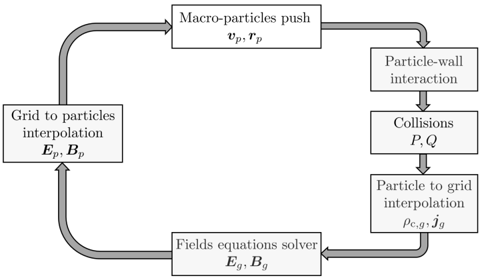
- Analysis: narrative overview of PIC/MCC algorithms, plasma-wall interaction models, hybrid versus full-PIC plume approaches, HPC techniques, and emerging methods such as sparse grids, implicit/energy-conserving PIC, reduced-order PIC, and deep-learning-based PIC.
Limitations
- The paper states that explicit PIC is constrained by Debye-length, plasma-period, and CFL restrictions, making multidimensional high-density simulations computationally expensive; numerical tricks such as enlarged permittivity or mass/size scaling are still used.
- It states that hybrid plume models with polytropic or Boltzmann electrons miss kinetic electron cooling, anisotropy, and peripheral/backflow plasma behavior, and that low-energy data for secondary electron emission, sputtering, neutral reflection, and ion recombination are lacking.
- Evident from the text: as a perspective/review, it presents no new primary data, no single validation study, and its forward-looking claims about future methods are authors’ assessments rather than demonstrated results.
Model-written summary. Check it against the paper before relying on it.
Integrity signals
Registry
Cites
Statistics
Figures
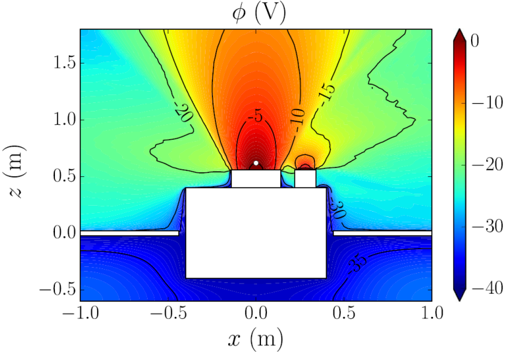
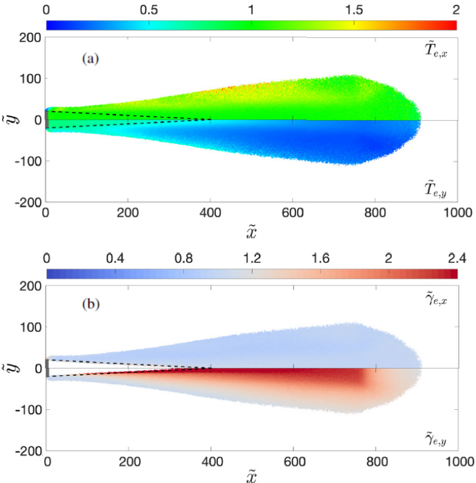

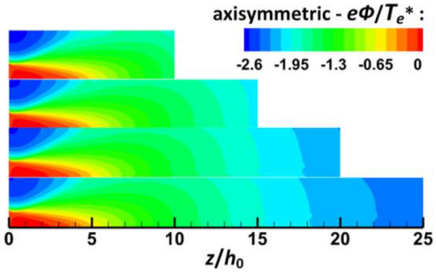
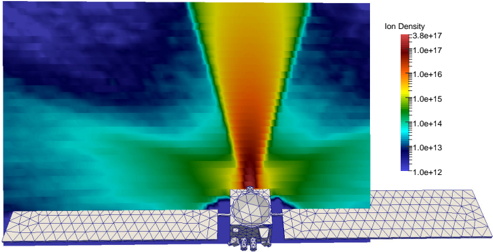
Verification
Claims the paper makes
14 Valid · 44 Not valid · 34 Not checked · 63 Own results and interpretations
Some cited sources support this claim and some don’t — read each source’s verdict below.
In the paper
“Therefore, such discharges are often modeled either by the two-fluid 109-112 or by hybrid 21,27 (fluid for electrons and particle for ions, see Sec. IV A) descriptions.”
What the sources say
- Could not verifycites [109] 2023, Two-dimensional effects on electrostatic instabilities in Hall thrusters. I. Insights from particle-in-cell simulations and two-point power spectral density reconstruction techniques, Phys. Plasmas sourceExperimental — accuracy not yet measured
The Introduction and Section II describe this paper’s PIC simulation of charged particles coupled to a fluid model for neutral gas. They do not address whether such discharges are often modeled with two-fluid descriptions or with the specified hybrid approach of fluid electrons and particle ions (searched: two-fluid, hybrid, fluid electrons/particle ions). (LLM, conf=0.72)
- Could not verifycites [110] 2017, 2D particle-in-cell simulations of the electron drift instability and associated anomalous electron transport in Hall-effect thrusters, Plasma Sources Sci. Technol. sourceExperimental — accuracy not yet measured
The citation is attached to the hybrid-description portion of the sentence. The Introduction and §2.2 describe particle-in-cell simulations, but the passages found for “hybrid,” “fluid,” and “two-fluid” do not address whether Hall-effect-thruster discharges are often modeled with hybrid fluid-electron/particle-ion descriptions. (LLM, conf=0.72)
- Disputedcites [111] 2019, Numerical studies of the E × B electron drift instability in Hall thrusters, Plasma Sources Sci. Technol. sourceExperimental — accuracy not yet measured
The citation is attached to the hybrid-model examples, but the source identifies its own approach as particle-in-cell/Monte Carlo collision (PIC-MCC), not a hybrid model with fluid electrons and particle ions. Section 3 (‘Two-dimensional PIC models’) states the method, and the Conclusions likewise describe two PIC-MCC models. No page numbers are available in our copy. (LLM, conf=0.87)
Checked by a reasoning model — may be wrong.
- Disputedcites [112] 2018, The effects of secondary electron emission on plasma sheath characteristics and electron transport in an discharge via kinetic simulations, Plasma Sources Sci. Technol. sourceExperimental — accuracy not yet measured
The citation is attached to the hybrid-description examples, but Section 2.1 identifies this paper’s model as a 2D-3V particle-in-cell/Monte-Carlo simulation, not a hybrid model with fluid electrons and particle ions. The Introduction mentions other fluid simulations; it does not describe this study as hybrid. (LLM, conf=0.86)
Checked by a reasoning model — may be wrong.
- Supportedcites [21] 2018, ID-HALL, a new double stage Hall thruster design. I. Principle and hybrid model of ID-HALL, Phys. Plasmas source
Section V describes simulations using a hybrid fluid-particle model. Section V.A specifies that it treats electrons as a fluid and ions as particles, supporting this paper as an example of the hybrid descriptions cited in the sentence. (LLM, conf=0.92)
- Supportedcites [27] 2021, Coupled plasma transport and electromagnetic wave simulation of an ECR thruster, Plasma Sources Sci. Technol. source
The Introduction describes this ECR-thruster discharge model as a hybrid PIC/fluid model. Sections 2.1 and 2.2 specify the division: ions are treated as particles and electrons as a fluid. The citation supports the hybrid example in the citing sentence; it is not offered as evidence for the separately cited two-fluid models. (LLM, conf=0.94)
plain- Asserted: passes — The authors put it forward as true.
- Checkable: passes — It can be checked against evidence.
- Load-bearing: passes — The paper’s conclusions depend on it.
- Based: passes — The paper gives a reason why it holds.
- Could not verify
The cited sources that could be checked couldn’t confirm or dispute this claim.
In the paper
“It has been recently 267,268 demonstrated that different numerical treatments of the neutrals change the spatio-temporal evolution of a HT discharge.”
What the sources say
- Could not verifycites [267] 2015, A collisionless plasma thruster plume expansion model, Plasma Sources Sci. Technol. sourceExperimental — accuracy not yet measured
The Abstract describes a collisionless model of far-region plume expansion, not the evolution of a Hall thruster discharge. The Introduction and section 5.3 discuss how neutrals affect plume collisions, but do not compare numerical treatments of neutrals or report their effects on spatio-temporal discharge evolution. Searches for those terms found no passage addressing the claim. (LLM, conf=0.75)
- Not checked — no full text of the sourcecites [268] 2015, Self-consistent model of a high-power Hall thruster plume, IEEE Trans. Plasma Sci. source
boostedstates a cause- Asserted: passes — The authors put it forward as true.
- Checkable: passes — It can be checked against evidence.
- Load-bearing: passes — The paper’s conclusions depend on it.
- Based: passes — The paper gives a reason why it holds.
- Could not verify
The cited sources that could be checked couldn’t confirm or dispute this claim.
In the paper
“Simulation results are highly sensitive to the model used for neutral dynamics.”
What the sources say
- Could not verifycites [267] 2015, A collisionless plasma thruster plume expansion model, Plasma Sources Sci. Technol. sourceExperimental — accuracy not yet measured
Section 5.1 reports that plume expansion differs appreciably with the assumed electron cooling rate, not with a model of neutral dynamics. Section 5.3 discusses neutrals and collisions but does not compare neutral-dynamics models or report that simulation results are highly sensitive to their choice. No page numbers are available in our copy. (LLM, conf=0.75)
- Not checked — no full text of the sourcecites [268] 2015, Self-consistent model of a high-power Hall thruster plume, IEEE Trans. Plasma Sci. source
boostedstates an association- Asserted: passes — The authors put it forward as true.
- Checkable: passes — It can be checked against evidence.
- Load-bearing: passes — The paper’s conclusions depend on it.
- Based: passes — The paper gives a reason why it holds.
- Could not verify
The cited sources that could be checked couldn’t confirm or dispute this claim.
In the paper
“Recent full PIC studies 243-245 , also observed a clear anisotropy in the electron parallel and perpendicular temperatures of a planar plume expansion.”
What the sources say
- Could not verifycites [243] 2020, Electron microphysics at plasma-solid interfaces, J. Appl. Phys. sourceExperimental — accuracy not yet measured
The Introduction (p. 1) and Synopsis (p. 16) discuss plasma–solid interfaces and their diagnostics, not planar plume expansion. Searches for the claimed electron-temperature anisotropy and full PIC studies found no passage in our copy addressing that observation. (LLM, conf=0.76)
- Not checked — no full text of the sourcecites [244] 2020, Plasma sheath material induced dependence due to secondary electron emission, Phys. Plasmas source
- Could not verifycites [245] 2013, Angular distribution of elastic electron backscattering from surfaces: Determination of the electron inelastic mean free path, J. Phys. D: Appl. Phys. sourceExperimental — accuracy not yet measured
The Results section describes Monte Carlo simulations of electrons elastically backscattered from solid surfaces, not full PIC studies of a planar plume. Searches for electron-temperature anisotropy and plume expansion found no passage addressing parallel and perpendicular electron temperatures. No page number was available in our copy. (LLM, conf=0.78)
boosted- Asserted: passes — The authors put it forward as true.
- Checkable: passes — It can be checked against evidence.
- Load-bearing: passes — The paper’s conclusions depend on it.
- Based: passes — The paper gives a reason why it holds.
- Could not verify
The cited sources support only part of this claim — read each source’s verdict below.
In the paper
“Moreover, the production of multiply charged ions from different species induced by the high-voltage [for example chlorine and carbon ions for polytetrafluoroethylene (PTFE) used as propellant for PPT 67 ] at very high densities leads to an obvious increase of the computational time, making it necessary to reduce the simulation cost with the usual numerical tricks cited above 66 .”
What the sources say
- Partly supportedcites [67] 2011, An energy- and charge-conserving, implicit, electrostatic particle-in-cell algorithm, J. Comput. Phys. sourceExperimental — accuracy not yet measured
Section 5.4 (pp. 20–23) supports the need to reduce PIC simulation costs: it explains how an implicit scheme can achieve CPU gains over an explicit one. It does not address the production of multiply charged ions from different species at very high densities or show that this production increases computational time. The chlorine and carbon ion example is attached to a different citation. (LLM, conf=0.86)
- Not checked — no full text of the sourcecites [66] 1999, Particle-in-cell plus direct simulation Monte Carlo (PIC-DSMC) approach for self-consistent plasma-gas simulations, IEEE Trans. Plasma Sci. source
boostedstates a cause- Asserted: passes — The authors put it forward as true.
- Checkable: passes — It can be checked against evidence.
- Load-bearing: unclear — It is unclear whether the paper’s conclusions depend on it.
- Based: passes — The paper gives a reason why it holds.
- Partly supported
57 more claims · 15 with their cited sources checked
Create a free account to see all 155 claims and to verify the 4 references still open.
- Probably not a substantial claim. 48
- It may state two separate claims as one. 67
- The quote only partly states this claim. 1
Citations
Cites
Yee, K. (1966) · IEEE Transactions on Antennas and Propagation · doi:10.1109/tap.1966.1138693 · Cited by 15,008
Classical Electrodynamics, 3rd ed .
Jackson, J. D., & Fox, R. F. (1999) · American Journal of Physics · doi:10.1119/1.19136 · Cited by 3,073
Mur, G. (1981) · IEEE Transactions on Electromagnetic Compatibility · doi:10.1109/temc.1981.303970 · Cited by 2,565
Solving unsymmetric sparse systems of linear equations with PARDISO
Schenk, O., & Gärtner, K. (2004) · Future Generation Computer Systems · doi:10.1016/j.future.2003.07.011 · Cited by 1,467
Birdsall, C. K. (1991) · IEEE Transactions on Plasma Science · doi:10.1109/27.106800 · Cited by 1,363
Vahedi, V., & Surendra, M. (1995) · Computer Physics Communications · doi:10.1016/0010-4655(94)00171-w · Cited by 1,065
Radiation boundary conditions for wave‐like equations
Bayliss, A., & Turkel, E. (1980) · Communications on Pure and Applied Mathematics · doi:10.1002/cpa.3160330603 · Cited by 1,026
Dissipation of Currents in Ionized Media
Buneman, O. (1959) · Physical Review · doi:10.1103/physrev.115.503 · Cited by 847
An object-oriented electromagnetic PIC code
Verboncoeur, J. P., Langdon, A. B., & Gladd, N. T. (1995) · Computer Physics Communications · doi:10.1016/0010-4655(94)00173-y · Cited by 658
Zangwill, A. (2012) · doi:10.1017/cbo9781139034777 · Cited by 658
Research works printed but not linked: 20
- 2005, Plasma Physics via Computer Simulation
- 2013, The DSMC Method
- 2021, Python Programming and Numerical Methods. A Guide for Engineers and Scientists
- 1988, Computer Simulation Using Particles
- 2010, Plasma Simulations by Example
- 2005, Computational Electrodynamics: The Finite-Difference Time-Domain Method
- 2007, Perfectly Matched Layer (PML) for Computational Electromagnetics
- 2018, Energy dissipation in helicon plasma at the near field of an antenna, Probl. At. Sci. Technol., 6, 86
- 2023, Density profile transition and high-energy electron transport in a magnetically expanding radio frequency plasma, Phys. Plasmas, 30, 013509, 10.1063/5.0126901 · DOI · Paper page
- 1957, On a singularity of the field of an electromagnetic wave propagated in an lnhomogeneous plasma, Sov. Phys. JETP, 4, 544
- 1996, Electron Cyclotron Resonance Ion Sources and ECR Plasmas
- D. Sydorenko , “Particle-in-cell simulations of electron dynamics in low pressure discharges with magnetic fields,” Ph.D. thesis (Department of Physics and Engineering Physics, University of Saskatchewan, 2006), unpublished thesis.
- 2006, Gaseous Electronics. Theory and Practice
- 2012, Gaseous Electronics. Tables, Atoms, and Molecules
- 2022, Programming Massively Parallel Processors: A Hands-on Approach
- 2014, Professional CUDA C Programming
- 2015, Heterogeneous Computing with OpenCL 2.0
- 2016, Parallel Programming with OpenACC
- 1981, A direct method for implicit particle-in-cell simulation, Commun. Plasma Phys. Control. Fusion, 6, 225
- 2021, GPU Porting of Scalable Implicit Solver with Green’s Function-Based Neural Networks by Openacc
Cited by
Faraji, F., & Reza, M. (2024) · Journal of Physics D Applied Physics · doi:10.1088/1361-6463/ada167 · Cited by 35
Digital twins for electric propulsion technologies
Reza, M., Faraji, F., & Knoll, A. K. (2024) · Journal of Electric Propulsion · doi:10.1007/s44205-024-00087-w · Cited by 18
“Because of the above complexities, the highest fidelity numerical approach most widely in use today, i.e., kinetic particle-in-cell (PIC) method, is prohibitively computationally costly to model full-size EP technologies over real-world operational timescales [34, 35].”
Reza, M., Faraji, F., & Knoll, A. K. (2024) · Plasma · doi:10.3390/plasma7030034 · Cited by 9
“The reduced-order PIC overall follows the standard algorithm of the particle-in-cell method [39–41].”
MethodPantera: A PIC-MCC-DSMC software for the simulation of rarefied gases and plasmas
Parodi, P., Boccelli, S., Bariselli, F., & Magin, T. (2025) · SoftwareX · doi:10.1016/j.softx.2025.102244 · Cited by 13
Data-driven local operator finding for reduced-order modeling of plasma systems
Faraji, F., Reza, M., Knoll, A. K., & Kutz, J. N. (2025) · Journal of Physics D Applied Physics · doi:10.1088/1361-6463/adbe85 · Cited by 8
“The positions and the velocities of the plasma particles are updated at each time step of the simulation according to the electromagnetic forces at the particles’ location [18, 19].”
Metadata
- Authors
- Taccogna, F., Cichocki, F., Eremin, D., Fubiani, G., & Garrigues, L.
- Affiliations
- Institute for the Science and Technology of Plasmas (IT)
- National Agency for New Technologies, Energy and Sustainable Economic Development (IT)
- Ruhr University Bochum (DE)
- Centre National de la Recherche Scientifique (FR)
- Venue
- Journal of Applied Physics
- Publisher
- AIP Publishing
- Published
- 2023-10-19
- Volume
- 134
- Issue
- 15
- ISSN
- 0021-8979 (ISSN-L)
- 1089-7550
- OpenAlex
- W4387781340
- Cited by
- 29
- References
- 327
- Citations by year
- 2026: 6 · 2025: 12 · 2024: 11
- FWCI
- 2.15
- Type
- journal article
- Language
- en
- Open access
- bronze
- doi.org
- Locations
- Journal of Applied Physics (publishedVersion)
- HAL (submittedVersion, other-oa)
- Funders
- Ministero dell'Università e della Ricerca (PON ARS01-00141)
- Agence Nationale de la Recherche (ANR) under the projet (ANR-22-CE46-0012)
- Topics
- Physical Sciences › Engineering › Electrical and Electronic Engineering › Low-Pressure Plasma Processing and Diagnostics
- Physical Sciences › Physics and Astronomy › Atomic and Molecular Physics, and Optics › Vacuum and Plasma Arcs
- Physical Sciences › Mathematics › Applied Mathematics › Gas Dynamics and Kinetic Theory
- Keywords
- plasma propulsion, particle-in-cell simulation, Monte Carlo collisions, electrostatic thrusters, electron cyclotron resonance thruster, plasma plume, plasma-wall interaction, plasma chemistry, alternative propellants
About these checks
Registry, retraction, Cites and statistics results are computed, not judged, with one exception: a printed reference that no index lists is read once by a model before it counts as a citation error. Claims are extracted by a model and kept only when their quote appears verbatim in the text; each cited source is then checked, with a model’s help, for whether it says what the claim relies on. Those verdicts can be wrong — read the claim’s quote and the cited source before relying on one.
The claim verdicts this report counts are experimental: their accuracy is not yet measured.
A language model drew the claims from the paper on 2026-10-12, under version 3 of the claim definition (model deepseek-v4.1-flash, prompt extract-v3).
A second model labelled each claim on 2026-10-12 (model jev-1.13-20260917, definition revision gold-guideline-v0.2).
Cited sources are checked with a language model’s help (gpt-6-sol).
Statistics and arithmetic are recomputed, not judged.
Confidence bands are shown only for fields calibrated on our annotated test set. None is calibrated yet, so no band is shown.
What counts as a claim ›How we measure confidence ›How we check this ›
Are you an author, or do you see a problem with this page? Request a review
How to cite
Cite CoChat for the checks on this page, and the paper for its own findings.
- This page
- CoChat. (2026). Citation check: Plasma propulsion modeling with particle-based algorithms. https://app.cochat.ai/papers/10.1063/5.0153862
- The paper
- Taccogna, F., Cichocki, F., Eremin, D., Fubiani, G., & Garrigues, L. (2023). Plasma propulsion modeling with particle-based algorithms. Journal of Applied Physics. https://doi.org/10.1063/5.0153862
Data sources
Bibliographic data: Semantic Scholar, OpenAlex, Crossref.
Contains information from the Semantic Scholar Academic Graph Datasets, made available under the ODC Attribution License (ODC-BY 1.0).
Semantic Scholar’s data is described in: Kinney, R., et al. (2023). The Semantic Scholar Open Data Platform. arXiv:2301.10140.
