

The DOI matches its Crossref record; 150 of the 156 references it cites were found in a registry or an index.
How Local and Global Metacognition Shape Mental Health
Open accessAbstract
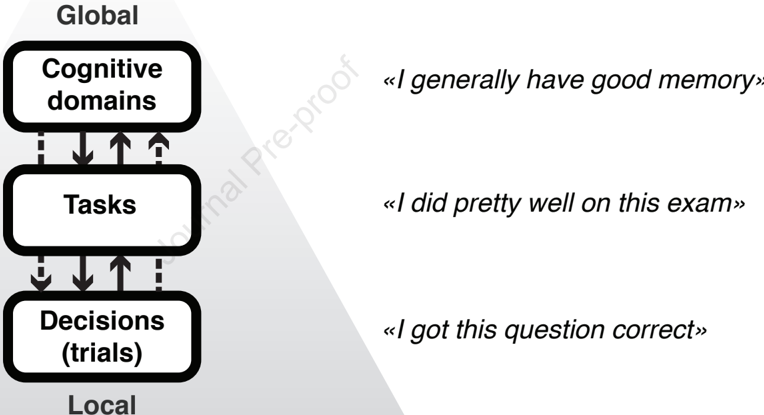
Metacognition is the ability to reflect on our own cognition and mental states. It is a critical aspect of human subjective experience and operates across many hierarchical levels of abstraction-encompassing local confidence in isolated decisions and global self-beliefs about our abilities and skills. Alterations in metacognition are considered foundational to neurologic and psychiatric disorders, but research has mostly focused on local metacognitive computations, missing out on the role of global aspects of metacognition. Here, we first review current behavioral and neural metrics of local metacognition that lay the foundation for this research. We then address the neurocognitive underpinnings of global metacognition uncovered by recent studies. Finally, we outline a theoretical framework in which higher hierarchical levels of metacognition may help identify the role of maladaptive metacognitive evaluation in mental health conditions, particularly when combined with transdiagnostic methods.
Overview
The claims and statistics of this paper haven’t been checked yet.
Run the check — free, no account needed. It reads the open-access text and checks the sources it cites.
Integrity signals
Registry
Cites
Statistics
Figures

Verification
Claims the paper makes
The claims and statistics of this paper haven’t been checked yet.
Run the check — free, no account needed. It reads the open-access text and checks the sources it cites.
Claims other papers make about this one
Each is checked against this paper’s own text: does it say what the citing paper says it does?
The source backs part of the claim, not all of it — or backs it for a different population, condition or comparison.
In the citing paper
“A number of studies have linked local and global metacognitive biases to individual differences in transdiagnostic mental health symptoms, including anxiety, depression, self-esteem, and compulsivity (Hoven et al. 2019, Seow et al. 2021).”
From Metacognition and Confidence: A Review and Synthesis (2024) · cites this paper as Seow et al. 2021
Experimental — accuracy not yet measuredThe source backs part of the claim, not all of it — or backs it for a different population, condition or comparison.
In the citing paper
“При многих психиатрических расстройствах нарушаются только глобальные метакогнитивные способности”
From Когнитивные механизмы дисфункционального принятия решений при психических расстройствах (2025) · cites this paper as Seow et al., 2021
Experimental — accuracy not yet measuredThe source backs part of the claim, not all of it — or backs it for a different population, condition or comparison.
In the citing paper
“при третьих -то и другое вместе.”
From Когнитивные механизмы дисфункционального принятия решений при психических расстройствах (2025) · cites this paper as Seow et al., 2021
Experimental — accuracy not yet measuredThe source backs part of the claim, not all of it — or backs it for a different population, condition or comparison.
In the citing paper
“при других -только локальные”
From Когнитивные механизмы дисфункционального принятия решений при психических расстройствах (2025) · cites this paper as Seow et al., 2021
Experimental — accuracy not yet measured
Self-check
Percentages, sums and reported differences re-computed from the paper’s own numbers.
The self-check needs the paper’s full text.
Citations
Cites
Self-efficacy: Toward a unifying theory of behavioral change
Bandura, A. (1977) · Psychological Review · doi:10.1037/0033-295x.84.2.191 · Cited by 43,925
Metacognition and cognitive monitoring: A new area of cognitive–developmental inquiry
Flavell, J. H. (1979) · American Psychologist · doi:10.1037/0003-066x.34.10.906 · Cited by 11,282 · cited 1×
“Metacognition, the ability to reflect on and evaluate our own thoughts and actions, is a crucial component of human behavior and subjective experience (1).”
BackgroundEncyclopedia of human behavior
(1994) · Choice Reviews Online · doi:10.5860/choice.32-0638 · Cited by 3,250
The role of the medial frontal cortex in cognitive control
Ridderinkhof, K. R., Ullsperger, M., Crone, E. A., & Nieuwenhuis, S. (2004) · Science · doi:10.1126/science.1100301 · Cited by 2,974
The epidemiology of obsessive-compulsive disorder in the National Comorbidity Survey Replication
Ruscio, A. M., Stein, D. J., Chiu, W. T., & Kessler, R. C. (2010) · Molecular Psychiatry · doi:10.1038/mp.2008.94 · Cited by 2,771
Does low self-esteem predict depression and anxiety? A meta-analysis of longitudinal studies.
Sowislo, J. F., & Orth, U. (2013) · Psychological Bulletin · doi:10.1037/a0028931 · Cited by 2,123 · cited 2×
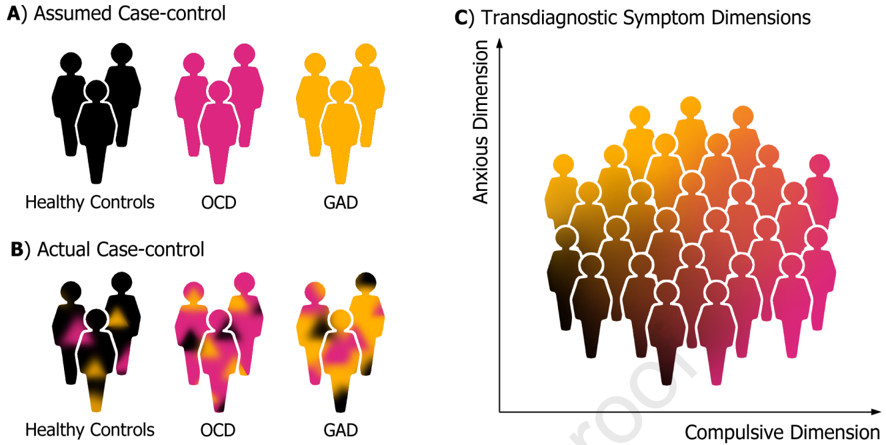
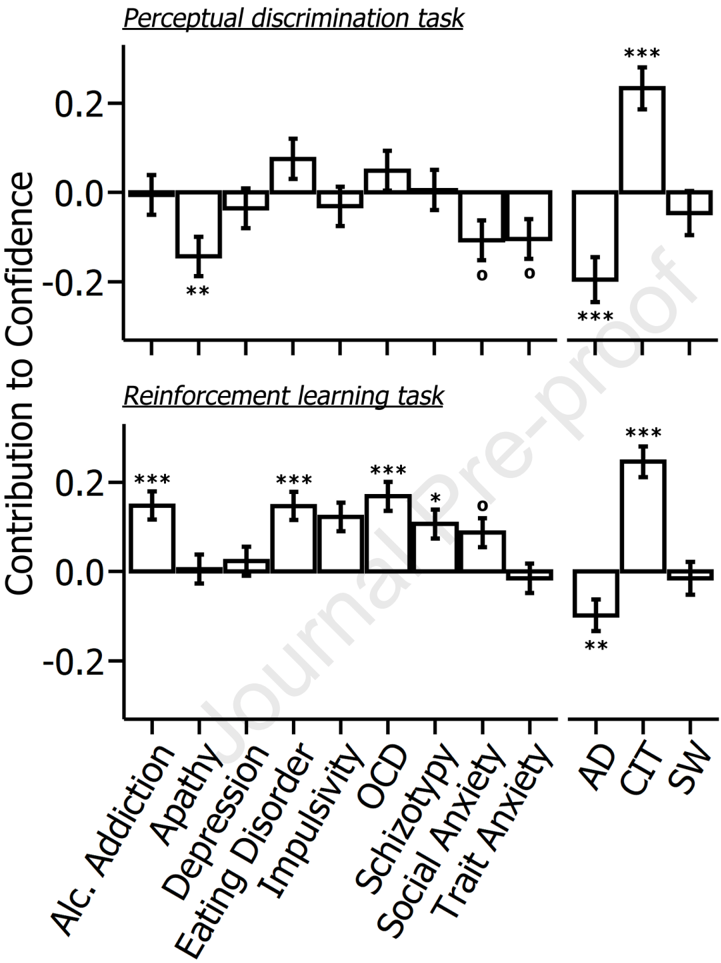
“This explanation is supported by observations that anxiety and depression symptoms are strongly linked to low self-esteem (72,73), while compulsivity is associated with difficulties in developing and using models to solve decision-making tasks”
BackgroundNeural mechanisms of the cognitive model of depression.
Disner, S. G., Beevers, C. G., Haigh, E. A. P., & Beck, A. T. (2011) · Nature Reviews Neuroscience · doi:10.1038/nrn3027 · Cited by 1,718
Risko, E. F., & Gilbert, S. J. (2016) · Trends in Cognitive Sciences · doi:10.1016/j.tics.2016.07.002 · Cited by 1,502
Fleming, S. M., & Lau, H. C. (2014) · Frontiers in Human Neuroscience · doi:10.3389/fnhum.2014.00443 · Cited by 1,408 · cited 1×
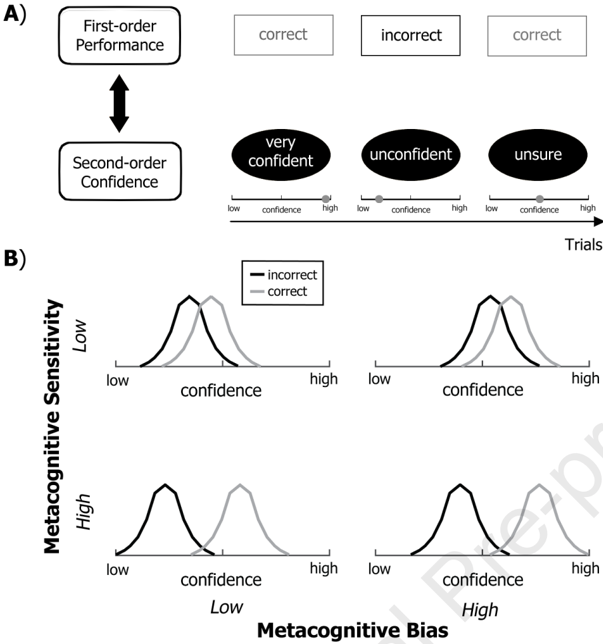
“Two independent aspects of local metacognition can be distinguished: metacognitive bias and sensitivity (15) (Figure 1B).”
BackgroundSelf-citationMetacognitive therapy for anxiety and depression
Veeraraghavan, V. (2009) · Anxiety, Stress & Coping · doi:10.1080/10615800902833770 · Cited by 1,165
Research works printed but not linked: 2
- Guggenmos, 2021, Validity and reliability of metacognitive performance measures, PsyArXiv
- Lee, 2021, Global visual confidence [published online ahead of print Mar 25], Psychon Bull Rev
Cited by
Sorted by citations
Items 101–159 of 159
Episodic and semantic feeling-of-knowing in aging: a systematic review and meta-analysisPreprint
Devaluez, M., Mazancieux, A., & Souchay, C. (2022) · doi:10.31234/osf.io/x5wc7 · Cited by 1
Agnoli, S., Zuberer, A., Nanni‐Zepeda, M., Milberg, W., McGlinchey, R. E., Esterman, M. S., & Degutis, J. M. (2022) · doi:10.31234/osf.io/2agtw · Cited by 1
Estimating self-performance when making complex decisionsPreprint
Lu, X., Murawski, C., Bossaerts, P. L., & Suzuki, S. (2023) · doi:10.31234/osf.io/7xatc · Cited by 1
Metacognition in anxious-depression is state-dependent: an observational treatment study
Fox, C. A., Lee, C. T., Hanlon, A. K., Seow, T. X., Lynch, K., Harty, S., Richards, D., Palacios, J., O’Keane, V., Stephan, K. E., et al. (2023) · doi:10.7554/elife.87193.2 · Cited by 1
Self-citationPettine, W. W., Winters, D. E., Murray, J. D., Anticevic, A., & Jacob, S. (2023) · PsyArXiv (OSF Preprints) · doi:10.31234/osf.io/n32gy · Cited by 2
Self-compassion is linked to positive affect and buffers declines in self-esteem in low performersPreprint
Weis, J. F., Krach, S., Paulus, F. M., & Stolz, D. S. (2025) · bioRxiv (Cold Spring Harbor Laboratory) · doi:10.1101/2025.11.11.687618 · Cited by 1
Ipatyuk, O. V., & Kozunova, G. L. (2025) · Психология Журнал Высшей школы экономики · doi:10.17323/1813-8918-2025-4-736-752
Metacognitive insight into cognitive performance in pre and early-stage Huntington’s diseasePreprint
Hewitt, S., White, A. J., Mason, S., & Barker, R. A. (2021) · medRxiv · doi:10.1101/2021.10.25.21265369
Relation between parenting style and confident decision-making in a student populationPreprint
Wolf, K., Tajchman, Z. J., & Vilares, I. (2022) · doi:10.31219/osf.io/udvsj
Matsuyoshi, D., Isato, A., & Yamada, M. (2022) · bioRxiv (Cold Spring Harbor Laboratory) · doi:10.1101/2022.10.24.513462
THE NEURAL CORRELATES OF METACOGNITIVE AWARENESS
Lenzoni, S. (2022) · doi:10.17771/pucrio.acad.61730
Prieto, F., Lorca-Vyhmeister, A. A., CALCAGNI, S. C., Silva, J. R., Goupil, L., & Gabriel Reyes, M. (2023) · doi:10.31234/osf.io/r3zm4
Terneusen, A. (2023) · Research Publications (Maastricht University) · doi:10.26481/dis.20230908at
Agnoli, S., Mahncke, H. W., Grant, S.-J., Milberg, W., Esterman, M. S., & DeGutis, J. (2023) · doi:10.31234/osf.io/z9p3a
Saramandi, A., Crucianelli, L., Koukoutsakis, A., Nisticò, V., Mavromara, L., Goeta, D., Boido, G., Gonidakis, F., Demartini, B., Bertelli, S., et al. (2023) · doi:10.31234/osf.io/c8mjv
Metacognitive Mechanisms in Psychological Resilience a Conceptual Framework and Empirical Studies
Evanytha, Riyanti, B. P. D., & Herabadi, A. G. (2023) · International Journal For Multidisciplinary Research · doi:10.36948/ijfmr.2023.v05i06.10320
Metamemory: An update of critical findings
Schwartz, B. L., & Metcalfe, J. (2023) · Elsevier eBooks · doi:10.1016/b978-0-443-15754-7.00004-3 · Cited by 1
Exogenous and Endogenous Sources of Uncertainty Inform Global Performance MonitoringPreprint
Chancel, M., Filevich, E., & Faivre, N. (2024) · SSRN Electronic Journal · doi:10.2139/ssrn.4784806
Metacognitive biases in anxious-depression and compulsivity extend across perception and memoryPreprint
Seow, T. X. F., Fleming, S. M., & Hauser, T. U. (2024) · doi:10.31234/osf.io/avyph
Self-citationКибальченко, И. А., & Эксакусто, Т. В. (2024) · International Journal of Cognitive Research in Science Engineering and Education · doi:10.23947/2334-8496-2024-12-2-357-372
Ger, E., & Cravet, E. (2025) · Acta Psychologica · doi:10.1016/j.actpsy.2025.105132
Autorregulación como estrategia de aprendizaje en estudiantes de violín de educación superior
Rangel, A. F. (2025) · REVISTA INTERNACIONAL DE EDUCACIÓN MUSICAL · doi:10.1177/23074841251365706 · Cited by 1
Pick, S., Millman, L. S. M., Gursoy, E. G., Basamh, Y., Uloyok-Job, J., Davies, J., Blunstone, L., Bhuma, S., Coebergh, J. A., David, A. S., et al. (2025) · medRxiv · doi:10.1101/2025.09.25.25336646
Zhang, G.-L., Zhang, J., Li, H., Liu, W., & Zhang, X. (2025) · BMC Psychology · doi:10.1186/s40359-025-03089-x
Alker, L. (2025) · Mental Illness · doi:10.1155/mij/9888704 · Cited by 1
How local and global metacognition relate to overt and covert narcissism in adolescentsPreprint
Liu, C., Shi, J., Luo, T., & Hu, X. (2025) · Research Square · doi:10.21203/rs.3.rs-8214411/v1
Hamilton, C., Gallagher, P., Donaghy, P., Ciafone, J., Firbank, M., Greenfinch, G., Heslegrave, A., Zetterberg, H., Taylor, J.-P., Allan, L., et al. (2026) · Psychological Medicine · doi:10.1017/s0033291725102997
Wang, S., Li, Z., Funahashi, S., Zhang, Z., Wu, J., & Yang, J. (2025) · International Conference on Health Big Data and Intelligent Healthcare (ICHIH) · doi:10.1145/3792746.3792750
Barnby, J. M., Dean, R. J., Burgess, H., Dayan, P., & Richards, L. J. (2026) · bioRxiv (Cold Spring Harbor Laboratory) · doi:10.64898/2026.03.02.709173
Dissociating accuracy and metacognition in nutritional judgements
Hoogervorst, K., Bavato, F., Tyrer, A., & Allen, M. (2026) · Cognition · doi:10.1016/j.cognition.2026.106744
Moore, L., Lund, A. E., & Russell, C. (2026) · BMC Neurology · doi:10.1186/s12883-026-04884-8
Military Mild Traumatic Brain Injury Predicts Greater Negative Metacognitive Bias
Chen, A., Fortier, C. B., Milberg, W., Esterman, M. S., & Degutis, J. M. (2026) · Journal of Head Trauma Rehabilitation · doi:10.1097/htr.0000000000001172
Pupil dilation as a physiological marker of metacognitive processes
Lenzoni, S., Horngacher, J., Kofler, J., Gat, O., & Hämmerer, D. (2026) · Biological Psychology · doi:10.1016/j.biopsycho.2026.109309
How local and global metacognition relate to overt and covert narcissism in adolescentsPreprint
Luo, T., Shi, J., Hu, X., & Liu, C. (2026) · SSRN Electronic Journal · doi:10.2139/ssrn.6864640
Metacognition and post-decisional processing in clinical decision-making
Katyal, S., & Fleming, S. M. (2026) · La Presse Médicale · doi:10.1016/j.lpm.2026.104369
Self-citationSocioeconomic status impacts metacognition of working memory and emotion recognition
Migeot, J., Wen, O., Olivares, D., Morales, J.-P., Franco-O´Byrne, D., Rodríguez‐Villagra, O. A., Ibáñez, A. M., & Huepe, D. (2026) · Neuroscience · doi:10.1016/j.neuroscience.2026.07.006
Decision processes underlying effort avoidance and their relationship with metacognition
Yoshida, K., Saito, R., Hayashi, R., Watanabe, S., & Okada, H. (2026) · Imaging Neuroscience · doi:10.1162/imag.a.1332
Sociolinguistic Context Constrains Bilingual Advantages in Metacognition
Polyanskaya, L., & Ordin, M. (2026) · Annals of the New York Academy of Sciences · doi:10.1111/nyas.70350
Phon-Amnuaisuk, P., Teckentrup, V., Fittipaldi, S., Crossen, R. J., Fox, C. A., Hanlon, A. K., Katyal, S., Fleming, S. M., & Gillan, C. M. (2026) · eLife · doi:10.7554/elife.112173
Self-citationPhon-Amnuaisuk, P., Teckentrup, V., Fittipaldi, S., Crossen, R. J., Fox, C. A., Hanlon, A. K., Katyal, S., Fleming, S. M., & Gillan, C. M. (2026) · eLife · doi:10.7554/elife.112173.1
Self-citationCzekalla, N., Schröder, A., Mayer, A. V., Stierand, J., Stolz, D. S., Κube, T., Korn, C. W., Wilhelm, I., Klein, J. P., Paulus, F. M., et al. (2026) · Translational Psychiatry · doi:10.1038/s41398-026-04341-7 · Cited by 3
Drops in confidence precede symptoms of obsessive-compulsive disorder
Marzuki, A. A., Kosina, L., Dome, L., Hewitt, S., & Hauser, T. U. (2026) · Nature Communications · doi:10.1038/s41467-026-76671-5
The Three Principles Beliefs Scale: Development and Preliminary ValidationPreprint
Catherine-Gray, J. L., Denkers, A. J. M., & McGinty, A. (2026) · Research Square · doi:10.21203/rs.3.rs-10732327/v1
Cheng, J., Cheng, X., Zhou, J., Deng, J., Feng, S., Sun, Y., Gong, K., Liu, K.-Z., Liu, C., Lei, W., et al. (2026) · Cognitive development · doi:10.1016/j.cogdev.2026.101763
Bridging psychiatric and educational metacognition: a perspective on insight and learning
Szalisznyó, K., & Silverstein, D. N. (2026) · Frontiers in Psychiatry · doi:10.3389/fpsyt.2026.1831296
Li, Y., Chen, X., Shi, J., Jian-yuan, W., Yang, C., Luo, L., & Hu, X. (2026) · Acta Psychologica · doi:10.1016/j.actpsy.2026.107715
Orlov, N. D., Sarzyńska, I., Góral-Półrola, J., Leśnicka, P., Bartkowska, O., Stańczyk, S., Siwiec, E., Ziółkowski, A., & Kopańska, M. (2026) · Brain Sciences · doi:10.3390/brainsci16090956
The Three Principles Beliefs Scale: Development and Preliminary ValidationPreprint
Denkers, A. J. M., Catherine-Gray, J. L., & McGinty, A. (2026) · Research Square · doi:10.21203/rs.3.rs-908242/v3
The Three Principles Beliefs Scale: Development and Preliminary ValidationPreprint
Catherine-Gray, J. L., Denkers, A. J. M., & McGinty, A. (2026) · Research Square · doi:10.21203/rs.3.rs-908242/v2
A dimensional link between gain–loss economic preferences and psychopathologyPreprint
Feng, Y.-Y., & Monosov, I. E. (2026) · bioRxiv (Cold Spring Harbor Laboratory) · doi:10.64898/2026.09.09.750300
Pain Modulates Optimism‐Biased Belief Updating and Confidence
Zhao, P.-G., & Liu, C.-Z. (2026) · Annals of the New York Academy of Sciences · doi:10.1111/nyas.70407
Halaj, A., Seow, T. X. F., & David, A. S. (2026) · Schizophrenia Research · doi:10.1016/j.schres.2026.09.028
Self-citationXu, A., Frömer, R., Wolff, W., & Shenhav, A. (2026) · Affective Science · doi:10.1007/s42761-026-00411-7 · Cited by 9
The role of visual feedback in metacognitive judgments of motor performance
Brun, L., Porte, P., Cottin, M., Guinet, É., Chalabaev, A., Palluel, E., Faivre, N., & Souchay, C. (2026) · Consciousness and Cognition · doi:10.1016/j.concog.2026.104138
Physicians’ metacognition in medical decision-making
Lakhlifi, C., Kouzy, R., Lejeune, F., Beuzon, N., Mawet, J., Roos, C., Khamassi, M., Rohaut, B., & Rouault, M. (2026) · Neuroscience of Consciousness · doi:10.1093/nc/niag064
Self-citationConceptual framework for emotion control integrating empathy, emotional regulation, and flexibility
Barbara, L. R., Antoine, D. C., Marion, T., & RAMDANI, C. (2026) · Frontiers in Psychology · doi:10.3389/fpsyg.2026.1753106
Goncalves, A., Ochoa, S., Moritz, S., Gawęda, Ł., Vanessa Acuña, P., König, C., Lamarca, M., & Berna, F. S. (2026) · Frontiers in Psychology · doi:10.3389/fpsyg.2026.1934181
Otomo, Y., & Kawachi, Y. (2026) · Frontiers in Psychology · doi:10.3389/fpsyg.2026.1900905
Metadata
- Authors
- Seow, T. X. F., Rouault, M., Gillan, C. M., & Fleming, S. M.
- Affiliations
- Wellcome Centre for Human Neuroimaging (GB)
- Université Paris Sciences et Lettres (FR)
- Trinity College Dublin (IE)
- Corresponding author
- Seow, Tricia X.F.
- Rouault, Marion
- Venue
- Biological Psychiatry
- Publisher
- Elsevier BV
- Published
- 2021-10
- Volume
- 90
- Issue
- 7
- Pages
- 436-446
- ISSN
- 0006-3223 (ISSN-L)
- OpenAlex
- W3164959546
- Cited by
- 159
- References
- 156
- Citations by year
- 2026: 37 · 2025: 22 · 2024: 27 · 2023: 48 · 2022: 21 · 2021: 3
- FWCI
- 3.66
- Type
- journal article
- Language
- en
- Open access
- green
- hal.science
- Locations
- Biological Psychiatry (publishedVersion)
- PubMed (publishedVersion)
- HAL (submittedVersion, cc-by)
- UCL Discovery (University College London) (submittedVersion, cc-by)
- Funders
- Agence Nationale de la Recherche (ANR-10-IDEX-0001-02 PSL, MQ16IP13)
- Wellcome Trust (203147/Z/16/Z, 206648/Z/17/Z)
- AXA Research Fund
- MQ Transforming Mental Health
- Max-Planck-Gesellschaft
- Royal Society
- Science Foundation Ireland (19/FFP/6418)
- University College London
- Topics
- Life Sciences › Neuroscience › Cognitive Neuroscience › Neural and Behavioral Psychology Studies
- Social Sciences › Psychology › Experimental and Cognitive Psychology › Anxiety, Depression, Psychometrics, Treatment, Cognitive Processes
- Life Sciences › Neuroscience › Cognitive Neuroscience › Memory Processes and Influences
- Keywords
- metacognition, mental health, metacognitive confidence, self-belief, transdiagnostic approach, mental illness, neurocognitive mechanisms
- MeSH terms
- Metacognition, Mental Disorders, Cognition, Humans, Mental Health
About these checks
Registry, retraction, Cites and statistics results are computed, not judged, with one exception: a printed reference that no index lists is read once by a model before it counts as a citation error. Claims are extracted by a model and kept only when their quote appears verbatim in the text; each cited source is then checked, with a model’s help, for whether it says what the claim relies on. Those verdicts can be wrong — read the claim’s quote and the cited source before relying on one.
Statistics and arithmetic are recomputed, not judged.
Confidence bands are shown only for fields calibrated on our annotated test set. None is calibrated yet, so no band is shown.
What counts as a claim ›How we measure confidence ›How we check this ›
Are you an author, or do you see a problem with this page? Request a review
