

The DOI matches its Crossref record; 150 of the 156 references it cites were found in a registry or an index.
How Local and Global Metacognition Shape Mental Health
Open accessAbstract
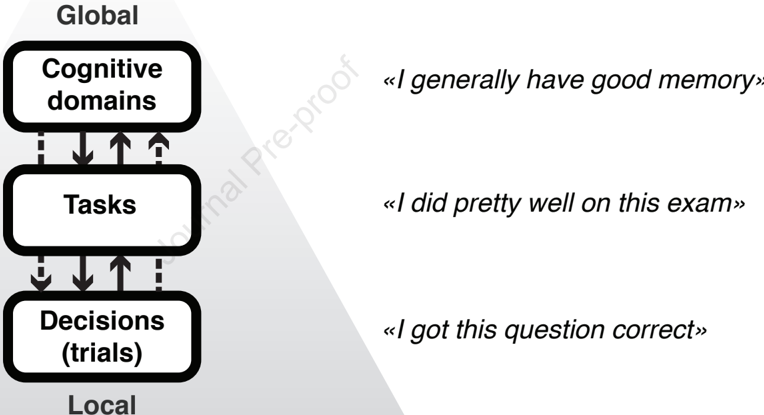
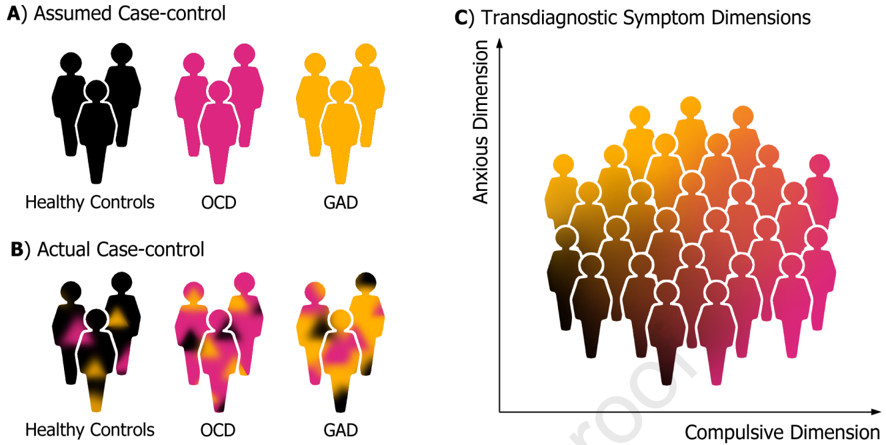
Metacognition is the ability to reflect on our own cognition and mental states. It is a critical aspect of human subjective experience and operates across many hierarchical levels of abstraction-encompassing local confidence in isolated decisions and global self-beliefs about our abilities and skills. Alterations in metacognition are considered foundational to neurologic and psychiatric disorders, but research has mostly focused on local metacognitive computations, missing out on the role of global aspects of metacognition. Here, we first review current behavioral and neural metrics of local metacognition that lay the foundation for this research. We then address the neurocognitive underpinnings of global metacognition uncovered by recent studies. Finally, we outline a theoretical framework in which higher hierarchical levels of metacognition may help identify the role of maladaptive metacognitive evaluation in mental health conditions, particularly when combined with transdiagnostic methods.
Overview
The claims and statistics of this paper haven’t been checked yet.
Run the check — free, no account needed. It reads the open-access text and checks the sources it cites.
Integrity signals
Registry
Cites
Statistics
Figures

Verification
Claims the paper makes
The claims and statistics of this paper haven’t been checked yet.
Run the check — free, no account needed. It reads the open-access text and checks the sources it cites.
Claims other papers make about this one
Each is checked against this paper’s own text: does it say what the citing paper says it does?
The source backs part of the claim, not all of it — or backs it for a different population, condition or comparison.
In the citing paper
“A number of studies have linked local and global metacognitive biases to individual differences in transdiagnostic mental health symptoms, including anxiety, depression, self-esteem, and compulsivity (Hoven et al. 2019, Seow et al. 2021).”
From Metacognition and Confidence: A Review and Synthesis (2024) · cites this paper as Seow et al. 2021
Experimental — accuracy not yet measuredThe source backs part of the claim, not all of it — or backs it for a different population, condition or comparison.
In the citing paper
“При многих психиатрических расстройствах нарушаются только глобальные метакогнитивные способности”
From Когнитивные механизмы дисфункционального принятия решений при психических расстройствах (2025) · cites this paper as Seow et al., 2021
Experimental — accuracy not yet measuredThe source backs part of the claim, not all of it — or backs it for a different population, condition or comparison.
In the citing paper
“при третьих -то и другое вместе.”
From Когнитивные механизмы дисфункционального принятия решений при психических расстройствах (2025) · cites this paper as Seow et al., 2021
Experimental — accuracy not yet measuredThe source backs part of the claim, not all of it — or backs it for a different population, condition or comparison.
In the citing paper
“при других -только локальные”
From Когнитивные механизмы дисфункционального принятия решений при психических расстройствах (2025) · cites this paper as Seow et al., 2021
Experimental — accuracy not yet measured
Self-check
Percentages, sums and reported differences re-computed from the paper’s own numbers.
The self-check needs the paper’s full text.
Citations
Cites
Self-efficacy: Toward a unifying theory of behavioral change
Bandura, A. (1977) · Psychological Review · doi:10.1037/0033-295x.84.2.191 · Cited by 43,925
Metacognition and cognitive monitoring: A new area of cognitive–developmental inquiry
Flavell, J. H. (1979) · American Psychologist · doi:10.1037/0003-066x.34.10.906 · Cited by 11,282 · cited 1×
“Metacognition, the ability to reflect on and evaluate our own thoughts and actions, is a crucial component of human behavior and subjective experience (1).”
BackgroundEncyclopedia of human behavior
(1994) · Choice Reviews Online · doi:10.5860/choice.32-0638 · Cited by 3,250
The role of the medial frontal cortex in cognitive control
Ridderinkhof, K. R., Ullsperger, M., Crone, E. A., & Nieuwenhuis, S. (2004) · Science · doi:10.1126/science.1100301 · Cited by 2,974
The epidemiology of obsessive-compulsive disorder in the National Comorbidity Survey Replication
Ruscio, A. M., Stein, D. J., Chiu, W. T., & Kessler, R. C. (2010) · Molecular Psychiatry · doi:10.1038/mp.2008.94 · Cited by 2,771
Does low self-esteem predict depression and anxiety? A meta-analysis of longitudinal studies.
Sowislo, J. F., & Orth, U. (2013) · Psychological Bulletin · doi:10.1037/a0028931 · Cited by 2,123 · cited 2×
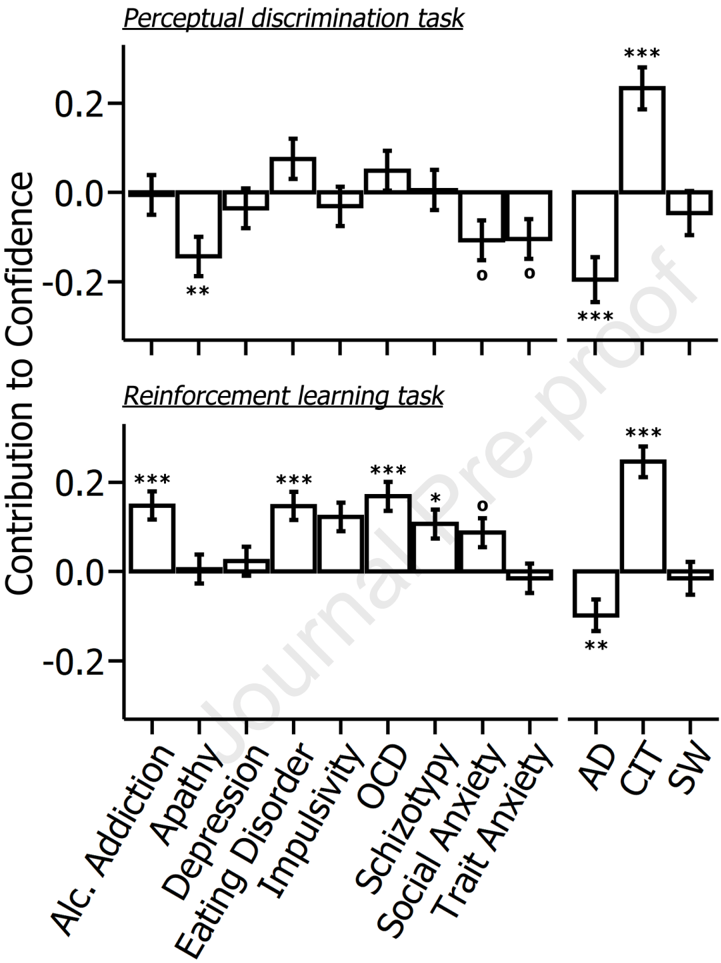
“This explanation is supported by observations that anxiety and depression symptoms are strongly linked to low self-esteem (72,73), while compulsivity is associated with difficulties in developing and using models to solve decision-making tasks”
BackgroundNeural mechanisms of the cognitive model of depression.
Disner, S. G., Beevers, C. G., Haigh, E. A. P., & Beck, A. T. (2011) · Nature Reviews Neuroscience · doi:10.1038/nrn3027 · Cited by 1,718
Risko, E. F., & Gilbert, S. J. (2016) · Trends in Cognitive Sciences · doi:10.1016/j.tics.2016.07.002 · Cited by 1,502
Fleming, S. M., & Lau, H. C. (2014) · Frontiers in Human Neuroscience · doi:10.3389/fnhum.2014.00443 · Cited by 1,408 · cited 1×
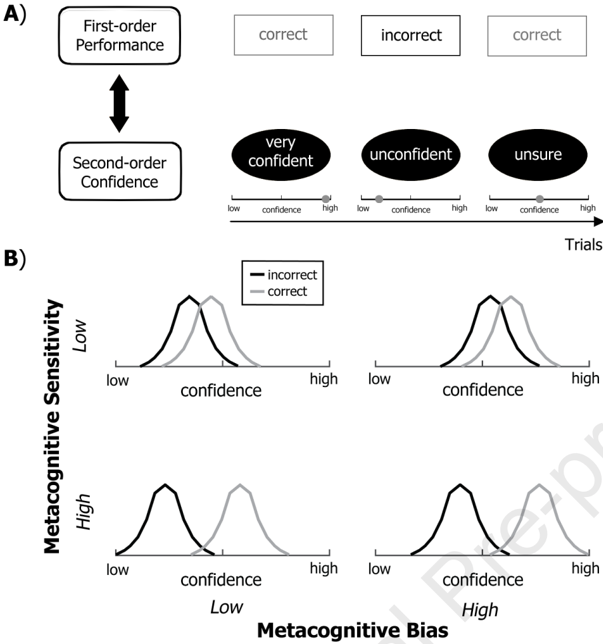
“Two independent aspects of local metacognition can be distinguished: metacognitive bias and sensitivity (15) (Figure 1B).”
BackgroundSelf-citationMetacognitive therapy for anxiety and depression
Veeraraghavan, V. (2009) · Anxiety, Stress & Coping · doi:10.1080/10615800902833770 · Cited by 1,165
Research works printed but not linked: 2
- Guggenmos, 2021, Validity and reliability of metacognitive performance measures, PsyArXiv
- Lee, 2021, Global visual confidence [published online ahead of print Mar 25], Psychon Bull Rev
Cited by
Sorted by citations
Metacognition and Confidence: A Review and Synthesis
Fleming, S. M. (2024) · Annual Review of Psychology · doi:10.1146/annurev-psych-022423-032425 · Cited by 256
“A number of studies have linked local and global metacognitive biases to individual differences in transdiagnostic mental health symptoms, including anxiety, depression, self-esteem and compulsivity (Hoven et al., 2019, Seow et al., 2021).”
Self-citationIdentifying Transdiagnostic Mechanisms in Mental Health Using Computational Factor Modeling
Wise, T., Robinson, O. J., & Gillan, C. M. (2023) · Biological Psychiatry · doi:10.1016/j.biopsych.2022.09.034 · Cited by 108
“Seow et al. (38) suggested that this is evidence of dissociable mechanisms underlying the con fi dence biases in compulsivity and AD; reduced con fi - dence in depression may stem from a lower setpoint of con fi dence relating to global self-beliefs [e.g., low self-esteem (39)], while overcon fi dence in CIT may be caused…”
Self-citationHow do confidence and self-beliefs relate in psychopathology: a transdiagnostic approach
Hoven, M., Luigjes, J., Denys, D. A. J. P., Rouault, M., & van Holst, R. J. (2023) · Nature Mental Health · doi:10.1038/s44220-023-00062-8 · Cited by 82
Self-citationThe future of metacognition research: Balancing construct breadth with measurement rigor
Katyal, S., & Fleming, S. M. (2024) · Cortex · doi:10.1016/j.cortex.2023.11.002 · Cited by 63
Self-citationBenwell, C., Mohr, G., Wallberg, J., Kouadio, A., & Ince, R. A. A. (2022) · npj Mental Health Research · doi:10.1038/s44184-022-00009-4 · Cited by 65
McWilliams, A., Bibby, H., Steinbeis, N., David, A. S., & Fleming, S. M. (2023) · Cognition · doi:10.1016/j.cognition.2023.105389 · Cited by 64
Self-citationReverse engineering of metacognition
Guggenmos, M. (2022) · eLife · doi:10.7554/elife.75420 · Cited by 52
Dar, R., Sarna, N., Yardeni, G., & Lazarov, A. (2022) · Psychological Medicine · doi:10.1017/s0033291722001908 · Cited by 42
Partially Overlapping Neural Correlates of Metacognitive Monitoring and Metacognitive Control
Boldt, A., & Gilbert, S. J. (2022) · Journal of Neuroscience · doi:10.1523/jneurosci.1326-21.2022 · Cited by 46
Towards a common conceptual space for metacognition in perception and memory
Mazancieux, A., Pereira, M., Faivre, N., Mamassian, P., Moulin, C. J. A., & Souchay, C. (2023) · Nature Reviews Psychology · doi:10.1038/s44159-023-00245-1 · Cited by 44
Formalising social representation to explain psychiatric symptoms
Barnby, J. M., Dayan, P., & Bell, V. (2023) · Trends in Cognitive Sciences · doi:10.1016/j.tics.2022.12.004 · Cited by 35
Low self-esteem and the formation of global self-performance estimates in emerging adulthood
Rouault, M., Will, G., Fleming, S. M., & Dolan, R. J. (2022) · Translational Psychiatry · doi:10.1038/s41398-022-02031-8 · Cited by 35
Self-citationMetacognitive Information Theory
Dayan, P. (2023) · Open Mind · doi:10.1162/opmi_a_00091 · Cited by 34
Hoven, M., Rouault, M., van Holst, R., & Luigjes, J. (2023) · Psychological Medicine · doi:10.1017/s003329172300209x · Cited by 28
Self-citationMetacognition and confidence: A review and synthesisPreprint
Fleming, S. M. (2023) · doi:10.31234/osf.io/ge7tz · Cited by 27
Self-citationReliable, rapid, and remote measurement of metacognitive bias
Fox, C. A., McDonogh, A., Donegan, K. R., Teckentrup, V., Crossen, R. J., Hanlon, A. K., Gallagher, E., Rouault, M., & Gillan, C. M. (2024) · Scientific Reports · doi:10.1038/s41598-024-64900-0 · Cited by 30
Self-citationDistorted learning from local metacognition supports transdiagnostic underconfidence
Katyal, S., Huys, Q. J. M., Dolan, R. J., & Fleming, S. M. (2025) · Nature Communications · doi:10.1038/s41467-025-57040-0 · Cited by 42
Self-citationA computational approach to understanding effort-based decision-making in depression
Valton, V., Mkrtchian, A., Moses-Payne, M. E., Gray, A., Kieslich, K., VanUrk, S., Samborska, V., Halahakoon, D. C., Manohar, S., Dayan, P., et al. (2025) · Psychological Medicine · doi:10.1017/s0033291725101967 · Cited by 29
Terneusen, A., Quaedflieg, C. W. E. M., Heugten, C. M. V., Ponds, R., & Winkens, I. (2023) · Metacognition and Learning · doi:10.1007/s11409-023-09350-1 · Cited by 28
Wang, X.-M., Huang, X.-T., & Zhou, W.-Q. (2024) · Thinking Skills and Creativity · doi:10.1016/j.tsc.2024.101658 · Cited by 34
Dobbs, M., Degutis, J. M., Morales, J., Joseph, K., & Swire‐Thompson, B. (2023) · Communications Psychology · doi:10.1038/s44271-023-00040-x · Cited by 24
Metacognition as a window into subjective affective experience
Cushing, C. A., Lau, H. C., Hofmann, S. G., LeDoux, J. E., & Taschereau‐Dumouchel, V. (2024) · Psychiatry and Clinical Neurosciences · doi:10.1111/pcn.13683 · Cited by 21
Confidence ratings do not distinguish imagination from reality
Dijkstra, N., Mazor, M., & Fleming, S. M. (2024) · Journal of Vision · doi:10.1167/jov.24.5.13 · Cited by 21
Self-citationCommon computations for metacognition and meta-metacognition
Zheng, Y., Recht, S., & Rahnev, D. (2023) · Neuroscience of Consciousness · doi:10.1093/nc/niad023 · Cited by 15
Mediterranean diet, interoception and mental health: Is it time to look beyond the ‘Gut-brain axis’?
Young, H. A., Freegard, G., & Benton, D. (2022) · Physiology & Behavior · doi:10.1016/j.physbeh.2022.113964 · Cited by 19
Interoceptive and metacognitive facets of fatigue in multiple sclerosis
Rouault, M., Pereira, I., Galioulline, H., Fleming, S. M., Stephan, K. E., & Manjaly, Z. (2023) · European Journal of Neuroscience · doi:10.1111/ejn.16048 · Cited by 21
Self-citationAnxiety Disorders: The Relationship between Insight and Metacognition
Halaj, A., Konstantakopoulos, G., Ghaemi, S. N., & David, A. S. (2024) · Psychopathology · doi:10.1159/000538096 · Cited by 17
Computational Mechanisms of Addiction and Anxiety: A Developmental Perspective
Goldway, N., Eldar, E., Shoval, G., & Hartley, C. A. (2023) · Biological Psychiatry · doi:10.1016/j.biopsych.2023.02.004 · Cited by 16
Neural correlates of impaired cognitive processes underlying self-unawareness in Alzheimer's disease
Salmon, É., Meyer, F., Genon, S., Collette, F., & Bastin, C. (2023) · Cortex · doi:10.1016/j.cortex.2023.10.009 · Cited by 13
Agnoli, S., Zuberer, A., Nanni‐Zepeda, M., McGlinchey, R. E., Milberg, W., Esterman, M. S., & Degutis, J. M. (2023) · Depression and Anxiety · doi:10.1155/2023/2925551 · Cited by 12
Factors perpetuating functional cognitive symptoms after mild traumatic brain injury
Picon, E. L., Wardell, V., Palombo, D. J., Todd, R. M., Aziz, B., Bedi, S., & Silverberg, N. D. (2023) · Journal of Clinical and Experimental Neuropsychology · doi:10.1080/13803395.2023.2247601 · Cited by 12
Metacognition, Adaptation, and Mental Health
Martin, A. M. S., & Lysaker, P. H. (2021) · Biological Psychiatry · doi:10.1016/j.biopsych.2021.09.028 · Cited by 12
Does age affect metacognition? A cross-domain investigation using a hierarchical Bayesian framework
Meunier-Duperray, L., Mazancieux, A., Souchay, C., Fleming, S. M., Bastin, C., Moulin, C. J. A., & Angel, L. (2025) · Cognition · doi:10.1016/j.cognition.2025.106089 · Cited by 12
Self-citationHu, X., Yang, C., & Luo, L. (2022) · Journal of Experimental Psychology General · doi:10.1037/xge0001257 · Cited by 10
Czekalla, N., Schröder, A., Mayer, A. V., Stierand, J., Stolz, D. S., Κube, T., Korn, C. W., Wilhelm, I., Klein, J. P., Paulus, F. M., et al. (2024) · bioRxiv (Cold Spring Harbor Laboratory) · doi:10.1101/2024.05.09.593087 · Cited by 10
Saramandi, A., Crucianelli, L., Koukoutsakis, A., Nisticò, V., Mavromara, L., Goeta, D., Boido, G., Gonidakis, F., Demartini, B., Bertelli, S., et al. (2024) · Computational Psychiatry · doi:10.5334/cpsy.109 · Cited by 11
Metacognitive biases in anxiety-depression and compulsivity extend across perception and memory
Seow, T. X. F., Fleming, S. M., & Hauser, T. U. (2025) · PLOS mental health. · doi:10.1371/journal.pmen.0000259 · Cited by 17
Self-citationEmbon, I., Cukier, S., Iorio, A., Barttfeld, P., & Solovey, G. (2023) · Consciousness and Cognition · doi:10.1016/j.concog.2023.103502 · Cited by 13
A Standard Framework for Social Cognition: interoperable algorithms for inference and representationPreprint
Barnby, J. M., Alon, N., Bellucci, G., Schilbach, L., Frith, C., & Bell, V. (2023) · PsyArXiv (OSF Preprints) · doi:10.31234/osf.io/cmgu7 · Cited by 16
Metacognitive sensitivity and symptoms of mental disorder: A systematic review and meta-analysis
Hohendorf, M., & Bauer, M. (2023) · Frontiers in Psychology · doi:10.3389/fpsyg.2023.991339 · Cited by 15
Metacognition of perceptual resolution across and around the visual field
Kim, C., & Chong, S. C. (2024) · Cognition · doi:10.1016/j.cognition.2024.105938 · Cited by 9
Domain-specific updating of metacognitive self-beliefs
Hoogervorst, K., Banellis, L., & Allen, M. (2024) · Cognition · doi:10.1016/j.cognition.2024.105965 · Cited by 9
Episodic and semantic feeling-of-knowing in aging: a systematic review and meta-analysis
Devaluez, M., Mazancieux, A., & Souchay, C. (2023) · Scientific Reports · doi:10.1038/s41598-023-36251-9 · Cited by 9
Information search under uncertainty across transdiagnostic psychopathology and healthy ageing
Mohr, G., Ince, R. A. A., & Benwell, C. (2024) · Translational Psychiatry · doi:10.1038/s41398-024-03065-w · Cited by 11
Noël, X., Saeremans, M., Kornreich, C., Chatard, A., Jaafari, N., & D’Argembeau, A. (2022) · Alcoholism Clinical and Experimental Research · doi:10.1111/acer.14763 · Cited by 9
Formalising social representation to explain psychiatric symptomsPreprint
Barnby, J. M., Dayan, P., & Bell, V. (2022) · doi:10.31234/osf.io/djwuf · Cited by 9
Behrendt, M. G., Clark, C., Elliott, M., & Dauer, J. T. (2024) · npj Science of Learning · doi:10.1038/s41539-024-00231-z · Cited by 10
Hot metacognition: poorer metacognitive efficiency following acute but not traumatic stress
Smith, A., Bisby, J. A., Dercon, Q., Bevan, A., Kigar, S. L., Lynall, M.-E., Dalgleish, T., Hitchcock, C., & Nord, C. L. (2024) · Translational Psychiatry · doi:10.1038/s41398-024-02840-z · Cited by 10
Investigating people’s metacognitive insight into their own face abilities
Kramer, R. S. S., & Tree, J. J. (2023) · Quarterly Journal of Experimental Psychology · doi:10.1177/17470218231218662 · Cited by 8
Going ‘meta’: a systematic review of metacognition and functional neurological disorder
Sadnicka, A., Strudwick, A.-M., Grogan, J. P., Manohar, S., & Nielsen, G. (2024) · Brain Communications · doi:10.1093/braincomms/fcaf014 · Cited by 7
Seow, T. X. F., Jelinek, L., Moritz, S., & Hauser, T. U. (2025) · Nature Reviews Psychology · doi:10.1038/s44159-025-00503-4 · Cited by 11
Self-citationAtypical meta-memory evaluation strategy in schizophrenia patients
Zheng, Y., Wang, L., Gerlofs, D. J., Duan, W., Wang, X., Jia, Y., Yan, C., Allé, M. C., Berna, F. S., Wang, J., et al. (2021) · Schizophrenia Research Cognition · doi:10.1016/j.scog.2021.100220 · Cited by 7
Confidence biases in problem gambling
Friedemann, M., Fox, C. A., Hanlon, A. K., Tighe, D., Yeung, N., & Gillan, C. M. (2024) · Journal of Behavioral Addictions · doi:10.1556/2006.2024.00030 · Cited by 7
Self-citationWeist, M. D., Domlyn, A. M., & Collins, D. (2023) · Issues in clinical child psychology · doi:10.1007/978-3-031-20006-9_10 · Cited by 7
Distorted learning from local metacognition supports transdiagnostic underconfidencePreprint
Katyal, S., Huys, Q. J. M., Dolan, R. J., & Fleming, S. M. (2023) · doi:10.31234/osf.io/qcg92 · Cited by 7
Self-citationHoogervorst, K., Banellis, L., Fardo, F., Xue, K., Tyrer, A., Rahnev, D., & Allen, M. (2024) · PsyArXiv (OSF Preprints) · doi:10.31234/osf.io/2gwky · Cited by 10
Sójta, K., Margulska, A., Jóźwiak-Majchrzak, W., Grażka, A., Grzelczak, K., & Strzelecki, D. (2023) · Brain Sciences · doi:10.3390/brainsci13071118 · Cited by 6
Bălăeţ, M., Alhajraf, F., Bourke, N., Welch, J., Razzaque, J., Malhotra, P., Hu, M. T., & Hampshire, A. (2024) · Frontiers in Neurology · doi:10.3389/fneur.2024.1399313 · Cited by 6
Davis, B. J., Bonfils, K., Zalzala, A. B., Lysaker, P., & Minor, K. S. (2022) · Schizophrenia Research · doi:10.1016/j.schres.2022.09.008 · Cited by 5
Lee, J. K., Rouault, M., & Wyart, V. (2023) · bioRxiv (Cold Spring Harbor Laboratory) · doi:10.1101/2023.01.05.522867 · Cited by 6
Self-citationBiased and inattentive responding contribute to apparent metacognitive biases in mental health
Sarna, N., Dar, R., & Mazor, M. (2026) · Proceedings of the National Academy of Sciences · doi:10.1073/pnas.2520832123 · Cited by 8
Relation between parenting style and confident decision-making in a student population
Wolf, K., Tajchman, Z. J., & Vilares, I. (2024) · PLoS ONE · doi:10.1371/journal.pone.0302495 · Cited by 5
Affordances from a control viewpoint
Proust, J. (2023) · Philosophical Psychology · doi:10.1080/09515089.2023.2274489 · Cited by 5
Common computations for metacognition and meta-metacognitionPreprint
Zheng, Y., Recht, S., & Rahnev, D. (2023) · doi:10.31234/osf.io/g4h65 · Cited by 5
No evidence of impaired visual and tactile metacognition in adults with Tourette disorder
Arbuzova, P., Guo, S., Koß, C., Kurvits, L., Faivre, N., Kühn, A. A., Filevich, E., & Ganos, C. (2022) · Parkinsonism & Related Disorders · doi:10.1016/j.parkreldis.2022.02.019 · Cited by 5
Love, S., & Armstrong, K. A. (2025) · Applied Cognitive Psychology · doi:10.1002/acp.70130 · Cited by 3
Wiedbusch, M. D., Dever, D. A., Delgado, T., & Azevedo, R. (2025) · International Journal of Artificial Intelligence in Education · doi:10.1007/s40593-025-00522-5 · Cited by 3
Yoshida, K., Sawamura, D., Ogawa, K., Mototani, T., Ikoma, K., & Sakai, S. (2023) · Journal of Cognitive Neuroscience · doi:10.1162/jocn_a_02064 · Cited by 3
Yüce, A. E. (2024) · Psikiyatride Guncel Yaklasimlar - Current Approaches in Psychiatry · doi:10.18863/pgy.1433144 · Cited by 3
Estimating self-performance when making complex decisions
Lu, X., Murawski, C., Bossaerts, P. L., & Suzuki, S. (2025) · Scientific Reports · doi:10.1038/s41598-025-87601-8 · Cited by 4
Clustering Learner’s Metacognitive Judgment Accuracy and Bias to Explore Learning with AIEd Systems
Wiedbusch, M. D., Sonnenfeld, N. A., Dever, D. A., & Azevedo, R. (2022) · Lecture notes in computer science · doi:10.1007/978-3-031-11644-5_33 · Cited by 4
Lee, J. K., Rouault, M., & Wyart, V. (2025) · Nature Mental Health · doi:10.1038/s44220-024-00364-5 · Cited by 13
Self-citationContext-dependent role of confidence in information-seeking
Marcke, H. V., & Desender, K. (2025) · Cognition · doi:10.1016/j.cognition.2025.106219 · Cited by 3
Metacognition in anxious-depression is state-dependent: an observational treatment studyPreprint
Fox, C. A., Lee, C. T., Hanlon, A. K., Seow, T. X. F., Lynch, K., Harty, S., Richards, D., Palacios, J. E., O’Keane, V., Stephan, K. E., et al. (2023) · eLife · doi:10.7554/elife.87193.1 · Cited by 3
Self-citationDomain-specific updating of metacognitive self-beliefsPreprint
Hoogervorst, K., Banellis, L., & Allen, M. (2023) · doi:10.31234/osf.io/knsb4 · Cited by 3
Clinical and Cognitive Metacognition in Gaming and Gambling Disorder: A Narrative Review
van Holst, R. J., Cornelissen, K., Bockting, C., & Spada, M. M. (2024) · Current Addiction Reports · doi:10.1007/s40429-024-00597-5 · Cited by 4
Pick, S., Millman, L. S. M., Gursoy, E. G., Basamh, Y., Uloyok-Job, J., Davies, J., Blunstone, L., Bhuma, S., Coebergh, J. A., David, A. S., et al. (2026) · Psychological Medicine · doi:10.1017/s0033291726103420 · Cited by 2
Domain specificity of error monitoring: An ERP study in young and older adults
Lenzoni, S., Sumich, A. L., & Mograbi, D. C. (2024) · Psychophysiology · doi:10.1111/psyp.14579 · Cited by 2
Lopez‐Persem, A., Rouault, M., & Volle, E. (2023) · Physics of Life Reviews · doi:10.1016/j.plrev.2023.11.007 · Cited by 2
Self-citationPartially overlapping neural correlates of metacognitive monitoring and metacognitive controlPreprint
Boldt, A., & Gilbert, S. J. (2020) · doi:10.31234/osf.io/3dz9b · Cited by 2
Interoceptive and metacognitive facets of fatigue in multiple sclerosisPreprint
Rouault, M., Pereira, I., Galioulline, H., Fleming, S. M., Stephan, K. E., & Manjaly, Z. (2023) · medRxiv · doi:10.1101/2023.01.23.23284429 · Cited by 2
Self-citationAn observational treatment study of metacognition in anxious-depression
Fox, C. A., Lee, C. T., Hanlon, A., Seow, T. X. F., Lynch, K., Harty, S., Richards, D., Palacios, J., O'Keane, V., Stephan, K. E., et al. (2023) · doi:10.31234/osf.io/uk7hr · Cited by 2
Self-citationDepression impairs metacognitive biases, but not learningPreprint
Sax, A.-L., Baddeley, R., & Costa, R. P. (2023) · PsyArXiv (OSF Preprints) · doi:10.31234/osf.io/9a7y8 · Cited by 2
Distinct forms of uncertainty guide information seeking and subjective confidencePreprint
Edwards-Lowe, G., Chiusa, E. L., Olawole‐Scott, H., & Yon, D. (2024) · PsyArXiv (OSF Preprints) · doi:10.31234/osf.io/cf4a7 · Cited by 6
Computational characterization of metacognitive ability in subjective decision-makingPreprint
Plate, C. R., Govil, D., Zheng, C. Y., Boundy-Singer, Z. M., Ziemba, C. M., & López-Guzmán, S. (2025) · bioRxiv (Cold Spring Harbor Laboratory) · doi:10.1101/2025.05.23.655775 · Cited by 3
Perceptual and attentional uncertainty impact global performance monitoring
Chancel, M., Filevich, E., & Faivre, N. (2025) · Neuroscience of Consciousness · doi:10.1093/nc/niaf041 · Cited by 1
Löbig, N., Pagenkopf, C., Südmeyer, M., & Werheid, K. (2024) · Cortex · doi:10.1016/j.cortex.2024.07.010 · Cited by 1
Hu, R., Yu, M., Li, L., He, H., Wei, S., Ma, J., Gu, Y., & Dai, Z. (2025) · Depression and Anxiety · doi:10.1155/da/5581270 · Cited by 1
Diminished reactivity effect of confidence rating on perceptual decision-making in depression
Zhang, L., Liu, Y., Wang, Y., Gong, K., Liu, K., Lei, W. I., & Chen, J. (2025) · Frontiers in Neuroscience · doi:10.3389/fnins.2025.1638734 · Cited by 1
Seng, S., Okoli, C. T. C., Williams, L. B., Babalonis, S. L., & Ashford, K. B. (2026) · Addictive Behaviors · doi:10.1016/j.addbeh.2026.108670 · Cited by 1
Metacognitive monitoring and calibration in the vocal emotion recognition task
Sinvani, R.-T., & Fogel‐Grinvald, H. (2026) · Frontiers in Psychology · doi:10.3389/fpsyg.2026.1763494 · Cited by 1
Towards an integrative neuroscience of metacognition
Fleming, S. M. (2026) · Nature reviews. Neuroscience · doi:10.1038/s41583-026-01081-x · Cited by 3
Self-citationMetacognitive insight into cognitive performance in Huntington’s disease gene carriers
Hewitt, S., White, A. J., Mason, S., & Barker, R. A. (2022) · BMJ Neurology Open · doi:10.1136/bmjno-2022-000268 · Cited by 1
Bhome, R., McWilliams, A., Price, G. W., Poole, N. A., Howard, R. J., Fleming, S. M., & Huntley, J. D. (2022) · Brain Communications · doi:10.1093/braincomms/fcac139 · Cited by 1
Self-citationMatsuyoshi, D., Isato, A., & Yamada, M. (2024) · BMC Psychology · doi:10.1186/s40359-024-01625-9 · Cited by 1
Embon, I., Gerbaudo, M. A., Usaj, A., Iorio, A., Barttfeld, P., & Solovey, G. (2024) · Current Psychology · doi:10.1007/s12144-024-06669-z · Cited by 1
Metacognitive training facilitates optimal cognitive offloading
Ngai, C., & Gilbert, S. J. (2026) · Cognitive Research Principles and Implications · doi:10.1186/s41235-026-00714-0 · Cited by 6
Huang, W., Song, F., Zhang, S., & Xia, T. D. (2022) · Frontiers in Psychology · doi:10.3389/fpsyg.2022.950412 · Cited by 1
An observational treatment study of metacognition in anxious-depression
Fox, C. A., Lee, C. T., Hanlon, A. K., Seow, T. X., Lynch, K., Harty, S., Richards, D., Palacios, J., O'Keane, V., Stephan, K. E., et al. (2023) · eLife · doi:10.7554/elife.87193.3 · Cited by 1
Self-citationKumar, N. (2023) · Chettinad Health City Medical Journal · doi:10.24321/2278.2044.202379 · Cited by 1
Metadata
- Authors
- Seow, T. X. F., Rouault, M., Gillan, C. M., & Fleming, S. M.
- Affiliations
- Wellcome Centre for Human Neuroimaging (GB)
- Université Paris Sciences et Lettres (FR)
- Trinity College Dublin (IE)
- Corresponding author
- Seow, Tricia X.F.
- Rouault, Marion
- Venue
- Biological Psychiatry
- Publisher
- Elsevier BV
- Published
- 2021-10
- Volume
- 90
- Issue
- 7
- Pages
- 436-446
- ISSN
- 0006-3223 (ISSN-L)
- OpenAlex
- W3164959546
- Cited by
- 159
- References
- 156
- Citations by year
- 2026: 37 · 2025: 22 · 2024: 27 · 2023: 48 · 2022: 21 · 2021: 3
- FWCI
- 3.66
- Type
- journal article
- Language
- en
- Open access
- green
- hal.science
- Locations
- Biological Psychiatry (publishedVersion)
- PubMed (publishedVersion)
- HAL (submittedVersion, cc-by)
- UCL Discovery (University College London) (submittedVersion, cc-by)
- Funders
- Agence Nationale de la Recherche (ANR-10-IDEX-0001-02 PSL, MQ16IP13)
- Wellcome Trust (203147/Z/16/Z, 206648/Z/17/Z)
- AXA Research Fund
- MQ Transforming Mental Health
- Max-Planck-Gesellschaft
- Royal Society
- Science Foundation Ireland (19/FFP/6418)
- University College London
- Topics
- Life Sciences › Neuroscience › Cognitive Neuroscience › Neural and Behavioral Psychology Studies
- Social Sciences › Psychology › Experimental and Cognitive Psychology › Anxiety, Depression, Psychometrics, Treatment, Cognitive Processes
- Life Sciences › Neuroscience › Cognitive Neuroscience › Memory Processes and Influences
- Keywords
- metacognition, mental health, metacognitive confidence, self-belief, transdiagnostic approach, mental illness, neurocognitive mechanisms
- MeSH terms
- Metacognition, Mental Disorders, Cognition, Humans, Mental Health
About these checks
Registry, retraction, Cites and statistics results are computed, not judged, with one exception: a printed reference that no index lists is read once by a model before it counts as a citation error. Claims are extracted by a model and kept only when their quote appears verbatim in the text; each cited source is then checked, with a model’s help, for whether it says what the claim relies on. Those verdicts can be wrong — read the claim’s quote and the cited source before relying on one.
Statistics and arithmetic are recomputed, not judged.
Confidence bands are shown only for fields calibrated on our annotated test set. None is calibrated yet, so no band is shown.
What counts as a claim ›How we measure confidence ›How we check this ›
Are you an author, or do you see a problem with this page? Request a review
