

The DOI matches its Crossref record; 42 of the 42 references it cites were found in a registry or an index.
Anxiety and orienting of gaze to angry and fearful faces
Open accessAbstract
Neuroscience research indicates that individual differences in anxiety may be attributable to a neural system for threat-processing, involving the amygdala, which modulates attentional vigilance, and which is more sensitive to fearful than angry faces. Complementary cognitive studies indicate that high-anxious individuals show enhanced visuospatial orienting towards angry faces, but it is unclear whether fearful faces elicit a similar attentional bias. This study compared biases in initial orienting of gaze to fearful and angry faces, which varied in emotional intensity, in high- and low-anxious individuals. Gaze was monitored whilst participants viewed a series of face-pairs. Results showed that fearful and angry faces elicited similar attentional biases. High-anxious individuals were more likely to direct gaze at intense negative facial expressions, than low-anxious individuals, whereas the groups did not differ in orienting to mild negative expressions. Implications of the findings for research into the neural and cognitive bases of emotion processing are discussed.
Overview
The claims and statistics of this paper haven’t been checked yet.
Run the check — free, no account needed. It reads the open-access text and checks the sources it cites.
Integrity signals
Registry
Cites
Statistics
Figures
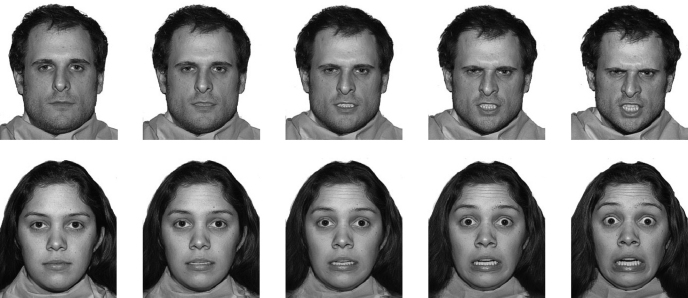
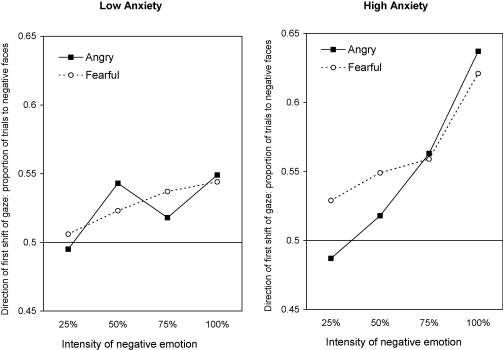
Verification
Claims the paper makes
The claims and statistics of this paper haven’t been checked yet.
Run the check — free, no account needed. It reads the open-access text and checks the sources it cites.
Claims other papers make about this one
Each is checked against this paper’s own text: does it say what the citing paper says it does?
The cited source says what the claim attributes to it.
In the citing paper
“Anxious individuals preferentially attend to threat (e.g. Mogg, Garner, & Bradley, 2007)”
From Testing the differential effects of acceptance and attention-based psychological interventions on intrusive thoughts and worry (2017) · cites this paper as Mogg, Garner, & Bradley, 2007
Self-check
Percentages, sums and reported differences re-computed from the paper’s own numbers.
The self-check needs the paper’s full text.
Citations
Cites
(1970) · Cited by 24,983
The cognitive control of emotion
OCHSNER, K., & GROSS, J. (2005) · Trends in Cognitive Sciences · doi:10.1016/j.tics.2005.03.010 · Cited by 4,495
(1996) · Cited by 3,692
The amygdala: vigilance and emotion
Davis, M., & Whalen, P. J. (2001) · Molecular Psychiatry · doi:10.1038/sj.mp.4000812 · Cited by 2,882
(1985) · Cited by 2,882
Whalen, P. J., Rauch, S. L., Etcoff, N. L., McInerney, S. C., Lee, M. B., & Jenike, M. A. (1998) · The Journal of Neuroscience · doi:10.1523/jneurosci.18-01-00411.1998 · Cited by 2,205
Methods for dealing with reaction time outliers.
Ratcliff, R. (1993) · Psychological Bulletin · doi:10.1037/0033-2909.114.3.510 · Cited by 2,142
Cognitive Psychology and Emotional Disorders
Williams, J. M. G. (1988) · UWA Profiles and Research Repository (UWA) · Cited by 1,871
Short, homogeneous versions of the Marlow-Crowne Social Desirability Scale
Strahan, R. F., & Gerbasi, K. C. (1972) · Journal of Clinical Psychology · doi:10.1002/1097-4679(197204)28:2 · Cited by 1,657
A cognitive-motivational analysis of anxiety.
Mogg, K., & Bradley, B. P. (1998) · Behaviour Research and Therapy · doi:10.1016/s0005-7967(98)00063-1 · Cited by 1,642
Self-citation
Cited by
Sorted by citations
Eye tracking of attention in the affective disorders: a meta-analytic review and synthesis
Armstrong, T., & Olatunji, B. O. (2012) · Clinical Psychology Review · doi:10.1016/j.cpr.2012.09.004 · Cited by 1,049
“…−20.00% Picture 2 10° Event Event Lange et al. (2011) 22 21 43 SAD Analogue −0.10% Face 16 n/a Event Event Mogg et al. (2000) 12 10 22 GAD Clinical 0.21% Face 2 2.5° Event – Mogg et al. (2007) 21 28 49 GAD Analogue −0.04% Face 2 3.85° Event – Pflugshaupt et al. (2007) 21 21 42 SP Clinical 0.14%…”
InfluentialProcessing of facial emotion expression in major depression: a review
Bourke, C., Douglas, K., & Porter, R. (2010) · Australian & New Zealand Journal of Psychiatry · doi:10.3109/00048674.2010.496359 · Cited by 557
Bos, P. A., Panksepp, J., Bluthé, R.-M., & Honk, J. V. (2012) · Frontiers in Neuroendocrinology · doi:10.1016/j.yfrne.2011.01.002 · Cited by 429
Stress and anxiety detection using facial cues from videos
Giannakakis, G. A., Pediaditis, M., Manousos, D., Kazantzaki, E., Chiarugi, F., Simos, P. G., Kostas Marias, A., & Tsiknakis, M. (2016) · Biomedical Signal Processing and Control · doi:10.1016/j.bspc.2016.06.020 · Cited by 360
Measuring attentional bias to threat: reliability of dot probe and eye movement indices
Waechter, S., Nelson, A. L., Wright, C., Hyatt, A., & Oakman, J. (2014) · Cognitive Therapy and Research · doi:10.1007/s10608-013-9588-2 · Cited by 324
Metadata
- Authors
- Mogg, K., Garner, M., & Bradley, B. P.
- Affiliations
- University of Southampton (GB)
- Corresponding author
- Mogg, Karin
- Venue
- Biological Psychology
- Publisher
- Elsevier BV
- Published
- 2007-10
- Volume
- 76
- Issue
- 3
- Pages
- 163-169
- ISSN
- 0301-0511 (ISSN-L)
- PMC
- PMC2075532
- OpenAlex
- W2040924069
- Cited by
- 192
- References
- 41
- Citations by year
- 2026: 2 · 2025: 5 · 2024: 8 · 2023: 7 · 2022: 11 · 2021: 7 · 2020: 11 · 2019: 8 · 2018: 7 · 2017: 8 · 2016: 16 · 2015: 11 · 2014: 10 · 2013: 19 · 2012: 11
- FWCI
- 5.51
- Type
- journal article
- Language
- en
- Open access
- hybrid
- doi.org
- Licence
- Locations
- Biological Psychology (publishedVersion, cc-by)
- PubMed Central (publishedVersion, cc-by)
- PubMed (publishedVersion)
- ePrints Soton (University of Southampton) (acceptedVersion)
- Funders
- Wellcome Trust (51076)
- Topics
- Life Sciences › Neuroscience › Cognitive Neuroscience › Face Recognition and Perception
- Social Sciences › Psychology › Experimental and Cognitive Psychology › Anxiety, Depression, Psychometrics, Treatment, Cognitive Processes
- Life Sciences › Neuroscience › Cognitive Neuroscience › Neural and Behavioral Psychology Studies
- Keywords
- anxiety, threat processing, amygdala, attentional bias, fearful faces, angry faces, facial expressions, emotional intensity, individual differences, attentional vigilance
- MeSH terms
- Adolescent, Adult, Analysis of Variance, Anger, Anxiety, Attention, Facial Expression, Fear, Female, Fixation, Ocular, Humans, Male, Pattern Recognition, Visual, Reaction Time
About these checks
Registry, retraction, Cites and statistics results are computed, not judged, with one exception: a printed reference that no index lists is read once by a model before it counts as a citation error. Claims are extracted by a model and kept only when their quote appears verbatim in the text; each cited source is then checked, with a model’s help, for whether it says what the claim relies on. Those verdicts can be wrong — read the claim’s quote and the cited source before relying on one.
Statistics and arithmetic are recomputed, not judged.
Confidence bands are shown only for fields calibrated on our annotated test set. None is calibrated yet, so no band is shown.
What counts as a claim ›How we measure confidence ›How we check this ›
Are you an author, or do you see a problem with this page? Request a review
