

The DOI matches its Crossref record; 42 of the 42 references it cites were found in a registry or an index.
Anxiety and orienting of gaze to angry and fearful faces
Open accessAbstract
Neuroscience research indicates that individual differences in anxiety may be attributable to a neural system for threat-processing, involving the amygdala, which modulates attentional vigilance, and which is more sensitive to fearful than angry faces. Complementary cognitive studies indicate that high-anxious individuals show enhanced visuospatial orienting towards angry faces, but it is unclear whether fearful faces elicit a similar attentional bias. This study compared biases in initial orienting of gaze to fearful and angry faces, which varied in emotional intensity, in high- and low-anxious individuals. Gaze was monitored whilst participants viewed a series of face-pairs. Results showed that fearful and angry faces elicited similar attentional biases. High-anxious individuals were more likely to direct gaze at intense negative facial expressions, than low-anxious individuals, whereas the groups did not differ in orienting to mild negative expressions. Implications of the findings for research into the neural and cognitive bases of emotion processing are discussed.
Overview
The claims and statistics of this paper haven’t been checked yet.
Run the check — free, no account needed. It reads the open-access text and checks the sources it cites.
Integrity signals
Registry
Cites
Statistics
Figures
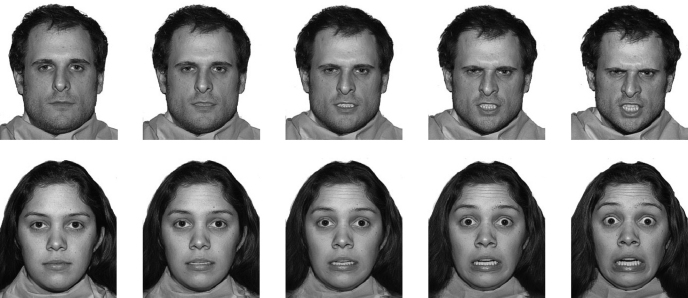
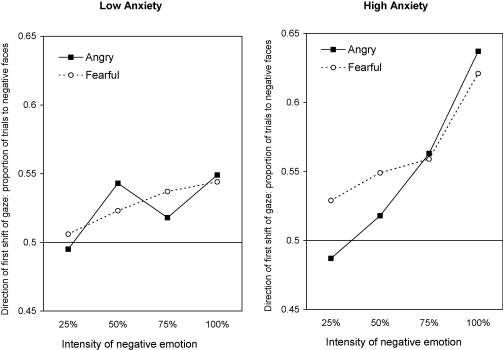
Verification
Claims the paper makes
The claims and statistics of this paper haven’t been checked yet.
Run the check — free, no account needed. It reads the open-access text and checks the sources it cites.
Claims other papers make about this one
Each is checked against this paper’s own text: does it say what the citing paper says it does?
The cited source says what the claim attributes to it.
In the citing paper
“Anxious individuals preferentially attend to threat (e.g. Mogg, Garner, & Bradley, 2007)”
From Testing the differential effects of acceptance and attention-based psychological interventions on intrusive thoughts and worry (2017) · cites this paper as Mogg, Garner, & Bradley, 2007
Self-check
Percentages, sums and reported differences re-computed from the paper’s own numbers.
The self-check needs the paper’s full text.
Citations
Cites
(1970) · Cited by 24,983
The cognitive control of emotion
OCHSNER, K., & GROSS, J. (2005) · Trends in Cognitive Sciences · doi:10.1016/j.tics.2005.03.010 · Cited by 4,495
(1996) · Cited by 3,692
The amygdala: vigilance and emotion
Davis, M., & Whalen, P. J. (2001) · Molecular Psychiatry · doi:10.1038/sj.mp.4000812 · Cited by 2,882
(1985) · Cited by 2,882
Whalen, P. J., Rauch, S. L., Etcoff, N. L., McInerney, S. C., Lee, M. B., & Jenike, M. A. (1998) · The Journal of Neuroscience · doi:10.1523/jneurosci.18-01-00411.1998 · Cited by 2,205
Methods for dealing with reaction time outliers.
Ratcliff, R. (1993) · Psychological Bulletin · doi:10.1037/0033-2909.114.3.510 · Cited by 2,142
Cognitive Psychology and Emotional Disorders
Williams, J. M. G. (1988) · UWA Profiles and Research Repository (UWA) · Cited by 1,871
Short, homogeneous versions of the Marlow-Crowne Social Desirability Scale
Strahan, R. F., & Gerbasi, K. C. (1972) · Journal of Clinical Psychology · doi:10.1002/1097-4679(197204)28:2 · Cited by 1,657
A cognitive-motivational analysis of anxiety.
Mogg, K., & Bradley, B. P. (1998) · Behaviour Research and Therapy · doi:10.1016/s0005-7967(98)00063-1 · Cited by 1,642
Self-citation
Cited by
Sorted by citations
Eye tracking of attention in the affective disorders: a meta-analytic review and synthesis
Armstrong, T., & Olatunji, B. O. (2012) · Clinical Psychology Review · doi:10.1016/j.cpr.2012.09.004 · Cited by 1,049
“…−20.00% Picture 2 10° Event Event Lange et al. (2011) 22 21 43 SAD Analogue −0.10% Face 16 n/a Event Event Mogg et al. (2000) 12 10 22 GAD Clinical 0.21% Face 2 2.5° Event – Mogg et al. (2007) 21 28 49 GAD Analogue −0.04% Face 2 3.85° Event – Pflugshaupt et al. (2007) 21 21 42 SP Clinical 0.14%…”
InfluentialProcessing of facial emotion expression in major depression: a review
Bourke, C., Douglas, K., & Porter, R. (2010) · Australian & New Zealand Journal of Psychiatry · doi:10.3109/00048674.2010.496359 · Cited by 557
Bos, P. A., Panksepp, J., Bluthé, R.-M., & Honk, J. V. (2012) · Frontiers in Neuroendocrinology · doi:10.1016/j.yfrne.2011.01.002 · Cited by 429
Stress and anxiety detection using facial cues from videos
Giannakakis, G. A., Pediaditis, M., Manousos, D., Kazantzaki, E., Chiarugi, F., Simos, P. G., Kostas Marias, A., & Tsiknakis, M. (2016) · Biomedical Signal Processing and Control · doi:10.1016/j.bspc.2016.06.020 · Cited by 360
Measuring attentional bias to threat: reliability of dot probe and eye movement indices
Waechter, S., Nelson, A. L., Wright, C., Hyatt, A., & Oakman, J. (2014) · Cognitive Therapy and Research · doi:10.1007/s10608-013-9588-2 · Cited by 324
Empirical recommendations for improving the stability of the dot-probe task in clinical research.
Price, R. B., Kuckertz, J. M., Siegle, G. J., Ladouceur, C. D., Silk, J. S., Ryan, N. D., Dahl, R. E., & Amir, N. (2015) · Psychological Assessment · doi:10.1037/pas0000036 · Cited by 312
Cognitive vulnerability to anxiety: A review and an integrative model
Ouimet, A. J., Gawronski, B., & Dozois, D. J. A. (2009) · Clinical Psychology Review · doi:10.1016/j.cpr.2009.05.004 · Cited by 283
Exploring the function of selective attention and hypervigilance for threat in anxiety
Richards, H. J., Benson, V., Donnelly, N., & Hadwin, J. A. (2014) · Clinical Psychology Review · doi:10.1016/j.cpr.2013.10.006 · Cited by 221
The current status of research on the structure of evaluative space
Norris, C. J., Gollan, J. K., Berntson, G. G., & Cacioppo, J. T. (2010) · Biological Psychology · doi:10.1016/j.biopsycho.2010.03.011 · Cited by 244
Perception of Face and Body Expressions Using Electromyography, Pupillometry and Gaze Measures
Kret, M. E., Stekelenburg, J. J., Karin Roelofs, A., & de Gelder, B. (2013) · Frontiers in Psychology · doi:10.3389/fpsyg.2013.00028 · Cited by 174
Peña-Gómez, C., Dídac Vidal-piñeiro, A., Clemente, I. C., Pascual‐Leone, Á., & Bartrés‐Faz, D. (2011) · PLoS ONE · doi:10.1371/journal.pone.0022812 · Cited by 187
Pearson, R. M., Lightman, S. L., & Evans, J. (2009) · Hormones and Behavior · doi:10.1016/j.yhbeh.2009.09.013 · Cited by 136
Ironside, M., O’Shea, J., Cowen, P. J., & Harmer, C. J. (2016) · Biological Psychiatry · doi:10.1016/j.biopsych.2015.06.012 · Cited by 125
Hedger, N., Gray, K. L. H., Garner, M., & Adams, W. J. (2016) · Psychological Bulletin · doi:10.1037/bul0000054 · Cited by 115
Self-citationReinholdt‐Dunne, M. L., Mogg, K., & Bradley, B. P. (2009) · Behaviour Research and Therapy · doi:10.1016/j.brat.2009.01.012 · Cited by 132
Self-citationPrice, R. B., Rosen, D., Siegle, G. J., Ladouceur, C. D., Tang, K., Allen, K. B., Ryan, N. D., Dahl, R. E., Forbes, E. E., & Silk, J. S. (2016) · Journal of Abnormal Psychology · doi:10.1037/abn0000127 · Cited by 114
Kujawa, A., MacNamara, A., Fitzgerald, K. D., Monk, C. S., & Phan, K. L. (2015) · Research on Child and Adolescent Psychopathology · doi:10.1007/s10802-015-0029-4 · Cited by 117
Short-term antidepressant treatment modulates amygdala response to happy faces
Norbury, R., Taylor, M. J., Selvaraj, S., Murphy, S. E., Harmer, C. J., & Cowen, P. J. (2009) · Psychopharmacology · doi:10.1007/s00213-009-1597-1 · Cited by 109
Beevers, C. G., Lee, H.-J., Wells, T. T., Ellis, A. J., & Telch, M. J. (2011) · American Journal of Psychiatry · doi:10.1176/appi.ajp.2011.10091309 · Cited by 106
Bethell, E., Holmes, A., MacLarnon, A. M., & Semple, S. (2016) · Behavioral Sciences · doi:10.3390/bs6010002 · Cited by 103
Clauss, K. E., Gorday, J. Y., & Bardeen, J. R. (2022) · Clinical Psychology Review · doi:10.1016/j.cpr.2022.102142 · Cited by 121
Anger in PTSD: Is there a need for a concept of PTSD-related posttraumatic anger?
McHugh, T., Forbes, D., Bates, G. W., Hopwood, M., & Creamer, M. C. (2011) · Clinical Psychology Review · doi:10.1016/j.cpr.2011.07.013 · Cited by 101
Carré, J. M., Fisher, P. M., Manuck, S. B., & Hariri, A. R. (2010) · Social Cognitive and Affective Neuroscience · doi:10.1093/scan/nsq101 · Cited by 98
No effect of inversion on attentional and affective processing of facial expressions.
Lipp, O., Price, S., & Tellegen, C. (2009) · Emotion · doi:10.1037/a0014715 · Cited by 90
Keeping Your Eyes on the Prize
Ford, B. Q., Tamir, M., Brunyé, T. T., Shirer, W. R., Mahoney, C. R., & Taylor, H. A. (2010) · Psychological Science · doi:10.1177/0956797610375450 · Cited by 93
Genetics of emotion regulation
Canli, T., Ferri, J. M., & Duman, E. A. (2009) · Neuroscience · doi:10.1016/j.neuroscience.2009.06.049 · Cited by 103
LOOKING UNDER THE HOOD OF THE DOT-PROBE TASK: AN fMRI STUDY IN ANXIOUS YOUTH
Price, R. B., Siegle, G. J., Silk, J. S., Ladouceur, C. D., McFarland, A. M., Dahl, R. E., & Ryan, N. D. (2014) · Depression and Anxiety · doi:10.1002/da.22255 · Cited by 88
Kanske, P., & Kotz, S. A. (2012) · Biological Psychology · doi:10.1016/j.biopsycho.2012.04.007 · Cited by 92
In the face of fear: Anxiety sensitizes defensive responses to fearful faces
Grillon, C., & Charney, D. R. (2011) · Psychophysiology · doi:10.1111/j.1469-8986.2011.01268.x · Cited by 86
Hikosaka, O., Yamamoto, S., Yasuda, M., & Kim, H. F. (2013) · Trends in Cognitive Sciences · doi:10.1016/j.tics.2013.07.001 · Cited by 88
Pearson, R. M., Lightman, S. L., & Evans, J. (2010) · Archives of Women s Mental Health · doi:10.1007/s00737-010-0180-4 · Cited by 90
Attentional bias towards negative stimuli in healthy individuals and the effects of trait anxiety
Veerapa, E., Grandgenevre, P., El Fayoumi, M., Vinnac, B., Haelewyn, O., Szaffarczyk, S., Vaiva, G., & D’Hondt, F. (2020) · Scientific Reports · doi:10.1038/s41598-020-68490-5 · Cited by 73
Neurocognitive mechanisms of gaze-expression interactions in face processing and social attention
Graham, R., & LaBar, K. S. (2012) · Neuropsychologia · doi:10.1016/j.neuropsychologia.2012.01.019 · Cited by 81
Price, R. B., Siegle, G. J., Silk, J. S., Ladouceur, C. D., McFarland, A. M., Dahl, R. E., & Ryan, N. D. (2012) · Depression and Anxiety · doi:10.1002/da.21966 · Cited by 73
Sustained Preferential Processing of Social Threat Cues: Bias without Competition?
Wieser, M. J., McTeague, L. M., & Keil, A. (2010) · Journal of Cognitive Neuroscience · doi:10.1162/jocn.2010.21566 · Cited by 75
Adenauer, H., Pinoesch, S., Catani, C., Gola, H., KEIL, J. E., Kissler, J. M., & Neuner, F. (2010) · Biological Psychiatry · doi:10.1016/j.biopsych.2010.05.015 · Cited by 72
Restoring effects of oxytocin on the attentional preference for faces in autism
Kanat, M., Spenthof, I., Riedel, A., van Elst, L. T., Heinrichs, M., & Domes, G. (2017) · Translational Psychiatry · doi:10.1038/tp.2017.67 · Cited by 70
Amygdala responses to avertedvsdirect gaze fear vary as a function of presentation speed
Adams, R. B., Franklin, R. G., Kveraga, K., Ambady, N., Kleck, R. E., Whalen, P. J., Hadjikhani, N. K., & Nelson, A. J. (2011) · Social Cognitive and Affective Neuroscience · doi:10.1093/scan/nsr038 · Cited by 74
Richards, A., Holmes, A., Pell, P. J., & Bethell, E. (2013) · Social Neuroscience · doi:10.1080/17470919.2013.854273 · Cited by 67
Simplicio, M. C. D., Norbury, R., Reinecke, A., & Harmer, C. J. (2013) · Psychological Medicine · doi:10.1017/s0033291713000731 · Cited by 67
Leleu, V., Douilliez, C., & Rusinek, S. (2013) · Journal of Behavior Therapy and Experimental Psychiatry · doi:10.1016/j.jbtep.2013.10.007 · Cited by 65
Oxytocin modulates amygdala reactivity to masked fearful eyes
Kanat, M., Heinrichs, M., Mader, I., van Elst, L. T., & Domes, G. (2015) · Neuropsychopharmacology · doi:10.1038/npp.2015.111 · Cited by 65
The HTR1A and HTR1B receptor genes influence stress-related information processing
Mekli, K., Payton, A., Miyajima, F., Platt, H., Thomas, E., Downey, D., Lloyd-Williams, K., Chase, D. S., Toth, Z. G., Elliott, R., et al. (2010) · European Neuropsychopharmacology · doi:10.1016/j.euroneuro.2010.06.013 · Cited by 62
Ekman (1993) · doi:10.1016/j.neuropsychologia.2009.11.023 · Cited by 68
Dawson, S. J., & Chivers, M. L. (2016) · PLoS ONE · doi:10.1371/journal.pone.0152785 · Cited by 56
Anxiety responses in Balb/c, c57 and CD-1 mice exposed to a novel open space test
Michalíková, S., van Rensburg, R., Chazot, P. L., & Ennaceur, A. (2009) · Behavioural Brain Research · doi:10.1016/j.bbr.2009.10.028 · Cited by 56
Anxiety and selective attention to angry faces: an antisaccade study
Reinholdt-Dunne, M. L., Mogg, K., Benson, V., Bradley, B. P., Hardin, M. G., Liversedge, S. P., Pine, D. S., & Ernst, M. (2012) · Journal of Cognitive Psychology · doi:10.1080/20445911.2011.560111 · Cited by 54
Self-citationDodd, H. F., & Porter, M. A. (2010) · Cognitive Neuropsychiatry · doi:10.1080/13546801003737157 · Cited by 54
Naltrexone alters the processing of social and emotional stimuli in healthy adults
Wardle, M. C., Bershad, A. K., & de Wit, H. (2015) · Social Neuroscience · doi:10.1080/17470919.2015.1136355 · Cited by 52
(De)coupling of our eyes and our mind’s eye: A dynamic process perspective on attentional bias.
Amir, I., Zvielli, A., & Bernstein, A. (2016) · Emotion · doi:10.1037/emo0000172 · Cited by 51
Thompson‐Booth, C., Viding, E. M., Mayes, L. C., Rutherford, H. J. V., Hodsoll, S., & McCrory, E. J. P. (2014) · PLoS ONE · doi:10.1371/journal.pone.0109362 · Cited by 52
Price, R. B., Allen, K. B., Silk, J. S., Ladouceur, C. D., Ryan, N. D., Dahl, R. E., Forbes, E. E., & Siegle, G. J. (2016) · Developmental Cognitive Neuroscience · doi:10.1016/j.dcn.2016.03.001 · Cited by 50
Morris, L. S., Tan, A., Smith, D., Grehl, M. M., Han-Huang, K., Naidich, T. P., Charney, D. S., Balchandani, P., Kundu, P., & Murrough, J. W. (2020) · NeuroImage Clinical · doi:10.1016/j.nicl.2019.102148 · Cited by 49
Selective attention to fearful faces during pregnancy
Roos, A., Löchner, C., Kidd, M., van Honk, J., Vythilingum, B., & Stein, D. J. (2011) · Progress in Neuro-Psychopharmacology and Biological Psychiatry · doi:10.1016/j.pnpbp.2011.11.012 · Cited by 53
Emotional faces guide the eyes in the absence of awareness
Vetter, P., Badde, S., Phelps, E. A., & Carrasco, M. (2019) · eLife · doi:10.7554/elife.43467 · Cited by 48
Culture, gaze and the neural processing of fear expressions
Adams, R. B., Franklin, R. G., Rule, N. O., Freeman, J. B., Kveraga, K., Hadjikhani, N., Yoshikawa, S., & Ambady, N. (2010) · Social Cognitive and Affective Neuroscience · doi:10.1093/scan/nsp047 · Cited by 47
Hou, R., Moss-Morris, R., Risdale, A., Lynch, J., Jeevaratnam, P., Bradley, B. P., & Mogg, K. (2014) · Behaviour Research and Therapy · doi:10.1016/j.brat.2013.10.005 · Cited by 47
Self-citationVisual Attention Patterns of Women with Androphilic and Gynephilic Sexual Attractions
Dawson, S. J., Fretz, K. M., & Chivers, M. L. (2016) · Archives of Sexual Behavior · doi:10.1007/s10508-016-0825-0 · Cited by 47
Stevens, S., Rist, F., & Gerlach, A. L. (2010) · Journal of Behavior Therapy and Experimental Psychiatry · doi:10.1016/j.jbtep.2010.11.001 · Cited by 46
Establishing trust with children
Krauss, B. A., Leroy, P. L. J. M., & KRAUSS, B. S. (2024) · European Journal of Pediatrics · doi:10.1007/s00431-024-05704-2 · Cited by 46
Jusyte, A., & Schönenberg, M. (2013) · Psychiatry Research · doi:10.1016/j.psychres.2013.12.031 · Cited by 43
Savulich, G., Shergill, S. S., & Yiend, J. (2012) · Journal of Experimental Psychopathology · doi:10.5127/jep.016711 · Cited by 46
Raz, S. (2014) · Behavioural Brain Research · doi:10.1016/j.bbr.2014.03.021 · Cited by 50
Is there a mutual relationship between opposite attentional biases underlying anxiety?
Onnis, R., Dadds, M. R., & Bryant, R. A. (2011) · Emotion · doi:10.1037/a0022019 · Cited by 49
Hollocks, M. J., Ozsivadjian, A., Matthews, C. E., Howlin, P., & Simonoff, E. A. (2013) · Autism Research · doi:10.1002/aur.1285 · Cited by 42
The effect of fear on attentional processing in a sample of healthy females
Finucane, A., & Power, M. (2009) · Journal of Anxiety Disorders · doi:10.1016/j.janxdis.2009.08.005 · Cited by 48
How do different kinds of incidental emotions influence risk decision making?
Yang, Q., Zhou, S., Gu, R., & Wu, Y. (2020) · Biological Psychology · doi:10.1016/j.biopsycho.2020.107920 · Cited by 43
Social Vision: Functional Forecasting and the Integration of Compound Social Cues
Adams, R. B., & Kveraga, K. (2015) · Review of Philosophy and Psychology · doi:10.1007/s13164-015-0256-1 · Cited by 38
Goddard, E., Carral-Fernández, L., Denneny, E., Campbell, I. C., & Treasure, J. L. (2013) · The World Journal of Biological Psychiatry · doi:10.3109/15622975.2012.750014 · Cited by 39
Pupillometric and saccadic measures of affective and executive processing in anxiety
Hepsomali, P., Hadwin, J. A., Liversedge, S. P., & Garner, M. J. (2017) · Biological Psychology · doi:10.1016/j.biopsycho.2017.05.013 · Cited by 37
Self-citationLau, J. Y. F., Hilbert, K., Goodman, R., Gregory, A. M., Pine, D. S., Viding, E. M., & Eley, T. C. (2012) · Biology of Mood & Anxiety Disorders · doi:10.1186/2045-5380-2-12 · Cited by 35
Verbal and facial‐emotional Stroop tasks reveal specific attentional interferences in sad mood
Isaac, L., Vrijsen, J. N., Eling, P., van Oostrom, I., Speckens, A., & Becker, E. S. (2012) · Brain and Behavior · doi:10.1002/brb3.38 · Cited by 35
“Once again, a possible explanation for why the present study found significance for threat stimuli in sad mood while others have found this primarily in anxious samples (e.g.,Van Honk et al. 2001; Mogg and Bradley 2002; Mogg et al. 2007) can perhaps be due to the exclusive use of verbal stimuli.”
BackgroundChildhood anxiety and attention to emotion faces in a modified stroop task
Hadwin, J. A., Donnelly, N., Richards, A., French, C. C., & Patel, U. (2008) · British Journal of Developmental Psychology · doi:10.1348/026151008x315503 · Cited by 35
Processing emotional stimuli: Comparison of saccadic and manual choice-reaction times
Bannerman, R. L., Milders, M. M., & Sahraie, A. (2008) · Cognition & Emotion · doi:10.1080/02699930802243303 · Cited by 35
Aversive eye gaze during a speech in virtual environment in patients with social anxiety disorder
Kim, H., Shin, J. E., Hong, Y.-J., Shin, Y., Shin, Y. S., Han, K., Kim, J., & Choi, S. (2017) · Australian & New Zealand Journal of Psychiatry · doi:10.1177/0004867417714335 · Cited by 34
Conejero, Á., & Rueda, M. R. (2018) · Scientific Reports · doi:10.1038/s41598-018-28831-x · Cited by 34
Kaiser, D., Jacob, G. A., van Zutphen, L., Siep, N., Sprenger, A., Tuschen‐Caffier, B., Senft, A., Arntz, A. R., & Domes, G. (2019) · Journal of Personality Disorders · doi:10.1521/pedi_2019_33_363 · Cited by 33
Freeman, T. P., Morgan, C. J. A., Beesley, T., & Curran, H. V. (2011) · Psychological Medicine · doi:10.1017/s0033291711001139 · Cited by 33
The importance of awareness in face processing: A critical review of interocular suppression studies
Lanfranco, R. C., Rabagliati, H., & Carmel, D. P. (2022) · Behavioural Brain Research · doi:10.1016/j.bbr.2022.114116 · Cited by 32
Petrova, K., Wentura, D., & Bermeitinger, C. (2013) · PLoS ONE · doi:10.1371/journal.pone.0076335 · Cited by 32
The impact of task-irrelevant emotional stimuli on attention in three domains.
O’Toole, L. J., DeCicco, J. M., Hong, M., & Dennis, T. A. (2011) · Emotion · doi:10.1037/a0024369 · Cited by 32
Bunford, N., Kujawa, A., Swain, J. E., Fitzgerald, K. D., Monk, C. S., & Phan, K. L. (2016) · European Child & Adolescent Psychiatry · doi:10.1007/s00787-016-0883-9 · Cited by 31
Neuhaus, E., Jones, E. J. H., Barnes, K., Sterling, L., Estes, A. M., MUNSON, J. A., Dawson, G., & Webb, S. J. (2016) · Journal of Autism and Developmental Disorders · doi:10.1007/s10803-016-2780-y · Cited by 28
The Perception of Facial Emotion in Typical and Atypical Development
Bayet, L., & Nelson, C. A. (2019) · Springer eBooks · doi:10.1007/978-3-030-17332-6_6 · Cited by 31
Demertzis, K. H., & Craske, M. G. (2006) · Springer eBooks · doi:10.1007/978-0-387-28370-8_30 · Cited by 27
Cooper, R., Bailey, J., Diaper, A., Stirland, R., Renton, L. E., Benton, C., Penton-Voak, I., Nutt, D., & Munafo, M. (2011) · Cognition & Emotion · doi:10.1080/02699931.2010.508887 · Cited by 28
Holas, P., Krejtz, I., Cypryańska, M., & Nezlek, J. B. (2014) · Psychiatry Research · doi:10.1016/j.psychres.2014.06.005 · Cited by 27
The Angry Spotlight: Trait Anger and Selective Visual Attention to Rewards
Ford, B. Q., Tamir, M., Gagnon, S. A., Taylor, H. A., & Brunyé, T. T. (2012) · European Journal of Personality · doi:10.1002/per.1840 · Cited by 29
Wabnitz, P., Martens, U., & Neuner, F. (2015) · Cognition & Emotion · doi:10.1080/02699931.2015.1019837 · Cited by 23
Affective priming enhances gaze cueing effect.
Ishikawa, M., Haensel, J. X., Smith, T. J., Senju, A., & Itakura, S. (2020) · Journal of Experimental Psychology Human Perception & Performance · doi:10.1037/xhp0000880 · Cited by 24
Rosen, D. K., Price, R. B., & Silk, J. S. (2019) · Journal of Anxiety Disorders · doi:10.1016/j.janxdis.2019.04.003 · Cited by 25
Child temperamental reactivity and self-regulation effects on attentional biases
Susa, G., Bengà, O., Pitică, I., & Miclea, M. (2014) · Frontiers in Psychology · doi:10.3389/fpsyg.2014.00922 · Cited by 27
Felmingham, K. L., Stewart, L. F., Kemp, A. H., & Carr, A. R. (2016) · Biological Psychology · doi:10.1016/j.biopsycho.2016.04.001 · Cited by 24
Emotional intelligence and attentional bias for threat‐related emotion under stress
Davis, S. K. (2018) · Scandinavian Journal of Psychology · doi:10.1111/sjop.12439 · Cited by 22
Cushing, C. A., Im, H. Y., Adams, R. B., Ward, N., Albohn, D. N., Steiner, T. G., & Kveraga, K. (2018) · Scientific Reports · doi:10.1038/s41598-018-20509-8 · Cited by 23
Hsu, K. J., Forgeard, M. J. C., Stein, A. T., Beard, C., & Björgvinsson, Þ. (2019) · Journal of Affective Disorders · doi:10.1016/j.jad.2019.01.017 · Cited by 22
Early gamma-band activity as a function of threat processing in the extrastriate visual cortex
Maratos, F. A., Senior, C., Mogg, K., Bradley, B. P., & Rippon, G. (2011) · Cognitive Neuroscience · doi:10.1080/17588928.2011.613989 · Cited by 21
Self-citationA Multimodal Data-Driven Framework for Anxiety Screening
Mo, H., Hui, S. C., Liao, X., Li, Y., Zhang, W., & Ding, S. (2024) · IEEE Transactions on Instrumentation and Measurement · doi:10.1109/tim.2024.3352713 · Cited by 20
Vigilant attention to threat, sleep patterns, and anxiety in peripubertal youth
Ricketts, E. J., Price, R. B., Siegle, G. J., Silk, J. S., Forbes, E. E., Ladouceur, C. D., Harvey, A. G., Ryan, N. D., Dahl, R. E., & McMakin, D. L. (2018) · Journal of Child Psychology and Psychiatry · doi:10.1111/jcpp.12923 · Cited by 19
Examining the validity and fidelity of a virtual reality simulator for basic life support training
Arthur, T., Loveland-Perkins, T., Williams, C., Harris, D., Wilson, M., de Burgh, T., Dhanda, J., & Vine, S. J. (2023) · BMC Digital Health · doi:10.1186/s44247-023-00016-1 · Cited by 19
Metadata
- Authors
- Mogg, K., Garner, M., & Bradley, B. P.
- Affiliations
- University of Southampton (GB)
- Corresponding author
- Mogg, Karin
- Venue
- Biological Psychology
- Publisher
- Elsevier BV
- Published
- 2007-10
- Volume
- 76
- Issue
- 3
- Pages
- 163-169
- ISSN
- 0301-0511 (ISSN-L)
- PMC
- PMC2075532
- OpenAlex
- W2040924069
- Cited by
- 192
- References
- 41
- Citations by year
- 2026: 2 · 2025: 5 · 2024: 8 · 2023: 7 · 2022: 11 · 2021: 7 · 2020: 11 · 2019: 8 · 2018: 7 · 2017: 8 · 2016: 16 · 2015: 11 · 2014: 10 · 2013: 19 · 2012: 11
- FWCI
- 5.51
- Type
- journal article
- Language
- en
- Open access
- hybrid
- doi.org
- Licence
- Locations
- Biological Psychology (publishedVersion, cc-by)
- PubMed Central (publishedVersion, cc-by)
- PubMed (publishedVersion)
- ePrints Soton (University of Southampton) (acceptedVersion)
- Funders
- Wellcome Trust (51076)
- Topics
- Life Sciences › Neuroscience › Cognitive Neuroscience › Face Recognition and Perception
- Social Sciences › Psychology › Experimental and Cognitive Psychology › Anxiety, Depression, Psychometrics, Treatment, Cognitive Processes
- Life Sciences › Neuroscience › Cognitive Neuroscience › Neural and Behavioral Psychology Studies
- Keywords
- anxiety, threat processing, amygdala, attentional bias, fearful faces, angry faces, facial expressions, emotional intensity, individual differences, attentional vigilance
- MeSH terms
- Adolescent, Adult, Analysis of Variance, Anger, Anxiety, Attention, Facial Expression, Fear, Female, Fixation, Ocular, Humans, Male, Pattern Recognition, Visual, Reaction Time
About these checks
Registry, retraction, Cites and statistics results are computed, not judged, with one exception: a printed reference that no index lists is read once by a model before it counts as a citation error. Claims are extracted by a model and kept only when their quote appears verbatim in the text; each cited source is then checked, with a model’s help, for whether it says what the claim relies on. Those verdicts can be wrong — read the claim’s quote and the cited source before relying on one.
Statistics and arithmetic are recomputed, not judged.
Confidence bands are shown only for fields calibrated on our annotated test set. None is calibrated yet, so no band is shown.
What counts as a claim ›How we measure confidence ›How we check this ›
Are you an author, or do you see a problem with this page? Request a review
