

The DOI matches its Crossref record; 40 of the 41 references it cites were found in a registry or an index.
Nothing is safe: Intolerance of uncertainty is associated with compromised fear extinction learning
Open accessAbstract
Extinction-resistant fear is considered to be a central feature of pathological anxiety. Here we sought to determine if individual differences in Intolerance of Uncertainty (IU), a potential risk factor for anxiety disorders, underlies compromised fear extinction. We tested this hypothesis by recording electrodermal activity in 38 healthy participants during fear acquisition and extinction. We assessed the temporality of fear extinction, by examining early and late extinction learning. During early extinction, low IU was associated with larger skin conductance responses to learned threat vs. safety cues, whereas high IU was associated with skin conductance responding to both threat and safety cues, but no cue discrimination. During late extinction, low IU showed no difference in skin conductance between learned threat and safety cues, whilst high IU predicted continued fear expression to learned threat, indexed by larger skin conductance to threat vs. safety cues. These findings suggest a critical role of uncertainty-based mechanisms in the maintenance of learned fear.
Overview
The claims and statistics of this paper haven’t been checked yet.
Run the check — free, no account needed. It reads the open-access text and checks the sources it cites.
Integrity signals
Registry
Cites
Statistics
Figures
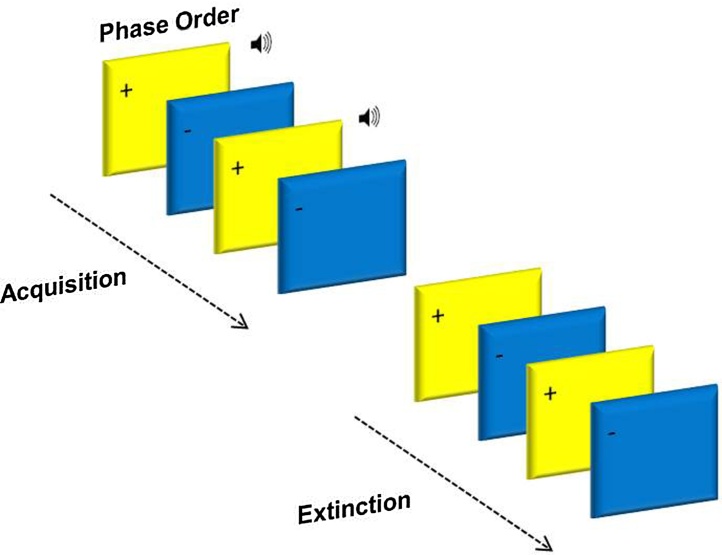
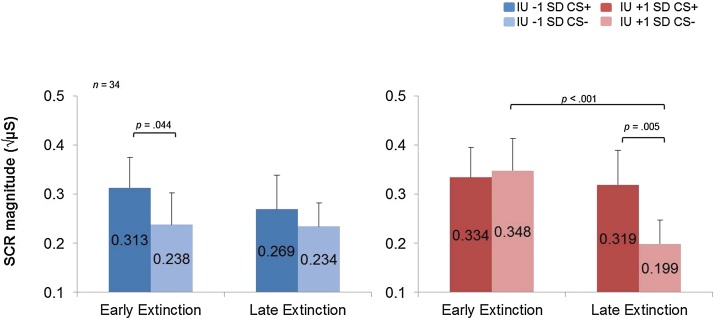
Verification
Claims the paper makes
The claims and statistics of this paper haven’t been checked yet.
Run the check — free, no account needed. It reads the open-access text and checks the sources it cites.
Claims other papers make about this one
Each is checked against this paper’s own text: does it say what the citing paper says it does?
The cited source doesn’t support the claim as written.
In the citing paper
“Two recent studies have demonstrated that individuals with high intolerance of uncertainty do not discriminate between threat and safety cues during fear acquisition and have slower fear extinction than those with low intolerance of uncertainty (Morriss, Macdonald, & van Reekum, 2016; Morriss, Christakou, & van Reekum, 2016).”
From Enhancing Inhibitory Learning: The Utility of Variability in Exposure (2019) · cites this paper as Morriss, Christakou, & van Reekum, 2016
Checked by a reasoning model — may be wrong.
Experimental — accuracy not yet measuredThe cited source doesn’t support the claim as written.
In the citing paper
“The majority of studies have found specificity of IU over other self-reported anxiety measures in predicting 1) differences in SCR to both learned threat and safety during early trials, 2) greater SCR to learned threat cues versus safety cues during late trials (36,37), or 3) greater SCR to learned threat cues across all trials (15,35).”
From I Doubt It Is Safe: A Meta-analysis of Self-reported Intolerance of Uncertainty and Threat Extinction Training (2021) · cites this paper as [37]
Checked by a reasoning model — may be wrong.
Experimental — accuracy not yet measuredThe source backs part of the claim, not all of it — or backs it for a different population, condition or comparison.
In the citing paper
“Intolerance of uncertainty may affect fear learning and fear extinction.”
From Enhancing Inhibitory Learning: The Utility of Variability in Exposure (2019) · cites this paper as Morriss, Christakou, & van Reekum, 2016
Experimental — accuracy not yet measuredThe cited source says what the claim attributes to it.
In the citing paper
“Two recent studies have demonstrated that individuals with high intolerance of uncertainty do not discriminate between threat and safety cues during fear acquisition and have slower fear extinction than those with low intolerance of uncertainty (Morriss, Macdonald, & van Reekum, 2016; Morriss, Christakou, & van Reekum, 2016).”
From Enhancing Inhibitory Learning: The Utility of Variability in Exposure (2019) · cites this paper as Morriss, Christakou, & van Reekum, 2016
The cited source says what the claim attributes to it.
In the citing paper
“In previous research, a few studies observed differences in SCR to both learned threat and safety cues during the early trials of threat extinction training (36,37).”
From I Doubt It Is Safe: A Meta-analysis of Self-reported Intolerance of Uncertainty and Threat Extinction Training (2021) · cites this paper as [37]
The cited source says what the claim attributes to it.
In the citing paper
“Notably, the original studies that found a relationship between IU and early extinction used a 100% reinforcement rate during acquisition (36,37), where the change in contingencies between acquisition and extinction are more obvious.”
From I Doubt It Is Safe: A Meta-analysis of Self-reported Intolerance of Uncertainty and Threat Extinction Training (2021) · cites this paper as [37]
In the citing paper
“We have previously shown the same experimental design to successfully evoke concomitant threat extinction psychophysiology and brain activation in adult populations41,44, similar to other labs using 100% reinforcement45.”
From Multimodal evidence for delayed threat extinction learning in adolescence and young adulthood (2019) · cites this paper as [44]
In the citing paper
“The conditioning task was identical to those used in previous studies41,42,44.”
From Multimodal evidence for delayed threat extinction learning in adolescence and young adulthood (2019) · cites this paper as [44]
Self-check
Percentages, sums and reported differences re-computed from the paper’s own numbers.
The self-check needs the paper’s full text.
Citations
Cites
Development and validation of brief measures of positive and negative affect: The PANAS scales.
Watson, D., Clark, L. A., & Tellegen, A. (1988) · Journal of Personality and Social Psychology · doi:10.1037/0022-3514.54.6.1063 · Cited by 32,433
Development and validation of the Penn State Worry Questionnaire
Meyer, T. J., Miller, M. L., Metzger, R. L., & Borkovec, T. D. (1990) · Behaviour Research and Therapy · doi:10.1016/0005-7967(90)90135-6 · Cited by 5,099 · cited 2×
“…such as expectancy of potential threat that may impede the re-establishment of a previously paired CS+ as safe, with implications for targeted treatment, with implications for targeted treatment (Dugas & Robichaud, 2007; Dunsmoor et al., In press; van der Heiden, Muris, & van der Molen, 2012)”
Neurons in medial prefrontal cortex signal memory for fear extinction
Milad, M. R., & Quirk, G. J. (2002) · Nature · doi:10.1038/nature01138 · Cited by 1,836
Effects of an expanding-spaced vs massed exposure schedule on fear reduction and return of fear
Rowe, M. K., & Craske, M. G. (1998) · Behaviour Research and Therapy · doi:10.1016/s0005-7967(97)10016-x · Cited by 1,782
Phelps, E. A., Delgado, M. R., Nearing, K. I., & LeDoux, J. E. (2004) · Neuron · doi:10.1016/j.neuron.2004.08.042 · Cited by 1,753 · cited 1×
“The conditioned response score was the first 2CS+ trials − the first 2CS − trials, similar to previous work assessing conditioned responses in extinction (Dunsmoor et al., In press; Milad et al., 2009; Phelps et al., 2004 .”
Fear Extinction as a Model for Translational Neuroscience: Ten Years of Progress
Milad, M. R., & Quirk, G. J. (2012) · Annual Review of Psychology · doi:10.1146/annurev.psych.121208.131631 · Cited by 1,466
LaBar, K. S., Gatenby, J. C., Gore, J. C., LeDoux, J. E., & Phelps, E. A. (1998) · Neuron · doi:10.1016/s0896-6273(00)80475-4 · Cited by 1,402
The intolerance of uncertainty scale: psychometric properties of the English version
Buhr, K., & Dugas, M. J. (2002) · Behaviour Research and Therapy · doi:10.1016/s0005-7967(01)00092-4 · Cited by 1,391
Neurobiological Basis of Failure to Recall Extinction Memory in Posttraumatic Stress Disorder
Milad, M. R., Pitman, R. K., Ellis, C. B., Gold, A. L., Shin, L. M., Lasko, N. B., Zeidan, M. A., Handwerger, K., Orr, S. P., & Rauch, S. L. (2009) · Biological Psychiatry · doi:10.1016/j.biopsych.2009.06.026 · Cited by 1,339 · cited 2×
“The conditioned response score was the first 2CS+ trials − the first 2CS − trials, similar to previous work assessing conditioned responses in extinction (Dunsmoor et al., In press; Milad et al., 2009; Phelps et al., 2004 .”
InfluentialThe Tie That Binds? Coherence Among Emotion Experience, Behavior, and Physiology.
Mauss, I. B., Levenson, R. W., McCarter, L., Wilhelm, F. H., & Gross, J. J. (2005) · Emotion · doi:10.1037/1528-3542.5.2.175 · Cited by 1,201
Research works printed but not linked: 1
- Spielberger, C. D., Gorsuch, R. L., Lushene, R., Vagg, P., & Jacobs, G. (1983). Palo Alto (CA): Consulting Psychologists Press, Inc. 2».
Cited by
Sorted by citations
Items 101–152 of 152
Psychological reactions of different affective temperaments to the COVID-19 pandemic
Kefeli, M. C., & Şanlı, E. (2022) · Journal of Experimental and Clinical Medicine · doi:10.52142/omujecm.39.3.2 · Cited by 2
Arslan, Ş., Delıce, O., Özpolat, G., & Omeroglu, M. (2021) · Minerva Psychiatry · doi:10.23736/s2724-6612.21.02183-7 · Cited by 2
The Effect of Social Anxiety on Threat Acquisition and Extinction: A Systematic ReviewPreprint
Wake, S. J., van Reekum, C. M., & Dodd, H. F. (2021) · doi:10.31234/osf.io/amn4h · Cited by 2
A Decision Architecture for Safety ComputationsPreprint
Tashjian, S. M., Zbozinek, T. D., & Mobbs, D. (2020) · PsyArXiv (OSF Preprints) · doi:10.31234/osf.io/4s8zb · Cited by 3
“Uncertainty computations vary across individuals, and intolerance of uncertainty is associated with both anxiety and compromised safety associations[37,38].”
BackgroundNo Evidence for Decreased Generalization of Fear Extinction in High-Trait Anxious Individuals
Endhoven, B., Krypotos, A. M., Mertens, G., & Engelhard, I. M. (2024) · Journal of Experimental Psychopathology · doi:10.1177/20438087241272700 · Cited by 1
“…by controlling for intolerance of uncertainty (i.e., the tendency to interpret uncertain situations as threatening; Hunt et al., 2022; Morriss et al., 2016) and worry (i.e., re fl ecting a more cognitive component of anxiety; Ryum et al., 2017), which are closely related to trait…”
Liu, G., Liang, Y., Yang, W., & Zheng, Y. (2025) · Psychophysiology · doi:10.1111/psyp.70131 · Cited by 1
“However, high IU individuals typically show deficits in safety learning and display generalized fear responses to safety signals (Gorka et al. 2014; Morriss et al. 2016).”
Appel, H., Mattes, A., & Gerlach, A. L. (2026) · Cognitive Behaviour Therapy · doi:10.1080/16506073.2026.2618137 · Cited by 1
“This exaggerated need for safety signals is also in line with behavioral studies showing slower fear extinction (i.e. delayed safety learning) as a function of IU (Morriss et al., 2016).”
Intolerance of uncertainty predicts altered threat expectancy ratings during reinstatement
Zuj, D. V., Dymond, S., Murray, S. B., Thomas, S., & Morriss, J. (2022) · Journal of Experimental Psychopathology · doi:10.1177/20438087221112330 · Cited by 1
“Firstly, it has been frequently identi fi ed that high IU participants show signi fi cantly less extinction than low IU participants (Morriss, 2019; Morriss et al., 2016), and it is therefore plausible that these fi ndings were driven by a reduced level of extinction, rather than reduced reinstatement…”
mufassery, M. R., Isazadegan, A., & Soleimani, E. (2022) · The Journal Of Psychological Science · doi:10.52547/jps.21.114.1193 · Cited by 2
Gao, Y., Fan, M., Li, Y., Zhao, S., Chen, W., Zhang, D., & Zheng, X.-F. (2024) · Psychology Research and Behavior Management · doi:10.2147/prbm.s447426 · Cited by 2
Multimodal assessment of the role of intolerance of uncertainty in fear acquisition and extinction
Malbec, M., Andreatta, M., & Wieser, M. J. (2024) · Biological Psychology · doi:10.1016/j.biopsycho.2024.108860 · Cited by 2
“For fear acquisition, our findings align with the majority of studies that have not observed an effect of IU on fear learning (Johnson et al., 2023; Mertens & Morriss, 2021; Morriss, 2019; Morriss, Christakou, et al., 2016; Morriss et al., 2015, 2020; Morriss, Saldarini & Chapman, Fig.”
InfluentialEcolalia en adultos sanos: correlatos cognitivos y conductuales
Morales, S. V. (2022) · UMA Editorial eBooks · doi:10.24310/mumaedmumaed.5314 · Cited by 1
Calvert, M. L., Cisler, J. M., & Bush, K. (2022) · bioRxiv (Cold Spring Harbor Laboratory) · doi:10.1101/2022.08.19.504571 · Cited by 1
A computational lens on the transdiagnostic nature of intolerance of uncertaintyPreprint
Sandhu, T., Xiao, B., & Lawson, R. P. (2022) · doi:10.31234/osf.io/eug64
Gramszlo, C. (2019) · ThinkIR: The University of Louisville's Institutional Repository (University of Louisville) · doi:10.18297/etd/3279
Morriss, J., Bell, T., Biagi, N., Johnstone, T., & van Reekum, C. M. (2020) · bioRxiv (Cold Spring Harbor Laboratory) · doi:10.1101/2020.05.23.112268
“This type of analysis with IU has been previously published elsewhere (Morriss et al., 2015, 2016).”
MethodMorriss, J., Biagi, N., & Dodd, H. F. (2019) · PsyArXiv (OSF Preprints) · doi:10.31234/osf.io/ys4ju
Meanings of Quality: Semantic-Information Distance and Total Quality Management
Steier, F., Zhao, B., Woodhams, W., & Gallup, S. P. (1993)
Wroblewski, A., Hollandt, M., Yang, Y., Ridderbusch, I. C., Pietzner, A., Szeska, C., Lotze, M., Wïttchen, H., Heinig, I., Pittig, A., et al. (2022) · doi:10.31234/osf.io/pm9z5
Shifty eyes: the impact of intolerance of uncertainty on gaze behaviour during threat conditioningPreprint
Rodriguez-Sobstel, C., Wake, S. J., Dodd, H. F., McSorley, E., van Reekum, C. M., & Morriss, J. (2022) · PsyArXiv (OSF Preprints) · doi:10.31234/osf.io/uqap3
Management techniques for value investors
Hausmann, A. M., & Kendzia, M. J. (2023) · International Journal of Financial Management and Economics · doi:10.33545/26179210.2023.v6.i1.166
Programa de intervención en un paciente con síndrome de Asperger
Barba, A. E. C. (2021) · UMA Editorial eBooks · doi:10.24310/mumaedmumaed.5442
Araujo, L. D. (2021) · UMA Editorial eBooks · doi:10.24310/mumaedmumaed.5428
¿Qué es la polarización? Una aproximación al concepto de polarización y a sus formas de medición
Montenegro, J., & Barros, M. (2021) · UMA Editorial eBooks · doi:10.24310/mumaedmumaed.5440
Jiménez, C. F. (2021) · UMA Editorial eBooks · doi:10.24310/mumaedmumaed.5434
Expresión de violencia de género a través de la dimensión de aislamiento en parejas jóvenes
Rando, M. D. C. L. (2021) · UMA Editorial eBooks · doi:10.24310/mumaedmumaed.5432
Vallecillo, A. C. (2021) · UMA Editorial eBooks · doi:10.24310/mumaedmumaed.5430
IV jornadas de investigación de la Facultad de psicología y logopedia : Libro de contribuciones
Rey, L. (2021) · UMA Editorial eBooks · doi:10.24310/mumaedmumaed.54
Control central de la vocalización. Evaluación y tratamiento en la disfonía espasmódica
Otálora, C. S. (2021) · UMA Editorial eBooks · doi:10.24310/mumaedmumaed.5436
Almoguera, C. A. (2021) · UMA Editorial eBooks · doi:10.24310/mumaedmumaed.5441
Aplicaciones para smartphones en la práctica clínica: Una revisión sistemática
Garrigós, J. J. A. (2021) · UMA Editorial eBooks · doi:10.24310/mumaedmumaed.5427
Luque, M. L. K. (2021) · UMA Editorial eBooks · doi:10.24310/mumaedmumaed.5433
Reconocimiento, exclusión social, resistencia y crimen: una propuesta de investigación empírica
Ferreira, C. P. (2021) · UMA Editorial eBooks · doi:10.24310/mumaedmumaed.5438
Gordillo, C. O. (2021) · UMA Editorial eBooks · doi:10.24310/mumaedmumaed.5437
Pasarín, L. G. (2021) · UMA Editorial eBooks · doi:10.24310/mumaedmumaed.5439
Claver, M. M. (2021) · UMA Editorial eBooks · doi:10.24310/mumaedmumaed.5429
Alabarce, M. L. –. D. (2021) · UMA Editorial eBooks · doi:10.24310/mumaedmumaed.5435
La relación entre la diferenciación del self y el apego adulto: Revisión bibliográfica
Vázquez, B. L. (2021) · UMA Editorial eBooks · doi:10.24310/mumaedmumaed.5431
V Jornadas de investigación. Facultad de Psicología y Logopedia
Rey-Peña, L. (2022) · UMA Editorial eBooks · doi:10.24310/mumaedmumaed.53
Jiménez, A. R. (2022) · UMA Editorial eBooks · doi:10.24310/mumaedmumaed.5319
Individual differences in fear extinction learning and the endocannabinoid system
Leen, N. A. (2024) · Utrecht University Repository (Utrecht University) · doi:10.33540/2135
Kabadayı, F., & Mercan, O. (2024) · Buca eğitim fakültesi dergisi (Online)/Buca Eğitim Fakültesi dergisi · doi:10.53444/deubefd.kuz14216u
Appel, H., Mattes, A., & Gerlach, A. L. (2026) · Journal of Clinical Psychology · doi:10.1002/jclp.70160
“…responses, Gorka et al. 2016); physiologically (e.g., increased electrodermal response in extinction learning involving uncertain threat, Morriss et al. 2016); behaviorally (e.g., increased checking of uncertain stimuli, Wake et al. 2022); and emotionally (e.g., increased negative…”
Predicting Fear of War: The Predictive Role of Transdiagnostic Vulnerability Factors
Kálcza-Jánosi, K., Kanyaró, K., Kotta, I., & Marschalkó, E. E. (2025) · Ludovika Egyetemi Kiadó eBooks · doi:10.36250/01260_03
Quintero, M. J., Jiménez, A. R., Morís, J., & Cobos, P. L. (2025) · Cognitive Therapy and Research · doi:10.1007/s10608-025-10655-5
Are we Different? Exploring Individual Differences in Learned Avoidance
Krypotos, A., Kamalabad, M. S., & Engelhard, I. M. (2025) · Journal of Experimental Psychopathology · doi:10.1177/20438087251360820
“Using a sound as aversive stimulus has been shown to be effective as a US (Morriss et al., 2016).”
Steggles, K., Biagi, N., Garner, M. J., & Morriss, J. (2026) · Behaviour Research and Therapy · doi:10.1016/j.brat.2026.105039
Azizpour, A., Alamdarloo, G. H., Shojaei, S., & Moradi, S. (2026) · Frontiers in Psychiatry · doi:10.3389/fpsyt.2026.1803782
Wang, J., Zixin, Y. U. A. N., Wikgren, J., Gan, X., Becker, B., Zhou, Y., & Lei, Y. (2026) · Journal of Affective Disorders · doi:10.1016/j.jad.2026.121901
Sullivan, A. J., Whalen, M., Cooper, S. E., & Kredlow, M. A. (2026) · Biological Psychology · doi:10.1016/j.biopsycho.2026.109282
Sridhar, S., Biagi, N., & Wake, S. (2026) · Behaviour Research and Therapy · doi:10.1016/j.brat.2026.105088
Metadata
- Authors
- Morriss, J., Christakou, A., & van Reekum, C. M.
- Affiliations
- University of Reading (GB)
- Venue
- Biological Psychology
- Publisher
- Elsevier BV
- Published
- 2016-12
- Volume
- 121
- Issue
- Pt B
- Pages
- 187-193
- ISSN
- 0301-0511 (ISSN-L)
- PMC
- PMC5154327
- OpenAlex
- W2378955611
- Cited by
- 152
- References
- 41
- Citations by year
- 2026: 8 · 2025: 5 · 2024: 13 · 2023: 13 · 2022: 29 · 2021: 43 · 2020: 12 · 2019: 15 · 2018: 7 · 2017: 5 · 2016: 1
- FWCI
- 5.94
- Type
- journal article
- Language
- en
- Open access
- hybrid
- doi.org
- Locations
- Biological Psychology (publishedVersion, cc-by)
- PubMed Central (publishedVersion, cc-by)
- PubMed (publishedVersion)
- CentAUR (University of Reading) (submittedVersion)
- ePrints Soton (University of Southampton) (submittedVersion)
- Funders
- Centre for Integrative Neuroscience and Neurodynamics (MR/J003980/1)
- Natalia Kontoudaki & Karolina Tokarska for their help in collecting the data
- Topics
- Life Sciences › Neuroscience › Cognitive Neuroscience › Memory and Neural Mechanisms
- Social Sciences › Psychology › Experimental and Cognitive Psychology › Anxiety, Depression, Psychometrics, Treatment, Cognitive Processes
- Life Sciences › Neuroscience › Cognitive Neuroscience › Memory Processes and Influences
- Keywords
- intolerance of uncertainty, fear extinction, fear acquisition, anxiety disorders, skin conductance response, electrodermal activity, cue discrimination, individual differences
- MeSH terms
- Acoustic Stimulation, Adolescent, Adult, Anxiety Disorders, Arousal, Autonomic Nervous System, Conditioning, Classical, Cues, Extinction, Psychological, Fear, Female, Galvanic Skin Response, Humans, Male, Pattern Recognition, Visual, Risk Factors, Safety, Uncertainty, Young Adult
About these checks
Registry, retraction, Cites and statistics results are computed, not judged, with one exception: a printed reference that no index lists is read once by a model before it counts as a citation error. Claims are extracted by a model and kept only when their quote appears verbatim in the text; each cited source is then checked, with a model’s help, for whether it says what the claim relies on. Those verdicts can be wrong — read the claim’s quote and the cited source before relying on one.
Statistics and arithmetic are recomputed, not judged.
Confidence bands are shown only for fields calibrated on our annotated test set. None is calibrated yet, so no band is shown.
What counts as a claim ›How we measure confidence ›How we check this ›
Are you an author, or do you see a problem with this page? Request a review
