

The DOI matches its Crossref record; 40 of the 41 references it cites were found in a registry or an index.
Nothing is safe: Intolerance of uncertainty is associated with compromised fear extinction learning
Open accessAbstract
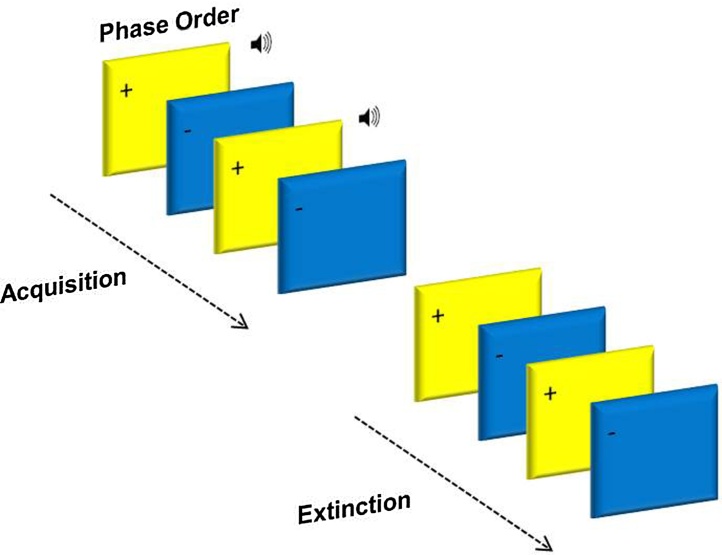
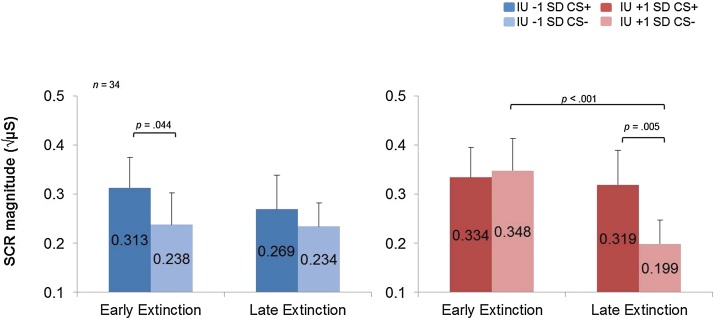
Extinction-resistant fear is considered to be a central feature of pathological anxiety. Here we sought to determine if individual differences in Intolerance of Uncertainty (IU), a potential risk factor for anxiety disorders, underlies compromised fear extinction. We tested this hypothesis by recording electrodermal activity in 38 healthy participants during fear acquisition and extinction. We assessed the temporality of fear extinction, by examining early and late extinction learning. During early extinction, low IU was associated with larger skin conductance responses to learned threat vs. safety cues, whereas high IU was associated with skin conductance responding to both threat and safety cues, but no cue discrimination. During late extinction, low IU showed no difference in skin conductance between learned threat and safety cues, whilst high IU predicted continued fear expression to learned threat, indexed by larger skin conductance to threat vs. safety cues. These findings suggest a critical role of uncertainty-based mechanisms in the maintenance of learned fear.
Overview
The claims and statistics of this paper haven’t been checked yet.
Run the check — free, no account needed. It reads the open-access text and checks the sources it cites.
Integrity signals
Registry
Cites
Statistics
Figures
Verification
Claims the paper makes
The claims and statistics of this paper haven’t been checked yet.
Run the check — free, no account needed. It reads the open-access text and checks the sources it cites.
Claims other papers make about this one
Each is checked against this paper’s own text: does it say what the citing paper says it does?
The cited source doesn’t support the claim as written.
In the citing paper
“Two recent studies have demonstrated that individuals with high intolerance of uncertainty do not discriminate between threat and safety cues during fear acquisition and have slower fear extinction than those with low intolerance of uncertainty (Morriss, Macdonald, & van Reekum, 2016; Morriss, Christakou, & van Reekum, 2016).”
From Enhancing Inhibitory Learning: The Utility of Variability in Exposure (2019) · cites this paper as Morriss, Christakou, & van Reekum, 2016
Checked by a reasoning model — may be wrong.
Experimental — accuracy not yet measuredThe cited source doesn’t support the claim as written.
In the citing paper
“The majority of studies have found specificity of IU over other self-reported anxiety measures in predicting 1) differences in SCR to both learned threat and safety during early trials, 2) greater SCR to learned threat cues versus safety cues during late trials (36,37), or 3) greater SCR to learned threat cues across all trials (15,35).”
From I Doubt It Is Safe: A Meta-analysis of Self-reported Intolerance of Uncertainty and Threat Extinction Training (2021) · cites this paper as [37]
Checked by a reasoning model — may be wrong.
Experimental — accuracy not yet measuredThe source backs part of the claim, not all of it — or backs it for a different population, condition or comparison.
In the citing paper
“Intolerance of uncertainty may affect fear learning and fear extinction.”
From Enhancing Inhibitory Learning: The Utility of Variability in Exposure (2019) · cites this paper as Morriss, Christakou, & van Reekum, 2016
Experimental — accuracy not yet measuredThe cited source says what the claim attributes to it.
In the citing paper
“Two recent studies have demonstrated that individuals with high intolerance of uncertainty do not discriminate between threat and safety cues during fear acquisition and have slower fear extinction than those with low intolerance of uncertainty (Morriss, Macdonald, & van Reekum, 2016; Morriss, Christakou, & van Reekum, 2016).”
From Enhancing Inhibitory Learning: The Utility of Variability in Exposure (2019) · cites this paper as Morriss, Christakou, & van Reekum, 2016
The cited source says what the claim attributes to it.
In the citing paper
“In previous research, a few studies observed differences in SCR to both learned threat and safety cues during the early trials of threat extinction training (36,37).”
From I Doubt It Is Safe: A Meta-analysis of Self-reported Intolerance of Uncertainty and Threat Extinction Training (2021) · cites this paper as [37]
The cited source says what the claim attributes to it.
In the citing paper
“Notably, the original studies that found a relationship between IU and early extinction used a 100% reinforcement rate during acquisition (36,37), where the change in contingencies between acquisition and extinction are more obvious.”
From I Doubt It Is Safe: A Meta-analysis of Self-reported Intolerance of Uncertainty and Threat Extinction Training (2021) · cites this paper as [37]
In the citing paper
“We have previously shown the same experimental design to successfully evoke concomitant threat extinction psychophysiology and brain activation in adult populations41,44, similar to other labs using 100% reinforcement45.”
From Multimodal evidence for delayed threat extinction learning in adolescence and young adulthood (2019) · cites this paper as [44]
In the citing paper
“The conditioning task was identical to those used in previous studies41,42,44.”
From Multimodal evidence for delayed threat extinction learning in adolescence and young adulthood (2019) · cites this paper as [44]
Self-check
Percentages, sums and reported differences re-computed from the paper’s own numbers.
The self-check needs the paper’s full text.
Citations
Cites
Development and validation of brief measures of positive and negative affect: The PANAS scales.
Watson, D., Clark, L. A., & Tellegen, A. (1988) · Journal of Personality and Social Psychology · doi:10.1037/0022-3514.54.6.1063 · Cited by 32,433
Development and validation of the Penn State Worry Questionnaire
Meyer, T. J., Miller, M. L., Metzger, R. L., & Borkovec, T. D. (1990) · Behaviour Research and Therapy · doi:10.1016/0005-7967(90)90135-6 · Cited by 5,099 · cited 2×
“…such as expectancy of potential threat that may impede the re-establishment of a previously paired CS+ as safe, with implications for targeted treatment, with implications for targeted treatment (Dugas & Robichaud, 2007; Dunsmoor et al., In press; van der Heiden, Muris, & van der Molen, 2012)”
Neurons in medial prefrontal cortex signal memory for fear extinction
Milad, M. R., & Quirk, G. J. (2002) · Nature · doi:10.1038/nature01138 · Cited by 1,836
Effects of an expanding-spaced vs massed exposure schedule on fear reduction and return of fear
Rowe, M. K., & Craske, M. G. (1998) · Behaviour Research and Therapy · doi:10.1016/s0005-7967(97)10016-x · Cited by 1,782
Phelps, E. A., Delgado, M. R., Nearing, K. I., & LeDoux, J. E. (2004) · Neuron · doi:10.1016/j.neuron.2004.08.042 · Cited by 1,753 · cited 1×
“The conditioned response score was the first 2CS+ trials − the first 2CS − trials, similar to previous work assessing conditioned responses in extinction (Dunsmoor et al., In press; Milad et al., 2009; Phelps et al., 2004 .”
Fear Extinction as a Model for Translational Neuroscience: Ten Years of Progress
Milad, M. R., & Quirk, G. J. (2012) · Annual Review of Psychology · doi:10.1146/annurev.psych.121208.131631 · Cited by 1,466
LaBar, K. S., Gatenby, J. C., Gore, J. C., LeDoux, J. E., & Phelps, E. A. (1998) · Neuron · doi:10.1016/s0896-6273(00)80475-4 · Cited by 1,402
The intolerance of uncertainty scale: psychometric properties of the English version
Buhr, K., & Dugas, M. J. (2002) · Behaviour Research and Therapy · doi:10.1016/s0005-7967(01)00092-4 · Cited by 1,391
Neurobiological Basis of Failure to Recall Extinction Memory in Posttraumatic Stress Disorder
Milad, M. R., Pitman, R. K., Ellis, C. B., Gold, A. L., Shin, L. M., Lasko, N. B., Zeidan, M. A., Handwerger, K., Orr, S. P., & Rauch, S. L. (2009) · Biological Psychiatry · doi:10.1016/j.biopsych.2009.06.026 · Cited by 1,339 · cited 2×
“The conditioned response score was the first 2CS+ trials − the first 2CS − trials, similar to previous work assessing conditioned responses in extinction (Dunsmoor et al., In press; Milad et al., 2009; Phelps et al., 2004 .”
InfluentialThe Tie That Binds? Coherence Among Emotion Experience, Behavior, and Physiology.
Mauss, I. B., Levenson, R. W., McCarter, L., Wilhelm, F. H., & Gross, J. J. (2005) · Emotion · doi:10.1037/1528-3542.5.2.175 · Cited by 1,201
Classical fear-conditioning in the anxiety disorders: a meta-analysis
Lissek, S., Powers, A. S., McClure, E. B., Phelps, E. A., Woldehawariat, G., Grillon, C., & Pine, D. S. (2005) · Behaviour Research and Therapy · doi:10.1016/j.brat.2004.10.007 · Cited by 1,034
Brain systems mediating aversive conditioning: an event-related fMRI study
Büchel, C., Morris, J., Dolan, R. J., & Friston, K. J. (1998) · Neuron · doi:10.1016/s0896-6273(00)80476-6 · Cited by 951
Duits, P., Cath, D. C., Lissek, S., Hox, J. J., Hamm, A. O., Engelhard, I. M., van den Hout, M. A., & Baas, J. M. P. (2015) · Depression and Anxiety · doi:10.1002/da.22353 · Cited by 726 · cited 1×
“In two recent meta-analyses, however, only small differences in fear extinction behavior were found between anxious and non-anxious individuals (Duits et al., 2015; Lissek et al., 2005).”
Neural circuitry underlying the regulation of conditioned fear and its relation to extinction
Delgado, M. R., Nearing, K. I., LeDoux, J. E., & Phelps, E. A. (2008) · Neuron · doi:10.1016/j.neuron.2008.06.029 · Cited by 716
Gentes, E. L., & Ruscio, A. M. (2011) · Clinical Psychology Review · doi:10.1016/j.cpr.2011.05.001 · Cited by 601
Presence and acquired origin of reduced recall for fear extinction in PTSD: Results of a twin study
Milad, M. R., Orr, S. P., Lasko, N. B., Chang, Y., Rauch, S. L., & Pitman, R. K. (2008) · Journal of Psychiatric Research · doi:10.1016/j.jpsychires.2008.01.017 · Cited by 512
Blechert, J., Michael, T., Vriends, N., Margraf, J., & Wilhelm, F. H. (2007) · Behaviour Research and Therapy · doi:10.1016/j.brat.2007.02.012 · Cited by 479
McEvoy, P. M., & Mahoney, A. E. J. (2012) · Behavior Therapy · doi:10.1016/j.beth.2011.02.007 · Cited by 468
Mineka, S., & Oehlberg, K. A. (2008) · Acta Psychologica · doi:10.1016/j.actpsy.2007.11.007 · Cited by 428
Hofmann, S. G. (2008) · Clinical Psychology Review · doi:10.1016/j.cpr.2007.04.009 · Cited by 397 · cited 1×
“During fear extinction, a reduction in reactivity to the learned threat cue over time is thought to reflect changes in harm expectancy and contingency beliefs (for a review see, (Hofmann, 2008)).”
The Study of Fear Extinction: Implications for Anxiety Disorders
Graham, B. M., & Milad, M. R. (2011) · American Journal of Psychiatry · doi:10.1176/appi.ajp.2011.11040557 · Cited by 387
Fear-Conditioning Mechanisms Associated with Trait Vulnerability to Anxiety in Humans
Indovina, I., Robbins, T. W., Núñez-Elizalde, A. O., Dunn, B. D., & Bishop, S. J. (2011) · Neuron · doi:10.1016/j.neuron.2010.12.034 · Cited by 310
Generalized Anxiety Disorder: Advances in Research and Practice
Storch, D. D. (2005) · Psychiatric Services · doi:10.1176/appi.ps.56.5.620 · Cited by 303
van der Heiden, C., Muris, P., & van der Molen, H. T. (2012) · Behaviour Research and Therapy · doi:10.1016/j.brat.2011.12.005 · Cited by 265 · cited 1×
“Additionally, these results show promise for the further development of recently implemented focused forms of anxiety disorder treatment, such as intolerance of uncertainty therapy (van der Heiden et al., 2012) and novel experimental models of”
Fear conditioning in panic disorder: Enhanced resistance to extinction
Michael, T., Blechert, J., Vriends, N., Margraf, J., & Wilhelm, F. H. (2007) · Journal of Abnormal Psychology · doi:10.1037/0021-843x.116.3.612 · Cited by 210
Chambers, J. A., Power, K., & Durham, R. C. (2003) · Journal of Anxiety Disorders · doi:10.1016/j.janxdis.2003.09.001 · Cited by 176
Deficient safety learning characterizes high trait anxious individuals
Gazendam, F. J., Kamphuis, J. H., & Kindt, M. (2012) · Biological Psychology · doi:10.1016/j.biopsycho.2012.11.006 · Cited by 168 · cited 3×
“Expanding previous research on individual differences in trait anxiety (Barrett & Armony, 2009; Gazendam et al., 2013; Indovina, Robbins, Núñez-Elizalde, Dunn, & Bishop, 2011; Sehlmeyer et al., 2011) and IU (Dunsmoor et al.”
Dunsmoor, J. E., Campese, V. D., Ceceli, A. O., LeDoux, J. E., & Phelps, E. A. (2015) · Biological Psychiatry · doi:10.1016/j.biopsych.2014.12.008 · Cited by 165
Neural correlates of trait anxiety in fear extinction
Sehlmeyer, C., Dannlowski, U., Schöning, S., Kugel, H., Pyka, M., Pfleiderer, B., Zwitserlood, P., Schiffbauer, H., Heindel, W., Arolt, V., et al. (2011) · Psychological Medicine · doi:10.1017/s0033291710001248 · Cited by 165 · cited 2×
“Expanding previous research on individual differences in trait anxiety (Barrett & Armony, 2009; Gazendam et al., 2013; Indovina, Robbins, Núñez-Elizalde, Dunn, & Bishop, 2011; Sehlmeyer et al., 2011) and IU (Dunsmoor et al.”
Expectancy biases in fear and anxiety and their link to biases in attention
Aue, T., & Okon‐Singer, H. (2015) · Clinical Psychology Review · doi:10.1016/j.cpr.2015.08.005 · Cited by 161 · cited 1×
“Importantly, these results highlight an opportunity for further research to examine how individual differences in IU may modulate cognitive biases, particularly that of expectancy bias, in fear and anxiety (Aue & Okon-Singer, 2015).”
Intolerance of uncertainty as a contributor to fear and avoidance symptoms of panic attacks
Carleton, R. N., Fetzner, M. G., Hackl, J. L., & McEvoy, P. (2013) · Cognitive Behaviour Therapy · doi:10.1080/16506073.2013.792100 · Cited by 126
An improved algorithm for model-based analysis of evoked skin conductance responses
Bach, D. R., Friston, K. J., & Dolan, R. J. (2013) · Biological Psychology · doi:10.1016/j.biopsycho.2013.09.010 · Cited by 122
Neumann, D. L., & Waters, A. M. (2006) · Biological Psychology · doi:10.1016/j.biopsycho.2006.03.004 · Cited by 110
Morriss, J., Christakou, A., & van Reekum, C. M. (2015) · Biology of Mood & Anxiety Disorders · doi:10.1186/s13587-015-0019-8 · Cited by 106 · cited 1×
“…to learned safety vs. threat cues, suggesting threat generalization Furthermore, in late extinction learning, high IU scores were associated with continued fear expression to learned threat vs. safety cues, indexed by larger skin conductance and right amygdala activity (Morriss et al., 2015 .”
Self-citationCognitive Behavioral Treatment for Generalized Anxiety Disorder: From Science to Practice
Robichaud, M., Koerner, N., & Dugas, M. J. (2019) · doi:10.4324/9781315709741 · Cited by 97
Barrett, J., & Armony, J. L. (2008) · Psychological Medicine · doi:10.1017/s0033291708003516 · Cited by 93
Haaker, J., Lonsdorf, T. B., Schümann, D., Menz, M. M., Brassen, S., Bunzeck, N., Gamer, M., & Kalisch, R. (2015) · Biological Psychology · doi:10.1016/j.biopsycho.2015.07.010 · Cited by 77 · cited 1×
“For example, trait anxious individuals have been shown to display slower reductions in startle reactivity to both threat and safety cues during extinction (Gazendam, Kamphuis, & Kindt, 2013), but not in skin conductance (Haaker et al., 2015) or expectancy ratings (Barrett & Armony, 2009; Gazendam et al.”
Thibodeau, M. A., Carleton, R. N., McEvoy, P. M., Zvolensky, M. J., Brandt, C. P., Boelen, P. A., Mahoney, A. E. J., Deacon, B. J., & Asmundson, G. J. G. (2015) · Journal of Anxiety Disorders · doi:10.1016/j.janxdis.2015.01.006 · Cited by 59 · cited 1×
“Furthermore, the development of new disorder-specific IU scales (Thibodeau et al., 2015) highlights that IU may be applicable to specific phobia and Post-Traumatic Stress Disorder (PTSD), which are”
Spoormaker, V. I., Blechert, J., Goya‐Maldonado, R., Sämann, P. G., Wilhelm, F. H., & Czisch, M. (2012) · NeuroImage · doi:10.1016/j.neuroimage.2012.08.050 · Cited by 15
Factor structure of the Barratt impulsiveness scale
Patton, J. H., Stanford, M. S., & Barratt, E. S. (1995) · Journal of Clinical Psychology · doi:10.1002/1097-4679(199511)51:6
Research works printed but not linked: 1
- Spielberger, C. D., Gorsuch, R. L., Lushene, R., Vagg, P., & Jacobs, G. (1983). Palo Alto (CA): Consulting Psychologists Press, Inc. 2».
Cited by
Sorted by citations
Lonsdorf, T. B., Menz, M. M., Andreatta, M., Fullana, M. A., Golkar, A., Haaker, J., Heitland, I., Hermann, A., Kuhn, M., Kruse, O., et al. (2017) · Neuroscience & Biobehavioral Reviews · doi:10.1016/j.neubiorev.2017.02.026 · Cited by 837
Satici, B., Saricali, M., Satici, S. A., & Griffiths, M. D. (2022) · International Journal of Mental Health and Addiction · doi:10.1007/s11469-020-00305-0 · Cited by 580
Lonsdorf, T. B., & Merz, C. J. (2017) · Neuroscience & Biobehavioral Reviews · doi:10.1016/j.neubiorev.2017.07.007 · Cited by 253
Tanovic, E., Gee, D. G., & Joormann, J. (2018) · Clinical Psychology Review · doi:10.1016/j.cpr.2018.01.001 · Cited by 214
“Similarly, (Morriss et al. (2016) found evidence of weaker fear extinction among individuals with higher IU.”
BackgroundResearch Review: Pediatric Anxiety Disorders—What Have We Learnt in the Last 10 Years?
Strawn, J. R., Lu, L., Peris, T. S., Levine, A., & Walkup, J. T. (2021) · Journal of Child Psychology and Psychiatry · doi:10.1111/jcpp.13262 · Cited by 168
Metadata
- Authors
- Morriss, J., Christakou, A., & van Reekum, C. M.
- Affiliations
- University of Reading (GB)
- Venue
- Biological Psychology
- Publisher
- Elsevier BV
- Published
- 2016-12
- Volume
- 121
- Issue
- Pt B
- Pages
- 187-193
- ISSN
- 0301-0511 (ISSN-L)
- PMC
- PMC5154327
- OpenAlex
- W2378955611
- Cited by
- 152
- References
- 41
- Citations by year
- 2026: 8 · 2025: 5 · 2024: 13 · 2023: 13 · 2022: 29 · 2021: 43 · 2020: 12 · 2019: 15 · 2018: 7 · 2017: 5 · 2016: 1
- FWCI
- 5.94
- Type
- journal article
- Language
- en
- Open access
- hybrid
- doi.org
- Locations
- Biological Psychology (publishedVersion, cc-by)
- PubMed Central (publishedVersion, cc-by)
- PubMed (publishedVersion)
- CentAUR (University of Reading) (submittedVersion)
- ePrints Soton (University of Southampton) (submittedVersion)
- Funders
- Centre for Integrative Neuroscience and Neurodynamics (MR/J003980/1)
- Natalia Kontoudaki & Karolina Tokarska for their help in collecting the data
- Topics
- Life Sciences › Neuroscience › Cognitive Neuroscience › Memory and Neural Mechanisms
- Social Sciences › Psychology › Experimental and Cognitive Psychology › Anxiety, Depression, Psychometrics, Treatment, Cognitive Processes
- Life Sciences › Neuroscience › Cognitive Neuroscience › Memory Processes and Influences
- Keywords
- intolerance of uncertainty, fear extinction, fear acquisition, anxiety disorders, skin conductance response, electrodermal activity, cue discrimination, individual differences
- MeSH terms
- Acoustic Stimulation, Adolescent, Adult, Anxiety Disorders, Arousal, Autonomic Nervous System, Conditioning, Classical, Cues, Extinction, Psychological, Fear, Female, Galvanic Skin Response, Humans, Male, Pattern Recognition, Visual, Risk Factors, Safety, Uncertainty, Young Adult
About these checks
Registry, retraction, Cites and statistics results are computed, not judged, with one exception: a printed reference that no index lists is read once by a model before it counts as a citation error. Claims are extracted by a model and kept only when their quote appears verbatim in the text; each cited source is then checked, with a model’s help, for whether it says what the claim relies on. Those verdicts can be wrong — read the claim’s quote and the cited source before relying on one.
Statistics and arithmetic are recomputed, not judged.
Confidence bands are shown only for fields calibrated on our annotated test set. None is calibrated yet, so no band is shown.
What counts as a claim ›How we measure confidence ›How we check this ›
Are you an author, or do you see a problem with this page? Request a review
