

The DOI matches its Crossref record; 46 of the 46 references it cites were found in a registry or an index.
Mindfulness-based cognitive therapy as a treatment for chronic depression: A preliminary study
Open accessAbstract
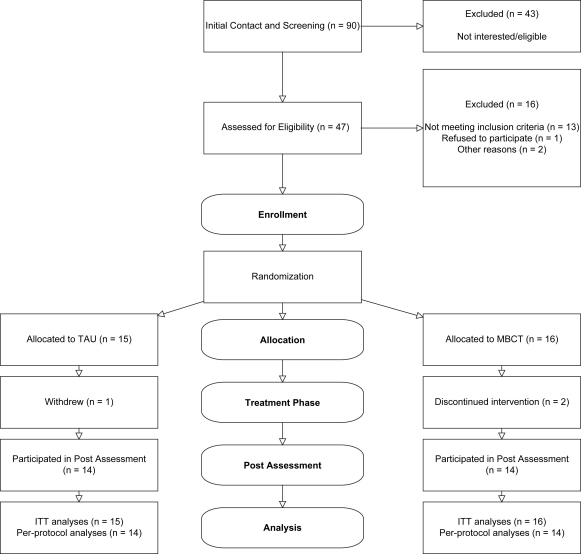
This pilot study investigated the effectiveness of Mindfulness-Based Cognitive Therapy (MBCT), a treatment combining mindfulness meditation and interventions taken from cognitive therapy, in patients suffering from chronic-recurrent depression. Currently symptomatic patients with at least three previous episodes of depression and a history of suicidal ideation were randomly allocated to receive either MBCT delivered in addition to treatment-as-usual (TAU; N=14 completers) or TAU alone (N=14 completers). Depressive symptoms and diagnostic status were assessed before and after treatment phase. Self-reported symptoms of depression decreased from severe to mild levels in the MBCT group while there was no significant change in the TAU group. Similarly, numbers of patients meeting full criteria for depression decreased significantly more in the MBCT group than in the TAU group. Results are consistent with previous uncontrolled studies. Although based on a small sample and, therefore, limited in their generalizability, they provide further preliminary evidence that MBCT can be used to successfully reduce current symptoms in patients suffering from a protracted course of the disorder.
Overview
The claims and statistics of this paper haven’t been checked yet.
Run the check — free, no account needed. It reads the open-access text and checks the sources it cites.
Integrity signals
Registry
Cites
Statistics
Figures
Verification
Claims the paper makes
The claims and statistics of this paper haven’t been checked yet.
Run the check — free, no account needed. It reads the open-access text and checks the sources it cites.
Claims other papers make about this one
Each is checked against this paper’s own text: does it say what the citing paper says it does?
The source backs part of the claim, not all of it — or backs it for a different population, condition or comparison.
In the citing paper
“Mindfulness has been shown to be inversely related to depressive symptoms in both cross‐sectional (Gilbert & Christopher, 2010; Gilbert & Gruber, 2014) and intervention (Barnhofer et al., 2009) studies.”
From A mindful yoga intervention for young women with major depressive disorder: Design and baseline sample characteristics of a randomized controlled trial (2020) · cites this paper as Barnhofer et al., 2009
Experimental — accuracy not yet measuredThe source backs part of the claim, not all of it — or backs it for a different population, condition or comparison.
In the citing paper
“Self-reported symptoms of depression were also found to be significantly reduced after receiving MBCT, whereas a similar reduction was not identified in patients who only received their usual pharmacological treatment [51].”
From Potential therapeutic effects of meditation for treating affective dysregulation (2014) · cites this paper as [51]
Experimental — accuracy not yet measuredThe cited source says what the claim attributes to it.
In the citing paper
“There is also preliminary evidence that MBCT is more effective than treatment as usual (TAU) in reducing depressive symptoms among currently depressed patients (Barnhofer et al., 2009; Hepburn et al., 2009)”
From Effects of mindfulness on psychological health: A review of empirical studies (2011) · cites this paper as Barnhofer et al., 2009
The check wasn’t confident either way, so it gives no verdict — never disputed.
In the citing paper
“Training produces a decoupling of the medial prefrontal cortex (associated with narrative focus) from the insula (viscero-somatic signals), and an increased connection between the insula and the lateral prefrontal cortex (associated with experiential focus).”
From Mindfulness in psychiatry - Where are we now? (2016) · cites this paper as [10]
Experimental — accuracy not yet measuredIn the citing paper
“Where substantially larger effects have been observed, these have been based on small samples (Barnhofer et al. 2009; Chiesa et al. 2015; Eisendrath et al. 2015; Kingston et al. 2007).”
From The Effectiveness of Mindfulness-Based Cognitive Therapy (MBCT) in Real-World Healthcare Services (2020) · cites this paper as Barnhofer et al. 2009
Self-check
Percentages, sums and reported differences re-computed from the paper’s own numbers.
The self-check needs the paper’s full text.
Citations
Cites
(2001) · Cited by 3,666
Self-citationPrevention of relapse/recurrence in major depression by mindfulness-based cognitive therapy.
Teasdale, J. D., Segal, Z. V., Williams, J. M. G., Ridgeway, V. A., Soulsby, J. M., & Lau, M. A. (2000) · Journal of Consulting and Clinical Psychology · doi:10.1037/0022-006x.68.4.615 · Cited by 3,236
Self-citationAttention regulation and monitoring in meditation
Lutz, A., Slagter, H. A., Dunne, J. D., & Davidson, R. J. (2008) · Trends in Cognitive Sciences · doi:10.1016/j.tics.2008.01.005 · Cited by 2,659
Constructive and unconstructive repetitive thought
Watkins, E. R. (2008) · Psychological Bulletin · doi:10.1037/0033-2909.134.2.163 · Cited by 2,421
Measuring experiential avoidance: A preliminary test of a working model
Hayes, S. C., Strosahl, K., Wilson, K. G., Bissett, R. T., Pistorello, J., Toarmino, D., Polusny, M. A., Dykstra, T. A., Batten, S. V., Bergan, J., et al. (2004) · The Psychological Record · doi:10.1007/bf03395492 · Cited by 2,140
Short-term meditation training improves attention and self-regulation
Tang, Y.-Y., Ma, Y., Wang, J., Fan, Y., Feng, S., Lu, Q., Yu, Q., Sui, D., Rothbart, M. K., Fan, M., et al. (2007) · Proceedings of the National Academy of Sciences · doi:10.1073/pnas.0707678104 · Cited by 1,597
Ma, S. H., & Teasdale, J. D. (2004) · Journal of Consulting and Clinical Psychology · doi:10.1037/0022-006x.72.1.31 · Cited by 1,390
Keller, M. B., McCullough, J. P., Klein, D. N., Arnow, B., Dunner, D. L., Gelenberg, A. J., Markowitz, J. C., Nemeroff, C. B., Russell, J. M., Thase, M. E., et al. (2000) · New England Journal of Medicine · doi:10.1056/nejm200005183422001 · Cited by 1,331
Cognitive Therapy vs Medications in the Treatment of Moderate to Severe Depression
DeRubeis, R. J., Hollon, S. D., Amsterdam, J. D., Shelton, R. C., Young, P. R., Salomon, R. M., O’Reardon, J. P., Lovett, M. L., Gladis, M. M., Brown, L. L., et al. (2005) · Archives of General Psychiatry · doi:10.1001/archpsyc.62.4.409 · Cited by 989
First, M. B., Spitzer, R. L., Gibbon, M., & Williams, J. B. W. (1997) · American Psychiatric Press eBooks · Cited by 983
Self-citation
Cited by
Sorted by citations
The effect of mindfulness based therapy on anxiety and depression: A meta analytic review
Hofmann, S. G., Sawyer, A. T., Witt, A. A., & Oh, D. (2010) · Journal of Consulting and Clinical Psychology · doi:10.1037/a0018555 · Cited by 3,846
Effects of mindfulness on psychological health: A review of empirical studies
Keng, S.-L., Smoski, M. J., & Robins, C. J. (2011) · Clinical Psychology Review · doi:10.1016/j.cpr.2011.04.006 · Cited by 2,687
Piet, J., & Hougaard, E. (2011) · Clinical Psychology Review · doi:10.1016/j.cpr.2011.05.002 · Cited by 807
Chiesa, A., & Serretti, A. (2011) · Psychiatry Research · doi:10.1016/j.psychres.2010.08.011 · Cited by 650
Cuijpers, P., Cristea, I. A., Karyotaki, E., Reijnders, M., & Huibers, M. J. H. (2016) · World Psychiatry · doi:10.1002/wps.20346 · Cited by 572
Metadata
- Authors
- Barnhofer, T., Crane, C., Hargus, E., Amarasinghe, M., Winder, R., & Williams, J. M. G.
- Affiliations
- Warneford Hospital (GB)
- Corresponding author
- Barnhofer, Thorsten
- Venue
- Behaviour Research and Therapy
- Publisher
- Elsevier BV
- Published
- 2009-05
- Volume
- 47
- Issue
- 5
- Pages
- 366-373
- ISSN
- 0005-7967 (ISSN-L)
- PMC
- PMC2866254
- OpenAlex
- W2027963802
- Cited by
- 396
- References
- 44
- Citations by year
- 2026: 5 · 2025: 16 · 2024: 12 · 2023: 11 · 2022: 27 · 2021: 22 · 2020: 27 · 2019: 19 · 2018: 25 · 2017: 16 · 2016: 32 · 2015: 29 · 2014: 27 · 2013: 25 · 2012: 39
- FWCI
- 36.37
- Type
- journal article
- Language
- en
- Open access
- hybrid
- doi.org
- Licence
- Locations
- Behaviour Research and Therapy (publishedVersion, cc-by)
- Europe PMC (PubMed Central) (publishedVersion, cc-by)
- PubMed Central (publishedVersion, cc-by)
- PubMed (publishedVersion)
- Research Portal (King's College London) (publishedVersion, other-oa)
- Funders
- Wellcome Trust
- Mind and Life Institute
- Topics
- Social Sciences › Psychology › Clinical Psychology › Mindfulness and Compassion Interventions
- Social Sciences › Psychology › Experimental and Cognitive Psychology › Anxiety, Depression, Psychometrics, Treatment, Cognitive Processes
- Social Sciences › Psychology › Clinical Psychology › Psychotherapy Techniques and Applications
- Keywords
- mindfulness-based cognitive therapy, chronic depression, recurrent depression, mindfulness meditation, cognitive therapy, suicidal ideation, depressive symptoms, treatment efficacy
- MeSH terms
- Adult, Depressive Disorder, Female, Humans, Male, Middle Aged, Patient Compliance, Pilot Projects, Psychiatric Status Rating Scales, Recurrence, Cognitive Behavioral Therapy, Treatment Outcome, Meditation, Suicidal Ideation
About these checks
Registry, retraction, Cites and statistics results are computed, not judged, with one exception: a printed reference that no index lists is read once by a model before it counts as a citation error. Claims are extracted by a model and kept only when their quote appears verbatim in the text; each cited source is then checked, with a model’s help, for whether it says what the claim relies on. Those verdicts can be wrong — read the claim’s quote and the cited source before relying on one.
Statistics and arithmetic are recomputed, not judged.
Confidence bands are shown only for fields calibrated on our annotated test set. None is calibrated yet, so no band is shown.
What counts as a claim ›How we measure confidence ›How we check this ›
Are you an author, or do you see a problem with this page? Request a review
