

The DOI matches its Crossref record; 46 of the 46 references it cites were found in a registry or an index.
Mindfulness-based cognitive therapy as a treatment for chronic depression: A preliminary study
Open accessAbstract
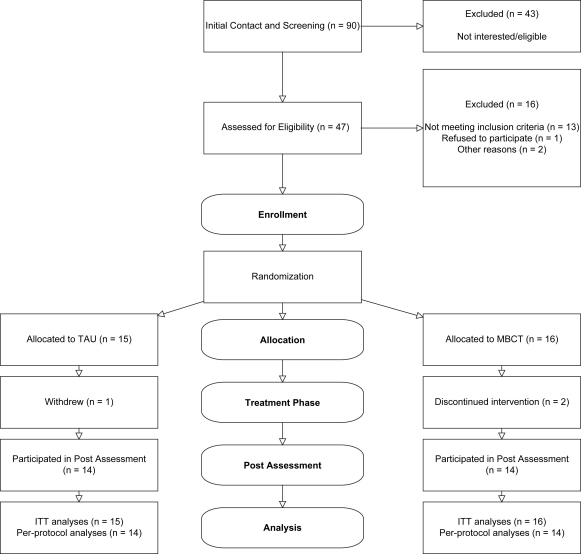
This pilot study investigated the effectiveness of Mindfulness-Based Cognitive Therapy (MBCT), a treatment combining mindfulness meditation and interventions taken from cognitive therapy, in patients suffering from chronic-recurrent depression. Currently symptomatic patients with at least three previous episodes of depression and a history of suicidal ideation were randomly allocated to receive either MBCT delivered in addition to treatment-as-usual (TAU; N=14 completers) or TAU alone (N=14 completers). Depressive symptoms and diagnostic status were assessed before and after treatment phase. Self-reported symptoms of depression decreased from severe to mild levels in the MBCT group while there was no significant change in the TAU group. Similarly, numbers of patients meeting full criteria for depression decreased significantly more in the MBCT group than in the TAU group. Results are consistent with previous uncontrolled studies. Although based on a small sample and, therefore, limited in their generalizability, they provide further preliminary evidence that MBCT can be used to successfully reduce current symptoms in patients suffering from a protracted course of the disorder.
Overview
The claims and statistics of this paper haven’t been checked yet.
Run the check — free, no account needed. It reads the open-access text and checks the sources it cites.
Integrity signals
Registry
Cites
Statistics
Figures
Verification
Claims the paper makes
The claims and statistics of this paper haven’t been checked yet.
Run the check — free, no account needed. It reads the open-access text and checks the sources it cites.
Claims other papers make about this one
Each is checked against this paper’s own text: does it say what the citing paper says it does?
The source backs part of the claim, not all of it — or backs it for a different population, condition or comparison.
In the citing paper
“Mindfulness has been shown to be inversely related to depressive symptoms in both cross‐sectional (Gilbert & Christopher, 2010; Gilbert & Gruber, 2014) and intervention (Barnhofer et al., 2009) studies.”
From A mindful yoga intervention for young women with major depressive disorder: Design and baseline sample characteristics of a randomized controlled trial (2020) · cites this paper as Barnhofer et al., 2009
Experimental — accuracy not yet measuredThe source backs part of the claim, not all of it — or backs it for a different population, condition or comparison.
In the citing paper
“Self-reported symptoms of depression were also found to be significantly reduced after receiving MBCT, whereas a similar reduction was not identified in patients who only received their usual pharmacological treatment [51].”
From Potential therapeutic effects of meditation for treating affective dysregulation (2014) · cites this paper as [51]
Experimental — accuracy not yet measuredThe cited source says what the claim attributes to it.
In the citing paper
“There is also preliminary evidence that MBCT is more effective than treatment as usual (TAU) in reducing depressive symptoms among currently depressed patients (Barnhofer et al., 2009; Hepburn et al., 2009)”
From Effects of mindfulness on psychological health: A review of empirical studies (2011) · cites this paper as Barnhofer et al., 2009
The check wasn’t confident either way, so it gives no verdict — never disputed.
In the citing paper
“Training produces a decoupling of the medial prefrontal cortex (associated with narrative focus) from the insula (viscero-somatic signals), and an increased connection between the insula and the lateral prefrontal cortex (associated with experiential focus).”
From Mindfulness in psychiatry - Where are we now? (2016) · cites this paper as [10]
Experimental — accuracy not yet measuredIn the citing paper
“Where substantially larger effects have been observed, these have been based on small samples (Barnhofer et al. 2009; Chiesa et al. 2015; Eisendrath et al. 2015; Kingston et al. 2007).”
From The Effectiveness of Mindfulness-Based Cognitive Therapy (MBCT) in Real-World Healthcare Services (2020) · cites this paper as Barnhofer et al. 2009
Self-check
Percentages, sums and reported differences re-computed from the paper’s own numbers.
The self-check needs the paper’s full text.
Citations
Cites
(2001) · Cited by 3,666
Self-citationPrevention of relapse/recurrence in major depression by mindfulness-based cognitive therapy.
Teasdale, J. D., Segal, Z. V., Williams, J. M. G., Ridgeway, V. A., Soulsby, J. M., & Lau, M. A. (2000) · Journal of Consulting and Clinical Psychology · doi:10.1037/0022-006x.68.4.615 · Cited by 3,236
Self-citationAttention regulation and monitoring in meditation
Lutz, A., Slagter, H. A., Dunne, J. D., & Davidson, R. J. (2008) · Trends in Cognitive Sciences · doi:10.1016/j.tics.2008.01.005 · Cited by 2,659
Constructive and unconstructive repetitive thought
Watkins, E. R. (2008) · Psychological Bulletin · doi:10.1037/0033-2909.134.2.163 · Cited by 2,421
Measuring experiential avoidance: A preliminary test of a working model
Hayes, S. C., Strosahl, K., Wilson, K. G., Bissett, R. T., Pistorello, J., Toarmino, D., Polusny, M. A., Dykstra, T. A., Batten, S. V., Bergan, J., et al. (2004) · The Psychological Record · doi:10.1007/bf03395492 · Cited by 2,140
Short-term meditation training improves attention and self-regulation
Tang, Y.-Y., Ma, Y., Wang, J., Fan, Y., Feng, S., Lu, Q., Yu, Q., Sui, D., Rothbart, M. K., Fan, M., et al. (2007) · Proceedings of the National Academy of Sciences · doi:10.1073/pnas.0707678104 · Cited by 1,597
Ma, S. H., & Teasdale, J. D. (2004) · Journal of Consulting and Clinical Psychology · doi:10.1037/0022-006x.72.1.31 · Cited by 1,390
Keller, M. B., McCullough, J. P., Klein, D. N., Arnow, B., Dunner, D. L., Gelenberg, A. J., Markowitz, J. C., Nemeroff, C. B., Russell, J. M., Thase, M. E., et al. (2000) · New England Journal of Medicine · doi:10.1056/nejm200005183422001 · Cited by 1,331
Cognitive Therapy vs Medications in the Treatment of Moderate to Severe Depression
DeRubeis, R. J., Hollon, S. D., Amsterdam, J. D., Shelton, R. C., Young, P. R., Salomon, R. M., O’Reardon, J. P., Lovett, M. L., Gladis, M. M., Brown, L. L., et al. (2005) · Archives of General Psychiatry · doi:10.1001/archpsyc.62.4.409 · Cited by 989
First, M. B., Spitzer, R. L., Gibbon, M., & Williams, J. B. W. (1997) · American Psychiatric Press eBooks · Cited by 983
Self-citation
Cited by
Sorted by citations
The effect of mindfulness based therapy on anxiety and depression: A meta analytic review
Hofmann, S. G., Sawyer, A. T., Witt, A. A., & Oh, D. (2010) · Journal of Consulting and Clinical Psychology · doi:10.1037/a0018555 · Cited by 3,846
Effects of mindfulness on psychological health: A review of empirical studies
Keng, S.-L., Smoski, M. J., & Robins, C. J. (2011) · Clinical Psychology Review · doi:10.1016/j.cpr.2011.04.006 · Cited by 2,687
Piet, J., & Hougaard, E. (2011) · Clinical Psychology Review · doi:10.1016/j.cpr.2011.05.002 · Cited by 807
Chiesa, A., & Serretti, A. (2011) · Psychiatry Research · doi:10.1016/j.psychres.2010.08.011 · Cited by 650
Cuijpers, P., Cristea, I. A., Karyotaki, E., Reijnders, M., & Huibers, M. J. H. (2016) · World Psychiatry · doi:10.1002/wps.20346 · Cited by 572
Parsons, C. E., Crane, C., Parsons, L. J., Fjorback, L. O., & Kuyken, W. (2017) · Behaviour Research and Therapy · doi:10.1016/j.brat.2017.05.004 · Cited by 550
Self-citationStrauss, C., Cavanagh, K., Oliver, A., & Pettman, D. (2014) · PLoS ONE · doi:10.1371/journal.pone.0096110 · Cited by 495
Mindfulness-based approaches: are they all the same?
Chiesa, A., & Malinowski, P. (2011) · Journal of Clinical Psychology · doi:10.1002/jclp.20776 · Cited by 454
Mindfulness and Behavior Change
Schuman-Olivier, Z., Trombka, M., Lovas, D. A., Brewer, J. A., Vago, D. R., Gawande, R., Dunne, J. P., Lazar, S. W., Loucks, E. B., & Fulwiler, C. (2020) · Harvard Review of Psychiatry · doi:10.1097/hrp.0000000000000277 · Cited by 435
Prospects for a clinical science of mindfulness-based intervention
Dimidjian, S., & Segal, Z. V. (2015) · American Psychologist · doi:10.1037/a0039589 · Cited by 291
Mindfulness meditation-based pain relief: a mechanistic account
Zeidan, F., & Vago, D. R. (2016) · Annals of the New York Academy of Sciences · doi:10.1111/nyas.13153 · Cited by 300
Zeidan, F., Grant, J. A., Brown, C. A., McHaffie, J. G., & Coghill, R. C. (2012) · Neuroscience Letters · doi:10.1016/j.neulet.2012.03.082 · Cited by 284
Mindfulness-Based Cognitive Therapy: Theory and Practice
Sipe, W. E. B., & Eisendrath, S. J. (2012) · The Canadian Journal of Psychiatry · doi:10.1177/070674371205700202 · Cited by 285
Britton, W. B., Shahar, B., Szepsenwol, O., & Jacobs, W. J. (2012) · Behavior Therapy · doi:10.1016/j.beth.2011.08.006 · Cited by 268
“MBCT (including the present study) has expanded into the treatment of acute or residual depression (Barnhofer et al., 2009; Britton, Haynes, Fridel, & Bootzin, 2010; Eisendrath et al., 2008; Finucane&Mercer, 2006;Kenny&Williams, 2007; Kingston, Dooley, Bates, Lawlor, & Malone, 2007; Kuyken et al.,…”
BackgroundThe third wave of cognitive behavioural therapies
Kahl, K. G., Winter, L., & Schweiger, U. (2012) · Current Opinion in Psychiatry · doi:10.1097/yco.0b013e328358e531 · Cited by 265
Adverse events in meditation practices and meditation‐based therapies: a systematic review
Farias, M., Maraldi, E., Wallenkampf, K. C., & Lucchetti, G. (2020) · Acta Psychiatrica Scandinavica · doi:10.1111/acps.13225 · Cited by 262
van Aalderen, J. R., Donders, A. R. T., Giommi, F., Spinhoven, P., Barendregt, H. P., & Speckens, A. E. M. (2012) · Psychological Medicine · doi:10.1017/s0033291711002054 · Cited by 262
van den Hout, M. A., & Engelhard, I. M. (2012) · Journal of Experimental Psychopathology · doi:10.5127/jep.028212 · Cited by 247
The empirical status of the "new wave" of cognitive behavioral therapy
Hofmann, S. G., Sawyer, A. T., & Fang, A. (2010) · Psychiatric Clinics of North America · doi:10.1016/j.psc.2010.04.006 · Cited by 255
Hargus, E., Crane, C., Barnhofer, T., & Williams, J. M. G. (2010) · Emotion · doi:10.1037/a0016825 · Cited by 212
Self-citationGross, M., Moore, Z. E., Gardner, F. L., Wolanin, A. T., Pess, R., & Marks, D. R. (2018) · International Journal of Sport and Exercise Psychology · doi:10.1080/1612197x.2016.1250802 · Cited by 213
Krusche, A., Cyhlarova, E., & Williams, J. M. G. (2013) · BMJ Open · doi:10.1136/bmjopen-2013-003498 · Cited by 192
Self-citationTraining Teachers to Deliver Mindfulness-Based Interventions: Learning from the UK Experience
Crane, R. S., Kuyken, W., Hastings, R. P., Rothwell, N., & Williams, J. M. G. (2010) · Mindfulness · doi:10.1007/s12671-010-0010-9 · Cited by 202
Self-citationEisendrath, S. J., Gillung, E., Delucchi, K. L., Segal, Z. V., Nelson, J. C., McInnes, L. A., Mathalon, D. H., & Feldman, M. D. (2016) · Psychotherapy and Psychosomatics · doi:10.1159/000442260 · Cited by 187
Cuijpers, P., de Beurs, D. P., van Spijker, B. A. J., Berking, M., Andersson, G., & Kerkhof, A. J. F. M. (2013) · Journal of Affective Disorders · doi:10.1016/j.jad.2012.06.025 · Cited by 176
McManus, F., Surawy, C., Muse, K., Vazquez-Montes, M., & Williams, J. M. G. (2012) · Journal of Consulting and Clinical Psychology · doi:10.1037/a0028782 · Cited by 179
Self-citationKlainin-Yobas, P., Cho, M. A. A., & Creedy, D. (2012) · International Journal of Nursing Studies · doi:10.1016/j.ijnurstu.2011.08.014 · Cited by 173
Mindfulness-based stress reduction: A non-pharmacological approach for chronic illnesses
Niazi, A., & Niazi, S. (2011) · North American Journal of Medical Sciences · doi:10.4297/najms.2011.320 · Cited by 170
European Psychiatric Association Guidance on psychotherapy in chronic depression across Europe
Jobst, A., Brakemeier, E., Buchheim, A., Caspar, F., Cuijpers, P. J., Ebmeier, K. P., Falkai, P., van der Gaag, R. J., Gäebel, W., Herpertz, S. C., et al. (2016) · European Psychiatry · doi:10.1016/j.eurpsy.2015.12.003 · Cited by 176
Cladder-Micus, M. B., Speckens, A. E. M., Vrijsen, J. N., T. Donders, A. R., Becker, E. S., & Spijker, J. (2018) · Depression and Anxiety · doi:10.1002/da.22788 · Cited by 141
“45) are smaller than in previous preliminary studies of chronic or treatment-resistant depressed patients (Barnhofer et al., 2009; Eisendrath et al., 2008; Kenny & Williams, 2007), as well as smaller than the effect size found in previous research on currently depressed patients (d = 0.”
ResultDzhambov, A. M., Hartig, T., Tilov, B., Atanasova, V., Makakova, D. R., & Dimitrova, D. D. (2019) · Environmental Research · doi:10.1016/j.envres.2019.108708 · Cited by 144
Li, S. Y. H., & Bressington, D. (2019) · International Journal of Mental Health Nursing · doi:10.1111/inm.12568 · Cited by 142
Kliem, S., Lohmann, A., Mößle, T., & Brähler, E. (2017) · BMC Psychiatry · doi:10.1186/s12888-017-1559-9 · Cited by 141
Manicavasgar, V., Parker, G., & Perich, T. (2011) · Journal of Affective Disorders · doi:10.1016/j.jad.2010.09.027 · Cited by 136
A randomized controlled trial of mindfulness‐based cognitive therapy for bipolar disorder
Perich, T., Manicavasagar, V., Mitchell, P. B., Ball, J. R., & Hadzi‐Pavlovic, D. (2013) · Acta Psychiatrica Scandinavica · doi:10.1111/acps.12033 · Cited by 136
Brief Psychotherapy for Depression: A Systematic Review and Meta-Analysis
Nieuwsma, J. A., Trivedi, R. B., McDuffie, J., Kronish, I., Benjamin, D., & Williams, J. W. (2012) · The International Journal of Psychiatry in Medicine · doi:10.2190/pm.43.2.c · Cited by 135
Self-citationWiltsey Stirman, S., Gamarra, J. M., Bartlett, B. A., Calloway, A., & Gutner, C. A. (2017) · Clinical Psychology: Science and Practice · doi:10.1111/cpsp.12218 · Cited by 138
Mindfulness‐Based Cognitive Therapy for Nonremitted Patients with Bipolar Disorder
Deckersbach, T., Hölzel, B. K., Eisner, L. R., Stange, J. P., Peckham, A., Dougherty, D. D., Rauch, S. L., Lazar, S. W., & Nierenberg, A. A. (2011) · CNS Neuroscience & Therapeutics · doi:10.1111/j.1755-5949.2011.00236.x · Cited by 140
Johnson, J., & Wood, A. M. (2015) · Cognitive Therapy and Research · doi:10.1007/s10608-015-9728-y · Cited by 143
van Bronswijk, S., Moopen, N., Beijers, L., Ruhe, H. G., & Peeters, F. (2019) · Psychological Medicine · doi:10.1017/s003329171800199x · Cited by 128
McIndoo, C. C., File, A. A., Preddy, T., Clark, C. G., & Hopko, D. R. (2016) · Behaviour Research and Therapy · doi:10.1016/j.brat.2015.12.012 · Cited by 111
How Does MBCT for Depression Work? Studying Cognitive and Affective Mediation Pathways
Batink, T., Peeters, F., Geschwind, N., van Os, J., & Wichers, M. (2013) · PLoS ONE · doi:10.1371/journal.pone.0072778 · Cited by 105
Delgado-Pastor, L. C., Perakakis, P., Subramanya, P., Telles, S., & Vila, J. (2013) · International Journal of Psychophysiology · doi:10.1016/j.ijpsycho.2013.07.006 · Cited by 108
Britton, W. B., Davis, J. H., Loucks, E. B., Peterson, B., Cullen, B. H., Reuter, L., Rando, A., Rahrig, H., Lipsky, J., & Lindahl, J. R. (2018) · Behaviour Research and Therapy · doi:10.1016/j.brat.2017.09.010 · Cited by 100
The Effectiveness of Mindfulness-Based Cognitive Therapy (MBCT) in Real-World Healthcare Services
Tickell, A., Ball, S., Bernard, P., Kuyken, W., Marx, R., Pack, S., Strauss, C., Sweeney, T., & Crane, C. (2020) · Mindfulness · doi:10.1007/s12671-018-1087-9 · Cited by 99
Self-citationKechter, A., Amaro, H., & Black, D. S. (2019) · Mindfulness · doi:10.1007/s12671-018-0974-4 · Cited by 102
“2012), another calculated number of days and hours per week (Barnhofer et al. 2009), and another calculated a practice score (0–20) based on 4 questions pertaining to the past 4-weeks (de Vibe et al.”
BackgroundMethodvan den Hout, M., Engelhard, I. M., Beetsma, D. J. V., Slofstra, C., Hornsveld, H. K., Houtveen, J. H., & Leer, A. (2011) · Journal of Behavior Therapy and Experimental Psychiatry · doi:10.1016/j.jbtep.2011.03.004 · Cited by 103
Okumura, Y., & Ichikura, K. (2014) · Journal of Affective Disorders · doi:10.1016/j.jad.2014.04.023 · Cited by 86
Vago, D. R., & Nakamura, Y. (2011) · Cognitive Therapy and Research · doi:10.1007/s10608-011-9391-x · Cited by 93
The Safety of Mindfulness-Based Interventions: a Systematic Review of Randomized Controlled Trials
Wong, S. Y. S., Chan, J. Y. C., Zhang, D., Lee, E. K. P., & Tsoi, K. K. F. (2018) · Mindfulness · doi:10.1007/s12671-018-0897-0 · Cited by 92
Le, T. N., & Gobert, J. M. (2013) · Journal of Child and Family Studies · doi:10.1007/s10826-013-9809-z · Cited by 93
Shahmalak, U., Blakemore, A., Waheed, M. W., & Waheed, W. (2019) · International Journal of Mental Health Systems · doi:10.1186/s13033-019-0320-9 · Cited by 102
Geschwind, N., Peeters, F., Huibers, M., van Os, J., & Wichers, M. (2012) · British Journal of Psychiatry · doi:10.1192/bjp.bp.111.104851 · Cited by 89
Chiesa, A., Castagner, V., Andrisano, C., Serretti, A., Mandelli, L., Porcelli, S., & Giommi, F. (2015) · Psychiatry Research · doi:10.1016/j.psychres.2015.02.003 · Cited by 89
Forkmann, T., Wichers, M., Geschwind, N., Peeters, F. P. M. L., van Os, J., Mainz, V., & Collip, D. (2014) · Comprehensive Psychiatry · doi:10.1016/j.comppsych.2014.08.043 · Cited by 100
Mindfulness Skills and Depressive Symptoms: A Longitudinal Study
Barnes, S. M., & Lynn, S. J. (2010) · Imagination, Cognition and Personality · doi:10.2190/ic.30.1.e · Cited by 85
Michalak, J., Schultze, M., Heidenreich, T., & Schramm, E. (2015) · Journal of Consulting and Clinical Psychology · doi:10.1037/ccp0000042 · Cited by 86
Mindfulness Meditation for Fibromyalgia: Mechanistic and Clinical Considerations
Adler-Neal, A. L., & Zeidan, F. Z. (2017) · Current Rheumatology Reports · doi:10.1007/s11926-017-0686-0 · Cited by 101
A preliminary investigation of the process of mindfulness
Erisman, S. M., & Roemer, L. (2012) · Mindfulness · doi:10.1007/s12671-011-0078-x · Cited by 80
Britton, W. B., Haynes, P. L., Fridel, K. W., & Bootzin, R. R. (2012) · Psychotherapy and Psychosomatics · doi:10.1159/000332755 · Cited by 81
van Spijker, B. A. J., Majo, M. C., Smit, F., van Straten, A., & Kerkhof, A. J. F. M. (2012) · Journal of Medical Internet Research · doi:10.2196/jmir.1966 · Cited by 82
Galante, J., Iribarren, S. J., & Pearce, P. F. (2013) · Journal of Research in Nursing · doi:10.1177/1744987112466087 · Cited by 79
Courbasson, C. M. A., Nishikawa, Y., & Shapira, L. B. (2010) · Eating Disorders · doi:10.1080/10640266.2011.533603 · Cited by 79
Can Inner Peace be Improved by Mindfulness Training: A Randomized Controlled Trial
Liu, X., Xu, W., Wang, Y., Williams, J. M. G., Geng, Y., Zhang, Q., & Liu, X. (2013) · Stress and Health · doi:10.1002/smi.2551 · Cited by 79
Self-citationThe Effect of Cognitive Behavioral Group Therapy for Depression: A Meta‐Analysis 2000–2010
Feng, C., Chu, H., Chen, C., Chang, Y., Chen, T., Chou, Y., Chang, Y., & Chou, K. (2012) · Worldviews on Evidence-Based Nursing · doi:10.1111/j.1741-6787.2011.00229.x · Cited by 66
Lever Taylor, B., Strauss, C., Cavanagh, K., & Jones, F. (2014) · Behaviour Research and Therapy · doi:10.1016/j.brat.2014.09.007 · Cited by 76
Experience of mindfulness in people with bipolar disorder: A qualitative study
Chadwick, P., Kaur, H., Swelam, M., Ross, S., & Ellett, L. (2011) · Psychotherapy Research · doi:10.1080/10503307.2011.565487 · Cited by 67
Changes in mindfulness skills and treatment response among veterans in residential PTSD treatment.
Owens, G. P., Walter, K. H., Chard, K. M., & Davis, P. A. (2012) · Psychological Trauma: Theory, Research, Practice, and Policy · doi:10.1037/a0024251 · Cited by 66
Jain, F. A., Walsh, R. N., Eisendrath, S. J., Christensen, S., & Rael Cahn, B. (2015) · Psychosomatics · doi:10.1016/j.psym.2014.10.007 · Cited by 64
Seidl, E., Padberg, F., Bauriedl-Schmidt, C., Albert, A., Daltrozzo, T., Hall, J., Renneberg, B., Seidl, O., & Jobst, A. (2020) · Journal of Affective Disorders · doi:10.1016/j.jad.2019.09.021 · Cited by 63
Proeve, M. J., Anton, R., & Kenny, M. A. (2018) · Psychology and Psychotherapy Theory Research and Practice · doi:10.1111/papt.12170 · Cited by 75
Williams, C., Wilson, P., Morrison, J., McMahon, A., Andrew, W., Allan, L., McConnachie, A., McNeill, Y., & Tansey, L. (2013) · PLoS ONE · doi:10.1371/journal.pone.0052735 · Cited by 62
Mindfulness-Based Stress Reduction and Diabetes
Whitebird, R. R., Kreitzer, M. J., & O'Connor, P. J. (2009) · Diabetes Spectrum · doi:10.2337/diaspect.22.4.226 · Cited by 59
Group cognitive-behavioral therapy for patients with epilepsy and comorbid depression and anxiety
Macrodimitris, S. D., Wershler, J. L., Hatfield, M., Hamilton, K., Backs-Dermott, B. J., Mothersill, K. J., Baxter, C., & Wiebe, S. (2010) · Epilepsy & Behavior · doi:10.1016/j.yebeh.2010.10.028 · Cited by 63
Li, Y., Jakary, A., Gillung, E., Eisendrath, S. J., Nelson, S. J., Mukherjee, P., & Luks, T. L. (2016) · Magnetic Resonance Materials in Physics Biology and Medicine · doi:10.1007/s10334-016-0526-7 · Cited by 58
Body Image Self-Discrepancy and Depressive Symptoms Among Early Adolescents
Solomon‐Krakus, S., Sabiston, C. M., Brunet, J., Castonguay, A. L., Maximova, K., & Henderson, M. (2016) · Journal of Adolescent Health · doi:10.1016/j.jadohealth.2016.08.024 · Cited by 57
Lange, K. W. (2021) · Global Health Journal · doi:10.1016/j.glohj.2021.07.001 · Cited by 64
Mindfulness and Memory: a Review of Findings and a Potential Model
Levi, U., & Rosenstreich, E. (2018) · Journal of Cognitive Enhancement · doi:10.1007/s41465-018-0099-7 · Cited by 57
Concreteness of Idiographic Periods of Worry and Depressive Rumination
Goldwin, M. A., & Behar, E. (2011) · Cognitive Therapy and Research · doi:10.1007/s10608-011-9428-1 · Cited by 48
Effects of Mindfulness-Based Cognitive Therapy on Specificity of Life Goals
Crane, C., Winder, R., Hargus, E., Amarasinghe, M., & Barnhofer, T. (2012) · Cognitive Therapy and Research · doi:10.1007/s10608-010-9349-4 · Cited by 46
“This resulted from a significant decrease in BDI-II score in the MBCT group, MI-J = 13.41, SE = 2.93, P \ .001, in the context of no change in those allocated to TAU (See Barnhofer et al. 2009 for full report on clinical outcomes).”
BackgroundMethodInfluentialSelf-citationZhang, B., Fu, W., Guo, Y., Chen, Y., Jiang, C., Li, X., & He, K. (2022) · Journal of Affective Disorders · doi:10.1016/j.jad.2022.09.091 · Cited by 47
Dispositional mindfulness is associated with reduced implicit learning
Stillman, C. M., Feldman, H., Wambach, C. G., Howard, J. H., & Howard, D. V. (2014) · Consciousness and Cognition · doi:10.1016/j.concog.2014.07.002 · Cited by 54
Chesin, M. S., Sönmez, C. C., Benjamin-Phillips, C. A., Beeler, B., Brodsky, B. S., & Stanley, B. (2015) · Mindfulness · doi:10.1007/s12671-015-0405-8 · Cited by 52
Lenz, A. S., Hall, J., & Smith, L. B. (2015) · The Journal for Specialists in Group Work · doi:10.1080/01933922.2015.1111488 · Cited by 56
Forkmann, T., Brakemeier, E., Teismann, T., Schramm, E., & Michalak, J. (2016) · Journal of Affective Disorders · doi:10.1016/j.jad.2016.01.047 · Cited by 50
Contribution of Mindfulness and Emotional Intelligence to Burnout Among Counseling Interns
Testa, D., & Sangganjanavanich, V. F. (2016) · Counselor Education and Supervision · doi:10.1002/ceas.12035 · Cited by 46
Bilinçli Farkındalık: Güncel Bir Gözden Geçirme
Aktepe, İ., & TOLAN, Ö. Ç. (2020) · Psikiyatride Guncel Yaklasimlar - Current Approaches in Psychiatry · doi:10.18863/pgy.692250 · Cited by 62
Foroughi, A., Sadeghi, K., Parvizifard, A., Moghadam, A. P., Davarinejad, O., Farnia, V., & Azar, G. (2020) · Trends in Psychiatry and Psychotherapy · doi:10.1590/2237-6089-2019-0016 · Cited by 52
Hale, L. S., Strauss, C., & Taylor, B. L. (2012) · Mindfulness · doi:10.1007/s12671-012-0137-y · Cited by 52
Hussain, N., & Said, A. S. A. (2019) · Journal of Evidence-Based Integrative Medicine · doi:10.1177/2515690x19876599 · Cited by 47
Dimidjian, S., & Davis, K. J. (2009) · Current Psychiatry Reports · doi:10.1007/s11920-009-0069-y · Cited by 44
Hedman-Lagerlöf, M., Hedman-Lagerlöf, E., & Öst, L.-G. (2018) · Psychological Medicine · doi:10.1017/s0033291718000259 · Cited by 61
A mind full of happiness: How mindfulness shapes affect dynamics in daily life.
Rowland, Z., Wenzel, M., & Kubiak, T. (2018) · Emotion · doi:10.1037/emo0000562 · Cited by 49
Lu, R., Zhou, Y., Wu, Q., Peng, X., Dong, J., Zhu, Z., & Xu, W. (2019) · Child: Care, Health and Development · doi:10.1111/cch.12650 · Cited by 43
Physical Pain as Pleasure: A Theoretical Perspective
Dunkley, C. R., Henshaw, C. D., Henshaw, S. K., & Brotto, L. A. (2019) · The Journal of Sex Research · doi:10.1080/00224499.2019.1605328 · Cited by 47
Seshadri, A., Orth, S. S., Adaji, A., Singh, B., Clark, M. M., Frye, M. A., McGillivray, J., & Fuller-Tyszkiewicz, M. (2021) · American Journal of Psychotherapy · doi:10.1176/appi.psychotherapy.20200006 · Cited by 42
Does Rumination Function as a Longitudinal Mediator Between Mindfulness and Depression?
Jury, T. K., & Jose, P. E. (2019) · Mindfulness · doi:10.1007/s12671-018-1031-z · Cited by 42
Barnhofer, T., Brennan, K., Crane, C., Duggan, D. S., & Williams, J. M. G. (2013) · Journal of Affective Disorders · doi:10.1016/j.jad.2013.09.001 · Cited by 46
Self-citationA Systematic Review of Interventions to Reduce Stress in Adolescence
Rew, L., Johnson, K. M., & Young, C. C. (2014) · Issues in Mental Health Nursing · doi:10.3109/01612840.2014.924044 · Cited by 51
The Effects of Mindfulness-Based Interventions on Suicide Outcomes: A Meta-Analysis
Schmelefske, E., Per, M., Khoury, B., & Heath, N. L. (2020) · Archives of Suicide Research · doi:10.1080/13811118.2020.1833796 · Cited by 42
Metadata
- Authors
- Barnhofer, T., Crane, C., Hargus, E., Amarasinghe, M., Winder, R., & Williams, J. M. G.
- Affiliations
- Warneford Hospital (GB)
- Corresponding author
- Barnhofer, Thorsten
- Venue
- Behaviour Research and Therapy
- Publisher
- Elsevier BV
- Published
- 2009-05
- Volume
- 47
- Issue
- 5
- Pages
- 366-373
- ISSN
- 0005-7967 (ISSN-L)
- PMC
- PMC2866254
- OpenAlex
- W2027963802
- Cited by
- 396
- References
- 44
- Citations by year
- 2026: 5 · 2025: 16 · 2024: 12 · 2023: 11 · 2022: 27 · 2021: 22 · 2020: 27 · 2019: 19 · 2018: 25 · 2017: 16 · 2016: 32 · 2015: 29 · 2014: 27 · 2013: 25 · 2012: 39
- FWCI
- 36.37
- Type
- journal article
- Language
- en
- Open access
- hybrid
- doi.org
- Licence
- Locations
- Behaviour Research and Therapy (publishedVersion, cc-by)
- Europe PMC (PubMed Central) (publishedVersion, cc-by)
- PubMed Central (publishedVersion, cc-by)
- PubMed (publishedVersion)
- Research Portal (King's College London) (publishedVersion, other-oa)
- Funders
- Wellcome Trust
- Mind and Life Institute
- Topics
- Social Sciences › Psychology › Clinical Psychology › Mindfulness and Compassion Interventions
- Social Sciences › Psychology › Experimental and Cognitive Psychology › Anxiety, Depression, Psychometrics, Treatment, Cognitive Processes
- Social Sciences › Psychology › Clinical Psychology › Psychotherapy Techniques and Applications
- Keywords
- mindfulness-based cognitive therapy, chronic depression, recurrent depression, mindfulness meditation, cognitive therapy, suicidal ideation, depressive symptoms, treatment efficacy
- MeSH terms
- Adult, Depressive Disorder, Female, Humans, Male, Middle Aged, Patient Compliance, Pilot Projects, Psychiatric Status Rating Scales, Recurrence, Cognitive Behavioral Therapy, Treatment Outcome, Meditation, Suicidal Ideation
About these checks
Registry, retraction, Cites and statistics results are computed, not judged, with one exception: a printed reference that no index lists is read once by a model before it counts as a citation error. Claims are extracted by a model and kept only when their quote appears verbatim in the text; each cited source is then checked, with a model’s help, for whether it says what the claim relies on. Those verdicts can be wrong — read the claim’s quote and the cited source before relying on one.
Statistics and arithmetic are recomputed, not judged.
Confidence bands are shown only for fields calibrated on our annotated test set. None is calibrated yet, so no band is shown.
What counts as a claim ›How we measure confidence ›How we check this ›
Are you an author, or do you see a problem with this page? Request a review
