

The DOI matches its Crossref record; 34 of the 34 references it cites were found in a registry or an index.
SUMOylation Is an Inhibitory Constraint that Regulates the Prion-like Aggregation and Activity of CPEB3
Abstract
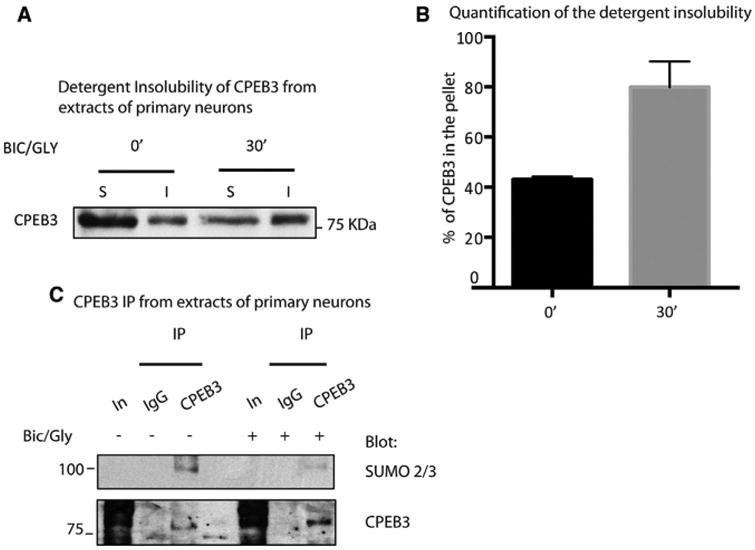
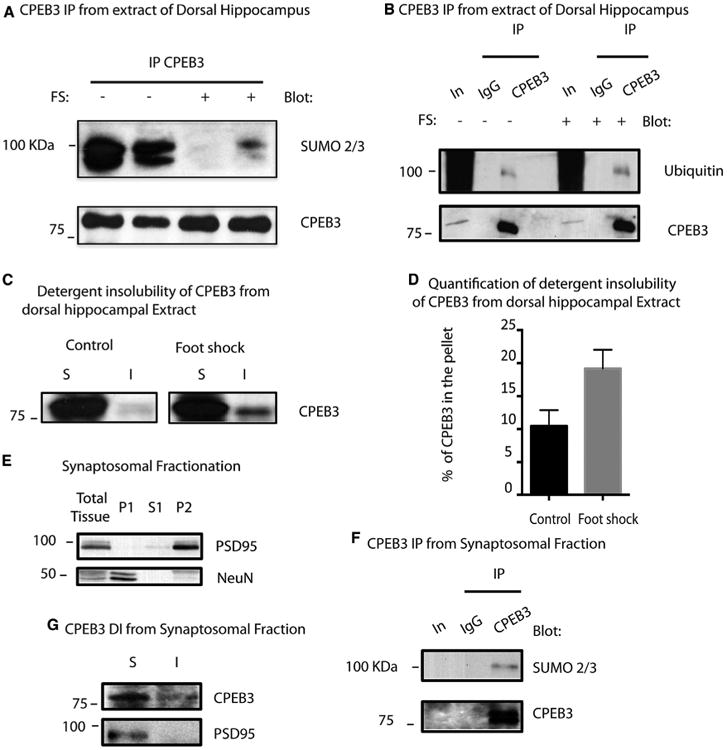
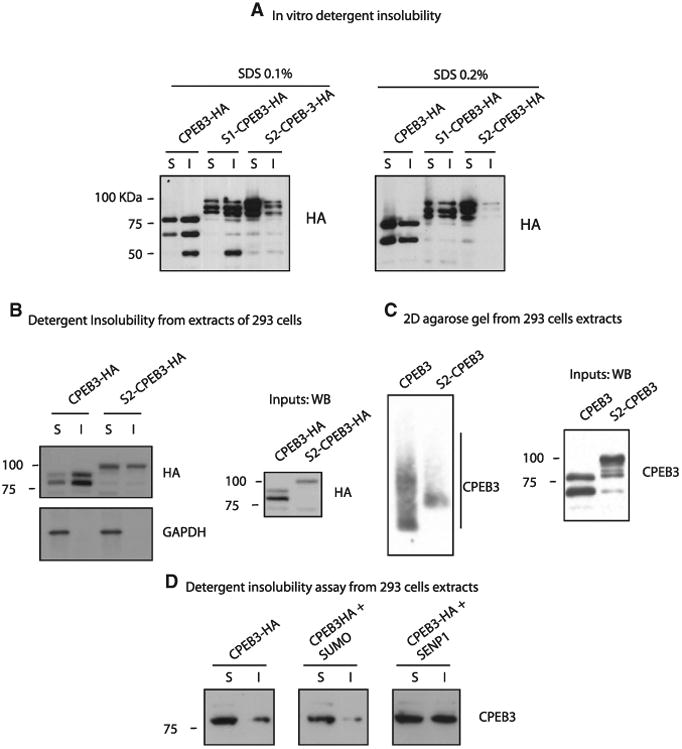
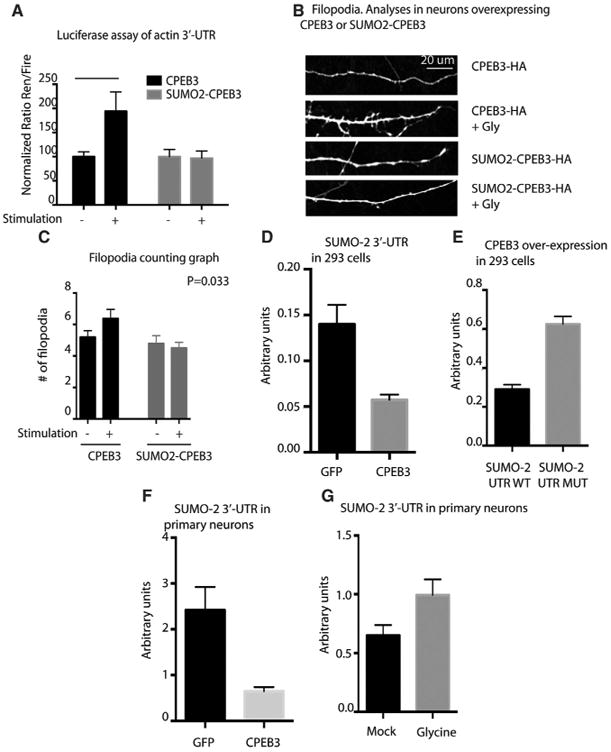
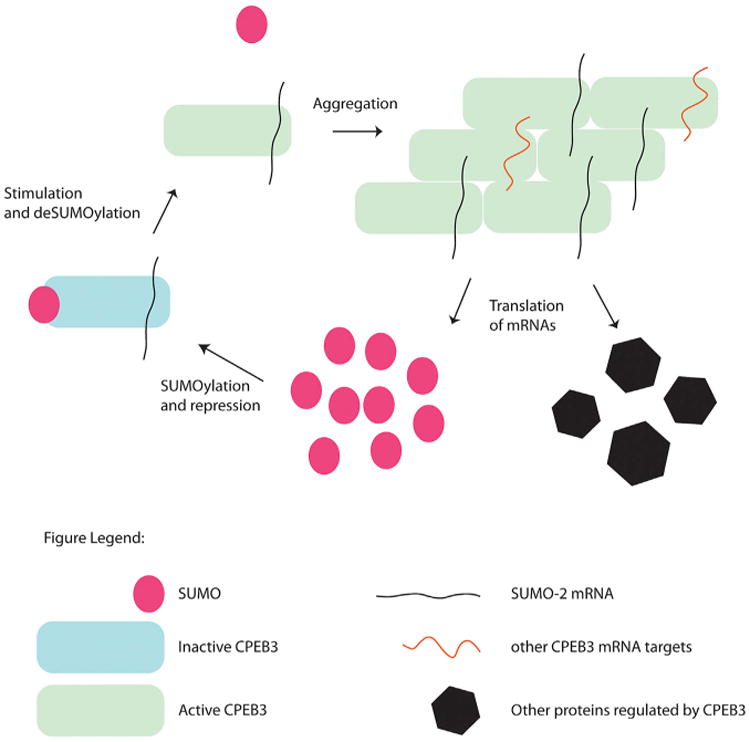
Protein synthesis is crucial for the maintenance of long-term-memory-related synaptic plasticity. The prion-like cytoplasmic polyadenylation element-binding protein 3 (CPEB3) regulates the translation of several mRNAs important for long-term synaptic plasticity in the hippocampus. Here, we provide evidence that the prion-like aggregation and activity of CPEB3 is controlled by SUMOylation. In the basal state, CPEB3 is a repressor and is soluble. Under these circumstances, CPEB3 is SUMOylated in hippocampal neurons both in vitro and in vivo. Following neuronal stimulation, CPEB3 is converted into an active form that promotes the translation of target mRNAs, and this is associated with a decrease of SUMOylation and an increase of aggregation. A chimeric CPEB3 protein fused to SUMO cannot form aggregates and cannot activate the translation of target mRNAs. These findings suggest a model whereby SUMO regulates translation of mRNAs and structural synaptic plasticity by modulating the aggregation of the prion-like protein CPEB3.
Overview
The claims and statistics of this paper haven’t been checked yet.
Run the check — free, no account needed. It reads the open-access text and checks the sources it cites.
Integrity signals
Registry
Cites
Statistics
Figures
Verification
Claims the paper makes
The claims and statistics of this paper haven’t been checked yet.
Run the check — free, no account needed. It reads the open-access text and checks the sources it cites.
Claims other papers make about this one
Each is checked against this paper’s own text: does it say what the citing paper says it does?
In the citing paper
“Moreover, CPEB3 contains a prion-like domain that has been shown to form amyloid-like aggregates upon neuronal activation (44) that are toxic in vitro (45).”
From MicroRNA-92a–CPEB3 axis protects neurons against inflammatory neurodegeneration (2023) · cites this paper as [45]
Self-check
Percentages, sums and reported differences re-computed from the paper’s own numbers.
The self-check needs the paper’s full text.
Citations
Cites
Protein aggregation and neurodegenerative disease
Ross, C. A., & Poirier, M. A. (2004) · Nature Medicine · doi:10.1038/nm1066 · Cited by 3,454
Kato, M., Han, T. W., Xie, S., Shi, K., Du, X., Wu, L. C., Mirzaei, H., Goldsmith, E. J., Longgood, J., Pei, J., et al. (2012) · Cell · doi:10.1016/j.cell.2012.04.017 · Cited by 2,012
Hou, F., Sun, L., Zheng, H., Skaug, B., Jiang, Q.-X., & Chen, Z. J. (2011) · Cell · doi:10.1016/j.cell.2011.06.041 · Cited by 1,282
The Molecular and Systems Biology of Memory
Kandel, E. R., Dudai, Y., & Mayford, M. R. (2014) · Cell · doi:10.1016/j.cell.2014.03.001 · Cited by 1,134
Self-citationThe SUMO pathway: emerging mechanisms that shape specificity, conjugation and recognition
Gareau, J. R., & Lima, C. D. (2010) · Nature Reviews Molecular Cell Biology · doi:10.1038/nrm3011 · Cited by 1,105
Lu, W.-Y., Man, H.-Y., Ju, W., Trimble, W. S., MacDonald, J. F., & Wang, Y. T. (2001) · Neuron · doi:10.1016/s0896-6273(01)00194-5 · Cited by 910
Han, T. W., Kato, M., Xie, S., Wu, L. C., Mirzaei, H., Pei, J., Chen, M., Xie, Y., Allen, J., Xiao, G., et al. (2012) · Cell · doi:10.1016/j.cell.2012.04.016 · Cited by 767
SUMO Modification of Huntingtin and Huntington's Disease Pathology
Steffan, J. S., Agrawal, N., Pallos, J., Rockabrand, E., Trotman, L. C., Slepko, N., Illes, K., Lukácsovich, T., Zhu, Y., Cattaneo, E. F., et al. (2004) · Science · doi:10.1126/science.1092194 · Cited by 743
Anatomical and Physiological Plasticity of Dendritic Spines
Alvarez, V. A., & Sabatini, B. L. (2007) · Annual Review of Neuroscience · doi:10.1146/annurev.neuro.30.051606.094222 · Cited by 629
A Neuronal Isoform of the Aplysia CPEB Has Prion-Like Properties
Si, K., Lindquist, S., & Kandel, E. R. (2003) · Cell · doi:10.1016/s0092-8674(03)01020-1 · Cited by 563
Self-citationDendritic spines and long-term plasticity
Segal, M. (2005) · Nature Reviews Neuroscience · doi:10.1038/nrn1649 · Cited by 489
Si, K., Choi, Y.-B., White-Grindley, E., Majumdar, A., & Kandel, E. R. (2010) · Cell · doi:10.1016/j.cell.2010.01.008 · Cited by 393
Self-citationNeurological Illness in Transgenic Mice Expressing a Prion Protein with an Insertional Mutation
Chiesa, R., Piccardo, P., Ghetti, B., & Harris, D. A. (1998) · Neuron · doi:10.1016/s0896-6273(00)80653-4 · Cited by 310
The Persistence of Long-Term Memory
Bailey, C. H., Kandel, E. R., & Si, K. (2004) · Neuron · doi:10.1016/j.neuron.2004.09.017 · Cited by 277
Self-citationCritical Role of Amyloid-like Oligomers of Drosophila Orb2 in the Persistence of Memory
Majumdar, A., Cesario, W. C., White‐Grindley, E., Jiang, H., Ren, F., Khan, M. R., Li, L., Choi, E. M.-L., Kannan, K. S., Guo, F., et al. (2012) · Cell · doi:10.1016/j.cell.2012.01.004 · Cited by 275
Sumoylation inhibits α-synuclein aggregation and toxicity
Krumova, P., Meulmeester, E., Garrido, M., Tirard, M., Hsiao, H., Bossis, G., Urlaub, H., Zweckstetter, M., Kügler, S., Melchior, F., et al. (2011) · The Journal of Cell Biology · doi:10.1083/jcb.201010117 · Cited by 265
Drisaldi, B., Stewart, R. S., Adles, C., Stewart, L. R., Quaglio, E., Biasini, E., Fioriti, L., Chiesa, R., & Harris, D. A. (2003) · Journal of Biological Chemistry · doi:10.1074/jbc.m213247200 · Cited by 228
Self-citationFioriti, L., Myers, C., Huang, Y.-Y., Li, X., Stephan, J. S., Trifilieff, P., Colnaghi, L., Kosmidis, S., Drisaldi, B., Pavlopoulos, E., et al. (2015) · Neuron · doi:10.1016/j.neuron.2015.05.021 · Cited by 221
Self-citationMunton, R. P., Tweedie‐Cullen, R. Y., Livingstone-Zatchej, M., Weinandy, F., Waidelich, M., Longo, D., Gehrig, P., Potthast, F., Rutishauser, D., Gerrits, B., et al. (2006) · Molecular & Cellular Proteomics · doi:10.1074/mcp.m600046-mcp200 · Cited by 219
Theis, M., Si, K., & Kandel, E. R. (2003) · Proceedings of the National Academy of Sciences · doi:10.1073/pnas.1133424100 · Cited by 193
Self-citationPavlopoulos, E., Trifilieff, P., Chevaleyre, V., Fioriti, L., Zairis, S., Pagano, A., Malleret, G., & Kandel, E. R. (2011) · Cell · doi:10.1016/j.cell.2011.09.056 · Cited by 192
Self-citationSUMO on the road to neurodegeneration
Dorval, V., & Fraser, P. E. (2007) · Biochimica et Biophysica Acta (BBA) - Molecular Cell Research · doi:10.1016/j.bbamcr.2007.03.017 · Cited by 188
Self-citationAnalysis of Amyloid Aggregates Using Agarose Gel Electrophoresis
Bagriantsev, S. N., Kushnirov, V. V., & Liebman, S. W. (2006) · Methods in enzymology on CD-ROM/Methods in enzymology · doi:10.1016/s0076-6879(06)12003-0 · Cited by 146
The CPEB3 Protein Is a Functional Prion that Interacts with the Actin Cytoskeleton
Stephan, J. S., Fioriti, L., Lamba, N., Colnaghi, L., Karl, K. A., Derkatch, I. L., & Kandel, E. R. (2015) · Cell Reports · doi:10.1016/j.celrep.2015.04.060 · Cited by 126
Self-citationPeroutka, R. J., Orcutt, S. J., Strickler, J. E., & Butt, T. R. (2010) · Methods in molecular biology · doi:10.1007/978-1-61737-967-3_2 · Cited by 103
Lee, L., Sakurai, M., Matsuzaki, S., Arancio, O., & Fraser, P. E. (2013) · NeuroMolecular Medicine · doi:10.1007/s12017-013-8257-7 · Cited by 94
Self-citationSpecificity of Prion Assembly in Vivo
Bagriantsev, S. N., & Liebman, S. W. (2004) · Journal of Biological Chemistry · doi:10.1074/jbc.m410611200 · Cited by 93
Jaafari, N., Konopacki, F. A., Owen, T. F., Kantamneni, S., Rubin, P. P., Craig, T. J., Wilkinson, K. A., & Henley, J. M. (2013) · PLoS ONE · doi:10.1371/journal.pone.0052345 · Cited by 64
Scrapie in Mice Deficient in Apolipoprotein E or Glial Fibrillary Acidic Protein
Tatzelt, J., Maeda, N., Pekny, M., Yang, S.-L., Betsholtz, C., Eliasson, C., Cayetano, J., Camerino, A. P., DeArmond, S. J., & Prusiner, S. B. (1996) · Neurology · doi:10.1212/wnl.47.2.449 · Cited by 59
Contribution of Orb2A Stability in Regulated Amyloid-Like Oligomerization of Drosophila Orb2
White‐Grindley, E., Li, L., Khan, R. M., Ren, F., Saraf, A., Florens, L. A., & Si, K. (2014) · PLoS Biology · doi:10.1371/journal.pbio.1001786 · Cited by 59
N-Terminal Protein Tails Act as Aggregation Protective Entropic Bristles: The SUMO Case
Graña‐Montes, R., Marinelli, P., Reverter, D., & Ventura, S. (2014) · Biomacromolecules · doi:10.1021/bm401776z · Cited by 48
(2004) · Birkhäuser Basel eBooks · doi:10.1007/978-3-0348-7949-1 · Cited by 44
Receptor Trafficking and the Regulation of Synaptic Plasticity by SUMO
Luo, J., Ashikaga, E., Rubin, P. P., Heimann, M. J., Hildick, K. L., Bishop, P., Girach, F., Josa‐Prado, F., Tang, L. T. H., Carmichael, R. E., et al. (2013) · NeuroMolecular Medicine · doi:10.1007/s12017-013-8253-y · Cited by 41
Native Structure Protects SUMO Proteins from Aggregation into Amyloid Fibrils
Sabaté, R., Espargaró, A., Graña‐Montes, R., Reverter, D., & Ventura, S. (2012) · Biomacromolecules · doi:10.1021/bm3004385 · Cited by 34
Cited by
Fioriti, L., Myers, C., Huang, Y.-Y., Li, X., Stephan, J. S., Trifilieff, P., Colnaghi, L., Kosmidis, S., Drisaldi, B., Pavlopoulos, E., et al. (2015) · Neuron · doi:10.1016/j.neuron.2015.05.021 · Cited by 221
Self-citationMolecular Mechanisms of Early and Late LTP
Baltaci, S. B., Mogulkoc, R., & Baltaci, A. K. (2019) · Neurochemical Research · doi:10.1007/s11064-018-2695-4 · Cited by 179
Maillo, C., Martín, J., Sebastián, D., Hernández-Alvarez, M., García-Rocha, M., Reina, O., Zorzano, A., Fernandez, M., & Méndez, R. (2017) · Nature Cell Biology · doi:10.1038/ncb3461 · Cited by 82
MicroRNA-92a–CPEB3 axis protects neurons against inflammatory neurodegeneration
Winkler, I., Engler, J. B., Vieira, V., Bauer, S., Liu, Y.-H., Di Liberto, G., Grochowska, K. M., Wagner, I., Bier, J., Bal, L. C., et al. (2023) · Science Advances · doi:10.1126/sciadv.adi6855 · Cited by 22
Metadata
- Authors
- Drisaldi, B., Colnaghi, L., Fioriti, L., Rao, N., Myers, C., Snyder, A. M., Metzger, D. J., Tarasoff, J., Konstantinov, E., Fraser, P. E., Manley, J. L., & Kandel, E. R.
- Venue
- Cell Reports
- Publisher
- Elsevier BV
- Published
- 2015-06
- Volume
- 11
- Issue
- 11
- Pages
- 1694-1702
- ISSN
- 2211-1247
- PMC
- PMC5477225
- Cited by
- 120
- References
- 34
- Language
- en
- Licence
- www.elsevier.com/tdm/userlicense/1.0/ (tdm)
- www.elsevier.com/legal/tdmrep-license (tdm)
- creativecommons.org/licenses/by-nc-nd/4.0/ (vor)
About these checks
Registry, retraction, Cites and statistics results are computed, not judged, with one exception: a printed reference that no index lists is read once by a model before it counts as a citation error. Claims are extracted by a model and kept only when their quote appears verbatim in the text; each cited source is then checked, with a model’s help, for whether it says what the claim relies on. Those verdicts can be wrong — read the claim’s quote and the cited source before relying on one.
Statistics and arithmetic are recomputed, not judged.
Confidence bands are shown only for fields calibrated on our annotated test set. None is calibrated yet, so no band is shown.
What counts as a claim ›How we measure confidence ›How we check this ›
Are you an author, or do you see a problem with this page? Request a review
Data sources
Bibliographic data: Semantic Scholar, OpenAlex, Crossref.
Contains information from the Semantic Scholar Academic Graph Datasets, made available under the ODC Attribution License (ODC-BY 1.0).
Semantic Scholar’s data is described in: Kinney, R., et al. (2023). The Semantic Scholar Open Data Platform. arXiv:2301.10140.
