

The DOI matches its Crossref record; 51 of the 53 references it cites were found in a registry or an index.
The Sedoheptulose Kinase CARKL Directs Macrophage Polarization through Control of Glucose Metabolism
Open accessAbstract
Immune cells are somewhat unique in that activation responses can alter quantitative phenotypes upwards of 100,000-fold. To date little is known about the metabolic adaptations necessary to mount such dramatic phenotypic shifts. Screening for novel regulators of macrophage activation, we found nonprotein kinases of glucose metabolism among the most enriched classes of candidate immune modulators. We find that one of these, the carbohydrate kinase-like protein CARKL, is rapidly downregulated in vitro and in vivo upon LPS stimulation in both mice and humans. Interestingly, CARKL catalyzes an orphan reaction in the pentose phosphate pathway, refocusing cellular metabolism to a high-redox state upon physiological or artificial downregulation. We find that CARKL-dependent metabolic reprogramming is required for proper M1- and M2-like macrophage polarization and uncover a rate-limiting requirement for appropriate glucose flux in macrophage polarization.
Overview
The claims and statistics of this paper haven’t been checked yet.
Run the check — free, no account needed. It reads the open-access text and checks the sources it cites.
Integrity signals
Registry
Cites
Statistics
Figures
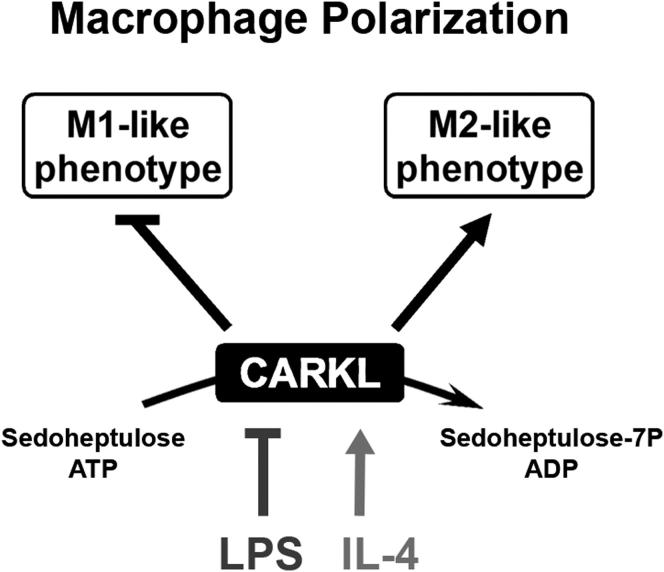
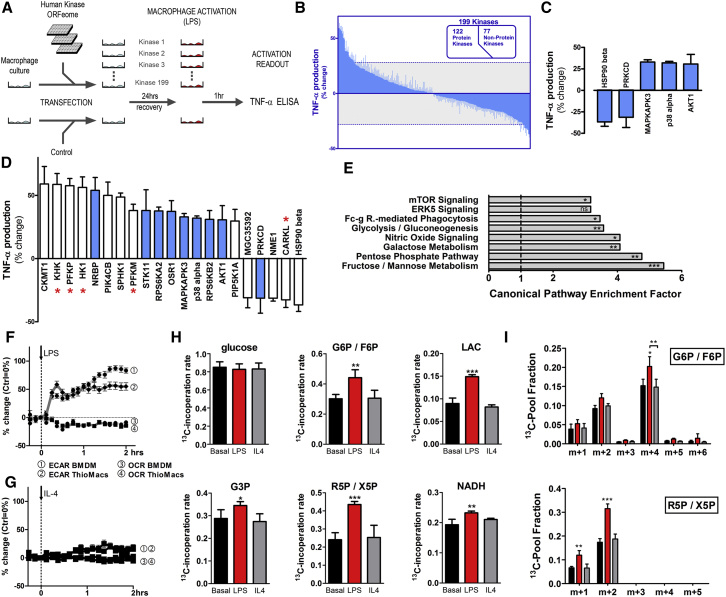
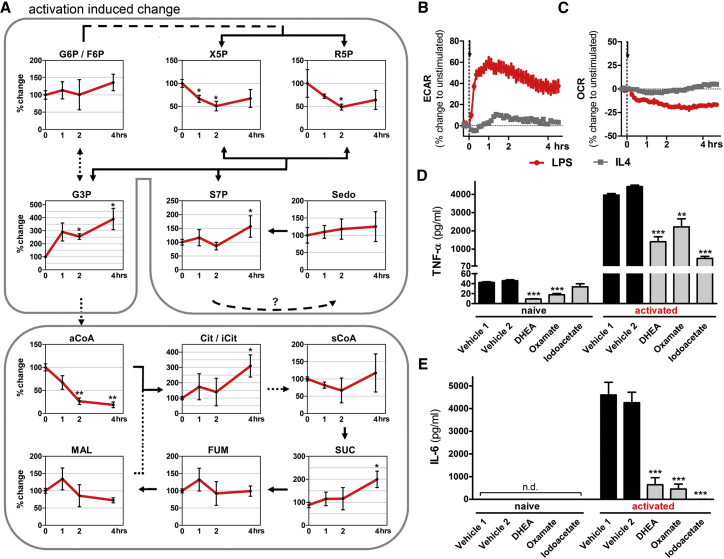
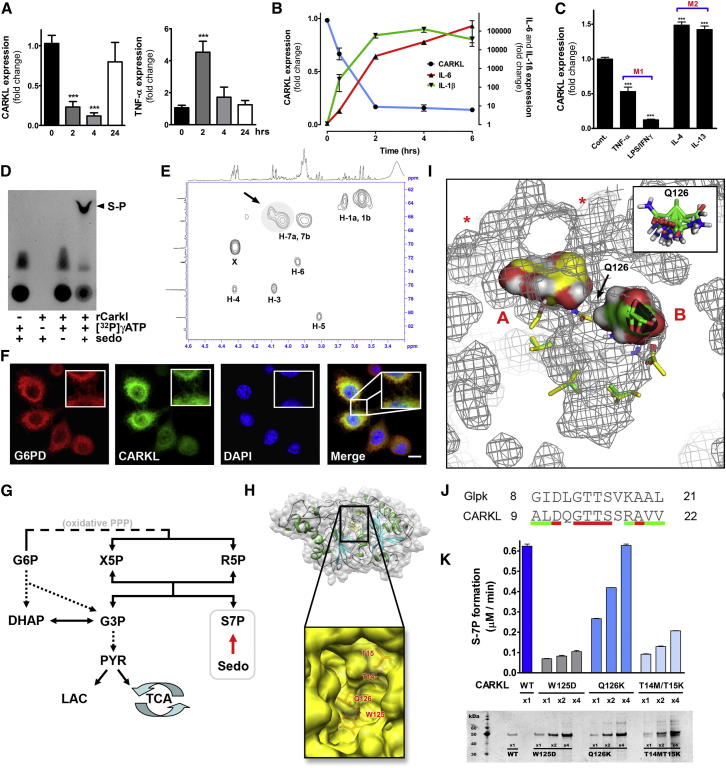
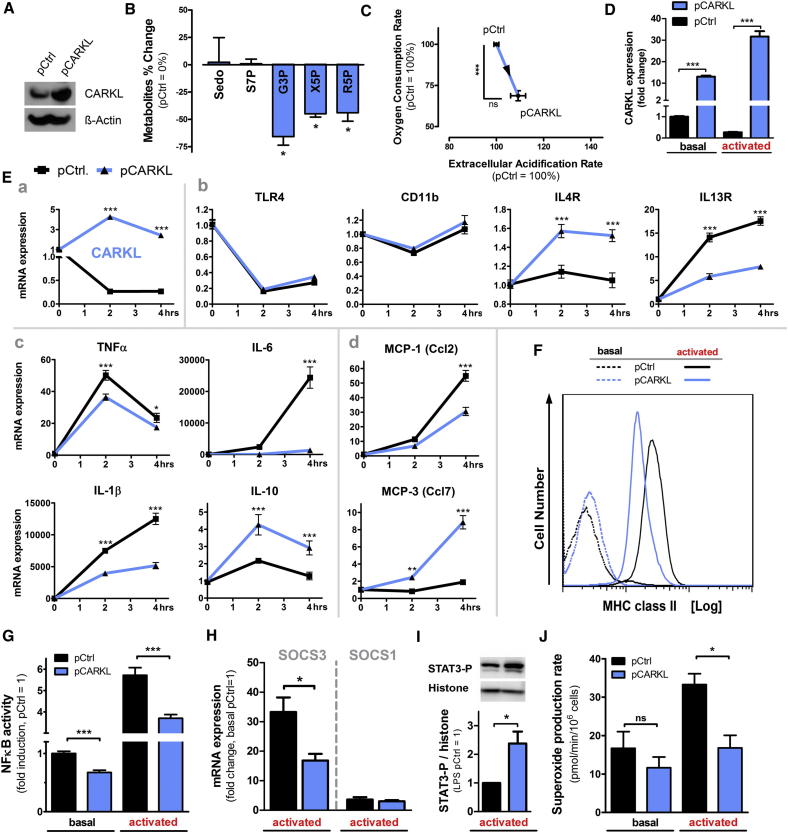
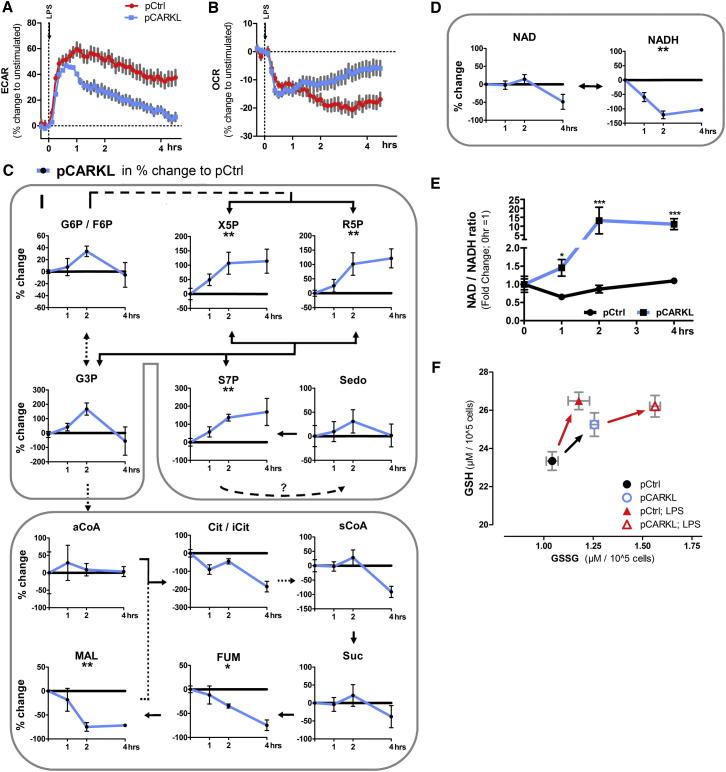
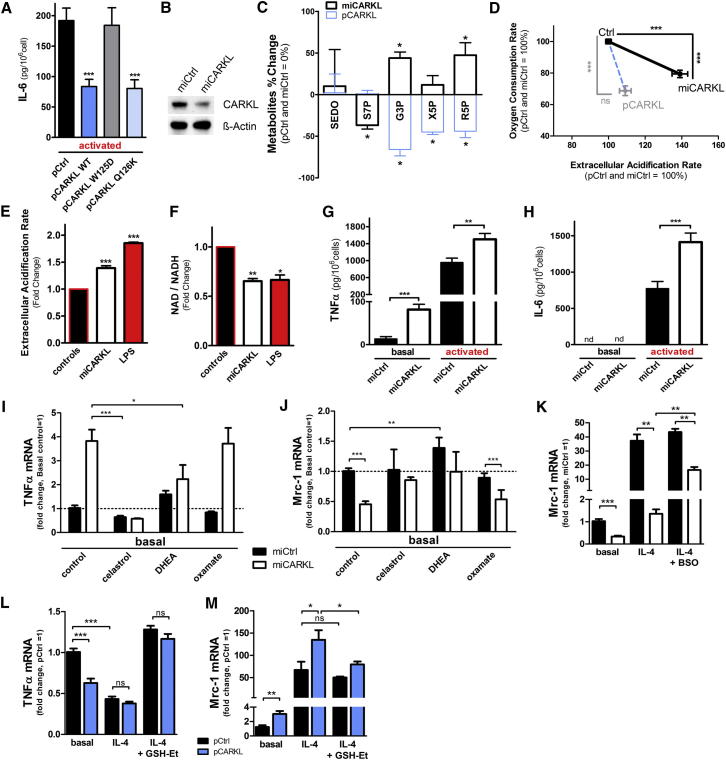
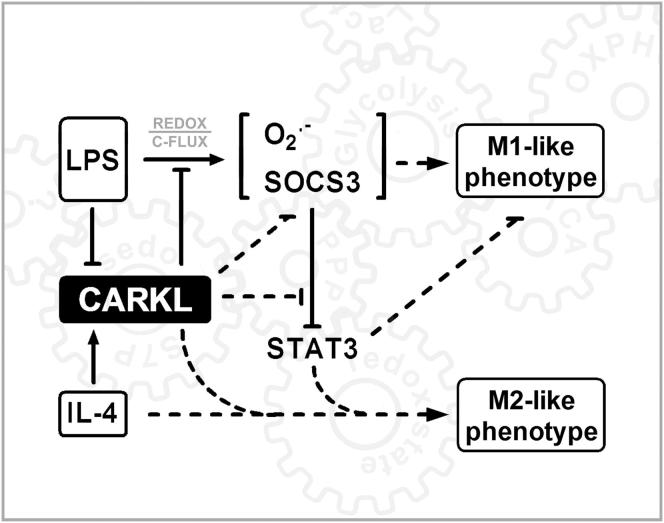
Verification
Claims the paper makes
The claims and statistics of this paper haven’t been checked yet.
Run the check — free, no account needed. It reads the open-access text and checks the sources it cites.
Claims other papers make about this one
Each is checked against this paper’s own text: does it say what the citing paper says it does?
In the citing paper
“TCR/CD28 stimulation of T cells (6), the stimulation of surface immunoglobulin on B cells (41), and TLR stimulation of macrophages and dendritic cells (DCs) (42, 43) all promote changes in aerobic glycolysis characteristic of the Warburg effect.”
From Fueling Immunity: Insights into Metabolism and Lymphocyte Function (2013) · cites this paper as [43]
Self-check
Percentages, sums and reported differences re-computed from the paper’s own numbers.
The self-check needs the paper’s full text.
Citations
Cites
Understanding the Warburg Effect: The Metabolic Requirements of Cell Proliferation
Vander Heiden, M. G., Cantley, L. C., & Thompson, C. B. (2009) · Science · doi:10.1126/science.1160809 · Cited by 16,197
Warburg, O. (1956) · Science · doi:10.1126/science.123.3191.309 · Cited by 13,425
Alternative activation of macrophages: mechanism and functions
Gordon, S., & Martinez, F. O. (2010) · Immunity · doi:10.1016/j.immuni.2010.05.007 · Cited by 4,197
Approaching the asymptote? Evolution and revolution in immunology.Preprint
Janeway, C. (1989) · Cold Spring Harbor Symposia on Quantitative Biology · doi:10.1101/sqb.1989.054.01.003 · Cited by 3,396
The Inflammasomes: Guardians of the Body
Martinon, F., Mayor, A., & Tschopp, J. (2009) · Annual Review of Immunology · doi:10.1146/annurev.immunol.021908.132715 · Cited by 2,436
Nathan, C., & Ding, A. (2010) · Cell · doi:10.1016/j.cell.2010.02.029 · Cited by 2,183
Inflammation 2010: New Adventures of an Old Flame
Medzhitov, R. M. (2010) · Cell · doi:10.1016/j.cell.2010.03.006 · Cited by 1,928
Shi, L. Z., Wang, R., Huang, G., Vogel, P., Neale, G., Green, D. R., & Chi, H. (2011) · Journal of Experimental Medicine · doi:10.1084/jem.20110278 · Cited by 1,803
SOCS proteins, cytokine signalling and immune regulation
Yoshimura, A., Naka, T., & Kubo, M. (2007) · Nature Reviews Immunology · doi:10.1038/nri2093 · Cited by 1,580
Toll-like receptor–induced changes in glycolytic metabolism regulate dendritic cell activation
Krawczyk, C. M., Holowka, T., Sun, J., Blagih, J., Amiel, E., DeBerardinis, R. J., Cross, J. R., Jung, E., Thompson, C. B., Jones, R. G., et al. (2010) · Blood · doi:10.1182/blood-2009-10-249540 · Cited by 1,246
Research works printed but not linked: 1
- Warburg, 1924, Ueber den Stoffwechsel der Tumoren, Biochem. Z., 152, 319
Cited by
Sorted by citations
A guide to immunometabolism for immunologists
O'Neill, L. A. J., Kishton, R. J., & Rathmell, J. (2016) · Nature Reviews Immunology · doi:10.1038/nri.2016.70 · Cited by 3,315
Murray, P. J. (2017) · Annual Review of Physiology · doi:10.1146/annurev-physiol-022516-034339 · Cited by 2,981
Microglial M1/M2 polarization and metabolic states
Orihuela, R., McPherson, C. A., & Harry, G. J. (2016) · British Journal of Pharmacology · doi:10.1111/bph.13139 · Cited by 2,070
Jha, A. K., Huang, S. C.-C., Sergushichev, A., Lampropoulou, V., Ivanova, Y., Loginicheva, E., Chmielewski, K., Stewart, K. M., Ashall, J., Everts, B., et al. (2015) · Immunity · doi:10.1016/j.immuni.2015.02.005 · Cited by 2,066
The metabolic signature of macrophage responses
Viola, A., Munari, F., Sánchez-Rodríguez, R., Scolaro, T., & Castegna, A. (2019) · Frontiers in Immunology · doi:10.3389/fimmu.2019.01462 · Cited by 2,021
Metadata
- Authors
- Haschemi, A., Kosma, P., Gille, L., Evans, C. R., Burant, C. F., Starkl, P., Knapp, B., Haas, R., Schmid, J. A., Jandl, C., Amir, S., Lubec, G., Park, J., Esterbauer, H., Bilban, M., Brizuela, L., Pospisilik, J. A., Otterbein, L. E., & Wagner, O.
- Affiliations
- Beth Israel Deaconess Medical Center (US)
- BOKU University (AT)
- University of Veterinary Medicine Vienna (AT)
- University of Michigan (US)
- Medical University of Vienna (AT)
- Harvard University (US)
- Max Planck Institute of Immunobiology and Epigenetics (DE)
- Corresponding author
- Haschemi, Arvand
- Pospisilik, J. Andrew
- ORCID
- Venue
- Cell Metabolism
- Publisher
- Elsevier BV
- Published
- 2012-06
- Volume
- 15
- Issue
- 6
- Pages
- 813-826
- ISSN
- 1550-4131 (ISSN-L)
- PMC
- PMC3370649
- OpenAlex
- W2047563937
- Cited by
- 635
- References
- 53
- Citations by year
- 2026: 30 · 2025: 35 · 2024: 68 · 2023: 56 · 2022: 41 · 2021: 60 · 2020: 57 · 2019: 50 · 2018: 48 · 2017: 61 · 2016: 35 · 2015: 41 · 2014: 24 · 2013: 14 · 2012: 3
- FWCI
- 11.47
- Type
- journal article
- Language
- en
- Open access
- hybrid
- doi.org
- Licence
- Locations
- Cell Metabolism (publishedVersion, cc-by-nc-nd)
- Europe PMC (PubMed Central) (publishedVersion, cc-by-nc-nd)
- PubMed Central (publishedVersion, cc-by-nc-nd)
- PubMed (publishedVersion)
- Max Planck Digital Library (submittedVersion)
- MPG.PuRe (Max Planck Society) (submittedVersion)
- Funders
- Bundesministerium für Wissenschaft und Forschung
- National Institute of General Medical Sciences (R01GM088666)
- National Institute of Diabetes and Digestive and Kidney Diseases (K25DK092558, DK089503, P30DK089503)
- Topics
- Life Sciences › Immunology and Microbiology › Immunology › Immune cells in cancer
- Life Sciences › Biochemistry, Genetics and Molecular Biology › Molecular Biology › Metabolism, Diabetes, and Cancer
- Life Sciences › Biochemistry, Genetics and Molecular Biology › Cancer Research › Cancer, Hypoxia, and Metabolism
- Keywords
- macrophage polarization, glucose metabolism, pentose phosphate pathway, metabolic reprogramming, M1/M2 macrophages, lipopolysaccharide stimulation, redox state, immune cell metabolism
- MeSH terms
- Amino Acid Sequence, Animals, Cell Line, Double-Blind Method, Energy Metabolism, Glucose, Humans, Lipopolysaccharides, Macrophages, Male, Mice, Inbred C57BL, Models, Molecular, Phenotype, Receptors, Immunologic, Transcription Factors, Tumor Necrosis Factor-alpha, Down-Regulation, Interleukin-6, Gene Expression Regulation, Enzymologic, Cell Polarity, Protein Structure, Tertiary, Phosphotransferases (Alcohol Group Acceptor), Endotoxemia, Carbohydrate Metabolism, Mice
About these checks
Registry, retraction, Cites and statistics results are computed, not judged, with one exception: a printed reference that no index lists is read once by a model before it counts as a citation error. Claims are extracted by a model and kept only when their quote appears verbatim in the text; each cited source is then checked, with a model’s help, for whether it says what the claim relies on. Those verdicts can be wrong — read the claim’s quote and the cited source before relying on one.
Statistics and arithmetic are recomputed, not judged.
Confidence bands are shown only for fields calibrated on our annotated test set. None is calibrated yet, so no band is shown.
What counts as a claim ›How we measure confidence ›How we check this ›
Are you an author, or do you see a problem with this page? Request a review
