

The DOI matches its Crossref record; 86 of the 86 references it cites were found in a registry or an index.
Designing and interpreting ‘multi-omic’ experiments that may change our understanding of biology
Open accessAbstract
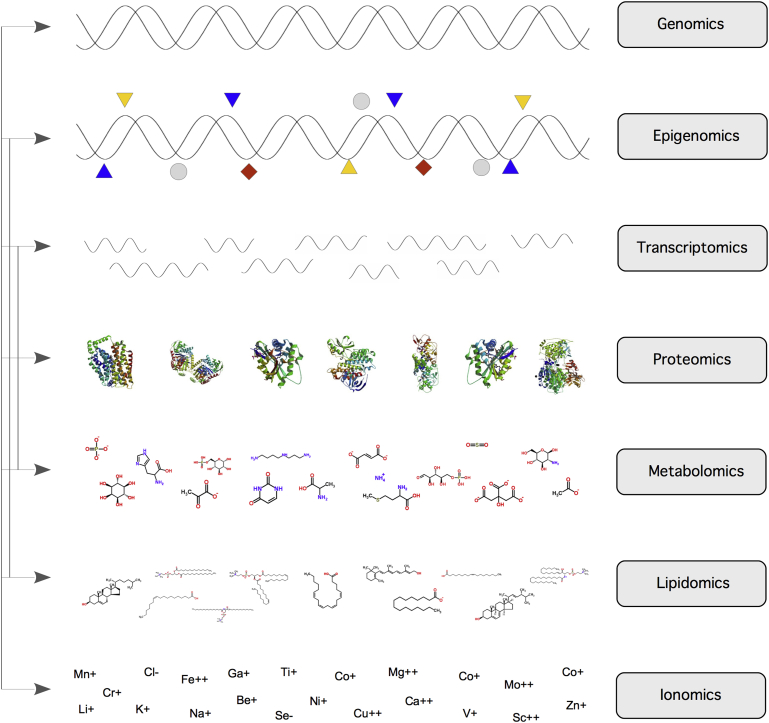
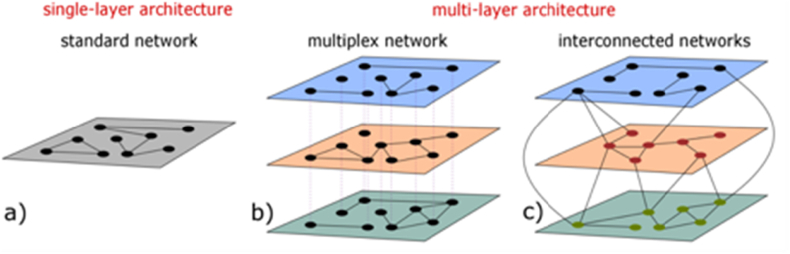
Most biological mechanisms involve more than one type of biomolecule, and hence operate not solely at the level of either genome, transcriptome, proteome, metabolome or ionome. Datasets resulting from single-omic analysis are rapidly increasing in throughput and quality, rendering multi-omic studies feasible. These should offer a comprehensive, structured and interactive overview of a biological mechanism. However, combining single-omic datasets in a meaningful manner has so far proved challenging, and the discovery of new biological information lags behind expectation. One reason is that experiments conducted in different laboratories can typically not to be combined without restriction. Second, the interpretation of multi-omic datasets represents a significant challenge by nature, as the biological datasets are heterogeneous not only for technical, but also for biological, chemical, and physical reasons. Here, multi-layer network theory and methods of artificial intelligence might contribute to solve these problems. For the efficient application of machine learning however, biological datasets need to become more systematic, more precise - and much larger. We conclude our review with basic guidelines for the successful set-up of a multi-omic experiment.
Overview
The claims and statistics of this paper haven’t been checked yet.
Run the check — free, no account needed. It reads the open-access text and checks the sources it cites.
Integrity signals
Registry
Cites
Statistics
Figures
Verification
Claims the paper makes
The claims and statistics of this paper haven’t been checked yet.
Run the check — free, no account needed. It reads the open-access text and checks the sources it cites.
Claims other papers make about this one
Each is checked against this paper’s own text: does it say what the citing paper says it does?
In the citing paper
“Currently, many of the multi-omic reviews are focussed on individual sub-topics.For example, designing studies (Haas et al., 2017;Hasin et al., 2017), setting up workflows (Kohl et al., 2014), choosing software tools (Misra et al., 2019) and evaluating overfitted performance (McCabe et al., 2020).”
From Using machine learning approaches for multi-omics data analysis: A review (2021) · cites this paper as Haas et al., 2017
In the citing paper
“However, there are few other challenges related to multi-omics studies which are not ML related such as study design (Haas et al., 2017), multi-site sample collection & management (Pinu et al., 2019), multi-site data sharing and governance (Saulnier et al., 2019), visualisation (Mougin et al., 2018), ethical standards (Lévesque et al., 2018), and finally making the research reproducible (Conesa”
From Using machine learning approaches for multi-omics data analysis: A review (2021) · cites this paper as Haas et al., 2017
In the citing paper
“In disease classification, certain disease classes are rarer than others which can cause a class imbalance in the multi-omics dataset (Haas et al., 2017).”
From Using machine learning approaches for multi-omics data analysis: A review (2021) · cites this paper as Haas et al., 2017
Self-check
Percentages, sums and reported differences re-computed from the paper’s own numbers.
The self-check needs the paper’s full text.
Citations
Cites
Deep learning in neural networks: an overview
Schmidhuber, J. (2015) · Neural Networks · doi:10.1016/j.neunet.2014.09.003 · Cited by 18,570
The Perseus computational platform for comprehensive analysis of (prote)omics data
Tyanova, S., Temu, T., Sinitcyn, P., Carlson, A., Hein, M. Y., Geiger, T., Mann, M., & Cox, J. (2016) · Nature Methods · doi:10.1038/nmeth.3901 · Cited by 8,803
Network biology: understanding the cell's functional organization
Barabási, A.-L., & Oltvai, Z. N. (2004) · Nature Reviews Genetics · doi:10.1038/nrg1272 · Cited by 7,903
The Large-Scale Organization of Metabolic Networks
Jeong, H., Tombor, B., Albert, R., Oltvai, Z. N., & Barabási, A.-L. (2000) · Nature · doi:10.1038/35036627 · Cited by 4,972
Finishing the euchromatic sequence of the human genome
International Human Genome Sequencing Consortium (2004) · Nature · doi:10.1038/nature03001 · Cited by 4,971
Coming of age: ten years of next-generation sequencing technologies
Goodwin, S., McPherson, J. D., & McCombie, W. R. (2016) · Nature Reviews Genetics · doi:10.1038/nrg.2016.49 · Cited by 4,352
Optimization Methods for Large-Scale Machine Learning
Bottou, L., Curtis, F. E., & Nocedal, J. M. (2018) · SIAM Review · doi:10.1137/16m1080173 · Cited by 3,573
Central Dogma of Molecular Biology
CRICK, F. (1970) · Nature · doi:10.1038/227561a0 · Cited by 3,444
Kivela, M., Arenas, A., Barthelemy, M., Gleeson, J. P., Moreno, Y., & Porter, M. A. (2014) · Journal of Complex Networks · doi:10.1093/comnet/cnu016 · Cited by 3,235
The structure and dynamics of multilayer networks
Boccaletti, S., Bianconi, G., Criado, R., del Genio, C. I., Gómez-Gardeñes, J., Romance, M., Sendiña-Nadal, I., Wang, Z., & Zanin, M. (2014) · Physics Reports · doi:10.1016/j.physrep.2014.07.001 · Cited by 3,125
Cited by
Sorted by citations
Identification of bioactive metabolites using activity metabolomics
Rinschen, M. M., Ivanisevic, J., Giera, M., & Siuzdak, G. (2019) · Nature Reviews Molecular Cell Biology · doi:10.1038/s41580-019-0108-4 · Cited by 1,008
Using machine learning approaches for multi-omics data analysis: A review
Reel, P. S., Reel, S., Pearson, E., Trucco, E., & Jefferson, E. (2021) · Biotechnology Advances · doi:10.1016/j.biotechadv.2021.107739 · Cited by 903
Systems biology and multi-omics integration: viewpoints from the metabolomics research community
Pinu, F. R., Beale, D. J., Paten, A. M., Kouremenos, K., Swarup, S., Schirra, H. J., & Wishart, D. (2019) · Metabolites · doi:10.3390/metabo9040076 · Cited by 723
Applications of multi‐omics analysis in human diseases
Chen, C., Wang, J., Pan, D., Wang, X., Xu, Y., Yan, J., Wang, L., Yang, X., Yang, M., & Liu, G. (2023) · MedComm · doi:10.1002/mco2.315 · Cited by 545
Escherichia coli as a host for metabolic engineering
Pontrelli, S., Chiu, T., Lan, E. I., Chen, F. Y.-H., Chang, P., & Liao, J. C. (2018) · Metabolic Engineering · doi:10.1016/j.ymben.2018.04.008 · Cited by 397
Metadata
- Authors
- Haas, R., Zelezniak, A., Iacovacci, J., Kamrad, S., Townsend, S., & Ralser, M.
- Affiliations
- The Francis Crick Institute (GB)
- University of Cambridge (GB)
- Corresponding author
- Ralser, Markus
- Venue
- Current Opinion in Systems Biology
- Publisher
- Elsevier BV
- Published
- 2017-12
- Volume
- 6
- Pages
- 37-45
- ISSN
- 2452-3100 (ISSN-L)
- PMC
- PMC7477987
- OpenAlex
- W2750804603
- Cited by
- 131
- References
- 86
- Citations by year
- 2026: 10 · 2025: 11 · 2024: 14 · 2023: 15 · 2022: 17 · 2021: 25 · 2020: 14 · 2019: 20 · 2018: 5
- FWCI
- 1.00
- Type
- journal article
- Language
- en
- Open access
- hybrid
- doi.org
- Licence
- Locations
- Current Opinion in Systems Biology (publishedVersion, cc-by)
- PubMed Central (publishedVersion, cc-by)
- PubMed (publishedVersion)
- Zenodo (CERN European Organization for Nuclear Research) (submittedVersion, cc-by)
- Figshare (submittedVersion, cc-by)
- Chalmers Research (Chalmers University of Technology) (submittedVersion)
- Spiral (Imperial College London) (submittedVersion, other-oa)
- The Francis Crick Institute (cc-by)
- Funders
- Francis Crick Institute
- Cancer Research UK (FC001134)
- UK Medical Research Council (FC001134)
- Wellcome Trust (FC001134)
- Topics
- Life Sciences › Biochemistry, Genetics and Molecular Biology › Molecular Biology › Bioinformatics and Genomic Networks
- Life Sciences › Biochemistry, Genetics and Molecular Biology › Molecular Biology › Gene Regulatory Network Analysis
- Life Sciences › Biochemistry, Genetics and Molecular Biology › Molecular Biology › Microbial Metabolic Engineering and Bioproduction
- Keywords
- multi-omics, biological mechanisms, data heterogeneity, proteomics, metabolomics, transcriptomics, ionomics, systems biology
About these checks
Registry, retraction, Cites and statistics results are computed, not judged, with one exception: a printed reference that no index lists is read once by a model before it counts as a citation error. Claims are extracted by a model and kept only when their quote appears verbatim in the text; each cited source is then checked, with a model’s help, for whether it says what the claim relies on. Those verdicts can be wrong — read the claim’s quote and the cited source before relying on one.
Statistics and arithmetic are recomputed, not judged.
Confidence bands are shown only for fields calibrated on our annotated test set. None is calibrated yet, so no band is shown.
What counts as a claim ›How we measure confidence ›How we check this ›
Are you an author, or do you see a problem with this page? Request a review
