

The DOI matches its Crossref record; 49 of the 49 references it cites were found in a registry or an index.
Age-related changes in insula cortical thickness and impulsivity: Significance for emotional development and decision-making
Open accessAbstract
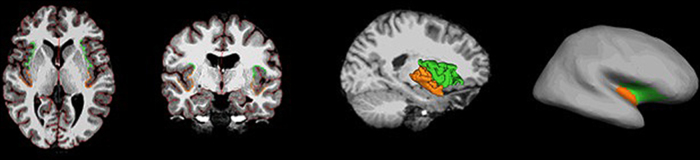
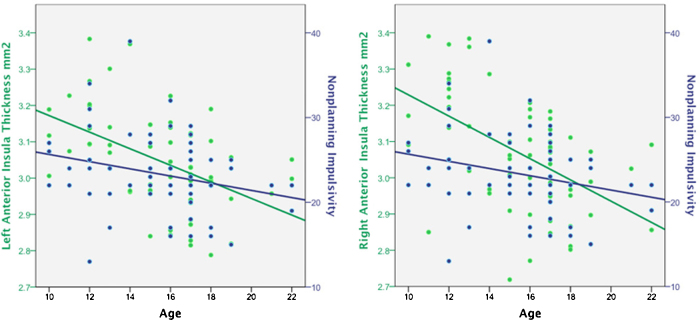
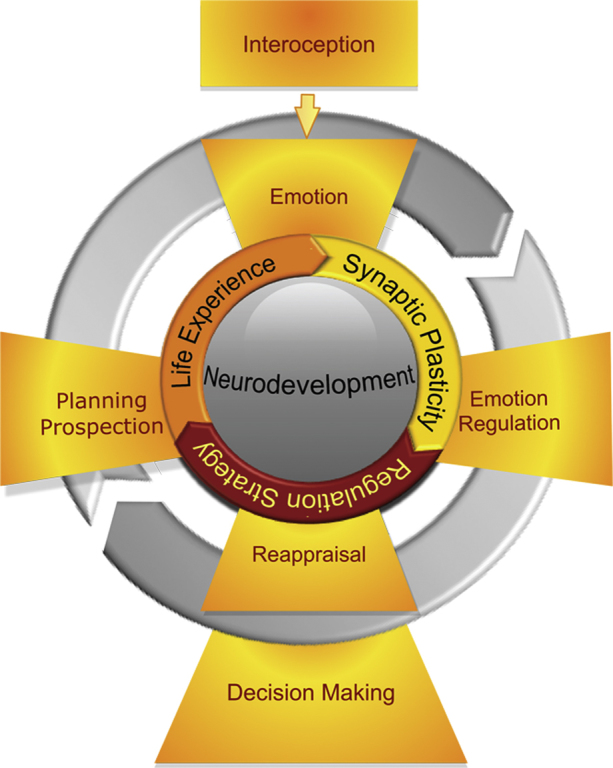
Insula function has been associated with emotional regulation, adjusting to changing outcomes under risk, reward and loss anticipation, discounting of future rewards, and self-rated impulsivity. The role of the insula in these processes may be fundamentally related to prospective thinking, a trait that increases with age. There is evidence that insular cortical thickness shows age related decreases that parallel age related increases in future orientation and planning. We tested the hypothesis that nonplanning decreases with age and that insula thickness is related to both age and nonplanning impulsivity. Fifty-nine male and female participants, ranging in age from 10 to 22 years old, underwent structural magnetic resonance imaging (MRI) procedures and were assessed using the Barratt Impulsiveness Scale (BIS). We observed that anterior insula thickness and nonplanning impulsivity show an inverse relationship with age and that there is a significant positive linear relationship between anterior insula thickness and nonplanning.
Overview
The claims and statistics of this paper haven’t been checked yet.
Run the check — free, no account needed. It reads the open-access text and checks the sources it cites.
Integrity signals
Registry
Cites
Statistics
Figures
Verification
Claims the paper makes
The claims and statistics of this paper haven’t been checked yet.
Run the check — free, no account needed. It reads the open-access text and checks the sources it cites.
Claims other papers make about this one
Each is checked against this paper’s own text: does it say what the citing paper says it does?
In the citing paper
“The crux of the dual system hypothesis is that the maturational imbalance during adolescence between heightened sensation seeking and a still-maturing capacity for self-regulation makes adolescents particularly susceptible to engage in risky behaviors [for review, see 25].”
From The role of the anterior insula in adolescent decision making (2014) · cites this paper as [25]
In the citing paper
“Current developmental theories posit that increases in risky behaviors during adolescence are a result of the maturational imbalance between neural systems underlying sensation-seeking and self-regulatory behaviors, which leads adolescents to disproportionately activate appetitive, reward-seeking circuitry rather than deliberative, cognitive control circuitry during risky decision making,”
From The role of the anterior insula in adolescent decision making (2014) · cites this paper as [25]
Self-check
Percentages, sums and reported differences re-computed from the paper’s own numbers.
The self-check needs the paper’s full text.
Citations
Cites
Desikan, R. S., Ségonne, F., Fischl, B., Quinn, B. T., Dickerson, B. C., Blacker, D., Buckner, R. L., Dale, A. M., Maguire, R. P., Hyman, B. T., et al. (2006) · NeuroImage · doi:10.1016/j.neuroimage.2006.01.021 · Cited by 13,324
Cortical Surface-Based Analysis
Dale, A. M., Fischl, B., & Sereno, M. I. (1999) · NeuroImage · doi:10.1006/nimg.1998.0395 · Cited by 10,910
Fischl, B., Salat, D. H., Busa, E., Albert, M., Dieterich, M., Haselgrove, C., van der Kouwe, A., Killiany, R., Kennedy, D., Klaveness, S., et al. (2002) · Neuron · doi:10.1016/s0896-6273(02)00569-x · Cited by 8,610
How do you feel — now? The anterior insula and human awareness
(Bud) Craig, A. D. (2009) · Nature Reviews Neuroscience · doi:10.1038/nrn2555 · Cited by 6,657
The feeling of what happens: body and emotion in the making of consciousness
(2000) · Choice Reviews Online · doi:10.5860/choice.37-6553 · Cited by 6,001
Measuring the thickness of the human cerebral cortex from magnetic resonance images
Fischl, B. R., & Dale, A. M. (2000) · Proceedings of the National Academy of Sciences · doi:10.1073/pnas.200033797 · Cited by 5,995
Dynamic mapping of human cortical development during childhood through early adulthood
Gogtay, N., Giedd, J. N., Lusk, L., Hayashi, K. M., Greenstein, D., Vaituzis, A. C., Nugent, T. F., Herman, D. H., Clasen, L. S., Toga, A. W., et al. (2004) · Proceedings of the National Academy of Sciences · doi:10.1073/pnas.0402680101 · Cited by 5,604
A nonparametric method for automatic correction of intensity nonuniformity in MRI data
Sled, J. G., Zijdenbos, A. P., & Evans, A. C. (1998) · IEEE Transactions on Medical Imaging · doi:10.1109/42.668698 · Cited by 4,731
The Feeling of What Happens: Body and Emotion in the Making of Consciousness
Panksepp, J., & Modell, A. H. (2000) · Neuropsychoanalysis · doi:10.1080/15294145.2000.10773287 · Cited by 3,421
Neural systems supporting interoceptive awareness
Critchley, H. D., Wiens, S., Rotshtein, P., Öhman, A., & Dolan, R. J. (2004) · Nature Neuroscience · doi:10.1038/nn1176 · Cited by 3,406
Cited by
Sorted by citations
Fractionating impulsivity: neuropsychiatric implications
Dalley, J. W., & Robbins, T. W. (2017) · Nature Reviews Neuroscience · doi:10.1038/nrn.2017.8 · Cited by 607
Olfactory dysfunction in aging and neurodegenerative diseases
Dan, X., Wechter, N., Gray, S., Mohanty, J. G., Croteau, D. L., & Bohr, V. A. (2021) · Ageing Research Reviews · doi:10.1016/j.arr.2021.101416 · Cited by 238
The Relationship Between Self-Control and Internet Addiction Among Students: A Meta-Analysis
Li, S., Ren, P., Chiu, M. M., Wang, C., & Lei, H. (2021) · Frontiers in Psychology · doi:10.3389/fpsyg.2021.735755 · Cited by 180
The Cambridge Handbook of Personality Psychology
(2020) · Cambridge University Press eBooks · doi:10.1017/9781108264822 · Cited by 148
The role of the anterior insula in adolescent decision making
Smith, A. R., Steinberg, L., & Chein, J. (2014) · Developmental Neuroscience · doi:10.1159/000358918 · Cited by 110
Belin, D., Daniel, M.-L., Puaud, M., Jupp, B., Sawiak, S. J., Howett, D., McKenzie, C., Caprioli, D., Besson, M., Robbins, T. W., et al. (2015) · Molecular Psychiatry · doi:10.1038/mp.2015.140 · Cited by 109
The goal priority network as a neural substrate of Conscientiousness
Rueter, A., Abram, S. V., MacDonald, A. W., Rustichini, A., & DeYoung, C. G. (2018) · Human Brain Mapping · doi:10.1002/hbm.24195 · Cited by 108
Pan, N., Wang, S., Zhao, Y., Lai, H., Qin, K., Li, J., Biswal, B. B., Sweeney, J. A., & Gong, Q. (2021) · Human Brain Mapping · doi:10.1002/hbm.25361 · Cited by 107
Temperament and brain networks of attention
Posner, M. I., & Rothbart, M. K. (2018) · Philosophical Transactions of the Royal Society B Biological Sciences · doi:10.1098/rstb.2017.0254 · Cited by 95
Prenatal tobacco exposure, birthweight, and offspring psychopathology
Talati, A., WICKRAMARATNE, P. J., Wesselhoeft, R. T., & Weissman, M. M. (2017) · Psychiatry Research · doi:10.1016/j.psychres.2017.03.016 · Cited by 63
Deep Learning and Multiplex Networks for Accurate Modeling of Brain Age
Amoroso, N., Rocca, M. L., Bellantuono, L., Diacono, D., Fanizzi, A., Lella, E., Lombardi, A., Maggipinto, T., Monaco, A., Tangaro, S., et al. (2019) · Frontiers in Aging Neuroscience · doi:10.3389/fnagi.2019.00115 · Cited by 59
Henje, E., Connolly, C. G., Ho, T. C., LeWinn, K. Z., Mobayed, N., Han, L. K. M., Paulus, M. P., Wu, J., Simmons, A. N., & Yang, T. T. (2015) · Journal of Affective Disorders · doi:10.1016/j.jad.2015.03.012 · Cited by 57
Processing of affective and emotionally neutral tactile stimuli in the insular cortex
Davidovic, M., Starck, G., & Olausson, H. (2017) · Developmental Cognitive Neuroscience · doi:10.1016/j.dcn.2017.12.006 · Cited by 56
Spontaneous mentalizing captures variability in the cortical thickness of social brain regions
Warnell, K. R., & Redcay, E. (2014) · Social Cognitive and Affective Neuroscience · doi:10.1093/scan/nsu081 · Cited by 53
Effect of self-control on aggression among students in China: A meta-analysis
Lei, H., Chiu, M. M., Quan, J., & Zhou, W. (2020) · Children and Youth Services Review · doi:10.1016/j.childyouth.2020.105107 · Cited by 46
Personality Neuroscience and the Five Factor Model
Allen, T. A., & DeYoung, C. G. (2016) · Oxford Handbooks Online · doi:10.1093/oxfordhb/9780199352487.013.26 · Cited by 143
Interoceptive accuracy predicts nonplanning trait impulsivity
Herman, A. M., Rae, C. L., Critchley, H., & Duka, T. (2019) · Psychophysiology · doi:10.1111/psyp.13339 · Cited by 40
Berner, L. A., Stefan, M., Lee, S., Wang, Z., Terranova, K., Attia, E., & Marsh, R. (2018) · Journal of Psychiatry and Neuroscience · doi:10.1503/jpn.170070 · Cited by 37
Factors Associated With Healthy Lifestyle Behaviors Among Adolescents
McGovern, C. M., Militello, L. K., Arcoleo, K., & Melnyk, B. (2018) · Journal of Pediatric Health Care · doi:10.1016/j.pedhc.2018.04.002 · Cited by 35
Corps, J., & Rekik, I. (2019) · Scientific Reports · doi:10.1038/s41598-019-46145-4 · Cited by 37
Kaag, A. M., Crunelle, C. L., van Wingen, G. A., Homberg, J. R., van den Brink, W., & Reneman, L. (2014) · Drug and Alcohol Dependence · doi:10.1016/j.drugalcdep.2014.09.016 · Cited by 37
Hemisphere and Gender Differences in the Rich-Club Organization of Structural Networks
Wang, B., Zhan, Q., Yan, T., Imtiaz, S., Xiang, J., Niu, Y., Liu, M., Wang, G., Cao, R., & Li, D. (2019) · Cerebral Cortex · doi:10.1093/cercor/bhz027 · Cited by 37
Altered regional homogeneity and efficient response inhibition in restrained eaters
Dong, D., Lei, X., Jackson, T., Wang, Y., Su, Y., & Chen, H. (2014) · Neuroscience · doi:10.1016/j.neuroscience.2014.01.062 · Cited by 36
Putamen functional connectivity during inhibitory control in smokers and non‐smokers
Akkermans, S. E. A., Luijten, M., van Rooij, D., Franken, I. H. A., & Buitelaar, J. K. (2016) · Addiction Biology · doi:10.1111/adb.12482 · Cited by 36
Ben‐Eliyahu, A., & Zeidner, M. (2020) · Cambridge University Press eBooks · doi:10.1017/9781108264822.041 · Cited by 33
DeYoung, C. G., & Blain, S. D. (2020) · Cambridge University Press eBooks · doi:10.1017/9781108264822.026 · Cited by 34
The relationship of impulsivity and cortical thickness in depressed and non-depressed adolescents
Fradkin, Y., Khadka, S., Bessette, K. L., & Stevens, M. C. (2017) · Brain Imaging and Behavior · doi:10.1007/s11682-016-9612-8 · Cited by 26
Reisenzein, R., Hildebrandt, A., & Weber, H. (2020) · Cambridge University Press eBooks · doi:10.1017/9781108264822.009 · Cited by 26
Accessing the development and heritability of the capacity of cognitive control
Chen, Y., Chen, C., Wu, T., Qiu, B., Zhang, W., & Fan, J. (2020) · Neuropsychologia · doi:10.1016/j.neuropsychologia.2020.107361 · Cited by 23
Tahmasian, M., Rochhausen, L., Maier, F., Williamson, K. L., Drzezga, A. E., Timmermann, L., van Eimeren, T., & Eggers, C. (2015) · Frontiers in Behavioral Neuroscience · doi:10.3389/fnbeh.2015.00317 · Cited by 20
Predicting Stroop Effect from Spontaneous Neuronal Activity: A Study of Regional Homogeneity
Liu, C., Chen, Z., Wang, T., Tang, D., Hitchman, G., Sun, J., Zhao, X., Wang, L., & Chen, A. (2015) · PLoS ONE · doi:10.1371/journal.pone.0124405 · Cited by 20
Hu, Y., Chen, S., Qi, D., & Zhu, S. (2025) · Cyberpsychology Behavior and Social Networking · doi:10.1089/cyber.2024.0537 · Cited by 31
Kubera, K. M., Schmitgen, M. M., Maier-Hein, K. H., Thomann, P. A., Hirjak, D., & Wolf, R. C. (2018) · Behavioural Brain Research · doi:10.1016/j.bbr.2018.05.006 · Cited by 18
Mortensen, J. A., Evensmoen, H. R., Klensmeden, G., & Håberg, A. (2016) · Frontiers in Human Neuroscience · doi:10.3389/fnhum.2016.00207 · Cited by 19
Balducci, T., González-Olvera, J. J., Angeles-Valdez, D., Espinoza-Luna, I., & Garza-Villarreal, E. A. (2018) · Frontiers in Psychiatry · doi:10.3389/fpsyt.2018.00328 · Cited by 16
Robinson, M. D., & Sedikides, C. (2020) · Cambridge University Press eBooks · doi:10.1017/9781108264822.031 · Cited by 18
The Five-Factor Model of Personality: Consensus and Controversy
McCrae, R. R. (2020) · Cambridge University Press eBooks · doi:10.1017/9781108264822.013 · Cited by 20
The heart-brain crosstalk in age related cardiovascular and neurodegenerative diseases
Fahim, M. A., Yao, Y., Tipparaju, S. M., & Xuan, W. (2025) · Fluids and Barriers of the CNS · doi:10.1186/s12987-025-00700-6 · Cited by 13
Social preferences correlate with cortical thickness of the orbito-frontal cortex
Fariña, A., Rojek-Giffin, M., Gross, J., & Dreu, C. K. W. D. (2021) · Social Cognitive and Affective Neuroscience · doi:10.1093/scan/nsab074 · Cited by 14
Melodic Contour Identification Reflects the Cognitive Threshold of Aging
Jeong, E., & Ryu, H. B. (2016) · Frontiers in Aging Neuroscience · doi:10.3389/fnagi.2016.00134 · Cited by 11
Evolutionary Personality Psychology
Lewis, D. M. G., Al-Shawaf, L., & Buss, D. M. (2020) · Cambridge University Press eBooks · doi:10.1017/9781108264822.022 · Cited by 11
Jadhav, K. S., Bernheim, A. P., Aeschlimann, L., Kirschmann, G., Décosterd, I., Hoffman, A. F., Lupica, C. R., & Boutrel, B. (2022) · Proceedings of the National Academy of Sciences · doi:10.1073/pnas.2121247119 · Cited by 11
Development of Personality across the Life Span
Atherton, O. E., Donnellan, M. B., & Robins, R. W. (2020) · Cambridge University Press eBooks · doi:10.1017/9781108264822.017 · Cited by 15
Zhang, B., Li, X., Deng, H., Tan, P., He, W., Huang, S., Wang, L., Xu, H., Cao, L., & Nie, G. (2024) · BMC Psychiatry · doi:10.1186/s12888-024-05653-y · Cited by 12
South, S. C., Reichborn‐Kjennerud, T., Eaton, N. R., & Krueger, R. F. (2012) · Wiley eBooks · doi:10.1002/9781118133880.hop205001 · Cited by 9
Approach–Avoidance Theories of Personality
Corr, P. J., & Krupıć, D. (2020) · Cambridge University Press eBooks · doi:10.1017/9781108264822.025 · Cited by 12
Allen, T. A., & Hallquist, M. N. (2020) · Psychopathology · doi:10.1159/000509984 · Cited by 8
Caprara, G. V., & Vecchione, M. (2020) · Cambridge University Press eBooks · doi:10.1017/9781108264822.038 · Cited by 9
Chang, C., Slowiejko, D. M., & Win, N. (2024) · Scientific Reports · doi:10.1038/s41598-024-77829-1 · Cited by 7
Li, Z., Li, H., Braimah, A., Dillman, J. R., Parikh, N. A., & He, L. (2022) · NeuroImage · doi:10.1016/j.neuroimage.2022.119484 · Cited by 7
Conceptual and Historical Perspectives
Cloninger, S. C. (2020) · Cambridge University Press eBooks · doi:10.1017/9781108264822.004 · Cited by 8
Niu, L., Song, X., Li, Q., Peng, L., Dai, H., Zhang, J., Chen, K., Lee, T. M. C., & Zhang, R. (2024) · Human Brain Mapping · doi:10.1002/hbm.26621 · Cited by 8
Geraghty, M. E. A., & Buse, D. C. (2015) · Current Pain and Headache Reports · doi:10.1007/s11916-015-0526-8 · Cited by 7
Personality, Preferences and Socioeconomic Behavior
Ferguson, E., Zhao, K., & Smillie, L. D. (2020) · Cambridge University Press eBooks · doi:10.1017/9781108264822.044 · Cited by 6
Temperament and Brain Networks of Attention
Rothbart, M. K., Posner, M. I., & Sheese, B. E. (2020) · Cambridge University Press eBooks · doi:10.1017/9781108264822.016 · Cited by 8
Biesanz, J. C., & Wallace, J. D. (2020) · Cambridge University Press eBooks · doi:10.1017/9781108264822.006 · Cited by 7
Aging in nucleus accumbens and its impact on alcohol use disorders
Konar-Nié, M., Guzmán-Castillo, A., Armijo‐Weingart, L., & Aguayo, L. G. (2022) · Alcohol · doi:10.1016/j.alcohol.2022.08.004 · Cited by 5
Personality in Clinical Psychology
Widiger, T. A., & McCabe, G. A. (2020) · Cambridge University Press eBooks · doi:10.1017/9781108264822.042 · Cited by 5
States and Situations, Traits and Environments
Asendorpf, J. B., & Rauthmann, J. F. (2020) · Cambridge University Press eBooks · doi:10.1017/9781108264822.007 · Cited by 10
Reck, A., Sweet, L. H., Geier, C. F., Kogan, S. M., Cui, Z., & Oshri, A. (2024) · Developmental Science · doi:10.1111/desc.13554 · Cited by 3
Si, Y., Jiang, L., Yi, C., Zhang, T., Yu, F., Li, P., Wan, F., Li, P., Yao, D., Li, F., et al. (2023) · Cerebral Cortex · doi:10.1093/cercor/bhad216 · Cited by 4
Are you more impulsive with age? Examining age, marital status, and gender on cognitive ageing
MacKinnon-Lee, K.-A., & Bahr, M. (2022) · Applied Neuropsychology Adult · doi:10.1080/23279095.2022.2029741 · Cited by 4
Mucignat‐Caretta, C., & Soravia, G. (2023) · Frontiers in Neuroscience · doi:10.3389/fnins.2023.1266766 · Cited by 5
A Joint Model for Predicting Structural and Functional Brain Health in Elderly Individuals
Varatharajah, Y., Saboo, K., Iyer, R. K., Przybelski, S. A., Schwarz, C. G., Petersen, R. C., Jack, C. R., & Vemuri, P. (2019) · IEEE International Conference on Bioinformatics and Biomedicine (BIBM) · doi:10.1109/bibm47256.2019.8983291 · Cited by 3
Personality Traits and Mental Disorders
Hakulinen, C. A., Jokela, M. M., Mika Kivimaki, B., & Elovainio, M. J. (2020) · Cambridge University Press eBooks · doi:10.1017/9781108264822.018 · Cited by 4
Anxiety, Depression and Cognitive Dysfunction
Eysenck, M. W., & Holmes, A. (2020) · Cambridge University Press eBooks · doi:10.1017/9781108264822.033 · Cited by 3
Salgado, J. F., Anderson, N. R., & Moscoso, S. (2020) · Cambridge University Press eBooks · doi:10.1017/9781108264822.040 · Cited by 4
Models of Personality Structure
Raad, B. D., & Barelds, D. P. H. (2020) · Cambridge University Press eBooks · doi:10.1017/9781108264822.012 · Cited by 4
Cognitive Processes and Models
Matthews, G. (2020) · Cambridge University Press eBooks · doi:10.1017/9781108264822.028 · Cited by 5
Basic Needs, Goals and Motivation
Szalma, J. L. (2020) · Cambridge University Press eBooks · doi:10.1017/9781108264822.030 · Cited by 3
Personality in Cross-Cultural Perspective
Dragūns, J. G., & Tanaka‐Matsumi, J. (2020) · Cambridge University Press eBooks · doi:10.1017/9781108264822.037 · Cited by 4
Narrative Identity in the Social World
McLean, K. C., Syed, M., Haraldsson, K. G., & Lowe, L. (2020) · Cambridge University Press eBooks · doi:10.1017/9781108264822.035 · Cited by 2
Lynam, D. R., Vize, C. E., & Miller, J. D. (2020) · Cambridge University Press eBooks · doi:10.1017/9781108264822.043 · Cited by 2
Jayawickreme, E., & Zachry, C. E. (2020) · Cambridge University Press eBooks · doi:10.1017/9781108264822.032 · Cited by 2
Claire, H. (2020) · Elsevier eBooks · doi:10.1016/b978-0-12-814411-4.00025-1 · Cited by 2
Kim, J., Kim, N., Kim, Y., Park, B., & Park, M. H. (2025) · Scientific Reports · doi:10.1038/s41598-025-14736-z · Cited by 2
Schick, M. R., Williams, J. N., Kirk‐Provencher, K. T., Cyders, M. A., & Spillane, N. S. (2021) · Psychology of Addictive Behaviors · doi:10.1037/adb0000798 · Cited by 2
Mikulincer, M., & Shaver, P. R. (2020) · Cambridge University Press eBooks · doi:10.1017/9781108264822.020 · Cited by 4
Models of Physical Health and Personality
Heilmayr, D., & Friedman, H. S. (2020) · Cambridge University Press eBooks · doi:10.1017/9781108264822.019 · Cited by 2
A performance‐based measure of emotion response control: A preliminary MRI study
Steinert, S. W., Daugherty, A. M., Shankar, S., Schwarb, H. D., Cerjanic, A. M., Sutton, B. P., & Arble, E. P. (2021) · Scandinavian Journal of Psychology · doi:10.1111/sjop.12705 · Cited by 1
Artificial Intelligence to Analyze the Cortical Thickness Through Age
Ledesma, S., Ibarra-Manzano, M.-A., Almanza-Ojeda, D.-L., Fallavollita, P., & Steffener, J. (2021) · Frontiers in Artificial Intelligence · doi:10.3389/frai.2021.549255 · Cited by 1
Reward circuit local field potential modulations precede risk taking
Hughes, N., Qian, H., Doss, D. J., Makhoul, G. S., Zargari, M., Zhao, Z., Singh, B., Wang, Z., Fulton, J. N., Johnson, G. W., et al. (2025) · Brain · doi:10.1093/brain/awaf107 · Cited by 1
Puaud, M., Joshi, D., Wright, A., Ho, V., Belin‐Rauscent, A., Fouyssac, M., Everitt, B. J., Peterschmitt, Y., & Belin, D. (2025) · eNeuro · doi:10.1523/eneuro.0156-25.2025 · Cited by 1
Sallis, H., Smith, G. D., & Munafo, M. R. (2020) · Cambridge University Press eBooks · doi:10.1017/9781108264822.024 · Cited by 1
Self-Regulation and Control in Personality Functioning
Carver, C. S., & Scheier, M. F. (2020) · Cambridge University Press eBooks · doi:10.1017/9781108264822.029 · Cited by 1
Linking the neural correlates of addiction and negative urgency
Halcomb, M., Yoder, K. K., & Cyders, M. A. (2022) · Springer eBooks · doi:10.1007/978-3-030-67928-6_30-1 · Cited by 1
Linking the Neural Correlates of Addiction and Negative Urgency
Halcomb, M., Yoder, K. K., & Cyders, M. A. (2022) · Springer eBooks · doi:10.1007/978-3-030-92392-1_30 · Cited by 1
Hamatschek, M. J., & Dahle, K.-P. (2024) · International Journal of Offender Therapy and Comparative Criminology · doi:10.1177/0306624x241281969 · Cited by 1
Karpov, G., Kleinschmidt, B. W., Heyn, S. A., Russell, J. D., & Herringa, R. J. (2026) · Developmental Cognitive Neuroscience · doi:10.1016/j.dcn.2026.101769 · Cited by 1
Reducing Youth Risk Behaviors Through Interactive Theater Intervention
Watson, R. J., McDonald, D. A., Carter, R., & Russo, J. M. (2016) · Journal of Human Sciences and Extension · doi:10.54718/wdxu4301 · Cited by 1
Personality in Nonhuman Animals
Bell, A. M., & Bensky, M. K. (2020) · Cambridge University Press eBooks · doi:10.1017/9781108264822.023 · Cited by 1
Weiß, A., & Deary, I. J. (2020) · Cambridge University Press eBooks · doi:10.1017/9781108264822.005 · Cited by 2
Personality and the Unconscious
Perugini, M., Richetin, J., & Costantini, G. (2020) · Cambridge University Press eBooks · doi:10.1017/9781108264822.008 · Cited by 2
Jadhav, K. S., Bernheim, A. P., Aeschlimann, L., Kirschmann, G., Décosterd, I., Hoffman, A. F., Lupica, C. R., & Boutrel, B. (2021) · bioRxiv (Cold Spring Harbor Laboratory) · doi:10.1101/2021.10.28.466154 · Cited by 1
Corr, P. J., & Matthews, G. (2020) · Cambridge University Press eBooks · doi:10.1017/9781108264822.001 · Cited by 1
Addendum: Statistical Analyses and Computer Programming in Personality
Corr, P. J., & Matthews, G. (2020) · Cambridge University Press eBooks · doi:10.1017/9781108264822.045 · Cited by 1
Neuroanatomical features reveal accelerated brain age in alcohol use disorderPreprint
Kamarajan, C., Ardekani, B. A., Pandey, A. K., Meyers, J. L., Chorlian, D. B., Kinreich, S., Pandey, G., de Viteri, S. S., Richard, C., Bingly, A., et al. (2025) · bioRxiv (Cold Spring Harbor Laboratory) · doi:10.1101/2025.09.30.679671 · Cited by 1
Evaluating performance on older individuals using a fMRI protocol for Wisconsin Card Sorting Task
Festa, J., Soares, J. M., Marques, P., Santos, N. C., Sousa, N., & Dias, N. S. (2015) · International IEEE/EMBS Conference on Neural Engineering · doi:10.1109/ner.2015.7146807
Aristotelian Moral Psychology and the Situationist Challenge
Croom, A. M. (2015) · Polish Psychological Bulletin · doi:10.1515/ppb-2015-0011
Baranger, D. A. A. (2018) · Open Scholarship Institutional Repository (Washington University in St. Louis) · doi:10.7936/2npp-kp25
Metadata
- Authors
- Churchwell, J. C., & Yurgelun-Todd, D. A.
- Affiliations
- University of Utah (US)
- Corresponding author
- Churchwell, John C.
- Venue
- Developmental Cognitive Neuroscience
- Publisher
- Elsevier BV
- Published
- 2013-10
- Volume
- 6
- Pages
- 80-86
- ISSN
- 1878-9293 (ISSN-L)
- PMC
- PMC6987805
- OpenAlex
- W1999016880
- Cited by
- 109
- References
- 49
- Citations by year
- 2026: 5 · 2025: 6 · 2024: 5 · 2023: 2 · 2022: 6 · 2021: 8 · 2020: 44 · 2019: 5 · 2018: 7 · 2017: 3 · 2016: 6 · 2015: 7 · 2014: 4
- FWCI
- 3.10
- Type
- journal article
- Language
- en
- Open access
- hybrid
- doi.org
- Licence
- Locations
- Developmental Cognitive Neuroscience (publishedVersion, cc-by-nc-nd)
- PubMed Central (publishedVersion, cc-by-nc-nd)
- PubMed (publishedVersion)
- Funders
- NIH (1R01 DA020269-01, R03DA029180-01)
- Topics
- Life Sciences › Neuroscience › Cognitive Neuroscience › Neural and Behavioral Psychology Studies
- Social Sciences › Decision Sciences › General Decision Sciences › Decision-Making and Behavioral Economics
- Social Sciences › Psychology › Clinical Psychology › Historical and Modern Theater Studies
- Keywords
- insula, cortical thickness, impulsivity, aging, emotional development, decision-making, emotion regulation, future orientation, planning, Barratt Impulsiveness Scale
- MeSH terms
- Adolescent, Aging, Cerebral Cortex, Child, Decision Making, Emotions, Female, Humans, Impulsive Behavior, Magnetic Resonance Imaging, Male, Neuronal Plasticity, Problem Solving, Thinking, Young Adult
About these checks
Registry, retraction, Cites and statistics results are computed, not judged, with one exception: a printed reference that no index lists is read once by a model before it counts as a citation error. Claims are extracted by a model and kept only when their quote appears verbatim in the text; each cited source is then checked, with a model’s help, for whether it says what the claim relies on. Those verdicts can be wrong — read the claim’s quote and the cited source before relying on one.
Statistics and arithmetic are recomputed, not judged.
Confidence bands are shown only for fields calibrated on our annotated test set. None is calibrated yet, so no band is shown.
What counts as a claim ›How we measure confidence ›How we check this ›
Are you an author, or do you see a problem with this page? Request a review
