

The DOI matches its Crossref record; 49 of the 49 references it cites were found in a registry or an index.
Age-related changes in insula cortical thickness and impulsivity: Significance for emotional development and decision-making
Open accessAbstract
Insula function has been associated with emotional regulation, adjusting to changing outcomes under risk, reward and loss anticipation, discounting of future rewards, and self-rated impulsivity. The role of the insula in these processes may be fundamentally related to prospective thinking, a trait that increases with age. There is evidence that insular cortical thickness shows age related decreases that parallel age related increases in future orientation and planning. We tested the hypothesis that nonplanning decreases with age and that insula thickness is related to both age and nonplanning impulsivity. Fifty-nine male and female participants, ranging in age from 10 to 22 years old, underwent structural magnetic resonance imaging (MRI) procedures and were assessed using the Barratt Impulsiveness Scale (BIS). We observed that anterior insula thickness and nonplanning impulsivity show an inverse relationship with age and that there is a significant positive linear relationship between anterior insula thickness and nonplanning.
Overview
The claims and statistics of this paper haven’t been checked yet.
Run the check — free, no account needed. It reads the open-access text and checks the sources it cites.
Integrity signals
Registry
Cites
Statistics
Figures
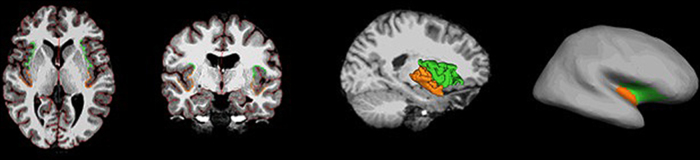
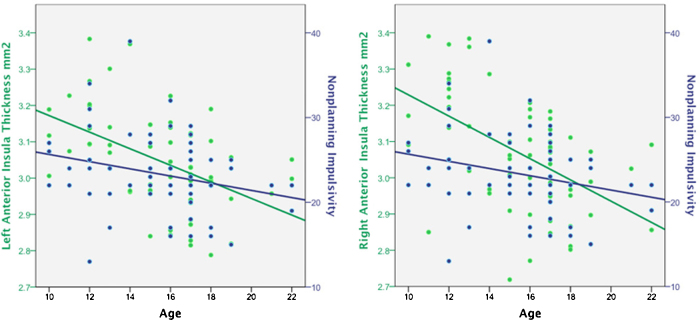
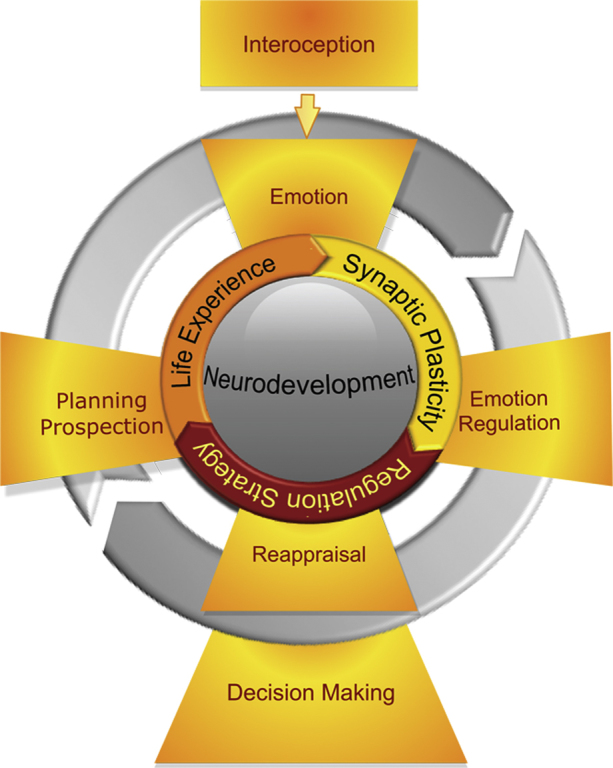
Verification
Claims the paper makes
The claims and statistics of this paper haven’t been checked yet.
Run the check — free, no account needed. It reads the open-access text and checks the sources it cites.
Claims other papers make about this one
Each is checked against this paper’s own text: does it say what the citing paper says it does?
In the citing paper
“The crux of the dual system hypothesis is that the maturational imbalance during adolescence between heightened sensation seeking and a still-maturing capacity for self-regulation makes adolescents particularly susceptible to engage in risky behaviors [for review, see 25].”
From The role of the anterior insula in adolescent decision making (2014) · cites this paper as [25]
In the citing paper
“Current developmental theories posit that increases in risky behaviors during adolescence are a result of the maturational imbalance between neural systems underlying sensation-seeking and self-regulatory behaviors, which leads adolescents to disproportionately activate appetitive, reward-seeking circuitry rather than deliberative, cognitive control circuitry during risky decision making,”
From The role of the anterior insula in adolescent decision making (2014) · cites this paper as [25]
Self-check
Percentages, sums and reported differences re-computed from the paper’s own numbers.
The self-check needs the paper’s full text.
Citations
Cites
Desikan, R. S., Ségonne, F., Fischl, B., Quinn, B. T., Dickerson, B. C., Blacker, D., Buckner, R. L., Dale, A. M., Maguire, R. P., Hyman, B. T., et al. (2006) · NeuroImage · doi:10.1016/j.neuroimage.2006.01.021 · Cited by 13,324
Cortical Surface-Based Analysis
Dale, A. M., Fischl, B., & Sereno, M. I. (1999) · NeuroImage · doi:10.1006/nimg.1998.0395 · Cited by 10,910
Fischl, B., Salat, D. H., Busa, E., Albert, M., Dieterich, M., Haselgrove, C., van der Kouwe, A., Killiany, R., Kennedy, D., Klaveness, S., et al. (2002) · Neuron · doi:10.1016/s0896-6273(02)00569-x · Cited by 8,610
How do you feel — now? The anterior insula and human awareness
(Bud) Craig, A. D. (2009) · Nature Reviews Neuroscience · doi:10.1038/nrn2555 · Cited by 6,657
The feeling of what happens: body and emotion in the making of consciousness
(2000) · Choice Reviews Online · doi:10.5860/choice.37-6553 · Cited by 6,001
Measuring the thickness of the human cerebral cortex from magnetic resonance images
Fischl, B. R., & Dale, A. M. (2000) · Proceedings of the National Academy of Sciences · doi:10.1073/pnas.200033797 · Cited by 5,995
Dynamic mapping of human cortical development during childhood through early adulthood
Gogtay, N., Giedd, J. N., Lusk, L., Hayashi, K. M., Greenstein, D., Vaituzis, A. C., Nugent, T. F., Herman, D. H., Clasen, L. S., Toga, A. W., et al. (2004) · Proceedings of the National Academy of Sciences · doi:10.1073/pnas.0402680101 · Cited by 5,604
A nonparametric method for automatic correction of intensity nonuniformity in MRI data
Sled, J. G., Zijdenbos, A. P., & Evans, A. C. (1998) · IEEE Transactions on Medical Imaging · doi:10.1109/42.668698 · Cited by 4,731
The Feeling of What Happens: Body and Emotion in the Making of Consciousness
Panksepp, J., & Modell, A. H. (2000) · Neuropsychoanalysis · doi:10.1080/15294145.2000.10773287 · Cited by 3,421
Neural systems supporting interoceptive awareness
Critchley, H. D., Wiens, S., Rotshtein, P., Öhman, A., & Dolan, R. J. (2004) · Nature Neuroscience · doi:10.1038/nn1176 · Cited by 3,406
Casey, B. J., Jones, R. M., & Hare, T. A. (2008) · Annals of the New York Academy of Sciences · doi:10.1196/annals.1440.010 · Cited by 3,345
Emotional intelligence meets traditional standards for an intelligence
Mayer, J. D., Caruso, D. R., & Salovey, P. (1999) · Intelligence · doi:10.1016/s0160-2896(99)00016-1 · Cited by 3,058
Automatic parcellation of human cortical gyri and sulci using standard anatomical nomenclature
Destrieux, C., Fischl, B., Dale, A., & Halgren, E. (2010) · NeuroImage · doi:10.1016/j.neuroimage.2010.06.010 · Cited by 2,956
The Neural Bases of Emotion Regulation: Reappraisal and Suppression of Negative Emotion
Goldin, P. R., McRae, K., Ramel, W., & Gross, J. J. (2008) · Biological Psychiatry · doi:10.1016/j.biopsych.2007.05.031 · Cited by 1,886
Casey, B. J., Getz, S., & Galvan, A. (2008) · Developmental Review · doi:10.1016/j.dr.2007.08.003 · Cited by 1,810
Fischl, B. R., Liu, A., & Dale, A. M. (2001) · IEEE Transactions on Medical Imaging · doi:10.1109/42.906426 · Cited by 1,755
Neurodevelopmental Trajectories of the Human Cerebral Cortex
Shaw, P., Kabani, N. J., Lerch, J. P., Eckstrand, K., Lenroot, R., Gogtay, N., Greenstein, D., Clasen, L., Evans, A., Rapoport, J. L., et al. (2008) · The Journal of Neuroscience · doi:10.1523/jneurosci.5309-07.2008 · Cited by 1,644
Steinberg, L., Albert, D., Cauffman, E., Banich, M., Graham, S., & Woolard, J. (2008) · Developmental Psychology · doi:10.1037/a0012955 · Cited by 1,542
Age differences in future orientation and delay discounting
Steinberg, L., Graham, S., O’Brien, L., Woolard, J., Cauffman, E., & Banich, M. (2009) · Child Development · doi:10.1111/j.1467-8624.2008.01244.x · Cited by 1,237
Decreased volume of left and total anterior insular lobule in schizophrenia
Makris, N., Goldstein, J. M., Kennedy, D. N., Hodge, S. M., Caviness, V. S., Faraone, S. V., Tsuang, M. T., & Seidman, L. J. (2006) · Schizophrenia Research · doi:10.1016/j.schres.2005.11.020 · Cited by 788
Parfit, D. (1971) · The Philosophical Review · doi:10.2307/2184309 · Cited by 766
Paulus, M. P., Rogalsky, C., Simmons, A., Feinstein, J. S., & Stein, M. B. (2003) · NeuroImage · doi:10.1016/s1053-8119(03)00251-9 · Cited by 745
Bridging emotion theory and neurobiology through dynamic systems modeling
Lewis, M. D. (2005) · Behavioral and Brain Sciences · doi:10.1017/s0140525x0500004x · Cited by 618
Differential effects of insular and ventromedial prefrontal cortex lesions on risky decision-making
Clark, L., Bechara, A., Damasio, H., Aitken, M. R. F., Sahakian, B. J., & Robbins, T. W. (2008) · Brain · doi:10.1093/brain/awn066 · Cited by 613
The insula and drug addiction: an interoceptive view of pleasure, urges, and decision-making
Naqvi, N. H., & Bechara, A. (2010) · Brain Structure and Function · doi:10.1007/s00429-010-0268-7 · Cited by 598
Risk-taking and the adolescent brain: Who is at risk?
Galvan, A., Hare, T., Voss, H., Glover, G., & Casey, B. J. (2007) · Developmental Science · doi:10.1111/j.1467-7687.2006.00579.x · Cited by 568
Emotional moments across time: a possible neural basis for time perception in the anterior insula
Craig, A. D. (. (2009) · Philosophical Transactions of the Royal Society B: Biological Sciences · doi:10.1098/rstb.2009.0008 · Cited by 499
Ersner-Hershfield, H., Garton, M. T., Ballard, K., Samanez-Larkin, G. R., & Knutson, B. D. (2009) · Judgment and Decision Making · doi:10.1017/s1930297500003855 · Cited by 456
Rubia, K., Smith, A. B., Taylor, E., & Brammer, M. (2007) · Human Brain Mapping · doi:10.1002/hbm.20347 · Cited by 417
Feelings of Emotion and the Self
Damásio, A. R. (2003) · Annals of the New York Academy of Sciences · doi:10.1196/annals.1279.014 · Cited by 411
Brenhouse, H. C., & Andersen, S. L. (2011) · Neuroscience & Biobehavioral Reviews · doi:10.1016/j.neubiorev.2011.04.013 · Cited by 363
Neural systems connecting interoceptive awareness and feelings
Pollatos, O., Gramann, K., & Schandry, R. (2007) · Human Brain Mapping · doi:10.1002/hbm.20258 · Cited by 301
Mood variability and the psychosocial adjustment of adolescents
Larson, R. W., Csíkszentmihályi, M., & Graef, R. (1980) · Journal of Youth and Adolescence · doi:10.1007/bf02089885 · Cited by 278
Wittmann, M., Leland, D. S., & Paulus, M. P. (2007) · Experimental Brain Research · doi:10.1007/s00221-006-0822-y · Cited by 266
The symbolic self in evolutionary context
Sedikides, C., & Skowronski, J. J. (1997) · Personality and Social Psychology Review · doi:10.1207/s15327957pspr0101_6 · Cited by 251
Ernst, M., Romeo, R. D., & Andersen, S. L. (2008) · Pharmacology Biochemistry and Behavior · doi:10.1016/j.pbb.2008.12.013 · Cited by 250
The impact of prior risk experiences on subsequent risky decision-making: The role of the insula
Xue, G., Lu, Z., Levin, I. P., & Bechara, A. (2010) · NeuroImage · doi:10.1016/j.neuroimage.2009.12.097 · Cited by 249
The maturation of incentive processing and cognitive control
Geier, C., & Luna, B. (2009) · Pharmacology Biochemistry and Behavior · doi:10.1016/j.pbb.2009.01.021 · Cited by 225
Separate Neural Mechanisms Underlie Choices and Strategic Preferences in Risky Decision Making
Venkatraman, V., Payne, J. W., Bettman, J. R., Luce, M. F., & Huettel, S. A. (2009) · Neuron · doi:10.1016/j.neuron.2009.04.007 · Cited by 222
Synaptic Pruning in Development: A Computational Account
Chechik, G., Meilijson, I., & Ruppin, E. (1998) · Neural Computation · doi:10.1162/089976698300017124 · Cited by 175
Neural mechanism of intertemporal choice: From discounting future gains to future losses
Xu, L., Liang, Z.-Y., Wang, K., Li, S., & Jiang, T. (2009) · Brain Research · doi:10.1016/j.brainres.2008.12.061 · Cited by 161
Adolescent social cognitive and affective neuroscience: past, present, and future
Pfeifer, J. H., & Blakemore, S. (2012) · Social Cognitive and Affective Neuroscience · doi:10.1093/scan/nsr099 · Cited by 159
Lewis, M. D., Granic, I., Lamm, C., Zelazo, P. D., Stieben, J., Todd, R. M., Moadab, I., & Pepler, D. (2008) · Development and Psychopathology · doi:10.1017/s0954579408000448 · Cited by 116
How grossed out are you? The neural bases of emotion regulation from childhood to adolescence
Pitskel, N. B., Bolling, D. Z., Kaiser, M. D., Crowley, M. J., & Pelphrey, K. A. (2011) · Developmental Cognitive Neuroscience · doi:10.1016/j.dcn.2011.03.004 · Cited by 100
Brain activations reflect individual discount rates in intertemporal choice
Marco‐Pallarés, J., Mohammadi, B., Samii, A., & Münte, T. F. (2010) · Brain Research · doi:10.1016/j.brainres.2010.01.025 · Cited by 70
Rosso, I. M., Makris, N., Britton, J. C., Price, L. M., Gold, A. L., Zai, D., Bruyere, J. R., Deckersbach, T., Killgore, W. D. S., & Rauch, S. L. (2010) · Depression and Anxiety · doi:10.1002/da.20765 · Cited by 46
An event-related fMRI study on risk taking by healthy individuals of high or low impulsiveness
Lee, T. M. C., Chan, C. C. H., Han, S., Leung, A. W. S., Fox, P. T., & Gao, J. (2008) · Neuroscience Letters · doi:10.1016/j.neulet.2008.04.061 · Cited by 34
Factor structure of the Barratt impulsiveness scale
Patton, J. H., Stanford, M. S., & Barratt, E. S. (1995) · Journal of Clinical Psychology · doi:10.1002/1097-4679(199511)51:6
Huttenlocher (1997) · doi:10.1002/(sici)1096-9861(19971020)387:2
Cited by
Sorted by citations
Fractionating impulsivity: neuropsychiatric implications
Dalley, J. W., & Robbins, T. W. (2017) · Nature Reviews Neuroscience · doi:10.1038/nrn.2017.8 · Cited by 607
Olfactory dysfunction in aging and neurodegenerative diseases
Dan, X., Wechter, N., Gray, S., Mohanty, J. G., Croteau, D. L., & Bohr, V. A. (2021) · Ageing Research Reviews · doi:10.1016/j.arr.2021.101416 · Cited by 238
The Relationship Between Self-Control and Internet Addiction Among Students: A Meta-Analysis
Li, S., Ren, P., Chiu, M. M., Wang, C., & Lei, H. (2021) · Frontiers in Psychology · doi:10.3389/fpsyg.2021.735755 · Cited by 180
The Cambridge Handbook of Personality Psychology
(2020) · Cambridge University Press eBooks · doi:10.1017/9781108264822 · Cited by 148
The role of the anterior insula in adolescent decision making
Smith, A. R., Steinberg, L., & Chein, J. (2014) · Developmental Neuroscience · doi:10.1159/000358918 · Cited by 110
Metadata
- Authors
- Churchwell, J. C., & Yurgelun-Todd, D. A.
- Affiliations
- University of Utah (US)
- Corresponding author
- Churchwell, John C.
- Venue
- Developmental Cognitive Neuroscience
- Publisher
- Elsevier BV
- Published
- 2013-10
- Volume
- 6
- Pages
- 80-86
- ISSN
- 1878-9293 (ISSN-L)
- PMC
- PMC6987805
- OpenAlex
- W1999016880
- Cited by
- 109
- References
- 49
- Citations by year
- 2026: 5 · 2025: 6 · 2024: 5 · 2023: 2 · 2022: 6 · 2021: 8 · 2020: 44 · 2019: 5 · 2018: 7 · 2017: 3 · 2016: 6 · 2015: 7 · 2014: 4
- FWCI
- 3.10
- Type
- journal article
- Language
- en
- Open access
- hybrid
- doi.org
- Licence
- Locations
- Developmental Cognitive Neuroscience (publishedVersion, cc-by-nc-nd)
- PubMed Central (publishedVersion, cc-by-nc-nd)
- PubMed (publishedVersion)
- Funders
- NIH (1R01 DA020269-01, R03DA029180-01)
- Topics
- Life Sciences › Neuroscience › Cognitive Neuroscience › Neural and Behavioral Psychology Studies
- Social Sciences › Decision Sciences › General Decision Sciences › Decision-Making and Behavioral Economics
- Social Sciences › Psychology › Clinical Psychology › Historical and Modern Theater Studies
- Keywords
- insula, cortical thickness, impulsivity, aging, emotional development, decision-making, emotion regulation, future orientation, planning, Barratt Impulsiveness Scale
- MeSH terms
- Adolescent, Aging, Cerebral Cortex, Child, Decision Making, Emotions, Female, Humans, Impulsive Behavior, Magnetic Resonance Imaging, Male, Neuronal Plasticity, Problem Solving, Thinking, Young Adult
About these checks
Registry, retraction, Cites and statistics results are computed, not judged, with one exception: a printed reference that no index lists is read once by a model before it counts as a citation error. Claims are extracted by a model and kept only when their quote appears verbatim in the text; each cited source is then checked, with a model’s help, for whether it says what the claim relies on. Those verdicts can be wrong — read the claim’s quote and the cited source before relying on one.
Statistics and arithmetic are recomputed, not judged.
Confidence bands are shown only for fields calibrated on our annotated test set. None is calibrated yet, so no band is shown.
What counts as a claim ›How we measure confidence ›How we check this ›
Are you an author, or do you see a problem with this page? Request a review
