

Pre-merger acquisition capabilities: A study of two successful serial acquirers
Open accessThe DOI matches its Crossref record; 36 of the 36 references it cites were found in a registry or an index; none of the 78 sources its claims cite is checked for support yet.
Abstract
The aim of this paper is to provide new insights into the pre-merger phase of M&A. It examines capabilities of serial acquirers, that is, expertise and routines. This is done by conducting a study of two successful serial acquirers. The study identifies and describes what elements expertise and routines consist of and how they are related, explaining how both are needed for a successful pre-merger phase. Moreover, it consolidates present knowledge on expertise and routines in the pre-merger phase and adds new empirical and theoretical insights. The result is the pre-merger capability typology showing in a fine-grained manner which capabilities and elements are important. Arguably, the study provides a holistic view of acquisition capabilities of successful serial acquirers in the pre-merger phase.
Overview
CoChat Summary
TL;DR
This paper studies the pre-merger phase of M&A in two successful Swedish serial acquirers, Alpha and Beta, and develops a pre-merger capability typology of expertise and routines. It finds that both expertise and routines, broken into specific elements, are needed and strongly related for successful target identification and acquisition-making.
Key findings
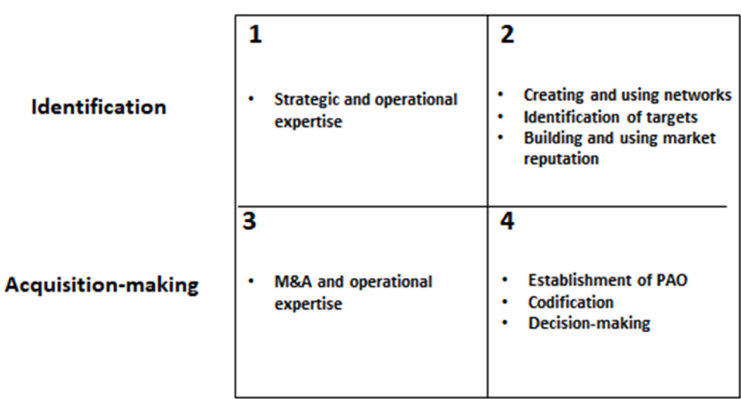
- The study identifies expertise elements as strategic and operational expertise in identification and M&A and operational expertise in acquisition-making; routines elements as creating and using networks, identification of targets, and building and using market reputation in identification, and establishment of the PAO, codification, and decision-making in acquisition-making.
- Expertise and routines are strongly related: routines for target identification support learning and development of expertise, while expertise affects the design and use of routines; the decentralized model of Alpha and Beta aligned routines and expertise across identification and acquisition-making.
- Between 2000 and 2019, Alpha and Beta each made more than 150 acquisitions; annualized total shareholder return was 15.9% for Alpha and 11.1% for Beta, compared with 5.1% for the 30 largest companies on the Nasdaq Stockholm stock exchange.
- At the year of the focal transaction, Alpha and Beta each screened more than 100 targets; Alpha made 11 acquisitions (3 in the focal division) and Beta made 13 (3 in the focal division). Beta estimated 5–10% of initiated deals resulted in a transaction, while Alpha estimated approximately 10%; Beta estimated 90% of deals with a signed LOI led to completion. Alpha estimated 80–90% of targets were identified through screening and contacts, with 10–20% from seller or adviser proposals.
Methods
- Qualitative case study of two large, successful global serial acquirers based in Sweden (Alpha and Beta), selected for many acquisitions, acquisition-driven growth, financial success, and strong total shareholder return.
- Data included 27 interviews with 14 interviewees, average interview length 79 minutes, transcriptions amounting to 670 double-spaced pages; internal documents of more than 400 pages plus external documents; 22 interviews were conducted in 2013–2014 and the remaining 5 in 2018 and 2020, using snowball sampling.
- Analysis was iterative and abductive, moving among data, emerging findings, and literature; the authors wrote detailed case chronologies, coded categories and aggregated them into elements, then analyzed relationships between elements to produce the pre-merger capability typology.
Limitations
- The paper states the setting is two successful serial acquirers focusing on acquiring small businesses, so other elements might be identified in another setting, such as companies making larger acquisitions.
- The paper states it assumes the identified capabilities contributed to competitive advantage and high shareholder returns, but alternative or complementary explanations, such as integration capabilities, are not ruled out.
- The paper states there were few key people involved in the pre-merger phase due to high secrecy, though the authors do not consider this to have affected interview quality, reliability, or validity; evident from the text, the findings are based on two Swedish firms and may not generalize.
Model-written summary. Check it against the paper before relying on it.
Integrity signals
Registry
Cites
Statistics
Figures
Verification
Claims the paper makes
0 Valid · 3 Not valid · 56 Not checked · 150 Own results and interpretations
A result the paper states — it cites no source for it, so there is none to check. The quote shows it is in the paper.
In the paper
“Not getting an approval was viewed by management as a failure.”
§ Pre-merger acquisition capabilities: A study of two successful serial acquirers > 4.2.4. Routines: decision-making
plain- Asserted: passes — The authors put it forward as true.
- Checkable: passes — It can be checked against evidence.
- Load-bearing: unclear — It is unclear whether the paper’s conclusions depend on it.
- Based: passes — The paper gives a reason why it holds.
A result the paper reports from its own data — it cites no other source for it, so there is none to check. The quote shows it is in the paper.
In the paper
“In Beta, none of the interviewees could recall an acquisition not getting approval by the board.”
§ Pre-merger acquisition capabilities: A study of two successful serial acquirers > 4.2.4. Routines: decision-making
plainSingle case- Asserted: passes — The authors put it forward as true.
- Checkable: passes — It can be checked against evidence.
- Load-bearing: unclear — It is unclear whether the paper’s conclusions depend on it.
- Based: passes — The paper gives a reason why it holds.
A result the paper reports from its own data — it cites no other source for it, so there is none to check. The quote shows it is in the paper.
In the paper
“The findings show that the establishment of the PAO was an important element in that respect.”
§ Pre-merger acquisition capabilities: A study of two successful serial acquirers > 4.3. Relationships between expertise and routines
plainstates a cause- Asserted: passes — The authors put it forward as true.
- Checkable: passes — It can be checked against evidence.
- Load-bearing: passes — The paper’s conclusions depend on it.
- Based: passes — The paper gives a reason why it holds.
A result the paper reports from its own data — it cites no other source for it, so there is none to check. The quote shows it is in the paper.
In the paper
“The council also disseminated experiences and lessons learned from acquisitions made by the company and from outside advisers and networks by using training seminars, etc.”
§ Pre-merger acquisition capabilities: A study of two successful serial acquirers > 4.2.3. Routines: codification
plain- Asserted: passes — The authors put it forward as true.
- Checkable: passes — It can be checked against evidence.
- Load-bearing: unclear — It is unclear whether the paper’s conclusions depend on it.
- Based: passes — The paper gives a reason why it holds.
A result the paper states — it cites no source for it, so there is none to check. The quote shows it is in the paper.
In the paper
“For example, Beta always used advisers for financial and legal due diligence.”
§ Pre-merger acquisition capabilities: A study of two successful serial acquirers > Reasons
plainSingle case- Asserted: passes — The authors put it forward as true.
- Checkable: passes — It can be checked against evidence.
- Load-bearing: unclear — It is unclear whether the paper’s conclusions depend on it.
- Based: passes — The paper gives a reason why it holds.
112 more claims
Create a free account to see all 209 claims and to verify the 68 references still open.
- It may state two separate claims as one. 54
- Probably not a substantial claim. 52
- The quote only partly states this claim. 1
Citations
Cites
Firm Resources and Sustained Competitive Advantage
Barney, J. (1991) · Journal of Management · doi:10.1177/014920639101700108 · Cited by 48,334
A resource‐based view of the firm
Wernerfelt, B. (1984) · Strategic Management Journal · doi:10.1002/smj.4250050207 · Cited by 25,635
The dynamic resource‐based view: capability lifecycles
Helfat, C. E., & Peteraf, M. A. (2003) · Strategic Management Journal · doi:10.1002/smj.332 · Cited by 4,553
Barney, J. B. (2001) · Journal of Management · doi:10.1177/014920630102700602 · Cited by 3,949
EXPERT AND EXCEPTIONAL PERFORMANCE: Evidence of Maximal Adaptation to Task Constraints
Ericsson, K. A., & Lehmann, A. C. (1996) · Annual Review of Psychology · doi:10.1146/annurev.psych.47.1.273 · Cited by 2,139
Managing acquisitions: Creating value through corporate renewal
(1991) · Long Range Planning · doi:10.1016/0024-6301(91)90291-u · Cited by 1,499
Finding Theory–Method Fit: A Comparison of Three Qualitative Approaches to Theory Building
Gehman, J., Glaser, V. L., Eisenhardt, K. M., Gioia, D., Langley, A., & Corley, K. G. (2018) · Journal of Management Inquiry · doi:10.1177/1056492617706029 · Cited by 1,192
Corporate Acquisitions: A Process Perspective
Jemison, D. B., & Sitkin, S. B. (1986) · The Academy of Management Review · doi:10.2307/258337 · Cited by 1,159
Where do capabilities come from and how do they matter? A study in the software services industry
Ethiraj, S. K., Kale, P., Krishnan, M. S., & Singh, J. V. (2005) · Strategic Management Journal · doi:10.1002/smj.433 · Cited by 897
The Process of Postmerger Integration: A Review and Agenda for Future Research
Graebner, M. E., Heimeriks, K. H., Huy, Q. N., & Vaara, E. (2017) · Academy of Management Annals · doi:10.5465/annals.2014.0078 · Cited by 615
Graebner, M. E., & Eisenhardt, K. M. (2004) · Administrative Science Quarterly · doi:10.2307/4131440 · Cited by 566
Bauer, F., & Matzler, K. (2014) · Strategic Management Journal · doi:10.1002/smj.2091 · Cited by 498
Alliance or acquisition? a dyadic perspective on interfirm resource combinations
Wang, L., & Zajac, E. J. (2007) · Strategic Management Journal · doi:10.1002/smj.638 · Cited by 452
Performance of serial acquirers: toward an acquisition program perspective
Laamanen, T., & Keil, T. (2008) · Strategic Management Journal · doi:10.1002/smj.670 · Cited by 398
Very, P., & Schweiger, D. M. (2001) · Journal of World Business · doi:10.1016/s1090-9516(00)00052-3 · Cited by 228
(Jay) Kim, J., & Finkelstein, S. (2009) · Strategic Management Journal · doi:10.1002/smj.754 · Cited by 226
The Pre-Deal Phase of Mergers and Acquisitions: A Review and Research Agenda
Welch, X., Pavićević, S., Keil, T., & Laamanen, T. (2020) · Journal of Management · doi:10.1177/0149206319886908 · Cited by 201
Trichterborn, A., Zu Knyphausen‐Aufseß, D., & Schweizer, L. (2016) · Strategic Management Journal · doi:10.1002/smj.2364 · Cited by 182
Angwin, D. (2001) · Journal of World Business · doi:10.1016/s1090-9516(00)00053-5 · Cited by 164
The Handbook of Mergers and Acquisitions
Giessner, S. R., Ullrich, J., van Dick, R., Faulkner, D., Teerikangas, S. P., & Joseph, R. (2012) · Oxford University Press eBooks · doi:10.1093/acprof:oso/9780199601462.001.0001 · Cited by 159
Business relatedness and performance: A study of managerial perceptions
Pehrsson, A. (2006) · Strategic Management Journal · doi:10.1002/smj.516 · Cited by 102
Integration managers' value‐capturing roles and acquisition performance
Teerikangas, S., Véry, P., & Pisano, V. (2011) · Human Resource Management · doi:10.1002/hrm.20453 · Cited by 88
The keys to successful acquisition programmes
Chatterjee, S. (2009) · Long Range Planning · doi:10.1016/j.lrp.2008.12.001 · Cited by 81
The Routledge Companion to Mergers and Acquisitions
Piscitello, L., Rabellotti, R., Scalera, V. G., Risberg, A., King, D. R., & Meglio, O. (2015) · Routledge eBooks · doi:10.4324/9780203761885 · Cited by 68
Why good things Don’t happen: the micro-foundations of routines in the M&A process
Angwin, D. N., Paroutis, S., & Connell, R. (2015) · Journal of Business Research · doi:10.1016/j.jbusres.2014.12.007 · Cited by 49
Unveiling the temporally contingent role of codification in alliance success
Heimeriks, K. H., Bingham, C. B., & Laamanen, T. (2015) · Strategic Management Journal · doi:10.1002/smj.2224 · Cited by 45
Grant, M. D., & Nilsson, F. (2019) · The British Accounting Review · doi:10.1016/j.bar.2019.100861 · Cited by 31
Self-citationDisentangling acquisition experience: A multilevel analysis and future research agenda
Schriber, S., & Degischer, D. (2020) · Scandinavian Journal of Management · doi:10.1016/j.scaman.2020.101097 · Cited by 20
Handbook of Intuition Research as Practice
Gani, A. N., van Riel, A. C. R., Streukens, S., & Grössler, A. (2020) · Edward Elgar Publishing eBooks · doi:10.4337/9781788979757 · Cited by 18
Nolop, B. (2008) · Strategic Direction · doi:10.1108/sd.2008.05624dad.005 · Cited by 12
Reshaping M&A scholarship – Broadening the boundaries of M&A research
Thanos, I. C., Angwin, D., Bauer, F., & Teerikangas, S. (2019) · European Management Journal · doi:10.1016/j.emj.2019.06.003 · Cited by 11
Acquisitions, Acquisition Programs, and Acquisition Capabilities
Keil, T., Laamanen, T., & Mäkisalo, A. (2012) · The Handbook of Mergers and Acquisitions · doi:10.1093/acprof:oso/9780199601462.003.0006 · Cited by 3
Mergers and acquisitions as multitude of processes: a review of qualitative research
(2015) · Routledge eBooks · doi:10.4324/9780203761885-30 · Cited by 2
The use of intuitive expertise in acquisition-making: an explorative study
Grant, M., Nilsson, F., & Nordvall, A.-C. (2020) · Handbook of Intuition Research as Practice · doi:10.4337/9781788979757.00011
Self-citation(1991)
(2007) · PubMed
Research works printed but not linked: 3
- Cullinan, G., Rovit, S., & Tymms, A. (2003). Organising for deal success. European Business Journal, 15(4), 181-184.
- Dreyfus, H., Dreyfus, S. E., & Athanasiou, T. (1988). Mind over machine. New York: The Free Press.
- Grant, M. (2018). Making acquisition. Ph.D. dissertation. Department of Business Studies. Uppsala University.
Cited by
Digital mergers and acquisitions: Creating or destructing value?
Maisenhelder, F., Baccarella, C. V., Maier, L., Müller, J. M., & Voigt, K. (2025) · European Management Journal · doi:10.1016/j.emj.2025.08.002 · Cited by 6
Too Much of a Good Thing? The Impact of Serial M&A on Innovation Performance
Zhang, X., Song, Y., & Liu, H. (2023) · Sustainability · doi:10.3390/su15129829 · Cited by 4
Pei, X., & Song, J. (2025) · Journal of strategy and management · doi:10.1108/jsma-05-2023-0107 · Cited by 4
Thanos, I. C., Angwin, D., Bauer, F., & Teerikangas, S. P. (2022) · European Management Journal · doi:10.1016/j.emj.2022.11.002 · Cited by 4
The Strategic Side of Charity: Evidence from M&AsPreprint
Vansteenkiste, C. (2025) · SSRN Electronic Journal · doi:10.2139/ssrn.5103313 · Cited by 2
Metadata
- Authors
- Grant, M., Nilsson, F., & Nordvall, A.-C.
- Affiliations
- Uppsala University (SE)
- Corresponding author
- Grant, Michael
- Venue
- European Management Journal
- Publisher
- Elsevier BV
- Published
- 2022-12
- Volume
- 40
- Issue
- 6
- Pages
- 932-942
- ISSN
- 0263-2373 (ISSN-L)
- OpenAlex
- W4306247477
- Semantic Scholar
- cdc6980d5fa7875b2818628bc5f147f71eb08718
- Cited by
- 21
- References
- 36
- Citations by year
- 2026: 7 · 2025: 4 · 2024: 4 · 2023: 5 · 2022: 1
- FWCI
- 1.92
- Type
- journal article
- Language
- en
- Open access
- hybrid
- doi.org
- Licence
- cc-by
- www.elsevier.com/tdm/userlicense/1.0/ (tdm)
- www.elsevier.com/legal/tdmrep-license (tdm)
- creativecommons.org/licenses/by/4.0/ (vor)
- Locations
- European Management Journal (publishedVersion, cc-by)
- Uppsala University Publications (Uppsala University) (submittedVersion, other-oa)
- RePEc: Research Papers in Economics (submittedVersion)
- Funders
- Uppsala Universitet
- Topics
- Social Sciences › Economics, Econometrics and Finance › Finance › Corporate Finance and Governance
- Social Sciences › Business, Management and Accounting › Strategy and Management › Innovation and Knowledge Management
- Social Sciences › Business, Management and Accounting › Strategy and Management › International Business and FDI
- Keywords
- mergers and acquisitions, serial acquirers, expertise, routines, acquisition success
About these checks
Registry, retraction, Cites and statistics results are computed, not judged, with one exception: a printed reference that no index lists is read once by a model before it counts as a citation error. Claims are extracted by a model and kept only when their quote appears verbatim in the text; each cited source is then checked, with a model’s help, for whether it says what the claim relies on. Those verdicts can be wrong — read the claim’s quote and the cited source before relying on one.
A language model drew the claims from the paper on 2026-11-23, under version 3 of the claim definition (model deepseek-v4.1-flash, prompt extract-v3).
A second model labelled each claim on 2026-11-23 (model jev-1.13-20260917, definition revision gold-guideline-v0.2).
Statistics and arithmetic are recomputed, not judged.
Confidence bands are shown only for fields calibrated on our annotated test set. None is calibrated yet, so no band is shown.
What counts as a claim ›How we measure confidence ›How we check this ›
Are you an author, or do you see a problem with this page? Request a review
Data sources
Bibliographic data: Semantic Scholar, OpenAlex, Crossref.
Contains information from the Semantic Scholar Academic Graph Datasets, made available under the ODC Attribution License (ODC-BY 1.0).
Semantic Scholar’s data is described in: Kinney, R., et al. (2023). The Semantic Scholar Open Data Platform. arXiv:2301.10140.
