

The DOI matches its Crossref record; 86 of the 87 references it cites were found in a registry or an index.
Ten striking facts about agricultural input use in Sub-Saharan Africa
Open accessAbstract
Conventional wisdom holds that Sub-Saharan African farmers use few modern inputs despite the fact that most poverty-reducing agricultural growth in the region is expected to come largely from expanded use of inputs that embody improved technologies, particularly improved seed, fertilizers and other agro-chemicals, machinery, and irrigation. Yet following several years of high food prices, concerted policy efforts to intensify fertilizer and hybrid seed use, and increased public and private investment in agriculture, how low is modern input use in Africa really? This article revisits Africa's agricultural input landscape, exploiting the unique, recently collected, nationally representative, agriculturally intensive, and cross-country comparable Living Standard Measurement Study-Integrated Surveys on Agriculture (LSMS-ISA) covering six countries in the region (Ethiopia, Malawi, Niger, Nigeria, Tanzania, and Uganda). Using data from over 22,000 households and 62,000 agricultural plots, we offer ten potentially surprising facts about modern input use in Africa today.
Overview
The claims and statistics of this paper haven’t been checked yet.
Run the check — free, no account needed. It reads the open-access text and checks the sources it cites.
Integrity signals
Registry
Cites
Statistics
Figures
Verification
Claims the paper makes
The claims and statistics of this paper haven’t been checked yet.
Run the check — free, no account needed. It reads the open-access text and checks the sources it cites.
Self-check
Percentages, sums and reported differences re-computed from the paper’s own numbers.
The self-check needs the paper’s full text.
Citations
Cites
Assessing the Impact of the Green Revolution, 1960 to 2000
Evenson, R. E., & Gollin, D. (2003) · Science · doi:10.1126/science.1078710 · Cited by 2,228 · cited 1×
“The gains from diffusion of these inputs were enjoyed broadly, including to consumers (Evenson and Gollin, 2003), helping to stimulate historically unprecedented economic growth and poverty reduction in east and southeast Asia (David and Otsuka, 1994).”
BackgroundTransforming Traditional Agriculture.
Balogh, T., & Schultz, T. W. (1964) · The Economic Journal · doi:10.2307/2228861 · Cited by 1,994
Safeguarding production—losses in major crops and the role of crop protection
Oerke, E.-C., & Dehne, H. W. (2003) · Crop Protection · doi:10.1016/j.cropro.2003.10.001 · Cited by 1,425 · cited 1×
“30% of attainable yields as collected from sources around the world (Oerke and Dehne, 2004).”
BackgroundThe role of agriculture in economic development
Johnston, B. F., & Mellor, J. W. (1961) · American Economic Review · Cited by 948
Agrifood Industry Transformation and Small Farmers in Developing Countries
Reardon, T., Barrett, C. B., Berdegué, J. A., & Swinnen, J. (2009) · World Development · doi:10.1016/j.worlddev.2008.08.023 · Cited by 945 · cited 2×
“…a middle class, increased access to market and other information through cell phones, and transformation of some food marketing channels—may have changed on-farm incentives and resulted in updates to farm management practices, including modern input use (e.g., Reardon et al., 2009; Tiffen, 2003).”
BackgroundInfluentialSelf-citationIntegrated Soil Fertility Management
Vanlauwe, B., Bationo, A., Chianu, J. N., Giller, K. E., Merckx, R., Mokwunye, U., Ohiokpehai, O., Pypers, P., Tabo, R., Shepherd, K. D., et al. (2010) · Outlook on Agriculture · doi:10.5367/000000010791169998 · Cited by 764
Fertilizer Use in African Agriculture
Morris, M., Kelly, V. A., Kopicki, R. J., & Byerlee, D. (2007) · World Bank, Washington, DC eBooks · doi:10.1596/978-0-8213-6880-0 · Cited by 661
The relation between farm size and farm productivity
Feder, G. (1985) · Journal of Development Economics · doi:10.1016/0304-3878(85)90059-8 · Cited by 622 · cited 1×
“The inverse (negative) relationship between farm size and productivity is a well-studied and fairly entrenched phenomenon in the agricultural development literature (e.g., Carter, 1984; Feder, 1985; Barrett et al., 2010).”
BackgroundGlobal pesticide consumption and pollution: with China as a focus
Zhang, W., Jiang, F., & Ou, J. (2011) · Cited by 590
Food Security, Farming, and Climate Change to 2050: Scenarios, Results, Policy Options
Nelson, G. C., Rosegrant, M. W., Palazzo, A., Gray, I. D., Ingersoll, C., Robertson, R., Tokgöz, S., Zhu, T., Sulser, T. B., Ringler, C., et al. (2010) · International Food Policy Research Institute eBooks · doi:10.2499/9780896291867 · Cited by 578
Cited by
Sorted by citations
Items 401–500 of 595
ASSURING SAFE PESTICIDE USE FOR COMMERCIAL CROPS, INCLUDING SOYBEAN, IN SUB-SAHARAN AFRICA
Lee, N. (2020) · African Journal of Food Agriculture Nutrition and Development · doi:10.18697/ajfand.88.silfarmdoc13 · Cited by 3
“Herbicide adoption rates vary widely throughout Sub-Saharan Africa, with only one percent of farmers in Malawi applying herbicides, while herbicide application is much more common in Ghana, where 55 percent of farmers use herbicides (Haggblade et al., 2017; Sheahan & Barrett, 2017).”
BackgroundSustainable agrowaste diversity versus sustainable development goals
Onu, P., & Mbohwa, C. (2021) · Elsevier eBooks · doi:10.1016/b978-0-323-85402-3.00012-7 · Cited by 3
A dinâmica da adoção das tecnologias agrárias em Moçambique: análise do período 2002 a 2020
Come, S. F. (2021) · Research Society and Development · doi:10.33448/rsd-v10i10.18691 · Cited by 3
Myths Become Realities—Or Do They?
Christiaensen, L., & Demery, L. F. (2017) · World Bank, Washington, DC eBooks · doi:10.1596/978-1-4648-1134-0_ch1 · Cited by 3
Schmitter, P., Tegegne, D., Adie, A., et al. (2018) · CGSPace A Repository of Agricultural Research Outputs (Consultative Group for International Agricultural Research) · doi:10.13140/rg.2.2.34576.46083 · Cited by 3
Pesticide Handling and Human Health: Conventional and Organic Cotton Farming in BeninPreprint
Aihounton, G. D. B., Henningsen, A., Trifković, N., et al. (2021) · RePEc: Research Papers in Economics · doi:10.22004/ag.econ.315407 · Cited by 3
“Farmers in developing countries are often unaware of the health hazards of inappropriate pesticide handling and frequently use excessive amounts of pesticides without adequate protective measures or training (e.g., Khan et al., 2015; Damalas and Abdollahzadeh, 2016; Hoi et al., 2016; Jallow et al., 2017; Sheahan and B…”
BackgroundAnang, B. T., Alhassan, H., & Danso-Abbeam, G. (2020) · doi:10.21203/rs.3.rs-17237/v1 · Cited by 3
“Evidence suggests that adoption of improved agricultural technologies such as improved maize varieties with high yielding potential and adaptability to drought, and pest and diseases has the potential to increase productivity and thus improve welfare as well as food and nutrition security (Donkor et al., 2016; Sheahan…”
BackgroundInfluentialA planetary health solution for disease, sustainability, food, water, and poverty challengesPreprint
Rohr, J. R., Bakhoum, S., Barrett, C. B., et al. (2022) · medRxiv · doi:10.1101/2022.08.02.22278196 · Cited by 3
Self-citationClimate change, income sources, crop mix, and input use decisions: Evidence from Nigeria
Amare, M., & Balana, B. (2023) · doi:10.2499/p15738coll2.136717 · Cited by 3
Digital Information Provision and Behavior Change: Lessons from Six Experiments in East Africa
Fabregas, R., Kremer, M. R., Lowes, M., On, R., & Zane, G. (2024) · National Bureau of Economic Research · doi:10.3386/w32048 · Cited by 3
Food Price Bubbles: Food Price Indices of Turkey, the FAO, the OECD, and the IMF
ÖZCAN, K. A. (2023) · Sustainability · doi:10.3390/su15139947 · Cited by 2
Agricultural Sector Performance in SADC Countries
Mabeta, J. (2025) · Economics Working Papers · doi:10.32725/ewp.2025.002 · Cited by 4
Integrated soil fertility management: Combining organic and inorganic inputs for better yield
Ghosh, A., Bharatbhushan, M., Kumaravel, S., et al. (2025) · International Journal of Research in Agronomy · doi:10.33545/2618060x.2025.v8.i7b.3183 · Cited by 2
Duguma, A. L., & Bai, X. (2025) · Environment Development and Sustainability · doi:10.1007/s10668-025-06765-5 · Cited by 2
Kouandou, A. (2025) · World Development Sustainability · doi:10.1016/j.wds.2025.100255 · Cited by 2
Mitigating Post-Harvest Losses in Onion and Potato for Sustainable Food Systems
Sahu, S., Sharma, J. P., BURMAN, R. R., Gills, R., & Satyapriya (2025) · International Journal of Advances in Engineering Sciences and Applied Mathematics · doi:10.1007/s12572-025-00415-9 · Cited by 4
Ayanwale, A. B., Kehinde, A. D., & Ige, A. O. (2025) · Social Sciences & Humanities Open · doi:10.1016/j.ssaho.2025.102328 · Cited by 2
Joint agricultural input use and food security: evidence from Tanzania
Ray, S. (2025) · Food Policy · doi:10.1016/j.foodpol.2025.102948 · Cited by 4
Tenessa, D. B. (2025) · SN Business & Economics · doi:10.1007/s43546-025-01038-9 · Cited by 2
“…and disease management once effectively applied give the poten - tial for higher yields by reducing the level of pests and diseases and environmental stresses, which alines well with studies signifying the possibility of agrochemical interventions in developing countries (Sheahan and Barrett 2017).”
InfluentialMboma, A. B., Kilima, F. T. M., Mchopa, A. D., et al. (2026) · Cogent Food & Agriculture · doi:10.1080/23311932.2025.2612201 · Cited by 2
Siqi, T. A. N. G., Sato, T., Kawasaki, K., et al. (2026) · Agriculture · doi:10.3390/agriculture16040438 · Cited by 2
Harerimana, B., Zheng, J., Muhirwa, F., et al. (2026) · Sustainable Production and Consumption · doi:10.1016/j.spc.2026.03.005 · Cited by 2
Nyengere, J., Tchuwa, F., Tholo, H. M., et al. (2026) · Frontiers in Sustainable Food Systems · doi:10.3389/fsufs.2026.1789367 · Cited by 2
Off-Farm Economic Activities of Rural Women for Household Food Security in Kaduna State, Nigeria
Issa, F. O. (2019) · Journal of Agricultural Extension · doi:10.4314/jae.v23i3.3 · Cited by 2
Cuffaro, N., Prota, L., & Bertini, R. (2022) · Springer eBooks · doi:10.1007/978-3-030-75556-0_4 · Cited by 2
Sustaining Natural Resources in African Agriculture: What Have We Learned in the Past Two Decades?
Place, F. (2022) · Emerging-economy state and international policy studies · doi:10.1007/978-981-19-5542-6_11 · Cited by 2
Does Row Planting Enhance Farm Productivity and Reduce Risk Exposure? Insights From Ethiopia
Ahmed, M. H. (2023) · Journal of Agricultural and Applied Economics · doi:10.1017/aae.2023.12 · Cited by 2
Wonde, K. M., Tsehay, A. S., & Lemma, S. E. (2023) · International Journal of Training Research · doi:10.1080/14480220.2023.2212886 · Cited by 2
“Modern agricultural inputs include improved seed varieties, chemical fertilizers, and agrochemicals (pesticides and insecticides) (Jilito & Wedajo, 2020; Sheahan & Barrett, 2017; Zelleke et al., 2019).”
BackgroundMwale, M. L., & Kamninga, T. M. (2024) · Journal of Population Research · doi:10.1007/s12546-024-09337-y · Cited by 2
“, 2010); and inaccessibility of the inputs due to farmers’ liquidity constraints (Holden, 2018) and high market prices for the inputs (Sheahan and Barrett, 2017).”
Closing the gaps in experimental and observational crop response estimates: a bayesian approach
Mkondiwa, M., Hurley, T. M., & Pardey, P. G. (2024) · Q Open · doi:10.1093/qopen/qoae017 · Cited by 2
Ricker-Gilbert, J. E. (2024) · Agrekon · doi:10.1080/03031853.2024.2426852 · Cited by 4
“It is well known that inorganic fertiliser use in SSA is well below the rest of the world on a per-hectare basis (Sheahan and Barrett 2014).”
Mulungu, K., & Kabwela, B. (2025) · Journal of Social and Economic Development · doi:10.1007/s40847-025-00440-1 · Cited by 2
Turizihiwe, Y. C., Hirwa, H., Kesande, P., & Sakurai, T. (2025) · Social Sciences & Humanities Open · doi:10.1016/j.ssaho.2025.101764 · Cited by 2
Oyinlola, M. A., Adedeji, A. A., & Olabisi, N. (2020) · Economic Change and Restructuring · doi:10.1007/s10644-020-09286-5 · Cited by 2
García, A. E., Jáuregui-García, C. Z., & Hernández-Montes, A. (2020) · Económicas CUC · doi:10.17981/econcuc.41.2.2020.org.3 · Cited by 2
Tanzania Agriculture Public Expenditure Review
Bank, W., & FAO (2022) · doi:10.1596/37991 · Cited by 2
Kebede, Y. (2019) · doi:10.18174/469972 · Cited by 2
“17 Abstract Agricultural landscapes in sub-Saharan Africa are dynamic and are shaped by farmers' land use decisions and livelihood strategies over time.”
BackgroundInfluentialEssays on the impacts of climate-smart agricultural innovations on household welfare
Tesfaye (2019) · Research Publications (Maastricht University) · doi:10.26481/dis.20190327wt · Cited by 2
Wichern, J. (2019) · doi:10.18174/475220 · Cited by 2
Adu-Baffour, F., Daum, T., & Regina Birner, B. (2018) · SSRN Electronic Journal · doi:10.2139/ssrn.3194436 · Cited by 2
“Yet African farming systems remain the least mechanized of all continents (Pingali, 2007: 2784; Sheahan and Barrett, 2017).”
BackgroundAgricultural Subsidies and Child Labour: Evidence from Malawi’s Farm Input Subsidy ProgrammePreprint
Frempong, R. B. (2018) · SSRN Electronic Journal · doi:10.2139/ssrn.3230678 · Cited by 2
Knowledge and Adoption of Complex Agricultural Technologies: Evidence from an Extension Experiment
Hörner, D., Bouguen, A., Frölich, F., & Wollni, M. (2021) · World Bank, Washington, DC eBooks · doi:10.1596/1813-9450-9840 · Cited by 2
“This paper contributes to the literature by focusing on the integrated adoption of a complex system technology,rather than on the uptake of individual practices,an issue that has been largely understudied to date (Sheahan and Barrett 2017; Jayne et al. 2019).”
Two Heads are Better than One: Agricultural Production and Investment in Côte D'Ivoire
Donald, A. A., Goldstein, M., & Rouanet, L. M. (2022) · World Bank policy research working paper · doi:10.1596/1813-9450-10047 · Cited by 2
“Indeed, poverty-reducing agricultural growth in the region is expected to come largely from expanded use of technology, including improved seeds and agro-chemicals (Sheahan and Barrett 2017).”
BackgroundAmare, M., Parvathi, P., & Nguyễn, T. T. (2023) · doi:10.2499/p15738coll2.136546 · Cited by 2
Miehe, C., Campenhout, B. V., Nabwire, L., Sparrow, R. A., & Spielman, D. J. (2023) · doi:10.2499/p15738coll2.136700 · Cited by 2
Nshakira‐Rukundo, E., Tabe‐Ojong, M. P. J., Gebrekidan, B. H., Agaba, M., Padmaja, S. S., & Dhebibi, B. (2023) · doi:10.2499/p15738coll2.136912 · Cited by 2
Adams, A., Jumpah, E. T., & Mohammed, A. S. (2023) · African Journal of Science Technology Innovation and Development · doi:10.1080/20421338.2023.2247921 · Cited by 1
“Empirical evidence of the bene fi ts that come with the adoption of these practices has been mixed and adoption rates have persistently remained low (Foster and Rosenz-weig 2010; Sheahan and Barrett 2017).”
BackgroundThe Agri-credit accessibility and the utilization of Agri-loan proceeds of rice farmers
Villena, K. M., Manalo, G. E., Ramirez, G. M. B., Consul, R. S., Vallada, J. E., & Villarma, R. V. (2024) · World Journal of Advanced Research and Reviews · doi:10.30574/wjarr.2024.24.3.3973 · Cited by 1
“Sheahan and Barrett [39] found that a large portion of loan money is spent on key inputs like seeds, fertilizers, and pesticides.”
Evaluating large‐scale government investments in fertilizer adoption: The Ethiopian experience
Assefa, T., McCullough, E., & Berhane, G. (2025) · American Journal of Agricultural Economics · doi:10.1111/ajae.70007 · Cited by 2
Duguma, A. L., Wassihun, A. N., Cai, Y., et al. (2025) · Environment Development and Sustainability · doi:10.1007/s10668-025-06646-x · Cited by 1
Smartphones in the villages: impacts on agricultural intensification in Nigeria
Kouandou, A., & Laajimi, R. (2025) · Agricultural and Resource Economics Review · doi:10.1017/age.2025.10013 · Cited by 1
“…African (SSA) countries in recent decades (Giller, 2020; Sanchez, 2002), productivity levels remain low relative to other regions and fall short of those required to ensure sustainable food security (Suri and Udry, 2022; Sheahan and Barrett, 2017; Collier and Dercon, 2014; Dercon and Gollin, 2014).”
Abetu, T. A., Ingenbleek, P. T. M., Giller, K. E., Wolde‐meskel, E., & Baars, E. (2025) · Technology in Society · doi:10.1016/j.techsoc.2025.103211 · Cited by 3
Predictive Analytics for Reducing Post-Harvest Losses in Agriculture
Rana, S. K., Singh, B., Kumar, D., et al. (2025) · International Conference on Computational Intelligence and Computing Applications (ICCICA) · doi:10.1109/iccica67008.2025.11337890 · Cited by 1
“Most importantly, it pays particular attention to the challenges and limitations faced in the application of such technologies in resource-poor environments, such as smallholder farms in developing countries [21].”
Wassihun, A. N., Zhu, Y., Mekie, T. M., et al. (2026) · Agribusiness · doi:10.1002/agr.70070 · Cited by 1
Agroforestry Innovations for Improved Soil Fertility and Resilience to Climate Change
Njoloma, J., Khataza, R., Nyoka, I. B., et al. (2026) · Springer eBooks · doi:10.1007/978-3-032-11288-0_13 · Cited by 1
Mekonnen, D., Abate, G. T., Yimam, S., Benfica, R., Spielman, D. J., & Place, F. (2026) · American Journal of Agricultural Economics · doi:10.1002/ajae.70061 · Cited by 1
Amare, M., & Balana, B. (2026) · The Journal of Development Studies · doi:10.1080/00220388.2026.2628673 · Cited by 1
Pierre, J. F., Ezui, K. S., Bombana, N., Pavan, W., Gaihre, Y. K., Nagarajan, L., Stewart, Z., Singh, U., & Timsina, J. (2026) · Irrigation and Drainage · doi:10.1002/ird.70136 · Cited by 2
Kárpáti, J., Szeiner, Z., Szabó, D., et al. (2026) · Frontiers in Sustainable Food Systems · doi:10.3389/fsufs.2026.1748403 · Cited by 1
Visscher, A. M., Fonte, S. J., Hartmann, M., Laub, M., Mucheru-Muna, M. W., Mugendi, D. N., Mutai, J. C., Ndungu, S. M., Six, J., Trivedi, P., et al. (2026) · Geoderma · doi:10.1016/j.geoderma.2026.117846 · Cited by 1
Kassa, A., Molla, J., Abebe, Z., et al. (2026) · Environmental Science Advances · doi:10.1039/d6va00318d · Cited by 1
Asem, F. E., Amissah, J. N., Hodey, L. S., et al. (2026) · Heliyon · doi:10.1016/j.heliyon.2026.e45206 · Cited by 1
Zhang, Y., Heydari, M., Kezhong, J., et al. (2026) · China & World Economy · doi:10.1111/cwe.70041 · Cited by 1
Berman, N., Couttenier, M., & Soubeyran, R. (2017) · Journal of the European Economic Association · doi:10.1093/jeea/jvz068 · Cited by 44
“Sheahan and Barrett (2014), using data from the World Bank LSMS surveys on six ssa countries, find that a third of surveyed farmers use inorganic fertilizers, and that this share reaches 55% in Ethiopia and 77% in Malawi.”
MethodInfluentialThe Use of Modern Inputs Viewed from the Field
Sheahan, M., & Barrett, C. B. (2017) · World Bank, Washington, DC eBooks · doi:10.1596/978-1-4648-1134-0_ch10 · Cited by 1
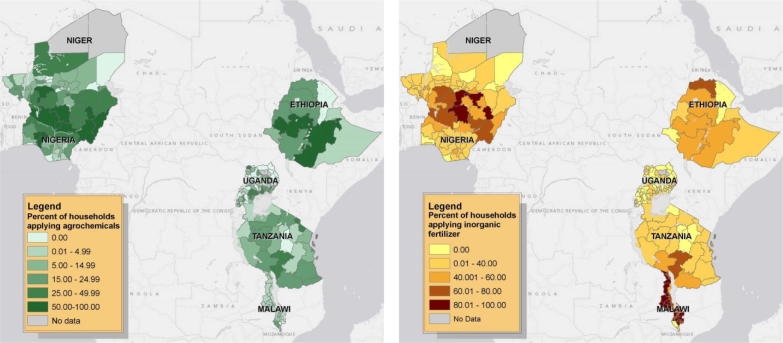
“…households applying inorganic fertilizer 0.00 0.01–40.00 40.01–60.00 60.01–80.00 80.01–100.00 no data b. Inorganic fertilizer Sources: Calculations using LSMS-ISA data: Ethiopia 2011/12, Malawi 2010/11, Niger 2011/12, Nigeria 2010/11, Tanzania 2010/11, and Uganda 2010/11; Sheahan and Barrett 2017.”
MethodInfluentialSelf-citationGweyi-Onyango, J. P., & Ntinyari, W. (2022) · Springer eBooks · doi:10.1007/978-3-030-93262-6_4 · Cited by 1
Plot size misperceptions and soil health: A New research agenda
Murphy, D. M. A., Simons, A. M., Pypers, P., et al. (2023) · Soil Security · doi:10.1016/j.soisec.2023.100117 · Cited by 1
Input Subsidies and Women Entrepreneurship: Evidence from Tanzania
Karata, R., & Otchia, C. S. (2024) · Journal of African Development · doi:10.5325/jafrideve.25.1.0001 · Cited by 1
Roa-Ortiz, S. A., & Cala-Vitery, F. (2025) · Research on World Agricultural Economy · doi:10.36956/rwae.v6i1.1263 · Cited by 1
A phenomenological inquiry to understand Ugandan farmers’ perceived barriers to fertilizer use
Mulvaney, C., & Kelsey, K. D. (2020) · Advancements in Agricultural Development · doi:10.37433/aad.v1i1.7 · Cited by 1
“Ugandan farmers reported the lowest rate of fertilizer adoption among SSA countries at 3.2% (Barrett & Sheahan, 2017).”
BackgroundInfluentialCebro, J. A. G., Quintela-del-Rı́o, A., & Santamaría, R. V. (2022) · Portuguese Economic Journal · doi:10.1007/s10258-022-00218-x · Cited by 1
“Fertilizers have more frequently been promoted by public subsidies, while herbicides use has been largely driven by private sector (Jayne and Rashid 2013; Haggblade et al. 2017; Sheahan and Barrett 2017).”
BackgroundShango, A. J., Maswi, P. B., Malya, R. B., et al. (2022) · CABI Reviews · doi:10.1079/cabireviews202217023 · Cited by 1
DEDAN, N. K., AdeOluwa, O. O., Ohakwere-Eze, M., et al. (2023) · Journal of Wastes and Biomass Management · doi:10.26480/jwbm.01.2023.29.33 · Cited by 1
Essays on household demand and agricultural policy implications in developing countries
Nsabimana, A. (2018) · Epsilon Open Archive (Sveriges lantbruksuniversitet biblioteket (Swedish University of Agricultural Sciences)) · Cited by 1
The Demand for Advice: Theory and Empirical Evidence from Farmers in Sub-Saharan Africa
Naeher, D., & Schündeln, M. (2021) · World Bank Economic Review · doi:10.1596/1813-9450-9532 · Cited by 13
It’s time to harvest! : Towards sustainable farming systems in the East African highlands
Marinus, W. (2021) · doi:10.18174/554716 · Cited by 1
Douthwaite, B., & Child, K. (2021) · doi:10.5337/2022.201 · Cited by 1
Is Dirt Cheap? The Economic Costs of Failing to Meet Soil Health Requirements on Smallholder Farms
Gourlay, S., & Kilic, T. (2022) · World Bank policy research working paper · doi:10.1596/1813-9450-10108 · Cited by 1
“2 See for instance the research on low levels of agricultural input use (Sheahan and Barrett, 2017), intra- and interhousehold gender differences in levels of and returns to agricultural inputs (Udry, 1996; Kilic et al.”
BackgroundNon-Labor Input Quality and Small Farms in Sub-Saharan Africa: A Review
Michelson, H., Gourlay, S., & Wollburg, P. R. (2022) · World Bank policy research working paper · doi:10.1596/1813-9450-10092 · Cited by 1
Jinbaani, A. N., & Wale, E. Z. (2022) · Research Square · doi:10.21203/rs.3.rs-1758933/v1 · Cited by 1
Models for predicting nutrient availability in soils from sub-Saharan Africa
Breure, M. S. (2022) · doi:10.18174/574564 · Cited by 1
Kadigi, I. L. (2025) · Research Square · doi:10.21203/rs.3.rs-7237495/v1 · Cited by 1
The Agricultural Determinants of Structural Transformation
Daymard, A. (2020) · doi:10.70675/36ca3771zc863z4b3bz9d69ze61fa0e9d373 · Cited by 1
Agricultural Input Decisions in the Presence of Complementarities: A Rational Inattention ModelPreprint
Naeher, D. (2017) · SSRN Electronic Journal · doi:10.2139/ssrn.3066873
Financing Agricultural Inputs in Africa: Own Cash or Credit?
Adjognon, G. S., Liverpool‐Tasie, L. S. O., & Reardon, T. (2017) · World Bank, Washington, DC eBooks · doi:10.1596/978-1-4648-1134-0_ch4
Brice, H. A., & Jingdong, L. (2018) · Journal of Agricultural Biotechnology and Sustainable Development · doi:10.5897/jabsd2017.0303
“This suggestion appears attractive following Berihun et al. (2014), George (2014) and Megan and Christopher (2017) for the fact that the agricultural technology adopted is likely to be linked with farm income.”
BackgroundRevisiting the old debate: on the relationship between size and productivity in TanzaniaPreprint
Boulay, B. (2018) · RePEc: Research Papers in Economics
Tugume, E., Byalebeka, J., & Mwine, J. (2019) · African Journal of Agricultural Research · doi:10.5897/ajar2019.14471
Muse, R., & Aradhyula, S. V. (2020) · Journal of Applied Statistics · doi:10.1080/02664763.2020.1757050
“Farm size significantly reduced the yield values; a result found by [25] who conducted a literature review of studies conducted in Sub-Saharan Africa.”
ResultMuse, R. (2019) · UA Campus Repository (The University of Arizona)
Strategic Use of Agriculture Information System by Agripreneurs in Rural Economies
Krishnadas, R., & Renganathan, R. (2020) · Advances in e-business research series · doi:10.4018/978-1-7998-4942-1.ch010
Hörner, D. (2019) · AEA Randomized Controlled Trials · doi:10.1257/rct.4406-1.0
Allen, T., Kenis, M., & Norgrove, L. (2021) · Journal of Plant Diseases and Protection · doi:10.1007/s41348-021-00480-9
Root traits for low input agroecosystems in AfricaPreprint
Ndoye, M. S., Burridge, J., Bhosale, R., et al. (2021) · doi:10.22541/au.162348333.37725366/v1
Nigus, H. Y. (2021) · Research Publications (Maastricht University) · doi:10.26481/dis.20210914hn
Plant growth and defense traits in Sorghum bicolor’s response to Chilo partellus in the tropics
Adesanya, A. W., Gómez, M. I., Morrell, K., et al. (2022) · Journal of Pest Science · doi:10.1007/s10340-021-01472-2
“This is typical for subsistence farmers in the tropics (Sheahan and Barrett 2017).”
BackgroundInternational Finance Corporation (2018) · World Bank, Washington, DC eBooks · doi:10.1596/978-1-4648-1277-4_ch6
Fertilizer Application and Maize Yield: A Spatial Econometric Approach
Ulimwengu, J. M., & Naik, A. K. (2022) · doi:10.54067/awps.004
Metadata
- Authors
- Sheahan, M., & Barrett, C. B.
- Affiliations
- Cornell University (US)
- Corresponding author
- Sheahan, Megan
- Venue
- Food Policy
- Publisher
- Elsevier BV
- Published
- 2017-02
- Volume
- 67
- Pages
- 12-25
- ISSN
- 0306-9192 (ISSN-L)
- PMC
- PMC5384438
- OpenAlex
- W2534397573
- Semantic Scholar
- 0119de42f830ef1f9a0fb240310e89ecd368143f
- Cited by
- 594
- References
- 87
- Citations by year
- 2026: 74 · 2025: 69 · 2024: 60 · 2023: 76 · 2022: 61 · 2021: 70 · 2020: 75 · 2019: 47 · 2018: 40 · 2017: 19
- FWCI
- 120.77
- Type
- journal article
- Language
- en
- Open access
- hybrid
- doi.org
- Locations
- Food Policy (publishedVersion, cc-by)
- PubMed Central (publishedVersion, cc-by)
- PubMed (publishedVersion)
- RePEc: Research Papers in Economics (submittedVersion)
- Funders
- International Fine Particle Research Institute
- Topics
- Life Sciences › Agricultural and Biological Sciences › General Agricultural and Biological Sciences › Agricultural Innovations and Practices
- Life Sciences › Agricultural and Biological Sciences › General Agricultural and Biological Sciences › Agricultural Economics and Practices
- Social Sciences › Economics, Econometrics and Finance › Economics and Econometrics › Agricultural economics and policies
- Keywords
- agricultural input use, modern agricultural inputs, fertilizer use, improved varieties, hybrid seeds, agrochemicals, agricultural machinery, irrigation, agricultural intensification, smallholder farmers, sub-Saharan Africa, food prices, agricultural growth
About these checks
Registry, retraction, Cites and statistics results are computed, not judged, with one exception: a printed reference that no index lists is read once by a model before it counts as a citation error. Claims are extracted by a model and kept only when their quote appears verbatim in the text; each cited source is then checked, with a model’s help, for whether it says what the claim relies on. Those verdicts can be wrong — read the claim’s quote and the cited source before relying on one.
Statistics and arithmetic are recomputed, not judged.
Confidence bands are shown only for fields calibrated on our annotated test set. None is calibrated yet, so no band is shown.
What counts as a claim ›How we measure confidence ›How we check this ›
Are you an author, or do you see a problem with this page? Request a review
